Strategic Basis Set Selection: Balancing Accuracy and Efficiency in Quantum Chemical Calculations
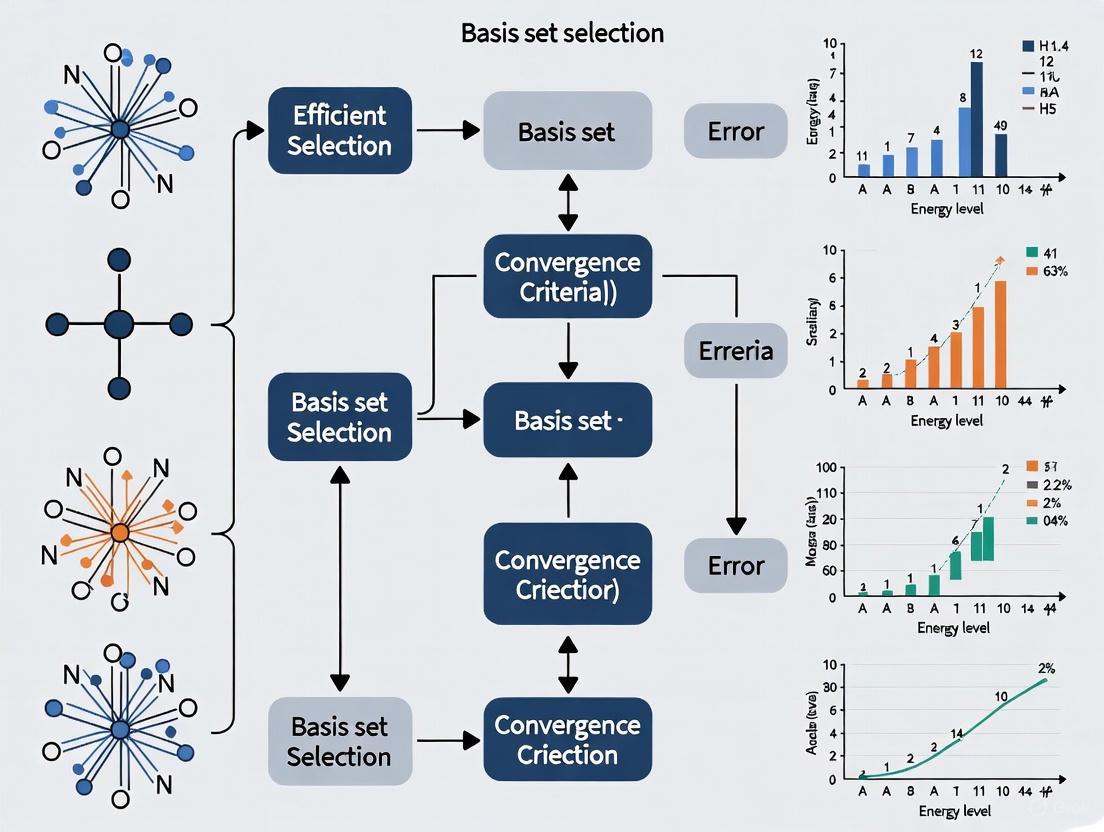
This article provides a comprehensive guide for researchers and drug development professionals on selecting and optimizing basis sets for quantum chemical calculations.
Strategic Basis Set Selection: Balancing Accuracy and Efficiency in Quantum Chemical Calculations
Abstract
This article provides a comprehensive guide for researchers and drug development professionals on selecting and optimizing basis sets for quantum chemical calculations. It covers foundational concepts, from minimal Slater-type orbitals to extended correlation-consistent sets, and details methodological strategies for specific applications like drug design and materials science. The guide addresses common challenges such as basis set superposition error (BSSE) and offers advanced optimization techniques, including the promising vDZP basis set and density-based corrections for quantum computing. Finally, it establishes a framework for validating basis set performance against gold-standard benchmarks and high-accuracy datasets, empowering scientists to make informed decisions that maximize computational efficiency without sacrificing chemical accuracy.
Understanding Basis Sets: From Core Concepts to Complete Basis Set Limits
Frequently Asked Questions (FAQs)
1. What is a basis set in quantum chemistry? A basis set is a set of mathematical functions, called basis functions, which are combined in linear combinations to represent the electronic wave function of a molecule or atom in a quantum mechanical calculation [1] [2]. Since the exact wave function is typically unknown and cannot be calculated directly, the wave function is approximated by a linear combination of these basis functions, with the coefficients determined by solving the Schrödinger equation [3] [2].
2. What are the main types of basis functions used? The two primary types are Slater-Type Orbitals (STOs) and Gaussian-Type Orbitals (GTOs). STOs more accurately describe electron density, particularly near the nucleus, but are computationally expensive [1] [4]. GTOs are computationally more efficient and are the modern standard because the product of two GTOs can be written as a linear combination of other GTOs, enabling huge computational savings [1] [4].
3. What does the "minimal" in a minimal basis set mean? A minimal basis set contains the minimum number of basis functions required to describe the electrons in an atom, using one basis function for each atomic orbital in the ground state configuration [1] [4]. A common example is the STO-3G basis set, which approximates each Slater-type orbital with 3 Gaussian-type orbitals [1].
4. Why would I use a polarized or diffuse basis set?
- Polarization functions (e.g., denoted by
*in Pople basis sets) add higher angular momentum functions (like d-functions on carbon) to the basis. This allows the electron density to distort from its atomic shape, which is crucial for accurately describing chemical bonding [1] [5]. - Diffuse functions (e.g., denoted by
+in Pople basis sets) are Gaussian functions with very small exponents, giving them a large spatial extent. They are essential for accurately modeling anions, excited states, dipole moments, and long-range interactions like van der Waals forces [1] [4] [5].
5. What is Basis Set Superposition Error (BSSE)? BSSE is an error that arises in calculations of molecular complexes or interaction energies. It occurs when the basis functions of one molecule artificially improve the description of the electron density of a neighboring molecule. This leads to an overestimation of the interaction energy [4]. BSSE can be mitigated by using larger basis sets or applying a counterpoise correction [4].
Troubleshooting Guides
Issue 1: Inaccurate Energy Calculations
Problem: Your calculated energies (e.g., reaction energies, binding energies) are inconsistent with benchmark data or experimental results.
Diagnosis: This is often caused by Basis Set Incompleteness Error (BSIE), where the basis set is too small to represent the electron correlation energy adequately [6].
Solution:
- Systematically increase the basis set size. Move from double-zeta to triple-zeta or larger [6].
- Use correlation-consistent basis sets. For high-accuracy energy calculations, employ a hierarchy like Dunning's cc-pVXZ sets (e.g., cc-pVDZ, cc-pVTZ, cc-pVQZ) and extrapolate to the complete basis set (CBS) limit [1] [4].
- Consider modern, efficient basis sets. For Density Functional Theory (DFT) calculations, the
vDZPbasis set has been shown to provide accuracy close to larger triple-zeta basis sets at a much lower computational cost, making it an excellent compromise [6].
Issue 2: Poor Description of Anions or Weak Interactions
Problem: Calculations for anions fail to converge, or intermolecular interaction energies (e.g., hydrogen bonding) are significantly underestimated.
Diagnosis: The basis set lacks diffuse functions, which are necessary to describe the loosely bound electrons that reside far from the nucleus [1] [5].
Solution:
- Add diffuse functions to your basis set. For example, switch from
6-31Gto6-31+Gfor first-row atoms, or to6-31++Gto also include diffuse functions on hydrogen atoms [1]. - Use basis sets designed for these properties. The "aug-" (augmented) series, such as
aug-cc-pVDZ, come with built-in diffuse functions [7].
Issue 3: Optimized Geometries Do Not Match Experimental Structures
Problem: The bond lengths and angles from your geometry optimization are systematically too long or too short.
Diagnosis: The basis set lacks the flexibility to properly describe the polarization of electron density around atoms as bonds are formed. This is typically due to missing polarization functions [4].
Solution:
- Always use a polarized basis set for geometry optimizations. A minimal basis set like STO-3G is insufficient. Start with at least a polarized double-zeta basis set, such as
6-31G*orcc-pVDZ[1] [4]. - Ensure polarization on all atoms. The
6-31Gbasis set adds polarization functions to hydrogen atoms, which can be critical for accurate geometries of molecules like water or ammonia [1].
Basis Set Selection and Performance
Table 1: Hierarchy of Common Gaussian Basis Sets
| Basis Set Type | Key Features | Common Examples | Typical Use Case |
|---|---|---|---|
| Minimal | One basis function per atomic orbital; fast but inaccurate. | STO-3G [1] | Very preliminary calculations on large systems. |
| Split-Valence | Multiple functions for valence electrons; good cost/accuracy balance. | 3-21G, 6-31G [1] [7] | Routine calculations on medium-sized molecules. |
| Polarized | Adds higher angular momentum functions (d, f). | 6-31G*, cc-pVDZ [1] [4] | Standard for molecular geometries and vibrations. |
| Diffuse | Adds spatially extended functions for "electron tails". | 6-31+G*, aug-cc-pVDZ [1] [7] | Anions, excited states, weak interactions. |
| Correlation-Consistent | Systematically designed to converge to the CBS limit. | cc-pVXZ (X=D,T,Q,5...) [1] [7] | High-accuracy energy calculations with extrapolation. |
Table 2: Performance Comparison of Selected Double-Zeta Basis Sets in DFT Calculations [6]
| Basis Set | Overall WTMAD2 Error (kcal/mol) | Relative Speed | Comment |
|---|---|---|---|
| vDZP | 7.13 - 9.56 | Fastest | Modern, efficient; minimizes BSIE/BSSE. |
| 6-31G(d) | ~Higher than vDZP | Fast | Classic polarized double-zeta. |
| def2-SVP | ~Higher than vDZP | Fast | Popular general-purpose double-zeta. |
| (aug)-def2-QZVP | 3.73 - 8.42 | Slowest | Large reference basis; near the CBS limit. |
Experimental Protocol: Basis Set Optimization for Quantum Phase Estimation
Objective: To reduce the computational cost of Quantum Phase Estimation (QPE) by optimizing the orbital basis to lower the Hamiltonian 1-norm (λ) without compromising energy accuracy [8].
Background: The cost of QPE scales with λ, which typically grows with the number of orbitals. This protocol uses the Frozen Natural Orbital (FNO) approach to truncate the virtual space from a large initial basis set, effectively capturing dynamic correlation with fewer orbitals [8].
Methodology:
- Initial Calculation: Perform a classical Hartree-Fock or DFT calculation on the target molecule using a large, dense basis set (e.g.,
cc-pVQZ). - Generate MP2 Natural Orbitals: Perform a second-order Møller-Plesset perturbation theory (MP2) calculation. From this, derive the natural orbitals and their occupation numbers.
- Truncate Virtual Space: Analyze the occupation numbers of the virtual natural orbitals. Discard orbitals with occupation numbers below a defined threshold (e.g., below 0.002).
- Form Active Space: The retained occupied and virtual orbitals form a smaller, more efficient active space for the subsequent quantum computation.
- Run QPE: Use the Hamiltonian constructed from this FNO active space to run the QPE algorithm.
Conclusion from Recent Research: Employing FNOs derived from a large basis set can lead to a reduction of up to 80% in the 1-norm λ and a 55% reduction in the number of orbitals, compared to using the full, untruncated basis set. This strategy is significantly more effective than directly optimizing the exponents of a small basis set [8].
The Scientist's Toolkit: Research Reagents & Materials
Table 3: Essential Basis Sets for Quantum Chemical Research
| Item / Basis Set | Function in Research |
|---|---|
| STO-3G | A minimal basis set for initial geometry optimizations or qualitative studies on very large systems [4]. |
| 6-31G / 6-31G* | A family of split-valence (and polarized) basis sets; a classic, widely-used workhorse for routine molecular calculations [1] [7]. |
| cc-pVXZ (X=D,T,Q,5) | Correlation-consistent basis sets designed for systematic convergence to the complete basis set limit in post-Hartree-Fock calculations [1] [4]. |
| def2-SVP / def2-TZVP | Popular split-valence and triple-zeta basis sets from the Ahlrichs group, often used in DFT calculations [7]. |
| vDZP | A modern double-zeta polarized basis set optimized for use with density functionals, offering near triple-zeta accuracy at a lower cost [6]. |
| Augmented Functions (+, aug-) | "Reagents" to add to standard basis sets to describe anions, excited states, and long-range interactions accurately [1] [7]. |
| Acremine I | Acremine I, MF:C12H16O5, MW:240.25 g/mol |
| Actiketal | Actiketal, MF:C15H15NO5, MW:289.28 g/mol |
Basis Set Selection Workflow
Core Concepts and Quantitative Comparison
Fundamental Definitions
In quantum chemical calculations, a basis set is a set of functions, called basis functions, used to represent the electronic wave function. These functions are combined linearly to construct molecular orbitals, turning complex partial differential equations into algebraic equations that can be solved computationally [9] [1]. The two primary types of atomic orbitals used are Slater-Type Orbitals (STOs) and Gaussian-Type Orbitals (GTOs).
Direct Comparison: STOs vs. GTOs
The table below summarizes the key characteristics and trade-offs between Slater-Type and Gaussian-Type Orbitals.
| Feature | Slater-Type Orbitals (STOs) | Gaussian-Type Orbitals (GTOs) |
|---|---|---|
| Mathematical Form | (\chi{STO} = Nr^{n-1}e^{-\zeta r}Y{lm}(\theta,\phi)) [10] | (\chi{GTO} = Nr^{l}e^{-\alpha r^2}Y{lm}(\theta,\phi)) [10] |
| Radial Decay | Exponential ((e^{-r})) [10] | Gaussian ((e^{-r^2})) [10] |
| Cusp Condition | Satisfied (accurate electron behavior near nucleus) [10] | Not satisfied (poor core electron representation) [10] |
| Long-Range Behavior | Accurate (matches actual atomic orbitals) [10] | Less accurate (decays too rapidly) [10] |
| Computational Efficiency | Low (integral calculation is difficult) [1] | High (product of two GTOs is another GTO) [1] |
| Primary Use Case | Physically motivated, high-accuracy benchmarks [1] | Standard for most practical computations [1] |
Troubleshooting Guide: Frequently Asked Questions
How do I choose between a minimal and a polarized basis set for my drug molecule calculation?
Answer: The choice depends on the property you wish to calculate and the required accuracy level.
- Minimal Basis Sets (e.g., STO-3G): These are the smallest possible sets, using one basis function for each orbital in the atom [1]. They are computationally cheap but provide rough results that are generally insufficient for research-quality publications, especially for analyzing electronic properties or subtle bonding interactions [1].
- Polarized Basis Sets (e.g., 6-31G*): These add functions with higher angular momentum (e.g., p-functions on hydrogen, d-functions on carbon) to provide flexibility for the electron density to polarize in response to the molecular environment [1]. This is crucial for accurately modeling chemical bonding, molecular properties, and reactivity in drug development.
Recommendation: For most research applications in pharmaceutical development, start with at least a split-valence polarized basis set like 6-31G*.
My calculations on an anionic molecule are unstable or inaccurate. What basis set feature is likely missing?
Answer: This issue commonly arises from the lack of diffuse functions. Diffuse functions are Gaussian functions with small exponents, which extend far from the nucleus and provide flexibility to the "tail" of the electron cloud [1]. They are essential for correctly describing anions, molecules with large dipole moments, and intra- or inter-molecular bonding.
Solution: Add diffuse functions to your basis set. In the Pople basis set notation, this is indicated by a "+" symbol. For example:
- Use 6-31+G* for diffuse functions on heavy atoms (like C, N, O) and polarization.
- Use 6-31++G* for diffuse functions on both heavy atoms and hydrogen [1].
For high-accuracy energy calculations, how can I systematically improve my results toward the exact value?
Answer: To systematically converge results to the complete basis set (CBS) limit, especially for post-Hartree-Fock (correlated) methods, use correlation-consistent basis sets developed by Dunning and coworkers [1].
Protocol:
- Select a hierarchy of basis sets, such as cc-pVDZ → cc-pVTZ → cc-pVQZ, where D (double-ζ), T (triple-ζ), and Q (quadruple-ζ) indicate increasing levels of completeness [1].
- Perform your calculation at each level of the hierarchy.
- Use empirical extrapolation techniques on the results (e.g., energies) to estimate the value at the complete basis set limit. This provides a controlled and systematic path to high accuracy.
The "cusp condition" is often cited as a weakness of GTOs. What is its practical impact on my calculation?
Answer: The cusp condition refers to the correct, discontinuous behavior of the wavefunction's derivative precisely at the atomic nucleus [10]. STOs satisfy this condition, accurately representing electron density near the nucleus. GTOs, however, fail to meet this condition, leading to a less accurate description of core electrons [10].
Practical Impact: For properties that depend heavily on electron density very close to the nucleus (e.g., hyperfine coupling constants in magnetic resonance spectroscopy), this can introduce inaccuracies. However, for many chemical properties (like reaction energies, conformational energies, and frontier orbital energies), the effect is less critical. The computational advantage of GTOs often outweighs this drawback, which is mitigated by using multiple contracted Gaussian functions to approximate a single STO [1].
Are plane waves a type of basis set, and when would I use them instead of atomic orbitals?
Answer: Yes, plane waves are another type of basis set frequently used in computational chemistry, particularly in solid-state and materials physics calculations [11] [1]. While Gaussian-type atomic orbitals are the standard for molecular quantum chemistry, plane waves offer advantages for periodic systems.
Selection Guideline:
- Use Atomic Orbitals (GTOs): For isolated molecules, cluster models, and most molecular properties in pharmaceutical research [11] [1].
- Use Plane Waves: For calculations involving infinite crystalline solids, surfaces, and materials with periodic boundary conditions [11].
The Scientist's Toolkit: Essential Basis Set Types
The table below catalogs key basis set types used in computational research, providing a quick reference for selection.
| Basis Set Type | Key Example(s) | Primary Function & Application |
|---|---|---|
| Minimal | STO-3G, STO-4G [1] | Provides a low-cost, low-accuracy starting point for very large systems. |
| Split-Valence | 3-21G, 6-31G, 6-311G [1] | Offers improved accuracy over minimal sets by describing valence electrons with multiple functions; good for geometry optimizations. |
| Polarized | 6-31G, 6-31G(d,p) [1] | Adds angular momentum flexibility for bonding accuracy; essential for property prediction. |
| Diffuse | 6-31+G, 6-31++G [1] | Extends the electron density "tail" for anions, excited states, and weak interactions. |
| Correlation-Consistent | cc-pVDZ, cc-pVTZ, cc-pVQZ [1] | Enables systematic convergence to the CBS limit for high-accuracy energy calculations. |
| Enacyloxin IIa | Enacyloxin IIa, MF:C33H45Cl2NO11, MW:702.6 g/mol | Chemical Reagent |
| Cypemycin | Cypemycin, MF:C99H154N24O24S, MW:2096.5 g/mol | Chemical Reagent |
Workflow for Efficient Basis Set Selection
The following diagram outlines a logical workflow for selecting an appropriate basis set, tailored for researchers and drug development professionals working on molecular systems.
In quantum chemical calculations, a basis set is a collection of mathematical functions that serves as the fundamental building blocks for representing molecular orbitals and electron densities [1]. The careful selection of an appropriate basis set represents one of the most critical decisions in computational chemistry, directly determining the accuracy, reliability, and computational cost of simulations aimed at predicting molecular properties, reaction mechanisms, and spectroscopic behavior [5]. This technical resource center provides a comprehensive framework for researchers navigating the complex hierarchy of basis sets, from minimal to extended sets, with particular emphasis on efficient selection strategies for drug discovery and materials research.
The fundamental challenge in basis set development stems from the trade-off between computational efficiency and accuracy. While larger basis sets typically provide more precise results, they demand substantially greater computational resources—a crucial consideration when studying large pharmaceutical compounds or conducting high-throughput virtual screening [6]. Understanding this balance is essential for designing computationally feasible yet scientifically rigorous research protocols.
Basis Set Fundamentals and Theoretical Background
Mathematical Foundation
Basis sets transform the partial differential equations of quantum mechanical models into algebraic equations suitable for computational implementation [1]. In modern computational chemistry, electronic wavefunctions are represented as linear combinations of basis functions:
[ |\psii\rangle \approx \sum{\mu} c_{\mu i} |\mu\rangle ]
where (|\mu\rangle) represents the basis functions and (c_{\mu i}) are the expansion coefficients determined through self-consistent field procedures [1]. This mathematical formalism allows researchers to approximate the complex behavior of electrons in molecules and materials.
Types of Basis Functions
The quantum chemistry community primarily employs three distinct types of basis functions, each with unique mathematical properties and computational advantages:
Slater-type orbitals (STOs): These exponential functions, represented as (N \cdot e^{-\alpha r}), closely resemble the exact solutions for hydrogen-like atoms and satisfy Kato's cusp condition at atomic nuclei [1] [5]. Despite their mathematical accuracy, STOs present significant computational challenges for integral evaluation in molecular systems.
Gaussian-type orbitals (GTOs): Following Frank Boys' pioneering work, these functions of the form (N \cdot e^{-\alpha r^2}) have become the standard in computational chemistry [1] [5]. The product of two GTOs can be expressed as another Gaussian, enabling efficient computation of molecular integrals through closed-form solutions.
Contractured Gaussians: To balance accuracy and efficiency, most modern basis sets employ fixed linear combinations of primitive Gaussian functions designed to approximate Slater-type orbitals while maintaining computational tractability [6].
Table: Comparison of Basis Function Types
| Function Type | Mathematical Form | Advantages | Disadvantages |
|---|---|---|---|
| Slater-type Orbitals (STOs) | (N \cdot e^{-\alpha r}) | Accurate representation, satisfies cusp condition | Computationally expensive integrals |
| Gaussian-type Orbitals (GTOs) | (N \cdot e^{-\alpha r^2}) | Efficient integral computation | Less accurate per function |
| Contracted Gaussians | (\sumi di \cdot N \cdot e^{-\alpha_i r^2}) | Balance of accuracy and efficiency | Limited flexibility in core regions |
The Basis Set Hierarchy: From Minimal to Extended Sets
Minimal Basis Sets
Minimal basis sets represent the simplest starting point for quantum chemical calculations, containing exactly one basis function for each atomic orbital in a Hartree-Fock calculation on the constituent atoms [1] [12]. For atoms in the second period of the periodic table (Li-Ne), this translates to five basis functions per atom (two s-type and three p-type functions) [12]. The most common minimal basis sets follow the STO-nG scheme, where 'n' indicates the number of Gaussian primitive functions used to approximate each Slater-type orbital [1].
While computationally efficient, minimal basis sets suffer from limited flexibility as they cannot adjust to different molecular environments [1]. They typically produce rough results insufficient for research-quality publications but serve as valuable tools for preliminary investigations or extremely large systems where computational cost prohibits more sophisticated approaches [12].
Table: Common Minimal Basis Sets
| Basis Set | Description | Typical Applications | Limitations |
|---|---|---|---|
| STO-3G | 3 Gaussians per STO | Preliminary geometry optimizations, very large systems | Poor description of electron distribution |
| STO-4G | 4 Gaussians per STO | Initial molecular scans | Limited accuracy for properties |
| STO-6G | 6 Gaussians per STO | Educational purposes, conceptual studies | Inadequate for publication-quality results |
Split-Valence Basis Sets
Recognizing that valence electrons primarily participate in chemical bonding, split-valence basis sets introduce multiple basis functions to describe each valence atomic orbital while maintaining a minimal representation for core orbitals [1] [5]. This approach provides the flexibility for electron density to adjust its spatial extent according to the molecular environment—a critical capability for accurate bonding description [1].
The Pople-style notation X-YZg provides key information about basis set composition, where X indicates the number of primitive Gaussians comprising each core atomic orbital basis function, while Y and Z specify the number of primitive Gaussians in the two basis functions describing valence orbitals [1]. For example, the widely used 6-31G basis set uses six primitive Gaussians for core orbitals, with valence orbitals described by one basis function composed of three primitives and another composed of one primitive Gaussian [1] [5].
Table: Common Split-Valence Basis Sets and Their Applications
| Basis Set | Type | Notable Features | Recommended Use Cases |
|---|---|---|---|
| 3-21G | Double-zeta | Moderate cost | Medium-sized organic molecules |
| 6-31G | Double-zeta | Balanced accuracy/speed | General purpose organic chemistry |
| 6-31G* | Polarized | d-functions on heavy atoms | Bond breaking, conformational analysis |
| 6-31+G | Diffuse | Additional diffuse functions | Anions, excited states, weak interactions |
| 6-311G | Triple-zeta | Improved valence description | High-accuracy thermochemistry |
| 6-311+G* | Polarized & diffuse | Comprehensive features | General high-accuracy applications |
Extended Basis Sets
Extended basis sets incorporate additional mathematical functions to address specific electronic phenomena and systematically approach the complete basis set (CBS) limit [1] [12]. These enhancements include polarization functions, diffuse functions, and higher-zeta representations, providing increasingly accurate descriptions of molecular electronic structure.
Polarization Functions
Polarization functions introduce angular momentum flexibility beyond the atomic ground state configuration, allowing orbitals to distort in response to molecular bonding environments [1] [5]. For example, adding d-type functions to carbon atoms or p-type functions to hydrogen atoms enables more accurate modeling of electron density deformation during bond formation [1]. In Pople basis set notation, a single asterisk () indicates polarization functions on heavy atoms, while double asterisks (*) signify additional polarization on hydrogen and helium atoms [1].
Diffuse Functions
Diffuse functions employ Gaussian basis functions with small exponents to extend the spatial range of atomic orbitals, better describing electron density far from atomic nuclei [1] [5]. These functions prove essential for modeling anions, Rydberg states, dipole moments, and non-covalent interactions where electron density extends significant distances from molecular cores [1]. In standard notation, "+" indicates diffuse functions on heavy atoms, while "++" extends these to hydrogen and helium atoms [1].
Correlation-Consistent Basis Sets
Developed by Dunning and coworkers, correlation-consistent basis sets (cc-pVNZ, where N=D,T,Q,5,6) provide systematic pathways to the complete basis set limit for post-Hartree-Fock calculations [1]. These sets are specifically optimized for electron correlation effects and enable empirical extrapolation techniques to estimate CBS limit properties through careful calculations at multiple basis set levels [1].
Research Reagents: Computational Tools for Basis Set Applications
Table: Essential Computational Resources for Basis Set Implementation
| Resource Category | Specific Tools | Function/Purpose | Access Method |
|---|---|---|---|
| Basis Set Libraries | Basis Set Exchange, EMSL | Centralized repository for basis set specifications | Web portal, API |
| Quantum Chemistry Software | Psi4, Gaussian, ORCA, Q-Chem | Implementation of basis sets in electronic structure calculations | Academic licensing, open source |
| Quantum Algorithms | QPE with Qubitization | First-quantized Hamiltonian simulation with arbitrary basis sets | Research implementations [13] |
| Composite Methods | ωB97X-3c, B97-3c | Optimized combinations of functionals and basis sets | Integrated in major packages |
| Analysis & Visualization | GaussView, ChemCraft, Jmol | Visualization of molecular orbitals and electron densities | Standalone or package-integrated |
Troubleshooting Guide: Common Basis Set Selection Issues
Basis Set Incompleteness Error (BSIE)
Problem: Inaccurate energy predictions due to insufficient basis set flexibility, particularly for correlation energy [6].
Symptoms:
- Systematic underestimation of binding energies
- Poor convergence of molecular properties with basis set size
- Inconsistent thermochemical predictions
Solutions:
- Employ hierarchical convergence studies (DZ → TZ → QZ)
- Use correlation-consistent basis sets for post-Hartree-Fock methods [1]
- Consider composite methods with specifically optimized basis sets [6]
Recommended Protocol: For systematic BSIE reduction, perform calculations with cc-pVDZ, cc-pVTZ, and cc-pVQZ basis sets, then extrapolate to the complete basis set limit using established protocols.
Basis Set Superposition Error (BSSE)
Problem: Artificial lowering of interaction energies due to "borrowing" of basis functions from adjacent molecules [6].
Symptoms:
- Overestimation of binding energies in intermolecular complexes
- Unphysical long-range interactions
- Size-dependent errors in cluster calculations
Solutions:
- Apply Counterpoise Correction (CP) methodology
- Use specifically optimized basis sets with reduced BSSE (e.g., vDZP) [6]
- Employ triple-zeta basis sets or larger where computationally feasible
Recommended Protocol: For accurate non-covalent interaction energies, use the vDZP basis set with B97-D3BJ or r2SCAN-D3(BJ) functionals, which demonstrate reduced BSSE while maintaining computational efficiency [6].
Computational Resource Limitations
Problem: Prohibitive computational costs when applying high-accuracy basis sets to large systems.
Symptoms:
- Excessive computation times for routine calculations
- Memory limitations during integral evaluation
- Disk space exhaustion for wavefunction storage
Solutions:
- Implement density fitting or resolution-of-identity approximations
- Use effective core potentials for heavy elements
- Employ fragmented or embedding methodologies
- Select Pareto-efficient basis sets like vDZP that balance cost and accuracy [6]
Recommended Protocol: For large systems (>100 atoms), begin with a double-zeta polarized basis set like 6-31G* or vDZP, then apply single-point energy corrections with larger basis sets on optimized geometries.
Frequently Asked Questions: Basis Set Selection Strategies
Q1: What basis set should I use for initial geometry optimizations of drug-like molecules?
For initial geometry optimizations of pharmaceutical compounds, we recommend the 6-31G* or vDZP basis sets. The 6-31G* provides balanced performance for organic molecules, while vDZP offers particularly low basis set superposition error and has demonstrated excellent performance across multiple density functionals without requiring reparameterization [6]. These sets provide sufficient flexibility for bond length and angle optimization while remaining computationally tractable for molecules containing 50-100 atoms.
Q2: When are diffuse functions absolutely necessary in basis set selection?
Diffuse functions become essential when studying: (1) Anionic systems, where electron density is more spatially extended; (2) Non-covalent interactions, including hydrogen bonding, π-stacking, and dispersion interactions; (3) Rydberg states and spectroscopic properties involving excited states with diffuse character; (4) Systems with significant dipole moments or charge separation; (5) Halogen-containing compounds where lone pairs require extended description [1] [5]. For these applications, basis sets like 6-31+G* or aug-cc-pVDZ provide substantial improvements over their non-diffuse counterparts.
Q3: How does the vDZP basis set achieve triple-zeta quality at double-zeta cost?
The vDZP basis set employs several innovative strategies to enhance efficiency: (1) Extensive use of effective core potentials to remove core electrons from explicit calculation; (2) Deeply contracted valence basis functions optimized specifically for molecular environments; (3) Careful balancing of primitive composition to minimize BSSE nearly to triple-zeta levels [6]. Benchmark studies demonstrate that vDZP with various density functionals produces accuracy approaching conventional triple-zeta basis sets while maintaining the computational cost characteristic of double-zeta sets [6].
Q4: What represents the best practice for basis set selection in high-accuracy thermochemical calculations?
For publication-quality thermochemical predictions, we recommend a hierarchical approach: (1) Begin with geometry optimization at the double-zeta polarized level (6-31G* or def2-SVP); (2) Perform frequency calculations at the same level to characterize stationary points and obtain thermal corrections; (3) Execute single-point energy calculations using a triple-zeta basis set (cc-pVTZ or def2-TZVP) with electron correlation methods (MP2, CCSD(T), or double-hybrid DFT); (4) When possible, extrapolate to the complete basis set limit using correlation-consistent basis sets of increasing quality [1] [6].
Q5: How do basis set requirements differ between wavefunction-based and DFT methods?
Wavefunction-based electron correlation methods (MP2, CCSD, CCSD(T)) typically demand higher-level basis sets with polarization and diffuse functions to accurately capture correlation energies. In contrast, many density functionals exhibit faster convergence with basis set size, often providing reasonable results with double-zeta polarized sets [1] [6]. The vDZP basis set has demonstrated particular efficiency with DFT methods, delivering near-triple-zeta accuracy across multiple functional classes without method-specific reparameterization [6].
Q6: What recent advances in basis set development impact drug discovery applications?
Recent progress includes: (1) Composite methods with specially optimized basis sets (e.g., ωB97X-3c) that deliver high accuracy with reduced computational cost [6]; (2) General-purpose double-zeta basis sets like vDZP that show exceptional performance across multiple property types [6]; (3) Implementation of novel algorithms enabling first-quantized quantum chemical calculations with arbitrary basis sets [13]; (4) Systematic optimization of basis sets for specific molecular properties like NMR shielding constants or optical spectra.
Advanced Protocols: Basis Set Implementation Strategies
Protocol for Systematic Basis Set Convergence Studies
Purpose: To establish the convergence behavior of molecular properties with respect to basis set size and extrapolate to the complete basis set limit.
Procedure:
- Select a hierarchy of correlation-consistent basis sets (e.g., cc-pVDZ, cc-pVTZ, cc-pVQZ)
- Perform identical calculations with each basis set level
- Plot the target property (energy, frequency, etc.) versus basis set cardinal number
- Apply appropriate extrapolation formulae to estimate CBS limit values
- Calculate differences between consecutive levels to assess convergence
Application Notes: This protocol proves particularly valuable for benchmarking new methodologies or establishing reference data for specific molecular systems.
Protocol for Balanced Basis Set Selection in Drug Discovery
Purpose: To select computationally efficient yet accurate basis sets for high-throughput screening of pharmaceutical compounds.
Procedure:
- For geometry optimizations of organic molecules: Use 6-31G* or vDZP basis sets
- For conformational analysis: Employ 6-31G* with empirical dispersion corrections
- For non-covalent interaction assessment: Implement 6-31+G* or def2-SVPD with counterpoise correction
- For final single-point energy evaluations: Apply cc-pVTZ or def2-TZVP basis sets
- For excited state properties: Utilize aug-cc-pVDZ or similar diffuse-containing sets
Application Notes: The vDZP basis set demonstrates exceptional performance across multiple stages of this protocol when paired with modern density functionals [6].
Emerging Methodologies and Future Directions
The development of novel basis sets continues to evolve, with several promising directions impacting computational drug discovery. Recent work demonstrates that first-quantized quantum chemical calculations can now employ arbitrary basis sets, potentially enabling more efficient quantum algorithms for molecular electronic structure problems [13]. Additionally, the systematic optimization of problem-specific basis sets for pharmaceutical applications represents an active research frontier.
Composite methodologies that integrate specialized basis sets with modern density functionals and empirical dispersions corrections continue to narrow the gap between computational cost and chemical accuracy [6]. These approaches particularly benefit drug discovery applications where balanced treatment of diverse chemical environments and interaction types proves essential for predictive simulations.
The Role of Polarization and Diffuse Functions in Capturing Electron Density
Troubleshooting Guides and FAQs
Why is my calculated molecular polarizability significantly lower than reference values?
This often indicates missing diffuse functions in your basis set [4]. Diffuse functions are large-sized Gaussian functions with small exponents that improve the description of electron density far from the nuclei [4].
Recommended Solution:
- Add diffuse functions: Switch from a standard basis set to its augmented version (e.g., from 6-31G(d) to 6-31++G(d)) [1] [4].
- Application context: Essential for properties involving long-range interactions such as molecular polarizabilities, electron affinities, and intermolecular interactions [4].
Methodology for Verification:
- Calculate the polarizability using your current basis set (e.g., 6-31G(d)).
- Recalculate the property using a basis set with diffuse functions (e.g., 6-31++G(d) or aug-cc-pVDZ).
- Compare the results with reference data or higher-level calculations. A significant increase toward the reference value confirms the issue.
Why are my computed intermolecular interaction energies too attractive?
This typically signals Basis Set Superposition Error (BSSE), where basis functions of one molecule artificially improve the electron density description of another, overestimating binding [4] [14].
Recommended Solution:
- Apply Counterpoise (CP) Correction: Calculate the energy of each monomer using the entire basis set of the complex [14].
- Use larger basis sets: BSSE is more pronounced in smaller basis sets. For more reliable results, use at least triple-ζ basis sets, for which CP correction is still beneficial [14].
Methodology for Counterpoise Correction:
- Compute the energy of the complex (AB) with its full basis set:
E_AB(AB). - Compute the energy of monomer A within the complex's full basis set:
E_A(AB). - Compute the energy of monomer B within the complex's full basis set:
E_B(AB). - The CP-corrected interaction energy is:
ΔE_CP = E_AB(AB) - E_A(AB) - E_B(AB)[14].
My geometry optimization predicts incorrect molecular shapes. What's wrong?
This problem frequently arises from insufficient flexibility in the basis set to accurately describe electron density distortion during bond formation [4].
Recommended Solution:
- Add polarization functions: These higher angular momentum functions (e.g., d-functions on carbon, p-functions on hydrogen) allow orbitals to change shape and are crucial for accurate molecular geometries and barrier heights [1] [4].
Methodology for Testing:
- Optimize the geometry with a standard double-zeta basis set (e.g., 6-31G).
- Re-optimize with a polarized basis set (e.g., 6-31G(d) or cc-pVDZ).
- Compare the resulting geometries. Improvements in bond lengths and angles with the polarized set indicate its necessity.
How can I achieve high accuracy without the cost of very large basis sets?
For systematic improvement, correlation-consistent basis sets are designed to converge toward the complete basis set (CBS) limit [1] [4].
Recommended Solution:
- Use a composite method: Methods like ωB97X-3c use specially designed, efficient double-zeta basis sets (e.g., vDZP) that minimize BSSE and offer accuracy接近 triple-ζ levels at lower cost [6].
- Basis set extrapolation: For the highest accuracy, perform calculations with two consecutive basis set sizes (e.g., cc-pVTZ and cc-pVQZ) and extrapolate to the CBS limit [14].
Extrapolation Methodology (Example):
The exponential-square-root function can be used for extrapolation [14]:
E_CBS ≈ E_X - A * exp(-α * X)
where E_X is the energy calculated with a basis set of cardinal number X (2 for double-ζ, 3 for triple-ζ, etc.), and α is an optimized parameter (e.g., 5.674 for B3LYP-D3(BJ)/def2-SVP-TZVPP extrapolation) [14].
Basis Set Selection Guide
The table below summarizes the capabilities of different basis set types and recommendations for specific chemical problems.
Table 1: Basis Set Capabilities and Recommendations
| Basis Set Type | Key Features | Recommended For | Limitations |
|---|---|---|---|
| Minimal (e.g., STO-3G) [4] | Minimum number of functions; computationally inexpensive. | Initial geometry optimizations; very large systems for qualitative study. | Low accuracy; poor description of bonding and electronic properties [4]. |
| Split-Valence (e.g., 6-31G) [1] | Multiple functions for valence orbitals; improved bonding description. | Routine calculations of molecular geometry and energies. | Lacks flexibility for electron distortion and long-range effects. |
| Polarized (e.g., 6-31G(d)) [1] | Adds higher angular momentum functions (d, f). | Accurate molecular geometries, vibrational frequencies, and reaction barrier heights [1] [4]. | Increased computational cost. |
| Diffuse (e.g., 6-31+G(d)) [1] [4] | Adds large, sparse functions for "electron tail." | Anions, excited states, weak interactions (H-bonding, van der Waals), and polarizabilities [1] [4]. | Higher cost; potential SCF convergence issues [14]. |
| Correlation-Consistent (e.g., cc-pVXZ) [1] [4] | Systematic hierarchy for converging to CBS limit. | High-accuracy benchmark studies; extrapolations to CBS limit [1] [4]. | High computational cost for larger X values. |
Table 2: Performance of Different Double-Zeta Basis Sets with Various Functionals This table, inspired by a 2024 study, shows that the vDZP basis set can be used broadly to achieve good accuracy with low computational cost. The values are weighted total mean absolute deviations (WTMAD2) from the GMTKN55 benchmark suite; lower is better [6].
| Functional | def2-QZVP (Large Ref.) | vDZP | 6-31G(d) | def2-SVP |
|---|---|---|---|---|
| B97-D3BJ | 8.42 | 9.56 | Data Missing | Data Missing |
| r2SCAN-D4 | 7.45 | 8.34 | Data Missing | Data Missing |
| B3LYP-D4 | 6.42 | 7.87 | Data Missing | Data Missing |
| M06-2X | 5.68 | 7.13 | Data Missing | Data Missing |
The Scientist's Toolkit: Research Reagent Solutions
Table 3: Essential Basis Sets for Quantum Chemical Calculations
| Reagent (Basis Set) | Primary Function | Key Application in Research |
|---|---|---|
| 6-31G(d) (Pople-style) | A balanced double-zeta polarized basis set. | A common default for optimizing molecular structures and calculating vibrational frequencies for medium-sized organic molecules [1]. |
| cc-pVDZ (Dunning-style) | A double-zeta correlation-consistent basis set. | The starting point in the correlation-consistent hierarchy for post-Hartree-Fock methods like MP2 or CCSD(T) [1] [4]. |
| 6-311++G(2df,2pd) | A triple-zeta basis with multiple polarization and diffuse functions. | High-accuracy calculations of molecular properties, including energies and spectroscopic constants, for small to medium molecules [1]. |
| vDZP | A modern, efficient double-zeta polarized basis set. | Designed for composite methods (e.g., ωB97X-3c); provides near triple-ζ accuracy at double-ζ cost for various density functionals [6]. |
| aug-cc-pVTZ | A triple-zeta correlation-consistent basis with diffuse functions. | The gold standard for high-accuracy calculations of properties sensitive to electron density, such as weak intermolecular interactions and electron affinities [4]. |
| Pyralomicin 2b | Pyralomicin 2b, MF:C19H19Cl2NO8, MW:460.3 g/mol | Chemical Reagent |
| DCN-83 | DCN-83, MF:C20H18BrN3S, MW:412.3 g/mol | Chemical Reagent |
Experimental Workflow and Pathway Diagrams
Basis Set Selection Workflow
Frequently Asked Questions (FAQs)
FAQ 1: What is the Complete Basis Set (CBS) limit and why is it a theoretical goal? The Complete Basis Set (CBS) limit is the exact solution of the electronic Schrödinger equation that would be obtained using an infinitely large, complete basis set. In practice, this is unattainable, so the goal is to approach this limit through calculations with progressively larger basis sets and subsequent extrapolation. Reaching the CBS limit is crucial for obtaining chemically accurate results (typically within ~1 kcal/mol) that are independent of the one-electron basis set used in the calculation [15].
FAQ 2: My computational resources are limited. What is the most efficient way to approach the CBS limit? For high-accuracy methods like CCSD(T), a highly efficient strategy is the combined FNO-NAF-NAB approach (Frozen Natural Orbitals - Natural Auxiliary Functions - Natural Auxiliary Basis). This method can achieve speedups of 7, 5, and 3 times for double-, triple-, and quadruple-ζ basis sets, respectively, without any loss of accuracy. This allows for the calculation of reaction energies and barrier heights well within chemical accuracy for molecules with more than 40 atoms [16].
FAQ 3: How does the choice of basis set affect my results in Quantum Phase Estimation (QPE) calculations? The cost of QPE, dominated by the Hamiltonian 1-norm, scales at least quadratically with the number of molecular orbitals. Employing a Frozen Natural Orbital (FNO) strategy starting from a large basis set can substantially reduce QPE resources. This approach can yield up to an 80% reduction in the 1-norm (λ) and a 55% reduction in the number of orbitals needed, while still effectively capturing dynamic correlation effects [8].
FAQ 4: I have computed energies with different basis set sizes. How do I extrapolate to the CBS limit? The two most common schemes are the exponential and power function extrapolations. For example, with correlation-consistent basis sets (e.g., cc-pVDZ, cc-pVTZ, cc-pVQZ), you can use the following formulas [15]:
- Exponential: ( EX = E{\infty} + B e^{-\alpha X} )
- Power Function: ( EX = E{\infty} + B X^{-\alpha} ) Here, ( X ) is the basis set cardinal number (2 for DZ, 3 for TZ, etc.), ( EX ) is the energy computed with that basis set, ( E{\infty} ) is the CBS limit energy, and ( B ), ( \alpha ) are fitting parameters.
FAQ 5: I am getting inconsistent results for properties like Raman intensities and J-couplings. Could this be related to my basis set? Yes. The normalization of Atomic Orbitals (AOs) in your basis set can physically impact computed molecular properties. Studies show that different normalization procedures can lead to non-negligible shifts—over 50 units in Raman activity and up to 6 Hz for phosphorus J-coupling constants. Ensure you are aware of and consistently apply the same normalization scheme, especially when using contracted Gaussian-type orbitals [17].
Troubleshooting Guides
Issue 1: High Computational Cost for CCSD(T) CBS Limit Calculations
Problem: CCSD(T) calculations with large basis sets are computationally prohibitive. Solution:
- Implement the FNO-NAF-NAB approach:
- FNO (Frozen Natural Orbitals): Reduce the molecular orbital space by diagonalizing a lower-level (e.g., MP2) one-particle density matrix and retaining only the natural orbitals with the highest occupation numbers [16].
- NAF (Natural Auxiliary Function): Use this data compression technique to reduce the size of the auxiliary basis set required for the density fitting (DF) approximation [16].
- NAB (Natural Auxiliary Basis): Apply this newer approach to decrease the size of the auxiliary basis needed for the expansion of explicitly correlated geminals (F12 methods) [16].
- Combine these approximations for a cumulative speedup, making near basis-set-limit computations feasible for molecules with 50+ atoms [16].
Issue 2: Inefficient Resource Scaling in Quantum Phase Estimation (QPE)
Problem: The resource requirements (Hamiltonian 1-norm, qubit count) for QPE grow too quickly when expanding the active space to include dynamic correlation. Solution:
- Avoid using small, coarse basis sets directly. Instead, generate your active space from Frozen Natural Orbitals (FNOs) derived from a large, high-quality parent basis set [8].
- This strategy focuses on improving the quality of the orbital basis, not just its size. It has been shown to reduce the number of orbitals by 55% and the Hamiltonian 1-norm by up to 80% compared to using a smaller parent basis, while maintaining accuracy [8].
Issue 3: Inconsistent CBS Extrapolation Results
Problem: Extrapolated CBS energies vary significantly depending on the formula or basis sets used. Solution:
- Use a consistent set of basis sets from a family designed for systematic convergence, such as Dunning's correlation-consistent (cc-pVXZ) series [15].
- Employ a multi-point extrapolation scheme (e.g., 3-point) for greater reliability than a 2-point one [15].
- Compare multiple extrapolation formulas. If results differ, consider the system's nature:
Issue 4: Unintended Basis Set Reduction and Normalization Errors
Problem: Quantum chemistry packages may automatically and silently apply basis set reduction or normalization, leading to irreproducible results. Solution:
- Identify the default behavior of your software (e.g., Gaussian) regarding basis set internal reduction [17].
- Use explicit keywords to prevent automatic reduction (e.g., in Gaussian, the keyword that prevents basis set reduction for approach
A2) [17]. - Source basis sets consistently from a reliable database like the Basis Set Exchange (BSE) and document this in your methodology (approach
A3Exc) [17]. - For the highest precision, consider using a tool like BasisSculpt to explicitly control and document the normalization procedure, retaining both positive and negative contraction coefficients (approach
A4BS) [17].
Quantitative Data Tables
Table 1: Performance of Efficiency Strategies for High-Level Electronic Structure Methods
| Method / Strategy | System Type Tested | Typical Speedup | Accuracy Preservation | Key Metric Improved |
|---|---|---|---|---|
| Combined FNO-NAF-NAB for CCSD(F12*)(T+) [16] | Molecules with >40 atoms (closed & open-shell) | 7x (DZ), 5x (TZ), 3x (QZ) | Within chemical accuracy (~1 kcal/mol) | Wall time / Feasibility |
| FNO for Quantum Phase Estimation (QPE) [8] | Dataset of 58 small organic molecules, N₂ dissociation | N/A (Resource Reduction) | Chemically accurate ground state energies | 55% fewer orbitals, 80% lower 1-norm (λ) |
| Direct Exponent Optimization [8] | Small molecules | Up to 10% 1-norm reduction | System-dependent, diminishes with molecular size | Hamiltonian 1-norm (λ) |
| Extrapolation Scheme | Functional Form | Typical Application | Number of Data Points Required | Notes |
|---|---|---|---|---|
| Exponential | ( EX = E{\infty} + B e^{-\alpha X} ) | Correlation energies | 2 or 3 | Found to be better than power form for correlation energies [15]. |
| Power Function | ( EX = E{\infty} + B X^{-\alpha} ) | Correlation energies | 2 or 3 | A commonly used, simple model. |
| Mixed Gaussian/Exponential | ( EX = E{\infty} + B e^{-(X-1)} + C e^{-(X-1)^2} ) | Total energies | 3 | Found to fit total energies through cc-pV5Z better than pure exponential [15]. |
| Inverse Power (Schwartz) | ( EX = E{\infty} + B (X + \frac{1}{2})^{-4} ) | Two-electron systems | 2 or 3 | Motivated by perturbation theory for He-like systems [15]. |
Experimental Protocols
Protocol 1: Three-Point CBS Extrapolation for Correlation Energy
Purpose: To obtain a correlation energy close to the CBS limit using a series of correlation-consistent basis sets. Materials: Access to a quantum chemistry program (e.g., Gaussian, ORCA, CFOUR); molecular geometry. Steps:
- Compute: Perform energy calculations (e.g., at the MP2 or CCSD(T) level) using three basis sets of increasing size, such as cc-pVTZ (X=3), cc-pVQZ (X=4), and cc-pV5Z (X=5).
- Select Model: Choose an extrapolation formula. The exponential form is often recommended for correlation energies [15]: ( EX = E{\infty} + B e^{-\alpha X} )
- Solve the System: For cardinal numbers ( n1, n2, n3 ) (e.g., 3, 4, 5) and their corresponding energies ( E1, E2, E3 ), solve for the CBS limit energy ( E{\infty} ) and parameters ( B ), ( \alpha ). This can be done by numerically solving the system of equations [15]: ( E1 = E{\infty} + B e^{-\alpha n1} ) ( E2 = E{\infty} + B e^{-\alpha n2} ) ( E3 = E{\infty} + B e^{-\alpha n3} )
- Validate: If possible, compare the extrapolated result with a calculation using an even larger basis set (e.g., cc-pV6Z) to assess convergence.
Protocol 2: Generating an Efficient Active Space via Frozen Natural Orbitals (FNOs)
Purpose: To create a compact and accurate active space for expensive quantum algorithms like QPE, capturing dynamic correlation with fewer resources. Materials: A pre-computed Hartree-Fock reference using a large parent basis set (e.g., aug-cc-pVQZ). Steps:
- Compute Density Matrix: Perform a lower-level, inexpensive correlation calculation (e.g., MP2) using the large parent basis set to obtain a one-particle density matrix [8] [16].
- Diagonalize: Diagonalize this density matrix to obtain Natural Orbitals (NOs) and their corresponding occupation numbers [8] [16].
- Truncate: Discard the virtual NOs with the lowest occupation numbers, as these contribute least to the correlation energy. The remaining set of orbitals constitutes the FNO active space [8] [16].
- Proceed: Use this reduced FNO active space in the subsequent high-level calculation (e.g., QPE, CCSD(T)). The significant reduction in orbitals drastically lowers the computational cost [8].
Workflow and Relationship Visualizations
Decision Workflow for Efficient CBS Limit Approaches
FNO Active Space Construction
The Scientist's Toolkit: Research Reagent Solutions
Table 3: Essential Computational "Reagents" for CBS Limit Research
| Item / "Reagent" | Function / Purpose | Example(s) | Notes |
|---|---|---|---|
| Correlation-Consistent Basis Sets | Systematically improvable basis sets for extrapolation. | cc-pVXZ (X=D,T,Q,5,6); aug-cc-pVXZ (with diffuse functions) [15] [17] | The foundation for reliable CBS extrapolation. |
| Frozen Natural Orbitals (FNOs) | Reduces orbital space for high-level methods, capturing dynamic correlation efficiently. | Used in CCSD(T) and QPE [8] [16] | Critical for reducing cost in QPE and CCSD(T). Parent basis set quality is key. |
| Auxiliary Basis Sets | Used in Density Fitting (DF) to approximate 4-center electron repulsion integrals. | Various sets tailored to specific orbital basis sets. | The NAF and NAB approximations compress these further [16]. |
| Explicitly Correlated (F12) Methods | Improves basis set convergence by explicitly including the electron-electron distance (râ‚â‚‚) in the wavefunction. | CCSD(F12*)(T+) [16] | Reduces the need for very large orbital basis sets. |
| Extrapolation Calculators | Automates the application of CBS extrapolation formulas. | Jamberoo CBS Calculator [15] | Solves complex equations for E∞, B, and α. |
| Basis Set Normalization Tools | Ensures control and reproducibility of basis set definitions. | BasisSculpt tool [17] | Prevents silent errors from automatic internal reduction in software. |
| Norselic acid B | Norselic acid B, MF:C29H44O4, MW:456.7 g/mol | Chemical Reagent | Bench Chemicals |
| Milbemycin A4 oxime | Milbemycin A4 oxime, MF:C32H45NO7, MW:555.7 g/mol | Chemical Reagent | Bench Chemicals |
Selecting the Right Tool: A Practical Guide to Basis Sets for Biomolecular and Materials Research
Pople vs. Dunning Basis Sets for HF, DFT, and Correlated Methods
Frequently Asked Questions
Q1: My NMR calculations for phosphorus (³¹P) show irregular, non-converging results with the aug-cc-pVXZ basis sets. What is the issue and how can I fix it?
This is a known issue specifically for third-row elements (Na-Cl) when using standard correlation-consistent valence basis sets (e.g., aug-cc-pVXZ). The scatter in results, where shieldings do not converge regularly as you increase the basis set size (e.g., from DZ to TZ), occurs because these basis sets lack sufficient flexibility in the core-electron region [18].
Recommended Solution:
- Switch to a core-valence basis set: Use the Dunning aug-cc-pCVXZ family instead. These are specifically designed to correlate core and core-valence electrons and have been shown to restore exponential convergence for NMR properties of third-row elements [18].
- Alternative Basis Sets: The Jensen aug-pcSseg-n or the compact Karlsruhe x2c-Def2 basis sets are also excellent alternatives that provide regular convergence for NMR shieldings [18].
Q2: For high-accuracy energy calculations aiming for the Complete Basis Set (CBS) limit, which basis set family is more suitable and how is it implemented?
The Dunning correlation-consistent family (cc-pVXZ) is the definitive choice for systematically approaching the CBS limit through extrapolation techniques [19]. Its design allows for a regular, exponential improvement in calculated energies with increasing cardinal number X (DZ, TZ, QZ, etc.) [18].
Experimental Protocol for CBS Extrapolation: A common composite method for reaching a high-accuracy CBS energy involves a multi-stage approach. The following workflow illustrates a typical protocol for a CCSD(T) calculation using basis set extrapolation [19]:
The total energy is constructed as:
- Reference Energy: The SCF energy is computed with a large basis, typically aug-cc-pVQZ [19].
- Correlation Energy: The MP2 correlation energy is obtained by a two-point Helgaker extrapolation using the large triple- and quadruple-zeta (TQ) basis sets [19].
- High-Level Correction: A delta correction is added, which is the difference between the CCSD(T) and MP2 correlation energies, extrapolated using double- and triple-zeta (DT) basis sets [19].
Q3: How do I choose between a Pople-style basis set and a Dunning-style basis set for routine DFT calculations on medium-sized organic molecules?
The choice involves a trade-off between computational cost and accuracy.
- Pople Basis Sets (e.g., 6-31G, 6-311G): These are a good choice for initial screening and routine calculations due to their compact size and computational efficiency. They often provide reasonable results for geometry optimizations and vibrational frequency calculations [20].
- Dunning Basis Sets (e.g., cc-pVDZ, cc-pVTZ): These are the preferred choice for higher-accuracy benchmark calculations, especially for properties like interaction energies, reaction barriers, and spectroscopic constants, due to their systematic convergence towards the CBS limit [18].
Quantitative Comparison in Band Gap Prediction: The table below summarizes a benchmark study on predicting the band gaps of conjugated polymers, showing the performance of different functionals and basis sets [20].
| Functional | Basis Set | Performance for Band Gap Prediction |
|---|---|---|
| B3PW91 | cc-pVDZ | Best performance in the study |
| B3PW91 | 6-31G(d,p) | Also gives good results |
| B3PW91 | 6-311G(d,p) | Also gives good results |
| B3PW91 | DGDZVP | Also gives good results |
| B3LYP | Various | Less accurate than B3PW91 for this property |
Q4: What are the essential "research reagents" – the standard basis sets and methodologies – I should have in my computational toolkit?
Every computational chemist's toolkit should include a selection of standard basis sets and protocols for different tasks. The table below lists key solutions.
| Research Reagent | Function & Application |
|---|---|
| Pople 6-31G(d,p) | A robust double-zeta polarized basis for initial geometry optimizations and frequency calculations on organic molecules [20]. |
| Dunning cc-pVXZ | The standard for correlated methods (MP2, CCSD(T)) and high-accuracy energy calculations via CBS extrapolation [18] [19]. |
| Dunning aug-cc-pCVXZ | Essential for accurate property calculations (e.g., NMR shieldings) of elements in the third row of the periodic table and beyond [18]. |
| Jensen aug-pcSseg-n | Designed for efficient and accurate calculation of molecular properties, including NMR shieldings [18]. |
| Karlsruhe def2-SVP | A compact, efficient basis set from the Ahlrichs family, suitable for DFT calculations on larger systems [21]. |
| CBS Extrapolation | A methodology to approximate the complete basis set result, crucial for obtaining benchmark-quality energies [19]. |
| Core-Valence Correction | A protocol using specific basis sets (e.g., aug-cc-pCVXZ) to correct for core-electron effects on molecular properties [18]. |
Troubleshooting Guide
Problem 1: Unphysical or Erratic Results for Third-Row Elements
- Symptoms: NMR shieldings, polarizabilities, or other electronic properties do not converge regularly as you increase the basis set size in a Dunning cc-pVXZ series [18].
- Root Cause: Inadequate description of core and core-valence electrons by the standard valence-only basis sets [18].
- Solution: As outlined in FAQ #1, switch to a basis set that includes core-correlating functions, such as aug-cc-pCVXZ or aug-pcSseg-n [18].
Problem 2: Prohibitively Long Computation Times for High-Accuracy Methods
- Symptoms: CCSD(T) or MP2 calculations with large basis sets like cc-pVQZ or cc-pV5Z are too costly.
- Root Cause: The computational cost of correlated methods scales steeply with the number of basis functions.
- Solution: Use a CBS extrapolation strategy. Perform calculations with smaller, more affordable basis sets (e.g., cc-pVDZ and cc-pVTZ) and mathematically extrapolate to the CBS limit, which is often more accurate than a single calculation with a medium-sized basis [19].
Problem 3: Selecting a Basis Set for a New Project
- Question: How do I systematically choose a basis set for a method I haven't used before?
- Guidance: Follow the decision logic below to select an appropriate basis set based on your target system, method, and desired accuracy.
FAQs on Basis Set Selection for Molecular Properties
1. Which basis set and functional are recommended for accurate dipole moment calculations of conjugated organic molecules? For accurate dipole moments of conjugated donor-acceptor (push-pull) molecules, the B3LYP functional with the aug-cc-pVTZ basis set, including anharmonic correction, provides results that align well with experimental data [22]. This combination has been shown to reproduce experimental dipole moments with high accuracy, particularly when the experiments were conducted at temperatures where rotation of substituents is hindered [22]. The APFD functional also yields similar results, while the M062X functional tends to produce larger deviations from experimental values [22].
2. What is a good general-purpose basis set that offers a balance of speed and accuracy for geometry optimizations? The 6-31G* basis set is widely considered the best compromise between computational cost and accuracy for routine calculations, including geometry optimizations [23]. It is a split-valence double-zeta basis set that includes polarization functions on all non-hydrogen atoms, which improves the modeling of core electrons and yields reasonable molecular geometries and energies [1] [23].
3. How do I select a basis set for calculating weak intermolecular interaction energies? Accurate calculation of weak intermolecular interaction energies requires careful basis set selection to minimize Basis Set Superposition Error (BSSE) [14].
- Using Counterpoise Correction: For calculations employing density functional theory (DFT), counterpoise (CP) correction is recommended when using double-zeta basis sets. For triple-zeta basis sets without diffuse functions, CP correction remains beneficial [14].
- Role of Diffuse Functions: Diffuse functions are important for spanning the intermolecular interaction region and describing fragment polarizabilities. They are often essential with double-zeta basis sets, but may become less critical with triple-zeta basis sets, especially when CP correction is applied [14].
- Efficient Alternative: A practical and simplified approach involves using a basis set extrapolation scheme with the def2-SVP and def2-TZVPP basis sets, which can achieve accuracy comparable to larger, CP-corrected calculations while reducing computational cost and improving SCF convergence [14].
4. When should I use diffuse functions in a basis set? Diffuse functions (denoted by '+' in Pople basis sets or the 'aug-' prefix in Dunning basis sets) are crucial for systems with significant electron density far from the nucleus [1]. You should consider using them for:
- Anions and systems with lone pairs [23].
- Calculating dipole moments and other electric response properties [1].
- Studying weak intermolecular interactions, such as van der Waals complexes [14].
- Rydberg states and other properties where the "tail" of the electron distribution is important [1].
5. What is the difference between the 6-31G* and 6-311G basis sets?* The primary difference lies in the description of the valence electrons. The 6-31G basis set is a double-zeta basis set, meaning valence orbitals are represented by two basis functions [1]. The 6-311G* basis set is a triple-zeta basis set, meaning valence orbitals are represented by three basis functions, providing greater flexibility and potentially higher accuracy at a higher computational cost [1] [23].
6. Are there more modern or efficient alternatives to the traditional Pople-style basis sets? Yes, several modern basis sets offer excellent performance.
- Jensen's pcseg-n: For density-functional theory (DFT) calculations, the
pcsegfamily (e.g.,pcseg-1for double-zeta) often outperforms Pople basis sets like 6-31G* without a significant increase in computational cost [24]. - Ahlrichs's def2: The
def2series (e.g.,def2-SVP,def2-TZVP) are well-optimized, general-purpose basis sets available for a wide range of elements [23] [24]. - Dunning's cc-pVnZ: The correlation-consistent basis sets (e.g.,
cc-pVTZ) are designed for high-accuracy post-Hartree-Fock calculations and for systematically converging to the complete basis set (CBS) limit [1] [24]. For efficiency in DFT, use the segmented variants (e.g.,cc-pVTZ(seg-opt)) [24].
Troubleshooting Guides
Problem: Calculated dipole moments are overestimated for push-pull conjugated molecules.
- Potential Cause 1: The use of conventional exchange-correlation functionals (like standard B3LYP) with inadequate basis sets can overestimate the degree of intramolecular charge transfer [22].
- Solution: Switch to the B3LYP/aug-cc-pVTZ model chemistry. Verify the temperature conditions of the experimental data you are comparing against, as internal rotation of substituents can affect the measured dipole moment [22].
- Potential Cause 2: Solvent effects or specific solute-solvent interactions (e.g., hydrogen bonding) in the experimental measurement can lower the observed dipole moment relative to a gas-phase calculation [22].
- Solution: Employ a polarizable continuum model (PCM) to simulate solvent effects in your calculation for a more direct comparison with solution-phase experimental data [22].
Problem: Calculation of interaction energies for a supramolecular complex is inaccurate and computationally expensive.
- Potential Cause: The basis set is too small, leading to a large Basis Set Superposition Error (BSSE), or it lacks the necessary features (like diffuse functions) to describe the weak interaction [14].
- Solution 1: Use a triple-zeta basis set with diffuse functions (e.g.,
aug-cc-pVTZ) and apply counterpoise (CP) correction to account for BSSE [14]. - Solution 2 (Efficient): Use a basis set extrapolation scheme. Perform single-point energy calculations with def2-SVP and def2-TZVPP basis sets, then extrapolate to the complete basis set (CBS) limit using the exponential-square-root function with an optimized parameter (α = 5.674 for B3LYP-D3(BJ)) [14]. This approach can yield accuracy comparable to CP-corrected calculations on larger basis sets at a lower cost.
Problem: The SCF procedure fails to converge when using a large, augmented basis set.
- Potential Cause: The inclusion of diffuse functions can make the basis set almost linearly dependent and challenge the SCF convergence [24] [14].
- Solution 1: Use "minimally augmented" basis sets (e.g.,
ma-TZVPP) which include a minimal set of diffuse functions necessary for good performance, reducing convergence problems [14]. - Solution 2: Start the calculation from a reasonable initial guess (e.g., a core Hamiltonian or the orbitals from a smaller basis set calculation). You can also use the
SCFTOLERANCE=HIGHkeyword to tighten the convergence criteria [23].
Basis Set Performance and Computational Cost
The table below summarizes the properties, strengths, and relative computational cost of commonly used basis sets, using Hartree-Fock energy calculations for acetone as an example [23].
Table 1: Comparison of Common Basis Sets for Quantum Chemical Calculations
| Basis Set | Type | Polarization Functions | Diffuse Functions | # Basis Functions (Acetone) | Relative Time | Best Use Cases |
|---|---|---|---|---|---|---|
| STO-3G [1] | Minimal | No | No | 26 | 0.05 | Quick preliminary scans, very large systems. |
| 3-21G* [23] | Split-Valence | On atoms >Ne | No | 48 | 0.2 | Initial geometry optimizations. |
| 6-31G* [1] [23] | Split-Valence | On all heavy atoms | No | 72 | 1 | Best compromise; geometry optimizations, frequency calculations. |
| 6-31+G* [1] [23] | Split-Valence | On all heavy atoms | On heavy atoms | 106 | 6 | Anions, excited states, weak interactions. |
| 6-311+G* [23] | Triple-Split-Valence | On all heavy atoms | On heavy atoms | 106 | 6 | Higher accuracy single-point energies. |
| aug-cc-pVTZ [1] [22] | Correlation-Consistent | Yes (multiple) | Yes | 204 | 82 | High-accuracy property calculations (e.g., dipoles). |
| def2-TZVPP [23] [14] | Triple-Zeta | Yes | No* | Similar to cc-pVTZ | Similar to cc-pVTZ | General-purpose, high-accuracy calculations. |
*Minimally augmented versions (ma-def2-TZVPP) are available for weak interactions [14].
Experimental Protocols
Protocol 1: Calculating Accurate Dipole Moments for Conjugated Molecules This protocol is derived from research on conjugated donor-acceptor systems [22].
- Geometry Optimization: Optimize the molecular geometry using the
B3LYP/6-31G*model chemistry. - Frequency Calculation: Perform a frequency calculation at the same level of theory to confirm the structure is a minimum (no imaginary frequencies) and to obtain thermal corrections.
- High-Level Single Point: Calculate the single-point energy and properties (including the dipole moment) using the B3LYP functional and the aug-cc-pVTZ basis set [22].
- Anharmonic Correction (Optional): For the highest accuracy, especially when comparing to gas-phase experimental data at low temperatures, apply anharmonic correction in the frequency calculation [22].
- Consider Internal Rotation: If the molecule has flexible substituents, confirm whether the experimental data was collected under conditions of hindered or free rotation. For high-temperature/free-rotation conditions, the dipole moment may need to be calculated as a Boltzmann average over all low-energy rotamers [22].
Protocol 2: Calculating Weak Intermolecular Interaction Energies with BSSE Correction This protocol uses the counterpoise method to correct for Basis Set Superposition Error [14].
- Geometry Preparation: Obtain the geometry of the dimer complex (AB) and the isolated monomers (A and B). It is best if these are optimized at a consistent level of theory.
- Single Point Calculations: Perform a series of single-point energy calculations using a suitable method (e.g.,
B3LYP-D3(BJ)/def2-TZVPP) [14]:E_AB(AB): Energy of the complex with its own basis set.E_A(AB): Energy of monomer A in the geometry and basis set of the complex.E_B(AB): Energy of monomer B in the geometry and basis set of the complex.E_A(A): Energy of monomer A with its own basis set.E_B(B): Energy of monomer B with its own basis set.
- Calculate BSSE and CP-Corrected Energy:
BSSE = [E_A(AB) - E_A(A)] + [E_B(AB) - E_B(B)]ΔE_CP = E_AB(AB) - E_A(AB) - E_B(AB)
Protocol 3: Basis Set Extrapolation to the Complete Basis Set (CBS) Limit for Interaction Energies This protocol provides an efficient and accurate alternative to direct calculation with very large basis sets [14].
- Geometry Preparation: Use a well-optimized geometry for the complex and monomers.
- Single Point Calculations: Perform single-point energy calculations for the complex and each monomer using two different basis sets: def2-SVP and def2-TZVPP [14].
- Calculate Interaction Energies: Compute the raw (uncorrected) interaction energy,
ΔE_X, for each basis setXusing the supermolecular approach:ΔE_X = E_AB,X - E_A,X - E_B,X. - Extrapolate to CBS Limit: Use the exponential-square-root (expsqrt) formula to extrapolate the interaction energies obtained from the two basis sets to the CBS limit [14]:
ΔE_CBS = ΔE_TZ - (ΔE_TZ - ΔE_DZ) / (e^(-5.674/√(3)) - e^(-5.674/√(2))) * e^(-5.674/√(3))- Where
ΔE_DZis the interaction energy with def2-SVP,ΔE_TZis the interaction energy with def2-TZVPP, and the exponent parameterα = 5.674is optimized for B3LYP-D3(BJ) [14].
Workflow for Basis Set Selection
The following diagram illustrates a logical workflow for selecting an appropriate basis set based on the target molecular property and available computational resources.
The Scientist's Toolkit: Essential Computational Reagents
Table 2: Key Software, Functionals, and Basis Sets for Quantum Chemical Calculations
| Tool Name | Type | Primary Function | Notes |
|---|---|---|---|
| Gaussian 16 [22] | Software Suite | Performs a wide variety of quantum chemical calculations. | Used in cited research for geometry optimization, frequency, and anharmonic calculations [22]. |
| B3LYP [22] | Density Functional | A hybrid functional for general-purpose calculations of energies, structures, and properties. | Recommended for accurate dipole moments of conjugated molecules [22]. |
| aug-cc-pVTZ [22] | Basis Set | A correlation-consistent basis set with diffuse functions. | Used for high-accuracy dipole moment and property calculations [22]. |
| def2-SVP / def2-TZVPP [14] | Basis Set Series | A family of efficient, modern basis sets. | Used in basis set extrapolation protocols for weak interaction energies [14]. |
| Counterpoise (CP) Correction [14] | Computational Method | Corrects for Basis Set Superposition Error (BSSE). | Essential for accurate weak interaction energies with small-to-medium basis sets [14]. |
| D3 Dispersion Correction [14] | Empirical Correction | Adds long-range dispersion interactions to DFT. | Often used with the B3LYP functional (B3LYP-D3) for improved modeling of weak forces [14]. |
| Mureidomycin D | Mureidomycin D, MF:C40H53N9O13S, MW:900.0 g/mol | Chemical Reagent | Bench Chemicals |
| Maridomycin I | Maridomycin I, CAS:35908-44-2, MF:C43H71NO16, MW:858.0 g/mol | Chemical Reagent | Bench Chemicals |
Frequently Asked Questions (FAQs)
What is the vDZP basis set and when should I consider using it? The vDZP is a specially developed double-zeta polarized basis set that extensively uses effective core potentials (ECPs) to remove core electrons and relies on deeply contracted valence basis functions optimized on molecular systems. You should consider using it for rapid quantum chemical calculations with a variety of density functionals when you need to balance computational cost and accuracy, particularly for main-group thermochemistry, non-covalent interactions, and barrier heights. It minimizes basis-set superposition error (BSSE) almost down to the triple-zeta level, making it effective despite its relatively small size. [6] [25]
How does the performance of vDZP compare to conventional double- and triple-zeta basis sets? The vDZP basis set substantially outperforms conventional double-zeta basis sets like 6-31G(d) and def2-SVP in accuracy, often delivering results comparable to triple-zeta basis sets but at a lower computational cost than standard triple-zeta sets. However, its computational cost is approximately 40% higher than a typical triple-zeta basis set for organic molecules due to a higher number of primitive Gaussian functions, positioning it somewhere between triple-zeta and quadruple-zeta in cost. For molecules with heavy atoms (beyond the second row), vDZP can be faster than triple-zeta basis sets because it uses ECPs. [6] [26]
Can I use the vDZP basis set with density functionals other than ωB97X? Yes, the vDZP basis set demonstrates general applicability across a wide variety of density functionals without requiring method-specific reparameterization. Research has shown it produces efficient and accurate results with functionals including B3LYP-D4, M06-2X, B97-D3BJ, and r2SCAN-D4, performing well on comprehensive benchmarks like the GMTKN55 database. [6] [27] [25]
What are composite methods and how do they differ from standard quantum chemical approaches? Composite methods are specially optimized combinations of functionals, basis sets, and empirical corrections designed to achieve significant speed increases relative to typical methods while maintaining high accuracy. They work by stripping down existing ab initio electronic structure methods, particularly using smaller basis sets, and employing targeted corrections like dispersion (D3/D4) and geometric counterpoise (gCP) to fix resulting inaccuracies through error cancellation. This differs from standard approaches that typically use larger basis sets by default. [28]
What are the main advantages of composite methods like the "3c" family? The primary advantages of composite methods include:
- Computational efficiency: They enable the treatment of larger systems or more thorough screenings by drastically reducing computation time.
- Robustness and broad applicability: Methods like r2SCAN-3c and B97-3c provide benchmark accuracy across diverse chemical properties.
- Pareto efficiency: They offer an optimal balance between computational cost and accuracy, filling the gap between semi-empirical methods and large-basis set DFT calculations. [28]
Troubleshooting Guides
Issue: Poor Performance with Conventional Double-Zeta Basis Sets
Problem: Calculations using conventional double-zeta basis sets (e.g., 6-31G, def2-SVP) show significant errors in thermochemistry, geometries, or interaction energies due to basis-set incompleteness error (BSIE) and basis-set superposition error (BSSE).
Solution:
- Switch to the vDZP basis set: Implement vDZP with your preferred functional, as it is specifically optimized to minimize BSSE and BSIE.
- Consider composite methods: Use established composite methods like B97-3c or r2SCAN-3c that already incorporate optimized basis sets and corrections.
- Verification: Run benchmark calculations on a subset of your system using both conventional basis sets and vDZP to compare results against experimental data or higher-level calculations.
Performance Comparison of Different Methods on GMTKN55 Benchmark:
| Method | Basis Set | WTMAD2 (Overall) | Basic Properties | Isomerization | Barrier Heights | Non-Covalent Interactions |
|---|---|---|---|---|---|---|
| B97-D3BJ | def2-QZVP | 8.42 | 5.43 | 14.21 | 13.13 | 5.11–7.84 |
| B97-D3BJ | vDZP | 9.56 | 7.70 | 13.58 | 13.25 | 7.27–8.60 |
| r2SCAN-D4 | def2-QZVP | 7.45 | 5.23 | 8.41 | 14.27 | 5.74–6.84 |
| r2SCAN-D4 | vDZP | 8.34 | 7.28 | 7.10 | 13.04 | 8.91–9.02 |
| B3LYP-D4 | def2-QZVP | 6.42 | 4.39 | 10.06 | 9.07 | 5.19–6.18 |
| B3LYP-D4 | vDZP | 7.87 | 6.20 | 9.26 | 9.09 | 7.88–8.21 |
| ωB97X-D4 | def2-QZVP | 3.73 | 3.18 | 6.04 | 3.75 | 2.84–3.62 |
| ωB97X-D4 | vDZP | 5.57 | 4.77 | 7.28 | 5.22 | 5.44–5.80 |
Note: All values are weighted mean absolute deviations. Lower values indicate better performance. Non-covalent interactions range covers both inter- and intra-molecular interactions. Data sourced from GMTKN55 benchmarks. [6] [25]
Issue: Implementing vDZP in Quantum Chemistry Software
Problem: Missing basis functions or errors when implementing vDZP in computational chemistry software.
Solution:
- Psi4-specific fix: For missing fluorine basis functions in Psi4's internal implementation, use a custom basis-set file that adds the missing functions. [6] [25]
- Software compatibility: Check if your preferred computational chemistry package (Gaussian, ORCA, etc.) supports vDZP natively or requires manual implementation.
- Calculation settings: When using vDZP, employ density fitting, a (99,590) integration grid with "robust" pruning, and the Stratmann-Scuseria-Frisch quadrature scheme with an integral tolerance of 10^-14 for optimal results. [6]
Issue: Choosing Between Different Composite Methods
Problem: Uncertainty in selecting the most appropriate composite method for a specific research application.
Solution:
- For geometry optimization and non-covalent interactions: Consider HF-3c or PBEh-3c for preliminary scans. [28]
- For general-purpose accuracy across diverse properties: B97-3c or r2SCAN-3c provide robust performance across thermochemistry, barrier heights, and non-covalent interactions. [28]
- For large systems or systems with small band gaps: HSE-3c offers improved robustness and speed. [28]
- When using specific functionals without reparameterization: Combine vDZP with your functional of choice (e.g., B3LYP-D4/vDZP for vibrational frequencies). [28]
Experimental Protocols
Protocol 1: Benchmarking vDZP Performance with Different Density Functionals
Objective: Evaluate the performance of vDZP basis set with various density functionals on the GMTKN55 main-group thermochemistry benchmark set.
Methodology:
- Software and Settings: Use Psi4 1.9.1 with modified default settings: (99,590) integration grid with "robust" pruning, Stratmann-Scuseria-Frisch quadrature scheme, integral tolerance of 10^-14, density fitting for all calculations, and level shift of 0.10 Hartree to accelerate SCF convergence. [6] [25]
- System Preparation: Omit the NBPRC, FH51, DC13, C60ISO, and HEAVY28 subsets from GMTKN55 due to documented errors in Psi4's effective-core-potential implementation. [6]
- Functionals Tested: Select functionals spanning different rungs of Jacob's Ladder: B97-D3BJ (GGA), r2SCAN-D4 (meta-GGA), B3LYP-D4 (hybrid GGA), and M06-2X (hybrid meta-GGA). [6]
- Reference Calculations: Compare results against reference values obtained with the large (aug)-def2-QZVP basis set. [6]
- Performance Metrics: Calculate weighted mean absolute deviations (WTMAD2) for overall performance and across different chemical properties including basic properties, isomerization energies, barrier heights, and non-covalent interactions. [6]
Protocol 2: Runtime Comparison of Different Basis Sets
Objective: Compare computational efficiency of vDZP against conventional double- and triple-zeta basis sets.
Methodology:
- Computational Setup: Perform calculations on a dedicated system with 8 Intel Cascade Lake processors and 16 GB memory, allocating 12 GB to Psi4. [6]
- Test Systems: Use a diverse set of molecules including a 153-atom system for timing comparisons. [28]
- Basis Sets Compared: Include vDZP, conventional double-zeta (6-31G(d), def2-SVP, pcseg-1), and triple-zeta (def2-TZVP) basis sets. [6]
- Timing Measurements: Record computation time for single-point energy calculations, geometry optimizations, and frequency calculations using consistent settings across all basis sets. [6]
Workflow and Decision Diagrams
Basis Set Selection Workflow
vDZP Benchmarking Protocol
The Scientist's Toolkit: Research Reagent Solutions
Essential Computational Resources for vDZP and Composite Method Implementation:
| Resource | Function | Application Notes |
|---|---|---|
| Psi4 | Quantum chemistry software package | Version 1.9.1 recommended; requires specific settings modification for optimal vDZP performance. [6] |
| vDZP Basis Set | Specialized double-zeta polarized basis | Uses ECPs for heavy atoms; deeply contracted valence functions minimize BSSE. [6] |
| Dispersion Corrections | Account for van der Waals interactions | D3(BJ) or D4 corrections essential for accurate non-covalent interactions. [6] [28] |
| GMTKN55 Database | Comprehensive benchmark suite | Tests main-group thermochemistry, kinetics, and non-covalent interactions; standard for method validation. [6] |
| geomeTRIC | Geometry optimization package | Version 1.0.2; used for geometry optimizations in benchmarking studies. [6] |
| Custom Basis Files | Supplemental basis set definitions | Required for complete vDZP implementation in some software (e.g., missing fluorine functions in Psi4). [6] |
| Argyrin G | Argyrin G, MF:C41H46N10O9S, MW:854.9 g/mol | Chemical Reagent |
| DHQZ 36 | DHQZ 36, MF:C21H18F2N2OS, MW:384.4 g/mol | Chemical Reagent |
Quantitative Comparison of Computational Methods
The accurate prediction of protein-ligand binding is crucial for drug discovery. The table below summarizes the performance of various low-cost computational methods benchmarked against the PLA15 dataset, which provides reference interaction energies at the DLPNO-CCSD(T) level of theory [29].
Table 1: Performance of Computational Methods on the PLA15 Benchmark Set [29]
| Method | Type | Mean Absolute Percent Error (%) | Coefficient of Determination (R²) | Spearman Ï |
|---|---|---|---|---|
| g-xTB | Semiempirical | 6.09 | 0.994 | 0.981 |
| GFN2-xTB | Semiempirical | 8.15 | 0.985 | 0.963 |
| UMA-m | NNP (OMol25) | 9.57 | 0.991 | 0.981 |
| eSEN-OMol25 | NNP (OMol25) | 10.91 | 0.992 | 0.949 |
| UMA-s | NNP (OMol25) | 12.70 | 0.983 | 0.950 |
| AIMNet2 (DSF) | NNP | 22.05 | 0.633 | 0.768 |
| GFN-FF | Polarizable Forcefield | 21.74 | 0.446 | 0.532 |
| Egret-1 | NNP | 24.33 | 0.731 | 0.876 |
| AIMNet2 | NNP | 27.42 | 0.969 | 0.951 |
| Orb-v3 | NNP (Materials) | 46.62 | 0.565 | 0.776 |
| ANI-2x | NNP | 38.76 | 0.543 | 0.613 |
| MACE-MP-0b2-L | NNP (Materials) | 67.29 | 0.611 | 0.750 |
The table highlights that semiempirical methods like g-xTB and neural network potentials (NNPs) trained on large molecular datasets (e.g., OMol25) currently offer the best balance of high correlation and low error for predicting protein-ligand interaction energies [29].
Research Reagent Solutions: Computational Tools
A variety of software tools are available to conduct different stages of protein-ligand modeling, from initial structure preparation to binding affinity prediction.
Table 2: Essential Software Tools for Protein-Ligand Modeling
| Tool Name | Primary Function | Description | License |
|---|---|---|---|
| Gypsum-DL [30] | 3D Structure Generation | Converts 1D/2D small-molecule representations into 3D models with alternate ionization, tautomeric, and chiral states. | Open Source |
| Dimorphite-DL [30] | Protonation State Generation | A fast, accurate, and modular open-source program for enumerating small-molecule ionization states at a user-specified pH range. | Open Source |
| AutoDock Vina [31] | Molecular Docking | A widely used program for predicting ligand binding modes and affinities by optimizing for a scoring function. | Open Source |
| rDock [31] | Molecular Docking | Designed for high-throughput virtual screening (HTVS) of small molecules against proteins and nucleic acids. | Open Source |
| Glide [31] | Molecular Docking | A ligand docking program for predicting binding modes and ranking ligands via HTVS, utilizing SP and XP scoring functions. | Commercial |
| BINANA [30] | Binding Interaction Analysis | Analyzes ligand poses to identify key molecular interactions (e.g., hydrogen bonds, hydrophobic contacts) that contribute to binding. | Open Source |
| FpocketWeb [30] | Binding Pocket Detection | A browser-based application for identifying pockets on protein surfaces where small-molecule ligands might bind. | Open Source |
| QM/MM-VM2 Protocols [32] | Binding Free Energy Calculation | Hybrid protocols that combine quantum mechanics/molecular mechanics (QM/MM) with the Mining Minima (M2) method for accurate binding free energy estimation. | - |
| Alchemical FEP [33] | Binding Free Energy Calculation | A method based on molecular dynamics simulations to calculate relative binding free energy differences via a non-physical (alchemical) pathway. | - |
| CENsible [30] | Binding Affinity Prediction | Uses deep-learning networks to predict small-molecule binding affinities and provides interpretable output by predicting the contributions of pre-calculated terms. | - |
Experimental Protocols & Workflows
Protocol 1: QM/MM-Enhanced Binding Free Energy Estimation
This protocol combines the accuracy of QM/MM-derived charges with the rigorous statistical mechanics framework of the Mining Minima method [32].
Detailed Methodology:
Classical Conformational Sampling (MM-VM2):
- Run a classical "Mining Minima" (MM-VM2) calculation on the protein-ligand complex using a force field. This step identifies multiple low-energy conformers (minima) of the ligand in the binding site and assigns them statistical weights [32].
Quantum Mechanical Charge Derivation (QM/MM):
- Conformer Selection: Select one or more representative conformers from the previous step. This could be the single most probable conformer or multiple conformers that collectively represent ~80% of the probability distribution [32].
- QM/MM Calculation: For each selected conformer, perform a QM/MM calculation. In this setup, the ligand is treated with quantum mechanics (QM), while the protein and surrounding solvent are treated with molecular mechanics (MM) [32].
- ESP Charge Fitting: Replace the force field atomic charges of the ligand with new, more accurate charges derived by fitting to the electrostatic potential (ESP) generated by the QM/MM calculation [32].
Free Energy Processing (FEPr):
- Use the new QM/MM-derived charges to recalculate the binding free energy. Two main approaches exist [32]:
- Single Conformer (Qcharge-FEPr): Perform free energy processing only on the most probable conformer without a new conformational search [32].
- Multi-Conformer (Qcharge-MC-FEPr): Perform free energy processing on multiple selected conformers (e.g., the top 4), which is more robust and has been shown to achieve a Pearson's R of 0.81 with experiment [32].
- Use the new QM/MM-derived charges to recalculate the binding free energy. Two main approaches exist [32]:
The workflow for this protocol is visualized below.
Protocol 2: 3D Ligand-Based Pharmacophore Modeling
This protocol is used for virtual screening to identify new active compounds when the structure of the target protein is unknown, but a set of active and inactive ligands is available [34].
Detailed Methodology:
Training and Test Set Preparation:
- Compound Selection: Cluster active and inactive compounds separately using a method like Butina clustering based on 2D pharmacophore fingerprints to ensure a representative training set [34].
- Stereoisomer Enumeration: Enumerate all possible stereoisomers for molecules with undefined chiral centers or double bonds [34].
- Conformer Generation: For each compound/stereoisomer, generate up to 100 conformers within a large energy range (e.g., 50 kcal/mol) to ensure coverage of extended structures, not just folded ones. Energy minimization can be performed with the MMFF94 force field [34].
Model Development and Selection:
- This is an iterative process that starts with 4-point pharmacophores.
- Hash Calculation & Occurrence: Calculate 3D pharmacophore hashes for all possible 4-point pharmacophores across all training set conformers. Analyze their frequency in active vs. inactive compounds [34].
- Statistical Selection: Select the best-performing pharmacophores based on statistical metrics like the F-score (F0.5 for strategy I, F2 for strategy II), which balance precision and recall [34].
- Iteration: In the next iteration, generate 5-point pharmacophores by adding one feature to the selected 4-point models. Repeat the hashing and selection process. The procedure continues until no new models meet the criteria, at which point the most complex models from the previous iteration are chosen [34].
- Post-processing: Remove models with three or fewer distinct feature coordinates, as these are considered too simplistic and promiscuous [34].
External Validation:
- Validate the selected pharmacophore models on an external test set of compounds not used in training. Performance is estimated using metrics like recall (true positive rate), precision, and F-score [34].
The logical flow of this protocol is shown in the following diagram.
Troubleshooting Guides and FAQs
FAQ 1: My binding free energy calculations show a systematic error, consistently over- or under-predicting affinity. How can I correct this?
- Problem: A systematic bias, often due to force field limitations or the treatment of electrostatic interactions.
- Solution:
- Apply a Universal Scaling Factor (USF): For methods that overestimate the absolute binding free energy (a common issue with implicit solvent models), applying a linear scaling factor can dramatically improve accuracy. For example, in QM/MM-Mining Minima protocols, a USF of 0.2 has been shown to minimize error [32].
- Use Differential Evolution: Implement a differential evolution algorithm to optimize the scaling factor for your specific dataset and method [32].
- Check Electrostatic Treatment: Ensure your method handles charged molecules correctly. Inadequate charge handling is a primary cause of error in neural network potentials and other methods [29]. Consider switching to methods like g-xTB that demonstrate excellent performance on charged complexes [29].
FAQ 2: My molecular docking results are inconsistent and I suspect the protein's flexibility is the issue. What strategies can I use?
- Problem: A single, rigid protein structure may not represent the conformational ensemble available for ligand binding, leading to poor pose prediction and affinity ranking.
- Solution:
- Ensemble Docking: Dock ligands into multiple experimentally determined or computationally generated conformations of the protein target. This accounts for side-chain and even backbone flexibility [31].
- Use Optimized Ensembles: Employ tools like EnOpt to streamline ensemble-docking analysis. EnOpt can identify the most predictive sub-ensembles of protein conformations and generate a consensus score, improving the reliability of virtual screening campaigns [30].
- Explore Pocket Conformations: Utilize molecular dynamics (MD) simulations with a tool like POVME2 to extract a diverse set of druggable pocket conformations for docking [30].
FAQ 3: I am using a neural network potential (NNP) for interaction energy calculations, but the results are poor. What could be wrong?
- Problem: Many NNPs are trained on specific types of data (e.g., small organic molecules or periodic materials) and may not generalize well to protein-ligand systems.
- Solution:
- Verify Training Data: Check the training domain of the NNP. Models trained on large, diverse molecular datasets like OMol25 generally perform better for protein-ligand tasks than those trained on materials science data [29].
- Ensure Proper Charge Handling: Confirm that the NNP can explicitly account for total molecular charge. Many complexes involve charged ligands or proteins, and NNPs that ignore this input often fail [29].
- Consider Alternative Methods: If NNP performance remains unsatisfactory, switch to a well-benchmarked semiempirical method like g-xTB, which has proven to be highly accurate and robust for protein-ligand interaction energies [29].
FAQ 4: How can I efficiently include dynamic correlation effects in quantum phase estimation (QPE) calculations without making the computational cost prohibitive?
- Problem: Expanding the active space to include more orbitals and capture dynamic correlation leads to a quadratic increase in the Hamiltonian 1-norm, which dominates QPE cost [8].
- Solution:
- Use Frozen Natural Orbitals (FNOs): Do not use a small, coarse basis set. Instead, start with a large basis set and employ the FNO strategy to truncate the virtual orbital space. This approach can reduce the number of orbitals by ~55% and the 1-norm by up to 80% without compromising accuracy, making QPE far more tractable [8].
- Basis Set Optimization: Directly optimizing Gaussian basis function coefficients can provide a modest reduction (up to 10%) in the 1-norm, but this is system-dependent and less effective than the FNO strategy for larger molecules [8].
Selecting an efficient basis set is a critical step in quantum chemical calculations, directly determining the balance between computational cost and accuracy. For researchers working with periodic systems and two-dimensional (2D) materials, this choice presents unique challenges. These materials exhibit properties like quantum confinement and strong electron correlation, demanding basis sets that can accurately describe their electronic structure without introducing prohibitive computational demands. [35] [36] This guide provides targeted troubleshooting advice and FAQs to help you navigate basis set selection for these advanced applications, framed within the broader research goal of achieving high efficiency and accuracy.
# Frequently Asked Questions (FAQs)
1. What does the "zeta" level (e.g., SZ, DZ, TZ) in a basis set mean and why is it important?
The "zeta" level indicates the number of basis functions used to represent each atomic orbital. A higher zeta level provides greater flexibility for the electron wavefunction to change shape during chemical bonding, generally improving accuracy. The hierarchy is: Single Zeta (SZ) (minimal, fast, but often inaccurate), Double Zeta (DZ), and Triple Zeta (TZ). For reliable results on material properties, DZP or TZP are typically the recommended starting points. [37]
2. My calculation on a 2D material failed with a "numerical instability" error. Could my basis set be the cause?
Yes. This is a common problem when using standard quantum chemistry basis sets, like aug-cc-pVXZ, which contain very diffuse functions for isolated molecules. In extended or periodic systems, these diffuse functions can cause the overlap matrix between atoms to become ill-conditioned, leading to convergence failures in self-consistent field (SCF) iterations. The solution is to switch to a basis set specifically designed for solids and large molecules, such as the MOLOPT family, which is optimized for low condition numbers and numerical stability. [35]
3. Which basis set should I use for excited-state calculations (e.g., GW-BSE) on a large nanographene system?
For excited-state methods like GW-BSE, the virtual (unoccupied) orbitals must be well-described. Standard ground-state-optimized basis sets converge excitation energies slowly. You should use an augmented basis set that includes diffuse functions tailored for excited states. For large systems, the newly developed aug-MOLOPT-ae family (e.g., aug-DZVP-MOLOPT-ae) is ideal, as it provides rapid convergence of GW gaps and BSE excitation energies while maintaining the numerical stability needed for large-scale calculations. [35]
4. How do I choose between an all-electron and a frozen-core basis set?
This choice balances accuracy and computational cost.
- Frozen-Core: Most core electrons are kept frozen, significantly speeding up calculations, especially for heavy elements. This is suitable for most ground-state geometric and electronic properties. [37]
- All-Electron (
Core None): Essential for properties that depend on the core electron density, such as hyperfine couplings or chemical shifts. All-electron calculations are also required when using hybrid density functionals or meta-GGAs. [37]
5. Are Slater-Type Orbitals (STOs) or Gaussian-Type Orbitals (GTOs) better for 2D materials?
Both have their place, and the "best" choice can depend on the specific code and method.
- GTOs (e.g., in
aug-cc-pVXZorMOLOPTfamilies) allow for efficient analytical integral evaluation and are a standard in quantum chemistry. [35] - STOs (used in codes like ADF) provide a more physically correct representation of the atomic orbital cusp and decay, often leading to more compact basis sets. Specialized STO sets like ZORA/TZ2P and ET-pVQZ are designed for relativistic calculations and approaching the basis set limit, respectively. [38] For 2D materials where electron correlation is strong, methods like Self-Healing Diffusion Monte Carlo (SHDMC) have been shown to produce high-quality wavefunctions with less sensitivity to the underlying basis set choice. [36]
# Troubleshooting Guides
# Problem: Inaccurate Band Gaps in 2D Materials
Issue: The calculated band gap for your 2D material (e.g., MoSâ‚‚) is significantly underestimated or overcompared to experimental results.
Diagnosis and Solution: This is often a two-fold problem: the choice of exchange-correlation functional and the incompleteness of the basis set, particularly in describing the conduction band states.
Assess Your Basis Set Quality: A minimal basis set (SZ) or one without polarization functions (DZ) provides a very poor description of virtual orbitals. The table below shows the typical convergence of band gaps with basis set size. [37]
Basis Set Typical Description for Band Gaps SZ Highly inaccurate, should be avoided. DZ Often inaccurate due to lack of polarization. DZP Reasonable for structural optimizations. TZP Recommended. Captures trends very well. TZ2P/QZ4P Benchmark quality for accurate results. Select a Robust Protocol:
- For Standard DFT: Use at least a TZP basis set. If the gap is still poor, the error likely stems from the density functional itself (e.g., PBE's band gap underestimation).
- For more accurate quasiparticle energies from
GWcalculations, employ an augmented basis set like aug-MOLOPT-ae or a large correlated-electron basis set like Corr/QZ6P. [38] [35]
# Problem: Slow Convergence in GW-BSE Calculations
Issue: Your GW or BSE calculation is computationally too expensive, preventing you from studying larger or more complex 2D systems.
Diagnosis and Solution:
The computational cost of GW scales steeply with the number of basis functions (often to the fourth power). [35] The solution is to use a basis set that offers a favorable accuracy-to-size ratio.
- Use Optimized Basis Sets: Avoid generic molecular basis sets. Switch to a compact, purpose-built basis set like the MOLOPT family, which is designed for fast convergence of energies in extended systems.
- Apply a Systematic Approach: The workflow below outlines an efficient strategy for basis set selection in excited-state calculations of extended systems.
Efficient Basis Set Selection Workflow
# Problem: Accounting for Substrate Effects in 2D Material Simulations
Issue: Your isolated 2D material model does not match experimental observations because it neglects the interaction with the underlying substrate (e.g., sapphire).
Diagnosis and Solution: The substrate can induce strain, modify the electronic structure, and even stabilize new phases. [39] Accurately modeling this requires a multi-scale approach.
- Methodology: Combine an evolutionary algorithm for crystal structure prediction with machine-learned interatomic potentials (MLIPs) and ab initio thermodynamics.
- Key Steps:
- Lattice Matching: Construct a supercell of the 2D material on a supercell of the substrate to minimize unphysical misfit stress. [39]
- Automated MLIP Training: Use a protocol like Automatic Self-Consistent Training (ASCT) to generate a robust potential that covers the configuration space of both the 2D material and the substrate. This avoids costly DFT calculations during global structure searches. [39]
- Stability Assessment: Use the trained MLIP within an evolutionary algorithm (e.g., USPEX) to find low-energy, stable structures of the 2D material on the substrate.
- Ab Initio Refinement: Final energies and electronic properties of the candidate structures should be computed with high-level DFT using a suitable periodic basis set (e.g., TZP) to confirm accuracy. [39]
# The Scientist's Toolkit: Essential Research Reagents
The table below lists key "research reagents" – computational tools and basis sets – essential for advanced calculations on periodic and 2D systems.
| Item Name | Function / Explanation | Example Use-Case |
|---|---|---|
| TZP Basis Set | Triple-zeta quality with polarization functions. Offers the best balance of accuracy and computational cost for general-purpose DFT. [37] | Geometry optimization and band structure calculation of a 2D MoSâ‚‚ monolayer. |
| aug-MOLOPT-ae | All-electron, augmented Gaussian basis set. Optimized for fast convergence of excitation energies and low condition number for numerical stability. [35] | GW and Bethe-Salpeter equation (BSE) calculations on large nanographenes. |
| ZORA/TZ2P | Slater-Type Orbital (STO) basis set designed for relativistic calculations with the ZORA Hamiltonian. Important for heavy elements. [38] | Investigating electronic properties of 2D materials containing heavy elements like Bismuth or Lead. |
| Machine-Learned Interatomic Potential (MLIP) | A fast, surrogate model trained on DFT data that approximates the potential energy surface. Enables large-scale and long-time-scale simulations. [39] | Exploring the phase space of a 2D material-substrate system during crystal structure prediction. |
| Frozen Core Approximation | Treats core electrons as inert, significantly reducing computational cost. Recommended for most calculations not involving core properties. [37] | Speeding up a geometry scan of a 2D material on a metallic substrate. |
| Secnidazole-d4 | Secnidazole-d4, MF:C7H11N3O3, MW:189.21 g/mol | Chemical Reagent |
| Camaric acid | Camaric acid, MF:C35H52O6, MW:568.8 g/mol | Chemical Reagent |
Overcoming Computational Hurdles: Error Mitigation and Advanced Optimization Techniques
Identifying and Correcting for Basis Set Superposition Error (BSSE)
Basis Set Superposition Error (BSSE) is a fundamental challenge in quantum chemical calculations using finite basis sets. When calculating interaction energies between molecules or different parts of a molecule, BSSE can lead to significant overestimation of binding energies, compromising the accuracy of your results. This error arises because as fragments approach each other, their basis functions begin to overlap, allowing each monomer to "borrow" functions from nearby components. This borrowing effectively increases the basis set available to each fragment in the complex compared to their isolated states, artificially lowering the energy of the complex and inflating the apparent interaction strength. Understanding how to identify and correct for BSSE is therefore essential for obtaining reliable computational results, particularly in fields like drug discovery where accurate interaction energies are critical.
FAQ: Understanding Basis Set Superposition Error
What is Basis Set Superposition Error (BSSE) and why does it occur?
BSSE is an inherent error in quantum chemical calculations that arises from the use of incomplete (finite) basis sets. It occurs because as atoms of interacting molecules (or different parts of the same molecule) approach one another, their basis functions overlap. Each monomer "borrows" basis functions from other nearby components, effectively increasing its basis set size and improving the calculation of its energy in the complex. This creates an inconsistency when comparing the energy of the complex (calculated with a larger effective basis) to the energies of the isolated monomers (calculated with smaller basis sets), leading to an overestimation of binding energies [40].
In which types of calculations is BSSE most problematic?
BSSE is particularly problematic in calculations involving:
- Weak intermolecular interactions (hydrogen bonding, van der Waals complexes, dispersion interactions)
- Binding energy calculations
- Reaction energies where the number or type of non-covalent interactions changes
- Systems where fragments have significantly different basis set requirements
- Intramolecular interactions in large, flexible molecules [40] [41]
How does the choice of basis set affect the magnitude of BSSE?
The size and quality of the basis set directly influence BSSE magnitude. Smaller basis sets (like minimal basis sets) typically exhibit larger BSSE, while larger, more complete basis sets reduce the error. Diffuse functions are particularly important for reducing BSSE in systems with weak interactions or anions. The error diminishes as basis sets approach the complete basis set (CBS) limit, though this is often computationally prohibitive [41] [42].
Can BSSE be completely eliminated?
While BSSE can be significantly reduced, complete elimination is challenging with finite basis sets. The error disappears in the complete basis set limit, but this is computationally unattainable for most systems. Therefore, correction schemes like the counterpoise method provide the most practical approach for managing BSSE in routine calculations [40].
Does BSSE affect all quantum chemical methods equally?
No, the impact of BSSE varies with the computational method. Hartree-Fock and density functional theory calculations show different BSSE behavior compared to correlated methods like MP2 or coupled-cluster. In correlated methods, the incomplete recovery of correlation energy can sometimes counter BSSE effects, making the overall trend less predictable than in Hartree-Fock theory [41].
Troubleshooting Guide: Identifying BSSE in Calculations
Symptom: Unphysically large binding energies
If your calculated binding energies seem excessively large compared to experimental values or expectations from chemical intuition, BSSE may be the culprit. This is especially likely when using small to medium basis sets.
Diagnostic: Basis set dependence test
Perform single-point energy calculations on your system using progressively larger basis sets. If the binding energy decreases significantly as the basis set improves, BSSE is likely present. The following table illustrates this phenomenon for a helium dimer:
Table 1: Basis Set Dependence of Interaction Energy in Helium Dimer
| Method | Basis Set | Number of Basis Functions | Interaction Energy (kJ/mol) | Bond Distance (pm) |
|---|---|---|---|---|
| RHF | 6-31G | 2 | -0.0035 | 323.0 |
| RHF | cc-pVDZ | 5 | -0.0038 | 321.1 |
| RHF | cc-pVTZ | 14 | -0.0023 | 366.2 |
| RBF | cc-pVQZ | 30 | -0.0011 | 388.7 |
| MP2 | 6-31G | 2 | -0.0042 | 321.0 |
| MP2 | cc-pVDZ | 5 | -0.0159 | 309.4 |
| MP2 | cc-pVTZ | 14 | -0.0211 | 331.8 |
| Experimental Best Estimate | -0.091 | 297 |
Data adapted from reference [41]
Diagnostic: Counterpoise correction test
Calculate the counterpoise correction for your system. If the correction is large relative to your binding energy (e.g., >10-20%), BSSE is significantly affecting your results. For the helium dimer example above, the counterpoise correction at the RHF/6-31G level reduces the interaction energy from -0.0035 kJ/mol to -0.0017 kJ/mol—a reduction of over 50% [41].
Symptom: Unusual geometric dependencies
If your calculated interaction energies show unusual dependence on fragment orientation or distance that contradicts chemical intuition, BSSE may be influencing the results. This often manifests as artificially short intermolecular distances in optimized complexes.
Experimental Protocols for BSSE Correction
Standard Counterpoise Correction Protocol
The counterpoise (CP) method is the most widely used approach for BSSE correction. It involves calculating the energy of each fragment in the full basis set of the complex using "ghost atoms."
Step-by-Step Procedure:
Calculate the energy of the complex: Compute the energy of the full complex AB at its equilibrium geometry (rc) using the chosen basis set: E(AB,rc)AB
Calculate fragment energies with ghost atoms: Calculate the energies of individual fragments A and B at their equilibrium geometries in the complex, but with the full basis set of the complex. This is done by placing ghost atoms at the nuclear positions of the other fragment:
- E(A,re)AB: Energy of fragment A with ghost atoms for fragment B
- E(B,re)AB: Energy of fragment B with ghost atoms for fragment A
Compute the counterpoise-corrected interaction energy: Eint,CP = E(AB,rc)AB - E(A,re)AB - E(B,re)AB [41]
Implementation in Q-Chem:
The following input example demonstrates a counterpoise calculation on a water monomer in the presence of the full dimer basis set using ghost atoms:
In this example, the energy of a water monomer is calculated in the presence of ghost atoms carrying the basis functions of the full water dimer, providing the counterpoise-corrected monomer energy [43].
Alternative Implementation Using @ Symbol:
Q-Chem also allows an alternative notation using the @ symbol to designate ghost atoms:
This approach eliminates the need for a separate $basis section when using the MIXED basis set specification [43].
Extended Protocol for Geometry Relaxation Effects
For systems where fragments undergo significant geometric deformation upon complex formation, a modified counterpoise approach accounts for both BSSE and deformation energy:
Step-by-Step Procedure:
Calculate deformation energy: Compute the energy required to deform isolated fragments from their equilibrium geometries (re) to the geometries they adopt in the complex (rc): Edef = [E(A,rc) - E(A,re)] + [E(B,rc) - E(B,re)] These calculations use only the monomer basis sets.
Calculate complex and fragment energies in full basis:
- E(AB,rc)AB: Energy of the complex
- E(A,rc)AB: Energy of fragment A at complex geometry with ghost B
- E(B,rc)AB: Energy of fragment B at complex geometry with ghost A
Compute the fully corrected interaction energy: Eint,CP = E(AB,rc)AB - E(A,rc)AB - E(B,rc)AB + Edef [41]
This approach separates the energy penalty for geometric deformation from the genuine interaction energy, providing a more physically meaningful result.
Workflow Visualization
The following diagram illustrates the complete counterpoise correction workflow:
Research Reagent Solutions: Basis Set Selection Guide
Selecting appropriate basis sets is crucial for balancing accuracy and computational cost in BSSE-affected calculations. The following table summarizes recommended basis sets for different scenarios:
Table 2: Basis Set Selection Guide for BSSE-Sensitive Calculations
| Basis Set | Type | Recommended Use | BSSE Performance | Computational Cost |
|---|---|---|---|---|
| STO-3G | Minimal | Quick preliminary calculations, very large systems | Very poor - large BSSE | Very low |
| 6-31G* | Double-zeta polarized | Standard geometry optimizations, medium systems | Moderate BSSE | Low |
| 6-311+G* | Triple-zeta with diffuse | Accurate single-point energies, anion calculations | Good balance | Medium |
| cc-pVDZ | Correlation-consistent DZ | Initial correlated calculations | Moderate BSSE | Medium |
| cc-pVTZ | Correlation-consistent TZ | Accurate correlated calculations | Good - low BSSE | High |
| aug-cc-pVDZ | Augmented correlation-consistent | Weak interactions, diffuse systems | Good for size | Medium-High |
| pcseg-1 | Polarization-consistent segmented | DFT calculations - replacement for 6-31G* | Better than 6-31G* at similar cost | Low |
| def2-SV(P) | Split-valance polarized | General purpose DFT | Moderate BSSE | Low |
| def2-TZVP | Triple-zeta valence polarized | Accurate DFT calculations | Good - low BSSE | Medium |
Recommendations compiled from references [24] [42]
Advanced Correction Methods
Chemical Hamiltonian Approach (CHA)
As an alternative to the counterpoise method, the Chemical Hamiltonian Approach prevents basis set mixing a priori by modifying the Hamiltonian to remove terms that would allow mixing. While conceptually different from CP, CHA typically yields similar results and avoids some limitations of the posteriori counterpoise correction [40].
Absolutely Localized Molecular Orbitals (ALMO)
ALMO methods provide an automated approach for BSSE correction with computational advantages. In Q-Chem, ALMO methods can be conveniently employed for fully automated evaluation of BSSE corrections, offering a robust alternative to traditional counterpoise schemes [43].
Best Practices and Recommendations
Always assess BSSE magnitude for interaction energy calculations, especially when using basis sets smaller than quadruple-zeta quality.
Use counterpoise corrections consistently across comparable systems to ensure meaningful relative energies.
Select basis sets with diffuse functions for weak interactions, anions, and systems with significant charge separation.
Report both corrected and uncorrected values to provide transparency about BSSE effects in your publications.
Consider the balance between basis set quality and BSSE - sometimes a medium basis set with CP correction provides better accuracy than a large basis set without correction at similar computational cost.
For geometry optimizations, performing optimization without CP correction followed by single-point CP correction often provides the best compromise between accuracy and cost.
By implementing these protocols and recommendations, researchers can significantly improve the reliability of their quantum chemical calculations, particularly for applications in drug discovery and materials science where accurate intermolecular interactions are crucial.
Managing Basis Set Incompleteness Error (BSIE) and Truncation Effects
Troubleshooting Guides
Troubleshooting Guide 1: Unexplained Shifts in Molecular Properties
Problem: After selecting a standard basis set (e.g., cc-pVDZ), computed molecular properties like J-coupling constants or Raman intensities show unexpected deviations from reference values or literature data. This may occur without significant changes to the total energy [17].
Diagnosis: This is frequently caused by undocumented automatic normalization procedures or internal basis set reductions applied by quantum chemistry packages. These procedures can alter the primitive composition of Atomic Orbitals (AOs), changing their shape and normalization, which in turn sensitively affects property calculations [17].
Solution:
- Identify Internal Reduction: Check your software's documentation to understand if it applies automatic basis set reduction. For example, the standard
cc-pVDZbasis set for hydrogen has 4 alpha values in its 'S' orbital block in its original form, but some internal libraries may reduce this to 3 [17]. - Control the Input: Use a keyword to prevent automatic reduction if available (e.g., the approach referred to as
A2in Gaussian software) [17]. - Use Original Basis Sets: Obtain the uncontracted, original basis set from a reliable source like the Basis Set Exchange (BSE) to ensure no pre-applied reductions [17].
- Apply Controlled Renormalization: Use specialized tools (e.g.,
BasisSculpt) to explicitly renormalize the basis set while retaining both positive and negative contraction coefficients, preserving the functional balance of the AOs [17].
Troubleshooting Guide 2: Prohibitive Computational Cost in High-Accuracy Calculations
Problem: Running Real-Time Time-Dependent Density-Functional Theory (RT-TDDFT) or Quantum Phase Estimation (QPE) calculations with a large basis set to achieve high accuracy is computationally infeasible due to the steep scaling of resource requirements [44] [8].
Diagnosis: The computational cost of methods like RT-TDDFT and QPE scales sharply with the number of basis functions (NAO). For QPE, the cost is dominated by the Hamiltonian 1-norm (λ), which scales at least quadratically with the number of orbitals [8]. In RT-TDDFT, constructing the Fock/Kohn-Sham matrix for each time step is the most time-consuming part [44].
Solution:
- For RT-TDDFT/LR-TDDFT: Implement a purpose-driven AO basis truncation scheme [44].
- Methodology: Perform a short preliminary RT calculation (as little as 1% of the total propagation time). Decompose the time-dependent electric dipole moment into contributions from individual AO basis functions [44].
- Action: Truncate the basis set by removing AOs that contribute negligibly to the electronic spectra in the region of interest. This can accelerate calculations by up to an order of magnitude with shifts in excitation energies typically within 0.2 eV [44].
- For QPE: Employ the Frozen Natural Orbital (FNO) strategy derived from a large basis set [8].
- Methodology: Generate FNOs from a dense, high-quality basis set and subsequently truncate the virtual orbital space [8].
- Action: This approach focuses on improving orbital quality rather than just size. It can reduce the number of orbitals by ~55% and the Hamiltonian 1-norm (λ) by up to 80%, dramatically reducing QPE resource requirements without compromising chemical accuracy [8].
Frequently Asked Questions (FAQs)
What is Basis Set Incompleteness Error (BSIE)?
BSIE is the error introduced into quantum chemical calculations because the finite basis set used cannot perfectly represent the complete, infinite basis set required for an exact solution to the Schrödinger equation. This error arises because the finite basis does not span the full Hilbert space. At finite temperature, the BSIE manifests in components of the canonical ensemble variational free energy [45].
How does basis set truncation differ from traditional basis set selection?
Traditional basis set selection involves choosing a pre-defined set (e.g., cc-pVDZ, 6-311G). Basis set truncation is a more advanced, system- and property-specific strategy. It starts with a larger, high-quality basis and systematically removes individual atomic orbitals (AOs) or virtual orbitals that contribute minimally to the specific property being computed, creating a tailored, more efficient basis for that particular calculation [44] [8] [17].
My total energy is stable, but my J-coupling constants are inaccurate. Could the basis set be the cause?
Yes. Properties like J-coupling constants and Raman intensities can be highly sensitive to the precise shape and normalization of atomic orbitals, even when the total energy appears stable. Automated internal reductions in basis sets can cause norm loss and alter the physical representation of AOs, leading to significant shifts in these sensitive properties (e.g., over 6 Hz for J(P–P) coupling) [17]. Always verify the basis set being used is the intended, uncontracted version.
Experimental Protocols & Data
Quantitative Impact of Normalization on Molecular Properties
The following table summarizes the observed shifts in molecular properties for different systems due to variations in basis set normalization and reduction procedures, as demonstrated in studies using the cc-pVDZ basis set [17].
Table 1: Property Shifts from Basis Set Normalization Procedures
| Molecule | Property Analyzed | Observed Shift | Implied Cause |
|---|---|---|---|
| Lycopene (Carotenoid) | Raman Activity | >50 units | AO norm loss affecting electron density polarization [17] |
| bis(diphenylphosphino)methane (dppm) | J(P–P) Coupling Constant | Up to 6 Hz | Alteration of spin-density distributions from AO pruning [17] |
| General Molecules | Total Energy | Minimal/Stable | Insensitive to tested normalization schemes [17] |
| General Molecules | Dipole Moment | Non-negligible | Changes in electron density distribution [17] |
Protocol: Purpose-Driven AO Basis Truncation for RT-TDDFT
This protocol outlines the steps for truncating an AO basis set to accelerate RT-TDDFT calculations while preserving accuracy in the electronic spectra region of interest [44].
- Preliminary Real-Time Propagation:
- Perform a short RT-TDDFT calculation on your system using the full, large basis set.
- Propagation Time: Only 1% of the total propagation time required for the full spectrum is sufficient for the analysis.
- During propagation, the MO coefficients C(t) are evolved using a propagator (e.g., "enforced time-reversal symmetry").
- Electric Dipole Moment Decomposition:
- The electronic dipole moment (\overrightarrow{d}(t)) is calculated as (-!e \cdot \text{Tr}({{{{{{{{\boldsymbol{P}}}}}}}}}^{{{{{{{{\rm{AO}}}}}}}}}(t)\overrightarrow{{{{{{{{\boldsymbol{D}}}}}}}}})), where ({{{{{{{{\boldsymbol{P}}}}}}}}}^{{{{{{{{\rm{AO}}}}}}}}}(t)) is the time-dependent density matrix in the AO basis and (\overrightarrow{{{{{{{{\boldsymbol{D}}}}}}}}}) is the electric dipole moment integral matrix [44].
- Decompose (\overrightarrow{d}(t)) into contributions ({\overrightarrow{O}}{\mu}(t)) from each individual AO basis function (χμ).
- Basis Function Evaluation:
- Analyze the contribution of each AO basis function to the dipole moment. Functions with consistently negligible contributions across the short propagation time are identified for truncation.
- Basis Set Truncation and Validation:
- Create a new, truncated basis set by removing the identified low-contribution AOs.
- Run the full RT-TDDFT calculation with the truncated basis set.
- Validation: Compare the excitation energies in the region of interest (e.g., valence-shell transitions) from the truncated basis to those from the full basis. Shifts are generally within an acceptable threshold (e.g., 0.2 eV) [44].
Workflow Diagram: Basis Set Selection & Optimization
The diagram below illustrates the decision process for selecting and optimizing a basis set to manage BSIE and truncation effects.
The Scientist's Toolkit: Research Reagent Solutions
Table 2: Essential Computational Tools for Basis Set Management
| Tool / Method | Function | Key Application |
|---|---|---|
| Basis Set Exchange (BSE) | Repository for accessing original, uncontracted basis sets. | Ensures calculations start from a well-defined, standard basis, avoiding undocumented internal reductions [17]. |
| Frozen Natural Orbitals (FNOs) | A technique to truncate the virtual orbital space. | Dramatically reduces resource requirements in high-level calculations like QPE by using orbitals derived from a large basis set [8]. |
| Purpose-Driven AO Truncation | A systematic scheme to remove low-contribution AOs. | Accelerates RT-TDDFT calculations by creating a tailored basis set for specific electronic spectra [44]. |
| BasisSculpt | An open-source tool for precise and controlled AO normalization. | Renormalizes basis sets while preserving constructive/destructive components of AOs, critical for accurate property calculation [17]. |
| Double Factorization (DF)/ Tensor Hypercontraction (THC) | Techniques for improved Linear Combination of Unitaries (LCU) representation. | Reduces the Hamiltonian 1-norm (λ) and implementation cost of the walk operator (C_W) in quantum algorithms like QPE [8]. |
| Cuevaene A | Cuevaene A, MF:C21H22O5, MW:354.4 g/mol | Chemical Reagent |
Frequently Asked Questions (FAQs)
Q1: What is the primary benefit of using density-based basis-set correction (DBBSC) in quantum chemistry calculations? The primary benefit is a significant reduction in the number of qubits required to achieve chemically accurate results (within 1 kcal/mol or 1.6 mHa of the exact energy). This method accelerates convergence to the complete-basis-set (CBS) limit, allowing you to obtain quantitative results from calculations with small basis sets that would otherwise require hundreds of logical qubits with brute-force approaches. It improves not only ground-state energies but also electronic densities and first-order properties like dipole moments [46].
Q2: My quantum simulation with a minimal basis set is not chemically accurate. Should I simply use a larger basis set? While using a larger basis set is a direct approach, it is often impractical on current and near-term quantum devices because the number of qubits required scales rapidly with the number of orbitals. A more efficient strategy is to enhance your small-basis-set calculation with a DBBSC. This approach embeds a quantum computing ansatz into density-functional theory (DFT) to provide a posteriori corrections, effectively mimicking the results of a much larger calculation without the massive qubit overhead [46].
Q3: How do I choose between the two main DBBSC strategies? The choice depends on your experimental goals:
- Strategy 1 (A Posteriori Correction): Apply the density-based correction as a single, additive adjustment to the energy obtained from your quantum algorithm (like VQE). This is simpler to implement and is ideal if your primary goal is to improve the accuracy of the final energy value with minimal changes to your existing quantum circuit [46].
- Strategy 2 (Self-Consistent Correction): Integrate the DBBSC method directly into the quantum algorithm, which dynamically modifies the one-electron density used in the correction. Use this strategy if you need an improved electronic density in addition to a better energy, for instance, when calculating molecular properties like dipole moments [46].
Q4: Are there other basis set optimization strategies that can reduce the cost of algorithms like Quantum Phase Estimation (QPE)? Yes, the Frozen Natural Orbital (FNO) approach is another powerful method. This strategy involves generating orbitals from a large, classical basis set and then truncating the virtual orbital space based on a perturbation theory criterion. This process creates a compact, high-quality active space that can capture dynamic correlation, leading to a substantial reduction in the Hamiltonian's 1-norm (up to 80%) and the number of orbitals (up to 55%) for QPE, thereby drastically cutting computational costs [8].
Q5: I am using a first-quantization algorithm. Can I apply these basis set optimization methods? Yes, recent research has developed methods to solve chemistry problems in first quantization using any basis set. You are no longer limited to plane-wave bases. This approach can offer asymptotic speedups and orders-of-magnitude resource improvements for specific systems, particularly when using dual plane waves or molecular orbitals. The key is to employ a sparse Hamiltonian representation and an efficient linear combination of unitaries (LCU) decomposition tailored to your chosen basis [13].
Q6: What is a System-Adapted Basis Set (SABS) and when should I use it? A System-Adapted Basis Set (SABS) is a minimal basis set that is crafted on-the-fly and is specifically tailored to a given molecular system and a user-defined qubit budget. You should use SABS when operating under a strict qubit constraint, as it allows you to perform calculations with a minimal number of orbitals while the DBBSC method compensates for the basis set truncation error, pushing the results toward the CBS limit [46].
Troubleshooting Guides
Problem: High Qubit Count Making Simulation Impractical
Possible Causes and Solutions:
Cause: Overly Large Basis Set
- Solution: Implement a Density-Based Basis-Set Correction (DBBSC).
- Procedure:
- Perform your quantum simulation (e.g., VQE) using a small basis set (e.g., a minimal or double-zeta basis).
- Calculate the DBBSC energy correction using the electron density from your quantum calculation. This correction uses a density functional to estimate the basis-set incompleteness error [46].
- Add this correction to your quantum energy result to obtain a chemically accurate total energy that approximates the large-basis-set result.
Cause: Inefficient Orbital Basis for the Problem
- Solution: Use the Frozen Natural Orbital (FNO) method to generate a compact, effective active space [8].
- Procedure:
- Classically compute the orbitals and an initial approximation of the electron correlation (e.g., using MP2) in a large basis set.
- Construct the virtual orbital density matrix and diagonalize it to obtain natural orbitals.
- Truncate the virtual orbital space by discarding orbitals with small occupation numbers, creating a smaller, optimized active space.
- Use this reduced set of FNOs for your subsequent quantum computation.
Problem: Inaccurate Results with Small Basis Sets
Possible Cause and Solution:
- Cause: Significant Basis Set Truncation Error
- Solution: Apply a System-Adapted Basis Set (SABS) combined with DBBSC [46].
- Procedure:
- Craft a minimal SABS specifically for your target molecule and qubit budget.
- Run your quantum algorithm to obtain a wavefunction and electron density.
- Apply the DBBSC method (Strategy 1 or 2) to correct the energy and density, effectively bridging the gap between your small SABS and the CBS limit.
Problem: High Hamiltonian 1-Norm in QPE Simulations
Possible Cause and Solution:
- Cause: The "1-norm" (λ) of the Hamiltonian, which dictates QPE cost, is too large.
- Solution: Optimize the orbital basis to reduce λ [8].
- Procedure:
- Direct Optimization (Limited Benefit): Try directly optimizing the exponents and coefficients of the Gaussian-type orbitals. This can lead to modest (up to 10%) reductions in the 1-norm but is system-dependent.
- FNO Strategy (Recommended): As described above, the FNO approach from a large starting basis set is far more effective, potentially reducing λ by up to 80% and also decreasing the number of orbitals.
Experimental Protocols & Data
Table 1: Comparison of Basis Set Optimization Strategies
| Strategy | Core Principle | Best For Algorithms | Key Metric Improved | Reported Efficiency |
|---|---|---|---|---|
| Density-Based Basis-Set Correction (DBBSC) [46] | Uses DFT to correct for basis-set truncation error in a wavefunction calculation. | VQE, QPE | Energy accuracy, Dipole moments, Electronic density | Achieves chemical accuracy from small basis sets, avoiding the need for hundreds of qubits. |
| Frozen Natural Orbitals (FNO) [8] | Truncates the virtual orbital space based on correlation importance to create a compact active space. | QPE | Hamiltonian 1-norm (λ), Number of orbitals | Up to 80% reduction in λ and 55% reduction in orbital count for small organic molecules. |
| First Quantization with Arbitrary Basis [13] | Represents the system in first quantization, allowing flexible basis set use with efficient LCU. | QPE (Qubitization) | Qubit count, Toffoli gate count | Asymptotic speedup for molecular orbitals; orders of magnitude improvement for dual plane waves. |
Detailed Methodology: Implementing the DBBSC Method
The following workflow outlines the two primary strategies for integrating density-based corrections with a quantum algorithm, based on the research in [46].
The Scientist's Toolkit
Table 2: Essential Research Reagents & Computational Tools
| Item | Function in Research | Specific Application Example |
|---|---|---|
| GPU-Accelerated State-Vector Emulation [46] | Provides a noiseless, high-performance classical environment to emulate and validate quantum algorithms before running on hardware. | Used to test the DBBSC method on molecules like Nâ‚‚ and Hâ‚‚O, emulating up to 32 qubits. |
| Quantum Package 2.0 [46] | An open-source software for quantum chemistry that can generate high-accuracy reference data (e.g., near-FCI/CBS limits). | Used to compute benchmark energies and dipole moments for validating the accuracy of corrected quantum computations. |
| Advanced QROAM [13] | A quantum primitive (Quantum Read-Only Memory) that allows efficient data loading in first quantization, trading qubits for gate complexity. | Critical for implementing the sparse LCU decomposition in first quantization with arbitrary basis sets, enabling the resource reductions. |
| Double Factorization (DF) / Tensor Hypercontraction (THC) [8] | Classical matrix factorization techniques used to create more efficient LCU representations of the Hamiltonian, reducing the 1-norm and block-encoding cost. | Employed in second quantization to reduce the runtime and resource requirements of the QPE algorithm. |
Leveraging Frozen Natural Orbitals (FNO) and System-Adapted Basis Sets (SABS)
Frequently Asked Questions (FAQs) and Troubleshooting Guides
Frozen Natural Orbitals (FNOs)
Q1: What are Frozen Natural Orbitals (FNOs) and what computational advantages do they offer?
Frozen Natural Orbitals (FNOs) are a cost-effective approach to accelerate correlated electronic structure calculations by reducing the virtual orbital space. They are defined as the eigenfunctions of the state's one-particle density matrix, with their eigenvalues (natural occupation numbers) indicating each orbital's contribution to electron correlation [47]. The key advantage is significant computational speed-up with minimal accuracy loss; for instance, in CCSDT calculations, truncating the virtual space with FNOs introduces errors with a standard deviation of only ~0.9 millihartrees, which is smaller than the inherent accuracy limit of the CCSDT method itself [47].
Q2: My FNO-CCSDT calculation shows small errors in total energy. How can I further improve accuracy?
Consider using the extrapolated FNO (XFNO) approach. By performing FNO-CCSDT calculations at different occupation number thresholds and extrapolating the energies, you can achieve a more balanced accuracy. The XFNO-CCSDT method reduces the standard deviation of errors to approximately 0.6 millihartrees [47]. This systematic improvement helps mitigate the slight inaccuracies introduced by virtual space truncation.
Q3: What are the recommended FNO occupation thresholds for balancing speed and accuracy?
The optimal threshold is method-dependent. For high-accuracy methods like CCSDT, a standard deviation of ~0.9 millihartrees is achievable with proper threshold selection [47]. Table 1 summarizes performance metrics for different methods. For Quantum Phase Estimation (QPE), employing an FNO strategy from a large initial basis set can reduce the Hamiltonian 1-norm by up to 80% and decrease orbital count by 55%, substantially cutting resource requirements [8].
Table 1: Performance of FNO-based Methods in Electronic Structure Calculations
| Method | Key Performance Metric | Reported Benefit/Accuracy |
|---|---|---|
| FNO-CCSDT (Ground State) [47] | Error Standard Deviation | ~0.9 millihartrees (smaller than CCSDT limit) |
| XFNO-CCSDT (Ground State) [47] | Error Standard Deviation | ~0.6 millihartrees (improved balance) |
| FNO for QPE [8] | Resource Reduction | Up to 80% reduction in 1-norm (λ), 55% fewer orbitals |
| FNO-EOM-CCSDT (Ionized/Attached States) [48] | Cost Reduction | Significant speed-up for IP, DIP, EA, DEA variants |
Q4: Can FNOs be applied to methods beyond ground state energy calculations?
Yes, the FNO approach is highly versatile. It has been successfully extended to Equation-of-Motion Coupled-Cluster (EOM-CC) methods for calculating various electronic states. This includes methods for ionization potentials (IP), double ionization potentials (DIP), electron attachment (EA), and double electron attachment (DEA) within the EOM-CCSDT framework [48]. The XFNO extrapolation technique can also be applied to these EOM-CCSDT variants to enhance accuracy for both total energies and energy gaps [48].
System-Adapted Basis Sets (SABS)
Q5: What are System-Adapted Basis Sets (SABS) and how do they reduce qubit requirements in quantum computing?
System-Adapted Basis Sets (SABS) are basis sets generated on-the-fly and tailored to a specific molecular system and a user-defined qubit budget [46] [49]. They are created using a modified pivoted-Cholesky strategy that exploits information from the initial Hartree-Fock computation [49]. This approach produces a basis set with a reduced size compared to the original target basis (e.g., a standard Dunning basis set), directly lowering the number of spin-orbitals and thus the number of logical qubits required for a quantum algorithm [46].
Q6: How does the Density-Based Basis-Set Correction (DBBSC) method work with SABS?
The DBBSC method is a classical strategy that accelerates convergence to the complete-basis-set (CBS) limit. It uses density-functional theory to provide a basis-set correction [46]. When coupled with SABS, this approach enables calculations to approach chemical accuracy (1 kcal/mol) with drastically fewer qubits [46] [49]. Two main workflows exist:
- Strategy 1 (A Posteriori Correction): A simple additive correction applied to a quantum hardware calculation after it is completed, using the Hartree-Fock density [46] [49].
- Strategy 2 (Self-Consistent Correction): Iteratively updates the short-range electronic density using a density functional, which can improve both energies and first-order properties like dipole moments [46] [49].
Q7: What resource reduction can I expect from using SABS and DBBSC?
The resource savings are substantial. For example, a calculation of the Hâ‚‚ total energy at the FCI/cc-pV5Z level, which would normally require over 220 logical qubits, was achieved with only 24 qubits by using the basis-set correction scheme and SABS technique [49]. This strategy provides a practical shortcut to chemically accurate results that would otherwise need hundreds of logical qubits [46].
Experimental Protocols
Protocol 1: Implementing an FNO-CCSDT Calculation for Ground State Energy
This protocol outlines the key steps for performing a ground state energy calculation using the FNO-CCSDT method [47].
- Initial Calculation: Perform a lower-level correlated calculation (typically MP2) in the desired atomic orbital basis set (e.g., cc-pVTZ) to generate the initial virtual orbitals and one-particle reduced density matrix (1-RDM).
- Diagonalize Density Matrix: Diagonalize the virtual-virtual block of the 1-RDM to obtain the Natural Orbitals (NOs) and their occupation numbers.
- Apply Threshold: Apply a predefined occupation number threshold to select the most important virtual orbitals. Orbitals with occupation numbers below this threshold are discarded ("frozen").
- Transform Integrals: Transform the electron repulsion integrals (ERIs) from the atomic orbital basis to the new, truncated molecular orbital basis, which consists of the full set of occupied orbitals and the selected subset of virtual FNOs.
- Run CCSDT Calculation: Perform the CCSDT calculation in this reduced orbital space.
- (Optional) XFNO Extrapolation: Repeat steps 3-5 using two or different thresholds and extrapolate the resulting energies to the zero-threshold limit for enhanced accuracy [47].
Protocol 2: Applying Density-Based Basis-Set Correction with SABS for Quantum Algorithms
This protocol describes how to integrate the DBBSC method with a quantum algorithm (e.g., VQE) using System-Adapted Basis Sets to approach the CBS limit [46] [49].
- Generate SABS: For the target molecule, perform a Hartree-Fock calculation in a large parent basis set (e.g., cc-pV5Z). Use a modified pivoted-Cholesky decomposition strategy on this result to generate a minimal, system-adapted basis set (SABS) that fits your qubit budget.
- Choose DBBSC Strategy:
- Strategy 1 (A Posteriori): Run your quantum algorithm (e.g., VQE) within the SABS to obtain the ground state energy and wavefunction. Compute the basis-set correction using the Hartree-Fock density and add it to the quantum energy result.
- Strategy 2 (Self-Consistent): Iterate between the quantum algorithm and the DBBSC functional. Use the electronic density from the quantum algorithm to compute the basis-set correction, which can be used to update the Hamiltonian or the ansatz until self-consistency is achieved for the density and energy.
- Final Energy: The final, corrected energy is a much closer approximation to the FCI/CBS limit than the result from the SABS alone.
The Scientist's Toolkit: Research Reagent Solutions
Table 2: Essential Computational Tools and Methods for FNO and SABS Research
| Tool / Method | Primary Function | Application Context |
|---|---|---|
| MP2-Generated 1-RDM | Provides initial Natural Orbitals and their occupation numbers for FNO selection. | Serves as an efficient and sufficiently accurate pre-screening tool for FNO-based CC and EOM-CC calculations [47] [48]. |
| FNO Occupation Threshold | A numerical cutoff to truncate the virtual orbital space, balancing computational cost and accuracy. | A key parameter in FNO-CCSDT and FNO-EOM-CCSDT; optimal values are method-dependent [47]. |
| XFNO Extrapolation | A post-processing technique that extrapolates energies from multiple FNO thresholds to the zero-threshold limit. | Used to enhance the accuracy of both ground state (CCSDT) and excited/ionized state (EOM-CCSDT) calculations [47] [48]. |
| Pivoted Cholesky Decomposition | A matrix decomposition technique used to generate a compact, system-adapted basis set (SABS) from a larger parent basis. | Critical for creating minimal SABS to reduce qubit counts in quantum algorithm simulations [49]. |
| Density-Based Basis-Set Correction (DBBSC) | A DFT-based functional that provides an additive energy correction for basis-set incompleteness error. | Can be applied a posteriori to quantum hardware results or self-consistently to improve energies and properties with SABS [46] [49]. |
Frequently Asked Questions (FAQs)
FAQ 1: What is the most important factor when selecting a basis set for routine DFT calculations on organometallic systems?
The most critical factor is choosing a balanced basis set that provides good accuracy at a reasonable computational cost. For Density Functional Theory (DFT) calculations, which converge faster to the basis set limit than post-Hartree-Fock methods, a triple-zeta basis set like def2-TZVP is generally recommended as it offers the best tradeoff between cost and accuracy [50]. The Karlsruhe def2 basis sets are particularly suitable as they are available for the entire periodic table and include effective core potentials for heavy elements, which is essential for transition metals [50].
FAQ 2: My geometry optimization is taking too long. What strategies can I use to speed it up without completely sacrificing accuracy?
You can utilize composite methods specifically designed for the Pareto frontier between speed and accuracy. Methods like HF-3c or B97-3c can provide significant speedups while maintaining useful accuracy for geometry optimization [28] [51]. Additionally, adjusting the optimization convergence criteria through "modes" can help. For example, using a "rapid" mode (Max Gradient = 0.005 Hartree/Ã…) instead of a "careful" mode (Max Gradient = 0.0009 Hartree/Ã…) can substantially reduce computation time [51].
FAQ 3: For calculating accurate reaction energies, should I use a larger basis set like cc-pVTZ with DFT?
While larger basis sets generally improve accuracy, computational cost increases significantly. For reaction energies, especially with DFT, def2-TZVP typically offers an excellent balance [50]. It's also advisable to employ a method that includes dispersion corrections, such as the composite method r2 SCAN-3c or a DFT functional with an explicit dispersion correction like D3, as these have been shown to provide benchmark accuracy for diverse chemical systems [28] [52].
FAQ 4: How can I systematically determine if my basis set is accurate enough for my specific system?
Implement a benchmarking protocol using a framework like QUID (QUantum Interacting Dimer) or other established benchmarks (e.g., GMTKN55) [52]. Calculate interaction energies or properties for a set of representative systems in your chemical space using a high-level method (e.g., LNO-CCSD(T)) with a complete basis set as a reference. Then, compare the performance of your target method and basis set against this "platinum standard" to quantify its accuracy [52].
FAQ 5: What does the "3c" suffix mean in methods like B97-3c and PBEh-3c?
The "3c" stands for "three corrections," indicating a composite method that uses a reduced basis set supplemented with multiple, physically-motivated corrections to recover accuracy [28]. These typically include:
- A dispersion correction (e.g., D3) to account for long-range electron correlation.
- A geometric counterpoise correction (gCP) to address basis set superposition error.
- A short-range basis (SRB) correction or specific reparameterization of the underlying functional to improve performance with the minimal basis [28].
Troubleshooting Guides
Problem: Unrealistically Long or Short Bond Lengths in Optimized Geometries
| Possible Cause | Diagnostic Steps | Solution |
|---|---|---|
| Insufficient basis set flexibility | Compare bond length with a larger basis set (e.g., def2-TZVPP) on a single-point calculation. | Switch to a polarized double- or triple-zeta basis set (e.g., def2-SV(P) or def2-TZVP) [28] [50]. |
| Missing dispersion interactions | Check if the system has significant π-stacking or van der Waals interactions. | Use a method that includes dispersion corrections, such as a composite method (B97-3c) or a DFT functional with an explicit -D3/-D4 suffix [28] [52]. |
| Basis set superposition error (BSSE) | Perform a counterpoise correction calculation on the optimized geometry. | Use a method with an built-in gCP correction, such as any of the "3c" composite methods [28]. |
Problem: Inaccurate Non-Covalent Interaction (NCI) Energies
| Possible Cause | Diagnostic Steps | Solution |
|---|---|---|
| Poor description of dispersion forces | Check performance on a benchmark set like S66 or S66x8. | Employ a method with a robust dispersion correction. r2 SCAN-3c has been shown to provide excellent accuracy for NCIs [28]. |
| Lack of diffuse functions | Test if energy changes significantly with a basis set containing diffuse functions (e.g., aug-cc-pVDZ). | For anion interactions or weak dispersion, use a larger basis set with diffuse functions, but be aware of the cost increase. Composite methods like B97-3c use modified basis sets to mitigate this need [28]. |
| Inadequate treatment of charge transfer | Use Symmetry-Adapted Perturbation Theory (SAPT) to analyze interaction components. | Consider using a range-separated hybrid functional or a method like ωB97X-3c designed for such interactions [28]. |
Problem: Computational Cost is Prohibitive for System Size
| Possible Cause | Diagnostic Steps | Solution |
|---|---|---|
| Basis set is too large | Check the number of basis functions for your system. | Downgrade strategically: Use a fast composite method like HF-3c for initial geometry scans, then refine with a better method [28] [51]. |
| Method scaling is unfavorable | Is the calculation time dominated by the SCF cycle or the integral evaluation? | For very large systems, consider semi-empirical methods or force fields for dynamics, using QM/MM where high accuracy is only needed in a small region [53]. |
| Optimization is inefficient | Check the number of optimization cycles. Are gradients oscillating? | Loosen optimization convergence criteria (use "rapid" mode with Max Gradient = 0.005 Hartree/Ã… for preliminary work) [51]. |
Experimental Protocols & Workflows
Protocol 1: Benchmarking Basis Set Accuracy for Interaction Energies
This protocol uses the QUID (QUantum Interacting Dimer) framework to validate your method and basis set choice for non-covalent interactions [52].
- System Selection: Select 5-10 representative dimer systems from the QUID dataset that mimic the non-covalent interactions (e.g., H-bonding, π-stacking, hydrophobic) in your research systems [52].
- Reference Calculation: Compute accurate interaction energies (E_int) for these dimers using a high-accuracy method like LNO-CCSD(T) or FN-DMC, which together form a "platinum standard" with an agreement of ~0.5 kcal/mol [52].
- Target Method Calculation: Calculate E_int for the same dimers using your target method/basis set (e.g., a composite method or DFT with a medium-sized basis set).
- Error Analysis: Compute the mean absolute error (MAE) and root mean square error (RMSE) of your target method against the reference values. An MAE below 1 kcal/mol is generally desirable for drug-discovery applications [52].
Protocol 2: Pareto Frontier Mapping for Method Selection
This workflow helps you visualize and select the optimal method for your project's specific needs.
Diagram Title: Method Selection via Pareto Frontier Analysis
Protocol 3: Robust Geometry Optimization for Drug-Like Molecules
A step-by-step procedure for efficiently optimizing structures of medium-to-large organic/drug-like molecules.
- Initial Optimization: Use a fast, robust composite method like HF-3c or B97-3c to generate a reasonable initial geometry [28]. Set the optimization mode to "rapid" to quickly reach the vicinity of the minimum [51].
- Frequency Validation: Perform a frequency calculation on the optimized geometry to confirm it is a true minimum (no imaginary frequencies) and to obtain thermodynamic corrections.
- Final Refinement (Optional): If higher accuracy is required, use the optimized geometry from step 1 as a starting point for a more accurate method (e.g., r2 SCAN-3c or a hybrid DFT functional with a larger basis set like def2-TZVPP). Use "careful" or "meticulous" optimization modes for final structures [51].
The Scientist's Toolkit: Essential Research Reagents
Table: Key Computational "Reagents" for Basis Set Research
| Item | Function | Example Use Case |
|---|---|---|
| Composite Methods (e.g., B97-3c, r2 SCAN-3c) | Pre-packaged combinations of functional, basis set, and corrections offering excellent speed/accuracy balance. | High-throughput screening of molecular geometries; primary method for optimization of medium-sized systems [28]. |
| Karlsruhe def2 Basis Sets | Systematically improvable basis sets for the entire periodic table, with ECPs for heavy elements. | Standard, transferable choice for DFT calculations across diverse molecular systems [50]. |
| Dispersion Corrections (D3, D4) | Add-on corrections to account for long-range van der Waals interactions, missing in many base functionals. | Essential for any calculation involving non-covalent interactions, reaction energies, or conformational analysis [28] [52]. |
| Geometric Counterpoise (gCP) Correction | An approximate, low-cost method to correct for Basis Set Superposition Error (BSSE). | Built into composite methods; can be applied to improve results with small basis sets [28]. |
| Benchmark Databases (GMTKN55, QUID, S66) | Curated sets of molecules and interactions with high-accuracy reference data. | Validating the performance of new methods and basis sets; testing transferability to new chemical spaces [28] [52]. |
| Orbital Optimization Algorithms | Algorithms (like OO-UCC) that optimize molecular orbitals for more compact wavefunction representation. | Improving efficiency of quantum chemistry calculations on both classical and quantum hardware [54]. |
Visualizing the Pareto Frontier in Practice
The graph below illustrates the core concept of the speed-accuracy trade-off, showing where different classes of methods fall in relation to the optimal frontier [28] [53].
Diagram Title: Method Placement on the Pareto Frontier
The Pareto frontier represents the set of optimal method choices where you cannot improve speed without losing accuracy, or vice versa. Composite methods (green) are particularly valuable as they occupy a strategic position on this frontier, offering a favorable balance for many applications [28].
Ensuring Predictive Power: Benchmarking and Validation Against Gold-Standard Data
Gold-Standard Databases FAQ
What are GMTKN55 and GSCDB138, and why are they important for quantum chemistry?
The GMTKN55 and GSCDB138 are comprehensive, curated benchmark libraries used to assess, validate, and develop quantum chemical methods, particularly density functionals [55]. They provide high-accuracy reference data, typically from coupled-cluster theory, allowing researchers to evaluate the performance of computational methods across a wide range of chemical properties.
- GMTKN55: Introduced in 2017, it covers general main-group thermochemistry, kinetics, and noncovalent interactions [55].
- GSCDB138: A newer, expanded database comprising 138 data sets with 8,383 individual entries. It updates legacy data from GMTKN55 and MGCDB84, removes problematic data points, and adds new property-focused sets, including those for transition-metal chemistry and molecular properties like dipole moments and vibrational frequencies [55].
Using these databases ensures that a chosen computational method is reliable for a specific chemical problem before applying it to novel research.
How do I choose an appropriate basis set for my DFT validation study?
Basis set selection is a critical compromise between accuracy and computational cost [56]. The optimal choice depends on the system size, property of interest, and level of theory.
- For preliminary testing or large systems: Efficient polarized minimal basis sets like
MIDI!are recommended for speed [24]. - For general-purpose DFT on medium-sized systems:
pcseg-1is a highly recommended double-zeta basis set that often outperforms traditional Pople basis sets like6-31G*without increased cost [24]. Pople's6-31G*(also known as6-31G(d)) remains a very popular and widely used choice [24]. - For higher-accuracy single-point energies: Larger basis sets like Pople's
6-311+G(2d,p)or the Dunning triple-zetacc-pVTZ(seg-opt)are appropriate [24]. Always check for multi-reference character and use frozen-core approximations for post-Hartree-Fock methods to manage cost [55].
A common DFT calculation fails to converge during a geometry optimization for a system in GSCDB138. What steps should I take?
SCF convergence failures are common, especially for systems with challenging electronic structures. A systematic troubleshooting approach is recommended:
- Verify the initial geometry: Ensure the starting molecular structure is reasonable.
- Adjust the SCF algorithm: Switch to a more robust algorithm like Quadratic Convergence (QC) or use a Direct Inversion of the Iterative Subspace (DIIS) with a larger subspace.
- Use a damping factor: Introducing a small damping or Fermi broadening can help stabilize initial cycles.
- Try a different initial guess: Construct an initial guess from a superposition of atomic densities (SAD) or a Hückel calculation instead of the default core Hamiltonian.
- Reduce the basis set size: First optimize the geometry with a smaller basis set (e.g.,
pcseg-1or6-31G*), then use the optimized geometry for a higher-level single-point energy calculation. - Investigate the electronic structure: Check for potential multi-reference character or spin contamination, which may require a different functional or method.
What does the benchmarking process using a gold-standard database look like?
The process involves comparing the output of a method under test against high-accuracy reference data. The following workflow outlines the key steps for a robust validation study.
How can I efficiently select basis sets for validating methods across diverse chemical problems?
A tiered strategy ensures both efficiency and comprehensiveness. Start with smaller basis sets for method screening and progress to larger ones for final validation, especially when developing new methods [24].
Database Composition and Key Metrics
The quantitative composition of GSCDB138 and its predecessor GMTKN55 provides insight into their scope and application for different validation studies.
Table 1: Key Metrics of Gold-Standard Benchmark Databases
| Database | Number of Data Sets | Total Data Points | Key Chemical Areas Covered |
|---|---|---|---|
| GSCDB138 | 138 | 8,383 | Main-group & transition-metal reaction energies & barrier heights, non-covalent interactions, dipole moments, polarizabilities, electric-field responses, vibrational frequencies [55] |
| GMTKN55 | 55 | (Superseded by GSCDB138) | General main-group thermochemistry, kinetics, and non-covalent interactions [55] |
Table 2: Example Subsets within GSCDB138 [55]
| Subset Name | Description | Number of Data Points | RMS ΔE (kcal/mol) |
|---|---|---|---|
| BH76 | Comprehensive reaction barrier heights | 876 | 26.93 |
| BH28 | Highly accurate subset of barrier heights | 28 | 35.18 |
| Dip146 | Dipole moments for small systems | 190 | 0.12 (D) |
| V30 | Vibrational frequencies of small molecular dimers | 275 | 6.0x10â»â´ (a.u.) |
| OEEF | Relative energies in oriented external electric fields | 128 | 18.07 |
The Scientist's Toolkit: Essential Research Reagents
Table 3: Key Computational Tools for Method Validation
| Item / "Reagent" | Function / Purpose | Example Use Case |
|---|---|---|
| Density Functional Approximations (DFAs) | The computational method being validated; approximates electron correlation. | Testing the balanced hybrid meta-GGA B97M-V or the hybrid GGA ωB97X-V, which are top performers in GSCDB138 [55]. |
| Correlation-Consistent Basis Sets | Systematically improvable basis sets for approaching the complete basis set (CBS) limit. | Using cc-pVTZ(seg-opt) for accurate single-point energies without the cost of generally contracted sets [24]. |
| Coupled-Cluster Theory (e.g., CCSD(T)) | Provides the "gold-standard" reference data for benchmarking. | Generating or verifying reference energies for database entries [55]. |
| Geometry Optimization Algorithm | Finds stable molecular structures and transition states on the potential energy surface. | Locating the saddle point for a barrier height in the BH76 dataset [57]. |
| Thermochemical Correction Protocol | Calculates zero-point energies and thermal corrections to convert electronic energies to free energies. | Computing the Gibbs free energy of activation (ΔG‡) for use in the Eyring equation [57]. |
Frequently Asked Questions
Energy Calculations
Q: How can I troubleshoot high percent errors in my calculated ground-state energies? High errors often originate from an inadequate basis set or an unsuitable classical optimizer. For ground-state energy calculations, ensure you are using a sufficiently large basis set. Benchmarking studies show that using higher-level basis sets (e.g., triple-zeta over double-zeta) can reduce percent errors to below 0.2% when compared to classical computational benchmarks [58] [59]. Furthermore, the choice of the classical optimizer in hybrid algorithms like the Variational Quantum Eigensolver (VQE) significantly impacts convergence and accuracy. Systematically testing optimizers like SLSQP is recommended to identify the most efficient one for your specific system [58].
Q: What methodology should I use to calculate accurate reaction energies? For accurate reaction energies, especially heats of reaction, it is critical to use a method that accounts for electron correlation and a basis set that is balanced for all reaction components. Isodesmic reactions, where the number and type of bonds remain constant, are less sensitive to systematic errors and often yield more reliable results with moderately-sized basis sets like 6-31G* [60]. For highly accurate heats of formation, multi-step composite methods like G3 or the faster T1 recipe are required, but these are computationally demanding and typically reserved for small molecules [60].
Molecular Geometry
Q: My force field optimization yields poor molecular geometries. How can I improve them? The accuracy of force field-optimized geometries is highly force field-dependent. A large-scale benchmark assessment of nine force fields on over 22,000 molecular structures found that performance varies significantly. For instance, OPLS3e and the latest Open Force Field Parsley (version 1.2) were top performers in reproducing reference quantum mechanical (QM) geometries, while established force fields like MMFF94S and GAFF2 showed worse performance [61]. If your geometries are inaccurate, switching to a higher-performance force field is the primary step. Always validate force field geometries against a QM reference for a small subset of your molecules.
Q: Why is my conformer ensemble analysis not matching experimental property data? Using a single 3D structure for property prediction ignores molecular flexibility, which can lead to inaccurate results. Properties are a function of the ensemble of conformers accessible at a finite temperature [62]. Ensure you are using a high-quality, extensive conformer ensemble as input for your models. The GEOM dataset, which provides millions of conformations generated with the accurate CREST software (based on semi-empirical quantum mechanics), is an excellent resource for training and benchmarking such models [62].
Basis Set Selection
Q: How do I choose a basis set that balances computational cost and accuracy? Basis set selection is a trade-off. Minimal basis sets (e.g., STO-3G) are fast but insufficient for accurate results, while larger basis sets increase cost and accuracy [1] [4]. Follow these guidelines:
- Routine Calculations: Start with a split-valence double-zeta basis set like 6-31G* or cc-pVDZ [1] [4].
- Electron Correlation: For post-Hartree-Fock methods, use correlation-consistent basis sets (e.g., cc-pVXZ) to systematically approach the complete basis set limit [1].
- Non-Covalent Interactions/Anions: Add diffuse functions (e.g., 6-31+G*) [1] [4].
- Bonding/Polarization: Add polarization functions (e.g., 6-31G* or 6-31G) [1] [4].
Q: My intermolecular interaction energies are overestimated. What is the cause? This is a classic symptom of Basis Set Superposition Error (BSSE). BSSE arises when the basis functions of one molecule artificially improve the description of its partner's electron density in a complex, leading to overestimated binding energies [4]. BSSE is most pronounced with small basis sets. To mitigate it, use a larger basis set with more diffuse functions or apply the counterpoise correction method, which calculates the energy of each molecule using the full basis set of the complex [4].
Experimental Protocols & Benchmarking Data
Protocol: Benchmarking Ground-State Energy Calculations
This protocol outlines how to benchmark the performance of an energy calculation method, such as VQE, for a molecular system.
1. Define System and Obtain Reference Data:
- Select your target molecules (e.g., small aluminum clusters like Al-, Al2, Al3-) [58].
- Obtain pre-optimized structures from databases like CCCBDB or JARVIS-DFT [58].
- Establish a benchmark reference energy using a high-accuracy classical method, such as exact diagonalization with NumPy or data from CCCBDB [58].
2. Single-Point Calculation and Active Space Selection:
- Perform a single-point calculation on the structure using a quantum chemistry package like PySCF to analyze molecular orbitals [58].
- Select an active space (e.g., 3 orbitals and 4 electrons) that captures the essential quantum chemistry, typically focusing on valence electrons [58].
3. Quantum Computation and Parameter Variation:
- Map the problem to qubits using a method like Jordan-Wigner mapping [58].
- Run the quantum computation (on a simulator or hardware), systematically varying key parameters:
4. Analysis and Comparison:
- Calculate the percent error between your computed energy and the reference benchmark.
- Submit successful results to a leaderboard like JARVIS for community benchmarking [58].
Protocol: Assessing Force Field Geometry Optimization
This protocol describes how to assess the performance of a force field for geometry optimization against quantum mechanical benchmarks.
1. Acquire Reference QM Data:
- Source a dataset of molecules with reference QM-optimized geometries and energies. The QCArchive is a suitable repository for such data [61].
2. Organize Molecular Structures:
- Group structures by their absolute molecular connectivity (isomeric SMILES) to ensure you are comparing the same molecule [61].
3. Assign Force Field Parameters:
- For each molecule, assign parameters and partial charges using the appropriate tool for the force field (e.g.,
antechamberfor GAFF/GAFF2,oeszybkifor MMFF94S, Schrodinger'sffbuilderfor OPLS3e) [61].
4. Energy Minimization:
- Perform gas-phase energy minimizations for all molecular structures using the force fields under assessment [61].
5. Evaluate Performance:
- Geometry: Compare root-mean-square deviations (RMSD) of force field-optimized geometries against the reference QM geometries.
- Energetics: Compare relative conformer energies from the force field with the QM reference data.
- Identify systematic outliers for specific chemical functional groups [61].
Quantitative Benchmarking Data
Table 1: Force Field Performance on Geometry and Energetics
This table summarizes the relative performance of various force fields in reproducing QM geometries and conformer energies, as assessed in a large-scale benchmark [61].
| Force Field Family | Example Force Fields | Performance in Reproducing QM Data | Key Characteristics |
|---|---|---|---|
| Open Force Field | OpenFF Parsley 1.2, 1.1, 1.0 | Approaches OPLS3e accuracy; significant improvements with recent versions [61]. | SMIRKS-based parameters; modern, data-driven parameterization [61]. |
| OPLS | OPLS3e | Top performer in benchmark study [61]. | Optimized for liquid simulations; broad coverage of drug-like molecules [61]. |
| Merck Molecular Force Field | MMFF94, MMFF94S | Generally worse performance than OPLS3e and OpenFF 1.2 [61]. | Originally developed for conformational analysis of drug-like molecules [61]. |
| General Amber Force Field | GAFF, GAFF2 | Generally worse performance than OPLS3e and OpenFF 1.2 [61]. | Designed for organic molecules, often used in drug discovery [61]. |
Table 2: Basis Set Hierarchy and Application
This table outlines common types of basis sets and their recommended use cases to help guide selection [1] [4].
| Basis Set Type | Examples | Key Features | Recommended Use Cases |
|---|---|---|---|
| Minimal | STO-3G, STO-6G | Fastest; one basis function per atomic orbital; limited accuracy [1] [4]. | Initial scans, very large systems, qualitative studies [4]. |
| Split-Valence | 6-31G, 6-311G, cc-pVDZ | Multiple functions for valence electrons; good balance of cost/accuracy [1] [4]. | Routine calculations of geometry, energy, and electronic properties [1]. |
| Polarized | 6-31G, cc-pVTZ | Adds higher angular momentum functions (d, f) for bond bending [1] [4]. | Improved geometries, vibrational frequencies, and reaction barrier heights [1]. |
| Diffuse | 6-31+G, aug-cc-pVDZ | Adds large, sparse functions for electron "tail" [1] [4]. | Anions, excited states, weak interactions (H-bonding, van der Waals) [1] [4]. |
| Correlation-Consistent | cc-pVXZ (X=D,T,Q,5...) | Systematic hierarchy for converging to the complete basis set limit [1] [4]. | High-accuracy energetics, benchmark studies, electron correlation methods [1]. |
The Scientist's Toolkit
Table 3: Essential Research Reagents & Computational Solutions
| Item | Function in Benchmarking | Example Use Case |
|---|---|---|
| CREST Software | Generates high-quality, extensive conformer ensembles using semi-empirical quantum mechanics (GFN2-xTB) and metadynamics sampling [62]. | Creating input ensembles for property prediction models or for benchmarking conformer generation methods [62]. |
| Quantum Chemistry Datasets (GEOM) | Provides millions of molecular conformations annotated with energies and experimental data for property prediction and model training [62]. | Benchmarking machine learning models that predict properties from conformer ensembles [62]. |
| Reference Databases (CCCBDB, JARVIS) | Provide reliable reference data, such as experimental and high-level computational molecular properties, for benchmarking [58]. | Validating the accuracy of new quantum computational methods against established benchmarks [58]. |
| Active Space Transformer (Qiskit Nature) | Automates the selection of the active space of orbitals and electrons in a quantum-DFT embedding workflow, focusing computation on the most relevant part of the system [58]. | Setting up a reduced Hamiltonian for a VQE calculation on a specific molecular fragment [58]. |
| Counterpoise Correction | A computational procedure that corrects for Basis Set Superposition Error (BSSE) in calculations of intermolecular interaction energies [4]. | Obtaining accurate binding energies for hydrogen-bonded complexes or host-guest systems [4]. |
FAQs: Basis Set Selection and Troubleshooting
Q1: What are the fundamental trade-offs between small and large basis sets in quantum chemistry?
Smaller basis sets (e.g., 6-31G(d), D95(d,p)) offer computational economy but are prone to Basis Set Superposition Error (BSSE) and may yield qualitatively incorrect geometries if not corrected [63]. Larger basis sets (e.g., aug-cc-pV5Z) reduce BSSE and improve accuracy but dramatically increase computational cost. A key strategy is to use a large parent basis set to generate a reduced, high-quality active space, such as Frozen Natural Orbitals (FNOs), which can reduce resource requirements by up to 80% for quantum algorithms like Quantum Phase Estimation (QPE) [8].
Q2: How does BSSE impact results, and how can it be corrected?
BSSE overstabilizes bound clusters relative to single fragments, leading to overestimated binding energies [64]. This occurs due to the completeness mismatch between systems of different sizes when using atom-centered basis functions [64].
- Correction Method: The standard approach is the Counterpoise (CP) correction [63] [64].
- Procedure: Optimize geometries on a CP-corrected potential energy surface (CP-OPT). This procedure is crucial for smaller basis sets, as it brings energies and geometries closer to those obtained with superior basis sets [63]. The need for CP correction attenuates as the basis set becomes more complete.
Q3: My Raman intensities/J-coupling constants are sensitive to the basis set. Why?
The accuracy of molecular properties like Raman intensities and J-coupling constants depends critically on the precise shape of the atomic orbitals (AOs), which can be affected by the normalization procedure of the basis set. Deviations in the norm of contracted basis functions can cause non-negligible shifts—over 50 units in Raman activity or up to 6 Hz for phosphorus J-couplings [17]. This is often due to the automatic elimination of primitive Gaussian functions by quantum chemistry packages. Ensuring consistent and controlled normalization, or using tools like BasisSculpt for precise renormalization, is essential for high-precision spectroscopy [17].
Q4: For large systems with H-bonding, what functional/basis set combinations offer a good balance of accuracy and cost?
Studies on the water dimer recommend the following combinations, ordered by increasing cost and accuracy [63]:
- D95(d,p) with B3LYP, B97D, M06, or MPWB1K
- 6-311G(d,p) with B3LYP
- D95++(d,p) with B3LYP, B97D, or MPWB1K
- 6-311++G(d,p) with B3LYP or B97D
- aug-cc-pVDZ with M05-2X, M06-2X, or X3LYP
These combinations provide acceptable accuracy without excessive computational burden, especially when geometries are optimized on a CP-corrected PES [63].
Q5: How do Plane Waves (PWs) compare to Gaussian-Type Orbitals (GTOs) like cc-pVXZ?
Plane Waves offer a systematically improvable, orthogonal basis set free from BSSE, as the basis completeness is controlled by a single parameter: the kinetic energy cutoff [64]. However, PWs typically require far more basis functions than GTOs and often use pseudopotentials to treat core electrons [64]. For noncovalent interactions, BSSE-corrected aug-cc-pV5Z results can be highly consistent with the PW complete basis set (CBS) limit, with mean absolute deviations as low as ~0.05 kcal/mol for MP2 interaction energies [64].
Troubleshooting Guides
Problem: Unphysically Strong Calculated Interaction Energies
This is a classic symptom of significant Basis Set Superposition Error (BSSE).
Steps to Resolve:
- Confirm Diagnosis: Perform a single-point counterpoise (CP) correction on your normally optimized geometry. A large energy change indicates substantial BSSE.
- Re-optimize Geometry: Rerun your geometry optimization on a CP-corrected potential energy surface (CP-OPT). This is crucial for smaller basis sets [63].
- Consider Basis Set Upgrade: If possible, use a larger, more complete basis set (e.g., aug-cc-pVQZ instead of aug-cc-pVDZ) where BSSE is inherently smaller [64].
- Alternative Strategy: For quantum algorithms like QPE, start with a large basis set and generate a reduced active space (e.g., via FNOs) to minimize resource costs while retaining accuracy [8].
Problem: Inconsistent Molecular Properties with Different Software
Different quantum chemistry packages may apply internal, undocumented normalization procedures or primitive Gaussian elimination, leading to irreproducible results for sensitive properties [17].
Steps to Resolve:
- Check Basis Set Source: Obtain your basis set from a controlled source like the Basis Set Exchange (BSE) to ensure a known starting point [17].
- Control Normalization: Use software-specific keywords (e.g., in Gaussian, a keyword can prevent basis set reduction [17]) to bypass automatic reduction.
- Use Specialized Tools: Employ open-source tools like
BasisSculptto explicitly control the normalization process, retaining both positive and negative contraction coefficients to preserve the physical shape of the orbital [17].
Data Presentation: Basis Set Performance
| Functional | Basis Set | ΔE (kcal/mol) | CP-Optimized? | Recommended Use Case |
|---|---|---|---|---|
| B2PLYPD | aug-cc-pV5Z | -5.19 | Yes | High Accuracy Benchmark |
| M05-2X | aug-cc-pVDZ | -5.14 | Yes | General H-bonding, Cost-effective |
| B3LYP | 6-311++G(d,p) | ~ -4.9* | Recommended | Large System Screening |
| B97D | D95(d,p) | ~ -4.4* | Recommended | Very Large Systems, Economy |
| MPWB1K | aug-cc-pV5Z | -4.58 | Yes | -- |
*Values estimated from trends in the source material.
| Atom | AO Block | Primitives in Full Set | Primitives in Reduced (A1) Set | Key Impact of Reduction |
|---|---|---|---|---|
| Hydrogen | S | 4 | 3 | Affects fundamental orbital shape |
| Carbon | S | 9 | 8 | Impacts total energy, core properties |
| Carbon | P | 4 | 3 | Affects bonding, polarization |
| Phosphorus | S | 12 | 11 | Influences J-coupling constants |
| Phosphorus | P | 8 | 7 | Impacts Raman intensities |
Experimental Protocols
Protocol: Accurate Calculation of Non-Covalent Interaction Energies
Objective: Determine the interaction energy of a dimer (e.g., water dimer) at a high level of accuracy, minimizing BSSE.
- Initial Geometry: Obtain initial guess geometries for the monomer fragments and the dimer complex.
- Geometry Optimization - Monomers:
- Optimize each monomer geometry using the chosen method (e.g., DFT functional and basis set).
- Crucial Step: Perform this optimization on a CP-corrected PES using the
Counterpoisekeyword in software like Gaussian. This corrects for the geometry's sensitivity to BSSE, which is critical for flat PESs like the water dimer [63].
- Geometry Optimization - Dimer:
- Using the optimized CP-corrected monomer geometries, optimize the dimer complex on a CP-corrected PES.
- Single-Point Energy Calculation:
Protocol: Assessing Basis Set Sensitivity for Molecular Properties
Objective: Evaluate how basis set normalization and pruning affect sensitive properties like Raman intensities or J-couplings.
- System Selection: Choose a test system with well-defined target properties (e.g., lycopene for Raman intensity, a phosphorus dimer for J-coupling) [17].
- Basis Set Acquisition: Obtain the full, unpruned basis set (e.g., cc-pVDZ) from the Basis Set Exchange (BSE) [17].
- Controlled Calculations:
- Run calculations using the software's default normalization (e.g., A1 approach in Gaussian).
- Run calculations using a controlled normalization that prevents automatic reduction (e.g., A2 approach in Gaussian) or using a custom renormalized set from
BasisSculpt(A4BS approach) [17].
- Analysis: Compare the results (total energies, dipole moments, target properties) across the different normalization schemes. A significant shift indicates high sensitivity to the basis set implementation.
Workflow Visualization
Basis Set Selection Strategy
BSSE Identification & Correction
The Scientist's Toolkit: Research Reagent Solutions
Table 3: Essential Computational Tools and Methods
| Item | Function | Application Note |
|---|---|---|
| Dunning's cc-pVXZ | Correlation-consistent basis sets for systematic recovery of electron correlation. | Increase cardinal number X (D,T,Q,5,6) to approach CBS limit; use aug- for diffuse functions [64]. |
| Plane Wave (PW) Basis | Orthogonal basis set free from BSSE; completeness tuned by kinetic energy cutoff. | Ideal for periodic systems and achieving a reference CBS limit for molecules; requires pseudopotentials [64]. |
| Frozen Natural Orbitals (FNOs) | Cost-reduction technique; virtual space truncated based on MP2 natural orbital occupation numbers. | Use orbitals derived from a large-basis-set calculation to capture dynamic correlation with fewer orbitals in QPE [8]. |
| Counterpoise (CP) Correction | A posteriori correction or optimization protocol to eliminate BSSE. | Essential for accurate interaction energies with small-to-medium basis sets; CP-OPT is recommended [63]. |
| BasisSculpt Tool | Open-source tool for precise control and renormalization of basis sets. | Mitigates irreproducibility from internal package pruning; critical for high-precision properties [17]. |
Open Molecules 2025 (OMol25) is a large-scale dataset from Meta's Fundamental AI Research (FAIR) team, designed to advance machine learning (ML) in molecular chemistry. It serves as a benchmark for validating quantum chemical methods, including the performance of various basis sets.
The dataset comprises over 100 million density functional theory (DFT) calculations performed at a high level of theory (ωB97M-V/def2-TZVPD), representing billions of CPU core-hours of compute [65] [66]. OMol25 is characterized by its unprecedented chemical diversity, containing molecular systems built from 83 elements and covering small molecules, biomolecules, metal complexes, and electrolytes, with system sizes of up to 350 atoms [65]. This scale and diversity make it an ideal resource for testing the transferability and general accuracy of computational methods across broad regions of chemical space.
Fundamental Concepts: Basis Sets in Quantum Chemistry
What is a Basis Set?
A basis set is a set of mathematical functions (e.g., Gaussian-type orbitals) used to represent the electronic orbitals of atoms in a molecule. These functions are combined linearly to approximate molecular orbitals, which are otherwise prohibitively difficult to solve for exactly [56]. The primary compromise in selecting a basis set lies in balancing computational cost against accuracy [56] [24].
Basis Set Quality and Hierarchy
The quality of a basis set is often described by its "zeta" (ζ) level, which relates to its flexibility in describing electron distribution [6].
- Minimal Basis Sets (e.g.,
STO-3G): Contain only a single basis function per atomic orbital. They are fast but often inaccurate due to poor electron density description [24] [6]. - Double-Zeta (DZ) Basis Sets (e.g.,
def2-SVP,6-31G*): Use two basis functions per orbital, offering a better balance of speed and accuracy but can still suffer from significant basis set incompleteness error (BSIE) and basis set superposition error (BSSE) [6]. - Triple-Zeta (TZ) Basis Sets (e.g.,
def2-TZVP,cc-pVTZ): Use three functions per orbital, providing much higher accuracy but at a substantially increased computational cost (often 5x or more compared to DZ sets) [6]. - Polarization and Diffuse Functions: These are additional functions added to basis sets to improve the description of electron deformation and anionic systems, respectively (denoted by
*in Pople basis sets or-aug-prefixes) [24].
Frequently Asked Questions (FAQs) and Troubleshooting
FAQ 1: My research involves biomolecules and metal complexes. Can the OMol25 dataset validate basis sets for these systems?
Yes. A key strength of the OMol25 dataset is its specific inclusion of diverse chemical domains, making it highly suitable for such validation [65] [66].
- Biomolecules: OMol25 includes structures sourced from the RCSB PDB and BioLiP2 datasets, with extensive sampling of protonation states, tautomers, and docked poses [66].
- Metal Complexes: Structures were combinatorially generated using various metals, ligands, and spin states via the Architector package, covering a wide range of coordination chemistries [66].
- Troubleshooting Tip: When working with these complex systems, avoid minimal basis sets. Begin your validation with a robust double-zeta basis set like
vDZPor a triple-zeta set likedef2-TZVPto ensure a reasonable starting point for accuracy.
FAQ 2: I need to run calculations on large systems (>100 atoms), but high-level methods are too slow. How can OMol25 guide my basis set choice?
OMol25 directly addresses this challenge. It includes systems of up to 350 atoms, providing reference data to benchmark the efficiency and accuracy of smaller basis sets on large, realistic systems [65].
- Guidance: The dataset enables the testing of faster methods against its high-accuracy ωB97M-V/def2-TZVPD benchmark. For example, internal benchmarks by Rowan scientists indicate that neural network potentials (NNPs) trained on OMol25 deliver high accuracy on huge systems previously considered infeasible [66].
- Troubleshooting Tip: For large systems, consider the
vDZPbasis set. Recent research shows it can be paired with various density functionals to achieve accuracy near the triple-zeta level at a much lower computational cost, acting as an efficient alternative to conventional double-zeta basis sets [6].
FAQ 3: How do I know if my basis set is causing errors in my calculated interaction energies?
Basis set superposition error (BSSE) is a common issue where interacting molecules artificially "borrow" basis functions from each other, overstating binding strengths. Basis set incompleteness error (BSIE) also leads to poor density description [6].
- Identification: Significantly overestimated binding or interaction energies are a primary symptom. The error tends to be larger for smaller basis sets.
- Troubleshooting Tip: Use the Counterpoise Correction method to quantify BSSE. For a more robust solution, select a basis set like
vDZP, which was specifically optimized using molecular systems to minimize BSSE, almost to the level of triple-zeta basis sets [6].
FAQ 4: Are basis sets from OMol25 transferable to other density functionals, or are they only optimal for ωB97M-V?
The def2-TZVPD basis set used in OMol25 is a high-quality, general-purpose triple-zeta set and can be reliably used with other functionals. Furthermore, research indicates that the vDZP basis set, inspired by composite methods, demonstrates strong general applicability [6].
- Evidence: A 2024 study evaluated
vDZPwith multiple common functionals (B3LYP, M06-2X, B97-D3BJ, r2SCAN) on the GMTKN55 benchmark. The results showed thatvDZPconsistently provided good accuracy, making it a versatile and efficient choice across different functionals without need for reparameterization [6].
Table 1: Key Computational Resources for Method Validation and Application.
| Resource Name | Type | Primary Function in Research | Key Feature / Use Case |
|---|---|---|---|
| OMol25 Dataset [65] [66] | Reference Dataset | Provides high-accuracy ground-truth data for training ML models and validating quantum chemical methods. | Covers 83 elements; systems up to 350 atoms. |
| Universal Model for Atoms (UMA) [66] [67] | Pre-trained ML Model | A foundational neural network potential for fast, accurate energy/force predictions across molecules/materials. | Serves as a versatile base for downstream tasks and fine-tuning. |
| vDZP Basis Set [6] | Basis Set | Enables efficient, accurate DFT calculations with minimal BSSE, approaching triple-zeta quality at double-zeta cost. | A general-purpose, efficient basis set for a wide range of functionals. |
| def2-TZVP Basis Set [65] [24] | Basis Set | A robust, standard triple-zeta basis set for achieving high-accuracy results. | Used for the high-level reference data in the OMol25 dataset. |
| Basis Set Exchange [24] | Online Repository | A comprehensive library for accessing and downloading a vast collection of standardized basis sets. | The primary source for obtaining basis set files for various computational codes. |
| GMTKN55 Database [6] | Benchmark Suite | A collection of 55 benchmark sets for evaluating the general accuracy of theoretical methods in main-group thermochemistry. | Standard for quantifying DFT method performance across diverse chemical problems. |
Experimental Protocols for Basis Set Validation
Protocol: Validating a Basis Set against OMol25 using Energy Calculations
This protocol outlines how to use a subset of OMol25 to benchmark the accuracy of a new or existing basis set.
1. Objective: To determine the accuracy of a target basis set (e.g., vDZP) for predicting molecular energies across diverse chemical systems by comparing it to OMol25's reference data.
2. Materials and Software:
- Reference Data: A curated subset of molecular structures and their corresponding single-point energies from the OMol25 dataset [65].
- Quantum Chemistry Software: Packages like ORCA, Psi4, or Q-Chem that can perform DFT calculations.
- Target Basis Set: The basis set you are validating.
- Density Functional: Must be consistent with the reference data (ωB97M-V) for a direct comparison.
3. Methodology:
- Step 1: Data Selection. Download a diverse, representative set of molecular structures from OMol25 (e.g., including small organics, biomolecular fragments, and metal complexes).
- Step 2: Single-Point Calculations. For each downloaded structure, perform a single-point energy calculation using the target basis set and the ωB97M-V functional.
- Step 3: Data Analysis. For each molecule, calculate the energy difference (error) between your calculated value and the OMol25 reference value.
- Step 4: Statistical Reporting. Compute statistical measures like Mean Absolute Error (MAE) and Root Mean Square Error (RMSE) for the entire test set to quantify the basis set's performance.
Protocol: Workflow for Selecting an Efficient Basis Set in a New Project
This workflow provides a logical, step-by-step process for researchers to select the most computationally efficient basis set that still meets the accuracy requirements of their project, leveraging insights from large-scale datasets like OMol25.
1. Problem Definition: Clearly define the chemical system and the target property (e.g., interaction energy, reaction barrier, geometry).
2. Initial Selection & Benchmarking: Based on system size and available resources, select a small, representative model system. Test multiple basis sets on this model, from efficient (e.g., vDZP) to large (e.g., def2-TZVP), and compare results to a high-level benchmark from a dataset like OMol25.
3. Decision Point: Analyze the trade-off between the accuracy gained and the computational cost incurred by the larger basis set.
4. Production Calculation: Proceed with the chosen basis set for the full-scale project. The following diagram illustrates this iterative workflow:
Performance Benchmarks and Data Presentation
Leveraging large-scale datasets allows for systematic benchmarking. The table below summarizes performance data from a study that evaluated the vDZP basis set with various density functionals on the comprehensive GMTKN55 benchmark, illustrating its effectiveness as a general-purpose, efficient choice [6].
Table 2: Performance Benchmark of the vDZP Basis Set with Various Density Functionals on the GMTKN55 Database [6]. WTMAD-2 values are weighted total mean absolute deviations (kcal/mol); lower values indicate better accuracy.
| Density Functional | Basis Set | Overall WTMAD-2 | Basic Properties | Barrier Heights | Non-Covalent Interactions (NCIs) |
|---|---|---|---|---|---|
| B97-D3BJ | def2-QZVP (Ref) |
8.42 | 5.43 | 13.13 | 5.11 - 7.84 |
vDZP |
9.56 | 7.70 | 13.25 | 7.27 - 8.60 | |
| r2SCAN-D4 | def2-QZVP (Ref) |
7.45 | 5.23 | 14.27 | 5.74 - 6.84 |
vDZP |
8.34 | 7.28 | 13.04 | 8.91 - 9.02 | |
| B3LYP-D4 | def2-QZVP (Ref) |
6.42 | 4.39 | 9.07 | 5.19 - 6.18 |
vDZP |
7.87 | 6.20 | 9.09 | 7.88 - 8.21 | |
| M06-2X | def2-QZVP (Ref) |
5.68 | 2.61 | 4.97 | 4.44 - 11.10 |
vDZP |
7.13 | 4.45 | 4.68 | 8.45 - 10.53 |
Frequently Asked Questions (FAQs)
FAQ 1: What are the most common sources of error in quantum chemical calculations, and how can I mitigate them? The most common errors stem from basis set incompleteness error (BSIE) and basis set superposition error (BSSE), which can lead to dramatically incorrect predictions of thermochemistry, geometries, and barrier heights [6]. Mitigation strategies include:
- Using larger triple-ζ or quadruple-ζ basis sets where computationally feasible [6].
- Applying the counterpoise (CP) correction for weak interaction energy calculations, which is considered mandatory for double-ζ basis sets and beneficial for triple-ζ sets [14].
- Employing basis set extrapolation techniques to approach the complete-basis-set (CBS) limit, which can serve as an alternative or complement to CP correction [14].
FAQ 2: How can I balance computational cost with accuracy when selecting a basis set? The trade-off between runtime and accuracy is a central challenge [6]. Effective strategies include:
- Using Pareto-efficient basis sets: The vDZP basis set is designed to offer accuracy close to triple-ζ levels at a speed comparable to conventional double-ζ basis sets, making it effective for a variety of density functionals [6].
- Leveraging Frozen Natural Orbitals (FNOs): For high-level methods like Quantum Phase Estimation (QPE), constructing active spaces from FNOs derived from a large basis set can significantly reduce the number of required orbitals and the Hamiltonian 1-norm, cutting computational costs while retaining accuracy [8].
- Basis set extrapolation: Using a two-point extrapolation from smaller basis sets (e.g., def2-SVP and def2-TZVPP) can yield accuracy comparable to larger basis set calculations at a fraction of the cost [14].
FAQ 3: My calculations are not reproducible. What aspects of my protocol should I check first? A lack of reproducibility often stems from incomplete documentation and variable control. Prioritize these areas:
- Standardized Procedures: Establish and meticulously document every step of your computational protocol, including software versions, functional and basis set names, convergence criteria, and any empirical corrections (e.g., D3 dispersion) [68] [69]. Any change to the protocol must be recorded.
- Transparent Reporting: Share all raw data, input files, and output files. This allows other researchers to reanalyze the data and confirm findings, fostering a collaborative environment for scientific advancement [68] [69].
- Validation and Replication: Use multiple methods or data sources to cross-check your findings. Replicate your own calculations and, if possible, have other research groups independently verify them [68].
FAQ 4: How do I know if my selected basis set is appropriate for studying weak intermolecular interactions? Weak interactions are particularly sensitive to basis set quality.
- Diffuse Functions: Diffuse basis functions are essential for spanning the intermolecular interaction region and describing fragment polarizabilities accurately [14]. For double-ζ basis sets, diffuse functions are critical. For triple-ζ basis sets with CP correction, they may become less necessary [14].
- Recommended Basis Sets: For Density Functional Theory (DFT) calculations, using a minimally augmented triple-ζ basis set (ma-TZVPP) with CP correction is a reliable approach [14]. Alternatively, an optimized basis set extrapolation from def2-SVP and def2-TZVPP can also yield highly accurate results [14].
FAQ 5: What is the difference between error suppression and error mitigation in quantum computing? These are distinct strategies for managing errors on quantum hardware [70]:
- Error Suppression: A proactive technique that uses flexibility in quantum platform programming to avoid or physically suppress errors at the gate and circuit level (e.g., via dynamical decoupling). It is deterministic and works for any application but cannot address all error types, such as random incoherent errors [70].
- Error Mitigation: A reactive technique that addresses noise in post-processing by performing many circuit repetitions and using statistical methods to average out the impact of noise (e.g., Zero-Noise Extrapolation). It can handle both coherent and incoherent errors but comes with exponential runtime overhead and is not suitable for algorithms that require full output distribution sampling [70].
Troubleshooting Guides
Issue 1: High Computational Cost with Large Basis Sets
Problem: Calculations with triple-ζ or larger basis sets are prohibitively slow for your system.
| Solution Strategy | Description | Key Considerations |
|---|---|---|
| Use Optimized Double-Zeta Basis Sets | Replace conventional double-ζ basis sets (e.g., 6-31G) with modern, optimized alternatives like vDZP. | vDZP is designed to minimize BSSE and BSIE, offering triple-ζ quality at double-ζ speed for various density functionals [6]. |
| Employ Frozen Natural Orbitals (FNOs) | Generate a compact, correlated active space from a large-basis-set calculation for use in subsequent, more expensive methods. | This can reduce the number of orbitals by ~55% and the Hamiltonian 1-norm by up to 80% in QPE calculations, drastically cutting resource requirements [8]. |
| Apply Basis Set Extrapolation | Use a two-point extrapolation from smaller, less expensive basis sets to approximate the CBS limit. | For B3LYP-D3(BJ), extrapolating from def2-SVP and def2-TZVPP with an exponent parameter (α) of 5.674 can reproduce the accuracy of larger CP-corrected calculations [14]. |
Recommended Workflow:
Issue 2: Inconsistent or Irreproducible Results
Problem: You cannot replicate your own or published results.
| Checkpoint | Action | Documentation Example |
|---|---|---|
| Protocol Standardization | Verify that every computational parameter is identical. This includes the functional, basis set, dispersion correction, integration grid, SCF convergence criteria, and geometry optimization settings [68] [69]. | Functional = ωB97X-D4, Basis = vDZP, Dispersion = D4, Grid = 99,590, SCF Convergence = 10^-8 |
| Data & Code Transparency | Ensure all raw data, input files (e.g., Gaussian .com or ORCA .inp), and output files are archived and accessible. For quantum computing, share state-vector emulation code and circuit diagrams [68] [46]. | Archive: Input_files.zip, Output_files.zip, Analysis_script.py |
| Peer Collaboration & Review | Use electronic lab notebooks and version control systems (e.g., Git) to track changes. Facilitate peer feedback on methodology and data interpretation [69]. | Git Repository: https://github.com/username/project_repo |
Diagnostic Diagram:
Issue 3: Selecting an Appropriate Basis Set for a New System
Problem: You are studying a new molecular system and need a rational approach to basis set selection.
Solution: Follow a decision tree that balances system properties, target properties, and computational resources.
The Scientist's Toolkit: Essential Research Reagents
The following table details key computational "reagents" and strategies essential for efficient and reliable basis set selection.
| Item Name | Function / Purpose | Key Context & Best Practices |
|---|---|---|
| vDZP Basis Set | A polarized valence double-zeta basis set designed for speed and accuracy. | Serves as a general-purpose, Pareto-efficient basis set for various density functionals, offering accuracy near triple-ζ levels at double-ζ cost [6]. |
| Frozen Natural Orbitals (FNOs) | A technique to generate a compact and effective orbital active space from a larger, more accurate calculation. | Drastically reduces qubit and gate requirements in quantum algorithms like VQE and QPE by truncating less important virtual orbitals, enabling the study of larger systems [8]. |
| Counterpoise (CP) Correction | A method to correct for Basis Set Superposition Error (BSSE). | Considered mandatory for weak interaction calculations with double-ζ basis sets and beneficial for triple-ζ sets. Its influence becomes negligible with quadruple-ζ basis sets [14]. |
| Basis Set Extrapolation | A mathematical technique to approximate the Complete Basis Set (CBS) limit using calculations from two finite basis sets. | Provides a cost-effective alternative to large basis set calculations. For DFT, the optimal exponent (α) is functional-dependent (e.g., α=5.674 for B3LYP-D3(BJ) with def2-SVP/TZVPP) [14]. |
| Error Suppression & Mitigation | A suite of techniques to manage errors on quantum hardware. | Suppression (e.g., dynamical decoupling) is a proactive first line of defense. Mitigation (e.g., ZNE) corrects errors in post-processing but adds significant runtime overhead [70]. |
| Gold-Standard Benchmark Data | High-accuracy reference data (e.g., CCSD(T)/CBS interaction energies) for method validation. | Critical for testing and parameterizing new methods, force fields, and machine-learning models. Databases like DES370K provide this essential ground truth [71]. |
Conclusion
Strategic basis set selection is not a one-size-fits-all endeavor but a critical, nuanced decision that directly impacts the reliability and cost of quantum chemical calculations. By understanding the foundational principles, applying method-specific strategies, proactively mitigating errors, and rigorously validating against benchmarks, researchers can achieve chemically accurate results with optimal computational efficiency. The emergence of new, efficient basis sets like vDZP and innovative techniques such as density-based corrections for quantum computing heralds a future where high-accuracy simulations of large, biologically relevant systems become routine. For drug development professionals, this progress translates directly into an enhanced ability to model complex molecular interactions, predict drug properties, and accelerate the discovery of new therapeutics, firmly embedding computational chemistry as an indispensable pillar of modern biomedical research.
References
- 1. Basis set (chemistry) [https://en.wikipedia.org/wiki/Basis_set_(chemistry)]
- 2. Basis set [https://edutinker.com/glossary/basis-set/]
- 3. 11.2: Gaussian Basis Sets [https://chem.libretexts.org/Bookshelves/Physical_and_Theoretical_Chemistry_Textbook_Maps/Physical_Chemistry_(LibreTexts)/11%3A_Computational_Quantum_Chemistry/11.02%3A_Gaussian_Basis_Sets]
- 4. Basis sets and their selection - Theoretical Chemistry [https://fiveable.me/theoretical-chemistry/unit-7/basis-sets-selection/study-guide/WFNllEnCeSpeoV5O]
- 5. Basis Sets [http://www.shodor.org/chemviz/basis/teachers/background.html]
- 6. The vDZP Basis Set Is Effective For Many Density Functionals [https://www.rowansci.com/publications/vdzp]
- 7. Basis Sets [https://gaussian.com/basissets/]
- 8. Improving the runtime of quantum phase estimation for ... [https://arxiv.org/html/2509.05733v1]
- 9. 11.2: Gaussian Basis Sets [https://chem.libretexts.org/Courses/Pacific_Union_College/Quantum_Chemistry/11%3A_Computational_Quantum_Chemistry/11.02%3A_Gaussian_Basis_Sets]
- 10. 8.1 Slater-type and Gaussian-type orbitals [https://fiveable.me/computational-chemistry/unit-8/slater-type-gaussian-type-orbitals/study-guide/TtPoYd481CskHrjO]
- 11. (IUCr) Benchmarking quantum chemical methods with X-ray ... [https://journals.iucr.org/m/issues/2025/04/00/pl5046/]
- 12. 11.3: Extended Basis Sets [https://chem.libretexts.org/Courses/Pacific_Union_College/Quantum_Chemistry/11%3A_Computational_Quantum_Chemistry/11.03%3A_Extended_Basis_Sets]
- 13. Quantum simulations of chemistry in first quantization with ... [https://www.nature.com/articles/s41534-025-00987-1]
- 14. Optimizing the basis set extrapolation parameter for weak ... [https://www.sciencedirect.com/science/article/abs/pii/S2210271X25004311]
- 15. Complete Basis Set Limit Extrapolation Calculator - Jamberoo [http://www.jamberoo.org/cbs/index.html]
- 16. Basis Set Limit CCSD(T) Energies for Extended Molecules ... [https://pmc.ncbi.nlm.nih.gov/articles/PMC9835832/]
- 17. Component-wise AO basis reduction: norm loss, negative ... [https://pubs.rsc.org/en/content/articlehtml/2025/cp/d5cp01681a]
- 18. Electron Correlation or Basis Set Quality: How to Obtain ... [https://www.mdpi.com/1420-3049/27/23/8230]
- 19. Complete Basis Set [https://psicode.org/psi4manual/master/cbs.html]
- 20. Comparison of DFT functionals for prediction of band gap of conjugated polymers and effect of HF exchange term percentage and basis set on the performance - ScienceDirect [https://www.sciencedirect.com/science/article/abs/pii/S0927025617303166]
- 21. 7.5. Choice of Basis Set - ORCA 6.0 Manual [https://www.faccts.de/docs/orca/6.0/manual/contents/detailed/basisset.html]
- 22. Dipole moments of conjugated donor–acceptor substituted ... [https://pmc.ncbi.nlm.nih.gov/articles/PMC8693400/]
- 23. Basis Set FAQ [https://downloads.wavefun.com/FAQ/BasisSetFAQ.html]
- 24. Basis Sets | Rowan Documentation [https://docs.rowansci.com/science/quantum-chemistry/methods-and-basis-sets/basis-sets]
- 25. The vDZP Basis Set Is Effective For Many Density Functionals [https://arxiv.org/html/2411.13253v1]
- 26. The vDZP Basis Set Is Effective For Many Density Functionals [http://www.compchemhighlights.org/2024/11/the-vdzp-basis-set-is-effective-for.html]
- 27. The vDZP Basis Set Is Effective For Many Density Functionals [https://arxiv.org/abs/2411.13253]
- 28. Composite Methods in Quantum Chemistry - Corin Wagen [https://corinwagen.github.io/public/blog/20230922_composite.html]
- 29. Benchmarking Protein–Ligand Interaction Energy | Rowan [https://www.rowansci.com/blog/benchmarking-protein-ligand-interaction-energy]
- 30. Durrant-Lab Software [https://durrantlab.pitt.edu/durrant-lab-software/]
- 31. List of protein-ligand docking software [https://en.wikipedia.org/wiki/List_of_protein-ligand_docking_software]
- 32. Accurate protein-ligand binding free energy estimation ... [https://www.nature.com/articles/s42004-024-01328-7]
- 33. Calculation of binding free energies [https://pubmed.ncbi.nlm.nih.gov/25330964/]
- 34. 2.3. 3D Ligand-Based Pharmacophore Modeling [https://bio-protocol.org/exchange/minidetail?id=3714194&type=30]
- 35. Gaussian basis sets for all-electron excited-state ... [https://arxiv.org/html/2508.12884v1]
- 36. Multireference diffusion Monte Carlo reaches 2D materials [https://pubmed.ncbi.nlm.nih.gov/41006441/]
- 37. Basis set — BAND 2025.1 documentation - SCM [https://www.scm.com/doc/BAND/Accuracy_and_Efficiency/Basis_Set.html]
- 38. Basis sets and atomic fragments — ADF 2025.1 documentation [https://www.scm.com/doc/ADF/Input/Basis_sets_and_atomic_fragments.html]
- 39. Substrate-aware computational design of two-dimensional ... [https://www.nature.com/articles/s41524-025-01754-8]
- 40. Basis set superposition error [https://en.wikipedia.org/wiki/Basis_set_superposition_error]
- 41. basis set superposition error (BSSE) [https://www.cup.uni-muenchen.de/ch/compchem/basis/bsse1.html]
- 42. Benchmarking Correlation-Consistent Basis Sets for ... [https://pmc.ncbi.nlm.nih.gov/articles/PMC11209939/]
- 43. 7.8 Basis Set Superposition Error (BSSE) [https://manual.q-chem.com/4.3/sect0050.html]
- 44. Automatic purpose-driven basis set truncation for time- ... [https://www.nature.com/articles/s41467-022-35694-4]
- 45. Basis set error in finite temperature electronic structure ... [https://archive.aps.org/smt/2025/mar-x68/10/]
- 46. Shortcut to chemically accurate quantum computing via ... [https://www.nature.com/articles/s42004-024-01348-3]
- 47. Frozen Natural Orbitalsâ€Based Coupledâ€Cluster Singles ... [https://pmc.ncbi.nlm.nih.gov/articles/PMC12282650/]
- 48. Frozen Natural Orbitals based Equation-of-motion coupled ... [https://arxiv.org/html/2509.14157v1]
- 49. Shortcut to Chemically Accurate Quantum Computing via ... [https://communities.springernature.com/posts/shortcut-to-chemically-accurate-quantum-computing-via-density-based-basis-set-correction]
- 50. Could Someone Give me Advice on Optimizing Basis Set ... [https://forum.psicode.org/t/could-someone-give-me-advice-on-optimizing-basis-set-selection-for-calculating-reaction-energies/3108]
- 51. Geometry Optimization Modes - Rowan Documentation [https://docs.rowansci.com/science/quantum-chemistry/modes]
- 52. Extending quantum-mechanical benchmark accuracy to ... [https://www.nature.com/articles/s41467-025-63587-9]
- 53. Quantum Chemistry in Drug Discovery - Rowan Newsletter [https://rowansci.substack.com/p/quantum-chemistry-in-drug-discovery]
- 54. Our algorithm improves the efficiency of chemistry ... [https://qunasys.com/en/news/posts/2nv8jbcxjk25/]
- 55. Gold-Standard Chemical Database 138 (GSCDB138) [https://arxiv.org/html/2508.13468v1]
- 56. 8.1 Introduction to Basis Sets [https://manual.q-chem.com/5.3/Ch8.S1.html]
- 57. 14.2 Quantum chemical calculations for reaction rates [https://fiveable.me/chemical-kinetics/unit-14/quantum-chemical-calculations-reaction-rates/study-guide/ioqpvmVBK0BhrOOP]
- 58. BenchQC: A Benchmarking Toolkit for Quantum Computation [https://arxiv.org/html/2502.09595v1]
- 59. BenchQC: A Benchmarking Toolkit for Quantum Computation [https://www.nist.gov/publications/benchqc-benchmarking-toolkit-quantum-computation]
- 60. Quantum Mechanics Energy FAQ [https://downloads.wavefun.com/FAQ/Energy_FAQs.html]
- 61. Benchmark assessment of molecular geometries and ... [https://pmc.ncbi.nlm.nih.gov/articles/PMC7863993/]
- 62. GEOM, energy-annotated molecular conformations for ... [https://www.nature.com/articles/s41597-022-01288-4]
- 63. A Comparison of the Behavior of Functional/Basis Set ... [https://pmc.ncbi.nlm.nih.gov/articles/PMC3073166/]
- 64. Plane Waves Versus Correlation-Consistent Basis Sets [https://pmc.ncbi.nlm.nih.gov/articles/PMC10753812/]
- 65. [2505.08762] The Open Molecules 2025 (OMol25) Dataset, ... [https://arxiv.org/abs/2505.08762]
- 66. Exploring Meta's Open Molecules 2025 (OMol25) & Universal ... [https://www.rowansci.com/blog/exploring-open-molecules-2025]
- 67. Sharing new breakthroughs and artifacts supporting ... [https://ai.meta.com/blog/meta-fair-science-new-open-source-releases/]
- 68. Tips to Enhance Reproducibility in Quantitative Research [https://www.linkedin.com/advice/3/how-can-you-enhance-reproducibility-reliability]
- 69. 5 Proven Methods to Enhance Reproducibility in Experiments [https://www.numberanalytics.com/blog/proven-methods-to-enhance-reproducibility-experiments]
- 70. Choosing the right quantum error reduction strategy [https://q-ctrl.com/blog/choosing-the-right-quantum-error-reduction-strategy-a-practical-guide-to-error-suppression-error-mitigation-and-quantum-error-correction]
- 71. Quantum chemical benchmark databases of gold-standard ... [https://www.nature.com/articles/s41597-021-00833-x]