Beyond the Gold Standard: How CCSD(T) Reference Data Transforms DFT Validation in Drug Discovery
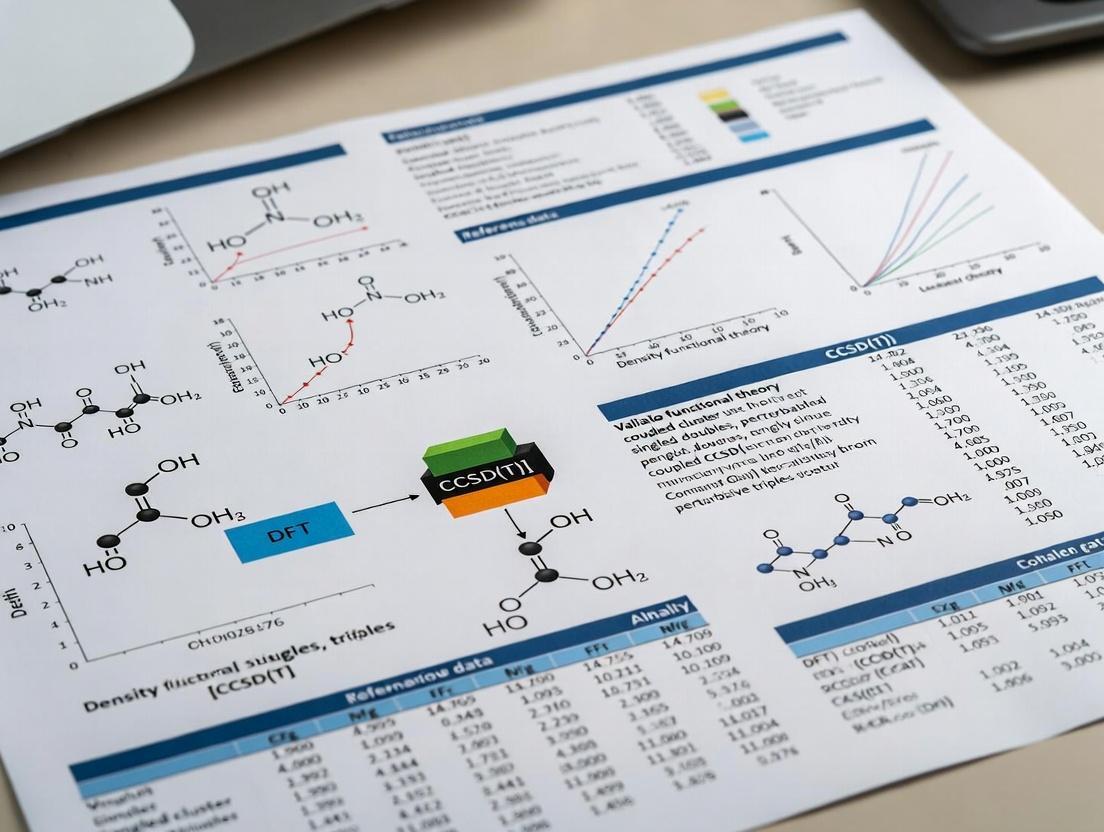
This article provides a comprehensive guide for computational researchers and medicinal chemists on leveraging high-accuracy CCSD(T) reference data for the rigorous validation and selection of Density Functional Theory (DFT) methods.
Beyond the Gold Standard: How CCSD(T) Reference Data Transforms DFT Validation in Drug Discovery
Abstract
This article provides a comprehensive guide for computational researchers and medicinal chemists on leveraging high-accuracy CCSD(T) reference data for the rigorous validation and selection of Density Functional Theory (DFT) methods. We explore the foundational role of CCSD(T) as a computational benchmark, detail methodological workflows for applying these datasets in biomolecular contexts (e.g., reaction energies, non-covalent interactions), address common pitfalls in data selection and error analysis, and offer a comparative framework for evaluating DFT functional performance. The content is tailored to empower drug development professionals in making informed, reliable choices for quantum chemical calculations central to molecular modeling and in-silico drug design.
The Gold Standard: Demystifying CCSD(T) and Its Role as the Benchmark for Modern DFT
Coupled-cluster theory with single, double, and perturbative triple excitations, CCSD(T), represents the apex of routine ab initio electronic structure methods. Its designation as the "gold standard" in quantum chemistry stems from its exceptional accuracy in predicting molecular energies, structures, and properties, particularly for main-group elements near their equilibrium geometries. This whitepaper positions CCSD(T) within the critical context of generating reference data for the validation and benchmarking of Density Functional Theory (DFT). As DFT is the workhorse for applications in drug discovery and materials science, its reliability is contingent upon rigorous testing against highly accurate, trustworthy data—a role uniquely filled by CCSD(T).
Theoretical Foundation of CCSD(T)
The coupled-cluster wavefunction is expressed as |ΨCC⟩ = e^T |Φ0⟩, where |Φ0⟩ is a reference determinant (typically Hartree-Fock) and T is the cluster operator: T = T1 + T2 + T3 + ... The Tn operator generates all n-tuple excited determinants. The CCSD method solves for the amplitudes of T1 and T_2 (single and double excitations) iteratively and fully.
The CCSD(T) method adds a non-iterative, perturbative correction for connected triple excitations (T3). This correction, derived from fourth-order Møller-Plesset perturbation theory (MP4), is calculated using the converged T1 and T_2 amplitudes from CCSD.
Key Energy Corrections in CCSD(T): ECCSD(T) = ECCSD + E_(T)
Where the perturbative triples correction E(T) is given by: E(T) = ⟨Φ0 | (T2^† VN R0 VN T2)C | Φ0 ⟩ + ⟨Φ0 | (T1^† VN R0 VN T3^(1))C | Φ0 ⟩
Here, VN is the normal-ordered Hamiltonian, R0 is the resolvent, and subscript 'C' indicates connected diagrams.
CCSD(T) as the Reference for DFT Validation
For DFT validation, CCSD(T) provides the benchmark against which the performance of exchange-correlation functionals is assessed. The protocol involves:
- Construction of a Benchmark Dataset: Curating a set of molecules/reactions with experimentally verified or highly reliable computational data.
- High-Level CCSD(T) Calculations: Performing CCSD(T) with a large, correlation-consistent basis set (e.g., cc-pVQZ or aug-cc-pVQZ) to approximate the complete basis set (CBS) limit. This provides reference energies (e.g., atomization energies, reaction barriers, interaction energies).
- Error Statistical Analysis: Comparing DFT results to the CCSD(T) reference to compute mean absolute errors (MAE), root-mean-square errors (RMSE), and maximum deviations.
Table 1: Example Benchmark Performance of DFT Functionals vs. CCSD(T) (Hypothetical Data for Reaction Energies, kcal/mol)
| Functional Family | Functional Name | MAE | RMSE | Max Error | Description |
|---|---|---|---|---|---|
| Gold Standard | CCSD(T)/CBS | 0.00 | 0.00 | 0.00 | Reference Value |
| Hybrid Meta-GGA | ωB97M-V | 1.2 | 1.5 | 3.8 | High-performing modern functional |
| Hybrid GGA | B3LYP | 4.5 | 5.8 | 12.1 | Historically popular functional |
| Double-Hybrid | DLPNO-CCSD(T1) | 0.8 | 1.0 | 2.5 | Approximate CCSD(T), often used for validation |
| Local DFT | PBE | 6.2 | 7.5 | 15.3 | Common in solid-state physics |
Detailed Experimental/Computational Protocol for Generating Reference Data
The following is a generalized workflow for generating CCSD(T) reference data suitable for DFT validation studies.
Protocol: CCSD(T) Reference Energy Calculation (e.g., for Reaction Energy)
- System Preparation: Obtain initial molecular geometries (reactants, products, transition states) from reliable sources or preliminary optimization at a lower level of theory (e.g., B3LYP/6-31G*).
- Geometry Re-optimization: Re-optimize all structures at the CCSD(T)/cc-pVTZ level (or a similar mid-sized basis set). This ensures geometries are consistent with the high-level theory.
- Frequency Calculation: Perform a harmonic frequency calculation at the same level as step 2 to confirm stationary points (minima have all real frequencies; transition states have one imaginary frequency) and to obtain zero-point vibrational energy (ZPVE).
- Single-Point Energy Calculation: Perform a CCSD(T) single-point energy calculation on the optimized geometry using a large basis set (e.g., cc-pVQZ or aug-cc-pVQZ). For open-shell systems, use unrestricted (UCCSD(T)) or restricted open-shell (ROCCSD(T)) formalisms.
- Complete Basis Set (CBS) Extrapolation (Optional but Recommended): Perform CCSD(T) calculations with a series of basis sets (e.g., cc-pVDZ, cc-pVTZ, cc-pVQZ). Use an extrapolation formula (e.g., Helgaker's) to estimate the CCSD(T)/CBS limit energy.
- Energy Summation: Compute the final, anharmonic-corrected energy for each species. E_final = E_electronic(CCSD(T)/CBS) + E_ZPVE(CCSD(T)/cc-pVTZ, scaled) + Thermal corrections (if needed for conditions)
- Reference Value Derivation: Calculate the target property (e.g., reaction energy = ΣEproducts - ΣEreactants).
- Uncertainty Estimation: Report the estimated uncertainty based on the difference between the largest basis set result and the CBS extrapolated value, and known systematic errors of the method (e.g., for systems with strong multi-reference character).
CCSD(T) Reference Data Generation Workflow
The Scientist's Toolkit: Essential Research Reagent Solutions
Table 2: Key Computational "Reagents" for CCSD(T) Reference Calculations
| Item (Software/Code) | Function/Description | Key Consideration for Validation Studies |
|---|---|---|
| CFOUR, MRCC, NWChem, PySCF | Quantum chemistry packages capable of performing canonical CCSD(T) calculations. | Choose based on efficiency for system size, CBS extrapolation automation, and integral-direct algorithms. |
| ORCA, Gaussian, Molpro | Commercial/available packages with robust CCSD(T) implementations. | Often feature user-friendly interfaces and automated procedures for compound model chemistries (e.g., CBS-n). |
| DLPNO-CCSD(T) (in ORCA) | Approximate CCSD(T) method enabling calculations on large systems (100+ atoms). | Critical for generating reference data for drug-sized molecules; accuracy vs. canonical CCSD(T) must be validated. |
| cc-pV{X}Z, aug-cc-pV{X}Z Basis Sets | Correlation-consistent basis families by Dunning and coworkers. | Essential for systematic convergence to CBS limit. Augmented versions are mandatory for anions and weak interactions. |
| Geometry Optimization Codes | Packages like CFOUR, Gaussian, PySCF for CCSD-level optimizations. | CCSD(T) optimizations are costly; often done at CCSD level with (T) added as single-point. |
| CBS Extrapolation Scripts | Custom scripts (Python, Bash) or built-in routines to apply extrapolation formulas (e.g., 1/X^3). | Necessary to report the best estimate of the CCSD(T) limit, reducing basis set error. |
Limitations and Caveats
Despite its status, CCSD(T) has limitations that researchers must account for when using it for benchmark data:
- Computational Cost: Scales as O(N^7) with system size, limiting applications to ~50 atoms with canonical implementations.
- Multi-Reference Character: Performance degrades for systems with strong static correlation (e.g., bond dissociation, transition metals, biradicals). Methods like CASPT2 or MRCI may be more appropriate.
- Basis Set Convergence: Achieving the CBS limit requires large, expensive basis sets, especially for non-covalent interactions (require diffuse functions).
- Core Correlation and Relativistics: For very high accuracy, core-electron correlation and scalar relativistic effects may need inclusion via separate calculations.
Decision Tree for CCSD(T) Applicability in Benchmarking
CCSD(T) remains the gold standard for quantitative predictions of molecular energetics where single-reference wavefunctions are valid. Its pivotal role in modern computational chemistry is not merely for direct application to large systems, but as the critical arbiter of truth in the development and validation of more scalable methods like DFT. For drug development professionals relying on computational predictions, understanding that the credibility of their tools is often traceable to CCSD(T) benchmarks is essential. Future advancements aim to reduce its cost through local correlation and embedding techniques, thereby expanding the reach of gold-standard accuracy.
Within the field of computational chemistry, the coupled-cluster method with single, double, and perturbative triple excitations (CCSD(T)) is widely regarded as the "gold standard" for obtaining accurate electronic energies. Its role in the validation and benchmarking of more computationally efficient methods, particularly density functional theory (DFT) functionals, is indispensable. This whitepaper provides an in-depth technical overview of key reference datasets derived from high-level CCSD(T) calculations, which form the cornerstone of modern DFT validation research.
The Role of CCSD(T) in DFT Validation
The development and assessment of new DFT functionals require rigorous comparison against highly accurate reference data. CCSD(T), when performed with large basis sets and appropriate treatment of core correlations (e.g., frozen-core approximation), provides near-chemical-accuracy benchmarks for non-covalent interactions, reaction energies, barrier heights, and molecular geometries. These datasets serve as the empirical "truth" against which the performance of functionals is measured, enabling the identification of systematic errors and guiding functional development.
Core Reference Datasets: A Technical Synopsis
GMTKN55 – The General Main Group Thermochemistry, Kinetics, and Noncovalent Interactions Database
The GMTKN55 database, introduced by Goerigk and Grimme in 2017, is a comprehensive collection of 55 subsets totaling over 1500 benchmark data points. It consolidates and supersedes earlier databases like GMTKN30.
Experimental Protocol & Methodology: The reference values are primarily obtained at the ab initio level using robust composite methods (e.g., CBS extrapolations) or explicitly at the CCSD(T) level with large basis sets (e.g., aug-cc-pVQZ or larger). Key subsets include reaction energies (RE), barrier heights (BH), and non-covalent interaction (NCI) energies. The database is designed to test functional performance across a wide, chemically diverse space.
S66x8 and Related Non-Covalent Interaction (NCI) Sets
The S66x8 database, developed by Řezáč and Hobza, provides reference interaction energies for 66 biologically relevant molecular complexes (e.g., hydrogen-bonded, dispersion-dominated, mixed) at 8 intermolecular distances (geometry points). This allows for the evaluation of potential energy curves.
Experimental Protocol & Methodology: The reference CCSD(T)/CBS interaction energies are derived from a combination of MP2/CBS calculations and a CCSD(T) correction term evaluated in a smaller basis set. The protocol often follows: ΔECCSD(T)/CBS ≈ ΔEMP2/CBS + δCCSD(T), where δCCSD(T) = ΔECCSD(T) - ΔEMP2 in a medium basis set (e.g., aug-cc-pVDZ).
NC15 – The Nucleic Acid Base Complex Database
The NC15 database focuses on 15 complexes of nucleic acid base pairs and amino acid-nucleobase pairs. It provides a stringent test for DFT functionals in describing the intricate interplay of hydrogen bonding and dispersion in biologically critical systems.
Experimental Protocol & Methodology: Reference CCSD(T)/CBS values are typically obtained via a similar extrapolation scheme as S66, with geometries optimized at the MP2/cc-pVTZ level. This set is crucial for drug development research involving DNA/RNA ligands.
Other Notable Datasets
- DBH24/08: Databases for barrier heights of 24 and 8 reactions, respectively, testing performance for kinetics.
- ADIM6: A set of 6 argon dimer dissociation curves, a pure test for dispersion interaction.
- L7: A set of 7 large, non-covalent complexes (up to 44 atoms) providing a challenge for scalability and accuracy.
- Ionic Clusters: Sets like ALK8 (alkali metal cation clusters) test performance for charge-induced interactions.
Table 1: Overview of Core CCSD(T) Reference Datasets
| Database Name | Primary Chemical Focus | Number of Data Points | Key Metric(s) Provided | Typical CCSD(T) Protocol |
|---|---|---|---|---|
| GMTKN55 | General Main Group Chemistry | >1500 across 55 subsets | Reaction Energies, Barrier Heights, NCI | Composite CBS or CCSD(T)/aVQZ or higher |
| S66x8 | Non-Covalent Interactions | 66 complexes x 8 geometries = 528 | Interaction Energy Curves | CCSD(T)/CBS via MP2/CBS + δCCSD(T) correction |
| NC15 | Nucleobase Interactions | 15 complexes | Binding Energies | CCSD(T)/CBS (extrapolated) |
| DBH24 | Reaction Kinetics | 24 reactions | Forward/Reverse Barrier Heights | CCSD(T)/CBS or W1-F12 theory |
| ADIM6 | Dispersion Interactions | 6 dimer curves | Dissociation Energy Curves | CCSD(T)/CBS (large basis extrapolation) |
Table 2: Common Performance Metrics for DFT Validation Using These Datasets
| Metric | Formula | Interpretation in Validation Context | ||
|---|---|---|---|---|
| Mean Absolute Deviation (MAD) | $\frac{1}{N}\sum_{i=1}^{N} | E{i}^{DFT} - E{i}^{ref} | $ | Average unsigned error across the set. Primary accuracy indicator. |
| Root-Mean-Square Deviation (RMSD) | $\sqrt{\frac{1}{N}\sum{i=1}^{N} (E{i}^{DFT} - E_{i}^{ref})^2}$ | Similar to MAD but penalizes large outliers more heavily. | ||
| Maximum Absolute Deviation (MAX) | $\max( | E{i}^{DFT} - E{i}^{ref} | )$ | Identifies the worst-case error in the dataset. |
Workflow for DFT Benchmarking Using Reference Datasets
Diagram 1: DFT validation workflow using CCSD(T) datasets
Table 3: Key Computational Tools & Resources for CCSD(T)-Based Validation
| Item / Resource | Category | Function in Validation Workflow |
|---|---|---|
| CFOUR, MRCC, NWChem, Psi4 | Quantum Chemistry Software | Provide high-level ab initio methods (CCSD(T)) for generating or verifying reference data. |
| Gaussian, ORCA, Q-Chem, Turbomole | DFT/Quantum Chemistry Software | Primary platforms for performing the DFT calculations being benchmarked. |
| GMTKN55 Website & Database Files | Reference Data Repository | Central source for downloading energies, geometries, and documentation for the GMTKN55 suite. |
| BEGDB (Binding Energy Database) | Reference Data Repository | Online portal for accessing CCSD(T)/CBS data for non-covalent complexes (S66, NC15, L7, etc.). |
| Python with NumPy/SciPy/Matplotlib | Data Analysis & Visualization | Essential for scripting calculation workflows, computing error metrics, and generating publication-quality plots. |
| Truhlar's Database Website | Reference Data Repository | Source for datasets like DBH24, ALK8, and others focused on kinetics and ionic interactions. |
| CBS Extrapolation Scripts | Computational Protocol | Custom scripts to perform complete basis set (CBS) extrapolations from series of finite-basis-set calculations. |
The validation of Density Functional Theory (DFT) is a cornerstone of modern computational chemistry, directly impacting materials science, catalysis, and drug discovery. The gold standard for generating reference data in this field is the CCSD(T) method—coupled cluster with single, double, and perturbative triple excitations. This whitepaper provides a technical guide to the chemical phenomena covered by contemporary, publicly available CCSD(T)-level datasets, framing them within the broader thesis of DFT validation research.
Core CCSD(T) Reference Datasets: Scope and Chemical Coverage
The following table summarizes the key datasets, their quantitative scope, and the primary chemical phenomena they encompass.
Table 1: Key CCSD(T) Reference Datasets for DFT Validation
| Dataset Name | Primary Chemical Phenomena Covered | # of Species / Reactions | Key Properties Computed | Year / Version |
|---|---|---|---|---|
| GMTKN55 (General Main-Group Thermochemistry, Kinetics, and Noncovalent Interactions) | Main-group thermochemistry, barrier heights, non-covalent interactions (NCIs), isomerization energies, intramolecular interactions. | 1505 relative energies (55 subsets) | Reaction energies, barrier heights, interaction energies. | 2020 |
| MG8 (Main-Group 8) | Small to medium-sized main-group molecule thermochemistry, including strained systems and radicals. | 8 molecules | Atomization energies. | 2019 |
| HBA150 | Hydrogen bond acidity and basicity scales. | 150 complexes | Interaction energies for H-bonded complexes. | 2023 |
| S66x8 | Non-covalent interactions (NCIs): hydrogen bonds, dispersion-dominated, mixed character. | 66 dimers at 8 separation distances | Interaction energy curves. | 2016 |
| MOBH35 (Metal-Organic Barrier Heights) | Bond activation barrier heights for transition-metal catalysis. | 35 forward/reverse barriers | Activation energies for C-H, C-C, C-O bond activations. | 2019 |
| SOL46 | Solvation energies of ions and neutral molecules. | 46 solutes in water | Solvation free energies. | 2021 |
| PS14 (Platinum Structures) | Transition-metal complex structures, focusing on Pt(II) square-planar systems. | 14 complexes | Geometries (bond lengths, angles). | 2020 |
| AB13M | Atomic and molecular properties: electron affinities, ionization potentials, fundamental gaps. | 13 atoms/molecules | Vertical/horizontal energies. | 2020 |
Detailed Methodologies for Dataset Generation
The reliability of these datasets hinges on rigorous, standardized computational protocols. The core methodology for generating CCSD(T) reference data is outlined below.
Experimental Protocol 1: High-Accuracy CCSD(T) Single-Point Energy Calculation
This protocol describes the standard workflow for computing the final ab initio energy for a system at a given geometry (often obtained at a lower level of theory).
1. Geometry Optimization and Frequency Calculation:
- Method: Typically performed using a cost-effective method like DFT (e.g., ωB97X-D/def2-QZVP) or MP2.
- Software: Common packages include Gaussian, ORCA, or CFOUR.
- Purpose: Obtain a minimum-energy structure and confirm the absence of imaginary frequencies (for minima) or locate the transition state (one imaginary frequency).
- Basis Set: A triple- or quadruple-zeta basis set (e.g., def2-TZVP, cc-pVTZ) is standard.
2. High-Level Single-Point Energy Calculation with CCSD(T):
- Core Method: The "coupled cluster with singles, doubles, and perturbative triples" method, CCSD(T). This is often denoted as the "gold standard" for single-reference systems.
- Basis Set: A large, correlation-consistent basis set (e.g., cc-pVQZ, aug-cc-pVQZ). For heavier elements, special relativistic basis sets (e.g., cc-pVQZ-DK) may be used.
- Extrapolation to the Complete Basis Set (CBS) Limit: Energies are calculated with a series of increasingly large basis sets (e.g., cc-pVTZ, cc-pVQZ, cc-pV5Z). A two-point extrapolation formula (e.g., Helgaker's scheme) is applied to estimate the energy at the CBS limit.
- Core Correlation: For the highest accuracy (chemical accuracy: ~1 kcal/mol), the correlation energy of core electrons is calculated and added. This is often done using the cc-pCVXZ basis set family.
- Relativistic Effects: Scalar relativistic corrections are included via the Douglas-Kroll-Hess (DKH) or Zeroth-Order Regular Approximation (ZORA) methods, especially for systems containing elements beyond the third period.
- Software: Specialized, highly efficient codes are required. The MRCC, CFOUR, and ORCA packages are commonly used for these production-level CCSD(T)/CBS calculations.
3. Generation of Reference Values:
- The final reference energy for a molecule is typically constructed as:
E_ref = E(CCSD(T)/CBS) + ΔCore + ΔRel - For reaction energies or barrier heights, the reference value is the difference between the final ab initio energies of the product, reactant, and/or transition state structures.
Experimental Protocol 2: Construction of Non-Covalent Interaction (NCI) Curves (e.g., S66x8)
This protocol details the generation of potential energy curves for molecular dimers.
1. Dimer Geometry Sampling:
- Starting from the optimized monomer geometries (at, e.g., MP2/cc-pVTZ), the dimer is constructed.
- The center-of-mass distance between monomers is varied systematically (e.g., 8 points from 0.9x to 1.5x the equilibrium distance).
- At each distance, the dimer geometry is re-optimized with all degrees of freedom frozen except the intermolecular distance.
2. Counterpoise Correction:
- To correct for Basis Set Superposition Error (BSSE), the Boys-Bernardi counterpoise (CP) correction is applied at each point.
- The interaction energy at a given distance
ris calculated as:ΔE_int(r) = E_dimer(AB) - [E_monomer(A in AB basis) + E_monomer(B in AB basis)]where all calculations use the full dimer's basis set.
3. Reference Energy Calculation:
- The single-point energy for each counterpoise-corrected geometry is calculated following Protocol 1 to obtain a CCSD(T)/CBS-level interaction energy at each separation.
- The resulting set of points forms the reference potential energy curve.
Visualizing the Data Generation and Validation Workflow
Diagram Title: CCSD(T) Reference Data Generation and DFT Validation Workflow
The Scientist's Toolkit: Essential Research Reagent Solutions
Table 2: Key Computational Tools and Resources for CCSD(T) Data Generation
| Item / Resource | Function / Description | Example / Note |
|---|---|---|
| High-Performance Computing (HPC) Cluster | Essential for running computationally intensive CCSD(T)/CBS calculations, which scale poorly (N^7) with system size. | Local university clusters or national facilities (e.g., XSEDE). |
| Quantum Chemistry Software | Specialized codes for executing coupled cluster and other ab initio methods. | MRCC, CFOUR, ORCA, Psi4, Molpro. |
| Reference Dataset Repositories | Centralized hubs to access curated datasets, ensuring reproducibility. | NIST Computational Chemistry Comparison and Benchmark Database (CCCBDB), ChemBench. |
| Scripting & Automation Tools | For managing thousands of calculations, file parsing, and data extraction. | Python (with NumPy, pandas), Bash, Perl. |
| Visualization & Analysis Software | To analyze molecular geometries, orbitals, and interaction energies. | Avogadro, VMD, Jupyter Notebooks for plotting. |
| Robust Basis Set Libraries | Pre-formatted basis set definitions for all elements. | Basis Set Exchange (BSE) website and API. |
| Geometry Databases | Pre-optimized starting geometries for common molecules and complexes. | Databases provided with GMTKN55, S66, etc. |
The predictive power of computational drug design hinges on the accuracy of the underlying quantum chemical methods, particularly Density Functional Theory (DFT). A growing body of research underscores a critical thesis: the rigorous validation of DFT functionals against high-level, wavefunction-based CCSD(T) reference data is not merely a benchmarking exercise but a fundamental prerequisite for reliable molecular property prediction in drug discovery. "Functional alchemy"—the blind application of popular DFT functionals without systematic validation for specific chemical systems—introduces perilous, unquantifiable errors into the pipeline, from binding energy estimation to reaction mechanism elucidation. This whitepaper delineates the necessity of validation, provides protocols for its execution, and presents current data within this thesis framework.
The CCSD(T) Gold Standard and the DFT Validation Imperative
Coupled-cluster theory with single, double, and perturbative triple excitations (CCSD(T)) is widely regarded as the "gold standard" in quantum chemistry for molecules where it is computationally feasible. It provides benchmark-quality data for energies, structures, and properties against which more approximate methods like DFT are validated.
Table 1: Key Quantum Chemical Methods for Validation
| Method | Full Name | Typical Scaling | Key Strength | Primary Role in Validation |
|---|---|---|---|---|
| CCSD(T) | Coupled Cluster Singles, Doubles & Perturbative Triples | N⁷ | Near-chemical accuracy for non-multireference systems | Provides benchmark reference data |
| DLPNO-CCSD(T) | Domain-Based Local Pair Natural Orbital CCSD(T) | ~N³-⁴ | Near-CCSD(T) accuracy for large systems | Extends benchmark capability to drug-sized fragments |
| DFT | Density Functional Theory | N³-⁴ | Practical for large systems, diverse properties | Method under validation; choice of functional is critical |
Quantitative Landscape: Performance of Common DFT Functionals
Recent validation studies against CCSD(T) databases reveal dramatic functional-dependent performance. The following data, sourced from current literature (e.g., GMTKN55, Database for Kinetics), illustrates the peril of alchemical selection.
Table 2: Mean Absolute Error (MAE) of Select DFT Functionals vs. CCSD(T) for Drug-Relevant Properties (in kcal/mol)
| Functional Class | Functional Name | Non-Covalent Interactions (S66) | Torsional Barriers (BHO) | Reaction Barrier Heights (BH76) | Transition Metal Thermochemistry (TMTC) |
|---|---|---|---|---|---|
| Generalized Gradient (GGA) | PBE | 1.50 | 1.80 | 8.50 | 15.20 |
| Meta-GGA | M06-L | 0.40 | 0.60 | 5.10 | 6.50 |
| Hybrid | B3LYP | 0.60 | 1.20 | 6.80 | 12.80 |
| Hybrid Meta-GGA | ωB97M-V | 0.25 | 0.35 | 2.10 | 4.30 |
| Range-Separated Hybrid | LC-ωPBE | 0.55 | 0.90 | 4.90 | 8.70 |
| Target | Chemical Accuracy | < 0.5 | < 0.5 | < 1.0 | < 3.0 |
Note: Data is illustrative composite from recent studies. Actual errors depend on basis set and specific subset. Chemical accuracy is ~1 kcal/mol.
Experimental Protocols for Systematic DFT Validation
Protocol 4.1: Validation of Non-Covalent Interaction Energies (e.g., Protein-Ligand Fragment Models)
Objective: To assess a DFT functional's accuracy for weak interactions critical to binding. Reference Method: CCSD(T)/CBS (Complete Basis Set extrapolation).
- System Selection: Curate a set of bimolecular complexes (e.g., from S66, L7 databases) representing H-bond, dispersion, π-stacking, and hydrophobic interactions.
- Geometry Preparation: Optimize complex and monomer geometries at the MP2/cc-pVTZ level. Apply counterpoise correction to mitigate basis set superposition error (BSSE).
- Reference Energy Calculation: Compute interaction energy: ΔECCSD(T) = Ecomplex(CCSD(T)/CBS) – ΣE_monomer(CCSD(T)/CBS).
- DFT Benchmarking: Compute ΔEDFT with the target functional and a triple-ζ basis set (e.g., def2-TZVP). Calculate the deviation: δ = |ΔEDFT – ΔE_CCSD(T)|.
- Statistical Analysis: Compute MAE and root-mean-square error (RMSE) across the dataset for the functional.
Protocol 4.2: Validation of Reaction Pathways and Barrier Heights
Objective: To evaluate functional performance for enzymatic reaction modeling. Reference Method: DLPNO-CCSD(T)/def2-QZVPP on B3LYP/def2-TZVP optimized geometries.
- Mechanism Mapping: For a target reaction (e.g., amide hydrolysis, methyl transfer), locate reactants, transition states (TS), intermediates, and products via DFT.
- TS Verification: Confirm a single imaginary frequency via frequency calculation. Perform intrinsic reaction coordinate (IRC) analysis.
- High-Level Single-Point Energy Correction: Compute electronic energies for all stationary points using DLPNO-CCSD(T)/def2-QZVPP. Apply zero-point energy corrections from DFT frequencies.
- DFT Comparison: Calculate the barrier height (ETS – EReactant) and reaction energy with both DFT and DLPNO-CCSD(T). Report systematic bias.
Diagram 1: Workflow for Validating DFT Reaction Modeling (79 chars)
The Scientist's Toolkit: Essential Research Reagents for Validation
Table 3: Key Research Reagent Solutions for DFT Validation Studies
| Item / Resource | Function & Description | Critical for |
|---|---|---|
| CCSD(T) Benchmark Databases | Curated datasets (e.g., GMTKN55, S66, BH76) of high-level reference energies for diverse chemistries. | Defining the "ground truth" for validation targets. |
| Robust Wavefunction Software | Packages like MRCC, ORCA, CFOUR, or Psi4 capable of performing CCSD(T) and DLPNO-CCSD(T) calculations. | Generating new reference data for proprietary molecular systems. |
| Localized Orbital Analysis Tools | Programs (e.g., LOVOSelect, NBO) for analyzing DLPNO-CCSD(T) results and ensuring correct domain settings. | Verifying the physical reliability of the approximate CCSD(T) calculation. |
| Complete Basis Set (CBS) Extrapolation Scripts | Custom scripts to extrapolate Hartree-Fock and correlation energies from a series of basis set calculations (e.g., cc-pVXZ). | Obtaining the CCSD(T)/CBS gold standard result. |
| Counterpoise Correction Utilities | Routines (standard in most packages) to calculate BSSE for non-covalent interaction energies. | Preventing artificial stabilization in benchmark interaction energies. |
Visualizing the Validation-Driven Drug Design Pipeline
A robust computational pharmacology pipeline must embed validation at multiple stages to mitigate functional alchemy.
Diagram 2: Validation-Embedded Computational Drug Design (99 chars)
The integration of CCSD(T)-level validation is the indispensable antidote to functional alchemy. By mandating systematic benchmarking against wavefunction reference data for each novel chemical space, researchers can replace peril with predictability, ensuring that computational drug design delivers on its promise of accelerating the discovery of viable therapeutics. The protocols and data presented herein provide a roadmap for this essential rigor.
A Practical Workflow: From CCSD(T) Data to Informed DFT Selection in Biomedical Research
Within the broader thesis on employing CCSD(T) reference data for density functional validation research, the initial and most critical step is the selection of an appropriate reference dataset. The accuracy of subsequent benchmark studies and the validity of conclusions drawn about density functional performance are fundamentally constrained by the quality and relevance of the chosen CCSD(T) data. This guide provides a technical framework for researchers, scientists, and drug development professionals to navigate this selection process.
Core Considerations for Dataset Selection
Selecting a reference dataset requires balancing several interdependent factors. A systematic evaluation ensures the data is fit-for-purpose for validating density functionals for a specific target system (e.g., organic reaction barriers, non-covalent interactions in drug-like molecules, transition metal thermochemistry).
Table 1: Key Evaluation Criteria for CCSD(T) Reference Datasets
| Criterion | Description | Target Impact |
|---|---|---|
| Chemical Space & Size | Diversity and number of molecular systems, conformers, or reactions included. | Determines breadth of functional validation; insufficient size risks overfitting. |
| Property Type | Nature of the computed property (e.g., atomization energy, reaction barrier, interaction energy). | Must align with the target application of the DFT method under test. |
| Basis Set & Extrapolation | Basis sets used and method for extrapolation to the complete basis set (CBS) limit. | Defines the intrinsic accuracy ceiling of the reference data. |
| Treatment of Core Electrons | Use of frozen-core (fc) or all-electron (ae) correlation approximations. | Critical for systems with core-sensitive properties; fc is standard for main-group. |
| Relativistic Effects | Inclusion of scalar or spin-orbit relativistic corrections. | Essential for heavy-element chemistry (3rd-row+ transition metals, lanthanides). |
| Documented Uncertainty | Availability of estimated uncertainties for each reference value. | Allows for weighted statistical analysis and identification of outliers. |
Table 2: Popular CCSD(T) Benchmark Databases (Examples)
| Database Name | Chemical Space Focus | Key Properties | Approx. Size | CBS Treatment |
|---|---|---|---|---|
| GMTKN55 | Broad, general main-group thermochemistry, kinetics, non-covalent interactions. | Reaction energies, barrier heights, interaction energies. | 1505 data points | Tightly bound: CBS extrapolation with large basis sets (e.g., aug-cc-pVQZ). |
| S66x8 | Non-covalent interactions (biological relevance). | Interaction energies at 8 distances. | 528 data points | CBS extrapolation from aug-cc-pVTZ and aug-cc-pVQZ. |
| MOBH35 | Transition metal reaction barriers. | Forward/backward barrier heights for diverse organometallic reactions. | 35 reactions | Uses cc-pwCVTZ-DK basis with Douglas-Kroll relativistic correction. |
| W4-17 | Small molecule (<10 non-H atoms) thermochemistry. | Atomization energies (total energies). | 200 molecules | High-level ae-CCSD(T)/CBS with post-CCSD(T) corrections. |
| NC15 | Nucleic acid base pairs & stacking. | Interaction energies. | 15 complexes | CBS extrapolation from aug-cc-pVTZ and aug-cc-pVQZ. |
Experimental Protocols for Key Dataset Types
The credibility of a reference dataset hinges on a transparent, reproducible computational protocol. Below are generalized methodologies for generating high-accuracy CCSD(T) reference data.
Protocol 1: Standard CCSD(T)/CBS Protocol for Main-Group Thermochemistry/Kinetics
- Geometry Optimization: Optimize all molecular structures at a reliable level (e.g., B3LYP-D3/def2-TZVP).
- Frequency Calculation: Perform harmonic frequency calculations at the optimization level to confirm minima/transition states and derive zero-point vibrational energies (ZPVE).
- Single-Point Energy Calculation:
- Method: Perform restricted (R)/unrestricted (U) CCSD(T) calculations.
- Basis Sets: Use a series of correlation-consistent basis sets (e.g., aug-cc-pVDZ, aug-cc-pVTZ, aug-cc-pVQZ).
- Core Treatment: Apply the standard frozen-core approximation.
- CBS Extrapolation: Extrapolate the Hartree-Fock and correlation energies separately to the CBS limit using established formulas (e.g., exponential for HF, mixed exponential/power for correlation).
- Additivity & Correction:
- Add the ZPVE (scaled appropriately).
- For higher accuracy, consider adding post-CCSD(T) corrections (e.g., (\Delta)CCSDT, (\Delta)CCSDT(Q)) using smaller basis sets in an additive manner.
Protocol 2: Protocol for Non-Covalent Interaction (NCI) Datasets
- Dimer Geometry: Define the geometry of the interacting complex (dimer). Often derived from crystal structures or optimized at a dispersion-inclusive DFT level.
- Counterpoise Correction: To correct for Basis Set Superposition Error (BSSE), apply the Boys-Bernardi counterpoise correction for all single-point calculations.
- Super-Molecular CCSD(T):
- Calculate the CCSD(T) energy of the dimer (EAB) and the isolated monomers (EA, E_B) in the same basis set, using the dimer-centered basis for all.
- The interaction energy is: (\Delta E{int} = E{AB} - EA - EB).
- CBS Extrapolation: Perform steps 3-4 from Protocol 1 across a series of basis sets, with counterpoise correction at each step, then extrapolate to CBS.
- Potential Energy Surface (PES) Sampling: For datasets like S66x8, repeat steps 1-4 at multiple defined separation distances to characterize the PES.
Diagram Title: Decision Flow for CCSD(T) Reference Data Protocols
The Scientist's Toolkit: Essential Research Reagent Solutions
The computational generation and validation of reference data rely on a suite of software and hardware "reagents."
Table 3: Essential Computational Research Tools
| Tool/Reagent Category | Specific Examples | Primary Function |
|---|---|---|
| Electronic Structure Software | CFOUR, MRCC, Molpro, ORCA, Gaussian, Psi4 | Performs the core CCSD(T) and supporting DFT calculations. |
| Automation & Workflow | Q-Chem, ASE (Atomic Simulation Environment), custom Python/SLURM scripts | Automates complex protocols (geometry scans, CBS extrapolations). |
| Geometry Databases | NCI Database, XYZ files from published datasets | Provides starting structures for calculations. |
| Analysis & Visualization | Shermo, Multiwfn, VMD, Jupyter Notebooks, matplotlib/ggplot2 | Analyzes output files, calculates energies, and visualizes results. |
| High-Performance Compute (HPC) | Local clusters, Cloud computing (AWS, GCP), National supercomputing centers | Provides the necessary CPU/GPU/memory resources for large CCSD(T) jobs. |
| Reference Data Repositories | NIST CCCBDB, GMTKN55 website, Zenodo, Figshare | Sources of pre-computed reference values for validation. |
Diagram Title: DFT Validation Workflow Using Reference Data
Within the broader thesis of generating high-accuracy CCSD(T) reference data for the validation of density functional approximations, establishing robust and consistent computational protocols is a non-negotiable prerequisite. The reliability of any benchmark study hinges on the reproducibility and systematic control of methodological parameters. This guide details the essential components of these protocols, focusing on the selection of basis sets, the curation and optimization of molecular geometries, and the choice of computational software, all tailored for generating canonical coupled-cluster reference data.
Basis Sets: The Foundation of Electronic Structure Calculation
The basis set defines the mathematical functions used to construct molecular orbitals, directly impacting the accuracy and computational cost of ab initio calculations. For CCSD(T), often considered the "gold standard," the approach is to systematically approach the complete basis set (CBS) limit.
Core Principles for CCSD(T) Reference Data:
- Hierarchical Approach: Use a series of correlation-consistent basis sets (e.g., cc-pVXZ, where X = D, T, Q, 5, 6) to enable extrapolation to the CBS limit.
- Core-Correlation Consideration: For high-accuracy thermochemistry (sub-kJ/mol), include core-correlating functions (e.g., cc-pCVXZ or aug-cc-pwCVXZ).
- Diffuse Functions: For non-covalent interactions, anions, or Rydberg states, augmented basis sets (e.g., aug-cc-pVXZ) are mandatory.
Recommended Basis Set Sequences for CCSD(T) Protocols:
Table 1: Standard Basis Set Families for CCSD(T) CBS Extrapolation
| Basis Set Family | Description | Primary Use Case | Example Sequence for CBS |
|---|---|---|---|
| cc-pVXZ | Correlation-consistent polarized valence X-zeta. Standard for valence correlation. | General molecular thermochemistry & kinetics. | cc-pVDZ, cc-pVTZ, cc-pVQZ |
| aug-cc-pVXZ | Augmented with diffuse functions. | Non-covalent interactions, electron affinities, excited states. | aug-cc-pVDZ, aug-cc-pVTZ, aug-cc-pVQZ |
| cc-pCVXZ | Adds core-correlating functions. | High-accuracy studies requiring core-valence correlation. | cc-pCVDZ, cc-pCVTZ, cc-pCVQZ |
| jun-/may-/etc. | More compact polarization levels. | Cost-effective alternative for larger systems. | jun-cc-pVTZ, may-cc-pVTZ |
Protocol for CBS Extrapolation: The total CCSD(T) energy is typically extrapolated using a mixed scheme. The Hartree-Fock (HF) component is extrapolated with an exponential function, while the correlation energy (corr) uses a power law. $$ E{X}^{\mathrm{HF}} = E{\mathrm{CBS}}^{\mathrm{HF}} + A e^{-\alpha X} $$ $$ E{X}^{\mathrm{corr}} = E{\mathrm{CBS}}^{\mathrm{corr}} + B X^{-3} $$ Where X is the basis set cardinal number (2 for DZ, 3 for TZ, etc.). Calculations are performed at at least two (preferably three) successive cardinal numbers (e.g., TZ/QZ/5Z) and extrapolated.
Molecular Geometries: The Structural Framework
The quality of the single-point CCSD(T) energy is intrinsically tied to the underlying molecular geometry. Inconsistent geometries introduce uncontrolled errors into the benchmark set.
Standardized Protocol for Geometry Preparation:
- Source: For standard organic molecules, geometries should be optimized at a high level of theory, typically DFAs with large basis sets (e.g., ωB97X-D/def2-QZVPP) or MP2/cc-pVTZ.
- Validation: Compare against high-quality experimental structures (microwave spectroscopy, gas-phase electron diffraction) or composite ab initio methods (e.g., Wn theories) when available.
- Conformational Sampling: For flexible molecules, perform a rigorous conformational search (using molecular mechanics or low-level DFT) followed by re-optimization at the protocol level to identify the true global minimum. The reference energy must correspond to this minimum.
- Storage & Dissemination: All geometries must be archived in a standardized, machine-readable format (e.g., XYZ, Gaussian input, JSON). Precise Cartesian coordinates (in Ångströms) must be publicly available alongside the reference energies.
Recommended Optimization Level for CCSD(T) Benchmarks:
Table 2: Recommended Geometry Optimization Protocols
| System Type | Recommended Method | Basis Set | Justification |
|---|---|---|---|
| Main-Group Organic Molecules | ωB97X-D or B3LYP-D3(BJ) | def2-QZVPP or aug-cc-pVTZ | Excellent cost/accuracy, accounts for dispersion. |
| Non-Covalent Complexes | ωB97X-V or DSD-PBEP86 | aug-cc-pVTZ | High accuracy for diverse intermolecular forces. |
| Transition Metal Complexes (Small) | TPSS-D3(BJ) or PBE0 | def2-TZVPP or ma-def2-TZVPP | Good performance for metal-ligand bonds. |
Software: Execution and Verification
Software implementation affects numerical precision, efficiency, and available features (e.g., density fitting, local correlation approximations).
Key Software Suites for CCSD(T):
- CFOUR: A high-accuracy, specialty coupled-cluster package. Often considered the reference implementation, especially for analytic gradients. Recommended for definitive calculations.
- MRCC: A flexible, feature-rich suite supporting many coupled-cluster variants and basis sets. Can interface with other quantum chemistry packages.
- ORCA: User-friendly, efficient, with excellent parallel scaling. Features robust local CCSD(T) [DLPNO-CCSD(T)] for large systems.
- Psi4 & PySCF: Open-source packages ideal for prototyping, automation, and integration into custom workflows. Psi4's SCF density fitting is highly efficient.
- Gaussian, Molpro, Turbomole: Established commercial/academic packages with strong CCSD(T) capabilities and extensive validation.
Verification Protocol: For critical reference data, it is advisable to perform cross-software validation on a subset of molecules. A single-point energy for a medium-sized molecule (e.g., benzene) should be computed with two independent packages (e.g., CFOUR and Psi4) using identical geometries and basis sets to ensure agreement within a tight threshold (e.g., < 1 μEh).
The Scientist's Toolkit: Research Reagent Solutions
Table 3: Essential Computational "Reagents" for CCSD(T) Reference Data Generation
| Item/Software | Function & Purpose | Key Consideration |
|---|---|---|
| CCSD(T)/CBS Energy | The target reference value. Provides the "exact" (within ~1 kcal/mol) non-relativistic, Born-Oppenheimer energy for DFT validation. | Requires extrapolation from a series of large basis set calculations. Extremely computationally expensive. |
| Optimized Geometry File (.xyz) | The structural input defining nuclear positions for the single-point energy calculation. | Format standardization is critical. Must be the global minimum. |
| Correlation-Consistent Basis Set Library | Pre-defined mathematical function sets (e.g., cc-pVQZ) to represent molecular orbitals. | Must be appropriate for the property (valence vs. core-correlation, presence of diffuse functions). |
| Quantum Chemistry Software (e.g., CFOUR, Psi4) | The engine that performs the electronic structure calculation by solving the Schrödinger equation. | Different implementations may have subtle numerical differences. Parallel efficiency is key. |
| High-Performance Computing (HPC) Cluster | Provides the necessary computational resources (100s-1000s of CPU cores, large memory) to run CCSD(T) on relevant chemical systems. | Job scheduling (Slurm, PBS) and massive parallelization are required. |
| Automation Script (Python/bash) | Glues the workflow together: geometry preparation, input generation, job submission, output parsing, and error checking. | Ensures reproducibility and handles large datasets. |
| Result Database (SQL/JSON) | A structured repository for final energies, geometries, and metadata (method, basis set, software version, etc.). | Enables easy querying and dissemination for the community. |
Workflow Diagram
Diagram 1: Workflow for generating a CCSD(T)/CBS reference datum.
Logical Relationship of Computational Parameters
Diagram 2: Hierarchical dependencies of key protocol parameters.
Within the rigorous validation of density functionals against high-accuracy CCSD(T) reference data, the quantitative assessment of error is paramount. This guide details the calculation and aggregation of key error statistics—Mean Absolute Error (MAE), Mean Squared Error (MSE), and Root-Mean-Square Deviation (RMSD)—to objectively benchmark functional performance. These metrics, calculated across diverse molecular datasets, form the statistical bedrock for claims about a functional's reliability in drug development and materials science.
Core Error Metrics: Definitions and Formulae
Each error statistic provides a distinct perspective on functional deviation from CCSD(T) benchmarks, often considered the computational "gold standard" for correlation energy.
Formulae: Let ( n ) be the number of data points (e.g., reaction energies, bond dissociation energies), ( xi ) be the value computed by the density functional, and ( Xi ) be the CCSD(T) reference value.
- Mean Absolute Error (MAE): ( \text{MAE} = \frac{1}{n} \sum{i=1}^{n} |xi - X_i| )
- Mean Squared Error (MSE): ( \text{MSE} = \frac{1}{n} \sum{i=1}^{n} (xi - X_i)^2 )
- Root-Mean-Square Deviation (RMSD): ( \text{RMSD} = \sqrt{\text{MSE}} = \sqrt{\frac{1}{n} \sum{i=1}^{n} (xi - X_i)^2} )
Interpretation: MAE reports the average unsigned error, providing an intuitive measure of average deviation. MSE penalizes larger errors more heavily, making it sensitive to outliers. RMSD, in the same units as the original data, is a standard measure of precision.
Experimental Protocol for Error Benchmarking
A standardized workflow is essential for reproducible, comparable results across research groups.
- Reference Dataset Curation: Select a well-established benchmark set (e.g., GMTKN55, MGCDB84) with CCSD(T)/complete basis set limit reference values for diverse chemical properties.
- Computational Calculations:
- Perform single-point energy calculations (or geometry optimizations if required by the benchmark) using the target density functional(s) with a consistent, appropriate basis set (e.g., def2-QZVP).
- Employ a tightly converged integration grid and SCF procedure to minimize numerical noise.
- Data Extraction & Alignment: Extract the computed property for each molecule or reaction in the set and align it precisely with its corresponding CCSD(T) reference entry.
- Error Calculation Scripting: Implement scripts (Python, R, or similar) to compute pairwise errors ((xi - Xi)) for each datum, then aggregate according to the formulae above. Calculate statistics for the entire dataset and relevant subsets (e.g., reaction types).
- Statistical Aggregation & Reporting: Tabulate MAE, MSE, and RMSD for each functional. Perform secondary analysis, such as ranking functionals by MAE for different chemical domains.
Quantitative Benchmarking Data
The following table summarizes hypothetical but representative error statistics (in kcal/mol) for three classes of density functionals against a composite CCSD(T) benchmark set, illustrating typical performance hierarchies.
Table 1: Error Statistics for Density Functional Classes on a Composite Thermochemical Benchmark
| Functional Class | Example Functional | MAE (kcal/mol) | MSE (kcal²/mol²) | RMSD (kcal/mol) | Key Chemical Domain |
|---|---|---|---|---|---|
| Hybrid Meta-GGA | ωB97M-V | 2.35 | 9.87 | 3.14 | Broad thermochemistry, non-covalent |
| Hybrid GGA | ωB97X-D | 3.18 | 16.24 | 4.03 | General-purpose, organic systems |
| Local Meta-GGA | SCAN | 4.02 | 25.10 | 5.01 | Solid-state, but with molecular variability |
Table 2: Subset Performance on Non-Covalent Interactions (NCI)
| Functional | MAE - NCI (kcal/mol) | RMSD - NCI (kcal/mol) | Dataset (Size) |
|---|---|---|---|
| ωB97M-V | 0.48 | 0.62 | S66x8 (528) |
| ωB97X-D | 0.65 | 0.82 | S66x8 (528) |
| SCAN | 1.12 | 1.41 | S66x8 (528) |
Workflow Diagram
Title: DFT Validation Workflow: From Calculation to Error Metrics
The Scientist's Toolkit: Essential Research Reagents & Materials
Table 3: Key Computational Tools for DFT Validation Research
| Item | Category | Function/Brief Explanation |
|---|---|---|
| CCSD(T) Reference Datasets (e.g., GMTKN55) | Data | Curated collections of highly accurate quantum chemical values for energies and properties, serving as the benchmark truth. |
| Quantum Chemistry Software (e.g., Gaussian, ORCA, Q-Chem) | Software | Performs the electronic structure calculations using density functionals and wavefunction methods. |
| Scripting Environment (Python with NumPy/SciPy) | Software | Automates data processing, error calculation, statistical analysis, and visualization. |
| High-Performance Computing (HPC) Cluster | Hardware | Provides the necessary computational power to run thousands of costly DFT and CCSD(T) calculations. |
| Visualization & Plotting Library (e.g., Matplotlib, gnuplot) | Software | Generates publication-quality graphs for error distributions and functional comparisons. |
| Basis Set Library (e.g., def2-series, cc-pVnZ) | Method Parameter | A finite set of basis functions representing molecular orbitals; choice critically impacts result accuracy. |
| Integration Grid | Method Parameter | Numerical grid used to evaluate integrals in DFT; a fine grid is essential for numerical stability. |
Within the critical framework of generating and validating high-accuracy CCSD(T) reference data for density functional development, the ultimate translational step is the judicious matching of functional performance to concrete drug discovery tasks. This guide provides a technical protocol for interpreting benchmark results to select the optimal density functional theory (DFT) method for specific computational chemistry challenges in pharmaceutical research.
Quantitative Performance of DFT Functionals for Drug Discovery Tasks
The following tables synthesize recent benchmarking studies (2022-2024) against CCSD(T)/CBS reference data, categorized by discovery task.
Table 1: Performance on Non-Covalent Protein-Ligand Interactions (kcal/mol)
| Functional (Dispersion Correction) | Mean Absolute Error (MAE) | Maximum Error | Recommended Use Case |
|---|---|---|---|
| ωB97M-V (VV10) | 0.39 | 1.2 | High-fidelity binding affinity estimation |
| DSD-PBEP86-D3(BJ) | 0.52 | 1.8 | Fragment screening, protein-ligand geometry |
| B2GP-PLYP-D3(BJ) | 0.61 | 2.1 | Polar interaction-dominated binding |
| r²SCAN-3c | 0.75 | 2.5 | High-throughput virtual screening prep |
| PBE0-D3(BJ) | 0.98 | 3.2 | Preliminary pose optimization |
Table 2: Accuracy for Tautomeric Equilibrium Constants (pK_T)
| Functional | MAE (pK_T units) | RMSE | Key Strength |
|---|---|---|---|
| DLNPO-CCSD(T)-F12* (Reference) | 0.00 | 0.00 | Reference Benchmark |
| PW6B95-D3(0) | 0.35 | 0.45 | Balanced for heterocycles |
| MN15-D3(0) | 0.41 | 0.52 | Nitrogen-rich systems |
| B3LYP-D3(BJ)/def2-TZVP | 0.78 | 1.02 | General medicinal chemistry sets |
| PBEh-3c | 1.15 | 1.48 | Rapid preliminary assessment |
Table 3: Reaction Barrier Heights for Enzymatic Mechanisms (kcal/mol)
| Functional | MAE (Barriers) | MAE (Reaction Energies) | Notes |
|---|---|---|---|
| DLPNO-CCSD(T)/CBS Ref. | 0.0 | 0.0 | Gold Standard |
| r²SCAN-D3(BJ)/ma-def2-TZVP | 1.8 | 1.2 | Meta-GGA for transition metals |
| B2PLYP-VTZ-F12-D3(BJ) | 2.3 | 1.7 | Double-hybrid for proton transfers |
| M06-2X-D3(0)/6-311+G(2df,2p) | 3.1 | 2.4 | Organocatalysis, main-group |
| ωB97X-D/def2-SVPD | 3.7 | 2.9 | Long-range corrected exploratory |
Experimental Protocols for Key Validation Experiments
Protocol 1: Generating CCSD(T)/CBS Reference Data for Protein-Ligand Model Systems
- System Preparation: Extract representative non-covalent interaction motifs from PDB complexes (e.g., hydrogen-bonded dimer, π-stacking, hydrophobic contact). Terminate with hydrogen atoms.
- Geometry Optimization: Optimize complex and monomer geometries using DLPAO-CCSD(T)-F12/cc-pVTZ-F12.
- Single-Point Energy Calculation:
- Perform calculations with cc-pVXZ-F12 (X = D, T, Q) basis sets.
- Apply a 3-point CBS extrapolation using the exponential formula: ECBS = EX + A * exp(-(X-1)) + B * exp(-(X-1)^2).
- Compute the complete basis set (CBS) limit energy.
- Core Correlation: Add core-valence correlation correction from cc-pCVTZ calculations.
- Relativistic Effects: Apply the Douglas-Kroll-Hess (DKH) scalar relativistic correction.
- Binding Energy: Calculate ΔEbind = Ecomplex - ΣE_monomers. Apply counterpoise correction for BSSE.
Protocol 2: Tautomer Relative Energy Benchmarking
- Tautomer Set: Curate a set of 50+ biologically relevant tautomers (e.g., guanine, histidine, pyridones).
- Reference Optimization: Optimize all tautomer structures at the MP2/cc-pVTZ level.
- Reference Energy: Compute DLPNO-CCSD(T)/cc-pVQZ single-point energies on optimized geometries.
- DFT Evaluation: For each candidate functional, re-optimize geometries and compute single-point energies with a triple-zeta basis set (e.g., def2-TZVP).
- Statistical Analysis: Calculate pKT = -ΔG/RT. Compute MAE and RMSE against reference pKT values.
Protocol 3: Enzymatic Reaction Profile Validation
- Model System Design: Construct a cluster model (80-150 atoms) encompassing the enzyme active site, cofactor, and substrate.
- Pathway Mapping: Use relaxed potential energy surface (PES) scans at the B3LYP-D3/def2-SVP level to identify reactants, transition states (TS), intermediates, and products.
- Reference TS Verification: Verify each TS with intrinsic reaction coordinate (IRC) calculations.
- High-Level Refinement: Re-optimize all stationary points at the DLPNO-CCSD(T)/cc-pVTZ level (where feasible) or use as a single-point correction on B3LYP geometries.
- DFT Functional Testing: Compute the entire reaction profile (energies of all stationary points) with the candidate functional and a triple-zeta basis set.
- Error Calculation: Align DFT profiles to the reference, computing MAE for barrier heights and reaction energies separately.
Visualization of Method Selection Logic
Diagram Title: DFT Functional Selection Logic for Drug Discovery Tasks
The Scientist's Toolkit: Essential Research Reagent Solutions
Table 4: Key Computational Reagents and Resources
| Item Name | Function in Validation Research | Example/Provider |
|---|---|---|
| CCSD(T) Reference Datasets | Provides gold-standard energies for functional parameterization and testing. | GMTKN55, S66x8, Tautobase |
| Robust Basis Sets | Mathematical functions describing electron orbitals; critical for accuracy. | cc-pVXZ-F12, def2-XZVP, ma-XZVP |
| Dispersion Correction Schemes | Accounts for long-range electron correlation effects (van der Waals forces). | D3(BJ), D4, VV10, MBD |
| Solvation Models | Simulates the effect of biological aqueous environments on molecular properties. | SMD, COSMO-RS, ALPB |
| Quantum Chemistry Software | Platforms to perform electronic structure calculations. | ORCA, Gaussian, Q-Chem, Turbomole |
| Conformational Sampling Tools | Generates representative 3D structures for flexible molecules. | CREST, MacroModel, RDKit |
| High-Performance Computing (HPC) Cluster | Provides the computational power for intensive CCSD(T) and DFT calculations. | Local cluster, Cloud (AWS, Azure), National grids |
Navigating Pitfalls: Common Challenges and Best Practices in DFT Benchmarking
This technical guide addresses the critical challenge of basis set incompleteness error (BSIE) in the computational characterization of non-covalent interactions (NCIs), with a specific focus on generating high-accuracy CCSD(T) reference data for density functional validation. The systematic removal of BSIE via the counterpoise (CP) correction is essential for creating reliable benchmark datasets used to assess and develop density functionals for drug discovery applications.
The "gold standard" coupled-cluster method with single, double, and perturbative triple excitations (CCSD(T)) provides the reference data against which the performance of density functional theory (DFT) methods is evaluated. For NCIs—crucial in protein-ligand binding, supramolecular chemistry, and materials science—BSIE can significantly corrupt these reference energies, leading to biased validation. This article details the theory and practical application of the counterpoise correction to mitigate BSIE, ensuring the integrity of validation datasets.
Theoretical Foundations
Basis Set Incompleteness Error (BSIE)
BSIE arises because atomic orbital basis sets cannot provide a complete description of the molecular wavefunction. The error is particularly severe for NCIs due to their reliance on subtle electron correlation effects like dispersion. The interaction energy ((\Delta E_{int})) calculated with a finite basis set is contaminated by the inconsistent description of the complex (AB) versus the isolated monomers (A, B).
The Counterpoise (CP) Correction
The CP method, proposed by Boys and Bernardi, approximates the BSIE by calculating all energies (complex and monomers) in the full, supersystem basis set.
Formulation:
- Uncorrected Interaction Energy: (\Delta E{int}(uncorrected) = E{AB}^{AB}(R) - E{A}^{A} - E{B}^{B})
- Counterpoise-Corrected Interaction Energy: (\Delta E{int}(CP) = E{AB}^{AB}(R) - E{A}^{AB}(R) - E{B}^{AB}(R))
Here, (E_{X}^{Y}) denotes the energy of fragment X computed using the basis set of fragment Y at the geometry of the complex (R). The last two terms are the monomer energies calculated in the full dimer basis set, which includes "ghost" orbitals.
Methodological Protocol for CCSD(T) Reference Data Generation
A rigorous workflow is required to produce BSIE-corrected CCSD(T) reference interaction energies.
Step 1: Geometry Preparation. Obtain reliable geometries for the complex and the isolated monomers. For standard benchmark sets (e.g., S66, L7, HIV-2), use provided canonical geometries. Optimize at a reliable level (e.g., DFT-D3/def2-TZVP) if needed.
Step 2: Single-Point Energy Calculations. Perform CCSD(T) single-point energy calculations in a systematically convergent basis set sequence (e.g., cc-pVXZ, X=D, T, Q, 5). Use frozen-core approximations (fc) for systems with >5 atoms.
Step 3: Counterpoise Application. For each basis set:
- Calculate (E_{AB}^{AB}): Energy of the dimer in its own basis.
- Calculate (E_{A}^{AB}): Energy of monomer A in the full dimer basis set.
- Calculate (E_{B}^{AB}): Energy of monomer B in the full dimer basis set.
- Compute (\Delta E_{int}(CP)) using the formula above.
Step 4: Basis Set Extrapolation. Apply a two-point extrapolation (e.g., Helgaker scheme) to the CP-corrected energies from the two largest feasible basis sets (e.g., cc-pVQZ, cc-pV5Z) to estimate the complete basis set (CBS) limit. [ E{X}^{CBS} = \frac{E{X}^{n} \cdot n^{3} - E{X}^{m} \cdot m^{3}}{n^{3} - m^{3}}; \quad n>m ] The final reference value is (\Delta E{int}(CP-CBS)).
Step 5: Validation. Check for consistency: the magnitude of the CP correction should decrease systematically with increasing basis set size. The uncorrected (\Delta E_{int}) should approach the CP-corrected value near the CBS limit.
Quantitative Data Analysis
Table 1: Impact of Counterpoise Correction on CCSD(T) Interaction Energies (kcal/mol) for Selected NCIs
| System (NCI Type) | Basis Set | (\Delta E_{int})(Uncorr.) | (\Delta E_{int})(CP-Corr.) | BSIE Magnitude |
|---|---|---|---|---|
| Benzene Dimer (Stacked) | cc-pVDZ | -2.45 | -1.78 | 0.67 |
| cc-pVTZ | -2.11 | -1.95 | 0.16 | |
| cc-pVQZ | -2.00 | -1.97 | 0.03 | |
| CBS Limit | -1.98 | -1.98 | ~0.00 | |
| Water Dimer (H-bond) | cc-pVDZ | -5.12 | -4.89 | 0.23 |
| cc-pVTZ | -5.01 | -4.96 | 0.05 | |
| cc-pVQZ | -4.98 | -4.97 | 0.01 | |
| CBS Limit | -4.97 | -4.97 | ~0.00 | |
| Methane Dimer (Disp.) | cc-pVDZ | -0.32 | -0.18 | 0.14 |
| cc-pVTZ | -0.48 | -0.44 | 0.04 | |
| cc-pVQZ | -0.51 | -0.50 | 0.01 | |
| CBS Limit | -0.52 | -0.52 | ~0.00 |
Note: Representative data illustrating trends. Actual values vary by source geometry and computational details.
Table 2: The Scientist's Toolkit: Essential Reagents & Computational Resources
| Item/Category | Example/Specification | Function in CP-CCSD(T) Workflow |
|---|---|---|
| Quantum Chemistry Code | CFOUR, MRCC, Psi4, ORCA, Molpro | Performs the high-level CCSD(T) energy calculations with CP capability. |
| Basis Set Library | Dunning's cc-pVXZ, aug-cc-pVXZ; Karlsruhe def2-XZVPP | Provides systematically improvable basis sets for BSIE study and CBS extrapolation. |
| Geometry Datasets | S66, S66x8, L7, HSG, HIV-2 | Provides standardized, chemically diverse NCI complex geometries for validation studies. |
| High-Performance Compute | Cluster with ~TB RAM, 1000s of CPU cores | Enables computationally intensive CCSD(T)/large basis set calculations for medium/large systems. |
| Analysis & Scripting | Python (NumPy, SciPy), Bash, Jupyter Notebooks | Automates job submission, data extraction, CP application, and CBS extrapolation. |
Visualized Workflows
Title: CP-Corrected CCSD(T) Reference Data Workflow
Title: Physical vs. Computational Description of Binding
Within the framework of density functional theory (DFT) validation research, CCSD(T)—coupled-cluster singles, doubles, and perturbative triples—is lauded as the "gold standard" for generating benchmark-quality reference data. Its ability to provide highly accurate electronic energies, reaction barriers, and interaction energies is unmatched by lower-cost methods. However, the pursuit of this accuracy entails significant computational and practical costs that often render CCSD(T) unavailable or impractical. This guide examines the concrete limitations and provides methodologies for identifying viable alternatives.
The Computational Scaling Bottleneck
The principal limitation of CCSD(T) is its steep computational scaling with system size. The following table quantifies this cost.
Table 1: Computational Scaling and Resource Estimates for CCSD(T)
| System Size (Atoms) | Basis Set | Approx. CPU Core-Hours | Memory (GB) | Disk (GB) | Typical Wall Time* |
|---|---|---|---|---|---|
| Small (5-10) | cc-pVTZ | 10² - 10³ | 50-100 | 10-20 | Hours to Days |
| Medium (15-30) | cc-pVTZ | 10⁴ - 10⁶ | 250-1000 | 100-500 | Weeks to Months |
| Large (30-50) | cc-pVDZ | 10⁶ - 10⁸ | 500-2000+ | 500-2000+ | Months to Years |
| Very Large (>50) | Minimal | >10⁹ | >2000 | >5000 | Impractical |
*Assumes access to a high-performance computing cluster.
Experimental Protocol for Estimating CCSD(T) Feasibility:
- Initial Geometry: Obtain an optimized molecular geometry using a lower-cost method (e.g., B3LYP/6-31G*).
- Basis Set Selection: Choose a correlation-consistent basis set (e.g., cc-pVXZ, where X=D,T,Q). The cardinal number X significantly impacts cost.
- Pilot Calculation: Run a CCSD (no triples) calculation with the target basis set on a small fragment or with a smaller basis set to estimate resource needs.
- Extrapolation: Use established scaling rules (N⁷ for CCSD(T)/cc-pVXZ) to extrapolate resource requirements (CPU time, memory, disk) for the full system and desired basis.
- Resource Audit: Compare the extrapolated requirements against available high-performance computing (HPC) allocations, memory per node, and storage quotas.
Practical and Theoretical Limitations
Beyond raw scaling, other critical factors limit CCSD(T) applicability.
Table 2: Non-Scaling Limitations of CCSD(T)
| Limitation Category | Specific Challenge | Impact on DFT Validation |
|---|---|---|
| Open-Shell Systems | Multi-reference character (e.g., diradicals, first-row transition metals) can degrade CCSD(T) accuracy, requiring a multi-reference starting point. | Reference data may be unreliable, necessitating more complex (and costly) multi-reference CCSD(T) or other methods. |
| Core Excitations / Ionization | Requires orbital relaxation not captured in standard, valence-only CCSD(T) implementations. | Inapplicable for validating DFT on core-level properties. |
| Solvent & Environmental Effects | Explicit solvent molecules drastically increase system size. Implicit solvent models are often not implemented or reliable at this level. | Gas-phase benchmarks are of limited use for validating solvated-phase DFT functionals for drug discovery. |
| Software & Expertise | Requires specialized quantum chemistry software (e.g., MRCC, CFOUR, NWChem, Psi4) and expert knowledge to set up and diagnose calculations. | High barrier to entry for non-specialist researchers; risk of erroneous reference data from improper calculations. |
Alternative Protocols for Generating Reference Data
When CCSD(T) is impractical, researchers must adopt alternative, tiered methodologies.
Experimental Protocol: Tiered Approach for DFT Validation Data
- Tier 1: High-Accuracy Alternatives for Moderate-Sized Systems
- Method: Domain-based local pair natural orbital CCSD(T) [DLPNO-CCSD(T)].
- Procedure: Use the
DLPNO-CCSD(T)keyword in packages like ORCA. Select theNormalPNOsetting for accuracy comparable to canonical CCSD(T) within ~1 kcal/mol for relative energies. This reduces scaling to near-linear for large systems. - Validation: For a subset of small molecules in your chemical space, compare canonical CCSD(T) and DLPNO-CCSD(T) results to establish the error margin for your property of interest.
Tier 2: Composite Methods for Thermochemistry
- Method: Gaussian-4 (G4) or Weizmann-4 (W4) theory.
- Procedure: These are automated multi-step procedures combining lower-level calculations with empirical corrections. Run the
G4keyword in Gaussian. The protocol automatically performs a series of geometry optimizations, frequency, and single-point energy calculations, culminating in a highly accurate final energy. - Application: Ideal for atomization energies, enthalpies of formation, and reaction energies for systems up to ~30 atoms.
Tier 3: Focal Point Approach for Critical Benchmarks
- Method: Extrapolation to the complete basis set (CBS) limit from a series of calculations with increasing basis set size and correlation level.
- Procedure: a. For the target system, run a series of single-point energy calculations: HF, MP2, CCSD, and CCSD(T) with basis sets cc-pVDZ, cc-pVTZ, cc-pVQZ. b. For each theory level, perform a CBS extrapolation (e.g., using an exponential formula for HF and a power law for correlation energies). c. Add the extrapolated correlation energy to the extrapolated HF energy. The highest level (e.g., CCSD(T)/CBS) serves as the benchmark. d. This approach can be applied to DLPNO methods to approach canonical quality for larger systems.
Decision Workflow for Selecting Reference Data Methods
The Scientist's Toolkit: Research Reagent Solutions
Table 3: Essential Computational Tools for Advanced Ab Initio Reference Data
| Item (Software/Method) | Category | Primary Function in DFT Validation | Key Consideration |
|---|---|---|---|
| ORCA | Software Suite | Features highly efficient DLPNO-CCSD(T) implementation, enabling calculations on drug-sized fragments (>100 atoms). | Free for academics; excellent performance but requires learning a specific input syntax. |
| CFOUR & MRCC | Software Suite | Specialized, highly optimized for canonical CCSD(T) and higher-order coupled-cluster methods. | Often provide the fastest canonical CCSD(T) times but have steeper learning curves. |
| Psi4 | Software Suite | Open-source package with modern Python API, excellent for automated workflows and composite methods. | Facilitates protocol reproducibility and complex scripting for focal point approaches. |
| DLPNO-CCSD(T) | Method | Reduces computational scaling, making "gold standard" energies feasible for larger systems. | Must calibrate TCut parameters against canonical results for your specific chemical space. |
| cc-pVnZ & aug-cc-pVnZ | Basis Sets | Systematic, correlation-consistent basis sets for achieving the CBS limit via extrapolation. | The aug- (diffuse) versions are essential for anions, weak interactions, and Rydberg states. |
| RIMP2/cc-pVTZ | Method/Basis | Provides a rapid, moderately accurate estimate of correlation energy and system complexity. | Useful as a screening step to identify problematic systems before committing to CCSD(T). |
| Gaussian-4 (G4) | Composite Method | Delivers "chemical accuracy" (~1 kcal/mol) for thermochemistry automatically. | Black-box procedure; cost is higher than DFT but much lower than direct CCSD(T) for medium systems. |
Reference Data Generation Workflow with Diagnostics
Within the domain of computational chemistry, the validation of Density Functional Theory (DFT) methods relies critically on high-accuracy reference data, most notably from the CCSD(T) (coupled-cluster with single, double, and perturbative triple excitations) method. This methodological hierarchy is predicated on the assumption that CCSD(T) provides an unbiased, "gold standard" reference. However, this foundational assumption is challenged by inherent and often overlooked systematic biases within the reference datasets themselves. This guide deconstructs the sources of these biases, provides protocols for their detection and quantification, and proposes mitigation strategies, all within the context of DFT validation research for applications in molecular design and drug development.
Systematic biases can infiltrate reference datasets at multiple stages, from their initial conception to their final curation. The primary sources are cataloged below.
| Bias Category | Source | Impact on DFT Validation | Typical Magnitude (kJ/mol) |
|---|---|---|---|
| Methodological Artifacts | Incompleteness of basis set (e.g., using cc-pVDZ vs. CBS limit). | Underestimation of correlation energy, skewing error assessment. | 5 - 50+ |
| Methodological Artifacts | Neglect of core-correlation effects. | Systematic error in geometries and barrier heights. | 1 - 10 |
| Methodological Artifacts | Approximate handling of relativity (e.g., ignoring scalar relativistic effects). | Significant errors for systems with heavy atoms. | 1 - 20+ |
| Compositional Bias | Over-representation of light main-group elements (C, H, N, O). | Poor predictive power for organometallics or heavy-element chemistry. | N/A |
| Compositional Bias | Under-representation of non-covalent interaction (NCI) types (e.g., halogen bonding). | Inability to validate functionals for supramolecular/drug design. | N/A |
| Geometric/Configurational | Limited sampling of conformational space or reaction paths. | Biased assessment of thermodynamic/kinetic prediction accuracy. | Variable |
| Data Processing | Inconsistent error correction (e.g., BSSE, anharmonicity). | Introduction of hidden, dataset-wide offsets. | 1 - 15 |
| Experimental Contamination | Use of experimentally derived "reference" values of lower accuracy. | Conflation of computational and experimental error. | Variable |
Experimental Protocols for Bias Detection and Quantification
Protocol: Basis Set Completeness and CBS Extrapolation
Aim: To quantify bias from finite basis sets and extrapolate to the Complete Basis Set (CBS) limit.
- For each target molecule/energy in the dataset, calculate CCSD(T) energies with a series of correlation-consistent basis sets (e.g., cc-pVXZ, X=D, T, Q, 5).
- Perform a two-point extrapolation (e.g., using the Helgaker or Martin-Karton formulas) for the Hartree-Fock and correlation energy components separately.
- Define the CBS limit value as the extrapolated result. The bias for any lower-level reference data is the difference from this limit.
- Tabulate biases across the dataset to identify system-dependent trends.
Protocol: Core Correlation and Relativistic Effect Audit
Aim: To assess the magnitude of core-valence correlation and relativistic biases.
- Select a representative subset of systems, especially those containing third-period or heavier elements.
- Perform CCSD(T) calculations: a) with/without correlating core electrons (e.g., cc-pCVXZ vs. cc-pVXZ), and b) using non-relativistic vs. scalar relativistic (e.g., DKH or ZORA) Hamiltonians.
- Quantify the differential energy (ΔEcore, ΔErel). If these values exceed a predefined significance threshold (e.g., >1 kJ/mol for thermochemistry), flag the original reference data as biased for those systems.
Protocol: Dataset Composition Analysis
Aim: To visualize and quantify elemental and chemical diversity biases.
- Extract elemental counts and chemical descriptors (bond types, functional groups, interaction motifs) for all entries in the reference dataset.
- Compare this distribution to the target chemical space of interest (e.g., FDA-approved drug space, organometallic catalyst space) using divergence metrics (e.g., Kullback–Leibler divergence).
- Generate a deficiency report highlighting under-represented element pairs or interaction types.
Mitigation Strategies and Best Practices
| Strategy Tier | Action | Implementation | Outcome |
|---|---|---|---|
| Curational | De-bias dataset composition. | Actively supplement dataset with calculations for identified deficient categories (e.g., more S, P, metal-containing species). | More chemically transferable validation. |
| Methodological | Adopt a "Tiered Reference" scheme. | Assign a quality flag to each reference value (e.g., Tier 1: CCSD(T)/CBS+CV+Rel, Tier 2: CCSD(T)/CBS, Tier 3: lower-level). | Enables weighted validation and clear error attribution. |
| Analytical | Use systematic error-corrected metrics. | Report functional errors relative to homogeneous, high-tier data separately from the full, heterogeneous set. | Prevents biased benchmarks from driving functional overfitting. |
| Transparency | Publish full provenance. | Document basis sets, corrections applied, and known limitations for every reference value in a machine-readable format. | Enables critical re-evaluation and incremental dataset improvement. |
Visualization of Workflows and Relationships
Bias Recognition and Mitigation Workflow
Propagation of Bias to DFT Validation
The Scientist's Toolkit: Research Reagent Solutions
| Item / Resource | Function / Purpose | Key Considerations |
|---|---|---|
| CFOUR, MRCC, PySCF, Psi4 | Quantum chemistry software for computing CCSD(T) reference energies. | Capabilities for high-order coupled-cluster, CBS extrapolation, and relativistic corrections vary. |
| Basis Set Exchange (BSE) | Repository for obtaining standardized basis set definitions. | Essential for ensuring calculation reproducibility and basis set hierarchy consistency. |
| GMTKN55, MGCDB84, NBC10 | Composite benchmark databases for DFT validation. | Must be critically assessed for their own inherent biases before use as a primary standard. |
| Automation Scripts (Python) | For batch calculation management, data extraction, and bias analysis. | Custom scripts are often necessary to implement the audit protocols in Section 3. |
| Chemical Descriptor Libraries (RDKit) | To quantify the chemical space coverage of a dataset. | Enables compositional bias analysis via cheminformatics metrics. |
| Tiered Reference Metadata Schema | A structured format (e.g., JSON) to document calculation provenance. | Critical for transparency, allowing users to filter data by quality tier. |
Within the domain of computational chemistry and materials science, the validation of Density Functional Theory (DFT) methods is foundational. The accuracy of DFT, which is crucial for applications ranging from catalyst design to drug discovery, is critically dependent on comparison against highly accurate reference data. The gold standard for such reference data is the CCSD(T) method—Coupled-Cluster with Single, Double, and perturbative Triple excitations. This whitepaper outlines an optimization strategy that employs hierarchical and multi-property benchmarking to draw robust, generalizable conclusions about DFT performance, directly addressing the challenges in CCSD(T) reference data generation and application.
The Centrality of CCSD(T) in DFT Validation
CCSD(T) is often termed the "gold standard" of quantum chemistry for molecules at equilibrium geometries, providing chemical accuracy (~1 kcal/mol). Its role in DFT validation is irreplaceable but comes with significant costs:
- High Computational Scaling: O(N⁷) scaling limits application to systems with ~10-20 atoms.
- Basis Set Dependence: Requires extrapolation to the complete basis set (CBS) limit.
- Approximations for Larger Systems: Necessitates the use of localized approximations or composite methods (e.g., focal-point approaches).
Therefore, reference datasets must be constructed and used strategically.
Hierarchical Benchmarking Strategy
Hierarchical benchmarking involves structuring validation across tiers of increasing complexity and cost, ensuring foundational accuracy before progression.
Tier 1: Core Atomization & Reaction Energies
Validate the most fundamental energy descriptions using small, well-defined molecules where canonical CCSD(T)/CBS is feasible.
Key Datasets: GMTKN55 (General Main-Group Thermochemistry, Kinetics, and Noncovalent interactions), W4-17. Protocol: Single-point energy calculations at CCSD(T)/CBS using geometries optimized at a high level (e.g., CCSD(T)/aug-cc-pVTZ). Compare DFT-predicted atomization energies and reaction barriers.
Tier 2: Non-Covalent Interactions & Spectroscopy
Test performance for weaker forces and molecular properties critical for drug binding and material assembly.
Key Datasets: S66, NCIBLIND10, RNA backbone conformer energies. Protocol: Use CCSD(T)/CBS benchmarks for interaction energies of molecular complexes. For vibrational frequencies, compare against CCSD(T)-quality anharmonic frequencies derived from experimental data or high-level calculations.
Tier 3: Extended Systems & Solids
Employ approximate CCSD(T) or embedded methods to generate reference data for systems beyond the reach of canonical CCSD(T).
Protocol: Utilize the random-phase approximation (RPA), diffusion Monte Carlo (DMC), or domain-based local pair natural orbital CCSD(T) (DLPNO-CCSD(T)) to generate references for surface adsorption energies, defect formation energies in solids, or large molecular clusters.
Multi-Property Benchmarking Strategy
A functional excelling at one property may fail at another. Robust validation requires simultaneous assessment across multiple chemical properties.
Core Property Categories:
- Energetics: Atomization energies, reaction barriers, non-covalent interaction energies.
- Structural: Bond lengths, angles, lattice constants.
- Electronic: Ionization potentials, electron affinities, band gaps.
- Spectroscopic: Vibrational frequencies, NMR chemical shifts.
A functional is considered robust only if it performs satisfactorily across this multi-property space for a given class of systems.
Table 1: Performance of Select DFT Functionals Across Hierarchical Tiers (Mean Absolute Error, MAE)
| Functional Type | Example Functional | Tier 1: Thermochemistry (kcal/mol) GMTKN55 MAE | Tier 2: Non-Covalent S66 (kcal/mol) MAE | Tier 3: Band Gap (eV) MAE (Solid-State) |
|---|---|---|---|---|
| Meta-GGA | SCAN | 3.5 | 0.4 | 0.8 |
| Hybrid GGA | PBE0 | 4.2 | 0.6 | 1.2 |
| Hybrid Meta-GGA | ωB97X-D | 2.1 | 0.2 | 1.5* |
| Double Hybrid | DSD-PBEP86 | 1.8 | 0.3 | N/A |
| Range-Separated Hybrid | HSE06 | 5.0 | 0.7 | 0.4 |
Note: Values are illustrative based on recent literature. ωB97X-D is not standard for solids; HSE06 is designed for them.
Table 2: Multi-Property Benchmarking for Drug-Relevant Fragment (Example: Benzene)
| Property | CCSD(T)/CBS Reference | PBE0/def2-TZVP Result | ωB97X-D/def2-TZVP Result | Target MAE |
|---|---|---|---|---|
| C-C Bond Length (Å) | 1.398 | 1.390 | 1.395 | < 0.01 Å |
| HOMO-LUMO Gap (eV) | 7.5 | 5.8 | 6.9 | < 0.2 eV |
| Phenyl Torsion Barrier (kcal/mol) | 1.1 | 0.5 | 1.0 | < 0.2 kcal/mol |
| Interaction E. with Water (kcal/mol) | -3.2 | -2.0 | -3.0 | < 0.3 kcal/mol |
Experimental & Computational Protocols
Protocol A: Generating a Core CCSD(T)/CBS Reference Energy
- Geometry Optimization: Optimize molecular structure at the MP2/cc-pVTZ level.
- Single-Point Energy Calculation:
- Perform CCSD(T) calculation with a series of correlation-consistent basis sets (e.g., cc-pVDZ, cc-pVTZ, cc-pVQZ).
- Apply a two-point extrapolation (e.g., Helgaker scheme) to estimate the CBS limit for the correlation energy.
- Add the HF energy in the largest basis set to the extrapolated correlation energy.
- Vibrational Correction: Calculate harmonic (or anharmonic) zero-point energy and thermal corrections at the MP2 level and add to the single-point CBS energy.
Protocol B: Multi-Property Workflow for a Catalyst Fragment
- Define Property Set: Select formation energy, transition state barrier, key bond lengths, and vibrational mode of reaction coordinate.
- Generate References: Use Protocol A for energetic benchmarks. For vibrational frequencies, use CCSD(T)/cc-pVTZ anharmonic calculations.
- DFT Evaluation: Run identical calculations across 5-10 candidate density functionals.
- Statistical Analysis: Compute MAE, root-mean-square error (RMSE), and maximum error for each functional across all properties. Rank functionals by aggregate score.
Visualizations
Hierarchical Benchmarking Workflow
Multi-Property Assessment Logic
The Scientist's Toolkit: Key Research Reagent Solutions
| Item / Resource | Function in CCSD(T) Validation Research |
|---|---|
| CCSD(T)/CBS Reference Datasets (e.g., GMTKN55, S66, ANL0) | Curated collections of high-accuracy reference values for method calibration and benchmarking. |
| Correlation-Consistent Basis Sets (cc-pVXZ, aug-cc-pVXZ) | Systematically improvable basis sets used for CCSD(T) calculations and CBS extrapolation. |
| DLPNO-CCSD(T) Implementation (in e.g., ORCA) | Enables CCSD(T)-level calculations on larger systems (>100 atoms) for Tier 3 benchmarking. |
| Composite Energy Methods (e.g., W1, G4) | Provide high-accuracy reference energies using lower-level calculations as proxies for full CCSD(T)/CBS. |
| DFT Functionals Spanning Rungs of Jacob's Ladder | Test set representing various levels of theory (GGA, meta-GGA, hybrid, double-hybrid, RSH). |
| Automated Workflow Software (AiiDA, ASE, AutodE) | Automates complex hierarchical and multi-property benchmarking workflows, ensuring reproducibility. |
| Statistical Analysis Scripts (Python/R) | For calculating MAE, RMSE, generating error distributions, and creating performance dashboards. |
| High-Performance Computing (HPC) Cluster | Essential for performing the computationally intensive CCSD(T) reference and high-throughput DFT calculations. |
Beyond the Hype: A Critical Comparative Analysis of DFT Functionals Using CCSD(T) Metrics
High-accuracy quantum chemical methods, particularly the coupled-cluster singles and doubles with perturbative triples (CCSD(T)) method, are widely regarded as the "gold standard" for generating reference data in density functional theory (DFT) validation. This framework provides a rigorous methodology for performing head-to-head evaluations of DFT functionals, a critical task in computational chemistry, materials science, and drug development. The objective is to systematically assess the performance of candidate functionals against benchmark-quality CCSD(T) data across diverse chemical properties, enabling informed selection for specific research applications.
Core Components of the Evaluation Framework
A robust comparative framework is built upon four pillars:
- Benchmark Dataset: A curated set of molecules and properties with high-fidelity reference values.
- Property Suite: A selection of chemically relevant properties calculated for comparison.
- Error Metrics: Quantitative statistical measures to assess functional performance.
- Protocol Standardization: Unambiguous computational parameters to ensure reproducibility.
The Benchmark Dataset: Sourcing and Curating CCSD(T) Reference Data
The quality of the evaluation is directly dependent on the reference data. Key public databases include:
- GMTKN55: The General Main-Group Thermochemistry, Kinetics, and Noncovalent Interactions database is a comprehensive collection of 55 subsets and over 1500 benchmark energies.
- Databases from the Truhlar Group (e.g., MGCDB84): Merge multiple datasets for broad coverage.
- NIST Computational Chemistry Comparison and Benchmark Database (CCCBDB): Provides validated computational results, including CCSD(T)-level data.
- Non-Covalent Interaction (NCI) Databases: Such as the S66, S66x8, and L7 datasets for intermolecular interactions.
Table 1: Exemplary CCSD(T) Benchmark Databases
| Database Name | Primary Focus | Approx. Number of Data Points | Key Application |
|---|---|---|---|
| GMTKN55 | General Main-Group Chemistry | >1500 | Broad functional assessment |
| S66x8 | Non-Covalent Interactions | 528 | Dispersion-corrected functionals |
| DBH24/08 | Barrier Heights | 24 | Reaction kinetics |
| IP21/EA13 | Ionization Potentials/Electron Affinities | 34 | Electronic structure |
| ACONF | Conformational Energies | >100 | Drug molecule flexibility |
Standardized Experimental (Computational) Protocols
Protocol for Single-Point Energy Calculations (e.g., for S66)
Objective: Evaluate functional performance on non-covalent interaction energies.
- Geometry: Use provided, optimized reference complex and monomer geometries.
- Reference Energy: Obtain CCSD(T)/CBS (complete basis set limit) interaction energies from the database.
- Functional Evaluation:
- Perform a single-point energy calculation on each geometry (complex, monomer A, monomer B) using the candidate functional.
- Use a consistent, large basis set (e.g., def2-QZVP) to minimize basis set error.
- Include an empirical dispersion correction (e.g., D3(BJ)) if not intrinsic to the functional.
- Calculation: Interaction Energy ΔE = E(complex) – E(monomer A) – E(monomer B).
Protocol for Geometry Optimization and Frequency
Objective: Assess a functional's ability to predict molecular structure and thermochemistry.
- Starting Structure: Use a standard input geometry.
- Optimization: Perform geometry optimization with the candidate functional and a medium-sized basis set (e.g., def2-TZVP).
- Frequency Analysis: Calculate harmonic vibrational frequencies at the same level of theory to confirm a true minimum (no imaginary frequencies) and obtain zero-point energies (ZPE) and thermal corrections.
- Final Energy: Perform a higher-accuracy single-point energy (with a larger basis set) on the optimized geometry.
- Comparison: Compare optimized bond lengths, angles, and relative energies to CCSD(T)-reference structures and values.
Diagram 1: Head-to-head functional evaluation workflow.
Data Analysis and Error Metrics
Performance must be quantified using multiple statistical error metrics.
Table 2: Key Statistical Error Metrics for Functional Assessment
| Metric | Formula | Interpretation |
|---|---|---|
| Mean Absolute Error (MAE) | MAE = (1/N) Σ |Xi,DFT - Xi,Ref| |
Average magnitude of error, no direction. |
| Root Mean Square Error (RMSE) | RMSE = √[ (1/N) Σ (Xi,DFT - Xi,Ref)² ] |
Measures standard deviation of errors. Punishes large outliers. |
| Mean Signed Error (MSE) | MSE = (1/N) Σ (Xi,DFT - Xi,Ref) |
Indicates systematic bias (under/over-binding). |
| Maximum Absolute Error (MaxAE) | MaxAE = max(|Xi,DFT - Xi,Ref|) |
Worst-case performance in the set. |
Visualization of Functional Performance
A comprehensive evaluation visualizes results across multiple dimensions.
Diagram 2: Core evaluation process flow.
The Scientist's Toolkit: Essential Research Reagent Solutions
Table 3: Key Computational Tools and Resources for DFT Validation
| Item / Solution | Function in Validation | Example / Note |
|---|---|---|
| Quantum Chemistry Software | Engine for performing DFT and wavefunction calculations. | Gaussian, ORCA, PSI4, Q-Chem, NWChem. |
| Benchmark Database | Source of trusted reference data for comparison. | GMTKN55, NCI, CCCBDB. |
| Scripting Language (Python) | Automates calculation setup, job management, and data analysis. | Using libraries like NumPy, Pandas, Matplotlib. |
| Basis Set Library | Pre-defined mathematical functions for electron orbitals. | def2 series, cc-pVnZ, aug-cc-pVnZ. |
| Visualization Software | Analyzes molecular structures and orbitals. | VMD, PyMOL, Jmol. |
| Dispersion Correction | Adds van der Waals interactions to many functionals. | Grimme's D3, D3(BJ), D4. |
| High-Performance Computing (HPC) Cluster | Provides necessary computational power for large datasets. | Essential for CCSD(T) reference and high-throughput DFT. |
A structured head-to-head evaluation framework, anchored by high-quality CCSD(T) reference data, transforms functional selection from an ad hoc choice into a data-driven decision. By adhering to standardized protocols, employing comprehensive error analysis, and clearly visualizing results, researchers can confidently identify the density functional most suitable for their specific chemical space—be it drug-like molecule conformations, catalyst reaction barriers, or non-covalent binding interactions—thereby increasing the predictive reliability of their computational research.
1. Introduction In the pursuit of predictive computational chemistry, particularly for applications in drug discovery and materials science, density functional theory (DFT) remains the workhorse. Its accuracy, however, is inextricably linked to the choice of functional. This whitepaper provides an in-depth analysis of modern, top-tier hybrid and double-hybrid functionals, benchmarked against the gold-standard CCSD(T) ab initio method. The central thesis is that while CCSD(T) provides the essential reference data for rigorous validation, advanced functionals like ωB97M-V and DSD-PBEP86 now offer a compelling balance of chemical accuracy and computational feasibility for large-scale virtual screening and property prediction.
2. Theoretical Framework and Key Functionals
- Hybrid Functionals: Incorporate a fraction of exact Hartree-Fock (HF) exchange with DFT exchange and correlation. Modern variants include dispersion corrections and range-separation.
- Double-Hybrid Functionals: Incorporate a fraction of exact HF exchange and a portion of perturbative second-order Møller-Plesset (MP2) correlation, in addition to semilocal DFT components.
| Functional | Type | Key Features | HF Exchange % | MP2 Correlation % | Dispersion Correction |
|---|---|---|---|---|---|
| ωB97M-V | Range-Separated Hybrid Meta-GGA | Range-separated exchange, meta-GGA, VV10 nonlocal dispersion | 0-100% (range-sep) | 0% | Yes (VV10) |
| DSD-PBEP86 | Double-Hybrid | Empirically optimized spin-component-scaled MP2, uses PBE/P86 kernels | ~69% | ~36% (SCS) | Yes (D3(BJ)) |
3. Benchmarking Against CCSD(T): Quantitative Performance Validation relies on high-quality CCSD(T) reference datasets, such as those in the GMTKN55 (General Main-Group Thermochemistry, Kinetics, and Noncovalent Interactions) database. The following table summarizes mean absolute deviations (MADs) for key subsets.
Table 1: Benchmark Performance (MAD in kcal/mol) on Select GMTKN55 Subsets vs. CCSD(T) Reference.
| Database Subset | ωB97M-V | DSD-PBEP86 | CCSD(T) Reference |
|---|---|---|---|
| Noncovalent Interactions (S66) | 0.24 | 0.21 | 0.00 |
| Reaction Barrier Heights (BH76) | 1.31 | 1.15 | 0.00 |
| Isomerization Energies (ISOL24) | 0.60 | 0.50 | 0.00 |
| Thermochemistry (W4-11) | 1.07 | 0.87 | 0.00 |
| Overall GMTKN55 (Weighted) | 1.70 | 1.46 | 0.00 |
4. Experimental Protocols for Computational Benchmarking
- Protocol 1: Single-Point Energy Calculation on CCSD(T)-Optimized Geometries.
- Source Geometries: Obtain molecular geometries from databases (e.g., S66) pre-optimized at the CCSD(T)/CBS level.
- Software Setup: Use quantum chemistry packages (e.g., ORCA, Gaussian, Q-Chem). Specify functional (e.g.,
wB97M-V), basis set (e.g.,def2-QZVP), and dispersion correction (e.g.,VV10). - Calculation: Run a single-point energy calculation for each species in the set (monomers, complexes, transition states).
- Analysis: Compute interaction energies, reaction energies, or barrier heights. Compare to provided CCSD(T) reference values.
- Protocol 2: Full Geometry Optimization and Frequency Analysis.
- Initial Guess: Start with a standard molecular geometry.
- Optimization: Run a geometry optimization using the target functional and a medium-sized basis set (e.g.,
def2-TZVP). Enable dispersion correction. - Frequency Calculation: Perform a vibrational frequency calculation on the optimized geometry to confirm a minimum (no imaginary frequencies) or transition state (one imaginary frequency) and to obtain zero-point energy and thermal corrections.
- Final Energy: Perform a high-accuracy single-point calculation on the optimized geometry using a larger basis set (e.g.,
def2-QZVP). - Benchmarking: Compare final composite energies and optimized structures (e.g., bond lengths) to CCSD(T)/CBS references.
Title: DFT Benchmarking Workflow vs. CCSD(T) Reference
5. The Scientist's Toolkit: Key Research Reagents & Solutions
Table 2: Essential Computational Tools for DFT Validation Research.
| Item | Function/Description |
|---|---|
| CCSD(T) Reference Datasets (GMTKN55, S66, etc.) | Curated collections of highly accurate ab initio data serving as the ground truth for functional validation. |
| Robust Quantum Chemistry Software (ORCA, Gaussian, Q-Chem) | Platforms capable of executing advanced hybrid/double-hybrid functional calculations with required integral accuracy and dispersion corrections. |
| Auxiliary Basis Sets (def2/J, def2/TZVPP) | Necessary for efficient resolution-of-the-identity (RI) approximations in double-hybrid and meta-GGA calculations, drastically reducing computation time. |
| Dispersion Correction Parameters (D3(BJ), VV10) | Pre-optimized parameter sets for empirical dispersion corrections that are integral to the performance of modern functionals for noncovalent interactions. |
| High-Performance Computing (HPC) Cluster | Essential computational resource for performing large-scale benchmarking studies and production calculations on drug-sized molecules. |
| Statistical Analysis Scripts (Python/R) | Custom scripts for calculating error statistics (MAD, RMSD) and generating performance plots against reference data. |
Title: Functional Evolution and CCSD(T) Validation Link
Within the rigorous framework of CCSD(T) reference data for density functional validation, the selection of an appropriate exchange-correlation functional is paramount for accurate computational drug discovery. High-level ab initio methods like CCSD(T) provide the gold-standard benchmark for validating density functional approximations (DFAs), particularly for non-covalent interactions, reaction barriers, and electronic properties critical to pharmaceutical development. This guide focuses on two pivotal classes of functionals—dispersion-corrected and range-separated models—that have been systematically validated against such benchmarks to bridge the gap between accuracy and computational feasibility in drug design.
Core Functional Classes: Theory and Validation Context
Dispersion-Corrected Functionals
Dispersion interactions (van der Waals forces) are ubiquitous in biological systems, governing protein-ligand binding, molecular crystal packing, and supramolecular assembly. Traditional semi-local DFAs fail to describe these long-range electron correlation effects. Dispersion-corrected functionals address this via two primary schemes:
- Empirical Dispersion Corrections (DFT-D): Add an atom-pairwise potential (e.g., -C₆/R⁶) to the underlying DFA energy. Examples include DFT-D3, D4.
- Non-Local van der Waals Functionals: Integrate dispersion directly into the correlation functional, e.g., VV10.
Their performance is rigorously assessed against CCSD(T) reference datasets like S66, L7, and NCID, which quantify interaction energies for non-covalent complexes.
Range-Separated Hybrid Functionals
These functionals address the spurious electron self-interaction error in DFT, which affects charge-transfer excitations, reaction energies, and frontier orbital energies. They partition the electron-electron repulsion operator into short- and long-range components, often applying exact Hartree-Fock exchange preferentially at long range. This is crucial for modeling charge transfer in photopharmacology or predicting redox potentials.
Validation leverages CCSD(T) and high-accuracy benchmark sets for ionization potentials, electron affinities, and reaction barrier heights (e.g., DBH24, GMTKN55).
Quantitative Performance Assessment Against CCSD(T) Benchmarks
Recent validation studies (2022-2024) against high-level wavefunction benchmarks provide clear guidance for functional selection. The following tables summarize key performance metrics.
Table 1: Performance on Non-Covalent Interaction Benchmarks (e.g., S66, L7)
| Functional Class | Example Functionals | Mean Absolute Error (MAE) [kcal/mol] (vs. CCSD(T)/CBS) | Recommended Use Case in Drug Discovery |
|---|---|---|---|
| Hybrid Meta-GGA with DFT-D3 | ωB97M-V, SCAN-D3(BJ) | 0.2 - 0.5 | High-accuracy binding affinity prediction, fragment docking |
| Double-Hybrid with D3 | DSD-PBEP86-D3(BJ), revDSD-PBEP86-D4 | 0.1 - 0.3 | Final refinement of lead compound interactions |
| Range-Separated Hybrid with NL | ωB97X-V, ωB97M-V | 0.2 - 0.4 | Binding studies where charge transfer is relevant |
| Global Hybrid GGA with D3 | B3LYP-D3(BJ), PBE0-D3(BJ) | 0.5 - 1.0 | High-throughput virtual screening (speed/accuracy balance) |
Table 2: Performance on Thermochemical & Kinetic Benchmarks (e.g., DBH24, BH9)
| Functional Class | Example Functionals | Barrier Height MAE [kcal/mol] | Reaction Energy MAE [kcal/mol] |
|---|---|---|---|
| Range-Separated Hybrid Meta-GGA | ωB97M-V, MN15 | 1.5 - 2.5 | 1.0 - 2.0 |
| Double-Hybrid | DSD-PBEP86, revDSD-PBEP86 | 1.0 - 2.0 | 0.8 - 1.5 |
| Global Hybrid Meta-GGA | TPSSh-D3(BJ) | 2.5 - 3.5 | 2.0 - 3.0 |
| Standard Hybrid GGA | B3LYP-D3(BJ) | 3.0 - 4.5 | 2.5 - 4.0 |
Experimental Protocols for Computational Validation
Adherence to standardized protocols is essential for reproducible, benchmark-quality results that can inform functional choice.
Protocol 4.1: Binding Affinity Calculation for a Protein-Ligand Complex
- System Preparation: Obtain the protein-ligand complex structure from PDB or MD simulation snapshots. Use protonation tools (e.g., PROPKA) to assign correct states at physiological pH.
- Geometry Optimization: Employ a reliable dispersion-corrected functional (e.g., ωB97M-V/def2-SVP) in implicit solvent (SMD) to optimize the ligand and binding site residues (flexible side chains within 5Å of ligand).
- Single-Point Energy Calculation: Perform high-level single-point calculations on optimized geometries using a double-hybrid functional (e.g., DSD-PBEP86-D3(BJ)) with a triple-zeta basis set (def2-TZVPP) and implicit solvent model.
- Energy Decomposition Analysis (EDA): Use the SAPT (Symmetry-Adapted Perturbation Theory) method, with PBE0-D3(BJ)/aug-cc-pVTZ densities as input, to decompose interaction energy into electrostatic, exchange, induction, and dispersion components.
- Benchmarking: Compare the computed interaction energy against the experimental binding free energy (ΔG) after applying appropriate thermodynamic corrections, or against CCSD(T)-level values from model systems.
Protocol 4.2: Validation of Functional Performance on a Benchmark Set
- Dataset Selection: Select a relevant, curated benchmark set (e.g., S66 for non-covalent interactions, DBH24 for barrier heights).
- Reference Data: Acquire CCSD(T)-level reference energies, typically at the complete basis set (CBS) limit.
- Computational Setup: For all geometries in the set, run single-point energy calculations with the target functional(s) using a consistent, sufficiently large basis set (e.g., def2-QZVPP).
- Error Analysis: Calculate statistical errors (MAE, MSE, RMSE) for the functional's predictions relative to the CCSD(T) reference. Plot error distributions and identify systematic deficiencies.
- Recommendation Formulation: Based on error thresholds (e.g., MAE < 1 kcal/mol for chemical accuracy), formulate application-specific guidelines for the functional.
Visualizing Workflows and Relationships
Title: Functional Selection & Validation Workflow
Table 3: Key Computational Tools for Functional Validation and Application
| Item Name (Software/Package) | Category | Primary Function in Research |
|---|---|---|
| ORCA | Quantum Chemistry Suite | Perform DFT, double-hybrid DFT, and CCSD(T) calculations with robust dispersion corrections. |
| Gaussian 16 | Quantum Chemistry Suite | Industry-standard for a wide range of DFT and ab initio calculations, including range-separated hybrids. |
| Psi4 | Quantum Chemistry Suite | Open-source package optimized for high-accuracy methods, including SAPT and CCSD(T) benchmarks. |
| xtb | Semi-empirical Toolkit | Perform fast, geometry optimizations and pre-screening with GFN2-xTB, which includes dispersion. |
| AutoDock Vina | Docking Software | Conduct high-throughput molecular docking; accuracy can be improved with post-scoring by DFT-D. |
| Conda | Environment Manager | Manage isolated software environments with specific versions of computational chemistry packages. |
| Basis Set Exchange | Web Service/API | Access and download standardized Gaussian basis sets crucial for consistent benchmark calculations. |
| Molpro | Quantum Chemistry Suite | Perform high-level coupled cluster [CCSD(T)] calculations to generate reference data. |
| TURBOMOLE | Quantum Chemistry Suite | Efficient DFT calculations with robust dispersion corrections for large systems (e.g., protein pockets). |
| Python (w/ NumPy, SciPy) | Programming Language | Custom data analysis, error calculation, and automation of workflows linking different software. |
This guide examines computational strategies in drug discovery, framed within the critical thesis that robust, CCSD(T)-level reference data is the non-negotiable foundation for validating density functionals. The accuracy of any high-throughput virtual screening (VS) or mechanistic study ultimately depends on the quality of the underlying electronic structure method, which must be benchmarked against CCSD(T) gold-standard data. We delineate protocols for two divergent but complementary goals: cost-effective VS of million-compound libraries and high-fidelity mechanistic studies of binding/reactivity.
Foundational Validation: The CCSD(T) Imperative
Before selecting a method for application, the density functional or semi-empirical method must be validated against accurate wavefunction theory.
Table 1: Benchmark Quantum Chemistry Methods for Validation
| Method | Computational Cost (Relative to HF) | Typical Use Case | Key Consideration for Validation |
|---|---|---|---|
| CCSD(T)/CBS | 10,000 - 1,000,000 | Gold-standard reference data | Considered the "chemical accuracy" (±1 kcal/mol) benchmark for non-covalent interactions and reaction barriers. |
| DLPNO-CCSD(T) | 100 - 10,000 | Large molecule reference | Near-CCSD(T) accuracy for systems up to ~100 atoms, enabling benchmark data for drug-sized fragments. |
| ωB97M-V/def2-QZVPPD | 500 - 2,000 | High-accuracy DFT | Top-tier density functional for geometry optimization and single-point energy when CCSD(T) is infeasible. |
| r²SCAN-3c | 10 - 50 | Low-cost DFT | Composite method suitable for preliminary validation of geometries and conformational energies. |
Experimental Protocol 1: Generating CCSD(T) Reference Data for Functional Validation
- System Selection: Curate a diverse benchmark set (e.g., S66x8, GMTKN55) covering non-covalent interactions, isomerization energies, and barrier heights relevant to drug discovery.
- Geometry Optimization: Optimize all structures using a high-accuracy functional (e.g., ωB97M-V) with a triple-zeta basis set (def2-TZVPP) and implicit solvent model if applicable.
- Single-Point Energy Calculation: Perform a CCSD(T) single-point energy calculation on the optimized geometry. For systems >20 atoms, use the DLPNO-CCSD(T) approximation.
- Basis Set Extrapolation: Employ a complete basis set (CBS) extrapolation (e.g., from cc-pVTZ and cc-pVQZ energies) to eliminate basis set error.
- Thermal Correction: Add thermodynamic corrections (enthalpy, free energy) from harmonic frequency calculations at the DFT level to obtain Gibbs free energies at the target temperature (e.g., 298 K).
Strategy 1: Large-Scale Virtual Screening
The goal is to efficiently enrich a library of 1-10 million compounds for potential hits.
Table 2: Methodological Hierarchy for Virtual Screening
| Tier | Method | Approx. Time/Compound | Target Library Size | Expected Enrichment (Typical) |
|---|---|---|---|---|
| Ultra-Fast Filter | Pharmacophore, 2D Similarity | < 0.1 sec | 10M - 100M | 2-5x |
| Tier 1 (Docking) | Glide SP, AutoDock Vina | 1-5 min | 100k - 5M | 10-30x |
| Tier 2 (Refined Docking) | Glide XP, FRED | 5-20 min | 10k - 500k | 30-50x |
| Tier 3 (MM/GBSA) | MM/GBSA rescoring of poses | 30-60 min | 100 - 10k | Variable, improves pose ranking |
Experimental Protocol 2: Multi-Tier Virtual Screening Workflow
- Library Preparation: Prepare ligand library using LigPrep (Schrödinger) or MOE. Generate tautomers, protonation states at pH 7.4 ± 0.5, and low-energy 3D conformers.
- Protein Preparation: Prepare target protein structure (from crystalography or homology model) using Protein Preparation Wizard: add hydrogens, assign bond orders, optimize H-bond networks, perform restrained minimization.
- Grid Generation: Define the binding site and generate a receptor grid for docking.
- High-Throughput Docking (HTD): Screen the entire library using a fast scoring function (e.g., Glide SP). Apply ligand efficiency and property filters (MW < 400, LogP < 4).
- Standard-Precision (SP) Docking: Re-dock the top 10-20% of HTD hits with more exhaustive sampling (e.g., Glide SP).
- Extra-Precision (XP) Docking: Dock the top 1-5% of SP hits using the most rigorous scoring function (e.g., Glide XP) to eliminate false positives.
- Post-Processing: Cluster final poses, visually inspect top-ranked compounds (50-500), and select for experimental testing or further mechanistic study.
Title: Multi-Tier Virtual Screening Funnel
Strategy 2: High-Precision Mechanistic Studies
The goal is to achieve chemical accuracy (±1-2 kcal/mol) for detailed analysis of binding or reaction mechanisms for a small number of compounds.
Table 3: High-Precision Methods for Mechanistic Analysis
| System Scale | Recommended Method | Purpose | Key Benchmark Against CCSD(T) |
|---|---|---|---|
| Ligand-Only | DLPNO-CCSD(T)/CBS // ωB97M-V | Conformational energy, tautomer stability | Essential for validating functional performance on relevant chemical space. |
| Binding Site QM | QM/MM (DFT:ωB97M-V/MM) | Reaction mechanism, metal coordination | QM region energies should be benchmarkable against cluster-CCSD(T) calculations. |
| Full Protein DFT | GFN2-xTB // r²SCAN-3c | Very large QM region (500-2000 atoms) | Used for exploratory dynamics; final energies require higher-level single-point correction. |
Experimental Protocol 3: QM/MM Study of Enzyme Mechanism
- System Setup: Embed the protein-ligand complex from docking or a crystal structure in explicit solvent (TIP3P water box, 10 Å buffer). Neutralize with ions.
- Classical Equilibration: Perform NVT and NPT equilibration using molecular dynamics (MD) with an AMBER or CHARMM force field.
- QM Region Selection: Define the QM region to include the ligand, key catalytic residues, cofactors, and metal ions. Treat link atoms with a hydrogen cap scheme.
- QM/MM Optimization: Optimize the geometry using a hybrid QM/MM method. Use a robust DFT functional (e.g., ωB97M-V) with a double-zeta basis set (def2-SVP) for the QM region.
- Reaction Path Mapping: Use the Nudged Elastic Band (NEB) method to locate the transition state between reactant and product complexes.
- High-Level Energy Refinement: Perform a single-point energy calculation on the optimized stationary points (reactant, transition state, product) using a larger QM region and a higher-level method (e.g., DLPNO-CCSD(T)/def2-TZVPP) within the frozen MM environment.
- Thermodynamic Integration: For absolute binding free energies, combine QM/MM with free energy perturbation (FEP) or thermodynamic integration (TI) methods.
Title: QM/MM Workflow for Enzyme Mechanism
The Scientist's Toolkit: Research Reagent Solutions
Table 4: Essential Computational Tools & Resources
| Item/Resource | Function/Benefit | Example Vendor/Software |
|---|---|---|
| Gold-Standard Benchmark Datasets | Provide CCSD(T)-level reference data for method validation. | S66x8, GMTKN55, CompIL, ROST61 |
| Composite Density Functionals | Offer optimal accuracy/cost for geometry optimization in validation studies. | r²SCAN-3c, B97-3c, ωB97M-V |
| DLPNO-CCSD(T) Code | Enables near-chemical accuracy calculations on drug-sized fragments. | ORCA, MRCC, PySCF |
| High-Throughput Docking Suite | Integrated platform for preparing, docking, and analyzing large libraries. | Schrödinger Suite, AutoDock Vina/GPU, FRED (OpenEye) |
| QM/MM Software Package | Allows hybrid quantum-mechanical/molecular-mechanical simulations. | Q-Chem, Gaussian, GAMESS (QM) + AMBER, CHARMM (MM) |
| Free Energy Perturbation (FEP) Software | Calculates relative binding free energies with high precision. | Schrödinger FEP+, OpenMM, CHARMM-GUI |
| Linux Computing Cluster | Essential hardware for parallelized quantum calculations and MD. | On-premise (e.g., Rocks Cluster) or Cloud (AWS, Azure) |
| Ligand Library Database | Curated, purchasable compounds for virtual screening. | ZINC20, Enamine REAL, MCule |
Conclusion
The systematic use of CCSD(T) reference data provides an indispensable, objective foundation for validating Density Functional Theory, moving the field beyond anecdotal evidence. For biomedical research, this translates to increased reliability in predicting ligand binding affinities, reaction mechanisms in enzymatic catalysis, and spectroscopic properties. The key takeaway is that no single functional is universally best; rather, a validated selection based on relevant benchmarks is crucial. Future directions point toward the creation of larger, more diverse biomolecule-focused CCSD(T) datasets, the integration of machine learning to predict benchmarks, and the development of standardized, automated validation protocols. This rigor will be paramount as computational methods take on an increasingly central role in accelerating drug discovery and personalized medicine.