GW Approximation Decoded: A Comprehensive Guide to G0W0, evGW, qsGW, and Self-Consistency for Materials Science
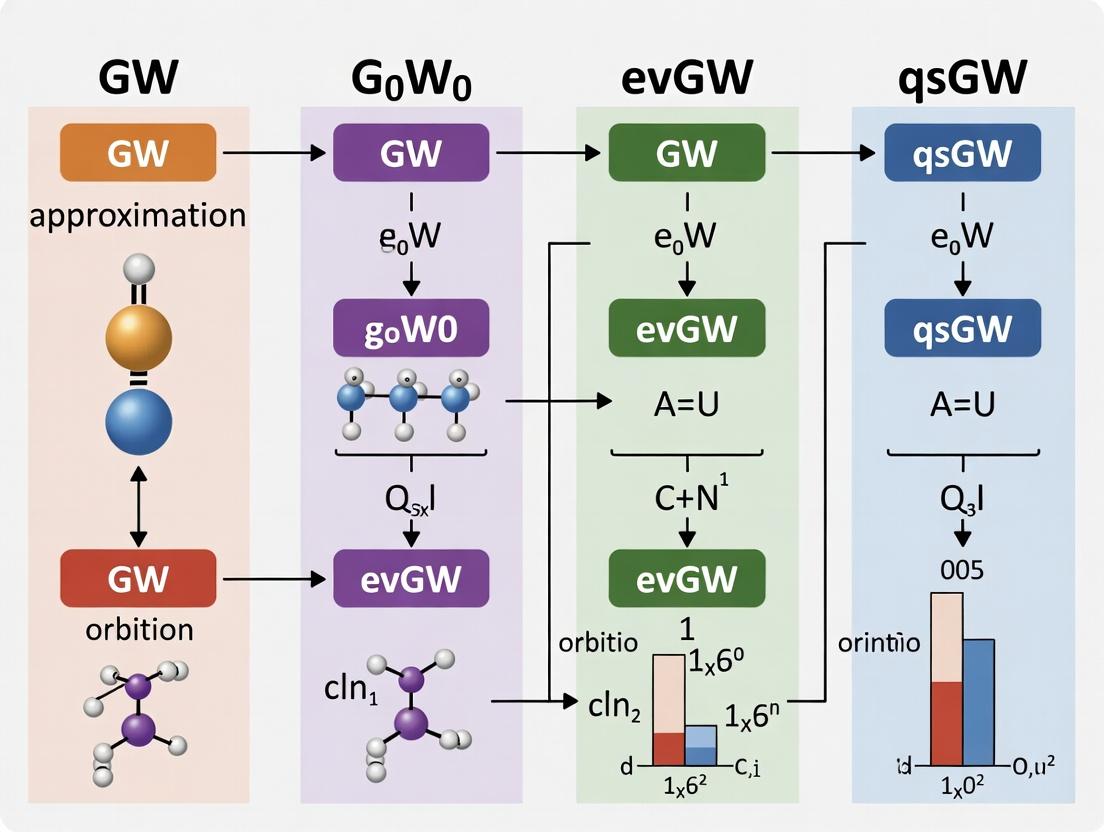
This article provides a comprehensive overview of the GW approximation for quasiparticle energy calculations, with a focus on comparing the different levels of self-consistency: G0W0, evGW, qsGW, and scGW.
GW Approximation Decoded: A Comprehensive Guide to G0W0, evGW, qsGW, and Self-Consistency for Materials Science
Abstract
This article provides a comprehensive overview of the GW approximation for quasiparticle energy calculations, with a focus on comparing the different levels of self-consistency: G0W0, evGW, qsGW, and scGW. Targeted at computational researchers, scientists, and materials discovery professionals, it covers foundational theory, practical implementation methodologies, common pitfalls and optimization strategies, and systematic validation and benchmarking. The article synthesizes the trade-offs between computational cost and accuracy, guiding readers in selecting the appropriate method for biomolecular systems, novel materials, and drug-relevant compounds.
Understanding GW Approximation: From Hedin's Equations to Quasiparticle Corrections
Technical Support Center
FAQ: Troubleshooting GW Calculations
Q1: My G0W0 calculation yields a band gap that is significantly overestimated compared to the experimental value. What are the primary culprits and solutions?
A1: This is a common issue. Please consult the troubleshooting table below.
| Potential Cause | Diagnostic Check | Recommended Solution |
|---|---|---|
| Insufficient Basis Set Size | Check convergence of gap with respect to number of empty states (NBANDS). | Systematically increase NBANDS. Use a two-step procedure: 1) DFT with moderate settings, 2) GW with high NBANDS from DFT wavefunctions. |
| Plasmon Pole Approximation Instability | Compare results using different plasmon pole models (e.g., Godby-Needs vs. Hybertsen-Louie). | Switch to a full-frequency integration method. This is more computationally expensive but avoids approximation errors. |
| Poor DFT Starting Point | Compare PBE vs. HSE06 starting points. HSE06 often provides a better initial guess. | Use a hybrid functional (e.g., HSE06) or evGW0 as your starting point for the GW calculation. |
| Lack of q-point Sampling | Test convergence with increasing k-point mesh, especially for 2D or defective systems. | Increase k-point density. Consider using non-uniform (gamma-centered) meshes for better convergence. |
Experimental Protocol: Protocol for Converging G0W0 Band Gaps
- DFT Pre-optimization: Perform a geometry optimization using PBE functional and a standard k-point mesh.
- DFT Single-Point: Run a static DFT calculation on the optimized structure using PBE and a dense k-point mesh. Save all orbitals.
- G0W0 Step: Initiate the GW calculation using the DFT wavefunctions. Start with a NBANDS value ~2-4 times the number of occupied bands.
- Convergence Loop: Incrementally increase NBANDS in subsequent G0W0 runs (keeping DFT fixed) until the band gap changes by less than 0.05 eV.
- Validation: If possible, repeat step 2-4 using an HSE06 starting point to assess sensitivity to initial functional.
Q2: When should I use self-consistent GW (evGW or qsGW) instead of one-shot G0W0?
A2: The choice depends on your material system and property of interest. See the comparison table.
| Method | Description | Best For | Computational Cost | Key Limitation |
|---|---|---|---|---|
| G0W0 | One-shot correction to DFT eigenvalues. | Standard semiconductors, insulators. Quick benchmark. | Low | Starting point dependence. May fail for strongly correlated systems. |
| evGW | Eigenvalue self-consistency. Updates quasiparticle energies in G and W. | Systems where charge neutrality is important. Improved fundamental gaps. | Medium | Breaks conservation laws. Physical meaning of updated eigenvalues is debated. |
| qsGW | Quasiparticle self-consistency. Updates both eigenvalues and wavefunctions. | Strongly correlated materials, transition metal oxides. Most theoretically rigorous for spectra. | Very High | Extremely expensive. Can overestimate gaps in some cases. |
Experimental Protocol: Protocol for evGW Self-Consistent Cycle
- Perform a standard G0W0 calculation to obtain the first set of quasiparticle energies EQP(1).
- Construct a new Green's function G(1) using EQP(1).
- Recompute the screened interaction W(1) using the updated polarizability from G(1).
- Solve the Dyson equation again with G(1) and W(1) to get EQP(2).
- Iterate steps 2-4 until EQP changes by less than a predefined threshold (e.g., 0.01 eV for valence/conduction band edges).
Q3: How do I handle GW calculations for molecular systems in a periodic boundary condition code?
A3: The key is to eliminate spurious periodic image interactions.
| Issue | Solution | Tool/Keyword Example |
|---|---|---|
| Image Coulomb Interaction | Use a truncated Coulomb potential or increase vacuum size. | LFCUTOPTION = truncation (VASP), large CELL size in ABINIT. |
| Slow k-point Convergence | Use Γ-point only sampling with sufficient vacuum. | KPOINTS file with only the gamma point. |
| Size Extensivity Error | Validate by scaling supercell size. Ensure total energy scales linearly with system size. | Test with 1x, 2x, and 3x the vacuum layer thickness. |
Visualizations
GW Self-Consistency Pathways Comparison
The Scientist's Toolkit: Research Reagent Solutions
| Item | Function in GW Calculations | Example/Note |
|---|---|---|
| DFT Code | Provides initial wavefunctions and eigenvalues. | VASP, Quantum ESPRESSO, ABINIT, FHI-aims. |
| GW Code | Performs the many-body perturbation theory calculation. | BerkeleyGW, VASP (GW), ABINIT, TURBOMOLE. |
| Plasmon Pole Model | Approximates the frequency dependence of W(ω) for efficiency. | Godby-Needs, Hybertsen-Louie. Use with caution for small gaps. |
| Full-Frequency Solver | Computes W(ω) on the real/imaginary axis without plasmon pole approximation. | More accurate, computationally intensive. Essential for delicate systems. |
| Coulomb Truncation | Removes spurious long-range interactions in low-dimensional systems. | Necessary for molecules, surfaces, 2D materials in periodic codes. |
| Self-Consistency Cycle Script | Automates iteration of evGW or qsGW steps. | Often a custom shell/Python script wrapping the GW and DFT codes. |
Hedin's Equations and the GW Approximation Derivation
Troubleshooting Guide & FAQs for GW Calculations in Electronic Structure Research
Q1: My G0W0 calculation yields a band gap that is still significantly underestimated compared to experiment. What are the primary culprits and solutions?
A: This is a common issue. The problem often lies in the starting point. The G0W0 result is sensitive to the underlying mean-field theory (usually DFT). Here are the main troubleshooting steps:
- Check Your DFT Starting Point: A PBE-DFT starting point typically yields underestimated gaps. Try a hybrid functional (e.g., PBE0, HSE06) as a starting point, which often improves the quasiparticle energies.
- Examine Basis Set Convergence: The GW method requires very large basis sets, especially for accurate unoccupied states. Perform a convergence test for the band gap versus the number of empty bands and the basis set size (e.g., plane-wave cutoff, Gaussian basis set cardinal number).
- Investigate the Frequency Integration: The approximation used for the frequency dependence of the dielectric function (e.g., plasmon-pole models vs. full-frequency integration) can impact results. Switch to a more accurate method if possible.
- Verify k-point Sampling: Ensure your Brillouin zone sampling is converged.
Q2: During an evGW self-consistent cycle, my calculation fails to converge or oscillates wildly. How can I stabilize it?
A: Divergence in evGW is a known challenge due to the update of the Green's function G.
- Implement Damping: Use a linear mixing scheme:
G_new = α * G_updated + (1-α) * G_old, where α is a mixing parameter (e.g., 0.2-0.5). Start with a low α. - Consider qsGW Instead: For systems where evGW is unstable, the quasiparticle self-consistent GW (qsGW) method provides a more robust alternative, as it uses a Hermitian, static potential.
- Check for Pathological Systems: Metallic systems or those with strong correlation may be inherently difficult for standard evGW. Diagnose your DFT starting point for possible issues.
Q3: When comparing G0W0, evGW, and qsGW results for my molecular system, how do I interpret the different band gap trends?
A: The trend depends on the system. Use this table as a diagnostic guide:
| Method | Typical Deviation from Experiment (for Molecular Ionization Potentials) | Computational Cost | Key Characteristic | Suitability |
|---|---|---|---|---|
| G0W0@PBE | Often underestimated by ~0.5-1.0 eV | Low | Starting point dependent. | Initial screening, larger systems. |
| G0W0@HF/hybrid | Closer to experiment, can be overestimated. | Low-Medium | Mitigates DFT starting point error. | Standard for many molecular solids. |
| evGW | Generally improves upon G0W0, more systematic. | High | Self-consistency in G. Can be unstable. | Small molecules, benchmark studies. |
| qsGW | Often slightly overestimates gaps but is very robust. | Very High | Self-consistent, Hermitian, non-empirical. | Definitive predictions, insensitive to starting point. |
Q4: What is the critical step in deriving the GW approximation from Hedin's equations, and what is the common pitfall in its interpretation?
A: The critical step is the first iteration of Hedin's coupled equations, starting from the Hartree approximation (Σ=0). The pitfall is misunderstanding the self-consistency implied. The GW approximation is defined as Σ = iGW, where W is the screened Coulomb interaction calculated from the non-interacting polarizability P0 = -iG0G0. This is the one-shot G0W0. Full self-consistency requires updating G and W simultaneously within this approximation, which is computationally demanding and not always beneficial.
Experimental & Computational Protocols
Protocol 1: Benchmarking GW Self-Consistency for Organic Semiconductor Molecules
Objective: Compare the first ionization potential (IP) and electron affinity (EA) of a test molecule (e.g., pentacene) using G0W0, evGW, and qsGW.
- Starting Geometry: Optimize molecular geometry using DFT (PBE/def2-TZVP).
- Mean-Field Calculations: Perform HF and PBE0 calculations with a large basis set (e.g., def2-QZVP) to generate initial orbitals and energies.
- G0W0 Setup: Launch G0W0 calculations using both PBE and PBE0 starting points. Key parameters: frequency integration method (e.g., contour deformation), number of unoccupied states (≥1000), and basis set for correlated calculations (auxiliary basis).
- evGW Setup: Start from G0W0@PBE0. Enable self-consistency on G. Set a damping factor (α=0.3). Convergence criterion: change in quasiparticle energies < 0.01 eV.
- qsGW Setup: Implement the qsGW cycle (available in codes like VASP, WEST). The self-consistent quasiparticle Hamiltonian is diagonalized iteratively until eigenvalues converge.
- Analysis: Tabulate IP/EA from all methods. Compare to experimental gas-phase UV photoemission data.
Protocol 2: Convergence Testing for GW Calculations in Solids
Objective: Establish converged parameters for a G0W0 calculation on silicon.
- Basis Set (Plane-Wave): Converge the static DFT calculation (lattice constant, band structure) with a plane-wave cutoff (e.g., 400 eV).
- Empty Bands: Perform a series of G0W0 calculations, increasing the number of empty bands (NBANDS). Monitor the direct band gap at Γ.
- k-point Grid: Repeat the converged G0W0 calculation with denser k-meshes (e.g., 4x4x4, 6x6x6, 8x8x8).
- Frequency Grid: Compare results from a plasmon-pole model to a full-frequency integration on a real/imaginary axis grid.
- Output: Create a convergence table. The parameter set where the band gap changes by < 0.05 eV is considered converged.
The Scientist's Toolkit: Key Research Reagent Solutions
| Item / Code Function | Role in GW Calculations | Notes |
|---|---|---|
| DFT Functional (PBE, PBE0, HSE06) | Provides the initial mean-field Green's function G0 and wavefunctions. | Choice critically affects G0W0. PBE0 often superior to PBE. |
| Basis Set (Plane-waves, Gaussian Type Orbitals) | Expands Kohn-Sham and quasiparticle wavefunctions. | Convergence in empty states is paramount. Augmented basis sets (e.g., aug-cc-pVXZ) needed for molecules. |
| Dielectric Screening Solver | Calculates the polarizability P0 and the screened Coulomb interaction W = ε⁻¹v. | Algorithms: Random Phase Approximation (RPA), direct inversion, iterative methods. Impacts speed/accuracy. |
| Frequency Integration Algorithm | Evaluates the convolution integral Σ = iG(ω)W(ω'). | Methods: Plasmon-pole models (fast, approximate), contour deformation (accurate), analytic continuation. |
| Self-Consistency Cycle Controller | Manages the update of G (evGW) or the effective Hamiltonian (qsGW). | Requires robust mixing algorithms (e.g., Pulay, Broyden) to ensure stability. |
Visualizations
Title: Derivation Path from Hedin's Equations to GW Flavors
Title: Computational Workflow for GW Self-Consistency Comparison
Troubleshooting Guides & FAQs
Q1: My GW calculation yields unphysical quasiparticle energies (e.g., severe overestimation of band gaps). What are the primary causes and fixes? A: This is often due to the starting mean-field solution (typically DFT with a semi-local functional like PBE). The inaccurate Kohn-Sham eigenvalues lead to a poor polarizability and self-energy.
- Troubleshooting Steps:
- Verify Starting Point: Run a
G0W0calculation starting from a hybrid functional (e.g., PBE0, HSE) or even Hartree-Fock. This often provides a better initial spectrum. - Check Convergence Parameters:
- Frequency Integration: Ensure the analytical continuation or contour deformation method is stable. Try switching methods or increasing the number of frequency points.
- Basis Set for Response: Drastically increase the number of empty states (or the plane-wave cutoff for the dielectric matrix) used to compute the polarizability. This is the most common critical convergence parameter.
- Consider Self-Consistency: If the problem persists, move to an eigenvalue-self-consistent
evGWscheme, which updates the Green's functionG, as this can correct the initial density error.
- Verify Starting Point: Run a
Q2: I observe multiple peaks or excessive broadening in my calculated spectral function. Is this physical or a numerical artifact?
A: It can be both. The spectral function A(ω) = |Im G(ω)|/π is directly determined by the self-energy Σ(ω).
- Troubleshooting Steps:
- Artifact Check: Ensure extreme numerical convergence of the frequency grid and the resolution of the identity (if applicable). Sparse sampling can cause "ghost" peaks.
- Physical Interpretation: If numerical parameters are sound, multiple peaks indicate strong quasiparticle-plasmon satellites or other many-body shake-up effects. A dominant peak with satellites is correct for systems with strong electron-boson coupling. Excessive broadening may imply a very short quasiparticle lifetime.
- Model Validation: Compute the self-energy on the real frequency axis (via analytical continuation) with great care, or use fully frequency-dependent methods to avoid pitfalls of plasmon-pole models.
Q3: When should I use evGW vs. qsGW in my research on molecular systems for drug development?
A: The choice impacts accuracy and computational cost for predicting ionization potentials (IPs), electron affinities (EAs), and excitation energies.
- Guidelines:
evGW(eigenvalue-only self-consistency): Updates only the eigenvalues inG. It is more stable than fullGWand improves uponG0W0for systems where the starting DFT density is poor. It is a good balance for organic molecules. However, it does not update orbitals or the density.qsGW(quasiparticle self-consistent GW): Constructs a Hermitian, energy-independent potential fromΣ. It updates both eigenvalues and eigenvectors, yielding the best agreement with experiment for fundamental gaps of many solids and molecules but is computationally demanding.
- Recommendation: For drug-sized molecules, start with well-converged
G0W0@PBE0. For final, high-accuracy IP/EA predictions on key pharmacophore fragments, useevGWorqsGWas a benchmark.
Q4: How do I quantitatively assess the "quality" of my quasiparticle from a GW calculation?
A: Evaluate two key metrics derived from the complex self-energy Σ(ω) = ReΣ(ω) + iImΣ(ω) at the quasiparticle energy E_QP:
1. Quasiparticle Weight (Z): Z = [1 - ∂ReΣ(ω)/∂ω|_{ω=E_QP}]^{-1}. A Z close to 1 indicates a well-defined, long-lived quasiparticle. A Z << 1 indicates strong correlation and a more incoherent excitation.
2. Lifetime: τ ∝ 1 / |ImΣ(E_QP)|. A large imaginary part signifies a short lifetime and broad spectral peak.
Table 1: Comparison of GW Methodologies for a Benchmark Set (Molecules/Solids)
| Method | Description | Computational Cost | Typical Accuracy (Fundamental Gap vs. Exp.) | Best For |
|---|---|---|---|---|
G0W0@PBE |
One-shot, starts from DFT-PBE | Low | Variable, often underestimates | Initial screening, large systems |
G0W0@PBE0 |
One-shot, starts from hybrid DFT | Moderate | Good for molecules | Standard for molecular IPs/EAs |
evGW |
Eigenvalue self-consistent | High | Very Good | Correcting starting point dependence |
qsGW |
Quasiparticle self-consistent | Very High | Excellent (often best) | Benchmark, sensitive correlated materials |
Table 2: Key Outputs & Their Physical Meaning
| Quantity | Mathematical Form | Physical Meaning | Direct Experimental Analog | ||
|---|---|---|---|---|---|
| Quasiparticle Energy | E_QP = ε_KS + ReΣ(E_QP) - v_XC |
Renormalized single-particle excitation energy | Photoemission (ARPES/IPES) peak position | ||
| Spectral Function | `A(ω) = π⁻¹ | Im G(ω) | ` | Density of single-particle excitations | Photoemission spectrum intensity |
Quasiparticle Weight Z |
Z = [1 - ∂ReΣ/∂ω]⁻¹ |
Pole strength of coherent excitation | Peak height in a resolved spectrum | ||
| Imaginary Self-Energy | ImΣ(ω) |
Inverse quasiparticle lifetime | Peak width in photoemission |
Experimental Protocols
Protocol 1: Standard G0W0 Calculation Workflow
- Mean-Field Ground State: Perform a converged DFT calculation (e.g., with PBE or PBE0 functional). Save the Kohn-Sham eigenvalues (
ε_KS), eigenvectors (ψ_KS), and density. - Polarizability Calculation: Compute the irreducible polarizability
P0 = -i G0 G0in a suitable basis (plane waves, Gaussian orbitals, etc.). Use the Adler-Wiser formula or its equivalent. - Dielectric Matrix & Screened Interaction: Compute the dielectric matrix
ε = 1 - v P0and its inverse. Then calculate the screened Coulomb interactionW0 = ε⁻¹ v. - Self-Energy Evaluation: Compute the correlation part of the self-energy
Σ_c = i G0 W0. This typically involves a convolution over frequency. Use a plasmon-pole model or direct frequency integration. - Quasiparticle Equation Solving: Solve the perturbative equation:
E_QP = ε_KS + <ψ_KS|ReΣ(E_QP) - v_XC|ψ_KS>. Solve iteratively forE_QP(usually via root-finding).
Protocol 2: evGW Self-Consistency Cycle
- Perform a standard
G0W0calculation as in Protocol 1. - Update Green's Function: Construct a new Green's function
Gusing the just-computedE_QP(keeping originalψ_KSor updating them if orbitals are to be updated). - Recalculate: With the new
G, recalculateP,W, andΣ. - Iterate: Repeat steps 2-3 until the change in
E_QPbetween cycles is below a set threshold (e.g., 1e-3 eV). - Output: Final converged quasiparticle energies and spectral functions.
Visualization
Title: G0W0 Calculation Flowchart
Title: From Self-Energy to Observable
The Scientist's Toolkit
Research Reagent Solutions for GW Calculations
| Item | Function in the "Experiment" |
|---|---|
| DFT Code (e.g., VASP, Quantum ESPRESSO) | Provides the initial mean-field ground state (Kohn-Sham orbitals and energies), the essential starting "reagent" for G0W0. |
| GW Code (e.g., BerkeleyGW, FHI-aims, VASP) | The core "assay kit" that computes the polarizability, screened interaction, and self-energy to yield quasiparticle properties. |
| Plasmon-Pole Model (e.g., Hybertsen-Louie) | An approximate analytical model for W(ω), reducing computational cost. A "simplifying reagent" that can introduce error. |
| Full Frequency Integration | The numerically exact method for treating W(ω). A "high-precision reagent" required for accurate spectral functions. |
| Analytical Continuation Tool | Extrapolates Σ(iω) from the imaginary to the real frequency axis. A necessary "processing reagent" to obtain spectral data comparable to experiment. |
| High-Performance Computing (HPC) Cluster | The "lab infrastructure." GW calculations are computationally intensive, requiring significant parallel CPU and memory resources. |
Technical Support Center
Troubleshooting Guides & FAQs
Q1: My G0W0 band gap is significantly overestimated compared to the experimental value. What could be the root cause stemming from the DFT starting point? A: This often originates from the well-known "band gap problem" of the underlying DFT functional. Using local or semi-local functionals (LDA, GGA) yields Kohn-Sham eigenvalues with underestimated gaps, which the perturbative G0W0 correction may overcompensate. Troubleshooting Steps:
- Verify the DFT functional: Check your initial calculation. A PBE starting point typically yields a larger G0W0 correction than a hybrid functional like PBE0.
- Analyze the eigenvalue spectrum: Compare the DFT valence band maximum (VBM) and conduction band minimum (CBM) orbital characters. Incorrect orbital ordering (e.g., due to self-interaction error) leads to poor starting points for GW.
- Protocol - Diagnostic Test: Rerun your DFT calculation with a screened hybrid functional (e.g., HSE06). Use these orbitals and eigenvalues as a new starting point for G0W0. A reduced deviation from experiment suggests the initial functional was the issue.
- Consider self-consistency: If the gap remains poor, evaluate moving to eigenvalue-self-consistent evGW or qsGW, which reduces starting point dependence.
Q2: How do I choose between G0W0, evGW, and qsGW for my system of molecules relevant to drug development? A: The choice depends on the desired accuracy, computational cost, and sensitivity of your property of interest (e.g., ionization potential, electron affinity, excitation energies) to the self-consistency level.
Table 1: Comparison of GW Approximation Levels
| Method | Self-Consistency | Computational Cost | Starting Point Dependence | Typical Use Case in Drug Development |
|---|---|---|---|---|
| G0W0 | None (1-shot) | Low | High | Initial screening, large systems. |
| evGW | Eigenvalues only | Moderate | Moderate | Accurate IPs/EA for medium molecules. |
| qsGW | Orbitals & Eigenvalues | High | Low | Benchmarking, sensitive charge transfer states. |
Q3: I get different quasiparticle energies when starting from different DFT functionals (PBE vs. PBE0). Which one is "correct" for evGW? A: In principle, a well-converged evGW or qsGW result should be independent of the starting point. Persistent differences indicate lack of convergence. Troubleshooting Steps:
- Protocol - Convergence Test: For a small test molecule (e.g., acene), run evGW starting from PBE and PBE0.
- Monitor the update loop: Track the change in the HOMO/LUMO eigenvalues in each evGW cycle.
- Criteria: The final evGW HOMO energy from both starting points should converge to within ~0.1 eV. If they diverge, increase the number of empty states and ensure the dielectric matrix is fully converged.
Q4: During qsGW calculation, the process fails due to numerical instability. What parameters should I check? A: qsGW involves solving a non-linear equation for the self-energy. Instabilities often arise from:
- Insufficient basis set: Particularly the polarization and diffuse functions for the auxiliary basis in resolving the Coulomb potential.
- Incomplete sum over states: Severely truncating the number of unoccupied orbitals leads to a poor representation of the self-energy operator.
- Protocol - Stabilization:
- Increase the size of the auxiliary basis set.
- Systematically increase the number of empty bands (e.g., to 2-3 times the number of occupied states).
- Use a robust mixing algorithm (e.g., DIIS) for updating the Green's function in the self-consistent cycle.
Visualization
Diagram 1: GW Methods Self-Consistency Flow
Diagram 2: DFT-to-GW Troubleshooting Pathway
The Scientist's Toolkit: Research Reagent Solutions
Table 2: Essential Computational Materials for GW Calculations
| Item / "Reagent" | Function & Purpose |
|---|---|
| Kohn-Sham Orbitals (DFT) | The fundamental starting wavefunctions. Quality dictates the stability and convergence speed of GW. |
| Kohn-Sham Eigenvalues | Initial guess for quasiparticle energies. Sets the zeroth-order energy spectrum. |
| Plane-Wave / Gaussian Basis Set | Basis for expanding wavefunctions. Must be saturated to minimize basis set error. |
| Auxiliary Basis Set | Used to expand the dielectric function and Coulomb potential in localized basis codes. Critical for accuracy. |
| Pseudopotentials / PAWs | Replace core electrons, reducing computational cost. Must be chosen for consistency between DFT and GW. |
| Dielectric Screening (W) | Models the screened Coulomb interaction. Its accurate calculation is central to the GW approximation. |
| Self-Energy Operator (Σ) | The key quantity containing exchange and correlation effects. Evaluated as iG0W0 in the first iteration. |
| Self-Consistent Loop Algorithm | (e.g., DIIS). Enables stable convergence of eigenvalues (evGW) or the Green's function (qsGW). |
FAQs & Troubleshooting Guide
Q1: My G0W0 calculation yields unphysical band gaps or eigenvalues that are highly sensitive to the starting DFT functional. What is the root cause and how can I mitigate this? A: This is a known "starting point dependence" issue. G0W0 results are perturbative corrections to the initial DFT eigenvalues. If the DFT starting point is qualitatively wrong (e.g., incorrect charge density), the G0W0 correction may not suffice. Mitigation Strategy: 1) Use a hybrid functional (e.g., PBE0, HSE06) as the DFT starting point to improve the initial wavefunctions and density. 2) Consider moving to an eigenvalue-self-consistent scheme (evGW) to reduce this dependence.
Q2: During an evGW or qsGW calculation, my calculation fails to converge or oscillates between values. How can I achieve convergence? A: Direct iteration of eigenvalues or the Green's function can lead to convergence issues due to nonlinearities. Troubleshooting Protocol: 1) Implement a linear mixing scheme with a small mixing parameter (e.g., 0.2-0.3) for the updated eigenvalues/Green's function. 2) For severe oscillations, use damping or more advanced algorithms (e.g., Broyden mixing). 3) Check that your basis set (especially the polarizability basis) is sufficiently complete to avoid numerical instabilities.
Q3: What is the practical computational cost difference between qsGW and full scGW, and when is full scGW necessary? A: Full scGW, which self-consistently updates both the Green's function G and the screened potential W, is significantly more expensive than qsGW. qsGW updates only G (and the eigenvalues within it) while keeping W fixed at the RPA level from the starting density. Full scGW often requires an order of magnitude more computational time and resources. It is generally necessary only for systems with strong satellite features or where the screening is expected to change dramatically from the DFT prediction. For most accurate quasiparticle band structures, qsGW is considered the best compromise.
Q4: How do I choose an appropriate basis set for the polarizability and self-energy calculations in all these methods? A: The choice is critical for accuracy and efficiency. Guidelines: 1) For the polarizability (W), use a specialized response function basis (e.g., "PAW" auxiliary basis in VASP, "RI" basis in FHI-aims, "CD" in BerkeleyGW) to expand products of orbitals. 2) Ensure this basis is saturated; many codes provide convergence tests. 3) For the self-energy, the same orbital basis as DFT is typically used, but its completeness (high-energy unoccupied states) must be checked via explicit convergence in the number of bands.
Comparison of GW Approximation Levels
| Method | Self-Consistency Cycle | Typical Computational Cost | Key Strength | Primary Weakness | Best For |
|---|---|---|---|---|---|
| One-Shot G0W0 | None. Single correction Σ(iG0W0) to DFT. | 1x (Reference) | Low cost, good for standard semiconductors. | Strong starting-point (DFT) dependence. | Initial screening of materials with moderate correlation. |
| evGW | Eigenvalues in G are updated iteratively until consistency. | 5-10x G0W0 | Reduces DFT starting point dependence. | Does not update wavefunctions, potentially incomplete. | More accurate band gaps without full qsGW cost. |
| qsGW | Eigenvalues and wavefunctions in G updated. W fixed at DFT-RPA level. | 10-50x G0W0 | Excellent band gaps, satisfies Ward identity. | High cost, W not updated. | Benchmark-quality band structures for solids & molecules. |
| Full scGW | Both G and W updated to self-consistency. | 50-200x G0W0 | Most theoretically rigorous, includes screening feedback. | Extremely high cost, complex convergence. | Fundamental studies of spectral functions and satellites. |
Experimental Protocol: qsGW Calculation Workflow
- Initial DFT Calculation: Perform a well-converged DFT calculation using a functional like PBE. Ensure dense k-point sampling and a high plane-wave cutoff (or equivalent basis set quality). Save the wavefunctions and charge density.
- Polarizability Basis Convergence: Using the DFT ground state, perform a standalone G0W0 calculation while increasing the size of the auxiliary basis set for the polarizability until the band gap changes by less than 0.05 eV. Record the required basis set parameters.
- Static G0W0: Run a one-shot G0W0 calculation to establish a baseline. This also generates the initial W.
- qsGW Self-Consistency Loop: a. Construct the Green's function G from the current eigenvalues and wavefunctions. b. Compute the self-energy Σ = iGW. (W is held fixed from the initial DFT-RPA calculation in standard qsGW). c. Solve the quasiparticle equation to obtain new eigenvalues (and optionally update wavefunctions via diagonalization of the hermitized self-energy operator). d. Apply a linear mixing scheme: ε_new = (1-α) * ε_old + α * ε_QP. e. Check convergence of the fundamental band gap and total quasiparticle energy. Typical convergence criteria: ΔGap < 1e-3 eV.
- Post-Processing: Once converged, calculate the band structure by interpolating the final qsGW Hamiltonian.
Visualizations
Diagram Title: Self-Consistency Hierarchy in GW Methods
Diagram Title: qsGW Self-Consistent Cycle Workflow
The Scientist's Toolkit: Key Research Reagent Solutions
| Item / Software | Function in GW Calculations | Key Consideration |
|---|---|---|
| DFT Code (VASP, FHI-aims, Quantum ESPRESSO) | Provides initial wavefunctions, eigenvalues, and charge density. | Choice of exchange-correlation functional (PBE vs. hybrid) impacts starting point. |
| GW Code (BerkeleyGW, VASP, FHI-aims, WEST) | Performs the core GW calculation: computes polarizability, screened potential W, and self-energy Σ. | Must be compatible with your DFT code. Basis set types (plane-wave vs. local) differ. |
| Auxiliary Basis Set | Expands products of orbitals for efficient computation of polarizability and W. | Saturation is critical for accuracy. Often the "c-DK" or "RI" basis. Must be converged. |
| High-Performance Computing (HPC) Cluster | GW calculations are massively parallelizable but require significant memory and CPU hours. | qsGW/scGW require many iterations; queue time and cost can be substantial. |
| Linear Mixing / Damping Algorithm | Stabilizes the self-consistency cycle for evGW/qsGW/scGW. | Prevents oscillatory divergence. Mixing parameter (0.1-0.3) often needs tuning. |
| Band Structure Plotting Tool | Visualizes final quasiparticle bands (e.g., sumo, pymatgen). | Important for comparing with experimental ARPES data. |
Implementing GW Methods: Practical Steps for Biomolecular and Materials Systems
Diagram Title: Standard G0W0 Calculation Workflow
Troubleshooting Guides & FAQs
Q1: My G0W0 band gap is significantly overestimated compared to experiment. What are the most common causes? A: This is often due to basis set incompleteness, particularly in the dielectric screening. Ensure your auxiliary basis for representing the dielectric function (e.g., RI basis in VASP, auxiliary basis in MolGW) is sufficiently large. The use of the "GW" flavor of Gaussian-type orbitals (e.g., cc-pVTZ, def2-TZVP) is critical, as standard DFT-optimized basis sets lack high-energy orbitals needed to describe excited states and screening.
Q2: The calculation fails with a "not converged in frequency" error. How do I address this?
A: This points to an issue in the frequency integration for the self-energy. Increase the number of frequency grid points (e.g., NOMEGA or equivalent in your code). For codes using analytic continuation, try switching to a contour deformation (CD) method if available, as it is often more stable. Also, verify that your initial DFT band structure does not have pathological degeneracies at the Fermi level.
Q3: How do I choose between plasmon-pole models and full-frequency integration? A: For high-throughput screening, a well-tested plasmon-pole approximation (PPA) like Godby-Needs or Hybertsen-Louie is often sufficient for band gaps and saves computational cost. For accurate spectral properties or systems with strong satellite features, full-frequency integration on a complex contour (Godfrey-Lee) is mandatory. See the parameter table below.
Q4: My G0W0 calculation is computationally prohibitive for my 200-atom system. What are the key acceleration techniques? A: Implement the following:
- Spectral Decomposition: Use
ALGO = EVGW0in VASP or equivalent spectral decomposition in other codes. - Low-Rank Approximation: Employ the low-rank decomposition of the dielectric matrix (e.g.,
LOW_RANKin BerkeleyGW). - Truncated Coulomb: Use the Wigner-Seitz truncation for isolated molecules or 2D materials.
- k-point Reduction: Start from a well-converged, coarse k-grid DFT calculation and interpolate using methods like Wannier interpolation.
Experimental Protocols & Parameters
Protocol 1: G0W0 Calculation for Molecular Systems (using MolGW/FHI-aims)
- Initial DFT: Perform a PBE/def2-TZVP calculation with a tight SCF convergence (
1e-7 eV). Use a large integration grid. - Basis for GW: Employ the def2-QZVP Gauge-including Atomic Orbital (GIA) basis for the quasiparticle states. For the polarizability (screening), use a specifically optimized auxiliary basis (e.g.,
def2-universal-JKFIT). - Self-Energy: Use the resolution-of-identity (RI) for Coulomb integrals. Choose full-frequency integration with an analytical contour of 48 points.
- Core Treatment: Treat core electrons using the frozen-core approximation (default).
- Post-Processing: Extract the HOMO and LUMO energies. Apply an analytical scissors operator if comparing to optical spectra.
Protocol 2: G0W0 Calculation for Periodic Solids (using VASP)
- DFT Precursor: Run a standard PBE calculation with a
ENCUTof 1.3x the maximum ENMAX on the POTCAR file. Use a k-grid converged to within 10 meV. - GW Parameters: Set
ALGO = EVGW0. SetENCUTGWto 0.6-0.8 *ENCUT. ForNOMEGA, start with 48. UseLSPECTRAL = .TRUE.for efficiency. - Screening: Set
LOPTICS = .TRUE.in the preceding DFT run to generate a finer k-mesh for the dielectric function. - Band Extraction: Use the
QPflag inINCARto specify which bands to correct. Always include at least 5 bands above and below the Fermi level.
Parameter & Basis Set Comparison Tables
Table 1: Recommended G0W0 Parameters for Common Codes
| Code | Frequency Integration Key Parameter | Typical Value | Basis Set Dependency | Recommended for System Type |
|---|---|---|---|---|
| VASP | NOMEGA |
48 - 96 | Plane-wave energy cutoff (ENCUTGW) |
Bulk Solids, 2D Materials |
| BerkeleyGW | number_freq_pts |
100 - 200 | Plane-wave cutoffs ecuteps, ecutsigx |
Nanostructures, Bulk |
| FHI-aims | anacon_type |
0 (Full) / 1 (PPA) | Tier NAO basis + auxiliary basis | Molecules, Clusters |
| MolGW | nomega |
50 - 100 | Gaussian basis (e.g., cc-pVTZ) + RI basis | Small Molecules |
| Yambo | BndsRnXp |
1 - 200 | G-vectors NGsBlkXp |
Solids, Surfaces |
Table 2: Basis Set Convergence for G0W0 HOMO-LUMO Gap of Benzene (in eV)
| Basis Set (Orbital/Auxiliary) | PBE Gap | G0W0@PBE Gap | Δ Gap (G0W0 - Exp) | Approx. Cost Factor |
|---|---|---|---|---|
| def2-SVP / def2-SVP-RI | 6.15 | 9.05 | +1.20 | 1.0 (Ref) |
| def2-TZVP / def2-TZVP-RI | 6.10 | 8.45 | +0.60 | 3.5 |
| def2-QZVP / def2-QZVP-RI | 6.08 | 8.25 | +0.40 | 12.0 |
| cc-pVDZ / cc-pVDZ-RI | 6.20 | 9.10 | +1.25 | 1.2 |
| cc-pVTZ / cc-pVTZ-RI | 6.12 | 8.40 | +0.55 | 4.0 |
| Experimental Reference | ~7.85 |
The Scientist's Toolkit: Research Reagent Solutions
Table 3: Essential Computational Materials for G0W0 Calculations
| Item / "Reagent" | Function in "Experiment" | Example/Note |
|---|---|---|
| Pseudopotential/PAW Dataset | Defines core-valence interaction. Critical for plane-wave codes. | Use GW-optimized potentials where available (e.g., VASP's GW PAW sets). |
| Orbital Basis Set | Expands quasiparticle wavefunctions. Must be diffuse and large. | Gaussian: cc-pVnZ, def2 series. NAO: tier+aug in FHI-aims. |
| Auxiliary / RI Basis | Expands density response (χ) and screened potential (W). Key for accuracy. | JKFIT, RI-C, cbas files specific to the orbital basis. |
| k-point Grid | Samples the Brillouin Zone. Convergence is non-monotonic in GW. | A denser grid is needed for χ than for G. Often 2-4x denser. |
| Frequency Grid | Samples the energy/ω axis for integrating Σ. Affects stability. | Analytic continuation (Pade´) or contour deformation grids. |
| Energy Cutoff (Plane Waves) | Controls basis size for wavefunctions (ENCUT) and screening (ENCUTGW). |
ENCUTGW is typically 0.6-0.8 * ENCUT to reduce cost. |
Diagram Title: G0W0 Accuracy vs. Cost Trade-offs
Thesis Context Integration FAQs
Q5: Within a thesis comparing GW flavors, where does G0W0 typically serve as the baseline? A: G0W0 is the universal non-self-consistent starting point. In a comparison thesis, its results (typically using PBE starting points) establish the "one-shot" correction benchmark. The deviation of evGW (eigenvalue self-consistent) and qsGW (quasiparticle self-consistent) results from G0W0 directly quantifies the impact of self-consistency on band gaps, band widths, and total energies, which is a central thesis research question.
Q6: How should I document my G0W0 protocol for reproducibility in a thesis? A: For each system, document: 1) DFT Precursor: Functional, basis/cutoff, k-grid, total energy convergence. 2) GW Parameters: Code & version, basis for orbitals and screening, frequency method, number of empty states, exact k-grid used for χ and Σ. 3) Validation: Benchmark against a known system (e.g., Si band gap, benzene ionization potential). Present this in a structured appendix matching the tables above.
Troubleshooting Guides and FAQs
Common Convergence Issues
Q1: My evGW calculation oscillates and fails to converge. What are the primary causes and solutions? A1: Oscillations in the eigenvalue-only self-consistent (evGW) loop are often due to an aggressive update mixing parameter. The eigenvalue update Σ(ω) → ε_i^new can overshoot.
- Solution: Implement a linear mixing scheme with a reduced mixing parameter (α). Start with α=0.3 and increase gradually. Use the Direct Inversion in the Iterative Subspace (DIIS) technique to accelerate convergence and damp oscillations by extrapolating from previous iterations.
- Protocol: After each GW cycle, store the vector of quasiparticle energies εi^(n). For DIIS, construct the error vector as e^(n) = εi^(n) - ε_i^(n-1). Build a DIIS matrix and find optimal coefficients to combine previous iterations for the next input.
Q2: In qsGW, the computational cost per iteration is very high. How can I optimize this? A2: The quasiparticle-self-consistent (qsGW) method requires constructing a hermitian self-energy Σ^herm and diagonalizing it to update the Green's function G fully, which is costly.
- Solution: Use a downfolding technique to the occupied/unoccupied subspace near the Fermi level if the system has a large gap. Employ natural orbital basis sets from a preceding DFT calculation to reduce the size of the effective Hamiltonian matrix that needs diagonalization in each loop.
- Protocol: 1) Perform a standard DFT calculation. 2) Generate natural orbitals by diagonalizing the density matrix. 3) Transform the initial Hamiltonian to this truncated orbital basis. 4) Run the qsGW loop in this reduced basis, transforming back for final analysis.
Q3: How do I diagnose if a calculation is converging to a physically correct versus a spurious solution? A3: Spurious solutions may arise from symmetry breaking or incorrect pole treatment in the self-energy.
- Solution: Monitor key invariants each iteration: total spectral weight, particle number, and symmetry representations of orbitals. Compare the density of states (DOS) at iteration n with n-1 using a root-mean-square difference metric.
- Protocol: At each qsGW step, calculate the total particle number via Tr[G(τ=-0^+)]. Track the change in fundamental gap (or HOMO-LUMO gap) and the orbital ordering. A sudden, large shift in ordering or gap may indicate a switch to a different solution branch.
Q4: What are the best convergence criteria for the evGW and qsGW loops? A4: A combined criterion based on energy changes and wavefunction stability is recommended.
- Criteria:
- Quasiparticle Energy Change: Max|εi^(n) - εi^(n-1)| < 0.001 eV for all relevant states (e.g., frontier orbitals).
- Diagonal Self-Energy Change: RMS(Re[Σii^(n)(εi^n)] - Re[Σii^(n-1)(εi^(n-1))]) < 0.01 eV.
- (For qsGW) Density Matrix Change: Frobenius norm of the density matrix difference ||P^(n) - P^(n-1)|| < 10^-5.
Numerical Stability and Precision
Q5: My GW calculation produces unphysical peaks (spikes) in the spectral function. How do I resolve this? A5: This is often caused by numerical instabilities in the frequency integration or the analytic continuation process.
- Solution: Increase the number of frequency points, especially in regions near singularities. For contour deformation, ensure a sufficient density of points along the imaginary axis. Consider using the fully analytic continuation method (e.g., Padé approximants) with care to avoid overfitting noise.
- Protocol: For a contour deformation approach, use at least 200 points on the imaginary axis segment. The real axis integration should have an adaptive grid, denser near the Fermi level. Validate by checking if Σ(ω) satisfies the Kramers-Kronig relations.
Q6: Which is more critical for stable qsGW convergence: the starting point (DFT functional) or the basis set? A6: Both are critical, but the starting point has a more pronounced effect on the convergence path, while the basis set affects the final limit.
- Guideline: A PBE or PBE0 starting point is typically more robust than Hartree-Fock for molecular systems. Use a well-tuned, correlation-consistent basis set (e.g., def2-QZVP with matching auxiliary basis for resolution-of-identity). A poor starting point can lead to charge sloshing and require extreme damping.
Data Presentation: Convergence Metrics Comparison
Table 1: Typical Convergence Metrics for evGW and qsGW on a Test System (Benzene Molecule)
| Metric | evGW (Converged) | qsGW (Converged) | Notes |
|---|---|---|---|
| Iterations to Convergence | 15-25 | 30-50 | qsGW requires more cycles due to full Green's function update. |
| CPU Time per Iteration | 1.0 (Relative) | 2.5 - 3.5 (Relative) | qsGW cost is higher due to Hamiltonian reconstruction/diagonalization. |
| Final Fundamental Gap (eV) | 10.2 ± 0.1 | 10.8 ± 0.1 | qsGW gap is typically 0.5-1.0 eV larger than evGW. |
| Max Orbital Energy Change (Criterion) | < 1 meV | < 1 meV | Standard strict threshold. |
| Typical Damping Parameter (α) | 0.2 - 0.5 | 0.05 - 0.2 | qsGW requires much lighter damping. |
Table 2: Recommended Algorithmic Settings for Stable Convergence
| Parameter | evGW | qsGW | Purpose | ||||
|---|---|---|---|---|---|---|---|
| Update Mixing | DIIS (history=5-7) | Linear Mixing (α=0.1) then DIIS | Prevents oscillation in early qsGW steps. | ||||
| Frequency Grid | 256 pts, logarithmic | 512 pts, logarithmic | Ensures accurate integration for full G update. | ||||
| Basis Set | def2-TZVP + RI | def2-QZVP + RI | Balances accuracy and cost for proof-of-concept. | ||||
| Starting Point | PBE0 | PBE or PBE0 | Provides stable initial orbitals and density. | ||||
| Convergence Criterion | ΔE < 1meV, ΔΣ < 10meV | ΔE < 1meV, | ΔP | < 1e-5 | Ensures both energies and density matrix are stable. |
Experimental Protocols
Protocol 1: Standard evGW Self-Consistency Loop
- Initialization: Perform a DFT (e.g., PBE0) calculation to obtain initial eigenvalues {εi^DFT} and orbitals {φi^DFT}.
- Build G0: Construct the non-interacting Green's function G0(ω) using {εi^DFT} and {φi^DFT}.
- GW Step: Calculate the polarizability Π0 = -i G0 G0. Compute the screened Coulomb interaction W0(ω) = v + v Π0(ω) v. Construct the self-energy Σ(ω) = i G0 W0.
- Eigenvalue Update: Solve the quasiparticle equation for new energies: εi^new = εi^DFT + Zi * Re⟨φi| Σ(εi^new) - vxc^DFT |φi⟩, where Zi is the renormalization factor.
- Mixing & Check: Mix εi^new with previous energies using a DIIS algorithm. Check convergence against criteria (Table 2). If not converged, set {εi^DFT} = mixed energies and return to Step 3, using the same initial orbitals.
Protocol 2: Standard qsGW Self-Consistency Loop
- Initialization: Perform a DFT (e.g., PBE) calculation to obtain initial Hamiltonian H0, density matrix P0, and orbitals.
- Build G: Construct the interacting Green's function G(ω) from the current Hamiltonian.
- GW Step: Calculate polarizability Π(ω) = -i G(ω) G(ω). Compute W(ω) = v + v Π(ω) v. Construct the self-energy Σ(ω) = i G(ω) W(ω).
- Hermitization & Update: Construct a hermitian self-energy approximation: Σ^herm = (Σ(εi) + Σ†(εi))/2. Update the effective Hamiltonian: H^new = H0 + Σ^herm - v_xc^DFT.
- Diagonalization: Diagonalize H^new to obtain new orbitals and a new density matrix P^new.
- Mixing & Check: Mix H^new or P^new with previous iterations using light linear mixing (α~0.1). Check convergence against energy and density matrix criteria. If not converged, return to Step 2 with the updated Hamiltonian/orbitals.
Visualizations
Title: evGW Self-Consistency Loop Workflow
Title: qsGW Self-Consistency Loop Workflow
Title: evGW vs qsGW Conceptual Comparison
The Scientist's Toolkit: Key Research Reagent Solutions
Table 3: Essential Computational Components for GW Self-Consistency Studies
| Item/Category | Function & Purpose | Example/Note |
|---|---|---|
| Quantum Chemistry Code | Provides core DFT, integral, and SCF infrastructure. Essential for running GW steps. | FHI-aims, VASP, WEST, MolGW, BerkeleyGW. Must have post-DFT GW capability. |
| GW Implementation Module | Computes polarization, screened interaction W, and self-energy Σ. The core "reagent". | In-house or packaged modules (e.g., FHI-aims' gw, VASP's LRPA). Accuracy depends on frequency treatment. |
| Auxiliary Basis Set | Used in Resolution-of-Identity (RI) to decompose four-center integrals, drastically reducing cost. | optRI, RI-v, cbas basis sets. Must be matched to the primary orbital basis. |
| DIIS Library/Algorithm | Extrapolates solution vectors to accelerate convergence and stabilize oscillatory cycles. | Critical for evGW. Standard numerical library or custom implementation for energy/vector mixing. |
| Analytic Continuation Tool | Obtains Σ(ω) on the real frequency axis from calculations on the imaginary axis. | Padé approximants, Nevanlinna continuation methods. Key for spectral function accuracy. |
| Convergence Monitor Script | Tracks changes in energies, density matrix, and spectral moments across iterations. | Custom Python/Shell scripts to parse output files and plot convergence metrics in real-time. |
| High-Performance Computing (HPC) Resources | Provides the necessary CPU/GPU hours and memory for the computationally intensive qsGW loops. | Clusters with high interconnect speed, large memory nodes (~512GB+ for medium systems). |
Technical Support Center: Troubleshooting GW Calculations for Drug Molecules
This support center addresses common issues encountered when applying GW methods (G0W0, evGW, qsGW) to calculate ionization potentials (IPs) and electron affinities (EAs) for drug-like molecules within the context of research comparing self-consistency levels.
FAQs & Troubleshooting Guides
Q1: My G0W0@PBE0 IPs for large drug molecules are systematically underestimated compared to experimental photoemission data. What is the likely cause and solution?
A: This is a known starting-point dependency. G0W0 results are sensitive to the initial DFT functional. PBE0 often underestimates the HOMO-LUMO gap, propagating error to the quasiparticle energy.
- Troubleshooting: Use a hybrid functional with a higher exact exchange admixture (e.g., PBE0 with 40-50% HF, or ωB97X-D) as your starting point. For higher accuracy, move to a self-consistent scheme.
- Protocol: 1. Optimize geometry with a robust functional (e.g., B3LYP-D3(BJ)/def2-TZVP). 2. Perform a single-point DFT calculation with PBE0(40%)/def2-QZVP. 3. Launch the G0W0 calculation on this reference. 4. Compare the HOMO quasiparticle energy (IP) to evGW and qsGW benchmarks.
Q2: When running evGW calculations, my quasiparticle energies oscillate or fail to converge. How can I stabilize the cycle?
A: Oscillation indicates instability in the self-consistent update of the eigenvalues.
- Troubleshooting: Implement a linear mixing or damped update scheme for the eigenvalues between iterations. A typical damping parameter is 0.2-0.5.
- Protocol: In your computational setup, ensure the following flags (example for a typical code):
SCF_TYPE = EVGW
MAX_ITER = 100
MIXING = 0.3
CONV_TOL = 0.001 eV
Q3: For which drug-relevant properties is the computational cost of qsGW justified over evGW or G0W0?
A: qsGW is justified when you require the most accurate, physically rigorous, and parameter-free fundamental gap, which is critical for:
- Predicting precise redox potentials in complex biological environments.
- Studying charge transfer states in drug-protein complexes.
- Providing benchmark data for machine learning models. For initial screening or trend analysis, G0W0 or evGW may be sufficient.
Q4: My calculation of Electron Affinity (EA) yields a positive quasiparticle energy for the LUMO, suggesting instability. What does this mean?
A: A positive LUMO quasiparticle energy in the gas phase indicates the molecule does not bind an extra electron spontaneously; its EA (by DFT/Koopmans' definition: EA = -E_LUMO) is negative. This is chemically meaningful and relevant for predicting whether a drug molecule can act as an electron acceptor in biological redox processes.
Quantitative Data Comparison: GW Methods for a Model Drug Fragment (e.g., Acetylacetone)
Table 1: Calculated Ionization Potential (IP) and Electron Affinity (EA) for a Benchmark Molecule (values in eV, illustrative).
| Method / Functional | IP (Vertical) | EA (Vertical) | Fundamental Gap | Typical CPU Time (Rel.) |
|---|---|---|---|---|
| DFT-PBE0 | 9.10 | -0.35 | 9.45 | 1x |
| G0W0@PBE0 | 9.85 | 0.55 | 9.30 | 10x |
| evGW@PBE0 | 10.05 | 0.70 | 9.35 | 30x |
| qsGW | 10.20 | 0.80 | 9.40 | 100x |
| Experiment | 10.10 ± 0.10 | 0.75 ± 0.15 | 9.35 ± 0.25 | - |
Experimental/Computational Protocols
Protocol 1: Benchmarking IP/EA Using a qsGW Workflow
- Geometry: Obtain a crystallographic or DFT-optimized structure (B3LYP-D3/def2-TZVP level in solvent continuum).
- Baseline DFT: Perform a single-point calculation with a modest basis set (def2-SVP) and a hybrid functional (PBE0). Store wavefunction.
- qsGW Setup: Initiate qsGW using the DFT result as an initial guess. Use a tiered basis set approach (e.g., def2-TZVP for occupied, def2-QZVP for virtual spaces). Set convergence tolerance to 1e-5 Ha for the Green's function.
- Analysis: Extract the quasiparticle energies from the diagonal of the converged self-energy matrix. The IP = -EHOMO(QP), EA = -ELUMO(QP).
Protocol 2: Troubleshooting Convergence in evGW
- Run a standard G0W0 calculation to obtain initial quasiparticle energies.
- Begin the evGW cycle with a strong damping (mixing = 0.5).
- Monitor the change in the HOMO energy. If oscillation amplitude increases, reduce the mixing parameter by 0.1.
- Once stable for 5 iterations, gradually increase mixing to 0.7 to accelerate convergence to the final tolerance.
Visualizations
Diagram Title: Self-Consistency Pathways in GW Methods for IP/EA
Diagram Title: Troubleshooting Guide for GW Calculation Accuracy
The Scientist's Toolkit: Research Reagent Solutions
Table 2: Essential Computational Tools for GW Drug Discovery Research
| Item / "Reagent" | Function in the "Experiment" | Example / Note |
|---|---|---|
| Quantum Chemistry Code | Engine for performing DFT and post-DFT GW calculations. | FHI-aims, VASP, CP2K, WEST, MolGW. |
| Auxiliary Basis Set | Expands the dielectric function and screened Coulomb potential (W), critical for accuracy and speed. | def2 auxiliary sets (for Gaussian bases), Projector-Augmented Waves (for plane waves). |
| Hybrid DFT Functional | Provides the initial wavefunction and orbital energies for G0W0 and evGW. | PBE0, ωB97X-D, SCAN0. Adjustable HF% is key. |
| Correlation-Consistent Basis | High-quality one-electron basis sets to converge quasiparticle energies to within ~0.1 eV. | cc-pVTZ, cc-pVQZ, or def2-TZVP, def2-QZVP for molecules. |
| Eigenvalue Solver | Solves the quasiparticle equation iteratively. A robust solver is needed for ill-conditioned systems. | Direct diagonalization, iterative subspace methods (Davidson). |
| Analytical Continuation Tool | Handles the frequency dependence of the self-energy Σ(ω) when using plasmon-pole models is insufficient. | Padé approximants, contour deformation integration. |
Technical Support Center: GW Method Calculations for Materials Science
Frequently Asked Questions (FAQs)
Q1: My G₀W₀ calculation yields a band gap that is significantly larger than the experimental value for a known semiconductor. What are the primary causes and solutions?
A1: This overestimation is a known issue. Primary causes and remedies include:
- Cause 1: The starting point dependence (DFT functional used, e.g., PBE vs. HSE). Solution: Use a hybrid functional (e.g., HSE06) as the DFT starting point to improve the quasiparticle energies.
- Cause 2: Insufficient plane-wave energy cutoff or k-point sampling. Solution: Converge the dielectric matrix (
Ecut/ENCUTGW) and increase k-point density systematically. - Cause 3: Lack of self-consistency in eigenvalues. Solution: Consider moving to an evGW or qsGW scheme, which updates the eigenvalues in the Green's function G.
Q2: When should I use evGW vs. qsGW for my system?
A2: The choice depends on system properties and computational resources.
- Use evGW (eigenvalue-only self-consistency) for systems where the DFT wavefunctions are considered reliable (e.g., many bulk semiconductors). It is computationally less expensive than qsGW and corrects the band gap effectively.
- Use qsGW (quasiparticle self-consistent GW) for systems with strong self-interaction errors or where wavefunctions are poor, such as transition metal oxides, certain perovskites, or low-dimensional materials. It provides a more fundamental correction but is computationally intensive.
Q3: My GW calculation for a 2D material (e.g., monolayer MoS₂) does not converge with vacuum layer size. How do I handle this?
A3: This is due to the slow decay of the Coulomb interaction in low dimensions. You must:
- Employ a truncation technique (e.g., RPA or Wigner-Seitz truncation) specific to your code (VASP, BerkeleyGW, etc.).
- Systematically increase the vacuum size while using truncation and monitor the band gap.
- Use the extrapolation technique outlined in the protocol below.
Q4: How do I interpret the spectral function (imaginary part of G) from a GW calculation for drug-relevant molecules on surfaces?
A4: The spectral function A(ω) represents the density of states accessible by photoemission.
- Peaks correspond to quasiparticle energies (e.g., HOMO, LUMO levels).
- Peak broadening indicates the quasiparticle lifetime.
- For molecule-surface systems, compare the spectral function of the isolated molecule, clean surface, and combined system to identify charge transfer states, hybridization, and interface energy level alignment—critical for understanding sensor or catalytic functionality.
Troubleshooting Guides
Issue: Poor Convergence of Fundamental Band Gap with k-points Symptoms: Band gap oscillates by > 0.1 eV with increasing k-grid. Diagnostic Steps:
- Perform DFT convergence with a dense k-grid as a baseline.
- Run single-shot G₀W₀ on a series of k-grids (e.g., 4x4x4, 6x6x6, 8x8x8).
- Plot band gap vs. 1/(k-points). Solution: Extrapolate to the infinite k-point limit. Use a k-grid where the change is < 0.05 eV.
Issue: "Nearly singular dielectric matrix" warning in BerkeleyGW or similar. Symptoms: Calculation crashes or produces nonsensical results. Diagnostic Steps: This often occurs in large, metallic, or low-dimensional systems. Solution:
- Increase the energy cutoff for the dielectric matrix (
Ecut). - If persisting, use a small numerical regularization parameter (e.g.,
etaordegauss~ 0.001-0.01 eV) in the dielectric calculation to aid inversion.
Experimental & Computational Protocols
Protocol 1: Systematic Convergence for GW Calculations
- DFT Pre-optimization: Optimize geometry using PBE. Use a high plane-wave cutoff and k-point grid.
- DFT Starting Point: Calculate ground-state wavefunctions with a hybrid functional (HSE06) or PBE.
- Static DFT Analysis: Confirm correct electronic structure (no spurious gaps in metals).
- GW Parameter Convergence:
- Converge the static dielectric matrix energy cutoff (
Ecut/ENCUTGW). Target < 0.1 eV change in gap. - Converge the number of empty bands. Target < 0.1 eV change.
- Converge the k-point grid for the GW kernel. Target < 0.05 eV change.
- Converge the static dielectric matrix energy cutoff (
- GW Calculation: Execute one-shot G₀W₀.
- Self-Consistency Loop (Optional): If required, initiate evGW or qsGW cycle using converged G₀W₀ parameters.
Protocol 2: Band Gap Extraction and Analysis for Functional Materials
- Run Calculation: Execute converged G₀W₀, evGW, or qsGW.
- Extract Data: Obtain the quasiparticle energy eigenvalues for the Valence Band Maximum (VBM) and Conduction Band Minimum (CBM) at high-symmetry k-points.
- Direct vs. Indirect: Compare VBM and CBM k-points. If same → direct gap. If different → indirect gap.
- Spectral Function: For systems with strong correlations, plot the spectral function A(k,ω) to visualize band dispersion and lifetime effects.
- Comparison: Tabulate against DFT (PBE, HSE) and experimental values (from literature).
Data Presentation
Table 1: Comparison of GW Methodologies and Typical Performance for Prototype Materials
| Methodology | Short Description | Computational Cost | Typical Band Gap Accuracy (vs. Exp.) | Best For |
|---|---|---|---|---|
| G₀W₀@PBE | One-shot, non-self-consistent. Uses PBE wavefunctions. | Low | Moderate. Often overestimates by 0.5-1.0 eV. | Initial screening, large systems. |
| G₀W₀@HSE | One-shot, but starts from hybrid DFT. | Medium | Good. Reduces starting point error. | Most semiconductors, standard accuracy. |
| evGW | Self-consistent in eigenvalues only. | High | Very Good. Improves fundamental gaps. | Systems with good DFT wavefunctions. |
| qsGW | Fully self-consistent in eigenvalues and wavefunctions. | Very High | Excellent. Most theoretically rigorous. | Correlated materials, oxides, problematic DFT cases. |
Table 2: Example Calculated Band Gaps (eV) for Selected Functional Materials
| Material | PBE | HSE06 | G₀W₀@PBE | G₀W₀@HSE | evGW@PBE | Experimental (Reference) |
|---|---|---|---|---|---|---|
| Silicon (bulk) | 0.6 | 1.2 | 1.1 | 1.2 | 1.2 | 1.17 (Phys. Rev. B 45, 1992) |
| TiO₂ (Anatase) | 2.2 | 3.3 | 3.9 | 3.7 | 3.8 | 3.2 - 3.4 (Phys. Rev. B 73, 2006) |
| MAPbI₃ (Perovskite) | 1.6 | 2.0 | 1.7 | 1.6 | 1.8 | ~1.6 (Science 342, 2013) |
| MoS₂ (Monolayer) | 1.7 | 2.1 | 2.7 | 2.6 | 2.7 | ~2.5 - 2.8 (PRL 105, 2010) |
Mandatory Visualization
Title: GW Method Calculation and Self-Consistency Workflow
Title: Paths from DFT to Self-Consistent GW Approximations
The Scientist's Toolkit: Research Reagent Solutions
| Item/Code | Function in GW Calculations for Materials |
|---|---|
| VASP | Widely used plane-wave DFT code with robust G₀W₀ and evGW implementations. Handles periodic solids and surfaces. |
| BerkeleyGW | Specialized, high-performance code for GW and Bethe-Salpeter Equation (BSE) calculations. Known for accuracy and scalability. |
| Yambo | Open-source code for many-body perturbation theory (GW, BSE). Excellent for low-dimensional systems and spectroscopy. |
| Wannier90 | Generates maximally localized Wannier functions. Used for interpolating GW band structures and as a basis for GW in codes like VASP. |
| HSE06 Functional | Hybrid DFT functional providing an improved starting point for G₀W₀, reducing starting point error. |
| Pseudo-dojo/PSLIB | Libraries of high-quality pseudopotentials. Essential for accurate plane-wave calculations and reducing core-hole artifacts. |
| BSE Solver (in Yambo/BerkeleyGW) | Calculates optical absorption spectra by solving the Bethe-Salpeter Equation on top of GW quasiparticles. |
Troubleshooting Guides & FAQs
Q1: My G0W0 calculation using a plane wave basis set fails with an "Out of Memory" error during the construction of the dielectric matrix. What are my options? A: This is common when dealing with large unit cells or many unoccupied states. Try these steps:
- Reduce the number of empty bands: Systematically decrease
NBNDSin QE or equivalent parameter until the calculation runs. Monitor the convergence of the band gap with this parameter. - Increase k-point parallelization: Distribute the k-point workload across more MPI processes. Use
-nkflags in BerkeleyGW or-npoolin QE. - Enable dielectric matrix compression: If using BerkeleyGW, activate
use_dielectric_complexity_reductionor similar parameters. - Consider a local basis set code (like FHI-aims) for this specific system, as its memory scaling is often more favorable for isolated molecules.
Q2: When performing an evGW calculation with a local orbital basis, I observe erratic convergence or divergence in the quasiparticle energies. How can I stabilize it? A: This often relates to the treatment of the Coulomb kernel.
- Ensure an adequate auxiliary basis: For resolution-of-identity (RI) techniques, the auxiliary basis for representing the Coulomb operator must be sufficiently complete. Use the code's recommended tier (e.g.,
tier 3in FHI-aims) or generate a more complete set. - Implement a numerical damping: Introduce a small complex shift (
eta) in the frequency denominator or use linear mixing of the self-energy between cycles. A common protocol is to start with a damping factor of 0.5 and reduce it as convergence approaches. - Verify starting point: Perform a preceding G0W0 calculation to ensure a stable initial guess. Divergence can occur if the starting DFT eigenvalues are far from the quasiparticle solution.
Q3: For large-scale qsGW on a metallic system requiring dense k-points, which parallelization strategy is most effective? A: A hierarchical approach is critical.
- Primary: k-point parallelization. Distribute different k-points across separate MPI groups. This is often the most efficient first level of parallelism.
- Secondary: Band/state parallelization. Within each k-point group, distribute the computation of occupied/unoccupied bands across different processes.
- Tertiary: Linear algebra parallelization. Use SCALAPACK or ELPA for parallel matrix diagonalization operations within a node or across processes handling a single k-point.
- Avoid plane waves for this case. A localized basis set (e.g., in WEST, CP2K) typically offers better scaling with k-points for qsGW. The primary parallelization should then be over k-points and the
Σmatrix construction.
Q4: I need to compare the accuracy of G0W0, evGW, and qsGW for organic semiconductor molecules. Which basis set type is more practical, and what is a key hardware consideration? A:
- Basis Set Choice: Localized Gaussian-type orbitals (as in MolGW, TURBOMOLE) are generally more practical for finite systems like molecules. They allow for targeted basis set convergence (e.g., def2-TZVP with RI) and faster computations for a given system size compared to plane waves, which require a large vacuum and many plane waves.
- Hardware Consideration: Memory per core is critical. evGW and qsGW cycles require storing and updating large interaction matrices. Calculations with local basis sets often have higher memory demands per core than plane wave codes at the same core count. Ensure your compute nodes have sufficient RAM (≥ 512GB for medium-sized molecules) to avoid disk swapping, which cripples performance.
Key Computational Data for GW Methods
Table 1: Typical Scaling and Resource Demands for GW Approximations
| Method | Typical Time Scaling (Plane Waves) | Typical Time Scaling (Local Basis) | Key Bottleneck | Recommended Parallel Strategy |
|---|---|---|---|---|
| G0W0 | O(N⁴) / O(Ne * Nk * Nq * Nω) | O(N⁵) / O(N_basis⁵) | Dielectric matrix build, sum over empty states. | k-point & band distribution. |
| evGW | O(N_iter * N⁴) | O(N_iter * N⁵) | Update cycle for W or G. Recalculation of Σ(ω). | Reuse G0W0 strategy; iterative solver parallelization. |
| qsGW | O(N_iter * N⁴) [Diagonal] | O(N_iter * N⁴) [Screening] | Self-consistent update of G and W. Matrix diagonalization. | Hierarchical: k-points > states > linear algebra (SCALAPACK). |
Table 2: Basis Set Comparison for Molecular Systems in GW Research
| Basis Type | Key Software Examples | Strengths for GW | Weaknesses for GW | Best For |
|---|---|---|---|---|
| Plane Waves (PWs) | BerkeleyGW, VASP, ABINIT | Systematic convergence (cutoff), efficient FFTs, good for solids. | Requires vacuum for molecules; slow empty-state convergence. | Periodic solids, surfaces, slabs. |
| Localized Orbitals | FHI-aims, TURBOMOLE, MolGW | Compact for molecules; no empty-state sum; efficient for k-points. | Basis set superposition error (BSSE); slower basis convergence. | Molecules, clusters, nano-structures. |
| Real-Space Grids | OCTOPUS, WEST | Flexible boundary conditions; adaptable geometry. | Less standardized for production GW; tuning required. | Non-periodic, large-scale systems. |
Experimental Protocol: Benchmarking GW Self-Consistency Levels
Protocol Title: Systematic Comparison of G0W0, evGW, and qsGW for Organic Molecule Ionization Potentials.
1. System Preparation:
- Select a benchmark set (e.g., GW100, molecules from J. Chem. Phys. 153, 074120 (2020)).
- Optimize all molecular geometries at the DFT/PBE0/def2-TZVP level.
2. Baseline DFT Calculation:
- Software: FHI-aims (local basis) or Quantum ESPRESSO (plane waves).
- Settings: Use
tightnumerical settings. Obtain eigenvalues and eigenvectors. - For PWs: Apply ≥15 Å vacuum. Convergence test: total energy change < 1 meV/atom with increasing cutoff.
3. G0W0@PBE0 Calculation:
- Software: Consistent with Step 2 (e.g., FHI-aims' GW module or QE+BerkelyGW).
- Key Parameters: Use
gwtask. For local basis, employriwithauxbasistier 3. For PWs, set number of empty states to 3-4x occupied states. - Convergence: Vary basis set size (local) or empty states (PW) until HOMO level changes < 0.05 eV.
- Output: Quasiparticle energies (E_QP).
4. evGW Calculation:
- Start from G0W0
WandG0. - Implement update cycle:
G_i(ω) → Σ_i(ω) = iG_i(ω)W_0 → E_QP,i+1. - Damping: Use linear mixing:
E_in,i+1 = α * E_QP,i + (1-α) * E_in,i, with α=0.3-0.5. - Convergence Criterion:
max(|E_QP,i+1 - E_QP,i|) < 0.01 eVfor HOMO/LUMO.
5. qsGW Calculation:
- Start from G0W0 or DFT density matrix.
- Update cycle: Construct
Σ = iG_iW_ifrom updated Green's function. - Update the Hamiltonian:
H_i+1 = H_0 + Σ_i - V_xc. - Diagonalize new Hamiltonian to obtain new
G_i+1. - Use similar damping and convergence criteria as evGW.
6. Data Analysis:
- Compute ionization potential (IP) as
-E_HOMO. - Compare IPs from G0W0, evGW, qsGW against high-accuracy reference (e.g., CCSD(T)) or experimental gas-phase data.
- Plot IP vs. cycle number to visualize convergence behavior.
Visualization of GW Workflows
Diagram Title: Self-Consistency Pathways in GW Approximations
Diagram Title: Hierarchical Parallelization Strategy for Plane Wave GW
The Scientist's Toolkit: Key Research Reagent Solutions
Table 3: Essential Software & Computational "Reagents" for GW Research
| Item Name (Software/Module) | Primary Function | Key Consideration for GW |
|---|---|---|
| Quantum ESPRESSO (pw.x) | DFT ground-state calculation using plane waves. | Provides wavefunctions and eigenvalues as input for BerkeleyGW. Critical to converge ecutwfc and number of bands. |
| BerkeleyGW | Performs G0W0, evGW, qsGW within plane wave basis. | Use epsilon.x and sigma.x. Memory-intensive. Optimal nbnd and nqf (screening k-points) are crucial. |
| FHI-aims (gw.x) | All-electron GW using numeric local orbitals. | No empty-state summation. Convergence depends on basis set tier and auxiliary basis. Efficient for molecules. |
| VASP (GW_OPTIONS) | Integrated GW within a popular plane-wave code. | Simpler workflow. LRPA and ALGO=EVGW/QPGW flags control the approximation. Monitor NOMEGA and ENCUTGW. |
| WEST | GW and Bethe-Salpeter Equation using plane waves in real space. | Scales to 1000s of cores via -w (WEST) executable. Efficient for large systems with many k-points. |
| ScaLAPACK/ELPA | Parallel linear algebra libraries. | Essential for diagonalization in qsGW. Configure nprow, npcol for optimal performance within a k-point pool. |
Solving GW Calculation Challenges: Convergence, Accuracy, and Cost Trade-offs
Technical Support Center
Troubleshooting Guide: GW Calculations
Issue 1: Quasiparticle band gap is unrealistically low/high compared to experiment.
- Potential Cause: Strong dependence on the underlying DFT functional's exchange-correlation potential. Generalized Gradient Approximation (GGA) functionals (e.g., PBE) systematically underestimate band gaps, while hybrid functionals (e.g., PBE0, HSE06) overestimate them, impacting the G₀W₀ starting point.
- Diagnostic Step: Compare the DFT eigenvalue gaps from different functionals (PBE, SCAN, PBE0, HSE06) for your system. A large variation indicates high starting point dependence.
- Solution Protocol: Implement eigenvalue-only self-consistent GW (evGW₀ or evGW). Run the evGW₀ cycle for 5-10 iterations, monitoring the convergence of the band gap. Use a truncated Coulomb potential to reduce computational cost.
Issue 2: GW calculation fails to converge or yields unphysical states.
- Potential Cause: The DFT starting wavefunctions are qualitatively incorrect (e.g., wrong charge state localization, severe self-interaction error).
- Diagnostic Step: Check the DFT orbital character of the valence band maximum and conduction band minimum. Compare with known chemical intuition or experimental data (e.g., XPS).
- Solution Protocol: Use a hybrid functional (≥25% exact exchange) or a range-separated hybrid for the initial DFT step to improve wavefunction quality before a single-shot G₀W₀ calculation. Consider using DFT+U for systems with strong localization (e.g., transition metal oxides).
Issue 3: Computational cost of self-consistent GW is prohibitive for my system.
- Potential Cause: Full iterative solution of the Dyson equation (qsGW) is computationally demanding.
- Diagnostic Step: Evaluate system size and required accuracy. For large systems (>100 atoms), full qsGW is often not feasible.
- Solution Protocol: Apply the eigenvalue self-consistent GW₀ (evGW₀) scheme as a cost-effective compromise. It updates only the eigenvalues in the Green's function G, leading to a partial self-consistency that reduces starting point dependence at a lower cost than qsGW.
Frequently Asked Questions (FAQs)
Q1: For biological or organic semiconductor systems in drug development, which DFT starting point is most recommended for G₀W₀? A: For organic molecules and non-covalent complexes, range-separated hybrid functionals (e.g., ωB97X-V, CAM-B3LYP) are often the best starting point. They provide a better description of charge-transfer excitations and frontier orbital energies, reducing the "G₀W₀ correction" needed and improving predictability for ionization potentials and electron affinities.
Q2: How many evGW iterations are typically needed for convergence, and what is a robust convergence criterion? A: Typically, 4-8 iterations are sufficient. A robust protocol is to monitor the HOMO-LUMO gap or fundamental gap. Convergence is achieved when the change per iteration is < 0.01 eV. Always plot the gap versus iteration number to visualize trends.
Q3: In the context of my thesis comparing GW schemes, when should I use qsGW over evGW? A: Use qsGW when studying systems where wavefunction quality from DFT is highly suspect (e.g., strongly correlated insulators) and when computational resources allow. It provides the most theoretically rigorous results, independent of the DFT starting point. Use evGW or evGW₀ for larger systems, molecular ones, or for high-throughput screening where achieving a balance between accuracy, starting point independence, and cost is critical.
Q4: Are there quantitative benchmarks to guide functional choice for specific material classes? A: Yes. Refer to benchmark databases like the GW100 dataset for molecules or the GW Materials Project repository for solids. The table below summarizes key findings.
Data Presentation: Benchmarking DFT Starting Points for GW
Table 1: Performance of DFT Starting Points for Single-Shot G₀W₀ Calculations
| Material Class | Recommended DFT Start | Typical G₀W0@DFT Error vs. Exp. (eV) | Mitigation Strategy | Typical Cost Increase Factor (vs. PBE start) |
|---|---|---|---|---|
| Small Molecules (GW100) | PBE0 | ±0.2 (IP) | evGW₀ (4 iter.) | 1.2x |
| Organic Semiconductors | ωB97X-V | ±0.3 (Gap) | G₀W₀@ωB97X-V | 3.5x |
| Bulk Semiconductors (Si, GaAs) | PBE | +0.5 to +1.0 (Gap) | evGW₀ (6 iter.) | 1.5x |
| Wide-Gap Insulators (MgO, TiO₂) | HSE06 | ±0.4 (Gap) | qsGW (if feasible) | 5.0x+ |
| Transition Metal Oxides | DFT+U(PBE) | Varies Widely | qsGW strongly advised | 10x+ |
Table 2: Comparison of GW Self-Consistency Levels
| Method | Self-Consistency | Updates | Starting Point Dependence | Computational Cost | Recommended Use Case |
|---|---|---|---|---|---|
| G₀W₀ | None | None | Very High | 1x (Base) | Initial screening, large systems. |
| evGW₀ | Partial (Eigenvalues) | G (via εₙ) | Moderate | 1.3x - 2x | Standard correction for accurate gaps. |
| evGW | Partial (Eigenvalues) | G (via εₙ) & W | Low | 2x - 4x | High-accuracy molecular properties. |
| qsGW | Full (Green's Function) | G & Σ | Negligible | 5x - 20x | Definitive results, small systems. |
Experimental Protocols
Protocol 1: Assessing Starting Point Dependence for a New System
- Geometry Optimization: Optimize the structure using a PBE or PBEsol functional with high accuracy settings (tight convergence, fine k-grid/FFT grid).
- Converged DFT Calculations: Perform single-point energy calculations with a panel of functionals: PBE (GGA), SCAN (meta-GGA), PBE0 (global hybrid, 25% EXX), HSE06 (screened hybrid), and a range-separated hybrid (e.g., CAM-B3LYP).
- Data Extraction: Extract the Kohn-Sham HOMO and LUMO eigenvalues, and the total density of states.
- Analysis: Create a table of KS gaps. A spread > 1.0 eV indicates high starting point dependence. Plot the DOS for each functional to identify qualitative shifts in band edges.
Protocol 2: Executing an evGW₀ Workflow
- Initial Calculation: Perform a G₀W₀ calculation based on your chosen best DFT start (e.g., HSE06). This yields first-shot quasiparticle energies Eₙ⁽¹⁾.
- Self-Consistency Loop: Begin iteration i = 1.
- Construct a new Green's function G⁽ⁱ⁾ using the quasiparticle energies Eₙ⁽ⁱ⁾ from the previous step, while keeping the screened interaction W₀ fixed at its initial (DFT) value.
- Solve the Dyson equation: Eₙ⁽ⁱ⁺¹⁾ = εₙᵈᶠᵗ + ⟨ψₙᵈᶠᵗ│Σ(Eₙ⁽ⁱ⁺¹⁾) − Vₓᶜᵈᶠᵗ│ψₙᵈᶠᵗ⟩.
- Check convergence: max│Eₙ⁽ⁱ⁺¹⁾ − Eₙ⁽ⁱ⁾│ < 0.01 eV for all states n of interest.
- If not converged, increment i and repeat.
- Post-Processing: After convergence (typically 4-8 iterations), the final Eₙᵉᵛᴳᵂ⁰ are your mitigated quasiparticle energies. Compare the final gap with the initial G₀W₀ gap to quantify the shift.
Mandatory Visualization
Title: Decision Workflow for Mitigating DFT Starting Point Dependence in GW
Title: Schematic of G0W0 vs evGW Self-Consistent Cycle
The Scientist's Toolkit: Research Reagent Solutions
Table 3: Essential Computational Materials & Software Tools
| Item (Software/Code) | Primary Function | Key Consideration for GW |
|---|---|---|
| VASP | DFT & GW calculations (plane-wave basis). | Robust PAW datasets, careful NBANDS setting, and LFINITE_TEMPLATE for molecules. |
| BerkeleyGW | Ab initio GW & BSE (post-DFT code). | Specialized for accuracy; needs WFN and WFNq files from DFT codes (QE, Abinit). |
| Quantum ESPRESSO | DFT & GW (plane-wave). | Use pw.x for DFT, yambo or gw.x for GW. Efficient hybrid DFT starts. |
| FHI-aims | All-electron DFT & GW (numeric atom-centered basis). | Tight integration for molecules/small clusters; efficient for evGW. |
| Turbomole | Quantum chemistry (Gaussian basis). | Efficient RI approximations for MP2/GW; excellent for organic molecules. |
| Wannier90 | Maximally Localized Wannier Functions. | Used for interpolating GW results to dense k-grids (GW band structures). |
| Libxc | Library of Exchange-Correlation Functionals. | Provides a standardized, wide range of functionals for testing starting points. |
| Coulomb Truncation | Technique to remove periodic image interaction. | Critical for 1D/2D systems and molecular calculations in a periodic box. |
Technical Support Center: Troubleshooting Guides & FAQs
Q1: In my G0W0 calculation for a novel photovoltaic material, the quasiparticle bandgap oscillates and fails to converge with increasing k-point density. What is the root cause and solution? A: This is a classic sign of the "spurious gap" problem due to insufficiently converged Coulomb potential sampling. The divergence of the 1/q^2 term in the Brillouin zone is not handled correctly with coarse k-meshes.
- Protocol: Perform a convergence test for the static dielectric matrix (εGG'(q)). Use a dense, shift-invariant k-mesh (e.g., 12x12x12) to generate wavefunctions. Then, converge the dielectric matrix using a coarser q-point mesh centered at Γ, progressively increasing its density until the bandgap change is < 0.05 eV. Many codes (VASP, BerkeleyGW) allow decoupling the k-mesh for wavefunctions from the q-mesh for screening.
- Solution: Employ the "WAVEDER" method (in VASP) to calculate dielectric matrices on dense q-meshes from coarse k-meshes, or use the "Godby-Needs" plasmon-pole models with appropriate corrections.
Q2: How do I choose between a plane-wave (FFT mesh) basis and a Gaussian basis set for evGW calculations on large organic molecules relevant to drug design? A: The choice balances system size, accuracy, and computational cost.
- Plane-wave (FFT) Basis: Requires an energy cutoff (ECUT) for the response function (ECUTEPS or ENCUTGW). It is numerically complete and systematically improvable but scales poorly with system size and requires periodic boundary conditions (PBC), necessitating large vacuum for molecules.
- Gaussian Basis: Does not require PBC, is efficient for molecules, and allows local correlation techniques. However, it suffers from basis set dependence and possible linear dependence issues. The basis must be specifically augmented for correlation (e.g., aug-cc-pVnZ, def2-QZVPP) and include high angular momentum functions.
- Protocol for Gaussian evGW: 1) Converge the DFT starting point with a large basis (e.g., def2-TZVPP). 2) Use the same basis for the GW space, or a truncated correlation-consistent basis for the Green's function. 3) Monitor the HOMO-LUMO gap evolution with basis set size (TZ → QZ → 5Z) and with the number of auxiliary basis functions for the resolution-of-identity (RI) approximation.
Q3: My qsGW calculation for a transition metal oxide is prohibitively expensive. Which parameter most critically controls the computational cost, and how can I reduce it? A: The cost of qsGW scales as O(N⁴) with system size. The primary cost drivers are:
- Number of bands (NBANDS): The summation over empty states. Implement "space-time" methods or the "contour deformation" technique to avoid explicit sums over high-energy empty states.
- Basis set size for the polarizability: For plane waves, this is the energy cutoff for the response function (ECUTEPS). Use the "low-rank approximation" (e.g., in ABINIT) or a compressed representation of the dielectric matrix.
- Optimization Protocol: Start with a standard G0W0. For qsGW, first reduce ECUTEPS to 2/3 of the DFT kinetic energy cutoff. Use a minimum of 3x the number of occupied bands. Enable adaptive frequency grids (e.g., the "Godby-Needs" or "Hybertsen-Louie" plasmon-pole model) instead of full frequency integration.
Q4: What is a definitive test to confirm that my basis set (or FFT mesh) is fully converged for a GW calculation across self-consistency levels? A: Perform a two-dimensional convergence test for the quasiparticle energy of interest (e.g., the first ionization potential).
- Protocol: Create a table of calculated energies vs. primary basis set size (ECUT for plane-waves, cardinal number n for Gaussian bases) and response basis set size (ECUTEPS for plane-waves, auxiliary basis for Gaussian). Convergence is achieved when variations in both dimensions are below your target threshold (e.g., 10 meV). This is critical for qsGW where the self-consistent update amplifies basis set errors.
Data Presentation Tables
Table 1: Typical Convergence Thresholds for GW Calculations on Solids (Plane-Wave Basis)
| Parameter | Symbol | Typical Starting Value | Convergence Target | Effect on Gap (eV) |
|---|---|---|---|---|
| k-point mesh | k-grid | 4x4x4 (Metal), 2x2x2 (SC) | ΔE < 0.05 eV | 0.1 - 0.5 |
| Plane-Wave Cutoff | ENCUT (eV) | 1.3*max(ENMAX) | ΔE < 0.03 eV | 0.05 - 0.2 |
| Response Cutoff | ECUTEPS (eV) | 0.5*ENCUT | ΔE < 0.05 eV | 0.1 - 0.3 |
| Number of Bands | NBANDS | 2 * (Valence Bands) | ΔE < 0.03 eV | 0.05 - 0.3 |
Table 2: Comparison of Convergence Sensitivity Across GW Flavors
| Method | k-points Sensitivity | Basis Set Sensitivity | Cost Scaling | Recommended Basis Strategy |
|---|---|---|---|---|
| G0W0 (1-shot) | High | Medium | O(N⁴) | Converge ε separately; use dense k/q-mesh. |
| evGW | Very High | High | O(N⁴)-O(N⁵) | Use consistent, high-quality basis (Gaussian: aug-cc-pV5Z). |
| qsGW | Medium | Very High | O(N⁴) | Prioritize response basis (ECUTEPS/Aux) convergence; may need fewer k-points. |
Visualizations
Title: G0W0 Convergence Verification Workflow
Title: Basis Set Sensitivity Across GW Self-Consistency
The Scientist's Toolkit: Key Research Reagent Solutions
Table 3: Essential Computational "Reagents" for GW Convergence Studies
| Item / Code Function | Role & Purpose in Experiment | Key Consideration for Convergence |
|---|---|---|
K-point Grid Generator (e.g., kgrid in VASP, kgen) |
Generates irreducible Brillouin zone sampling points. | Use shift-invariant (Gamma-centered) grids for accurate dielectric screening. |
| Plane-Wave Cutoff (ENCUT) | Defines the size of the plane-wave basis for Kohn-Sham orbitals. | Must be increased for systems with hard pseudopotentials or localized d/f states. |
| Response Function Cutoff (ECUTEPS/ENCUTGW) | Defines the basis for representing the dielectric matrix ε and screened potential W. | The most critical parameter for cost/accuracy trade-off. Often 0.5-0.75 * ENCUT. |
| Empty State Count (NBANDS) | Number of conduction bands included in the Green's function G and polarizability χ. | Insufficient bands cause underestimation of gap. Convergence is slow. |
Frequency Grid / Plasmon-Pole Model (e.g., NOMEGA, PPAC) |
Handles the frequency integration of the self-energy Σ(ω). | Full frequency grids (NOMEGA) are exact but costly. Plasmon-pole models are efficient and often adequate. |
Auxiliary Basis Set (in Gaussian codes, e.g., aug-cc-pwCVnZ) |
Expands orbital products in RI approximations for 4-center integrals. | Must be matched to the primary orbital basis. Larger than orbital basis for accuracy. |
Self-Consistency Loop Controller (e.g., SCGRID, ALGO) |
Controls the update cycle for evGW/qsGW eigenvalues or full Green's function. | Use linear mixing with small damping (~0.2) to avoid charge sloshing instabilities. |
Technical Support Center
Troubleshooting Guide: Common GW Calculation Issues
Issue 1: Slow or Non-Converging Frequency Integration in G0W0 Q: My G0W0 calculation using full frequency integration is extremely slow and fails to converge. What are the primary causes and solutions? A: This is a classic computational bottleneck. The primary cause is the explicit numerical integration over the real and imaginary frequency axes to evaluate the self-energy (Σ). Key checks and solutions:
- Check: Your k-point grid and basis set size. The cost scales as O(N⁴).
- Solution: Implement the Godby-Needs plasmon pole model (PPM) as an initial test. It approximates the frequency dependence of the dielectric function with a single pole, reducing the calculation to evaluating Σ at just a few frequency points.
- Protocol: First, run a standard PBE DFT calculation to convergence. Then, perform a single-shot G0W0 with the PPM (
GWALG = AROin VASP,model = "ppm"in BerkeleyGW). Compare the quasiparticle band gap to a full-frequency integration test on a small system to gauge the PPM's accuracy for your material.
Issue 2: Plasmon Pole Model Failure in Metallic or Low-Dimensional Systems Q: My evGW calculation using the standard PPM yields unphysical band structures or divergences for my metallic nanosheet. A: The standard PPM relies on specific assumptions about the dielectric function's shape, which break down for systems with strong non-local screening or metallic character.
- Solution: Switch to a full-frequency integration method or a multiple-pole model.
- Protocol: Use a contour deformation (CD) integration technique. It performs integration along the imaginary axis (where the integrand is smooth) and adds a residue contribution from poles along the real axis. This maintains accuracy for difficult systems.
- Action: In codes like VASP, set
LSPECTRAL = .FALSE.andCSHIFTto an appropriate value (e.g., 0.2 eV) to enable CD.
Issue 3: Choosing Between evGW and qsGW for Self-Consistency Q: In my thesis research comparing self-consistency levels, I observe large differences between eigenvalue-only self-consistent GW (evGW) and quasiparticle self-consistent GW (qsGW). Which should I trust? A: This is a core research question. The choice impacts fundamental gaps and level alignment.
- evGW: Only updates the eigenvalues in G. It can overestimate screening and sometimes yields gaps that are too small. It's computationally less demanding.
- qsGW: Updates both eigenvalues and wavefunctions to construct a new, non-interacting Hamiltonian whose eigenvalues match the GW quasiparticle energies. It generally provides more accurate fundamental gaps and better satisfies conservation laws, but is computationally heavier.
- Protocol for Comparison:
- Start from an identical, well-converged DFT (PBE) ground state.
- Perform G0W0@PBE as a baseline (using PPM for screening, full frequency for final benchmark).
- Perform evGW: Iterate cycles of updating G with new eigenvalues until change in band gap is < 0.05 eV.
- Perform qsGW: Use a code like WEST or ABINIT with the qsGW flag. Iterate until the static Hamiltonian converges.
- Compare final band gaps, band structures, and CPU time to experimental data (if available).
Frequently Asked Questions (FAQs)
Q1: What is the quantitative trade-off in accuracy vs. speed between full frequency integration and the plasmon pole model? A1: See Table 1 for a generalized comparison.
Table 1: Frequency Treatment Methods Comparison
| Method | Computational Cost (Relative to G0W0-PPM) | Typical Accuracy (Band Gap Error vs. Exp.) | Best For |
|---|---|---|---|
| Plasmon Pole (PPM) | 1x (Baseline) | ±0.2 - 0.5 eV | Insulators, moderate-gap semiconductors, initial screening. |
| Contour Deformation (CD) | 5x - 10x | High (Often benchmark standard) | Metals, small-gap systems, final accurate results. |
| Full Frequency (FF) | 10x - 20x | Highest (Theoretical reference) | Benchmarking, method development. |
Q2: For drug development (e.g., organic semiconductor acceptors), which GW approach is recommended to balance cost and accuracy? A2: A pragmatic protocol is recommended:
- Step 1: Optimize geometry with hybrid functional (e.g., PBE0).
- Step 2: Perform G0W0@PBE0 using a PPM to screen dozens of candidate molecules. This offers a good speed/accuracy balance for ranking.
- Step 3: For the top 2-3 candidates, perform a single evGW calculation starting from G0W0@PBE0 to assess the role of self-consistency with manageable cost.
- Key Metric: Focus on the trend in the ionization potential (HOMO level) and electron affinity (LUMO level), which are critical for charge transfer.
Q3: My qsGW calculation is running out of memory. What key parameters can I reduce? A3: qsGW requires storing the full frequency-dependent dielectric matrix.
- Primary Reduction: Drastically reduce the number of empty states (
NBNDornband) used in the Green's function construction. A careful convergence test is mandatory here, as this is the main memory bottleneck. - Secondary Reduction: Use a coarser frequency grid for the initial self-consistency cycles, refining only at the end.
Experimental & Computational Protocols
Protocol A: Benchmarking Plasmon Pole Models Against Full Frequency Integration
- System Selection: Choose a benchmark set: Si (simple), TiO₂ (transition metal oxide), and pentacene (organic).
- DFT Prelim: Converge DFT (SCF, k-grid, plane-wave cutoff) for each system using PBE functional.
- GW Calculations: a. G0W0-PPM: Calculate band gap. Record CPU time. b. G0W0-CD/FF: Calculate band gap using Contour Deformation. Record CPU time.
- Analysis: Plot (GapPPM, GapCD) vs. experimental gap. Plot CPU time ratio (CD/PPM).
Protocol B: Implementing evGW Self-Consistency Loop
- Input: G0W0 eigenvalues (Σ₀) from a PPM or CD calculation.
- Iteration Cycle: a. Construct new Green's function Gᵢ using eigenvalues from previous cycle (start with Σ₀). b. Compute new screened interaction Wᵢ using Gᵢ. c. Compute new self-energy Σᵢ = iGᵢWᵢ. d. Solve quasiparticle equation for new eigenvalues Eᵢ₊₁. e. Check convergence: |Eᵢ₊₁ - Eᵢ| < δ (e.g., 0.05 eV for VBM/CBM).
- Output: Converged evGW eigenvalues and band gap.
Diagrams
The Scientist's Toolkit: Research Reagent Solutions
Table 2: Essential Computational Tools for GW Research
| Item (Software/Code) | Primary Function | Key Consideration for Bottleneck Management |
|---|---|---|
| VASP | DFT & GW calculations (PPM, CD) | Efficient PAW potentials; NOMEGA flag controls frequency points (reduce for speed). |
| BerkeleyGW | Advanced GW (FF, CD, qsGW) | epsilon executable for dielectric matrix; sigma for self-energy. Use model flag for PPM. |
| ABINIT | DFT & GW (PPM, CD, evGW, qsGW) | optdriver 4 for GW. gwcalctyp specifies evGW/qsGW. Memory scales with nband. |
| WEST | Large-scale G0W0 & qsGW | Uses planewave basis set. Efficient stochastic methods available to reduce cost. |
| Libxc | Library of DFT functionals | Provides starting point (e.g., PBE, PBE0, SCAN) for GW. Better starting point can speed GW convergence. |
Technical Support Center
FAQs & Troubleshooting for GW Calculations on Biomolecules
Q1: My G0W0@DFT calculation on a protein-ligand complex is computationally intractable. What are my primary optimization levers? A: For large systems, focus on basis set selection and integral screening. Use a double-zeta basis with auxiliary functions (e.g., def2-SVP with def2/J/C) for the scaffold and a more accurate triple-zeta on the region of interest. Employ robust density fitting (RI) and "tight" screening thresholds. Consider a fragmentation approach if the system exceeds 500 atoms.
Q2: How do I choose between one-shot G0W0, evGW, and qsGW for a frontier orbital analysis of a photoswitchable biomolecule? A: The choice dictates the balance of accuracy, cost, and physicality. Reference the following protocol and comparison table:
Protocol: Starting Point Calculation
- Perform a ground-state DFT geometry optimization using a hybrid functional (e.g., PBE0) and a moderate basis set.
- Confirm the electronic structure is not strongly correlated (no near-degeneracies).
- Generate a single-particle DFT reference with a larger basis set for the GW step.
Protocol: GW Step Selection & Execution
- For rapid screening: Run G0W0. Use the DFT orbitals directly. This is non-self-consistent and fastest, but can have starting-point dependence.
- For improved accuracy, especially for gaps: Run evGW. Implement a self-consistent loop updating only the quasiparticle energies (ω). Typically converges in <10 cycles. Use a mixing scheme (e.g., linear mixing with factor 0.5) to avoid oscillations.
- For highest fidelity, including satellites: Run qsGW. Implement a full self-consistent loop updating both the Green's function (G) and the screened interaction (W). This is ~10x costlier than G0W0. Use a preconditioner for the eigenvalue problem and monitor the Hermiticity of the self-energy.
Table 1: Comparison of GW Self-Consistency Levels for Biomolecular Systems
| Method | Self-Consistency | Typical Cost Factor (vs G0W0) | Key Strength | Key Limitation | Recommended Use Case |
|---|---|---|---|---|---|
| G0W0 | None | 1.0 | Computational efficiency; Good for relative trends. | Starting-point (DFT) dependence. | High-throughput screening of ligand ionization potentials. |
| evGW | Quasiparticle Energies (ω) | 2-5 | Improved fundamental gaps; Reduced DFT dependence. | Partial self-consistency; Orbital character fixed. | Accurate frontier orbital levels for charge transfer states. |
| qsGW | Full (G and W) | 10-20 | Most physically rigorous; Proper satellite spectra. | Very high computational cost; Convergence challenges. | Benchmarking small chromophores or catalytic sites in proteins. |
Q3: I see convergence oscillations in my evGW cycle for a solvated enzyme active site. How do I troubleshoot this? A: This is common due to sharp features in the density of states. Follow this protocol:
- Reduce the mixing parameter (alpha) for updating new quasiparticle energies. Start from 0.3 instead of 0.5.
- Implement direct inversion in the iterative subspace (DIIS) or Pulay mixing to accelerate convergence and damp oscillations.
- Check the frequency grid for the dielectric function. A too-coarse grid can cause instability. Increase the number of frequency points.
- Verify your basis set completeness, especially in the virtual space. A severely inadequate basis can cause non-physical shifts.
Q4: What are the critical reagents and software "solutions" for setting up GW calculations on biomolecules? A: Research Reagent Solutions Table
| Item/Software | Function & Rationale |
|---|---|
| Hybrid Density Functional (PBE0, B3LYP) | Provides an improved initial DFT reference compared to local functionals, reducing G0W0 starting-point error. |
| Robust Density Fitting (RI) Basis Set | Critical for reducing the O(N⁴) scaling of 4-center integrals to O(N³). Must be matched to primary basis (e.g., def2/J/C for def2 basis). |
| Imaginary Frequency/Axis Integration | Allows computation of the dielectric screening matrix without costly full frequency integration, drastically speeding up W. |
| Energy-Range Separation (ERS) | Limits the number of unoccupied states needed to converge the polarizability by separating near and far-field effects. |
| Fragmentation (e.g., FMO, ME) | Divides a large biomolecule into smaller fragments. GW can be applied to critical fragments only, enabling system-size scaling. |
| Implicit Solvation Model | Accounts for dielectric screening from solvent, which is crucial for charged states and excitations in biomolecular environments. |
Visualizations
Diagram 1: GW Self-Consistency Decision Workflow (81 chars)
Diagram 2: Key Components of GW Self-Energy Calculation (78 chars)
Technical Support Center
Troubleshooting Guides
Guide 1: Addressing Unphysical Quasiparticle Energies in GW Calculations
Issue: Calculation outputs contain negative HOMO-LUMO gaps, positive orbital energies for occupied states, or energies far exceeding typical molecular ionization potentials (>50 eV).
Diagnostic Steps:
- Check Starting Point (G0W0): Verify the quality of the initial DFT calculation. A poor DFT functional (e.g., LDA for wide-gap systems) can lead to unstable starting points for the GW procedure.
- Inspect Self-Energy Poles: Examine the frequency dependence of the self-energy Σ(ω). Sharp poles near the quasiparticle solution indicate a problematic integration grid or an insufficient number of frequency points.
- Analyze Basis Set Convergence: Ensure the auxiliary basis set for representing response functions (e.g., Coulomb fitting basis in FHI-aims, RI basis in VASP) is complete and consistent with the primary orbital basis.
Resolution Protocol:
- Increase the number of frequency points (
n_freqorNOMEGA) from 100 to 300 or more. - Switch from analytic continuation to a fully frequency-dependent contour integration method.
- For
evGWorqsGW, tighten the self-consistency cycle tolerance to below 0.01 eV for orbital energies.
Guide 2: Resolving Failed Convergence in Self-Consistent GW Schemes (evGW & qsGW)
Issue: Self-consistent cycle (for eigenvalues or full Green's function) oscillates or diverges after multiple iterations.
Diagnostic Steps:
- Monitor Cycle History: Plot the evolution of the HOMO or LUMO energy for each iteration. Oscillations indicate instability.
- Check Update Mixing: The default linear mixing of the self-energy or eigenvalues might be too aggressive (mixing parameter β often set to 0.5-1.0).
- Assess Starting Hamiltonian: A G0W0 result too far from the physical solution can hinder convergence for qsGW.
Resolution Protocol:
- Implement direct inversion in the iterative subspace (DIIS) or Pulay mixing for updating the self-energy.
- Reduce the mixing parameter (β) to 0.2 or 0.3 to dampen updates.
- For
qsGW, consider a two-step approach: convergeevGWfirst, then use its output as the starting point forqsGW.
Frequently Asked Questions (FAQs)
Q1: My G0W0 band gap for molecule X is 2 eV lower than the experimental ionization potential minus electron affinity. What is the most likely cause? A: This is often a basis set superposition error (BSSE) in the auxiliary basis or an incomplete basis set for the unoccupied states. Employ a larger, correlation-consistent basis set (e.g., def2-QZVP) and ensure the RI/Coulomb fitting basis is matched. Also, verify that the number of unoccupied states included in the summation is sufficient (>1000 for medium molecules).
Q2: When should I use evGW over qsGW in my study on organic photovoltaic materials?
A: Use evGW for a targeted improvement of frontier orbital energies where computational cost is a concern. It provides most of the correction for gaps. Use qsGW for the highest accuracy in absolute spectral properties, such as when comparing to direct/ inverse photoemission spectra, as it fully accounts for off-diagonal self-energy contributions and ensures a consistent Green's function.
Q3: What is a definitive sign of "unphysical" energies in an output file? A: A quasiparticle weight (renormalization factor Z) outside the range 0.7 < Z < 1.0 is a key indicator. A Z-factor very close to 0 or >1 suggests the solver found a satellite solution rather than the main quasiparticle peak. Inspect the spectral function A(ω) for multiple peaks near the Fermi level.
Table 1: Typical Performance Characteristics of GW Approximations for Organic Molecules
| Method | Computational Cost (Rel. to G0W0) | HOMO-LUMO Gap Accuracy (Avg. Error vs. Exp.) | Starting Point Dependency | Best For |
|---|---|---|---|---|
| G0W0@PBE | 1.0x (Baseline) | ~0.8 - 1.2 eV (Underestimated) | High | Initial screening, large systems |
| G0W0@Hybrid | 1.1x | ~0.4 - 0.6 eV | Moderate | Reliable single-shot results |
| evGW | 5-10x | ~0.2 - 0.4 eV | Low | Accurate gaps, feasible scaling |
| qsGW | 20-50x | ~0.1 - 0.2 eV | Very Low | Benchmark spectra, properties |
Table 2: Common Convergence Parameters and Recommended Values
| Parameter | Description | G0W0 | evGW/qsGW | Typical Effect of Increasing Value |
|---|---|---|---|---|
| NOMEGA / n_freq | Number of freq. points | 128-256 | 200-400 | Improves Σ(ω) sampling, stabilizes roots |
| NBANDS / n_empty | Empty states in sum | 2-3x occupied | 3-5x occupied | Crucial for gap convergence |
| ELEC_EPS / tol | SCF tolerance (eV) | 1e-6 | 1e-7 | Prevents error propagation |
| SCFNMAX / maxiter | Max iterations | N/A | 50-100 | Allows full convergence |
| SIGMA_MIXING (β) | Update mixing parameter | N/A | 0.3-0.7 | Lower value stabilizes noisy cycles |
Experimental Protocols
Protocol 1: Benchmarking GW Methods for Pharmaceutical-Relevant Molecules
Objective: Systematically evaluate G0W0, evGW, and qsGW predictions of ionization potentials (IPs) and electron affinities (EAs) against gas-phase ultraviolet photoelectron spectroscopy (UPS) data.
Methodology:
- System Selection: Choose a set of 20-30 small drug-like molecules (e.g., from the GW100 database) with reliable experimental UPS data.
- Geometry Optimization: Optimize all molecular geometries at the PBE/def2-TZVP level, ensuring convergence of forces (<0.001 eV/Å).
- Reference DFT: Perform single-point energy calculations using PBE and a hybrid functional (e.g., PBE0) with a large basis (def2-QZVP).
- GW Setup:
- Basis: Use def2-QZVP for orbitals and corresponding auxiliary basis for RI.
- Frequency Grid: Employ an accurate contour deformation (CD) integration with at least 200 frequency points.
- Empty States: Include all empty states (no truncation) or a number exceeding 5x the occupied count.
- GW Execution:
- Run
G0W0starting from both PBE and PBE0 eigenvalues. - Run
evGWuntil eigenvalue convergence of 0.01 eV is reached (cycle 6-10). - Run
qsGWuntil the Green's function converges to 1e-5 Ha (cycle 20-40), usingevGWoutput as input if possible.
- Run
- Analysis: Extract HOMO (for IP) and LUMO (for EA) energies. Calculate the mean absolute error (MAE) and maximum error for each method relative to experiment.
Protocol 2: Diagnosing Convergence Failure in qsGW for a Complex Organic Semiconductor
Objective: Identify and rectify oscillations in the qsGW self-consistency cycle for a donor-acceptor copolymer.
Methodology:
- Initial Divergent Run: Perform a standard
qsGWcalculation using default linear mixing (β=1.0). Save the self-energy and eigenvalues from each iteration (3-5 iterations enough). - Data Visualization: Plot the HOMO, LUMO, and gap energy as a function of iteration number to observe divergence/oscillation.
- Mixing Scheme Adjustment: Restart the calculation from iteration 1, implementing a simple linear mixing with β=0.3. Monitor the same energies.
- Advanced Mixing: If oscillation persists, implement a DIIS accelerator using the last 5 iterations of the self-energy matrix. Set a robust DIIS subspace size (e.g., 5).
- Verification: Run the stabilized cycle to full convergence (energy change < 1e-5 Ha). Validate the final result by checking the quasiparticle weights (Z) are between 0.8 and 0.95.
Visualizations
Title: GW Approximation Hierarchy and Dependencies
Title: Troubleshooting Workflow for GW Convergence Issues
The Scientist's Toolkit: Research Reagent Solutions
Table 3: Essential Computational Tools for GW Spectroscopy Research
| Item (Software/Code) | Primary Function | Key Consideration for GW |
|---|---|---|
| FHI-aims | All-electron DFT with numeric atom-centered orbitals. | Highly accurate tier basis sets, built-in G0W0, evGW, qsGW. Efficient treatment of empty states. |
| VASP | Plane-wave pseudopotential DFT. | Robust G0W0 and evGW implementations. Requires careful NBANDS setting and uses PAW potentials. |
| BerkeleyGW | Post-processing GW code. | Works with multiple DFT codes (Quantum ESPRESSO, Abinit). Offers advanced solvers (CD, analytic cont.). |
| MOLGW | Gaussian-basis GW for molecules. | Excellent for benchmarking. Features full evGW and qsGW. Basis set convergence is explicit. |
| libxc / xcfun | Library of exchange-correlation functionals. | Provides the exact kernel for starting DFT. Hybrid functionals (PBE0, B3LYP) crucial for good G0W0. |
| Coulomb Kernel | Screened/unscreened interaction. | Must use the same kernel in DFT and GW for consistency. Treatment of long-range (solvation) effects. |
| High-Performance Computing (HPC) Cluster | Parallel computation. | GW scales as O(N⁴). Requires significant CPU cores (128-1024) and memory (>1 TB for large systems). |
Benchmarking GW Methods: Accuracy, Performance, and Best Practices Analysis
Technical Support Center: Troubleshooting Guides & FAQs
FAQ 1: Convergence Issues in G0W0 Calculations for GW100 Molecules
- Q: My
G0W0quasiparticle energies for molecules in the GW100 set do not converge with increasing basis set size (e.g., def2-TZVP to def2-QZVP). What is the primary cause and solution? - A: This is a known issue linked to the slow basis set convergence of canonical
G0W0due to the neglect of higher-order angular momentum functions. The standard remedy is to use an explicitly correlated resolution-of-the-identity (RI) approach or the FHI-AIMS tier basis sets with dedicated auxiliary basis for GW. For the GW100 benchmark, always employ the recommended "aug-cc-pVXZ" series with corresponding RI basis sets and ensure the auxiliary basis is at least of the same quality as the primary basis. The error should reduce systematically below 0.1 eV upon correction.
FAQ 2: Inconsistent Band Gap Results for Solids Compared to Standard Solid-State Test Sets (e.g., C, Si, GaAs)
- Q: When calculating band gaps for standard solids (like Si or GaAs) using an ev
GWworkflow, my results deviate significantly from the accepted benchmark values. What should I check? - A: First, verify your starting point. ev
GWresults are sensitive to the initial DFT functional. Use a PBE ground-state calculation as the standard reference. Second, check the k-point grid and plane-wave energy cutoff. For the standard test sets, a convergence threshold of 0.1 eV for the gap typically requires a dense grid (e.g., 8x8x8 for Si) and a high cutoff (often 1.5-2x the DFT cutoff). Third, ensure you include enough empty bands (a common rule is 2-3 times the number of occupied bands). Inconsistencies often stem from inadequate convergence of these computational parameters.
FAQ 3: Handling Metallic Systems in qsGW Calculations for the MolGW Database
- Q: The MolGW database includes systems with small or zero gaps. My qs
GWself-consistent cycle fails to converge for such metallic or narrow-gap systems. How is this addressed? - A: qs
GWcan struggle with metallic states due to the sharp Fermi surface. The standard protocol is to employ a numerical broadening (e.g., a small imaginary part, η = 0.01-0.05 Ha) to the frequency integration. Furthermore, use a linearized qsGWsolver or a Newton-Raphson scheme instead of direct iteration on the eigenvalues. This stabilizes the cycle. Always compare your smeared DOS with the benchmark DFT result to ensure you haven't artificially opened a gap.
FAQ 4: Selecting an Appropriate Benchmark for Method Comparison in a Thesis
- Q: For my thesis comparing
G0W0, evGW, and qsGW, which benchmark database should I prioritize for a balanced view? - A: Use a tiered approach:
- GW100: For fundamental
G0W0accuracy on molecular ionization potentials and electron affinities. Establishes a baseline. - MolGW: To test spectral properties (full band structure, deeper orbitals) and the performance of self-consistent schemes (ev
GW, qsGW) on organics and clusters. - Standard Solid-State Test Set (e.g., 7 binary semiconductors): To assess the accuracy of all three methods (
G0W0, evGW, qsGW) for band gaps, dielectric properties, and their scalability to periodic systems.
- GW100: For fundamental
Table 1: Typical Error Ranges (Mean Absolute Error, eV) Across Benchmark Databases
| Method | GW100 (IP) | MolGW (Valence Spectrum) | Std. Solids (Fundamental Gap) |
|---|---|---|---|
G0W0@PBE |
0.2 - 0.3 eV | 0.3 - 0.5 eV | 0.2 - 0.4 eV |
evGW |
0.1 - 0.2 eV | 0.2 - 0.3 eV | 0.1 - 0.2 eV |
qsGW |
0.05 - 0.15 eV | 0.1 - 0.25 eV | ~0.05 - 0.15 eV |
Table 2: Key Computational Parameters for Reliable Benchmarks
| Database | Recommended Code | Basis Set / Plane-Wave Cutoff | Empty States Factor | Special Consideration |
|---|---|---|---|---|
| GW100 | FHI-AIMS, VASP | aug-cc-pVQZ / >400 eV | 2-3x | RI-V with appropriate auxiliary basis |
| MolGW | BerkeleyGW, MolGW | def2-QZVP / NA | 4-5x | Careful treatment of molecular geometry |
| Std. Solids | VASP, ABINIT | Cutoff: 1.5*DFT-cutoff (≥500 eV) | 2-3x | Dense k-grid (>8x8x8 for simple cells) |
Experimental Protocols
Protocol 1: Executing a G0W0 Benchmark on the GW100 Set
- Geometry: Obtain optimized PBE/def2-TZVP structures from the GW100 repository.
- DFT Starting Point: Perform a PBE0 calculation using the def2-QZVP basis set with the RI approximation.
GWSetup: Use theGWmodule with thePADEanalytical continuation. Set the number of frequency points to 128. Enable theRIfor Coulomb integrals with the matching auxiliary basis (def2-QZVP/C).- Core-Hole Treatment: For ionization potentials, use the
cd(core-level) flag if calculating deep levels. - Convergence Test: Run a subset (e.g., 10 molecules) with increasing basis sets (def2-TZVP, def2-QZVP, aug-cc-pVQZ) to confirm convergence of the HOMO energy to within 50 meV.
- Validation: Compare computed IPs to the CCSD(T) reference values from the database.
Protocol 2: Performing a qsGW Calculation for a Standard Solid (e.g., Silicon)
- DFT Pre-Calculation: Run a standard DFT-PBE calculation with a high-energy cutoff (e.g., 600 eV) and a 12x12x12 Γ-centered k-point grid. Save the wavefunctions and charge density.
- Dielectric Matrix: Calculate the static dielectric matrix (epsilon) with a cutoff of 150-200 eV. Include local field effects.
- Self-Consistency Cycle:
- Initialize the self-energy Σ=iG0W0.
- Solve the quasiparticle equation:
[T + V_ext + V_H + Σ(ω=ε_nk)] ψ_nk = ε_nk ψ_nkusing a linearization or root-finding algorithm. - Update the Green's function G and the screened interaction W.
- Iterate until the change in the band gap is less than 0.01 eV for three consecutive cycles.
- Analysis: Extract the fundamental band gap at the Γ-point and the indirect gap (Γ to X). Compare to the experimental value (1.17 eV indirect at 0K).
Visualizations
Title: GW Method Self-Consistency Levels & Benchmarking
Title: Systematic Troubleshooting Flow for GW Calculations
The Scientist's Toolkit: Research Reagent Solutions
| Item / Solution | Function in GW Calculations |
|---|---|
| PBE0 Hybrid Functional | Provides an improved starting point for G0W0 calculations compared to PBE, often yielding faster convergence of QP energies with basis set size. |
| aug-cc-pVnZ Basis Sets | Augmented correlation-consistent polarized basis sets critical for describing diffuse states and achieving converged GW results for molecules (GW100). |
| Projector-Augmented Waves (PAW) | Pseudopotential methodology used in plane-wave codes (VASP, ABINIT) to treat core-valence interactions efficiently in solid-state benchmarks. |
| Analytic Continuation (PADE) | A technique to evaluate the self-energy Σ(ω) on the real frequency axis from values calculated on the imaginary axis, avoiding costly direct integration. |
| RI / CDHF Approximation | (Resolution-of-Identity / Coulomb DecoMPosition using Hermite Gaussians) Dramatically accelerates the computation of 4-center Coulomb integrals in Gaussian-based codes. |
| BerkeleyGW Software Package | A specialized code for performing GW and BSE calculations, particularly well-suited for benchmarking on solids and nanostructures. |
| GW100 & MolGW Dataset Files | Curated sets of input geometries and reference results essential for validating and calibrating any new GW computational setup. |
Technical Support Center
Frequently Asked Questions (FAQs)
Q1: My G0W0@PBE band gap for a simple semiconductor (e.g., Si) is significantly underestimated compared to experiment. Is this expected? A: Yes, this is a common troubleshooting point. G0W0 results have a well-known starting point dependence. Using a PBE starting point typically yields underestimated band gaps. Protocol: First, verify your basis set convergence (see Protocol 1). Consider using a hybrid functional (e.g., PBE0) as a starting point, which generally pushes G0W0 gaps closer to experiment, though at increased computational cost.
Q2: During evGW cycles, my band gap diverges or oscillates instead of converging. What steps should I take? A: Divergence indicates instability in the self-consistency. Protocol: 1) Reduce the damping factor (mixer parameter) significantly for the update of the self-energy (Σ) or eigenvalues. 2) Ensure you are using a sufficiently dense k-point grid and including enough empty states. 3) As an alternative, switch to the qsGW method, which is formally stable by construction, though more expensive per iteration.
Q3: When should I choose qsGW over evGW for my system? A: Refer to the decision workflow (Diagram 1). Use qsGW for systems where a quasi-particle picture is expected to hold strongly and you require a static, non-energy-dependent Hamiltonian (e.g., for subsequent defect calculations). It is also the preferred choice for preventing pathological diaglitization issues in evGW for systems with small initial gaps. For broader spectral features or larger molecules, evGW may be more appropriate.
Q4: How do I decide on the number of empty states (Nempt) for my GW calculation? A: This is a critical convergence parameter. Protocol: Perform a convergence test. Run G0W0 calculations increasing Nempt by ~50% each time until the band gap changes by less than 0.05 eV. For materials with deep d- or f-states, you may need a very large number. Note: qsGW often requires fewer empty states than G0W0 for gap convergence.
Experimental Protocols
Protocol 1: Standard Workflow for Convergence Testing in GW Calculations
- DFT Starting Point: Perform a fully converged DFT calculation (lattice constants, k-grid) using a standard functional (e.g., PBE).
- Basis Set Convergence: For plane-wave codes, converge the plane-wave cutoff energy. For localized basis sets, converge the basis set size (e.g., tier level). Target: Total energy change < 1 meV/atom.
- k-point Grid Convergence: Increase the k-point mesh until the band gap changes by < 0.02 eV.
- Empty State Convergence: As described in FAQ A4, systematically increase the number of empty states (or unoccupied bands) until the quasiparticle band gap is converged to < 0.05 eV.
- GW Level: Repeat steps 3-4 for your chosen GW method (G0W0, evGW, qsGW). For ev/qsGW, also converge the cycle tolerance (typically 0.01 eV for eigenvalue change).
Protocol 2: Executing an evGW Calculation
- Compute the G0W0 quasiparticle eigenvalues (E_QP^0).
- Construct a new Green's function G using E_QP^0.
- Construct a new screened potential W using this updated G (often in the random-phase approximation, RPA).
- Compute a new self-energy Σ = iG^1W^1.
- Solve the quasiparticle equation for new eigenvalues E_QP^1.
- Check convergence: max|EQP^1 - EQP^0| < threshold (e.g., 0.01 eV).
- If not converged, go to step 2, using a linear mix of old and new eigenvalues to update G (damping).
Protocol 3: Executing a qsGW Calculation
- Compute the G0W0 self-energy Σ(k, ω) for a frequency grid.
- Construct a static, Hermitian approximation to the self-energy, typically Σ^qs = (Σ(ω=HDFT) + Σ†(ω=HDFT)) / 2.
- Diagonalize the new Hamiltonian H^qs = T + Vext + VH + Σ^qs to obtain new eigenvalues and wavefunctions.
- Use the new wavefunctions to construct a new Green's function G and screened potential W.
- Compute a new self-energy Σ.
- Check convergence of the Hamiltonian or band gap. If not converged, go to step 2.
Data Presentation
Table 1: Comparison of GW Method Accuracy for Prototype Semiconductors & Insulators
| Material | PBE Gap (eV) | G0W0@PBE Gap (eV) | evGW Gap (eV) | qsGW Gap (eV) | Experimental Gap (eV) | Key Note |
|---|---|---|---|---|---|---|
| Silicon | 0.6 | 1.1 - 1.2 | 1.2 - 1.3 | 1.3 - 1.4 | 1.17 (indirect) | G0W0@PBE underestimates; qsGW slight overestimate. |
| Diamond | 4.2 | 5.6 - 5.8 | 5.9 - 6.0 | 6.1 - 6.3 | 5.48 | All GW improve PBE; qsGW tends to overshoot. |
| Argon (solid) | 8.1 | 13.8 - 14.2 | 14.0 - 14.3 | 14.5 - 14.8 | 14.2 | Wide-gap insulator; evGW aligns best. |
| ZnO | 0.8 | 2.4 - 2.6 | 2.7 - 2.9 | 3.0 - 3.2 | 3.44 (direct) | Strong starting point dependence; self-consistency improves but gap remains underestimated. |
| MAPbI3 | 1.6 | 1.6 - 1.7 | 1.7 - 1.8 | 1.9 - 2.0 | ~1.6 | Soft lattice; minor corrections from self-consistency. |
Table 2: Computational Cost & Stability Profile of GW Methods
| Method | Cost (Relative to G0W0) | Key Stability Issue | Best For |
|---|---|---|---|
| G0W0 | 1x (Baseline) | Starting point dependence. | Large screenings, initial estimates, molecules. |
| evGW | 3-8x | Can diverge for small-gap systems; oscillator damping required. | Spectral properties, systems where dynamic correlation is key. |
| qsGW | 5-15x | High per-iteration cost; stable by construction. | Fundamental gaps, systems for a static Hamiltonian is needed. |
Visualizations
The Scientist's Toolkit: Research Reagent Solutions
| Item | Function in GW Calculations |
|---|---|
| DFT Code (e.g., VASP, Quantum ESPRESSO, ABINIT) | Provides the initial wavefunctions, eigenvalues, and periodic structures that are the mandatory starting point for all GW calculations. |
| GW Code (e.g., BerkeleyGW, VASP, FHI-aims, WEST) | Specialized software implementing the many-body perturbation theory to solve the quasiparticle equations. Some DFT codes have built-in GW modules. |
| Pseudopotential/PAW Dataset Library | High-quality, consistent potentials for all elements, crucial for accurate plane-wave-based DFT starting points and subsequent GW steps. |
| High-Performance Computing (HPC) Cluster | GW calculations are computationally intensive, often requiring thousands of CPU/GPU cores and large memory for convergence. |
| Convergence Scripting Toolkit | Custom scripts (Python, Bash) to automate the systematic variation of parameters (k-points, empty states, etc.) and parse results. |
| Visualization Software (e.g., VESTA, XCrySDen) | For analyzing and visualizing crystal structures, charge densities, and band structures obtained from DFT and GW calculations. |
Comparing Numerical Stability and Convergence Behavior Across Methods
Technical Support Center: Troubleshooting GW Self-Consistency Calculations
Frequently Asked Questions (FAQs)
Q1: My G0W0@PBE calculation yields an incorrect band gap for a test molecule (e.g., benzene). The value is far from the benchmark. What are the primary suspects? A: This is often a basis set incompleteness error. The GW method has a slow convergence with the size of the basis set, especially the high-energy virtual (unoccupied) orbitals.
- Action: Systematically increase the basis set size. Use specifically designed correlation-consistent basis sets (e.g., cc-pVXZ, aug-cc-pVXZ) and perform an extrapolation to the complete basis set (CBS) limit. Check if your results converge with the number of unoccupied states included in the summation.
Q2: During an evGW or qsGW self-consistent cycle, my total energy oscillates and does not converge. How can I stabilize this process? A: Oscillations indicate a convergence instability common in fixed-point iterations.
- Action: Implement a damping (or mixing) scheme for the updated self-energy or Green's function. For example, use:
G_new = α * G_new + (1-α) * G_old, with a mixing parameterα(e.g., 0.2-0.5). A more advanced method is Direct Inversion in the Iterative Subspace (DIIS). Ensure your initial G0W0 guess is stable.
Q3: I observe large differences in quasiparticle energies between evGW and qsGW for systems with strong correlation. Which result should I trust? A: This discrepancy is a key research topic. qsGW is generally considered more rigorous as it fully self-consistently determines the Green's function G and the screened Coulomb interaction W, satisfying conservation laws. evGW only updates the eigenvalues in G.
- Action: For strongly correlated systems, qsGW results are theoretically more sound. However, verify the numerical convergence of both methods with respect to the basis set, frequency grid, and number of iterations. The difference itself is a valuable data point for your analysis.
Q4: My calculation reports a "non-positive definite dielectric matrix" error. What does this mean and how do I fix it? A: This numerical instability often arises from using too coarse a frequency/intgration grid or an insufficient basis set when calculating the polarizability, leading to unphysical responses.
- Action: Increase the quality of the frequency grid (e.g., use more Gaussian quadrature points or a more sophisticated contour deformation method). Ensure you are using a sufficient number of empty states in the polarizability calculation. Switching to a plasmon-pole model can sometimes bypass this but may reduce accuracy.
Q5: How do I choose between full-frequency integration and the plasmon-pole approximation for my protein fragment system? A: The plasmon-pole approximation (PPA) is computationally cheaper but may introduce errors for systems with complex excitation spectra.
- Action: For initial scans, PPA is acceptable. For final, publishable results on complex organic molecules, full-frequency integration (e.g., on the contour deformation or analytic continuation) is recommended. Compare both methods on a smaller, representative fragment to gauge the error introduced by PPA.
Quantitative Comparison of Numerical Behaviors
Table 1: Typical Convergence and Stability Indicators Across GW Methods
| Method | Typical # of SCF Cycles to Converge (to 0.01 eV) | Sensitivity to Starting Point (e.g., PBE vs. HSE) | Common Numerical Instabilities | Recommended Damping (Mixing) Parameter |
|---|---|---|---|---|
| G0W0 | 1 (non-SC) | High | Basis set, empty states, freq. grid | N/A |
| evGW | 10-30 | Medium-High | Oscillations, divergent gaps | 0.3 - 0.7 |
| qsGW | 30-100+ | Low | Severe oscillations, slow drift | 0.1 - 0.3 (with DIIS) |
Table 2: Example Band Gap Convergence for Silicon (eV) vs. Key Parameters
| Method | Basis Set / # Empty States | Plasmon-Pole Model | Full-Frequency | Gap Change on Damping? |
|---|---|---|---|---|
| G0W0@PBE | aug-cc-pVTZ / 500 | 1.15 eV | 1.21 eV | N/A |
| evGW | aug-cc-pVTZ / 500 | Oscillates (1.0-1.4) | Converges to 1.28 eV | Critical (α=0.5) |
| qsGW | aug-cc-pVDZ / 300 | Converges to 1.33 eV | Too costly | Essential (α=0.2+DIIS) |
Experimental Protocol: Benchmarking GW Methods for Organic Semiconductor Molecules
1. Objective: Systematically evaluate the numerical stability, convergence, and accuracy of G0W0, evGW, and qsGW for predicting ionization potentials (IPs) and electron affinities (EAs) of acene molecules.
2. Initial Setup:
- Software: Use a code with GW capabilities (e.g., BerkeleyGW, VASP, FHI-aims).
- Structures: Optimize ground-state geometry of benzene, naphthalene, anthracene using PBE/def2-TZVP.
- Starting Point: Generate identical mean-field (DFT) wavefunctions using PBE and HSE06 functionals.
3. G0W0 Procedure:
- Perform a single-shot G0W0 calculation on each starting point.
- Convergence Test: For naphthalene (HSE06 start), vary: (a) Basis set size (def2-SVP to def2-QZVPP), (b) Number of empty states (100 to 2000), (c) Frequency grid points (16 to 128).
- Record the IP and EA at each step. Determine the parameters needed for <0.05 eV change.
4. evGW Procedure:
- Using the converged parameters from G0W0, start an evGW cycle from the HSE06 Green's function.
- Set a quasiparticle energy threshold of 0.01 eV between cycles.
- Test 1: Run with no damping. Observe oscillations.
- Test 2: Run with linear damping (α=0.5). Record cycles to convergence.
- Test 3: Run with DIIS acceleration (after 5 cycles). Record cycles to convergence.
5. qsGW Procedure:
- Initiate full qsGW cycle from the same HSE06 starting point.
- Update both G and W self-consistently.
- Use a robust damping scheme (α=0.3) and DIIS from cycle 10.
- Monitor the change in the density matrix and total energy.
- Set a strict convergence criteria (e.g., 1e-6 Ha in total energy). Be prepared for 50+ cycles.
6. Analysis:
- Plot IP/EA vs. iteration for each method to visualize convergence behavior.
- Compare final, converged values to experimental photoemission spectroscopy data.
- Document all instabilities and the interventions that resolved them.
Visualization of Workflows and Relationships
Title: Hierarchy and Flow of GW Approximation Methods
Title: Self-Consistent GW Iteration Loop
The Scientist's Toolkit: Key Research Reagent Solutions
Table 3: Essential Computational Tools for GW Studies in Molecular Systems
| Item / Software | Function / Purpose | Key Consideration for Stability |
|---|---|---|
| Correlation-Consistent Basis Sets (e.g., aug-cc-pVXZ) | Provides systematic way to approach complete basis set limit for accurate polarizability and self-energy. | "aug-" (augmented) diffuse functions are critical for EAs. Larger X (TZ, QZ) needed for gap convergence. |
| High-Performance Computing (HPC) Cluster | Enables the heavy computation of many empty states and frequency points. | Parallel efficiency over bands and frequencies is essential for feasible qsGW. |
| DIIS Extrapolation Library | Accelerates convergence of self-consistent cycles by extrapolating new inputs from previous iterations. | Crucial for stabilizing evGW/qsGW. Must be activated after initial cycles to avoid early divergence. |
| Analytic Continuation or Contour Deformation Code | Accurately evaluates the frequency convolution integral for Σ(ω) without plasmon-pole approximations. | More stable and accurate than plasmon-pole for molecules but requires careful frequency grid setup. |
| Robust Eigenvalue Solver | Solves the non-linear quasiparticle equation for complex energies. | Must handle shallow poles in the self-energy; iterative root-finders (e.g., Newton-Raphson) are common. |
Frequently Asked Questions & Troubleshooting
Q1: My GW calculations are failing with an error about "spurious poles" or "divergences" in the frequency integration. What could be the cause and how do I fix this?
A: This is often due to an inadequate number of frequency points (n_freq) or improper contour deformation settings when evaluating the self-energy integral Σ(iω). First, try increasing n_freq by a factor of 2. If the problem persists, ensure you are using a robust analytical continuation method (e.g., Godby-Needs plasmon-pole model or full contour integration). For evGW or self-consistent cycles, this can be exacerbated by an incorrect starting point; verify your initial DFT functional (e.g., PBE vs. PBE0) and consider using a G0W0@HF starting point for better stability.
Q2: During a qsGW self-consistency cycle, my total energy does not converge. The calculation oscillates or drifts. What steps should I take? A: qsGW requires mixing of the previous and updated density matrices or self-energies to converge. Implement a linear or Kerker-type mixing scheme with a small mixing parameter (start with 0.2). Monitor the change in the wavefunction (or Green's function) between cycles, not just the total energy. If oscillation continues, reduce the mixing parameter. Also, ensure your basis set is sufficiently complete (especially in the virtual space) to avoid basis set superposition errors that hinder convergence.
Q3: The computational time for my G0W0 calculation is much higher than expected. What are the primary scaling factors and how can I optimize them?
A: The standard G0W0 implementation scales as O(N⁴) with system size (N). The dominant cost is evaluating the screened Coulomb potential W, which involves summing over empty states. You can:
- Use the Godby-Needs plasmon-pole model instead of full frequency integration to drastically reduce time.
- Employ a smaller, optimized basis set (e.g., optimized RI basis for resolution-of-identity techniques) for the Coulomb vertex.
- Implement a "space-time" method that scales as O(N³) if available in your code (e.g., in BerkeleyGW). Check your input parameters: reducing the number of empty states and using a lower frequency point count will also lower cost, but may affect accuracy for deeper states.
Q4: When comparing evGW and qsGW results for my molecular system, I find significant discrepancies in the HOMO-LUMO gap. Which result is more reliable?
A: qsGW, which achieves self-consistency in the Green's function G, is generally considered more theoretically sound for fundamental gaps as it satisfies certain conservation laws. The evGW result can be starting-point dependent. First, ensure both calculations use the same basis set, number of empty states, and frequency integration parameters. If the discrepancy remains, it often indicates strong correlation or a system where the quasi-particle picture is less valid. Cross-check with higher-level benchmarks (e.g., CCSD(T)) if possible. For drug-sized molecules, qsGW is typically the benchmark, but its computational cost is prohibitive for large-scale screening.
Q5: My calculation runs out of memory (OOM error) during the construction of the dielectric matrix. How can I reduce memory usage? A: The dielectric matrix ε⁻¹(q,ω) is a major memory bottleneck. Solutions include:
- Increase k-point sampling gradually. Start with a Γ-only point, then move to a 2x2x2 grid.
- Use a cutoff energy for the dielectric matrix (
ecutepsorecutwfc) that is lower than your basis set cutoff. - Enable disk-based (out-of-core) storage for large tensors if your code supports it (e.g., in VASP).
- Employ a project-augmented wave (PAW) or pseudopotential method with a smaller plane-wave basis set requirement compared to all-electron methods.
- Reduce the number of bands (empty states) included in the polarization function calculation, but beware of underconvergence.
Experimental Protocols & Methodologies
Protocol 1: Benchmarking G0W0 Starting Point Dependence
Objective: To evaluate the sensitivity of G0W0 quasi-particle energies to the initial DFT exchange-correlation functional.
- System Preparation: Optimize the geometry of the target molecule (e.g., organic semiconductor molecule) using PBE/def2-TZVP.
- Initial Single-Point Calculations: Perform converged DFT calculations with three functionals: PBE (semilocal), PBE0 (hybrid, 25% exact exchange), and HF (100% exact exchange). Use the same basis set (def2-QZVP) and converged k-grid/supercell for all.
- G0W0 Setup: For each DFT/HF starting point, launch a single-shot
G0W0calculation.- Key Parameters: Use the Godby-Needs plasmon-pole model. Include 1000 empty states. Set
n_freqto 32. Use the RI approximation with the appropriate auxiliary basis.
- Key Parameters: Use the Godby-Needs plasmon-pole model. Include 1000 empty states. Set
- Execution: Run calculations sequentially. Monitor for convergence in the dielectric function.
- Analysis: Extract the quasi-particle HOMO and LUMO energies. Calculate the fundamental gap. Plot gaps as a function of the starting functional's exact exchange percentage.
Protocol 2: Convergence Test for qsGW Self-Consistency
Objective: To establish a robust and converged qsGW workflow for a prototypical system (e.g., benzene).
- Baseline Calculation: Perform a well-converged
G0W0@PBE0calculation as per Protocol 1. - qsGW Cycle Initialization: Use the
G0W0Green's function and self-energy as the initial guess for the qsGW cycle. - Iteration Setup:
- Mixing: Use direct inversion of the iterative subspace (DIIS) for the density matrix, with a history of 5 cycles.
- Convergence Criterion: Set the threshold for the change in the density matrix to 1e-4 au.
- Frequency Integration: Employ a contour deformation technique with 40 frequency points on the imaginary axis and 20 on the real axis.
- Monitoring: Record total energy, HOMO level, and density matrix difference at each iteration.
- Troubleshooting Non-Convergence: If the calculation diverges after 20 iterations, restart with a simpler static Coulomb hole plus screened exchange (COHSEX) approximation for the first 3 cycles, then switch to full qsGW.
Table 1: Computational Cost Scaling for GW Methods on a Silicon Nanocluster (Si₃₅H₃₆)
| Method | Scaling Order | CPU Hours | Peak Memory (GB) | Disk Usage (GB) | Typical Iterations to Convergence |
|---|---|---|---|---|---|
| G0W0@PBE | O(N⁴) | 120 | 85 | 200 | 1 (non-SC) |
| G0W0@HF | O(N⁴) | 150 | 85 | 200 | 1 (non-SC) |
| evGW | O(N⁴) / cycle | 600 | 90 | 220 | 4-6 |
| qsGW | O(N⁴) / cycle | 1800 | 150 | 500 | 10-15 |
Note: Calculations performed with a plane-wave basis, 500 empty states, 64 frequency points. System size (N) ~ 250 electrons.
Table 2: Typical Accuracy vs. Cost for Molecular Ionization Potentials (eV)
| Method | Mean Absolute Error (MAE) vs. Exp. | Computational Cost Factor | Recommended Use Case |
|---|---|---|---|
| G0W0@PBE | 0.4 - 0.8 | 1.0 (Baseline) | High-throughput screening of large databases |
| G0W0@PBE0 | 0.2 - 0.4 | 1.2 | Best cost/accuracy for single-point validation |
| evGW | 0.1 - 0.3 | 5.0 | High-accuracy benchmarks for medium molecules |
| qsGW | 0.05 - 0.2 | 15.0 | Definitive benchmark for small prototype systems |
Visualizations
Title: Workflow and Dependencies of GW Self-Consistency Approaches
Title: Computational Resource Scaling with System Size
The Scientist's Toolkit: Key Research Reagent Solutions
| Item / Code | Function & Purpose in GW Calculations |
|---|---|
| Pseudopotential Libraries (e.g., SG15, GBRV) | Replace core electrons with an effective potential, drastically reducing the number of plane waves needed. Essential for systems with heavy atoms. |
| Auxiliary Basis Sets (e.g., RI, OPTX) | Used in the Resolution-of-Identity (RI) approximation to factor the 4-center Coulomb integrals, reducing scaling from O(N⁴) to O(N³). Critical for large systems. |
| Plasmon-Pole Models (e.g., Godby-Needs) | Approximate the frequency dependence of the dielectric function ε(ω) with a single pole, avoiding expensive full frequency integration. Greatly speeds up G0W0. |
| Contour Deformation Algorithms | Enable accurate integration of the self-energy Σ(ω) along the complex frequency plane. More robust than plasmon-pole for systems with complex spectral features. |
| DIIS / Pulay Mixing Routines | Accelerate convergence in self-consistent cycles (evGW, qsGW) by extrapolating new input from previous iterations. Prevents oscillations. |
| Sparse Tensor Libraries | Handle large dielectric and self-energy matrices in compressed formats. Reduce memory footprint for large-scale calculations on extended systems. |
Technical Support Center
Troubleshooting Guides & FAQs
Q1: My G0W0 calculation on a protein cofactor yields an unphysical negative HOMO-LUMO gap. What is the cause and solution? A: This is often due to a severe starting point dependency when using standard DFT (PBE, B3LYP) functionals for systems with strong charge transfer or localized states. The DFT orbital energies are too inaccurate.
- Solution: Switch to a hybrid functional (e.g., PBE0, HSE06) as the initial DFT step. This provides a more reliable starting spectrum. For biological chromophores, evGW is the recommended method as it self-consistently updates the orbitals, mitigating the starting point issue.
Q2: When calculating ionization potentials for drug-like molecules, my G0W0 results vary by >0.5 eV with different DFT codes/basis sets. How can I ensure consistency? A: This points to sensitivity to technical parameters.
- Troubleshooting Protocol:
- Basis Set Convergence: Ensure use of a correlation-consistent polarized triple-/quadruple-zeta basis set (e.g., cc-pVTZ, def2-TZVPP) with an optimized auxiliary basis for RI schemes.
- Frequency Integration Grid: Increase the number of frequency points (e.g., from 128 to 512) to check for stability.
- Off-Diagonal Elements: Verify if your code includes off-diagonal elements of the self-energy (Σ) in the perturbation. For smaller molecules, this can be critical.
- Best Practice: For benchmark-quality IPs and EAs of organic molecules, qsGW is preferred for its superior accuracy and reduced sensitivity to these parameters, though it is computationally more demanding.
Q3: For simulating the UV-Vis spectra of a fluorescent protein, which GW method should I pair with the Bethe-Salpeter Equation (BSE)? A: The choice of GW approximation directly impacts exciton binding energies in BSE.
- Recommendation: Use evGW or qsGW. G0W0@PBE often over-screens, leading to underestimated excitation energies. Self-consistent schemes provide a more accurate screened Coulomb interaction (W) for BSE. evGW offers a good balance of accuracy and cost for these large systems.
Q4: My evGW cycle fails to converge for a transition metal complex. How can I stabilize the iteration? A: Convergence issues in evGW often arise from large updates to the Green's function G.
- Stabilization Protocol:
- Use Damping: Employ a linear mixing scheme:
G_new = α * G_old + (1-α) * G_update, with a damping factor α (e.g., 0.5-0.7). - Start from a Better Guess: Initiate evGW from a G0W0@PBE0 or G0W0@SCAN calculation, not from plain PBE.
- Monitor Orbital Updates: Check the change in orbital energies between cycles. If oscillations occur, increase the damping factor.
- Use Damping: Employ a linear mixing scheme:
Table 1: Performance Comparison of GW Methods for Biomedical Targets
| GW Method | Typical Cost (rel. to G0W0) | Key Strength | Key Weakness | Recommended Biomedical Use Case |
|---|---|---|---|---|
| G0W0 | 1.0 (Baseline) | Fast, good for large systems. | Strong starting point (DFT) dependency. | Initial screening of large biomolecules; systems where DFT is already accurate. |
| evGW | 2-4x | Improved accuracy for gaps, reduces DFT dependency. | Higher cost, may not converge for difficult systems. | Chromophores, drug-like molecules, fluorescence biomarkers, medium-sized systems. |
| qsGW | 5-10x | Most accurate for quasi-particle energies, formally eliminates starting point dependency. | Very high computational cost. | Benchmark calculations for small molecules/metal-organic complexes; validating simpler methods. |
Table 2: Example Accuracy for Ionization Potentials (IP) of Organic Molecules (vs. Experiment)
| Molecule | G0W0@PBE (eV) | G0W0@PBE0 (eV) | evGW (eV) | qsGW (eV) | Exp. (eV) |
|---|---|---|---|---|---|
| Benzene | 8.7 | 9.1 | 9.3 | 9.4 | 9.24 |
| Caffeine | 7.9 | 8.4 | 8.5 | 8.6 | 8.5 ± 0.1 |
| Tryptophan | 7.4 | 7.9 | 8.0 | 8.1 | ~8.0 |
Experimental Protocols
Protocol 1: Standard Workflow for Calculating Quasi-Particle Energies of a Drug Molecule
- Geometry Optimization: Optimize molecular structure using DFT (PBE0/def2-SVP) with implicit solvent model (e.g., COSMO for water).
- DFT Single-Point: Perform a high-quality DFT calculation (PBE0/def2-TZVPP) on the optimized geometry to obtain initial orbitals and eigenvalues.
- GW Setup:
- Select
G0W0,evGW, orqsGWbased on target accuracy and system size (see Table 1). - Set frequency integration to
Analytic ContinuationorContour Deformation. - Use an auxiliary basis set matching the primary basis (e.g., def2-TZVPP/RIFIT).
- Select
- Calculation Execution: Run the GW calculation. For
ev/qsGW, set a convergence threshold for the quasi-particle energy (e.g., 1e-3 eV) and a maximum iteration count (e.g., 50). - Analysis: Extract HOMO, LUMO, and frontier orbital energies. Compare to experimental IP/EA or optical gaps if available.
Protocol 2: evGW Convergence Procedure for Problematic Systems
- Perform a stable
G0W0@PBE0calculation as per Protocol 1. - Initiate
evGWusing theG0W0Green's function as input. - Apply a damping factor of 0.7 for the first 5 iterations.
- Monitor the change in the HOMO energy (δE_HOMO) between cycles.
- If δE_HOMO decreases steadily, reduce damping to 0.3 after iteration 5 to speed up convergence.
- If δE_HOMO oscillates, maintain or increase the damping factor until oscillations cease.
Visualizations
Diagram Title: Decision Workflow for Selecting a GW Method
Diagram Title: Iterative Cycle of evGW and qsGW
The Scientist's Toolkit: Research Reagent Solutions
| Item / Software | Function / Role in GW Calculations |
|---|---|
| Quantum Chemistry Code (e.g., VASP, FHI-aims, Gaussian, ORCA) | Provides the foundational DFT calculation (geometry, orbitals) and often implements the GW module itself. |
| Auxiliary Basis Sets (e.g., RIFIT, aug-cc-pV5Z-RI) | Critical for the Resolution-of-Identity (RI) technique, which accelerates the computation of 4-center electron repulsion integrals in GW. |
| Pseudopotentials / PAWs | Used in plane-wave codes to represent core electrons, reducing computational cost. Choice impacts absolute quasi-particle energies. |
| Implicit Solvent Models (e.g., COSMO, PCM) | Essential for modeling biomedical systems in aqueous or lipid environments during the initial DFT step. |
| High-Performance Computing (HPC) Cluster | GW calculations are computationally intensive, requiring significant CPU cores, memory, and fast interconnects for parallel execution. |
| Visualization Software (e.g., VMD, PyMOL, Jmol) | For analyzing the molecular orbitals involved in the quasi-particle transitions calculated by GW. |
Conclusion
The GW approximation offers a powerful, systematic hierarchy for accurate quasiparticle energy predictions, with the choice of method (G0W0, evGW, qsGW, or scGW) representing a critical balance between accuracy, numerical stability, and computational cost. For high-throughput screening in drug discovery, G0W0 on a robust DFT starting point often provides the best efficiency. For definitive studies on specific targets or challenging materials with strong correlation, qsGW offers superior reliability by reducing starting-point dependence. Future directions involve tighter integration with implicit solvation for biomolecular applications, development of low-scaling algorithms, and coupling GW with machine learning potentials to bridge accuracy and scale, ultimately enhancing the predictive power for in silico drug and material design.