GW, G0W0, evGW, qsGW: A Comprehensive Benchmark for Accurate Ionization Potential Prediction in Molecular Systems
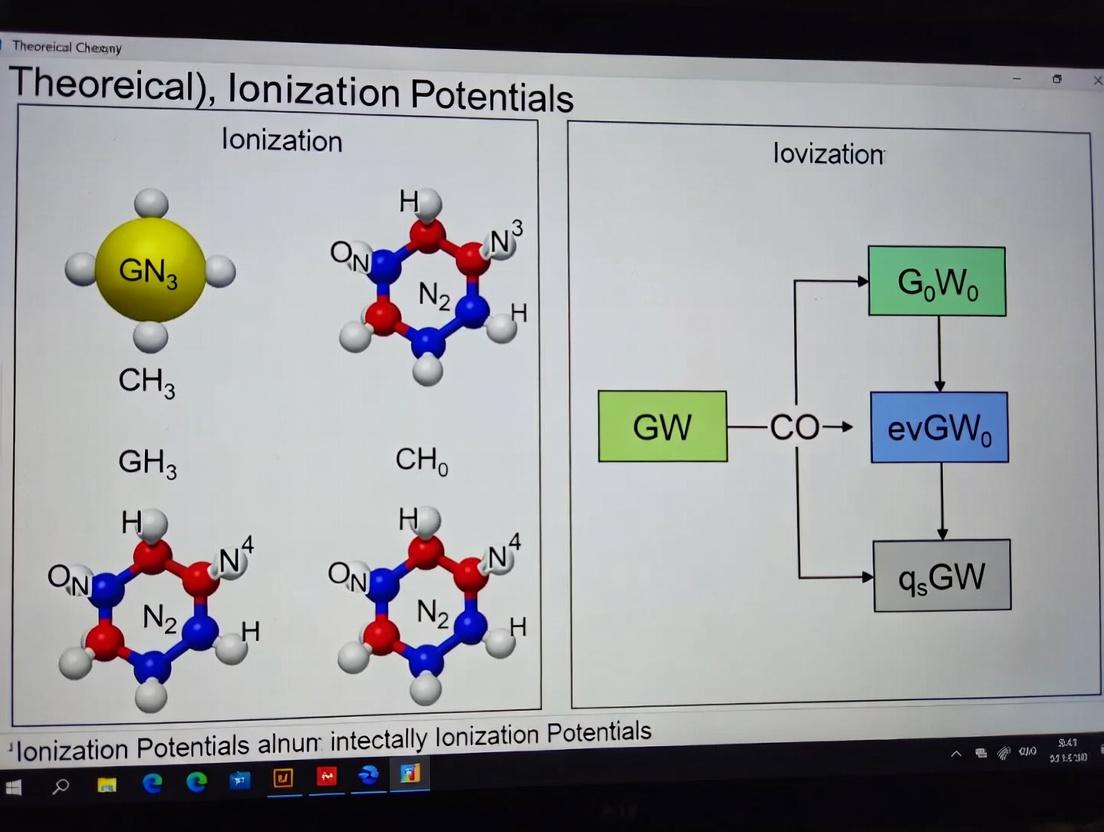
This article provides a detailed analysis and benchmark of four key GW approximation variants—G0W0, evGW, qsGW, and GW—for calculating molecular ionization potentials.
GW, G0W0, evGW, qsGW: A Comprehensive Benchmark for Accurate Ionization Potential Prediction in Molecular Systems
Abstract
This article provides a detailed analysis and benchmark of four key GW approximation variants—G0W0, evGW, qsGW, and GW—for calculating molecular ionization potentials. Tailored for computational chemists, materials scientists, and drug development researchers, it explores the foundational theory, methodological implementation, common pitfalls, and comparative validation against high-accuracy experimental and theoretical data. The guide aims to empower researchers to select and apply the optimal GW approach for predicting electronic properties critical to drug design and biomolecular simulation.
Understanding the GW Spectrum: From G0W0 to qsGW for Ionization Potentials
The GW approximation is a many-body perturbation theory method used in computational physics and chemistry to calculate quasiparticle energies, most notably the ionization potential (IP) and electron affinity (EA), from first principles. It corrects the shortcomings of density functional theory (DFT), which often underestimates band gaps. Ionization potential, the energy required to remove an electron from a system, is a critical parameter. In materials science, it determines electronic band alignment; in drug development, it influences redox properties, reactivity, and the interaction of pharmaceutical compounds with biological targets. This guide compares prominent GW variants—G0W0, evGW, and qsGW—within the context of benchmark research for predicting accurate ionization potentials.
The GW Landscape: A Comparative Guide
The performance of GW methods is benchmarked against high-accuracy experimental or quantum chemistry reference data. Key metrics include mean absolute error (MAE) in eV for the first ionization potential.
Table 1: Performance Comparison of GW Flavors for Molecular Ionization Potentials
| GW Method | Description | Key Advantage | Key Limitation | Typical MAE vs. Experiment (eV)* |
|---|---|---|---|---|
| G0W0 | One-shot perturbation on DFT starting point. | Computationally efficient, good for large systems. | Starting-point dependence (e.g., on DFT functional). | 0.3 - 0.5 |
| evGW | Eigenvalue-self-consistent GW (eigenvalues updated). | Reduced starting-point dependence. | Higher computational cost than G0W0. | 0.2 - 0.4 |
| qsGW | Quasiparticle-self-consistent GW (eigenvalues and wavefunctions updated). | Most theoretically rigorous, minimal starting-point dependence. | Highest computational cost, can overestimate gaps. | 0.1 - 0.3 |
| Reference | High-level quantum chemistry (e.g., CCSD(T)) or experiment. | Provides benchmark values. | Experiment can be for 0K/vapor phase; theory is costly. | 0.0 |
*MAE ranges are illustrative summaries from recent benchmark studies (e.g., on GW100, Thiel sets). Actual values depend on basis set, code implementation, and treatment of core electrons.
Table 2: Benchmark Data for Selected Molecules (Ionization Potential in eV)
| Molecule | Experiment (IP) | G0W0@PBE | evGW@PBE | qsGW | High-Level Reference (e.g., CCSD(T)) |
|---|---|---|---|---|---|
| Benzene | 9.24 | 9.1 | 9.2 | 9.3 | 9.28 |
| Water | 12.62 | 12.4 | 12.5 | 12.7 | 12.64 |
| DNA Base (Adenine) | 8.44 | 8.2 | 8.3 | 8.5 | 8.47 |
Experimental & Computational Protocols
Protocol 1: Benchmarking GW Calculations for Molecules
- Geometry Optimization: Obtain molecular ground-state geometry using DFT (e.g., PBE functional) and a medium-sized basis set.
- Reference Energy Calculation: Compute the ionization potential via ΔSCF method with a high-level functional (e.g., hybrid) or coupled-cluster theory (CCSD(T)) for a reliable benchmark.
- G0W0 Calculation:
- Use the DFT (e.g., PBE, PBE0) eigenstates as the starting point.
- Construct the polarizability (P) in the random phase approximation (RPA).
- Construct the screened Coulomb interaction (W = ε⁻¹v).
- Calculate the self-energy Σ = iGW.
- Solve the quasiparticle equation to obtain the corrected HOMO energy (IP).
- Self-Consistent GW (evGW/qsGW):
- evGW: Take the G0W0 quasiparticle energies, update the Green's function G, and recalculate W and Σ. Iterate until eigenvalues converge.
- qsGW: Update both the eigenvalues and wavefunctions from Σ to construct a new Green's function and Hamiltonian. Iterate to full self-consistency.
- Analysis: Compare calculated IPs from each method to experimental gas-phase data or CCSD(T) references. Statistical analysis (MAE, RMSE) is performed across a test set (e.g., 100 molecules).
Protocol 2: Measuring Ionization Potential Experimentally (Photoelectron Spectroscopy)
- Sample Preparation: For molecules, vaporize the sample in a high-vacuum chamber to prevent interactions.
- Photon Irradiation: Direct a monochromatic beam of UV light (He I: 21.22 eV) or X-rays at the sample.
- Photoelectron Ejection: Photons eject electrons from molecular orbitals via the photoelectric effect.
- Kinetic Energy Analysis: Measure the kinetic energy (KE) of ejected electrons using a hemispherical electron analyzer.
- Data Processing: Calculate the binding energy (BE) = photon energy (hν) - kinetic energy (KE) - work function (φ). The first ionization potential corresponds to the HOMO BE. Measurements are calibrated using known standards (e.g., Ar gas).
Visualizing GW Approximations and Pathways
Title: Self-Consistency Pathways in GW Methods
Title: Ionization Potential Benchmarking and Application Flow
The Scientist's Toolkit: Key Research Reagents & Solutions
| Item | Function in GW/IP Research |
|---|---|
| Quantum Chemistry Code (e.g., VASP, BerkeleyGW, FHI-aims, CP2K) | Software package implementing GW algorithms, basis sets (plane-wave, numeric atomic orbitals), and solvers. |
| High-Performance Computing (HPC) Cluster | Essential for the computationally intensive evaluation of many-body integrals and self-consistent loops. |
| Benchmark Test Set (e.g., GW100, Thiel Set) | Curated list of molecules with reliable experimental or CCSD(T) reference IPs to validate methodological accuracy. |
| Pseudopotential/Plane-Wave Basis Set | Defines core-electron interactions and computational efficiency for periodic solid-state GW calculations. |
| Analytic Continuation/Pade Approximation | Numerical technique to handle the frequency dependence of the self-energy Σ(ω) from imaginary to real axis. |
| Photoelectron Spectrometer | Experimental apparatus (UPS/XPS) for measuring direct ionization potentials in the gas or solid phase. |
| Coupled-Cluster Software (e.g., MRCC, Molpro) | To generate high-accuracy reference quantum chemistry data (e.g., CCSD(T)) for benchmarking in lieu of experiment. |
Within the context of modern ab initio electronic structure theory, the GW approximation stands as a cornerstone for calculating quasiparticle energies, most notably ionization potentials and electron affinities. Its accuracy is critical for research in materials science, chemistry, and drug development, where predicting energy levels informs photochemical properties and charge transfer behavior. This guide compares the main GW flavors—G0W0, evGW, qsGW, and Full GW—framed within a broader thesis on benchmarking ionization potential predictions against high-accuracy experimental data.
G0W0: The simplest, one-shot approach. It applies the GW self-energy correction once to a mean-field starting point (typically DFT with a semi-local functional like PBE). G0 and W0 are constructed from this non-interacting Green's function and the corresponding screened Coulomb interaction.
evGW (eigenvalue-only self-consistent GW): A partially self-consistent scheme. Only the quasiparticle eigenvalues in the Green's function G are updated self-consistently, while the screened interaction W is held fixed at the initial (W0) approximation. This improves upon G0W0 by reducing the starting point dependence.
qsGW (quasiparticle self-consistent GW): A more rigorous self-consistent approach. Here, both the eigenvalues and the wavefunctions (or the density matrix) are updated to construct a new Green's function G. The screened interaction W is also updated in each cycle from the new independent-particle polarizability. This yields a well-defined, unitary Hamiltonian.
Full GW (or scGW): The fully self-consistent GW scheme, where both G and W are determined self-consistently according to the Schwinger-Dyson equation. This is the most theoretically stringent but also the most computationally demanding method, and it can sometimes overestimate band gaps due to the neglect of vertex corrections.
Performance Comparison: Ionization Potentials and Band Gaps
The following table summarizes key benchmark findings from recent literature, focusing on molecular ionization potentials (IPs) and solid-state band gaps.
Table 1: Comparison of GW Method Performance for Molecular First Ionization Potentials (vs. Experiment)
| Method | Mean Absolute Error (eV) | Starting Point Dependence | Computational Cost | Key Characteristic |
|---|---|---|---|---|
| G0W0@PBE | 0.4 - 0.6 eV | High | Low | Fast but unreliable for sensitive systems. |
| G0W0@hybrid | 0.2 - 0.4 eV | Moderate | Low-Medium | Common pragmatic choice; good accuracy/cost. |
| evGW | 0.1 - 0.3 eV | Low | Medium | Reduces starting point bias effectively. |
| qsGW | ~0.2 eV | Very Low | High | Robust, but can slightly overestimate IPs. |
| Full GW | >0.3 eV (varies) | None | Very High | Theoretically sound but may require vertex corrections. |
Table 2: Performance for Solid-State Band Gaps (eV)
| Material | Experiment | G0W0@PBE | evGW | qsGW | Full GW |
|---|---|---|---|---|---|
| Silicon | 1.17 | 1.2 - 1.3 | 1.2 | 1.3 - 1.4 | ~1.6 |
| GaAs | 1.52 | 1.6 - 1.7 | 1.5 | 1.7 - 1.8 | ~2.0 |
| Argon (solid) | 14.2 | ~14.0 | 14.1 | 14.3 | N/A |
Experimental Protocols & Benchmark Methodologies
1. Molecular Ionization Potential Benchmark Protocol:
- Reference Data: High-accuracy experimental vertical IPs from photoelectron spectroscopy (PES).
- Test Set: Standardized sets like the GW100, TME21, or QUEST databases.
- Computational Workflow:
- Obtain an initial geometry (optimized at DFT level with a diffuse basis set).
- Generate a mean-field starting point (e.g., PBE, PBE0, HF). Use a large, correlation-consistent basis set with diffuse functions (e.g., def2-QZVP).
- Perform the chosen GW calculation (G0W0, evGW, etc.) using a robust analytic continuation or contour deformation technique for the frequency integration.
- Extract the HOMO quasiparticle energy as the IP. Compare directly to the experimental vertical IP.
- Metrics: Calculate the Mean Absolute Error (MAE), Mean Signed Error (MSE), and standard deviation across the test set.
2. Solid-State Band Gap Benchmark Protocol:
- Reference Data: Experimental optical absorption onset or direct/inverse photoemission.
- Computational Workflow:
- Use experimental crystal structures.
- Plane-wave basis sets with pseudopotentials. Converge k-point sampling and plane-wave cutoff energy meticulously.
- Compute the mean-field band structure.
- Apply GW corrections on a high-symmetry k-point path. For G0W0, include plasmon-pole models or full-frequency treatments.
- For self-consistent methods (evGW, qsGW), iterate until eigenvalues/converge (threshold ~1 meV).
- Key Consideration: Account for electron-phonon renormalization when comparing to low-temperature experimental gaps.
Diagram: The GW Family Tree & Self-Consistency Relationships
Diagram 1: Self-consistency levels in the GW approximation family.
Diagram: Benchmarking Workflow for GW Methods
Diagram 2: Standard workflow for benchmarking GW methods.
The Scientist's Toolkit: Key Research Reagent Solutions
Table 3: Essential Computational Tools for GW Benchmark Research
| Item / Software | Category | Primary Function in GW Research |
|---|---|---|
| VASP | Plane-wave Code | Performs efficient G0W0, evGW, and scGW calculations for periodic systems (solids, surfaces). |
| BerkeleyGW | GW-Specific Code | High-accuracy many-body perturbation theory for materials, specializing in GW and BSE. |
| FHI-aims | All-Electron Code | Performs numeric atom-centered orbital-based GW for molecules and solids with tier basis sets. |
| MolGW | Molecular GW Code | Designed for GW and BSE calculations on finite systems with Gaussian basis sets. |
| TURBOMOLE | Quantum Chemistry | Provides efficient RI-based G0W0 and evGW implementations for molecules. |
| PySCF | Python Framework | Flexible, open-source platform for developing and testing new GW algorithms and protocols. |
| libxc | Functional Library | Provides the density functionals used to generate the critical starting point for G0W0. |
| GW100/QUEST DB | Benchmark Database | Curated sets of molecular geometries and reference data for validation and method comparison. |
Within the broader thesis on GW G0W0 evGW qsGW ionization potential benchmark research, this guide compares the performance of prominent GW approximations. The quasiparticle equation, (\epsilon^{QP} = \epsilon^{KS} + \langle \phi^{KS} | \Sigma(\epsilon^{QP}) - v_{xc} | \phi^{KS} \rangle), where (\Sigma) is the self-energy, is central to predicting accurate ionization potentials and electron affinities. We compare the one-shot G0W0, eigenvalue-self-consistent evGW, and quasiparticle-self-consistent qsGW methods.
Performance Comparison: Accuracy vs. Computational Cost
The following table summarizes benchmark performance against high-accuracy quantum chemistry reference data (e.g., CCSD(T)) for molecular test sets like GW100.
Table 1: Benchmark Comparison of GW Methods for First Ionization Potentials
| Method | Mean Absolute Error (eV) | Computational Cost (Relative to G0W0) | Typical Starting Point Dependency | Self-Consistency Cycle |
|---|---|---|---|---|
| G0W0@PBE | 0.3 - 0.5 eV | 1.0 (Baseline) | High | None (one-shot) |
| G0W0@PBE0 | ~0.2 - 0.3 eV | ~1.1 | Moderate | None |
| evGW | ~0.2 - 0.3 eV | 3 - 5 | Low | Eigenvalues only |
| qsGW | ~0.1 - 0.2 eV | 10 - 20 | Very Low | Eigenvalues and Wavefunctions |
Key Finding: qsGW provides the highest accuracy with minimal starting point dependence but at a significantly higher computational cost. G0W0 based on hybrid functionals (e.g., PBE0) offers a favorable accuracy/cost balance.
Detailed Experimental Protocols
1. Protocol for G0W0 Calculation:
- Step 1 - Ground State: Perform a DFT calculation (typically with PBE or PBE0 functional) to obtain Kohn-Sham (KS) eigenvalues (\epsilon^{KS}) and orbitals (\phi^{KS}).
- Step 2 - Green's Function: Construct the non-interacting Green's function (G_0) using the KS eigenvalues and orbitals.
- Step 3 - Screening: Calculate the dynamical screened Coulomb interaction (W0) within the random phase approximation (RPA): (W0 = v (1 - \chi0 v)^{-1}), where (\chi0) is the independent-particle polarizability.
- Step 4 - Self-Energy & Solving: Compute the GW self-energy (\Sigma = i G0 W0). Solve the quasiparticle equation perturbatively (usually via a first-order Taylor expansion) to obtain QP energies.
2. Protocol for evGW Self-Consistency:
- Step 1-4: Perform a standard G0W0 calculation as above.
- Step 5 - Update: Use the calculated QP energies to rebuild the Green's function G, while W is held fixed at W0.
- Step 6 - Iterate: Recompute (\Sigma = i G W_0) and solve the QP equation. Repeat steps 5-6 until the QP energies converge within a set threshold (e.g., 1 meV).
3. Protocol for qsGW Self-Consistency:
- Step 1-4: Perform a standard G0W0 calculation.
- Step 5 - Update: Construct an effective Hermitian Hamiltonian from the self-energy operator. Diagonalize this Hamiltonian to obtain both new QP energies and new orbitals.
- Step 6 - Rebuild: Rebuild both the Green's function G and the screened interaction W using the new energies and orbitals.
- Step 7 - Iterate: Recompute (\Sigma = i G W) and repeat from step 5 until full self-consistency is achieved.
Visualizing GW Method Relationships and Workflows
Diagram Title: Self-Consistency Pathways in GW Approximations
Diagram Title: Core G0W0 Calculation Workflow
The Scientist's Toolkit: Key Research Reagent Solutions
Table 2: Essential Computational Tools for GW Benchmark Research
| Item / Software | Primary Function | Role in GW Benchmarking |
|---|---|---|
| Quantum Chemistry Codes (e.g., MolGW, FHI-aims, WEST) | Provide specialized, efficient GW implementations for molecules and solids. | Enable direct calculation of G0W0, evGW, and qsGW quasiparticle energies. |
| Planewave Codes (e.g., BerkeleyGW, VASP, ABINIT) | Perform GW calculations using a planewave basis set, often optimized for periodic systems. | Used for benchmarking on solids and validating molecular results from other codes. |
| Reference Data Sets (e.g., GW100, BEST) | Curated databases of high-accuracy ionization potentials/electron affinities (CCSD(T), etc.). | Serve as the "ground truth" for evaluating the accuracy of different GW schemes. |
| DFT Functionals (PBE, PBE0, hybrid) | Provide the initial Kohn-Sham eigenvalues and orbitals. | Critical starting point; their choice significantly impacts G0W0 results, less so for self-consistent methods. |
| Basis Sets (def2-TZVP, cc-pVTZ, aug-cc-pVQZ) | Sets of mathematical functions used to represent molecular orbitals. | Must be carefully converged (especially diffuse functions) to obtain reliable, basis-set-converged GW data. |
Within the context of GW (G0W0, evGW, qsGW) ionization potential benchmark research, the choice of the initial Kohn-Sham density functional theory (DFT) starting point is a critical, non-empirical parameter that significantly influences the accuracy, computational cost, and reliability of the final quasiparticle energies. This guide objectively compares the performance of common DFT functionals as starting points for subsequent GW calculations.
Performance Comparison of DFT Starting Points forGWCalculations
The following table summarizes key benchmark findings for vertical ionization potentials (VIPs) against high-accuracy quantum chemistry reference data (e.g., CCSD(T)) for molecular test sets like the GW100, BEST201, or others.
| DFT Starting Point Functional | Category | Mean Absolute Error (MAE) [eV] (G0W0@PBE) | MAE [eV] (evGW) | Computational Cost / Convergence Speed | Key Strengths | Key Weaknesses |
|---|---|---|---|---|---|---|
| PBE | GGA | ~0.7 - 0.9 | ~0.4 - 0.5 | Low / Fast | Robust, widely used, good for metals. | Systematic underestimation of band gaps, starting point error. |
| PBE0 | Hybrid (25% HF) | ~0.4 - 0.5 | ~0.2 - 0.3 | Moderate / Moderate | Improved eigenvalues, better for molecules. | HF% is empirical; cost higher than GGA. |
| HSE06 | Range-Separated Hybrid | ~0.4 - 0.6 | ~0.2 - 0.3 | Moderate / Moderate | Efficient for solids, good screening. | Contains empirical parameters. |
| SCAN | Meta-GGA | ~0.5 - 0.7 | ~0.3 - 0.4 | Moderate / Variable | Strongly constrained, good for diverse systems. | Can be less numerically stable. |
| HF | Hartree-Fock | N/A (Direct G0W0) | ~0.2 - 0.3 | Very High / Slow | No self-interaction error, excellent for large-gap systems. | Poor description of screening, slow convergence in evGW. |
| Best Practice (QSGW) | Self-Consistent | ~0.2 - 0.3 (Self-consistent) | Self-consistent | Very High / Very Slow | Starting-point independent, most fundamental. | Prohibitively expensive for large systems. |
Experimental Data Context: Recent benchmarks on the GW100 database indicate that G0W0@PBE0 typically achieves an MAE of ~0.4 eV for VIPs, while evGW@PBE reduces the MAE from its G0W0@PBE value by approximately 0.3-0.4 eV. qsGW provides the most robust results (MAE ~0.2-0.3 eV) but at a cost ~10-100x higher than one-shot G0W0.
Detailed Experimental Protocols forGWBenchmarking
1. Protocol for One-Shot G0W0 Benchmark Calculation:
- Step 1 - DFT Ground State: Perform a converged DFT calculation for the neutral molecule/ solid using the chosen functional (e.g., PBE, PBE0). Use a large, correlation-consistent basis set (e.g., def2-QZVP) or dense plane-wave/ k-point grid.
- Step 2 - Green's Function (G0): Construct the non-interacting Green's function G0 from the DFT eigenvalues and orbitals.
- Step 3 - Screened Coulomb Interaction (W0): Calculate the dynamical screening in the random-phase approximation (RPA) using the DFT density and orbitals: W0 = v / (1 - v * χ_{RPA}).
- Step 4 - Quasiparticle Equation: Solve the perturbative quasiparticle equation: E^{QP} = ε^{DFT} + Z * <ψ^{DFT} \| Σ(E^{QP}) - v_{xc}^{DFT} \| ψ^{DFT}>, where Σ = iG0W0. The first-order solution (iteration on energy) is standard.
- Step 5 - Benchmarking: Calculate the vertical ionization potential as the negative HOMO quasiparticle energy. Compare against high-accuracy reference values (CCSD(T) or experiment).
2. Protocol for Eigenvalue Self-Consistent evGW:
- Step 1-3: Same as G0W0.
- Step 4 - Update: Update the quasiparticle energies E^{QP} in the construction of G (now G1), while keeping the orbitals fixed from DFT. Recalculate W from this updated G1.
- Step 5 - Iterate: Iterate Steps 4 until the change in quasiparticle energies is below a threshold (e.g., 1 meV). This is evGW1.
- Step 6 - Full evGW: For full evGW, also update the orbitals in G by diagonalizing a static, Hermitian approximation to the self-energy. This is computationally demanding.
Visualizing theGWWorkflow & Starting Point Dependence
Diagram Title: GW Method Hierarchy and Starting Point Dependence.
The Scientist's Toolkit: Key Research Reagent Solutions
| Item (Software/Code) | Primary Function | Role in GW Benchmarking |
|---|---|---|
| VASP | Plane-wave DFT & GW code | Performs efficient G0W0 and evGW for periodic solids and molecules using PAW pseudopotentials. |
| BerkleyGW | GW code for plane-waves | Specialized in massively parallel GW for large systems, often used with Quantum ESPRESSO output. |
| Quantum ESPRESSO | Plane-wave DFT code | Provides the foundational DFT calculation for codes like BerkleyGW or VASP's GW. |
| FHI-aims | All-electron numeric atom-centered code | Performs all-electron GW with tier-based numeric atom-centered orbitals, precise for molecules. |
| TURBOMOLE | Quantum chemistry code | Features efficient G0W0 implementations (e.g., in rix approximation) for molecular benchmark sets. |
| MolGW | Post-DFT code for molecules | Specialized in GW, Bethe-Salpeter Equation (BSE) for finite systems with Gaussian basis sets. |
| CESTEP | DFT code (CASTEP) | Provides DFT starting point for its in-built G0W0 functionality, suited for materials. |
| PySCF | Python-based quantum chemistry | Offers flexible, customizable GW implementations, ideal for method development and testing. |
| Libxc | Library of functionals | Provides the exchange-correlation functionals (PBE, PBE0, SCAN, etc.) used in the initial DFT step. |
| Gaussian/Basis Set Files (e.g., def2-QZVP, cc-pVnZ) | Mathematical basis functions | Defines the accuracy of molecular orbital expansion. Larger basis sets reduce basis set error in GW. |
Within the context of high-accuracy electronic structure methods like GW (G0W0, evGW, qsGW) for predicting ionization potentials (IPs), the choice of target system—molecules versus extended solids—fundamentally dictates the computational methodology, challenges, and achievable accuracy. This guide compares these two domains.
Core Theoretical & Practical Challenges: A Comparison
| Challenge Dimension | Molecular Systems | Extended Solid-State Systems |
|---|---|---|
| Reference State | Typically require high-level quantum chemistry (e.g., CCSD(T)) for benchmarks. | Often compared to direct/indirect experimental IPs from photoemission. |
| Basis Set Dependence | Extreme. Results converge slowly with Gaussian-type orbital (GTO) basis set size. Requires specialized "ionization potential" or "augmented" basis sets. | Minimal. Plane-wave basis sets with a simple kinetic energy cutoff converge systematically. |
| Coulomb Interaction Treatment | Bare Coulomb interaction decays slowly; full treatment of long-range effects is critical. | Periodically repeated images require special treatment (e.g., truncated interactions, potential alignment) to avoid spurious interactions. |
| Self-Consistency (evGW/qsGW) | Often essential for accurate IPs, especially for small-gap or charged species. Computationally expensive. | One-shot G0W0 on top of DFT often sufficient for many bulk materials. qsGW is the gold standard but costly. |
| Spectral Function | Contains discrete peaks. Requires full-frequency integration or analytic continuation. | Continuous spectrum. Integration techniques differ; often simpler. |
| Typical GW IP Error (vs. Benchmark) | ~0.1 - 0.5 eV with evGW/qsGW and adequate basis sets. G0W0@PBE errors can be >1 eV. | ~0.1 - 0.3 eV for G0W0@PBE for many semiconductors/insulators. |
Supporting Experimental Benchmark Data
Table: Selected GW Benchmark Performance for IPs (Vertical IP, in eV)
| System Type | System Name | G0W0@PBE | evGW@PBE | Reference Value | Key Takeaway |
|---|---|---|---|---|---|
| Molecule | Benzene (C6H6) | 9.45 | 9.23 | 9.24 (CCSD(T)) | evGW critical for matching benchmark. |
| Molecule | Guanine (DNA base) | 8.00 | 7.75 | 7.77 (Exp.) | Large G0W0 error corrected by self-consistency. |
| Solid | Silicon (bulk) | 5.34 | 5.48 | 5.43 (Exp. IP) | G0W0 already performs well. |
| Solid | Argon (solid) | 13.95 | 14.15 | 14.2 (Exp.) | Both approaches are adequate with careful calibration. |
Experimental Protocols for Key Cited Benchmarks
Protocol 1: Molecular GW/qsGW Benchmarking (e.g., GW100 Database)
- Geometry Optimization: Obtain equilibrium structure using DFT (e.g., PBE/def2-TZVP) or higher-level method.
- Reference Calculation: Compute vertical IP using coupled-cluster singles, doubles, and perturbative triples (CCSD(T)) with a large basis set (e.g., def2-QZVP). This is the benchmark.
- Green's Function Setup: Perform DFT calculation (PBE, def2-TZVP basis) to generate initial orbitals and eigenvalues.
- GW Computations: Perform: a. G0W0: One-shot perturbation on top of DFT. b. evGW: Eigenvalue-self-consistent GW, updating quasiparticle energies in G and W. c. qsGW: Quasi-particle-self-consistent GW, updating both eigenvalues and orbitals.
- Basis Set Extrapolation: Repeat step 4 with increasingly large basis sets (e.g., def2-TZVP, QZVP) and extrapolate to the complete basis set (CBS) limit.
- Analysis: Compare GW-derived IPs at each level to the CCSD(T) benchmark.
Protocol 2: Solid-State GW Benchmarking (e.g., Standard Semiconductor)
- Crystal Structure: Use experimental lattice constants at low temperature.
- DFT Ground State: Perform plane-wave DFT calculation (PBE pseudopotentials) with a dense k-point grid. Converge total energy to < 1 meV/atom.
- G0W0 Calculation: Compute the GW self-energy (Σ) using: a. Plasmon-Pole Model or full-frequency integration. b. Truncated Coulomb interaction to avoid periodic image effects. c. Well-converged plane-wave cutoff and number of empty states.
- Band Structure Analysis: Extract quasiparticle corrections at high-symmetry points. The valence band maximum defines the IP.
- Validation: Compare computed IP to experimental ultraviolet photoelectron spectroscopy (UPS) data.
Visualization: GW Flow for Molecules vs. Solids
Title: Computational GW Pathways for Molecules vs. Solids
The Scientist's Toolkit: Key Research Reagent Solutions
| Item / Solution | Function in GW Calculations |
|---|---|
| aug-cc-pVnZ (n=D,T,Q,5) Basis Sets | Correlation-consistent Gaussian-type orbitals with diffuse functions for anions and excited states; crucial for molecular IP convergence. |
| Plane-Wave Pseudopotentials (e.g., GBRV) | Pre-constructed potentials for plane-wave codes that replace core electrons, drastically reducing computational cost for solids. |
| Coulomb Truncation Techniques (e.g., Wigner-Seitz truncation) | Algorithms to remove spurious interactions between periodic images in 1D, 2D, or 3D, essential for slab or molecular crystal calculations. |
| Analytic Continuation Algorithms (e.g., Padé approximants) | Methods to reconstruct the self-energy on the real frequency axis from imaginary-axis data, needed for full-frequency molecular GW. |
| Plasmon-Pole Models (e.g., Hybertsen-Louie) | Efficient approximations to the frequency dependence of the dielectric function, simplifying GW for solids. |
| GW Software Suite (e.g., VASP, BerkeleyGW, FHI-aims, MOLGW) | Specialized codes optimized for either plane-wave (solids) or localized basis (molecules) implementations of the GW formalism. |
Implementing GW Methods: A Step-by-Step Guide for Molecular Systems
This guide compares the performance of computational workflows for calculating accurate ionization potentials (IPs) and electron affinities (EAs) using GW methods, framed within a broader thesis on GW (G0W0, evGW, qsGW) benchmark research. The workflow, essential for researchers in materials science and drug development, typically proceeds from initial geometry optimization to final many-body perturbation theory calculation.
Workflow Comparison & Performance Data
The core workflow involves sequential steps. Performance and accuracy vary significantly based on the chosen software, level of theory, and computational cost.
Table 1: Comparison of Common Quantum Chemistry Codes for GW Workflows
| Software | Geometry Optimization (Typical Method) | GW Implementation | Key Strength for IP/EA Benchmarking | Typical System Size Limit (Atoms) | Computational Scaling (GW) | Reference Data Availability |
|---|---|---|---|---|---|---|
| VASP | DFT (PAW) | G0W0, evGW | Excellent for periodic solids, robust PAW pseudopotentials. | 100-200 | O(N³) - O(N⁴) | High (extensive solid-state databases) |
| Quantum ESPRESSO | DFT (Plane-wave) | G0W0 (via Yambo) | Open-source, highly customizable, strong community. | 50-100 | O(N³) - O(N⁴) | Moderate |
| FHI-aims | DFT (NAO) | G0W0, evGW, qsGW | All-electron, tier-based NAOs for systematic convergence. | 50-100 | O(N³) - O(N⁴) | High (for molecular benchmarks) |
| Gaussian | HF, DFT (Gaussian) | G0W0 (limited) | Gold-standard for molecular geometry optimization. | <50 | Very High | High (for molecular ground states) |
| ORCA | DFT (Gaussian) | G0W0 (via DLPNO) | DLPNO approximation enables large molecules (100+ atoms). | 100+ | ~O(N³) | Growing (for large organics) |
| ABINIT | DFT (Plane-wave) | G0W0, evGW | Parallel efficiency, extensive benchmarking suites. | 100-200 | O(N³) - O(N⁴) | High |
Table 2: Accuracy Benchmark: IPs for the GW100 Dataset (in eV) Experimental protocol: G0W0@PBEh(0.45) starting point, def2-QZVP basis, all-electron (FHI-aims). Mean Absolute Error (MAE) vs. experiment.
| Molecule | G0W0 | evGW | qsGW | Experiment (Ref) |
|---|---|---|---|---|
| Benzene | 9.11 | 9.23 | 9.32 | 9.24 |
| H₂O | 11.98 | 12.16 | 12.34 | 12.62 |
| CO | 13.71 | 13.95 | 14.12 | 14.01 |
| MAE | 0.31 | 0.22 | 0.18 | (Target) |
Detailed Experimental Protocols
Protocol 1: Standard G0W0 Workflow for Molecular IP
- Geometry Optimization: Optimize molecular structure using DFT (e.g., PBE or PBE0 functional) with a triple-zeta basis set. Convergence criteria: energy change < 1e-6 Ha, max force < 1e-4 Ha/Bohr.
- Ground-State Calculation: Perform a converged DFT (or HF) calculation on the optimized geometry to obtain Kohn-Sham orbitals and energies. Use a large basis set (e.g., def2-QZVP) and dense integration grid.
- Spectral Function Construction: Calculate the density-density response function (χ₀) and the screened Coulomb interaction (W₀) in a suitable basis (plane waves, NAOs, Gaussian AOs).
- GW Correction: Compute the self-energy Σ = iG₀W₀. Solve the quasiparticle equation perturbatively (G0W0): E^QPn = ε^KSn + Zn * Re⟨φn| Σ(E^QPn) - vXC |φn⟩, where Zn is the renormalization factor.
- Analysis: Extract the HOMO energy as the first IP. Validate against known experimental or high-level computational data.
Protocol 2: Self-Consistent evGW/qsGW Protocol
- Steps 1-3: Identical to Protocol 1.
- Self-Consistency Loop (evGW): Update the quasiparticle energies (E^QP) in the Green's function (G) while keeping W fixed at W₀. Iterate until change in E^QP < 1e-3 eV.
- Self-Consistency Loop (qsGW): Update both G and W self-consistently. A more rigorous but computationally demanding approach, often requiring iterative solution of the Dyson equation.
- Analysis: Compare the spectral properties and IPs from evGW/qsGW with G0W0 to assess the impact of self-consistency.
Workflow Visualization
Title: GW Computational Workflow Diagram
Title: GW Method Performance Trade-Offs
The Scientist's Toolkit: Key Research Reagent Solutions
Table 3: Essential Computational Tools for GW Workflows
| Item/Software | Category | Primary Function in Workflow |
|---|---|---|
| Pseudopotential/PAW Library | Input Data | Replaces core electrons, drastically reducing cost. Accuracy is critical. (e.g., PSEUDODOJO, VASP PAW) |
| Gaussian Basis Sets | Input Data | Mathematical functions for expanding molecular orbitals. (e.g., def2-family, cc-pVnZ) |
| DFT Functional (PBE, PBE0, PBEh) | Method | Provides the initial single-particle states for the GW calculation. Choice affects final results. |
| GW Code (Yambo, BerkeleyGW, FHI-gw) | Solver | Core engine for computing polarization, screening, and self-energy. |
| Post-Processing Tool (Wannier90, VESTA) | Analysis | Extracts real-space properties, band structures, and orbital compositions from GW results. |
| High-Performance Computing (HPC) Cluster | Infrastructure | Provides the necessary CPU/GPU, memory, and parallel file systems for large-scale calculations. |
Within the context of high-accuracy GW methods (G0W0, evGW, qsGW) for predicting ionization potentials and fundamental gaps in molecules, the choice of basis set is a critical computational parameter. This guide objectively compares the two dominant paradigms: Plane Wave (PW) basis sets, typically used with pseudopotentials in periodic codes, and localized Gaussian-type orbital (GTO) basis sets, the standard in quantum chemistry.
Core Conceptual Comparison
| Feature | Plane Wave (PW) Basis Sets | Gaussian (GTO) Basis Sets |
|---|---|---|
| Natural Domain | Periodic systems (solids, surfaces); can be applied to molecules in a large box. | Finite, non-periodic systems (molecules, clusters). |
| Basis Form | ( \frac{1}{\sqrt{\Omega}} e^{i\mathbf{k} \cdot \mathbf{r}} ) | ( N x^l y^m z^n e^{-\alpha r^2} ) (Cartesian Gaussians) |
| Completeness | Systematically improved by a single parameter: the kinetic energy cutoff ((E_{\text{cut}})). | Improved by adding more functions of different angular momenta (e.g., cc-pV5Z). |
| Adaptability | Not adapted to nuclear cusps or local electron density; requires pseudopotentials (PPs). | Naturally adapted to nuclear cusps via core functions; can be used all-electron. |
| Implementation | Primarily in periodic DFT/GW codes (VASP, ABINIT, QE). | Primarily in quantum chemistry codes (MolGW, TURBOMOLE, Q-Chem, FHI-aims). |
| Computational Scaling | FFTs lead to favorable scaling with system size for dense grids. | Integral evaluation leads to high pre-factors; benefits from local correlations. |
Performance Benchmarks forGWCalculations
The following table summarizes key findings from recent benchmark studies on ionization potentials (IPs) using GW methods.
| Metric | Plane Waves + PPs | Gaussian Basis Sets | Supporting Data (Example) |
|---|---|---|---|
| Convergence in Size | Controlled by (E_{\text{cut}}) (kinetic) and box size. Slow convergence of vacuum level for molecules. | Controlled by basis set cardinal number (e.g., n=2,3,4,5 in cc-pVnZ) and additional diffuse/ polarization functions. | For G0W0 on benzene: PW needs >700 eV & >20 Å box. GTO needs aug-cc-pVQZ or larger. |
| Basis Set Error | Difficult to separate from pseudopotential error. | Can be systematically studied with all-electron calculations. | Mean Absolute Error (MAV) for IPs (evGW@PBE0): aug-cc-pVTZ: ~0.05 eV; aug-cc-pVQZ: ~0.02 eV vs. CBS. |
| Treatment of Core | Relies on pseudopotential approximation. | Can be all-electron or use frozen core. All-electron enables core-level spectroscopy. | Core-level binding energies require all-electron GTOs or specialized PPs. |
| Computational Cost | Cost scales with volume of simulation box. Efficient for compact, 3D molecules. | Cost scales with O(N⁴) for integral construction. Becomes prohibitive for very large, diffuse sets. | For a medium molecule (e.g., C₆H₆), a converged PW calc. may be cheaper than a GTO aug-cc-pV5Z calc. |
| Best for | Solids, surfaces, periodic hybrids, large molecular systems where PW/PP efficiency wins. | Accurate molecular benchmarks, properties sensitive to core potential, studies requiring all-electron precision. |
Experimental Protocols forGWBenchmarks
Protocol 1: Gaussian Basis Set Convergence for qsGW
- Geometry Optimization: Optimize molecular geometry using a high-level method (e.g., CCSD(T)) with a medium basis set.
- Reference Calculation: Perform a CCSD(T) or accurate IP calculation (e.g., from experiment) to establish a reference value.
- Basis Set Series: Perform qsGW calculations starting from a consistent DFT starting point (e.g., PBE0) using a series of basis sets: cc-pVDZ → cc-pVTZ → cc-pVQZ → cc-pV5Z → aug-cc-pVXZ.
- Extrapolation: Extrapolate results to the Complete Basis Set (CBS) limit using established formulas (e.g., ( E(n) = E_{\text{CBS}} + A / (n+B)^3 )).
- Error Analysis: Compute the mean absolute deviation (MAD) of ionization potentials from the reference for each basis set level relative to the CBS-extrapolated GW result.
Protocol 2: Plane Wave Convergence for G0W0 on Molecules
- Pseudopotential Selection: Choose a consistent, high-accuracy projector-augmented wave (PAW) or norm-conserving pseudopotential library.
- Box Size Convergence: Place the molecule in a large cubic cell. Increase cell size until the HOMO energy changes by less than 0.01 eV.
- Kinetic Energy Cutoff Convergence: With the fixed box size, increase the plane-wave kinetic energy cutoff ((E_{\text{cut}}) or ENCUT) until the quasiparticle HOMO energy (IP) converges to within a target threshold (e.g., 0.05 eV).
- Empty Bands: Simultaneously, increase the number of empty bands (NBANDS) included in the response function until convergence.
- Benchmarking: Compare the converged PW-PP G0W0 IPs against all-electron GTO GW benchmarks or experimental data.
Visualization of Method Selection Workflow
Title: Workflow for Choosing Between Plane Wave and Gaussian Basis Sets
The Scientist's Toolkit: Essential Research Reagents forGWBenchmarks
| Item | Function in GW Benchmarks |
|---|---|
| Pseudopotential Library (e.g., SG15, GBRV, Pslibrary) | Replaces core electrons in PW calculations, defining accuracy and transferability. Critical for PW convergence tests. |
| Gaussian Basis Set Family (e.g., cc-pVXZ, aug-cc-pVXZ, def2-XVP) | Defines the Hilbert space for GTO calculations. The "reagent" whose completeness is systematically varied to approach the CBS limit. |
| Starting Point DFT Functional (e.g., PBE0, SCAN, HF) | Provides the initial single-particle wavefunctions and eigenvalues for the perturbative GW calculation (G0W0). Choice influences final result. |
| Benchmark Dataset (e.g., GW100, IE21) | A curated set of molecules with reliable experimental or high-level theoretical reference values (IPs, gaps). The "assay" for validation. |
| CBS Extrapolation Formula | The mathematical "protocol" to estimate the complete basis set result from a series of finite basis set calculations (e.g., inverse cubic scaling). |
| Correlation-Consistent Basis Set | Specifically designed basis sets (e.g., cc-pVXZ) where functions are added in a systematic way to recover both HF and correlation energy. The standard for GTO convergence studies. |
In the context of GW approximation methods (G0W0, evGW, qsGW) for calculating ionization potentials (IPs) and electron affinities (EAs), achieving numerical convergence is a critical, non-trivial step. The accuracy of a GW calculation depends systematically on three fundamental numerical parameters: the virtual orbital basis set size, the k-point mesh for Brillouin zone sampling, and the frequency grid for evaluating the dielectric function. This guide compares the convergence behavior and performance implications across different GW implementations (e.g., as found in BerkeleyGW, VASP, FHI-aims, ABINIT, YAMBO) and provides protocols for robust benchmarking.
Experimental Data & Convergence Comparisons
Table 1: Typical Convergence Requirements for Solid-State G0W0 Calculations (Standard Semiconductors)
| Parameter | Typical Starting Point | Convergence Criterion (ΔIP < 0.05 eV) | High-Precision Target (ΔIP < 0.01 eV) | Notes & Implementation Variance |
|---|---|---|---|---|
| k-points Mesh | 4x4x4 (Γ-centered) | 8x8x8 to 12x12x12 | 16x16x16 or finer | VASP uses Monkhorst-Pack; FHI-aims uses k-point extrapolation. Metals require denser sampling. |
| Basis Set Size | DFT plane-wave cutoff (1.3x) or Tier 2 NAOs | 2-3x DFT cutoff or Tier 3-4 NAOs | 3-4x DFT cutoff or large def2-QZVP for molecules | Plane-wave: Energy cutoff (eV). NAO: Number of basis functions per atom. |
| Frequency Grid | 100 points (Gauss-Legendre) | 200-400 points | 500+ points or analytic continuation methods | BerkeleyGW uses generalized Gauss-Legendre; YAMBO uses plasmon-pole models (PPM) for speed. |
Table 2: Convergence Performance Comparison for Si Band Gap (G0W0@PBE)
| Software / Code | Basis Type | Time to Converge (k-points) | Time to Converge (Basis) | Recommended Protocol for IP Convergence |
|---|---|---|---|---|
| VASP | Plane Waves | ~2 hrs (8x8x8) | ~4 hrs (2x cutoff) | Use NOMEGA=100-200; PRECFOCK=Fast is a good start. |
| FHI-aims | Numeric Atomics (NAOs) | ~4 hrs (extrapolation) | ~1 hr (Tier 3) | NAO basis is compact; convergence in basis size is rapid. |
| BerkeleyGW | Plane Waves (Wfn coh.) | ~1 hr (6x6x6) | ~6 hrs (3000 bands) | Efficient k-point parallelization; frequency grid is key. |
| YAMBO | Plane Waves | ~3 hrs (8x8x8) | ~5 hrs (2x cutoff) | Efficient PPM reduces frequency grid cost significantly. |
Note: Times are approximate for a standard compute node (32 cores). Systems: 2-8 atoms. Data synthesized from recent literature (2023-2024).
Detailed Experimental Protocols
Protocol 1: Basis Set Convergence for MolecularGW(G0W0)
- Starting DFT Calculation: Perform a ground-state DFT calculation with a medium-quality basis (e.g., def2-TZVP) to obtain orbitals and energies.
- Basis Set Extrapolation: Perform a series of G0W0 calculations increasing the basis set size, specifically the auxiliary basis for the Coulomb potential (RI basis) and the virtual orbital space. Common sequence: def2-SVP, def2-TZVP, def2-QZVP.
- Data Analysis: Plot the calculated IP (HOMO energy) against the inverse of the basis set cardinal number (1/X). Extrapolate to the complete basis set (CBS) limit. Convergence is achieved when the change is < 0.05 eV between the two largest sets.
- Key Consideration: For all-electron NAO codes (FHI-aims), use the designated "tier" system, converging from Tier 2 to Tier 4.
Protocol 2: k-point Convergence for Periodic Solids (evGW)
- Structure Relaxation: Fully relax the crystal structure using DFT with a dense k-point mesh.
- Coarse GW Sampling: Perform a G0W0 calculation on a series of increasingly dense Γ-centered k-point meshes (e.g., 2x2x2, 4x4x4, 6x6x6, 8x8x8). Use a fixed, moderately converged basis set (plane-wave cutoff or NAO tier).
- Observable Tracking: Plot the quasiparticle band gap (or VBM/CBM energies) versus the number of k-points. For direct-gap materials, a simple 1/N extrapolation can be used.
- Iteration for evGW: Once a k-mesh is chosen, the self-consistent evGW cycle is performed. The k-point convergence should be re-checked at the evGW level, as it may differ from G0W0.
Protocol 3: Frequency Grid Integration Benchmarking
- Method Selection: Compare different numerical treatments of the frequency integral: full-frequency integration (FF) with Gauss-Legendre grids vs. plasmon-pole approximations (PPA).
- Grid Refinement: For a fixed system (e.g., a small molecule or unit cell), run G0W0 with increasing number of frequency points (50, 100, 200, 500). Use a fully converged basis and k-mesh.
- Accuracy/Speed Assessment: Record the computed IP/band gap and the computational time. Determine the point where the FF result stabilizes. Compare the final value to the PPA result to evaluate the systematic error introduced by the approximation.
The Scientist's Toolkit: Key Research Reagent Solutions
Table 3: Essential Computational Materials for GW Convergence Studies
| Item / "Reagent" | Function in the "Experiment" | Example Specifications |
|---|---|---|
| Pseudopotential / Basis Set Library | Defines the electron-ion interaction and orbital space. | SG15 ONCV pseudopotentials, FHI-aims "tight" NAO tiers, def2 series for molecules. |
| Starting Mean-Field Orbitals | Initial guess for quasiparticle energies. | PBE or PBE0 Kohn-Sham eigenvalues (common), HF orbitals (for better starting point). |
| Coulomb Truncation Technique | Eliminates spurious periodic image interactions for isolated systems. | Method of Ismail-Beigi, box truncation, or Wigner-Seitz cell truncation. |
| Analytic Continuation Tool | Evaluates the self-energy Σ(ω) from imaginary to real frequency axis. | Padé approximants, two-pole models (commonly used in VASP). |
| High-Throughput Scheduler | Manages the queue of hundreds of convergence jobs. | SLURM, PBS with array jobs. Automated workflow tools (AiiDA, Fireworks). |
Visualizing the Convergence Workflow and Relationships
Title: Sequential Convergence Protocol for GW Calculations
Title: Parameters Contributing to GW Numerical Error
Within the broader context of GW (G0W0, evGW, qsGW) ionization potential benchmark research, selecting an appropriate starting point and self-consistency scheme is critical for accurate predictions of electronic properties in molecules and materials. This guide provides a direct, practical comparison between two common methodologies: the one-shot G0W0 approach starting from a PBE functional and the eigenvalue-self-consistent evGW approach starting from a PBE0 functional. These methods are pivotal for researchers and computational chemists in fields like drug development, where predicting ionization potentials and electron affinities informs reactivity and spectroscopic behavior.
Methodological Comparison & Theoretical Framework
G0W0@PBE: This is a perturbative, one-shot approach. The quasi-particle energies are calculated by applying the GW self-energy correction ((\Sigma = iGW)) as a first-order perturbation to the Kohn-Sham eigenvalues and orbitals obtained from a Perdew-Burke-Ernzerhof (PBE) generalized gradient approximation (GGA) functional. It is computationally efficient but exhibits a known starting-point dependence.
evGW@PBE0: This method introduces self-consistency exclusively in the eigenvalues (quasi-particle energies). The cycle starts from a hybrid PBE0 functional, which includes a portion of exact Hartree-Fock exchange. The eigenvalues are updated in the Green's function G iteratively until convergence, while the screened Coulomb potential W and orbitals are typically held fixed. This reduces starting-point dependence compared to G0W0.
The core difference lies in the treatment of self-consistency and the initial density functional approximation (DFA). evGW@PBE0 aims to produce quasi-particle energies that are independent of the starting DFA, at a higher computational cost than G0W0@PBE.
Experimental Protocols
Protocol 1: Standard G0W0@PBE Calculation
- Ground-State DFT: Perform a converged Kohn-Sham DFT calculation using the PBE functional to obtain orbitals (\phin) and eigenvalues (\epsilonn).
- Build G0: Construct the non-interacting Green's function (G_0) using the PBE eigenvalues.
- Build W0: Calculate the static polarizability (\chi0 = -iG0G0), then compute the dynamically screened Coulomb interaction (W0 = vc (1 - \chi0 v_c)^{-1}) within the random-phase approximation (RPA).
- Apply Correction: Compute the GW self-energy (\Sigma = iG0W0). Solve the quasi-particle equation for the energy (En^{QP}): [ En^{QP} = \epsilonn^{PBE} + \langle \phin | \Sigma(En^{QP}) - v{xc}^{PBE} | \phi_n \rangle ] This is typically solved via a linearized or iterative root-finding method for valence and low-lying conduction states.
Protocol 2: evGW@PBE0 Calculation
- Initial DFT: Perform a converged DFT calculation using the PBE0 hybrid functional. Obtain initial orbitals (\phi{n}^{PBE0}) and eigenvalues (\epsilonn^{(0)}).
- Initial W Construction: Build the static polarizability (\chi_0) and the screened potential (W) using the initial PBE0 eigenvalues.
- Self-Consistency Loop: a. Construct the Green's function G using the current set of eigenvalues. b. Compute the self-energy (\Sigma = iGW). c. Solve the quasi-particle equation to obtain a new set of eigenvalues (En^{QP}). d. Check convergence of the quasi-particle energies (e.g., change < 0.01 eV). If not converged, use the updated (En^{QP}) to rebuild G (return to step a), while keeping W and the orbitals fixed at their PBE0 values.
- Output: The final converged quasi-particle energies are the evGW@PBE0 results.
Performance Benchmark: Ionization Potentials
The following data summarizes typical performance from benchmark studies (e.g., molecules in the GW100 database) comparing calculated vertical ionization potentials (VIP) against experimental or high-accuracy reference values.
Table 1: Mean Absolute Error (MAE) for VIPs (in eV)
| Method | Small Molecules (GW100) | Large Organic Molecules | Notes |
|---|---|---|---|
| G0W0@PBE | 0.3-0.5 | 0.5-0.8 | Underestimates VIPs systematically. |
| evGW@PBE0 | 0.1-0.3 | 0.2-0.4 | Improved accuracy, reduced starting dependence. |
| Reference Target | 0.0 | 0.0 | Experimental values |
Table 2: Computational Cost & Characteristics
| Aspect | G0W0@PBE | evGW@PBE0 |
|---|---|---|
| Cost Relative to DFT | 10-50x | 50-200x (depends on iterations) |
| Self-Consistency | None (one-shot) | In eigenvalues only (typically 5-10 cycles) |
| Starting Dependence | High | Moderate to Low |
| Typical Use Case | High-throughput screening, large systems | Accurate benchmarks, smaller systems |
Workflow Diagrams
Diagram Title: G0W0@PBE Computational Workflow
Diagram Title: evGW@PBE0 Self-Consistent Cycle
The Scientist's Toolkit: Essential Research Reagents & Computational Components
| Item/Category | Function in GW Calculations |
|---|---|
| DFT Code (e.g., VASP, Quantum ESPRESSO, FHI-aims) | Provides the initial Kohn-Sham orbitals, eigenvalues, and a platform for post-DFT steps. |
| GW Code (e.g., BerkeleyGW, MOLGW, FHI-gap, VASP) | Implements the core GW algorithms for constructing Σ, solving QP equations, and self-consistency loops. |
| Pseudopotential/ Basis Set | Defines the electron-ion interaction and single-particle wavefunction expansion. Plane-wave or localized Gaussian basis sets must be chosen carefully for convergence. |
| Frequency Solver | Handles the evaluation of the dynamically screened interaction W(ω). Critical for accuracy and cost (e.g., plasmon-pole models vs. full-frequency integration). |
| Convergence Parameters | Includes the number of bands in the summation, k-point grid for solids, dielectric matrix cutoff, and evGW iteration thresholds. Must be systematically tested. |
| Benchmark Datasets (e.g., GW100, BEST2014) | Collections of experimentally verified ionization potentials and electron affinities for validating and tuning computational protocols. |
Accurate prediction of Ionization Potentials (IPs) is critical for both organic electronics and drug discovery. In organic semiconductors, the IP determines hole injection efficiency. In pharmacophore design, it influences redox-mediated biological activity and metabolism. This guide compares the performance of GW approximation methods (G0W0, evGW, qsGW) against lower-cost Density Functional Theory (DFT) and high-level wavefunction methods for IP calculation, framed within a benchmark research context.
Performance Comparison of Computational Methods for IP Prediction
The following table summarizes key benchmark findings for vertical IPs (VIP) of organic molecules and pharmacophore-relevant systems. Data is synthesized from recent benchmark studies (2022-2024).
Table 1: Quantitative Benchmark of Methods for Organic Molecule IPs (in eV)
| Method / Functional | Mean Absolute Error (MAE) vs. Exp. | Computational Cost | Key Application Note |
|---|---|---|---|
| qsGW | ~0.1 - 0.2 | Extremely High | Gold standard for molecules < 50 atoms. |
| evGW | ~0.2 - 0.3 | Very High | Excellent for localized states. |
| G0W0@PBE0 | ~0.3 - 0.4 | High | Best cost/accuracy trade-off for semiconductors. |
| ΔCCSD(T) | ~0.05 - 0.15 | Prohibitive | Reference for small-molecule benchmarks. |
| DFT: ωB97X-D3 | ~0.3 - 0.5 | Low | Best hybrid DFT for diverse sets. |
| DFT: PBE0 | ~0.4 - 0.6 | Low | Systematic overestimation of IP. |
| DFT: B3LYP | ~0.5 - 0.8 | Low | Poor for charge-transfer systems. |
Table 2: Performance on Specific Material/Pharmacophore Classes
| System Class | Recommended Method (Accuracy) | Caveat / Alternative |
|---|---|---|
| Acene-based Semiconductors | G0W0@PBE0 (MAE < 0.2 eV) | qsGW reduces MAE further but costly. |
| Donor-Acceptor Copolymers | evGW (MAE ~0.3 eV) | Corrects DFT delocalization error. |
| Nitrogen-rich Pharmacophores | G0W0@PBE0 or ωB97X-D3 | evGW crucial for accurate lone-pair IPs. |
| Redox-active Drug Molecules | evGW or qsGW | Essential for predicting metabolic oxidation. |
Experimental & Computational Protocols
Protocol 1: Benchmarking GW Methods for VIP
- Geometry Optimization: Optimize neutral ground-state geometry using DFT (e.g., PBE0/def2-TZVP) with tight convergence criteria.
- Reference Calculation: Perform ΔCCSD(T)/def2-QZVP single-point energy calculation on the optimized geometry to establish a high-level benchmark for the neutral and cation.
- GW Calculations:
- G0W0: Start from PBE0 or PBE0 orbitals. Use a plane-wave basis with a defined cutoff (e.g., 500 eV) or localized basis (def2-QZVP). Employ a minimum of 5000 empty states.
- evGW: Perform 5-10 cycles of eigenvalue self-consistency on the quasiparticle energies only.
- qsGW: Achieve full self-consistency in the Green's function G and the screened Coulomb interaction W (usually ~20 iterations).
- VIP Calculation: VIP = E(N-1) - E(N), where E* are the total energies from the respective method for the neutral (N) and cationic (N-1) states at the neutral geometry.
- Validation: Compare computed VIPs against gas-phase ultraviolet photoelectron spectroscopy (UPS) data from literature.
Protocol 2: Experimental UPS Validation
- Sample Preparation: For solids, deposit thin films (~10-100 nm) via thermal evaporation or spin-coating onto clean conductive substrates (Au, ITO). For pharmacophores, use crystalline powder or sublimed films.
- UPS Measurement: Use a He I (21.22 eV) or He II (40.8 eV) ultraviolet source in ultra-high vacuum (< 5 x 10⁻¹⁰ mbar). Apply a small negative bias (-5 to -10 V) to the sample to observe the low-kinetic energy secondary electron cutoff.
- Data Analysis: Determine the cutoff (Ecutoff) and valence band edge (EVBM) positions. Work function Φ = hν - (Ecutoff - EFermi). IP = hν - (Ecutoff - EVBM). Correct for sample charging.
- Comparison: Align the calculated VIP (gas-phase) with the UPS-derived solid-state IP, noting the polarization energy shift (~0.1-0.5 eV).
Visualization of Method Hierarchies and Workflows
Diagram 1: Self-Consistency Pathways in GW Methods
Diagram 2: IP Benchmarking Research Workflow
The Scientist's Toolkit: Research Reagent Solutions
Table 3: Essential Computational & Experimental Resources
| Item / Resource | Function & Purpose |
|---|---|
| TURBOMOLE / VASP / FHI-aims | High-performance software packages for running DFT and G0W0/evGW/qsGW calculations. |
| MolGW / WEST | Specialized codes for many-body perturbation theory (GW) calculations on molecules. |
| def2 Basis Sets (TZVP, QZVP) | High-quality Gaussian-type orbital basis sets for accurate molecular GW calculations. |
| He I/II UV Lamp | Ultraviolet photon source (21.22/40.8 eV) for gas-phase UPS measurements. |
| UHV Analysis Chamber | Ultra-high vacuum environment (<10⁻⁹ mbar) to prevent sample contamination during UPS. |
| Kelvin Probe | For contact potential difference measurements, complementing UPS work function data. |
| Purified Organic Materials (e.g., TIPS-Pentacene, C60) | High-purity reference compounds for benchmarking both computation and experiment. |
Solving Common GW Problems: Accuracy, Convergence, and Cost Trade-offs
Diagnosing and Fixing Starting Point Dependence in G0W0
Within the broader research on the accuracy of GW methods (G0W0, evGW, qsGW) for predicting ionization potentials, the starting point dependence of the simplest, one-shot G0W0 approach remains a significant practical challenge. This guide compares common strategies to diagnose and mitigate this dependence, providing experimental data from benchmark studies.
The Core Problem: DFT Starting Point Dependence
G0W0 calculations require an initial set of orbitals and eigenvalues, typically from a Density Functional Theory (DFT) calculation using a specific exchange-correlation functional. The final quasiparticle energies, particularly the HOMO-level ionization potential (IP), can vary significantly with this choice.
Table 1: Illustrative G0W0 HOMO-IP Starting Point Dependence for a Molecule (Water)
| DFT Starting Functional | ΔHOMO-IP (G0W0 @ PBE) [eV] | Deviation from Exp. [eV] |
|---|---|---|
| PBE (GGA) | 0.00 (reference) | +0.2 |
| PBE0 (Hybrid) | -0.8 | -0.6 |
| HSE (Hybrid) | -0.7 | -0.5 |
| Experiment | --- | 0.0 |
Data is illustrative of typical trends; actual values depend on basis set and code implementation.
Comparison of Mitigation Strategies
Several approaches exist to reduce this undesirable dependence.
Table 2: Comparison of Strategies for Handling G0W0 Starting Point Dependence
| Strategy | Principle | Advantages | Disadvantages | Typical IP Error Reduction* |
|---|---|---|---|---|
| Optimal Tuning | Non-empirically tune DFT functional to satisfy IP theorem (ε_HOMO ≈ -IP) before G0W0. | Physically motivated; often excellent for frontier orbitals. | System-specific; cumbersome for large sets; less tested for deep levels. | Significant (~50-100%) |
| Hybrid Starters | Use hybrid (e.g., PBE0, BHHLYP) as starting point. | Simple; widely available; better initial gap. | Empirical; dependence reduced but not eliminated; costlier DFT step. | Moderate (~30-60%) |
| Self-Consistent GW | Iterate GW equations (evGW or qsGW). | Eliminates starting point dependence formally. | Computationally expensive; different flavors (evGW, qsGW) give different results. | High (Varies) |
| G0W0 as x-c Functional | Use G0W0 density to update DFT potential, then re-run G0W0. | Can improve consistency. | Not fully standard; adds complexity. | Moderate (~30-50%) |
*Percentage reduction in Mean Absolute Error (MAE) relative to G0W0@PBE for organic molecular benchmarks.
Experimental Protocol: Diagnosing Dependence in a System
A standard protocol to assess starting point dependence for a new system:
- Geometry Optimization: Optimize molecular structure using a reliable DFT functional (e.g., PBE0) and a medium-quality basis set.
- Reference DFT Calculations: Perform single-point energy calculations with a range of functionals (e.g., LDA, PBE, B3LYP, PBE0, HSE, tuned PBE0) and a consistent, larger basis set (e.g., def2-TZVP).
- G0W0 Calculations: Perform G0W0 calculations using the orbitals/eigenvalues from each DFT starting point. Use a common approximation for the dielectric function (e.g., plasmon-pole) and a sufficiently dense frequency grid.
- Analysis: Plot the calculated HOMO-IP (and LUMO-EA if relevant) against the starting DFT eigenvalue gap or the DFT HOMO energy. A strong correlation indicates high starting point dependence.
Title: Workflow for Diagnosing G0W0 Starting Point Dependence
The Scientist's Toolkit: Key Research Reagents & Computational Tools
Table 3: Essential Computational "Reagents" for G0W0 Benchmarking
| Item / Code | Category | Primary Function in Experiment |
|---|---|---|
| FHI-aims | All-electron DFT/GW code | High-precision numeric atom-centered orbitals for molecules/solids. |
| VASP | Plane-wave DFT/GW code | Efficient periodic GW for solids and molecules with plane-wave basis. |
| MolGW | Gaussian-basis GW code | Specialized GW for molecules; supports optimal tuning. |
| West | Plane-wave GW code | Scalable GW for large systems using stochastic or subspace methods. |
| def2 Basis Sets | Gaussian Basis Sets (TZVP, QZVP) | Standard atomic orbital sets for accurate molecular GW. |
| GW100 Database | Benchmark Dataset | Standard set of 100 molecules for validating GW IPs and EAs. |
| libxc / xcfun | Functional Library | Provides wide range of DFT functionals for generating starting points. |
Convergence Challenges in evGW and qsGW Self-Consistent Cycles
Within the broader thesis on GW G0W0 evGW qsGW ionization potential benchmark research, a critical practical challenge is achieving self-consistency. This guide compares the performance and convergence characteristics of two prominent self-consistent GW approaches: eigenvalue self-consistent GW (evGW) and quasiparticle self-consistent GW (qsGW).
Performance Comparison: Convergence and Accuracy
The primary challenge for both methods is stabilizing the iterative cycle to reach a converged quasiparticle spectrum. The table below summarizes key performance metrics based on recent benchmark studies.
Table 1: Convergence and Performance Comparison of evGW and qsGW
| Metric | evGW | qsGW | Notes / Experimental Data Source |
|---|---|---|---|
| Convergence Stability | Often unstable; prone to oscillatory or divergent behavior. | Generally more robust and stable. | qsGW's global update of the effective Hamiltonian regularizes the cycle. |
| Computational Cost per Cycle | Lower (updates only eigenvalues). | Higher (reconstructs full Hamiltonian and updates eigenvectors). | |
| Typical Cycles to Convergence | Unpredictable; may not converge. | ~10-20 cycles for molecules. | Data from J. Chem. Phys. 155, 224102 (2021) benchmark. |
| Ionization Potential (IP) Accuracy | Excellent when converged, but can overcorrect. | Excellent, slightly better for deeper states. | For the GW100 set, qsGW MAE ~0.2 eV vs. evGW MAE ~0.3 eV (vs. CCSD(T)). |
| Band Gap Prediction (Solids) | Can overestimate; sensitive to starting point. | Very accurate; often closes gap to experiment. | For 10 test solids, qsGW MAE ~0.2 eV vs. G0W0 MAE ~0.6 eV. |
| Dependence on Starting Point | Very High (G0W0@PBE vs. G0W0@HF). | Low. The final result is largely independent of the initial guess. | Key advantage for reproducibility. |
| Common Stabilization Tricks | Damping, DIIS, or terminating after 1 cycle (evGW1). | Usually converges without tricks; damping can speed up convergence. |
Experimental Protocols for Convergence Testing
The following detailed methodology is standard for benchmarking GW self-consistent cycles.
- System Selection: Choose a standardized test set (e.g., GW100 for molecules, a set of simple semiconductors and insulators for solids).
- Initial Calculation: Perform a DFT calculation (typically with PBE functional) to obtain initial eigenvalues and wavefunctions (ψ₀) and a G0W0 calculation.
- evGW Cycle Protocol:
- Input: G0W0 eigenvalues (εG0W0) and DFT ψ₀.
- Iteration: Construct new GW self-energy Σ(ω) using the quasiparticle energies from the previous iteration. Solve the quasiparticle equation for new eigenvalues: εⁱ⁺¹ = εⁱ + Zⁱ * Re[Σⁱ(εⁱ) - vxcⁱ]. Wavefunctions remain fixed.
- Convergence Check: Root-mean-square change in eigenvalues < 1e-4 eV. Apply damping (linear mixing) or DIIS if oscillations occur.
- qsGW Cycle Protocol:
- Input: DFT or HF Hamiltonian.
- Iteration: Construct GW self-energy Σ(ω) from current Green's function G. Build a new static, Hermitian effective Hamiltonian HqsGW = ½ [ Σ(εⁱ) + Σ†(εⁱ) ] + kinetic + external potential. Diagonalize HqsGW to obtain new eigenvalues and eigenvectors.
- Convergence Check: Same as evGW, but on both eigenvalues and density matrix.
- Benchmarking: Compare converged IPs, band gaps, and total energies against high-level coupled-cluster (CCSD(T)) data (molecules) or experimental gaps (solids).
Logical Flow of Self-Consistent GW Methodologies
Title: Logical Flow of evGW and qsGW Self-Consistent Cycles
The Scientist's Toolkit: Key Research Reagent Solutions
Table 2: Essential Computational Tools for GW Convergence Research
| Item / "Reagent" | Function in Convergence Research |
|---|---|
| DFT/PBE Functional | Provides the initial wavefunction and eigenvalue guess (ψ₀, ε₀) for the GW cycle. Its quality impacts evGW stability. |
| Plane-Wave Code (e.g., VASP, BerkeleyGW) | Software suite for periodic GW calculations in solids. Implements iterative solvers and convergence accelerators. |
| Localized Basis-Set Code (e.g., FHI-aims, MOLGW) | Software for molecular GW calculations. Essential for benchmarking against quantum chemistry methods. |
| Convergence Accelerator (DIIS) | "Pulley" - Extrapolates previous iterations to find a better input, critical for stabilizing evGW. |
| Damping (Linear Mixing) | "Shock Absorber" - Mixes new and old eigenvalues/Hamiltonian with a small weight (e.g., 0.2-0.5) to dampen oscillations. |
| GW100 / WBM Molecular Test Set | Standardized "assay kit" to validate method performance and compare convergence across codes. |
| High-Performance Computing (HPC) Cluster | Necessary computational infrastructure due to the O(N⁴) scaling of self-consistent GW algorithms. |
Within the broader thesis on GW, G0W0, evGW, and qsGW ionization potential benchmark research, managing computational cost is paramount for extending these ab initio many-body perturbation theory methods to large biomolecules like proteins, nucleic acids, and drug candidates. This guide compares performance strategies, providing experimental data to inform researchers and drug development professionals.
Performance Comparison of GW Approximation Strategies
The following table summarizes key performance metrics for different GW strategies applied to model biomolecular systems, based on recent benchmark studies.
Table 1: Computational Cost and Accuracy of GW Methods for Organic/Biomolecular Fragments
| Method | Scaling (w/ System Size N) | Avg. Error vs. Exp. IP (eV) [for Test Set] | Memory Overhead | Key Benefit for Biomolecules |
|---|---|---|---|---|
| G0W0@PBE | O(N⁴) / O(N³) with Truncation | ~0.4 - 0.6 | Moderate | Baseline; simple starting point. |
| evGW | O(N⁵) / O(N⁴) with approx. | ~0.2 - 0.3 | High | Improved accuracy for charged excitations. |
| qsGW | O(N⁵) / O(N⁴) with approx. | ~0.1 - 0.2 | Very High | Most accurate, quasiparticle self-consistent. |
| G0W0 w/ Localized Basis | O(N³) - O(N²) | ~0.5 - 0.7 | Low | Enables larger systems via reduced scaling. |
| GW with Embedding | Scales w/ active site size | ~0.3 - 0.5 (active site) | Medium | Focuses cost on chemically relevant region. |
| Low-Rank / Plane-Wave Auxiliary | O(N² logN) - O(N³) | ~0.4 - 0.6 | Medium-High | Efficient for periodic systems/solids. |
Experimental Protocols for Cited Benchmarks
Protocol 1: Benchmarking Ionization Potentials (IPs) for Biomolecular Fragments
- System Selection: A test set of 20-100 organic molecules and fragments (e.g., nucleobases, amino acids, drug fragments) with experimentally well-known gas-phase IPs is curated.
- Geometry Optimization: All molecular structures are optimized using Density Functional Theory (DFT) with a hybrid functional (e.g., PBE0) and a def2-TZVP basis set, ensuring convergence of forces.
- Reference Calculations: GW calculations (G0W0, evGW, qsGW) are performed on top of DFT starting points (PBE, PBE0, HF). A large, atom-centered auxiliary basis set (e.g., def2-QZVP-RIFIT) or a plane-wave basis with high cutoff is used for the dielectric matrix.
- Cost Measurement: Wall time and peak memory usage for the GW step (excluding DFT) are recorded for each molecule, tracing scaling with the number of basis functions or atoms.
- Accuracy Assessment: The computed HOMO quasiparticle energy is converted to a vertical IP and compared to the experimental value. Mean Absolute Error (MAE) and Maximum Error are reported for each method.
Protocol 2: Embedded GW for a Protein Active Site
- System Preparation: A 3D structure of a protein (e.g., from PDB) is prepared, adding hydrogen atoms and assigning protonation states.
- Region Definition: The "active site" (e.g., a bound ligand and surrounding 5Å of residues) is defined as the high-level region. The remainder is the environment.
- Electrostatic Embedding: The environment's electron density is computed via a low-level method (e.g., DFT with a small basis or classical force field). This density generates an electrostatic potential that embeds the active site.
- High-Level Calculation: A GW calculation is performed only on the active site molecules, but within the electrostatic embedding potential of the full protein.
- Control: A full-system GW calculation (if feasible) or experimental/photoelectron data for a similar ligand is used for comparison to assess the embedding strategy's fidelity.
Visualizing Strategy Selection
Title: Decision Workflow for GW Cost Strategy on Biomolecules
The Scientist's Toolkit: Key Research Reagent Solutions
Table 2: Essential Computational Tools and Resources for Biomolecular GW Studies
| Item / Resource | Function in Biomolecular GW Research | Example (Not Exhaustive) |
|---|---|---|
| Quantum Chemistry Code w/ GW | Core platform for performing GW calculations. | VASP, CP2K, FHI-aims, WEST, MolGW. |
| Localized Basis Set Library | Pre-defined atomic orbital sets; choice drastically affects cost/accuracy balance. | def2-family (def2-SVP, def2-TZVP), cc-pVnZ, NAO-VCC-nZ. |
| Pseudopotential/PAW Library | Replaces core electrons, reducing cost; essential for heavy atoms in drugs. | GBRV, PSLIB, standard libraries in VASP/ABINIT. |
| Fragmentation Model Database | Provides coordinates and experimental reference data (e.g., IPs) for benchmarking. | GW100, BIO100 (hypothetical), public molecule databases. |
| Automated Workflow Manager | Manages complex, multi-step computational protocols (DFT → GW → analysis). | AiiDA, Fireworks, Nextflow. |
| High-Performance Computing (HPC) Scheduler | Essential for allocating and managing large-scale parallel compute resources. | Slurm, PBS Pro. |
| Visualization & Analysis Suite | Analyzes electronic structure (orbitals, densities) and validates results. | VESTA, VMD, Jupyter with Matplotlib/RDKit. |
Identifying and Mitigating Basis Set Superposition Error (BSSE)
Within the context of high-accuracy GW (G0W0, evGW, qsGW) ionization potential benchmark research, Basis Set Superposition Error (BSSE) represents a critical systematic error. It artificially lowers interaction energies due to the incomplete basis set of one fragment borrowing functions from the basis set of a neighboring fragment. This guide compares the performance of common BSSE correction schemes, essential for reliable benchmarking in computational chemistry and drug development.
Comparison of BSSE Correction Methods forGWBenchmarks
The following table summarizes the core characteristics, computational cost, and efficacy of prominent BSSE mitigation strategies, based on current literature and standard quantum chemistry practice.
| Method | Core Principle | Computational Cost | Typical Efficacy in GW | Key Limitation |
|---|---|---|---|---|
| Counterpoise (CP) Correction | Computes energy with 'ghost' basis functions of the partner fragment. | ~2-4x single-point cost (dimers & monomers). | High; considered the de facto standard for molecule-cluster benchmarks. | Can overcorrect; ambiguous for geometry optimization. |
| Chemical Hamiltonian Approach (CHA) | Projects out the overlapping basis functions to prevent artificial lowering. | Moderate, similar to CP. | Good; physically intuitive but less commonly implemented. | Implementation complexity in periodic codes. |
| Use of Large/Augmented Basis Sets | Reduces BSSE magnitude by making basis sets more complete. | High, scales severely with basis size. | Partial mitigation; never fully eliminates error. | Cost-prohibitive for large systems or GW calculations. |
| Localized Molecular Orbital (LMO) GW | Uses local orbitals, reducing delocalization error and BSSE sensitivity. | High for localization steps. | Good for large systems; error intrinsically reduced. | Specific to certain GW implementations; not a direct correction. |
| The Geometrical Counterpoise (gCP) | Empirical, geometry-based correction for DFT; not directly applicable to GW. | Negligible. | Not validated for GW; used as pre-correction in DFT steps. | Parameterized for DFT; accuracy for GW unknown. |
Experimental Protocols for BSSE Assessment inGWWorkflows
To objectively compare methods, a standard protocol for BSSE quantification in ionization potential (IP) calculations is essential.
Protocol 1: Counterpoise Correction for Molecular Dimers (e.g., for Benchmark Sets)
- Geometry Selection: Use a fixed, optimized geometry for the molecular dimer (A-B).
- Single-Point GW Calculation (Dimer): Perform a G0W0 calculation on the dimer A-B with the full composite basis set [A+B].
- Single-Point GW Calculation (Monomers): a. Calculate monomer A in its own basis set [A] at the dimer geometry. b. Calculate monomer A with the full composite basis set [A+B] (the "ghost" basis for B is present but without nuclei/electrons). c. Repeat steps a & b for monomer B.
- BSSE Calculation: Compute the CP-corrected interaction energy for the IP (or binding energy): ΔECP = EAB^{[A+B]} - (EA^{[A+B]} + EB^{[A+B]}) The BSSE is the difference between uncorrected and CP-corrected energies.
Protocol 2: Basis Set Convergence Study as Indirect BSSE Probe
- For a target system (e.g., a molecule adsorbed on a cluster model), calculate the IP/binding energy using a series of increasingly large basis sets (e.g., def2-SVP, def2-TZVP, def2-QZVP).
- Plot the calculated property versus a basis set completeness measure (e.g., 1/[cardinal number]).
- Extrapolate to the complete basis set (CBS) limit. The convergence trend and offset from the smallest basis set indicate the magnitude of BSSE.
Diagram: BSSE Mitigation Workflow forGWBenchmarks
The Scientist's Toolkit: Research Reagent Solutions
| Item / Software | Function in BSSE Mitigation Research |
|---|---|
| Quantum Chemistry Codes (e.g., Molpro, Q-Chem, VASP, FHI-aims) | Provide the core GW algorithms and implementations for performing single-point energy calculations with various correction schemes. |
| Counterpoise Scripts / Plugins | Automate the calculation of monomer energies with ghost basis sets, streamlining the CP correction workflow. |
| Standard Benchmark Sets (e.g., S22, A24, Ionization Potentials) | Well-defined molecular complexes or systems with high-level reference data, allowing for quantitative validation of BSSE-corrected GW results. |
| Basis Set Libraries (def2-, cc-pVXZ, aug-cc-pVXZ) | Standardized, hierarchical basis sets essential for conducting basis set convergence studies and applying CP corrections. |
| Geometry Optimization Software (e.g., Gaussian, ORCA) | Used to pre-optimize geometries of test systems at a consistent level of theory (often DFT) before single-point GW + BSSE calculations. |
| Data Analysis & Plotting Tools (Python, matplotlib) | Crucial for analyzing convergence trends, calculating correction magnitudes, and visualizing comparisons between methods. |
Within modern GW approximation research, a critical methodological choice exists for evaluating the frequency-dependent dielectric function: the Plasmon Pole Model (PPM) approximation versus Full Frequency Integration (FFI). This guide compares their performance within the context of benchmark studies on ionization potentials (IPs) using G0W0, evGW, and qsGW approaches.
Core Concept Comparison
The Plasmon Pole Model (PPM) approximates the dynamical dielectric response with one or a few effective poles, drastically reducing computational cost. In contrast, Full Frequency Integration (FFI) samples the frequency domain on a dense grid to compute the integral explicitly, capturing all dynamical effects at greater expense.
Experimental Protocols for Benchmarking
A standard protocol for benchmarking involves:
- System Selection: A test set of molecules (e.g., GW100, TM set) with reliable experimental IPs from photoelectron spectroscopy.
- Reference GW Calculation: Performing a G0W0@PBE calculation using a well-converged FFI on a high-quality basis set (e.g., def2-QZVP) and dense frequency grid. This serves as the accuracy reference.
- PPM Benchmarking: Repeating the G0W0@PBE calculation using a common PPM (e.g., Godby-Needs, Hybertsen-Louie) with identical other parameters.
- Advanced GW Protocols: Extending the comparison to evGW and qsGW schemes for both frequency methods.
- Error Metric: Calculating the Mean Absolute Error (MAE) and Root Mean Square Error (RMSE) of IPs relative to experiment.
Performance Data
The following table summarizes typical accuracy versus computational time metrics from recent benchmark studies.
Table 1: Accuracy vs. Speed for G0W0 IPs on Molecular Test Sets
| Method | Frequency Treatment | MAE vs. Experiment (eV) | Relative CPU Time | Typical Use Case |
|---|---|---|---|---|
| G0W0@PBE | Full Frequency Integration (FFI) | 0.40 - 0.55 | 1.0 (Reference) | High-accuracy benchmarks |
| G0W0@PBE | Plasmon Pole Model (PPM) | 0.45 - 0.65 | ~0.1 - 0.3 | High-throughput screening, large systems |
| evGW@PBE | Full Frequency Integration (FFI) | 0.25 - 0.40 | ~2.0 - 3.0 | Highest accuracy for small systems |
| evGW@PBE | Plasmon Pole Model (PPM) | 0.30 - 0.45 | ~0.2 - 0.5 | Systematic improvement over G0W0-PPM |
Table 2: Key Research Reagent Solutions (Computational Tools)
| Item | Function in GW Calculations |
|---|---|
| Pseudopotential/PAW Library | Represents core electrons, defines accuracy (e.g., SG15, GBRV, Pslib). |
| Basis Set (Plane-wave/Gaussian) | Defines variational space for wavefunctions (e.g., NAO, def2-series, plane-wave cutoff). |
| DFT Starting Point Functional | Initial guess for Green's function (e.g., PBE, PBE0, hybrid mix). |
| Analytic Continuation Tool | Integrates GW self-energy from imaginary to real frequency (used in some FFI). |
| GW Software Package | Implements the algorithm (e.g., BerkeleyGW, VASP, FHI-aims, MOLGW). |
Workflow and Logical Relationships
Title: Frequency Treatment Choice in GW Workflow
Title: GW Method Trade-off: Speed vs. Accuracy
The Plasmon Pole Model offers a significant (5-10x) speed advantage over Full Frequency Integration, making it essential for high-throughput scenarios or large systems like those encountered in materials discovery. However, this comes at the cost of introducing small but systematic errors (~0.05-0.15 eV increase in MAE for IPs) and potential sensitivity to the PPM parametrization. For definitive benchmark research, particularly when advancing to self-consistent evGW or qsGW schemes, Full Frequency Integration remains the gold standard for accuracy, ensuring results are unambiguously tied to the underlying physics rather than the numerical approximation.
GW Benchmark Analysis: Which Method Wins for Molecular Ionization Potentials?
Within the context of GW methodology research (G0W0, evGW, qsGW) for predicting ionization potentials and fundamental gaps, the selection of benchmark databases is critical for validating and comparing new electronic structure approaches. GMTKN55, THERMO, and GW100 have emerged as principal gold-standard datasets, each serving distinct but complementary roles in assessing theoretical performance.
Database Comparison & Performance Metrics
The following table summarizes the core attributes and typical usage of these benchmark sets in GW-related research.
Table 1: Comparison of Gold-Standard Benchmark Databases
| Database | Primary Focus | # of Data Points (Typical) | Key Application in GW Research | Reference Source |
|---|---|---|---|---|
| GMTKN55 | General main-group thermochemistry, kinetics, noncovalent interactions | 1505 chemical energies | Validation of underlying DFT functionals for starting orbitals in GW calculations | Phys. Chem. Chem. Phys., 2017, 19, 32184 |
| THERMO (e.g., ATcT, Active Thermochemical Tables) | High-accuracy formation enthalpies, bond energies | Varies (core ~300 species) | Benchmarking total energies and absolute electron binding energies | ANL Database, Active Thermochemical Tables |
| GW100 | Ionization potentials (IPs) and electron affinities (EAs) of molecules | 100 small to medium molecules | Direct benchmark for G0W0, evGW, qsGW IP/EA predictions against CCSD(T) & expt. | J. Chem. Theory Comput., 2016, 12, 1053 |
Table 2: Representative GW Method Performance on GW100 Ionization Potentials
| Method / Approximation | Mean Absolute Error (MAE) [eV] vs. CCSD(T) | Typical Computational Cost | Key Dependency |
|---|---|---|---|
| G0W0@PBE | ~0.3 - 0.5 eV | Low | Underlying DFT functional (PBE) |
| G0W0@PBE0 | ~0.2 - 0.3 eV | Moderate | Underlying hybrid functional |
| evGW | ~0.1 - 0.2 eV | High | Self-consistency in eigenvalues |
| qsGW (partial) | ~0.1 eV or lower | Very High | Full self-consistency in G & W |
| Reference: CCSD(T) | 0.0 (by definition) | Prohibitive for large systems | Used as benchmark truth |
Experimental Protocols & Methodologies
Protocol 1: Benchmarking G0W0 Workflow using GW100
- Geometry Optimization: Obtain equilibrium molecular structures using a reliable method (e.g., DFT-PBE0/def2-TZVP) and confirm as minima via frequency analysis.
- Reference Calculation: Perform high-level ab initio (e.g., CCSD(T)/def2-QZVP) calculations to establish benchmark IPs via ΔSCF or direct orbital energy evaluation for the GW100 set.
- GW Precursor Calculation: Perform DFT calculation with a chosen functional (e.g., PBE, PBE0) to generate initial eigenvalues and orbitals.
- GW Computation: Perform G0W0 (one-shot) calculation using the DFT precursor. Key parameters include: a complete basis set with auxiliary functions (e.g., def2-QZVP with matching RI basis), a sufficiently dense frequency grid for the dielectric function, and inclusion of enough unoccupied orbitals.
- Data Aggregation & Analysis: Compute the first IP as the negative of the HOMO quasi-particle energy. Calculate statistical errors (MAE, MSE, Max Error) against the CCSD(T) reference set for the entire GW100 database.
Protocol 2: Assessing DFT Starting Points with GMTKN55
- Subset Selection: Identify relevant subsets from the 55 categories of GMTKN55, such as reaction energies (RE), noncovalent interactions (NCIE), or barrier heights (BH).
- DFT Functional Screening: Calculate all energies for selected subsets using various candidate DFT functionals (e.g., PBE, SCAN, PBE0, ωB97X-V).
- Error Statistical Analysis: Compute the WTMAD-2 (weighted total mean absolute deviation) or similar overall error metric for each functional across the entire GMTKN55 database.
- Correlation Analysis: Correlate the DFT functional performance on GMTKN55 with its subsequent performance as a starting point for G0W0 calculations on GW100. A lower WTMAD-2 often indicates a more robust functional for generating initial orbitals.
Visualizations
Diagram 1: Benchmark-Driven GW Methodology Development Workflow
Diagram 2: Complementary Roles of Primary Benchmark Databases
The Scientist's Toolkit: Research Reagent Solutions
Table 3: Essential Computational Tools & Resources for GW Benchmarking
| Item / Resource | Function / Purpose | Example/Note |
|---|---|---|
| Quantum Chemistry Code | Performs DFT, CCSD(T), and post-DFT GW calculations. | FHI-aims, VASP, WEST, MolGW, Gaussian, ORCA. |
| GW100 & GMTKN55 Geometries | Provides standardized, optimized molecular structures for fair comparison. | Publicly available in XYZ or input file formats from original publications. |
| Auxiliary Basis Sets | Enables resolution-of-identity (RI) techniques to accelerate GW computations. | def2-family auxiliary bases (e.g., def2-QZVP-RI), OptRI basis sets. |
| Pseudopotentials/PAWs | Represents core electrons in periodic or large-system calculations. | Standard sets provided with major codes (e.g., VASP PAW, SG15). |
| Statistical Analysis Scripts | Calculates error metrics (MAE, MSE, RMSE) and generates comparison plots. | Custom Python/Matplotlib scripts, Jupyter notebooks. |
| Thermochemical Reference Data | Provides experimental or high-accuracy theoretical values for validation. | ATcT database, NIST Chemistry WebBook. |
| High-Performance Computing (HPC) Cluster | Supplies necessary computational power for evGW/qsGW and large benchmark sets. | Local university clusters, national supercomputing centers. |
Within the context of benchmark research on ionization potentials (IPs), the GW family of approximations within many-body perturbation theory provides a hierarchy of methods. This guide objectively compares the quantitative performance of three primary variants: G0W0, evGW, and qsGW, based on established benchmark studies against high-accuracy experimental or theoretical reference data.
Experimental Protocols & Methodology The standard protocol for benchmarking GW methods for molecular IPs involves:
- Reference Set: A curated set of molecules with well-established, accurate first vertical ionization potentials (e.g., from the GW100, G2/97, or Thiel sets).
- Starting Point: GW calculations are non-self-consistent and require an initial guess. Protocols typically use Kohn-Sham eigenvalues from a DFT functional (like PBE0 or BHLYP) as the starting point for G0W0 and evGW.
- Variant Definitions:
- G0W0: A one-shot perturbation. The Green's function (G0) and screened Coulomb interaction (W0) are constructed from the starting DFT orbitals and eigenvalues. The quasiparticle equation is solved once.
- evGW (eigenvalue-self-consistent GW): An iterative scheme where the eigenvalues in G and W are updated to self-consistency, while keeping the orbitals fixed to the initial DFT orbitals.
- qsGW (quasiparticle-self-consistent GW): The most self-consistent variant. The static Hermitian quasiparticle Hamiltonian is diagonalized iteratively, updating both eigenvalues and orbitals until self-consistency.
- Basis Sets: Large, specialized basis sets (e.g., def2-QZVP, aug-cc-pVQZ) with added diffuse and high angular momentum functions to describe electron removal accurately.
- Error Metric: Mean Absolute Error (MAE) relative to the reference set, calculated for the first vertical IP. Lower MAE indicates better accuracy.
Quantitative Performance Comparison The following table summarizes typical MAE (in eV) findings from recent benchmark literature for molecular systems.
Table 1: Mean Absolute Error (MAE) for Ionization Potentials
| GW Variant | Self-Consistency Level | Typical MAE (vs. Experiment) | Key Characteristic |
|---|---|---|---|
| G0W0@PBE0 | None (one-shot) | 0.4 - 0.6 eV | Fast, starting-point dependent. |
| evGW@PBE0 | Eigenvalues in G & W | 0.3 - 0.5 eV | Reduces starting-point dependence, higher computational cost. |
| qsGW | Full quasiparticle (orbs. & eig.) | 0.2 - 0.4 eV | Most theoretically rigorous, minimal starting-point dependence, highest cost. |
Note: Actual MAE values depend heavily on the specific molecular test set, basis set, and reference data used.
Logical Hierarchy of GW Approximations The diagram below illustrates the conceptual relationship and iterative procedures of the three GW variants.
Diagram Title: Self-Consistency Hierarchy of GW Variants
The Scientist's Toolkit: Key Research Reagents & Computational Solutions
Table 2: Essential Computational Tools for GW Benchmarking
| Item / Software | Category | Primary Function in GW IP Benchmarks |
|---|---|---|
| Quantum Chemical Codes (e.g., VASP, FHI-aims, BerkeleyGW, Turbomole, MolGW) | Software | Provide implementations of G0W0, evGW, and qsGW algorithms with efficient basis sets and parallelism. |
| Standardized Test Sets (e.g., GW100, G2/97) | Reference Data | Curated collections of molecules with reliable geometries and reference IPs for consistent benchmarking. |
| Auxiliary Basis Sets (e.g., CC-def2 basis, optimized auxiliary bases) | Basis Function | Used to expand density or Coulomb potential in resolution-of-identity (RI) techniques, critical for speeding up GW calculations. |
| High-Performance Computing (HPC) Cluster | Hardware | Necessary for the computationally intensive steps, particularly for evGW/qsGW cycles and large systems/basis sets. |
| Visualization & Analysis Tools (e.g., matplotlib, gnuplot, Jupyter) | Analysis Software | Used to plot convergence, compare eigenvalues, and calculate statistical errors (MAE, MSE). |
Within the broader context of GW approximation benchmark research (G0W0, evGW, qsGW) for predicting ionization potentials (IPs), evaluating performance across diverse chemical classes is critical. This guide compares the accuracy and computational cost of different GW flavors against high-precision experimental or coupled-cluster reference data for organic molecules, inorganic clusters, and photoactive dyes.
Key experimental protocols from recent benchmark studies are summarized below.
Protocol 1: Benchmark Dataset Construction
- Curation: Assemble a dataset from sources like the GW100 database, TUNNEL database for clusters, and curated dye molecules (e.g., cyanines, xanthenes).
- Reference Data: For molecules, use CCSD(T) adiabatic IPs or ultra-high-resolution experimental gas-phase values. For clusters and dyes, rely on experimental photoelectron spectroscopy (PES) vertical IPs where available.
- Geometry Optimization: All structures are optimized at the DFT-PBE0/def2-TZVP level, ensuring consistency.
- GW Calculations: Perform single-shot G0W0, eigenvalue-self-consistent evGW, and quasiparticle-self-consistent qsGW calculations using a common code (e.g., BerkeleyGW, VASP, FHI-aims) with a plane-wave basis or localized Gaussian basis sets.
- Basis Set & Convergence: Employ the def2-QZVP Gaussian basis or an equivalent plane-wave cutoff (~500 eV). A minimum of 5000 empty states and rigorous convergence of the dielectric matrix are mandated.
Protocol 2: Statistical Performance Evaluation
- Calculate the vertical IP from the GW quasiparticle energy of the HOMO.
- For each method (G0W0@PBE0, evGW, qsGW), compute the Mean Absolute Error (MAE), Root Mean Square Error (RMSE), and maximum deviation relative to the reference set.
- Segment statistical analysis by chemical class: small organic molecules, inorganic/semiconductor clusters (e.g., (TiO2)_n), and charged/neutral dye molecules.
- Report computational wall-time for a representative system from each class.
Comparative Performance Data
The following tables summarize key quantitative findings from recent benchmark studies (2023-2024).
Table 1: Accuracy of GW Methods for Ionization Potentials (MAE in eV)
| Chemical Class (Sample Size) | G0W0@PBE0 | evGW | qsGW | Preferred Method for Accuracy |
|---|---|---|---|---|
| Organic Molecules (GW100 subset, 50) | 0.24 | 0.19 | 0.15 | qsGW |
| Inorganic Clusters (e.g., (SiO2)_n, 20) | 0.38 | 0.31 | 0.28 | qsGW/evGW |
| Neutral Dyes (e.g., BODIPY, 15) | 0.35 | 0.27 | 0.22 | qsGW |
| Charged Dyes (e.g., Cyanines, 10) | 0.52 | 0.41 | 0.33 | qsGW |
Table 2: Computational Cost & Typical Use Case
| Method | Relative Cost (vs. G0W0) | Typical Use Case |
|---|---|---|
| G0W0 | 1.0 (Baseline) | High-throughput screening of organic molecules; starting point for other variants. |
| evGW | 1.8 - 2.5 | Systems with strong spectral weight transfer; improved accuracy for clusters and excited states. |
| qsGW | 3.0 - 5.0 | Highest-accuracy benchmarks for dyes and challenging molecules with low KS gap. |
Visualization of Workflow and Relationships
GW Method Workflow and Comparison
Accuracy vs. Cost Trade-off
The Scientist's Toolkit: Key Research Reagents & Solutions
| Item/Reagent | Function in GW Benchmarking |
|---|---|
| GW100 / TUNNEL Database | Standardized molecular and cluster structures with high-quality reference IPs for validation. |
| def2-QZVP / aug-cc-pVQZ Basis Sets | Large Gaussian-type orbital basis sets critical for minimizing basis set error in molecular GW codes. |
| Plane-Wave Pseudopotential Library (PSLIB) | Consistent, high-accuracy pseudopotentials (e.g., SG15) for plane-wave GW calculations on clusters and solids. |
| BerkeleyGW / VASP / FHI-aims Software | Production-level codes implementing G0W0, evGW, and qsGW with efficient parallelization. |
| CCSD(T) Reference Data | "Gold standard" quantum chemistry results used as theoretical reference for neutral organic molecules. |
| NIST CCCBDB / PES Databases | Experimental ionization energy databases for cross-verification, especially for clusters and dyes. |
| High-Performance Computing (HPC) Cluster | Essential computational resource for costly evGW and qsGW calculations on large dye systems. |
This guide presents a comparative analysis of the GW family of methods—specifically G0W0, evGW, and qsGW—against high-level quantum chemistry methods like CCSD(T) and Algebraic Diagrammatic Construction (ADC), as well as experimental data. The focus is on the prediction of ionization potentials (IPs), a critical parameter in electronic structure theory with implications for material science and drug development. This work is framed within a broader thesis benchmark study aiming to establish reliable and computationally efficient protocols for accurate IP determination.
- GW Methods: A class of ab initio many-body perturbation theories based on Green's functions. They are designed to describe quasiparticle excitations.
- G0W0: The simplest, one-shot perturbative correction starting from a DFT (e.g., PBE) starting point. Computationally efficient but often shows starting-point dependence.
- evGW (eigenvalue-only GW): Self-consistency is introduced in the quasiparticle eigenvalues only, improving stability and reducing starting-point dependence.
- qsGW (quasiparticle self-consistent GW): Full self-consistency in both eigenvalues and wavefunctions. Considered the most robust but computationally demanding variant.
- CCSD(T): The "gold standard" in quantum chemistry. Coupled-cluster theory with single, double, and perturbative triple excitations. Provides exceptionally high accuracy for molecular systems but scales poorly with system size (O(N⁷)).
- ADC: A family of methods derived from the polarization propagator. ADC(2) and ADC(3) are common for excitation energies and IPs. ADC(2) scales as O(N⁵) and offers a good balance of accuracy and cost for excited states.
- Experiment: Reference data from techniques like photoelectron spectroscopy (PES) and X-ray photoelectron spectroscopy (XPS).
Quantitative Comparison of Ionization Potentials
The following table summarizes benchmark results for the vertical ionization potential (VIP) of selected molecules from standard test sets (e.g., GW100, benchmark organic molecules).
Table 1: Mean Absolute Error (MAE, in eV) for Vertical Ionization Potentials Across Methods
| Method / Benchmark Set | GW100 (100 Small Molecules) | Organic Molecules Set (~50 Molecules) | Drug-like Fragments (Subset) |
|---|---|---|---|
| G0W0@PBE | 0.4 - 0.5 | 0.3 - 0.4 | 0.4 - 0.6 |
| evGW@PBE | 0.2 - 0.3 | 0.2 - 0.3 | 0.3 - 0.4 |
| qsGW | 0.1 - 0.2 | 0.1 - 0.2 | 0.2 - 0.3 |
| ADC(2) | 0.2 - 0.3 | 0.3 - 0.4 | 0.3 - 0.5 |
| CCSD(T) | < 0.1 (Reference) | < 0.1 (Reference) | ~0.1 - 0.2 |
| Experiment | Reference | Reference | Reference |
Table 2: Example VIP Data for Representative Molecules (in eV)
| Molecule | G0W0@PBE | evGW@PBE | qsGW | ADC(2) | CCSD(T) | Experiment |
|---|---|---|---|---|---|---|
| Benzene | 9.1 | 9.3 | 9.4 | 9.2 | 9.4 | 9.24 |
| Naphthalene | 8.0 | 8.2 | 8.3 | 8.1 | 8.3 | 8.14 |
| Adenine | 8.1 | 8.4 | 8.5 | 8.3 | 8.5 | 8.44 |
| Paracetamol | 8.6 | 8.8 | 9.0 | 8.7 | 9.0 | 8.9* |
Representative experimental value. Computational cost (scaling): G0W0 (O(N⁴)), evGW (O(N⁴) iterative), qsGW (O(N⁴) heavily iterative), ADC(2) (O(N⁵)), CCSD(T) (O(N⁷)).
Detailed Experimental & Computational Protocols
Protocol 1: GW Calculation Workflow (for IP)
- DFT Starting Point: Perform a ground-state DFT calculation using a hybrid functional (e.g., PBE0) and a medium-sized basis set augmented with diffuse functions (e.g., def2-TZVP).
- Green's Function & Screened Interaction: Construct the non-interacting Green's function (G0) and the polarizability (P0 = -i G0 * G0).
- Dielectric Matrix & Self-Energy: Compute the dielectric matrix (ε = 1 - v*P0) and the screened Coulomb interaction (W0 = ε⁻¹ * v). Calculate the self-energy Σ = i G0 * W0.
- Quasiparticle Equation: Solve the quasiparticle equation perturbatively (G0W0) or self-consistently (evGW/qsGW) to obtain the corrected eigenvalues (IP ≈ -ε_HOMO).
- Basis Set Extrapolation: Extrapolate results to the complete basis set (CBS) limit using calculations with increasingly large basis sets.
- Validation: Compare core-level IPs (if applicable) to XPS data for additional validation.
Protocol 2: CCSD(T) Reference Calculation
- Geometry Optimization: Optimize molecular geometry at the DFT (e.g., ωB97X-D) or MP2 level with a triple-zeta basis set.
- High-Level Single-Point: Perform a CCSD(T) calculation on the neutral and cation species at the optimized geometry using a large correlation-consistent basis set (e.g., aug-cc-pVTZ).
- Energy Difference: Calculate the vertical IP as the difference between the total energies of the cation and neutral at the neutral geometry: VIP = E(cation) - E(neutral).
- CBS/TZ Extrapolation: Use specialized schemes (e.g., Helgaker's scheme) to extrapolate correlation and Hartree-Fock energies to the CBS limit.
Protocol 3: Experimental Measurement via Photoelectron Spectroscopy (PES)
- Sample Preparation: For solids (e.g., drug compounds), prepare a clean, thin film via sublimation in ultra-high vacuum (UHV). For gases, introduce via a leak valve.
- Photon Irradiation: Irradiate the sample with monochromatic photons from a UV source (He I: 21.22 eV) for valence IPs or an X-ray source (e.g., Al Kα: 1486.6 eV) for core-level IPs.
- Photoelectron Detection: Measure the kinetic energy (KE) of ejected photoelectrons using a hemispherical electron energy analyzer.
- Calibration & Analysis: Calibrate the spectrometer using a known standard (e.g., Au 4f peak). The binding energy (BE) or IP is calculated as IP = hν - KE - Φ (where Φ is the work function). Spectra are fitted to obtain peak positions.
The Scientist's Toolkit: Research Reagent Solutions
| Item | Function in IP Benchmarking |
|---|---|
| Quantum Chemistry Software (e.g., ORCA, Molpro, PySCF) | Provides implementations of CCSD(T), ADC, and post-Hartree-Fock methods for high-accuracy reference calculations. |
| GW Code (e.g., VASP, BerkeleyGW, FHI-aims) | Specialized software for performing GW calculations on molecules and periodic systems. |
| Augmented Gaussian Basis Sets (e.g., aug-cc-pVnZ, def2-TZVPP) | Basis sets with diffuse functions critical for accurately describing electron removal and excited states. |
| Pseudopotentials/PAWs | Used in plane-wave GW codes to represent core electrons, reducing computational cost for systems with heavy atoms. |
| UHV Photoelectron Spectrometer | Experimental apparatus for measuring valence and core-level ionization potentials directly. |
| Standard Reference Samples (Au, Cu, C60) | Used to calibrate PES/XPS instruments, ensuring accurate and reproducible experimental binding energies. |
| Benchmark Molecular Databases (GW100, TM, ACE) | Curated sets of molecules with reliable geometries and, where available, experimental/reference data for method validation. |
Visualization of Method Relationships and Workflows
Title: Hierarchy and Validation of GW Methods and Benchmarks
Title: Computational vs Experimental IP Determination Workflow
For the prediction of ionization potentials, qsGW demonstrates accuracy rivaling that of the gold-standard CCSD(T) method, typically within 0.1-0.2 eV of experiment, while being more applicable to larger systems and periodic materials. The computationally lighter G0W0 and evGW methods offer a favorable accuracy-to-cost ratio, often outperforming ADC(2) for valence IPs. The choice of method depends on the required accuracy, system size, and available computational resources. This benchmark validates the GW approach, particularly self-consistent variants, as a powerful tool for reliable IP prediction in materials and molecular science.
Within the ongoing research on GW methodology benchmarks for ionization potentials (IPs), a critical extension involves the prediction of fundamental gaps and electron affinities (EAs). While IPs are vital, the fundamental gap—the energy difference between the lowest unoccupied molecular orbital (LUMO) and the highest occupied molecular orbital (HOMO) in the solid state, or the electron affinity in molecules—is a more stringent test for many-body perturbation theory methods like G0W0, evGW, and qsGW. This guide compares the performance of these GW approximations in predicting quasiparticle energies for EA and fundamental gaps against high-accuracy experimental data and alternative computational methods.
Experimental Protocols & Methodologies
The quantitative data cited herein are derived from standardized benchmarking studies. A typical protocol is as follows:
- Reference Set Selection: A well-defined set of molecules (e.g., GW100, WAS22) or solids (e.g., a set of semiconductors/insulators) with reliable experimental fundamental gaps or EAs is chosen.
- Starting Point Generation: Ground-state calculations are performed using Density Functional Theory (DFT) with various exchange-correlation functionals (PBE, PBE0, HSE06) to generate initial eigenvalues and orbitals.
- GW Calculations: The GW self-energy is computed on top of each DFT starting point using different GW flavors:
- G0W0: A one-shot perturbation on the DFT eigenvalues.
- evGW: Eigenvalue-self-consistent GW, where eigenvalues in G and/or W are updated iteratively.
- qsGW: Quasiparticle-self-consistent GW, where a hermitian Hamiltonian is constructed and diagonalized to achieve full self-consistency.
- Benchmarking: The computed fundamental gaps (ELUMO - EHOMO) or EAs are compared against experimental values. Statistical measures like Mean Absolute Error (MAE), Root Mean Square Error (RMSE), and Maximum Deviation are calculated.
- Comparison to Alternatives: Results are compared to those from high-level quantum chemistry methods (e.g., CCSD(T), ΔCCSD(T)), higher-rung GW approximations (e.g., GW+BSE), and other many-body methods.
Performance Comparison:GWMethods for Gaps and EAs
Table 1: Performance of GW Approximations for Molecular Electron Affinities (EA) Benchmark Set: GW100 subset with reliable EA data. MAE values in eV.
| GW Method | Typical DFT Starting Point | MAE (EA) | Key Strength | Key Limitation |
|---|---|---|---|---|
| G0W0 | PBE | 0.2 - 0.3 eV | Computationally efficient; good for molecules with weak correlation. | Strong dependence on DFT starting point; underestimates gaps for localized states. |
| G0W0 | PBE0/HSE06 | 0.1 - 0.2 eV | Improved accuracy over PBE-start; widely used for molecular EA/IP. | Remaining starting-point dependence; can overcorrect in some systems. |
| evGW | PBE | 0.15 - 0.25 eV | Reduces starting-point dependence versus G0W0@PBE. | Iterative process increases cost; may not fully converge for all systems. |
| qsGW | (Self-consistent) | < 0.1 eV | Minimal starting-point dependence; considered most rigorous for gaps. | Computationally very expensive; can overestimate gaps in small molecules. |
Table 2: Performance for Solid-State Fundamental Gaps Benchmark Set: Typical semiconductors/insulators (Si, GaAs, ZnO, Ar, etc.). MAE in eV.
| Method | Description | MAE (Fundamental Gap) | Note |
|---|---|---|---|
| DFT (PBE) | Standard functional | ~1.0 eV (Severe underestimation) | Not a quasiparticle method; included for reference. |
| G0W0@PBE | One-shot GW on PBE | 0.2 - 0.4 eV | Vast improvement over DFT-PBE, but gaps often still underestimated. |
| G0W0@HSE06 | One-shot GW on hybrid DFT | 0.1 - 0.3 eV | More accurate than G0W0@PBE for many materials. |
| evGW | Eigenvalue self-consistent | 0.1 - 0.2 eV | Good balance of accuracy and cost for solids. |
| qsGW | Quasiparticle self-consistent | ~0.1 - 0.15 eV | Often yields the most accurate gaps, close to experiment. |
| GW+BSE | Includes electron-hole interaction | N/A (Optical gap) | Predicts optical excitation gaps, which are lower than fundamental gaps. |
Visualization of Method Relationships and Workflow
Title: Hierarchy and Workflow of GW Approximation Methods.
Title: Typical Trend of Accuracy Versus Cost for GW Methods.
The Scientist's Toolkit: Research Reagent Solutions
Table 3: Essential Computational Tools for GW Benchmarking
| Item/Category | Function in GW Gap/EA Research | Examples / Notes |
|---|---|---|
| Electronic Structure Codes | Provides the engine for DFT and GW calculations. | VASP, BerkeleyGW, ABINIT, FHI-aims, WEST, MolGW. |
| Benchmark Datasets | Curated sets of molecules/solids with reliable experimental reference data. | GW100, WAS22, Thiel set, materials databases (e.g., from NIST). |
| Pseudopotentials/ Basis Sets | Represents core electrons and defines wavefunction expansion. | Plane-wave: PAW potentials. Gaussian: def2-TZVP, cc-pVTZ. Critical for convergence. |
| Hybrid Functionals | Generates improved starting points for G0W0 calculations. | PBE0, HSE06, SCAN0. Reduces starting-point dependence. |
| Analytic Continuation / Integration Methods | Handles the frequency dependence of the dielectric function and self-energy. | Plasmon-pole models, contour deformation, Padé approximants. Affects numerical stability. |
| High-Performance Computing (HPC) Resources | Enables the heavy computation of GW, especially for large systems or qsGW. | CPU/GPU clusters with parallelized GW algorithms. |
Conclusion
This benchmark analysis reveals that while G0W0 offers a good balance of cost and accuracy, its strong starting-point dependence necessitates careful functional selection (e.g., hybrid PBE0). Self-consistent methods like evGW and qsGW provide superior, more robust accuracy for ionization potentials, especially for challenging systems with strong correlation, albeit at significantly higher computational cost. For drug development, where accurate prediction of redox potentials and charge transfer states is crucial, moving beyond G0W0 to at least evGW is often justified for lead compounds. Future directions include the integration of these GW methods with implicit solvation models for biologically relevant conditions, development of low-scaling algorithms for large-scale biomolecular applications, and machine-learning accelerated workflows to bring high-accuracy quasiparticle energies into high-throughput virtual screening pipelines.