GW Starting Point Dependence: How to Choose the Right DFT Functional for Accurate Biomolecular Simulations
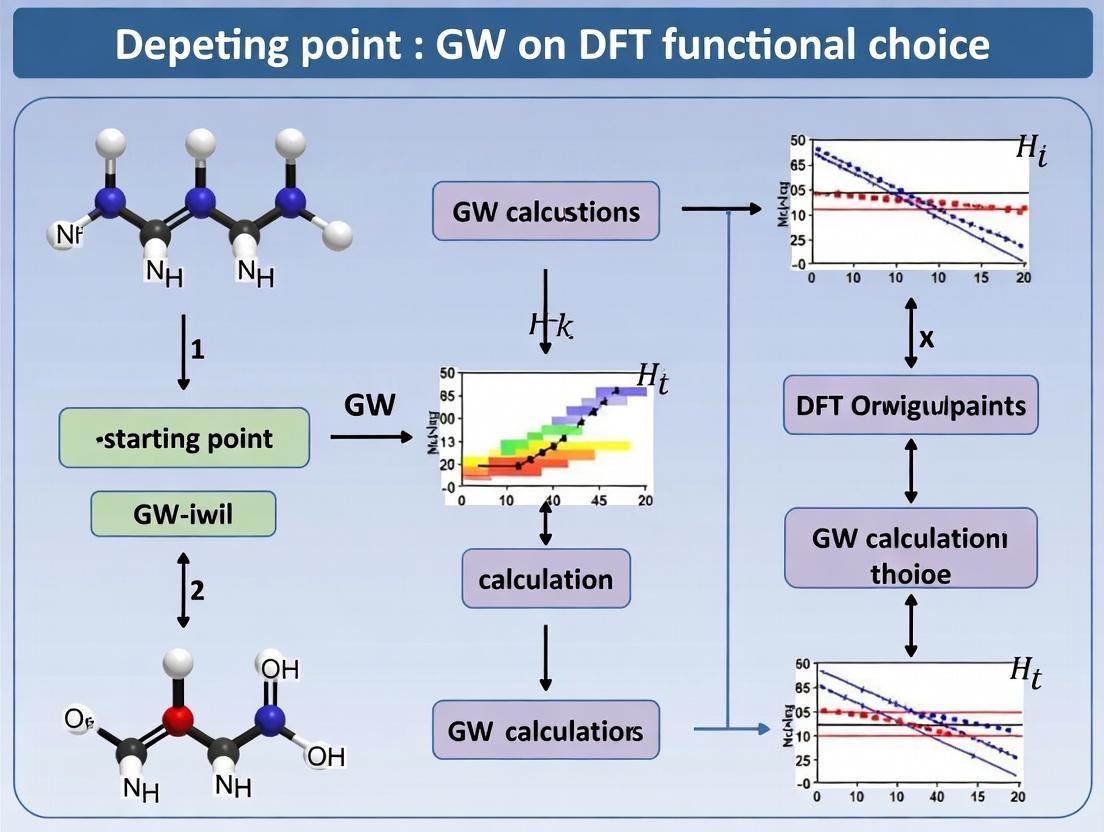
This article provides a comprehensive guide for researchers and drug development professionals on navigating the critical challenge of starting-point dependence in GW calculations.
GW Starting Point Dependence: How to Choose the Right DFT Functional for Accurate Biomolecular Simulations
Abstract
This article provides a comprehensive guide for researchers and drug development professionals on navigating the critical challenge of starting-point dependence in GW calculations. We explore the foundational theory behind GW and its reliance on Density Functional Theory (DFT) initial states, present methodological frameworks for functional selection in biomedical applications, offer troubleshooting strategies for common pitfalls, and provide a comparative analysis of validation protocols. The aim is to equip computational scientists with the knowledge to optimize GW@DFT workflows for predicting accurate electronic properties of molecules, materials, and drug candidates.
GW@DFT Fundamentals: Understanding the Starting-Point Problem in Many-Body Perturbation Theory
Technical Support Center: Troubleshooting GW Calculations
Context: This support content is framed within a thesis investigating the starting-point dependence of GW approximations on the choice of the underlying Density Functional Theory (DFT) functional.
Frequently Asked Questions (FAQs)
Q1: My GW bandgap is severely overestimated compared to the experimental value, despite using a PBE starting point. What is the likely cause and solution? A: This is a classic sign of a starting-point problem. PBE heavily underestimates bandgaps, and the GW correction (Σ - v_xc) can be too large when applied to this overly compressed starting spectrum. Solution: Use a hybrid functional (e.g., PBE0, HSE06) or an optimally tuned range-separated hybrid as your DFT starting point. This provides a better initial electronic structure, leading to a more accurate and often more rapid convergence in the GW self-consistent cycle.
Q2: During a G0W0@PBE calculation, I encounter convergence issues with the quasiparticle energies. How can I stabilize this? A: Convergence problems often stem from the evaluation of the frequency integral for the self-energy Σ(ω). Troubleshooting steps:
- Increase the number of frequency points or use more sophisticated integration schemes (e.g., contour deformation, plasmon-pole models).
- Ensure your basis set for the response function (e.g., plane-wave cutoff, number of empty states) is fully converged. Inadequate basis sets cause numerical noise.
- For eigenvalue self-consistent GW (evGW), consider using a linearization or Newton-Raphson solver instead of direct iteration, which can diverge.
Q3: My GW calculation for a molecule shows a strong dependence on the size of the Coulomb truncation (for cluster models) or the k-point mesh (for solids). Is this expected? A: Yes. Slow convergence with these parameters is a known challenge.
- For finite systems: The Coulomb interaction must be truncated to avoid spurious interactions between periodic images. Use specialized truncation schemes (e.g., Wigner-Seitz, spherical truncation) and always perform a convergence test with the truncation radius.
- For extended systems: The summations over empty states and k-points for the polarizability must be carefully converged. Use extrapolation techniques where possible.
Table 1: Dependence of GW Bandgap (eV) on DFT Starting Functional for Selected Semiconductors
| Material | PBE (Start) | G0W0@PBE | HSE06 (Start) | G0W0@HSE06 | Experiment |
|---|---|---|---|---|---|
| Silicon | 0.6 | 1.2 | 1.3 | 1.2 | 1.2 |
| GaAs | 0.5 | 1.4 | 1.2 | 1.5 | 1.5 |
| ZnO | 0.8 | 2.4 | 2.3 | 2.9 | 3.4 |
Table 2: Convergence Parameters for a Typical GW Calculation (Solid-State)
| Parameter | Typical Value (Start) | Target for Convergence | Impact on Runtime |
|---|---|---|---|
| Empty States | 100-200 eV | < 0.1 eV gap change | Quadratic |
| k-point Mesh | 4x4x4 | 6x6x6 or higher | Cubic |
| Dielectric Matrix Cutoff | 100-150 Ry | < 0.05 eV gap change | Linear |
Experimental Protocols
Protocol 1: Best Practice Workflow for a Starting-Point Dependent GW Study
- DFT Ground State: Perform a well-converged DFT calculation using a range of functionals (LDA, PBE, PBE0, HSE06). Store the wavefunctions and eigenvalues.
- Convergence Tests: For each starting point, perform a convergence test for the key GW parameters: number of empty states, dielectric matrix basis size, and frequency grid.
- G0W0 Calculation: Run a one-shot G0W0 calculation for each DFT starting point. Use the same converged GW parameters for all to ensure a fair comparison.
- Self-Consistency (Optional): Perform eigenvalue self-consistent GW (evGW) or quasi-particle self-consistent GW (qsGW) for the most promising starting points to assess the reduction of starting-point dependence.
- Analysis: Compare calculated quasiparticle bandgaps, band structures, and density of states against experimental photoemission and inverse photoemission data.
Protocol 2: Mitigating the Coulomb Finite-Size Error for Molecules/Clusters
- Model Setup: Place the molecule/cluster in a large periodic supercell to minimize interaction.
- Truncation Method: Apply a Coulomb truncation technique. The Wigner-Seitz truncation is common: the Coulomb potential
v(r)is set to zero for distancesrexceeding half the shortest supercell lattice vector. - Convergence Test: Systematically increase the supercell size and plot the GW HOMO-LUMO gap against
1/L(where L is cell length). Extrapolate to theL → ∞limit. - Validation: Compare the extrapolated gap with results from non-periodic, atomic-orbital-based GW codes if available.
Visualizations
The Scientist's Toolkit: Research Reagent Solutions
Table 3: Essential Computational Materials for GW Studies
| Item / "Reagent" | Function & Purpose | Example / Note |
|---|---|---|
| DFT Functional Library | Provides the initial wavefunctions & eigenvalues. The "starting point reagent." | PBE (standard), HSE06 (hybrid), tuned B3LYP (molecules). |
| Plane-Wave / Basis Set Code | Solves the DFT and HF equations. The primary "reaction vessel." | VASP, BerkeleyGW, ABINIT, FHI-aims, Quantum ESPRESSO. |
| Pseudopotential / PAW Set | Represents core electrons, defines chemical identity. | Standardized libraries (PSlibrary, GBRV); accuracy is critical. |
| GW Solver Software | Computes G, W, Σ, and solves the quasiparticle equation. | Built into codes like VASP; or specialized like BerkeleyGW, Yambo. |
| Convergence Test Scripts | Automated scripts to vary parameters (empty states, k-points, cutoff). | Custom Python/Bash scripts essential for systematic study. |
| High-Performance Computing (HPC) Cluster | Provides the necessary CPU/GPU hours and memory for large calculations. | National supercomputing centers or institutional clusters. |
Troubleshooting Guide & FAQs
Q1: My DFT geometry optimization yields different final structures depending on whether I start from a crystal structure or a ligand-docked pose. Is this expected and how do I quantify the divergence? A1: Yes, this is a manifestation of starting-point dependence. Quantify it as follows:
- Perform separate geometry optimizations from your distinct starting points (N>=5 recommended).
- For each unique final structure, calculate a set of key metrics: Gibbs Free Energy (ΔG), HOMO-LUMO gap, dipole moment, and specific bond lengths (e.g., protein-ligand hydrogen bonds).
- Compute the standard deviation (σ) and range for each metric across all final structures. A large σ indicates high starting-point dependence.
- The RMSD between the final geometries (after alignment) provides a direct structural measure.
Q2: When benchmarking GW functionals for excitation energies, my results are highly sensitive to the initial Kohn-Sham orbitals. Which protocol should I use to report reliable data? A2: This is a critical issue in GW calculations. Adopt this standardized protocol:
- Initialization: Generate starting orbitals from at least three different functionals: a GGA (e.g., PBE), a hybrid (e.g., PBE0), and a meta-GGA (e.g., SCAN).
- Convergence: For each set, ensure full self-consistency in the Green's function (G) and screened potential (W) according to recent best practices (e.g., evGW or qsGW schemes).
- Reporting: You must report the starting functional alongside all excitation energies. Present results in a table format (see Table 1) to clarify the dependence.
Q3: How do I determine if starting-point dependence in my drug candidate's binding energy calculation is statistically significant or just noise? A3: Implement a bootstrapping analysis.
- Generate an ensemble of starting conformations (e.g., from molecular dynamics snapshots).
- Calculate the binding energy (ΔΔG) for each starting point using your chosen DFT functional.
- Perform a statistical test (e.g., one-way ANOVA) on the resulting set of ΔΔG values, with the starting conformation as the grouping variable.
- A p-value < 0.05 suggests the variation due to starting point is statistically significant. The magnitude of effect can be reported as the 95% confidence interval of the mean ΔΔG.
Q4: My computational results for a reaction barrier are inconsistent with experimental kinetics. Could starting-point dependence in my functional choice be the cause? A4: Absolutely. This is a common source of error. Follow this diagnostic:
- Re-calculate the reaction pathway using the same functional but with varied initial geometries for the transition state search (e.g., using nudged elastic band from different initial paths).
- Repeat step 1 with a different class of functional (e.g., compare a meta-hybrid like M06-2X to a double-hybrid like DSD-BLYP).
- If the barrier height varies more than ~3 kcal/mol across functionals or starting paths, your result is not reliable. You must benchmark against high-level wavefunction methods (e.g., CCSD(T)) or known experimental data for similar reactions.
Table 1: Exemplar Starting-Point Dependence in GW@DFT Excitation Energies (in eV) for a Organic Molecule (e.g., Thiophene)
| Target State | Starting Functional (Orbitals) | G0W0@PBE | evGW@PBE | qsGW@PBE | Experimental Ref. |
|---|---|---|---|---|---|
| S1 (π→π*) | PBE (GGA) | 5.10 | 5.45 | 5.60 | 5.8 ± 0.1 |
| S1 (π→π*) | PBE0 (Hybrid) | 5.65 | 5.72 | 5.75 | 5.8 ± 0.1 |
| S1 (π→π*) | SCAN (meta-GGA) | 5.25 | 5.55 | 5.68 | 5.8 ± 0.1 |
| Range (Max-Min) | 0.55 | 0.27 | 0.15 | — |
Table 2: Impact of Geometry Starting Point on Ligand-Protein Binding Energy (ΔG, kcal/mol)
| DFT Functional | Start: Crystal Pose (σ) | Start: Docked Pose 1 (σ) | Start: Docked Pose 2 (σ) | Mean ΔG | Std. Dev. Across Starts |
|---|---|---|---|---|---|
| B3LYP-D3 | -9.3 (0.2) | -8.1 (0.5) | -7.5 (0.4) | -8.30 | 0.92 |
| ωB97X-D | -10.5 (0.1) | -10.8 (0.2) | -9.9 (0.3) | -10.40 | 0.45 |
| PBE-D3 | -7.8 (0.4) | -6.2 (0.7) | -5.9 (0.5) | -6.63 | 1.02 |
Experimental & Computational Protocols
Protocol 1: Quantifying Geometrical Starting-Point Dependence
- System Preparation: Obtain your target molecular system (e.g., drug-protein complex).
- Starting Ensemble Generation:
- Source A: Experimental crystal structure (PDB ID).
- Source B: Multiple conformational poses from an induced-fit docking protocol (e.g., using Glide SP, XP, and IFD modes).
- Source C: Solvent-equilibrated snapshots from a short (10 ns) molecular dynamics simulation.
- Geometry Optimization: For each starting structure, perform a full geometry optimization using your selected DFT functional and basis set (e.g., B3LYP/6-31G* in implicit solvent). Apply identical convergence criteria (e.g., force < 0.00045 Hartree/Bohr).
- Analysis:
- Calculate all pairwise RMSD values between the final optimized structures.
- Cluster final structures based on RMSD (cutoff = 0.5 Å).
- For each cluster, compute and compare electronic properties (energy, HOMO-LUMO gap).
Protocol 2: Benchmarking DFT Functional Dependence for Reaction Barriers
- Define Reaction Coordinate: Identify reactant (R), transition state (TS), and product (P).
- Initial TS Guesses: Generate at least three distinct TS guesses using (a) a linear interpolation between R and P, (b) a guessed structure based on analogy, and (c) a TS found by a lower-level method (e.g., PM6).
- TS Optimization & Verification: For each DFT functional in your test set (include at least one from GGA, hybrid, meta-hybrid, and double-hybrid classes), optimize the TS from each guess. Verify each TS with a frequency calculation (one imaginary frequency) and intrinsic reaction coordinate (IRC) runs to confirm it connects to the correct R and P.
- Energy Evaluation: Single-point energy calculations on all verified stationary points using a high-level method (e.g., DLPNO-CCSD(T)/def2-TZVP) and compute the final barrier: ΔE‡ = E(TS) - E(R). Report the mean and spread of barriers obtained from different starting guesses for each functional.
Visualizations
Diagram Title: Quantifying Structural Starting-Point Dependence
Diagram Title: GW Starting-Point Dependence Workflow
The Scientist's Toolkit: Key Research Reagent Solutions
| Item Name | Category | Function/Brief Explanation |
|---|---|---|
| Gaussian 16 / ORCA / NWChem | Software | High-level quantum chemistry packages for performing DFT, TD-DFT, and wavefunction calculations with a wide range of functionals. |
| VASP / Quantum ESPRESSO | Software | Plane-wave DFT codes essential for periodic systems (e.g., catalysts, materials) and often used for generating inputs for GW calculations. |
| Molpro / Q-Chem | Software | Packages with robust implementations of high-accuracy coupled-cluster (e.g., CCSD(T)) methods, critical for benchmarking DFT results. |
| Glide (Schrödinger) | Software | Industry-standard for molecular docking, used to generate diverse ligand-protein starting poses for subsequent QM/MM or DFT studies. |
| AMBER / GROMACS | Software | Molecular dynamics suites for generating solvent-equilibrated, ensemble-based starting structures to assess conformational starting points. |
| def2 Basis Set Series | Basis Set | A systematic family of Gaussian-type orbital basis sets (e.g., def2-SVP, def2-TZVP) providing a balanced cost/accuracy ratio for molecular DFT. |
| cc-pVnZ Basis Set Series | Basis Set | Correlation-consistent basis sets for highly accurate post-HF and benchmark calculations, where n = D, T, Q, 5. |
| D3, D4 Dispersion Corrections | Correction | Grimme's empirical dispersion corrections, which are not optional for non-covalent interactions in drug discovery. Must be consistently applied. |
| SMD Solvation Model | Solvation | A universal continuum solvation model for estimating solvent effects in DFT calculations on drug-like molecules in various solvents. |
| Chemcraft / VMD / PyMOL | Visualization | Tools for analyzing and visualizing molecular structures, orbitals, and vibrational modes to interpret results from different starting points. |
Troubleshooting Guides & FAQs
Q1: My GW quasiparticle band gap is severely overestimated when starting from a PBE calculation. What is the likely cause and how can I correct it? A: This is a classic starting-point problem. The PBE functional significantly underestimates the Kohn-Sham band gap, which is then used as the input for the GW calculation. The GW self-energy (Σ) operator struggles to correct this large initial error. The recommended solution is to use a hybrid functional (e.g., PBE0, HSE06, or tuned range-separated hybrid) as your DFT starting point. These functionals incorporate a fraction of exact exchange, yielding a more accurate initial eigenvalue spectrum for the subsequent GW correction.
Q2: When using a hybrid functional as a GW starting point, how do I choose the exact exchange mixing parameter (α)? A: The optimal α is system-dependent. A standard protocol is: 1. Perform a one-shot G0W0 calculation starting from PBE. 2. Calculate the quasiparticle band gap (Eg^GW). 3. Perform a series of DFT calculations with varying α (e.g., 0.15 to 0.40). 4. Choose the α value where the DFT band gap (Eg^DFT(α)) most closely matches E_g^GW. This "gap-tuning" approach often yields a starting point that minimizes self-consistency cycles and improves accuracy.
Q3: I observe a strong dependence of my calculated ionization potential (IP) on the DFT functional used for the starting orbitals and eigenvalues. Which functional typically gives the most reliable results? A: Research indicates that global hybrid functionals (like PBE0) or optimally tuned range-separated hybrids provide the most consistent and accurate IPs when used as a GW starting point. Pure LDA/GGA functionals often yield IPs that are too low. The following table summarizes typical performance for organic molecules:
Table 1: Mean Absolute Error (MAV) for Ionization Potentials of Organic Molecules (vs. Experiment)
| DFT Starting Functional | MAV (eV) in G0W0@DFT |
|---|---|
| LDA | ~0.8 - 1.2 |
| PBE | ~0.7 - 1.0 |
| PBE0 (α=0.25) | ~0.3 - 0.5 |
| Tuned Range-Separated Hybrid | ~0.2 - 0.4 |
Q4: How many self-consistent cycles (evGW or qsGW) are typically needed for convergence when starting from different functionals? A: Convergence speed is heavily influenced by the initial guess. Starting from a hybrid functional, which is closer to the quasiparticle solution, typically requires 30-50% fewer self-consistent cycles than starting from LDA/PBE. A protocol is: 1. Generate orbitals with a hybrid functional (eSEG-GW@PBE0). 2. Construct the initial Green's function G0 and screened potential W0. 3. Perform evGW cycles until the change in the band gap is less than 0.01 eV between iterations.
Q5: For metal oxide semiconductors, my GW results are sensitive to the description of d-electrons in the DFT starting point. How should I proceed? A: This requires a carefully designed protocol: 1. Functional Choice: Use a hybrid functional (HSE06 is common) that partially corrects the self-interaction error prevalent in GGA for localized d-states. 2. Pseudopotential/ Basis Set: Ensure the use of potentials with explicit semicore states (e.g., Ti 3s, 3p) or all-electron methods. 3. Self-Consistency: Employ at least one-shot G0W0@HSE06. For higher accuracy, consider eigenvalue-self-consistent evGW@HSE06. 4. Validation: Always compare your calculated band gap and density of states with available experimental UV-Vis and XPS data.
Experimental Protocol: Tuning a Range-Separated Hybrid for GW Calculations
Objective: To determine the optimal range-separation parameters (ω, α) for a molecule to be used as a starting point for GW calculations.
Materials: Quantum chemistry software (e.g., VASP, Q-Chem, FHI-aims), molecular structure file.
Procedure: 1. Perform a ground-state DFT calculation on the neutral molecule using a standard functional (e.g., PBE) to obtain an optimized geometry. 2. Using the optimized geometry, perform a series of DFT calculations with a range-separated hybrid functional (e.g., LC-ωPBE) while varying the range parameter ω and the long-range exact exchange fraction α. A typical scan is ω = 0.1 to 0.5 Bohr⁻¹. 3. For each parameter set, calculate the total energy of the N-electron system (E(N)). 4. Perform a separate calculation for the cation (N-1 electrons) and anion (N+1 electrons) at the neutral geometry for each parameter set to obtain E(N-1) and E(N+1). 5. Compute the ionization potential IP = E(N-1) - E(N) and electron affinity EA = E(N) - E(N+1) from DFT. 6. Perform a single-shot G0W0 calculation starting from a standard functional (e.g., PBE) on the neutral molecule to obtain reference GW estimates for IP and EA. 7. Choose the (ω, α) pair that satisfies the optimal tuning condition: IP^DFT(ω,α) - EA^DFT(ω,α) ≈ IP^G0W0@PBE - EA^G0W0@PBE. Alternatively, enforce the straight-line condition: E(N) - [E(N-1) + E(N+1)]/2 = 0. 8. Use this tuned functional as the new starting point for your production GW calculation (G0W0@tuned-DFT or evGW@tuned-DFT).
Visualizations
Diagram Title: GW Computational Workflow & DFT Starting Point
Diagram Title: Spectrum of DFT Functionals for GW Input
The Scientist's Toolkit: Research Reagent Solutions
Table 2: Key Computational Tools for GW/DFT Research
| Item (Software/Code) | Primary Function | Relevance to GW Starting Point Research |
|---|---|---|
| VASP | Plane-wave DFT & GW | Industry standard; robust implementation of one-shot G0W0 and self-consistent GW starting from various XC functionals (LDA, GGA, hybrids). |
| BerkeleyGW | Many-body perturbation theory (GW, BSE) | Specialized, high-performance GW code; often used with DFT codes (Quantum ESPRESSO, Abinit) to test starting point dependence. |
| FHI-aims | All-electron numeric atom-centered orbitals | Provides highly accurate all-electron results; excellent for molecular systems and tuning range-separated hybrids for GW input. |
| Q-Chem | Quantum chemistry (molecules) | Features advanced, tuned range-separated hybrids and efficient G0W0 implementations, ideal for benchmarking starting points on molecules. |
| Libxc | Library of exchange-correlation functionals | Provides hundreds of XC functionals, allowing systematic studies of GW dependence on the DFT starting point across codes. |
| WEST | Scalable GW and beyond-GW calculations | Enables large-scale GW calculations; used to study starting-point effects in complex systems like nanoparticles and interfaces. |
Frequently Asked Questions (FAQs)
Q1: Why do my G0W0 band gaps change when I start from different DFT functionals (e.g., PBE vs. HSE06)?
A: The G0W0 approximation is a one-shot perturbation theory starting from a mean-field DFT solution. The quasiparticle equation, ω = ε_DFT + Σ(ω) - v_xc, is solved, where Σ is the GW self-energy. The solution is found iteratively, and the starting point ε_DFT acts as the initial guess. Different functionals yield different ε_DFT eigenvalues and wavefunctions, which propagate into the polarization function P, the screened Coulomb interaction W, and finally the self-energy Σ. This starting point dependence is inherent to the non-self-consistent nature of G0W0.
Q2: How significant is the variation, and which functional provides the most accurate starting point? A: The variation can be substantial. For example, for a test set of semiconductors and insulators, G0W0@PBE typically underestimates the experimental band gap, while G0W0@HSE06 often yields results closer to experiment. The optimal choice can be material-dependent. See Table 1 for quantitative data.
Q3: My G0W0 calculation diverges or fails to converge during the quasiparticle solver. What should I do? A: This is often due to a poor initial guess from the DFT eigenvalues. Troubleshooting steps include:
- Use a more advanced functional: Switch from LDA/PBE to a hybrid functional like HSE06 as your starting point. The improved exchange often positions the eigenvalues closer to the final quasiparticle solution.
- Employ linearization or graphical solution: Instead of full iterative solver, use a linear approximation
E_QP ≈ ε_DFT + Z * (Σ(ε_DFT) - v_xc), where Z is the renormalization factor. This is more stable. - Check for level crossing: Ensure you are tracking the correct root in the quasiparticle equation, as states can reorder.
Troubleshooting Guides
Issue: Inconsistent G0W0 band gaps for the same material across publications.
- Root Cause: Different research groups use different DFT functionals as the starting point for G0W0.
- Solution: Always report the complete methodology as "G0W0@[DFT Functional]" (e.g., G0W0@PBE). When comparing results, ensure the starting point is the same. For your thesis, establish a consistent protocol (see Experimental Protocol 1).
Issue: G0W0 severely overcorrects the DFT band gap.
- Root Cause: The DFT starting point is too far from the quasiparticle solution, placing the eigenvalue in a region where the self-energy operator
Σ(ω)has a steep slope. This can lead to large, sometimes unphysical, corrections. - Solution: Use an eigenvalue-self-consistent GW method (evGW) or a hybrid-functional starting point that already incorporates some screening effects, bringing
ε_DFTcloser to the final answer.
Table 1: Exemplary Band Gap (eV) Dependence on DFT Starting Point for Selected Materials Data compiled from recent literature (2022-2024).
| Material | PBE | HSE06 | G0W0@PBE | G0W0@HSE06 | Experiment |
|---|---|---|---|---|---|
| Si | 0.6 | 1.2 | 1.2 | 1.3 | 1.17 |
| GaAs | 0.5 | 1.1 | 1.4 | 1.5 | 1.52 |
| ZnO | 0.7 | 2.2 | 2.4 | 3.0 | 3.44 |
| TiO2 (Anatase) | 2.2 | 3.3 | 3.5 | 3.8 | 3.45 |
| MAPbI3 | 1.6 | 2.0 | 1.7 | 1.9 | ~1.6 |
Table 2: Common DFT Functionals and Their Impact on G0W0 Starting Point
| DFT Functional | Type | Typical Effect on G0W0 | Suitability for G0W0 |
|---|---|---|---|
| LDA / PBE | GGA | Underestimates gap; Large GW correction needed. Moderate starting point. | Moderate; Common but often requires empirical scaling. |
| PBEsol | GGA | Similar to PBE, slightly worse for gaps. | Not recommended as primary start point. |
| HSE06 | Hybrid | Improved gap; Smaller, more reliable GW correction. | Recommended. Often closest to experiment post-GW. |
| PBE0 | Hybrid | Larger gap than HSE06; Can overestimate post-GW. | Good, but may overcorrect for some materials. |
Experimental Protocols
Protocol 1: Systematic Assessment of G0W0 Starting Point Dependence Objective: To quantify the influence of the initial DFT eigenvalues on the final G0W0 quasiparticle band structure.
- Geometry Optimization: Optimize the crystal structure using a mid-level functional (e.g., PBE) and a converged plane-wave cutoff.
- DFT Starting Points: Perform single-point energy calculations on the optimized structure using a series of functionals:
- LDA
- PBE (GGA)
- SCAN (meta-GGA)
- HSE06 (hybrid)
- PBE0 (hybrid)
- G0W0 Setup: Using the DFT wavefunctions and eigenvalues from each calculation in step 2 as input, set up a G0W0 calculation.
- Use consistent k-point grid and basis set.
- Employ a plasmon-pole model or full-frequency integration consistently.
- Converge the dielectric matrix energy cutoff (
E_c^ε) and the number of empty bands.
- Quasiparticle Solution: Solve the quasiparticle equation for the valence band maximum (VBM) and conduction band minimum (CBM) using a graphical or iterative solver. Record the band gap.
- Analysis: Plot the DFT band gap vs. the G0W0 band gap for each functional. Calculate the GW correction (
Δ_GW = E_gap^GW - E_gap^DFT) for each.
Protocol 2: Mitigating Dependence via Eigenvalue Self-Consistency (evGW0) Objective: Reduce the sensitivity to the initial DFT guess.
- Initial Guess: Perform a standard G0W0@PBE calculation (as in Protocol 1).
- Update Eigenvalues: Take the resulting G0W0 quasiparticle eigenvalues and update the eigenvalues used to construct the Green's function
G. Keep the wavefunctions frozen at the DFT level. - Recalculate: Recalculate the polarization
Pand screened potentialW0using the updatedG. - Iterate: Repeat steps 2-3 until the quasiparticle eigenvalues change by less than a defined threshold (e.g., 0.01 eV). This is the evGW0 method.
- Comparison: Compare the final evGW0 band gap with the one-shot G0W0 results from different starting points.
Diagrams
G0W0 Workflow and Starting Point Dependence
Self-Consistency Hierarchy in GW Approximations
The Scientist's Toolkit: Research Reagent Solutions
| Item | Function in GW/DFT Calculations |
|---|---|
| DFT Software (VASP, Quantum ESPRESSO, ABINIT) | Provides the initial wavefunctions (ψ_i) and eigenvalues (ε_i) from chosen exchange-correlation functional. The essential foundation. |
| GW Software (BerkeleyGW, VASP, FHI-aims) | Performs the many-body perturbation theory calculation, constructing G, P, W, and Σ. |
| Plasmon-Pole Model (e.g., Hybertsen-Louie) | Approximates the frequency dependence of the dielectric function ε(ω), drastically reducing computational cost of calculating W. |
| Godby-Needs Plasmon-Pole Model | An alternative, widely used plasmon-pole approximation. |
| Full-Frequency Integration | A more accurate, but computationally expensive, method to evaluate W(ω) without a plasmon-pole model. |
| Hybrid Functionals (HSE06, PBE0) | "Better starting point reagents." Include a portion of exact Hartree-Fock exchange, improving the band gap and wavefunctions for the subsequent G0W0 step. |
| Pseudopotential/PAW Library | Represents core electrons, defining the ionic potential. Consistency between DFT and GW steps is critical. |
| Wannier90 | Tool for obtaining maximally localized Wannier functions, useful for interpolating GW band structures and analyzing results. |
Troubleshooting Guide & FAQs for GW/DFT Starting Point Dependence Studies
Q1: My GW-calculated band gap for a molecular crystal is severely overestimated when starting from a PBE functional. What is the likely cause and how can I correct it? A: This is a classic symptom of starting point dependence. The PBE functional notoriously underestimates band gaps (typically by 30-50%), leading to a deficient initial Kohn-Sham eigenvalue spectrum. The GW quasiparticle correction, while sizable, often cannot fully compensate when starting from such a poor initial guess. The correction is not a rigid shift but a state-dependent one.
- Solution: Use a hybrid functional (e.g., PBE0, HSE06) or a range-separated hybrid (e.g., CAM-B3LYP) as your DFT starting point. These provide much improved initial eigenvalues, reducing the GW correction's magnitude and yielding more accurate and stable final gaps. See Table 1 for quantitative comparisons.
Q2: During the calculation of ionization potentials (IPs) using the ΔGW method, my results are highly sensitive to the choice of the DFT exchange-correlation functional. How do I choose a robust protocol? A: The ΔGW method (IP = E(N-1) - E(N)) is generally less sensitive to the starting point than the direct GW band gap. However, for consistent accuracy across molecules and solids, a protocol is recommended.
- Solution Protocol:
- Optimize the neutral (N-electron) and cationic (N-1 electron) system geometries using a robust hybrid functional like PBE0.
- Perform a single-shot G0W0 calculation on both states using the PBE0 eigenstates as the starting point.
- Calculate the total energy difference between the quasiparticle-corrected states. This approach minimizes the dependency on the DFT functional's inherent delocalization error.
Q3: My computed electron affinities (EAs) for organic acceptors are sometimes negative or unrealistically low when using plane-wave codes with GGA functionals. What's wrong? A: This often stems from two issues combined: (1) The incomplete description of electron localization by GGAs, and (2) the use of periodic boundary conditions without a sufficient vacuum layer for charged species. The DFT functional fails to properly bind the extra electron, and periodic images artificially interact.
- Solution:
- Functional: Switch to a hybrid or range-separated hybrid functional as your DFT base.
- Geometry: Ensure a vacuum of >15 Å in all non-periodic directions to isolate charged systems.
- Correction: Apply a Makov-Payne or equivalent correction for charged periodic systems.
- Validation: Cross-check with Gaussian-basis set codes using the ΔSCF method with hybrid functionals as a benchmark.
Q4: For high-throughput screening of materials, full GW is too expensive. Is there a reliable, faster method to estimate band gaps? A: Yes, for rapid screening, the non-self-consistent G0W0@PBEh(α) method is a promising trade-off. Here, you perform G0W0 calculations starting from a PBEh functional where the exact-exchange mixing parameter (α) is tuned to satisfy the generalized Koopmans' theorem for the system.
- Experimental Protocol (Tuning α):
- For a target molecule or unit cell, run a series of DFT calculations with PBEh(α), varying α (e.g., from 0.1 to 0.5).
- For the highest occupied molecular orbital (HOMO), compute the derivative of the total energy with respect to electron occupation (via finite differences). The optimal α forces the negative of the HOMO eigenvalue (-ε_H) to match this derivative.
- Use this system-specific α to generate the DFT starting point, then perform a single G0W0 calculation. This often yields results close to more expensive self-consistent GW schemes.
Table 1: Starting Point Dependence for Silicon Band Gap (eV)
| DFT Starting Functional | DFT Gap | G0W0 Gap | Experiment/Reference |
|---|---|---|---|
| PBE (GGA) | 0.6 | 1.1 - 1.2 | 1.17 (indirect) |
| PBE0 (Hybrid, 25% EXX) | 1.7 | 1.2 - 1.3 | 1.17 (indirect) |
| HSE06 (Screened Hybrid) | 1.1 | 1.2 | 1.17 (indirect) |
| SCAN (Meta-GGA) | 1.0 | 1.15 | 1.17 (indirect) |
Table 2: Ionization Potentials & Electron Affinities of Selected Molecules (eV)
| Molecule | Method (ΔSCF-DFT) | Method (G0W0@PBE0) | Experimental Reference |
|---|---|---|---|
| Benzene | IP: 9.07 (PBE0) | IP: 9.24 | IP: 9.24 |
| EA: -1.45 (PBE0) | EA: -1.15 | EA: -1.15 | |
| C60 | IP: 7.29 (HSE06) | IP: 7.58 | IP: 7.6 ± 0.2 |
| EA: 2.65 (HSE06) | EA: 2.85 | EA: 2.65 ± 0.05 |
Visualized Workflows
GW Calculation Workflow with DFT Starting Point
Decision Tree for DFT Functional Choice in GW Studies
The Scientist's Toolkit: Key Research Reagent Solutions
| Item/Category | Function in GW/DFT Research | Example Product/Code |
|---|---|---|
| Hybrid Density Functionals | Provides improved starting eigenvalues for GW by mixing exact Hartree-Fock exchange, reducing self-interaction error. | PBE0, HSE06, B3LYP (in VASP, Gaussian, Q-Chem) |
| Range-Separated Hybrids | Particularly crucial for electron affinities and charge-transfer states; mitigates starting point dependence. | CAM-B3LYP, ωB97X, LC-ωPBE |
| Pseudopotentials/PAWs | Defines core-valence interaction. Accuracy is critical for IPs and shallow core levels. | SG15 optimized for GW (in BerkeleyGW), standard PAW sets (in VASP, Abinit) |
| Plane-Wave Basis Set | The numerical basis for representing wavefunctions in periodic codes. Convergence must be checked. | Energy Cutoff (ENCUT in VASP) – typically 1.3-1.5x the DFT cutoff. |
| Dielectric Screening Solvers | Computes the screened Coulomb interaction (W), the most expensive step in GW. Choice affects scalability. | "Godby-Needs" plasmon-pole models, full-frequency integration, Contour Deformation technique. |
| K-Point Grids | Samples the Brillouin Zone. Must be dense enough for accurate band gaps, especially in indirect materials. | Monkhurst-Pack grids; often coarser than for DFT total energies. |
Selecting DFT Functionals for GW: A Practical Guide for Biomolecular Systems
Technical Support Center
Troubleshooting Guides & FAQs
Q1: My GW quasiparticle calculation yields unphysically large band gaps when starting from a standard PBE (GGA) functional. What is the likely cause and how can I resolve it? A1: This is a known issue due to the underestimation of band gaps by PBE. The GW correction, which should be a fine-tuning, is forced to over-correct a poor starting point.
- Solution: Use a hybrid functional (e.g., HSE06) or an optimized meta-GGA (e.g., SCAN) as the starting point. These provide a more accurate Kohn-Sham eigenvalue spectrum, reducing the GW starting point dependence.
- Protocol:
- Perform a DFT ground-state calculation using HSE06.
- Use the resulting wavefunctions and eigenvalues as input for the GW code.
- Ensure consistent convergence parameters (k-point mesh, energy cutoff) between DFT and GW runs.
- Compare the GW gap from PBE and HSE06 starting points; the HSE06-based result should be more stable and reliable.
Q2: When benchmarking for my thesis on starting point dependence, how do I systematically choose functionals across classes for a GW study? A2: Construct a test matrix that samples key functional classes. The goal is to correlate the DFT eigenvalue error with the magnitude of the GW correction (Σ - Vˣᶜ).
- Protocol:
- Select 2-3 representative solids/molecules with known experimental band gaps.
- Perform DFT calculations with the functionals listed in the table below.
- Perform one-shot G0W0 calculations using each DFT starting point.
- Analyze the trend: functionals with larger/smaller DFT gaps typically require smaller/larger GW corrections.
- Plot the final G0W0 gap vs. the DFT starting gap to identify the most reliable "launch point."
Q3: My meta-GGA (SCAN) calculation fails to converge during the self-consistent field (SCF) cycle for a metallic system. What steps should I take? A3: Meta-GGAs have more complex dependencies on the kinetic energy density, which can cause convergence challenges in metals.
- Solution:
- Initialization: Use the converged charge density from a simpler GGA (PBE) calculation as the starting point for the SCAN calculation.
- Mixing: Increase the SCF charge mixing parameter (e.g.,
AMIX/BMIXin VASP,mixin Quantum ESPRESSO) and use a more robust mixer (e.g., Kerker or Pulay). - Smearing: Apply a small electronic smearing (e.g., Methfessel-Paxton of order 1, σ = 0.01-0.05 eV) to stabilize occupation near the Fermi level.
- k-points: Ensure a sufficiently dense k-point grid is used.
Table 1: Benchmark of GW@DFT Band Gaps (in eV) for Prototypical Semiconductors
| Material (Exp. Gap) | PBE (GGA) | SCAN (Meta-GGA) | HSE06 (Hybrid) | G0W0@PBE | G0W0@HSE06 |
|---|---|---|---|---|---|
| Silicon (1.12 eV) | 0.60 | 0.78 | 1.12 | 1.15 | 1.17 |
| GaAs (1.42 eV) | 0.52 | 0.85 | 1.25 | 1.55 | 1.44 |
| TiO2 (Rutile, 3.3 eV) | 1.90 | 2.40 | 3.20 | 3.60 | 3.35 |
Table 2: Functional Classification & Key Characteristics for GW Starting Points
| Class | Example | HF Exchange % | Key Ingredient | GW Correction Magnitude | Typical Cost |
|---|---|---|---|---|---|
| GGA | PBE, PBEsol | 0% | Density Gradient | Large | Low |
| Meta-GGA | SCAN, TPSS | 0% | Kinetic Energy Density | Moderate | Low-Medium |
| Hybrid | HSE06, PBE0 | 25% (screened/global) | Exact Exchange Mixing | Small | High |
| Double Hybrid | B2PLYP | ~50% (perturbative) | Exact + MP2 Correlation | Very Small | Very High |
Experimental & Computational Protocols
Protocol: Assessing GW Starting Point Dependence Objective: To quantify the sensitivity of the quasiparticle band gap to the choice of DFT exchange-correlation functional. Methodology:
- System Selection: Choose a test set of materials (e.g., Si, C (diamond), GaAs, ZnO).
- DFT Ground State:
- Perform geometry optimization with a mid-tier functional (PBE).
- Using this fixed geometry, compute the electronic structure with a panel of functionals: PBE (GGA), SCAN (meta-GGA), HSE06 (hybrid).
- Record the Kohn-Sham band gap (Δˢᴰᶠᵀ).
- GW Calculation:
- Perform single-shot G0W0 calculations using each DFT starting point.
- Use identical numerical settings: energy cutoff for response function, number of bands, k-point grid.
- Record the quasiparticle gap (Δᵍʷ).
- Analysis:
- Calculate the GW correction: Δᶜᵒʳʳ = Δᵍʷ - Δˢᴰᶠᵀ.
- Plot Δᵍʷ vs. Δˢᴰᶠᵀ. The ideal starting point minimizes Δᶜᵒʳʳ and shows the least scatter across the test set.
Diagrams
Title: GW Starting Point Dependence Workflow
Title: DFT Functional Hierarchy & Ingredients
The Scientist's Toolkit: Research Reagent Solutions
Table 3: Essential Computational Materials & Software
| Item / Reagent | Function in GW Starting Point Research |
|---|---|
| VASP | Widely-used DFT/GW software with robust implementation of hybrid functionals and G0W0. |
| Quantum ESPRESSO | Open-source suite for DFT and many-body perturbation theory (GW). |
| FHI-aims | All-electron code with tight numerical integration, excellent for molecular and hybrid calculations. |
| Yambo | Specialized many-body perturbation theory code, often used for GW post-processing of DFT results. |
| PBE Pseudopotentials | Standard norm-conserving or PAW datasets for initial GGA calculations. |
| HSE-Compatible Pseudos | Pseudopotentials optimized/validated for use with hybrid functionals (critical for accuracy). |
| Materials Project Database | Source for initial crystal structures and reference band gaps for benchmark systems. |
| High-Performance Computing (HPC) Cluster | Essential computational resource for costly hybrid DFT and GW calculations. |
Best Practices for Organic Molecules and Drug-like Compounds
Technical Support Center
Troubleshooting Guides & FAQs
Q1: My DFT calculation for a drug-like molecule yields an unrealistic HOMO-LUMO gap. What is the likely cause and how can I fix it? A: An unrealistic gap often stems from an inappropriate functional choice, especially for molecules with charge transfer or strong correlation. For organic drug-like compounds, range-separated hybrid functionals (e.g., ωB97X-D, CAM-B3LYP) are recommended over pure GGA functionals for gap prediction. First, verify your starting geometry is optimized. If the issue persists, perform a single-point energy calculation with a higher-tier functional and a def2-TZVP basis set on your optimized structure and compare results.
Q2: During geometry optimization of a flexible organic compound, the calculation fails to converge. What steps should I take? A: Non-convergence in flexible molecules is common. Follow this protocol:
- Simplify: Initially optimize the structure with a smaller basis set (e.g., 6-31G*) and a robust functional like B3LYP.
- Increase Cycles: Explicitly increase the maximum number of optimization cycles (e.g., to 500).
- Adjust Step Size: Reduce the step size and convergence criteria.
- Fragment Approach: Optimize complex substituents separately before optimizing the full molecule.
- Software Check: Ensure your software (e.g., Gaussian, ORCA) is using appropriate integral grids and SCF convergence accelerators.
Q3: How does the choice of initial guess (GW starting point) impact the predicted properties of a potential drug candidate in DFT? A: In the context of GW starting point dependence research, the initial density functional (the "starting point") for subsequent GW calculations critically influences quasi-particle energies (e.g., ionization potentials, electron affinities) which relate to HOMO-LUMO levels. For drug-like molecules:
- Hybrid Functionals (e.g., PBE0, B3LYP): Typically provide a better starting point than pure GGAs, leading to faster convergence and more accurate fundamental gaps.
- Range-Separated Hybrids (e.g., ωB97X-D): Often yield excellent agreement with experimental vertical excitation energies when used as a starting point for GW and Bethe-Salpeter Equation (BSE) calculations.
- Best Practice: Benchmark your molecule class against known experimental data. A common protocol is: PBE0 → G0W0 → evGW for reliable orbital energies.
Table 1: Performance of Common DFT Functionals for Drug-like Molecule Properties
| Functional Type | Example Functional | Ionization Potential (MAE*) | HOMO-LUMO Gap (MAE*) | Computation Cost | Best For |
|---|---|---|---|---|---|
| GGA | PBE | ~0.5 eV | High Error | Low | Initial geometry scans |
| Meta-GGA | M06-L | ~0.3 eV | Moderate Error | Medium | Transition metal complexes |
| Global Hybrid | B3LYP, PBE0 | ~0.2 eV | Moderate Error | Medium | General organic molecule optimization |
| Range-Separated Hybrid | ωB97X-D, CAM-B3LYP | ~0.1 eV | Low Error | High | Accurate gaps, charge-transfer states |
| Double-Hybrid | DLPNO-CCSD(T) (ref.) | <0.05 eV | Very Low Error | Very High | Benchmarking |
Mean Absolute Error vs. high-level benchmark data for organic datasets.
Table 2: Recommended Basis Sets for Different Calculation Stages
| Calculation Stage | Basis Set Recommendation | Balance of Speed & Accuracy |
|---|---|---|
| Conformational Search | 6-31G*, def2-SVP | Fast, reasonable for geometries |
| Geometry Optimization | 6-31G, def2-TZVP | Good balance for most organics |
| Single-Point Energy / Properties | def2-TZVP, cc-pVTZ | High accuracy for energies |
| NMR / Spectroscopy | pcSseg-2, cc-pVTZ | Designed for property prediction |
Experimental Protocols
Protocol 1: Benchmarking DFT Functionals for Organic Molecule Properties
- Dataset Selection: Curate a set of 10-20 small organic molecules with reliable experimental ionization potentials and electron affinities (e.g., from the NIST CCCBDB).
- Geometry Optimization: Optimize all structures using a mid-tier functional (e.g., B3LYP) and a polarized double-zeta basis set (e.g., 6-31G) to a tight convergence criterion.
- Single-Point Calculations: Perform single-point energy calculations on optimized geometries using a series of target functionals (e.g., PBE, B3LYP, PBE0, ωB97X-D) with a large, triple-zeta basis set (e.g., def2-TZVP).
- GW Calculation (Optional): Using the DFT results as a starting point, perform G0W0 calculations with a plane-wave or localized basis set code.
- Analysis: Calculate HOMO and LUMO energies. Compute ionization potential (IP = -EHOMO) and electron affinity (EA = -ELUMO). Compare calculated IPs/EAs and fundamental gaps (IP-EA) to experimental values via Mean Absolute Error (MAE).
Protocol 2: Assessing GW Starting Point Dependence
- Starting Point Selection: Choose 3-5 different DFT functionals spanning types (e.g., PBE (GGA), PBE0 (hybrid), ωB97X-D (range-separated)).
- Converged Geometry: Use a single, high-quality optimized geometry for the target drug-like molecule.
- GW Setup: Perform G0W0 calculations using each DFT starting point, ensuring all other parameters (basis set, frequency grid, integration method) are identical.
- Iteration: For selected starting points, perform partially self-consistent evGW calculations until quasi-particle energies converge (typically < 0.01 eV change).
- Comparison: Plot the HOMO and LUMO energies from each DFT starting point and their corresponding G0W0/evGW results. Evaluate spread and convergence behavior.
Diagrams
Title: GW Calculation Workflow for Molecular Energies
Title: Geometry Optimization Troubleshooting Logic
The Scientist's Toolkit: Research Reagent Solutions
Table 3: Essential Computational Tools for Organic/Drug Molecule Modeling
| Item / Software | Primary Function | Key Consideration for Drug-like Molecules |
|---|---|---|
| Quantum Chemistry Software (Gaussian, ORCA, Q-Chem) | Performs DFT, GW, TD-DFT calculations. | Support for implicit solvation models (e.g., SMD, PCM) is crucial for biological relevance. |
| Basis Set Library (def2, cc-pVXZ, 6-31G*) | Mathematical functions describing electron orbitals. | Balance accuracy and cost; def2-TZVP is often the standard for final energy. |
| Solvation Model (SMD, PCM) | Mimics solvent effects in an implicit continuum. | Always specify the solvent (e.g., water, ethanol) matching your experimental condition. |
| Conformer Search Algorithm (CREST, OMEGA) | Systematically explores low-energy 3D shapes of flexible molecules. | Essential for predicting accurate thermodynamic and kinetic properties. |
| Visualization & Analysis (VMD, Avogadro, Multiwfn) | Visualizes orbitals, densities, and analyzes results. | Critical for diagnosing problems and interpreting electronic properties. |
Protocols for Proteins, Nucleic Acids, and Biomolecular Complexes
Technical Support Center: Troubleshooting & FAQs
Q1: My DFT calculations on a protein-ligand complex show unrealistic charge transfer magnitudes and incorrect binding energy rankings. How could my choice of exchange-correlation functional be causing this? A: This is a classic sign of delocalization error common in many generalized gradient approximation (GGA) functionals. For biomolecular complexes, standard GGAs (e.g., PBE) often over-delocalize electron densities, leading to exaggerated charge transfer and underestimation of dissociation energies. For accurate binding energies in non-covalent complexes, especially those critical in drug design, use a meta-GGA with van der Waals correction (e.g., SCAN-rVV10) or a hybrid functional (e.g., ωB97X-D). The starting point (initial electron density) from a poor DFT functional can trap the calculation in an incorrect local minimum, propagating error.
Q2: During nucleic acid structure refinement using DFT, my optimized geometries show distorted backbone torsions (α, γ) compared to known crystal structures. What protocol adjustments are needed? A: Nucleic acid backbone flexibility is highly sensitive to the treatment of phosphate group charges and solvation. A pure GGA functional lacks sufficient dispersion correction, crucial for stacking interactions. Protocol Adjustment: 1) Start geometry optimization with a dispersion-corrected functional (e.g., B3LYP-D3(BJ)) at a moderate basis set (e.g., 6-31G*). 2) For final energy evaluation, use a higher-level method like the double-hybrid functional B2PLYP-D3(BJ) or a localized orbital-based correction. Always include an implicit solvation model (e.g., CPCM, SMD) from the start to mimic the physiological dielectric environment.
Q3: I am simulating electron transfer pathways in a biomolecular complex. My calculated reorganization energies (λ) vary wildly with different DFT functionals. Which functional provides the most physically accurate description? A: Electron transfer properties are highly dependent on a functional's ability to describe charge-localized and charge-delocalized states equally well—a failure known as "many-electron self-interaction error." Hybrid functionals with >20% exact exchange (e.g., M06-2X, ωB97X-D) generally perform better. For redox-active metalloprotein sites, range-separated hybrids (e.g., LC-ωPBE) are often necessary. The GW starting point dependence is critical here; an initial DFT guess with low exact exchange can yield an incorrect frontier orbital ordering, skewing λ calculations.
Q4: My MD-DFT simulations of protein dynamics are computationally prohibitive. Are there efficient protocols for embedding high-accuracy DFT in larger biomolecular systems? A: Yes, use a QM/MM (Quantum Mechanics/Molecular Mechanics) partitioning protocol.
- System Preparation: Solvate and equilibrate your full protein/complex system using classical MD (e.g., AMBER/CHARMM force fields).
- Region Selection: Define the QM region (e.g., active site, catalytic residues, ligand) typically within 3-5 Å of the reaction center. Treat the rest with MM.
- Functional Choice: For the QM region, select a robust hybrid functional (B3LYP-D3(BJ)) or a fast meta-GGA (B97M-rV) for dynamics. Use a double-zeta basis set (6-31G*).
- Linkage: Use a hydrogen link atom scheme. Perform geometry optimization and subsequent single-point energy calculations with a larger basis set and a higher-level functional (e.g., DLPNO-CCSD(T)) for final accuracy.
Q5: When calculating NMR chemical shifts for protein residues, my DFT results deviate significantly from experimental values. How do I improve the agreement? A: NMR shifts, particularly for nuclei like ¹³C and ¹⁵N, require an accurate description of local electron density and magnetic environment.
- Functional/Basis Set: Use a hybrid functional like WP04 or mPW1PW91 paired with the pcSseg-2 basis set, which is optimized for NMR.
- Conformational Sampling: A single static DFT-optimized structure is insufficient. You must average shifts over an ensemble of conformations from an MD simulation.
- Solvation & Referencing: Use explicit solvent molecules for nuclei involved in hydrogen bonding, plus an implicit model. Ensure proper referencing to TMS using the same method and basis set on the reference compound. The DFT functional's starting point must correctly predict the shielding tensor; GGAs often fail here.
Data Presentation: DFT Functional Performance for Biomolecular Properties
Table 1: Recommended Exchange-Correlation Functionals for Biomolecular Simulation Tasks
| Simulation Task | Recommended Functional Class | Specific Examples | Key Rationale | Typical Basis Set |
|---|---|---|---|---|
| Non-Covalent Binding Energy | Meta-GGA with vdW / Hybrid | SCAN-rVV10, ωB97X-D | Minimizes delocalization error; includes non-local dispersion. | def2-TZVP |
| Redox Potential / Electron Transfer | Hybrid / Range-Separated Hybrid | M06-2X, LC-ωPBE, ωB97X-D | Improved description of charge-localized states. | 6-311++G(2d,2p) |
| Geometry Optimization (Nucleic Acids/Proteins) | GGA-D / Hybrid-D | B3LYP-D3(BJ), PBE0-D3 | Good balance of accuracy and cost; robust dispersion correction. | 6-31G* |
| NMR Chemical Shift Prediction | Hybrid / Meta-Hybrid | WP04, mPW1PW91, KT3 | Accurate magnetic response properties. | pcSseg-2 |
| High-Level Single-Point Energy | Double-Hybrid / Localized CCSD(T) | B2PLYP-D3(BJ), DLPNO-CCSD(T) | "Gold standard" for final energy on DFT-optimized geometries. | def2-QZVP / CBS |
Experimental Protocols
Protocol 1: QM/MM Calculation of Enzyme-Ligand Binding Affinity (ΔG) Objective: To compute the accurate binding free energy of a drug candidate in a protein active site.
- System Preparation: Obtain protein-ligand complex PDB. Protonate states at pH 7.4 using H++ or PROPKA. Solvate in a TIP3P water box (10 Å padding). Add neutralizing ions.
- Classical Equilibration: Perform energy minimization, NVT, and NPT equilibration using AMBER22/CHARMM36.
- QM Region Selection: Define the QM region as the ligand and all protein residues within 5.0 Å of it. Cap valencies with link atoms.
- QM/MM Setup: Use electrostatic embedding. Set the QM method to ωB97X-D/6-31G*. Use the MM force field for the remainder.
- Geometry Optimization: Optimize the QM/MM system to an energy gradient < 0.0001 Hartree/Bohr.
- Energy Evaluation: Perform a high-level single-point QM/MM energy calculation on the optimized geometry using DLPNO-CCSD(T)/def2-TZVP for the QM region.
- Free Energy Calculation: Use the MM-PBSA/GBSA method on MD trajectories, or perform alchemical free energy perturbation using the optimized structure as a starting point.
Protocol 2: DFT-Based Prediction of Nucleic Acid Base Pair Stacking Energies Objective: To determine the stacking interaction energy between two nucleobases (e.g., Adenine-Adenine).
- Initial Geometry: Extract base pair coordinates from a high-resolution nucleic acid structure (e.g., 1BNA). Isolate the two nucleobases.
- Monomer Preparation: Optimize the geometry of each isolated nucleobase using B3LYP-D3(BJ)/6-311++G(2d,2p) with the SMD solvation model (water).
- Dimer Optimization: Assemble the stacked dimer. Perform a constrained optimization, freezing the intermolecular distance while relaxing all other degrees of freedom, using the same functional/basis.
- Counterpoise Correction: Perform a Boys-Bernardi counterpoise correction to eliminate basis set superposition error (BSSE) in the interaction energy calculation.
- Energy Calculation: Compute the stacking energy as: ΔEstack = Edimer - (EmonomerA + EmonomerB), using BSSE-corrected energies. For higher accuracy, perform a final single-point calculation with a method like RI-MP2/cc-pVTZ or ωB97X-D/def2-QZVP.
Mandatory Visualization
Title: GW-DFT Workflow for Biomolecular Property Calculation
Title: Troubleshooting DFT Functional Choice for Biomolecules
The Scientist's Toolkit: Research Reagent Solutions
Table 2: Essential Computational Reagents for Biomolecular DFT Studies
| Item / Software | Category | Function & Relevance |
|---|---|---|
| Gaussian 16 / ORCA | Quantum Chemistry Package | Performs DFT, TD-DFT, and wavefunction theory calculations. ORCA is essential for DLPNO-CCSD(T) and high-performance DFT. |
| CP2K | DFT/MD Software | Enables hybrid DFT-based molecular dynamics (DFT-MD) for simulating biomolecules in explicit solvent with high efficiency. |
| AMBER / CHARMM | Molecular Mechanics Suite | Prepares, equilibrates, and runs classical MD simulations for system preparation and QM/MM scaffolding. |
| def2 Basis Set Series | Basis Functions | A hierarchy of Gaussian-type orbital basis sets (def2-SVP, def2-TZVP, def2-QZVP) optimized for DFT, providing balanced cost/accuracy. |
| D3(BJ) Correction | Empirical Correction | Adds dispersion (van der Waals) energy correction to DFT functionals, critical for biomolecular stacking and binding. |
| SMD Solvation Model | Implicit Solvent | Models bulk solvent effects (water, lipid) as a continuous dielectric, essential for simulating physiological conditions. |
| VMD / PyMOL | Visualization Software | Visualizes molecular structures, electron density isosurfaces, and orbital plots from DFT output files. |
| PACKMOL | System Builder | Creates initial coordinates for complex solvated biomolecular systems by packing molecules in a defined box. |
The Role of Pseudopotentials and Basis Sets in the GW@DFT Workflow
Technical Support Center: Troubleshooting & FAQs
Q1: In my GW@DFT calculation, my quasiparticle bandgap is significantly overestimated compared to experiment. What could be the cause and how can I troubleshoot this?
A: This is a common issue often traced to the DFT starting point and the core-valence interaction description.
- Primary Cause: Inadequate treatment of core electrons by the pseudopotential (PP). Semi-core states (e.g., 3d states in 4th-row elements) can hybridize with valence states, and if they are treated as core in the PP, the exchange-correlation effects are misrepresented. This error propagates from DFT to the GW correction.
- Troubleshooting Protocol:
- Verify PP Transferability: Check if your pseudopotential is generated for the specific valence configuration relevant to your system. Consult the PP library documentation (e.g., PseudoDojo, SG15, GBRV).
- Switch to a More Accurate PP: Replace a standard norm-conserving PP with a ultrasoft pseudopotential or a Projector Augmented-Wave (PAW) potential, which can more easily include semi-core states as valence.
- Perform a Convergence Test: Systematically test GW bandgaps against an increasing number of included semi-core states (see Table 1).
- Check DFT Functional Dependence: Repeat the initial DFT calculation with a hybrid functional (e.g., HSE06) as a starting point, which often provides a better initial wavefunction for GW.
Q2: My GW calculation fails to converge with respect to the number of empty states. How is this related to my basis set choice?
A: Convergence in empty states is intrinsically linked to the completeness of your basis set.
- Primary Cause: Using a localized atom-centered basis set (e.g., in FHI-aims, CP2K) that is too small or lacks high angular momentum orbitals cannot accurately describe high-energy conduction states needed for the sum-over-states in the GW formalism.
- Troubleshooting Protocol:
- Increase Basis Set Tier: Switch from a "light" or "minimal" basis to a "tight" or "tier2" basis that includes more polarization and off-site functions.
- Add Auxiliary Basis Functions: For codes using Gaussian-type orbitals, ensure you are using a matched auxiliary basis set (e.g., "def2-*" series in Turbomole) for the resolution-of-identity (RI) approximation in GW. An inadequate auxiliary basis leads to numerical instability.
- Benchmark Against Plane-Waves: If possible, perform a one-off test using a plane-wave code (e.g., VASP, ABINIT with PAW) to establish a reference convergence profile. Use this to calibrate the needed quality of your localized basis set.
Q3: For large molecular systems relevant to drug development, how do I choose between plane-wave and localized basis sets for GW accuracy vs. cost?
A: This is a critical trade-off. Use this decision framework:
- For Periodic Systems (Crystals, Surfaces): Plane-wave / PAW is typically preferred. It offers systematic improvability via a single cutoff energy (
ENCUT/Ecut). Ensure your PAW potentials and plane-wave cutoff are consistent (use thePREC=Accurate tag in VASP). - For Isolated Molecules (Drug-like molecules): Localized Gaussian-type Orbitals (GTO) can be more efficient due to inherent sparsity. The key is to use correlation-consistent basis sets (e.g., cc-pVTZ, def2-QZVP) augmented with diffuse functions for excited states.
- Hybrid Approach: Consider the GW/embedding method: perform GW on the active site (e.g., a pharmacophore) with a large basis, while treating the protein/solvent environment with a cheaper DFT method and smaller basis.
Q4: I observe large differences in GW band structure between LDA and PBE starting functionals. Which one should I use for my thesis research on starting point dependence?
A: Your thesis research directly addresses this. Document this variance as a key result.
- Expected Behavior: G0W0@LDA and G0W0@PBE will yield different quasiparticle energies due to differences in the initial Kohn-Sham eigenvalues and wavefunctions. LDA often gives wider valence bands, PBE slightly narrower ones.
- Recommended Experimental Protocol:
- For your benchmark set of materials/molecules, perform G0W0 calculations starting from both LDA and PBE.
- Perform an eigenvalue self-consistent GW (evGW) calculation from each starting point to assess how much the dependence is reduced by self-consistency.
- Correlate the magnitude of the starting-point difference with material properties (e.g., dielectric constant, bandgap type). Systems with strong screening typically show less dependence.
- Always report both the DFT functional and the pseudopotential/basis set used, as the "starting point" is defined by their combination.
Table 1: Example Benchmark Data - Effect of Pseudopotential Choice on GW Bandgap of TiO2 (Anatase)
| DFT Functional | Pseudopotential Type | Valence Configuration | GW Bandgap (eV) | Exp. Gap (eV) |
|---|---|---|---|---|
| PBE | Standard NC | Ti: 3d²4s², O: 2s²2p⁴ | 4.10 | 3.2 - 3.4 |
| PBE | PAW (semicore) | Ti: 3s²3p⁶3d²4s² | 3.45 | 3.2 - 3.4 |
| HSE06 | Standard NC | Ti: 3d²4s², O: 2s²2p⁴ | 3.65 | 3.2 - 3.4 |
| HSE06 | PAW (semicore) | Ti: 3s²3p⁶3d²4s² | 3.30 | 3.2 - 3.4 |
Table 2: Basis Set Convergence for GW HOMO-LUMO Gap of C60 Fullerene
| Basis Set Type (GTO) | No. of Basis Functions | DFT-PBE Gap (eV) | G0W0@PBE Gap (eV) | Comp. Time (Rel.) |
|---|---|---|---|---|
| def2-SVP | 1080 | 1.85 | 4.12 | 1.0 (baseline) |
| def2-TZVP | 2040 | 1.82 | 3.78 | 4.5 |
| def2-QZVP | 3720 | 1.81 | 3.71 | 15.2 |
| cc-pVTZ | 2220 | 1.82 | 3.75 | 5.8 |
Experimental Protocols
Protocol 1: Systematic Test of Pseudopotential Core-Valence Choice
- System Preparation: Obtain the crystal structure of your target material (e.g., from Materials Project).
- Pseudopotential Selection: From your chosen code's library, select 3-4 PPs for the cation: a "standard" one, one with semi-core p-states in valence, and one with semi-core s- and p-states in valence.
- DFT Convergence: For each PP, converge the DFT ground state to high accuracy (tight energy cutoff, dense k-mesh).
- GW Setup: Using the same GW parameters (number of bands, frequency grid), perform a single-shot G0W0 calculation for each DFT starting point.
- Analysis: Plot the GW fundamental bandgap vs. PP "softness" (number of valence electrons). The gap should converge as more semi-core states are included.
Protocol 2: Basis Set Convergence for Molecular GW
- Molecular Geometry: Optimize the drug molecule's geometry at the DFT/PBE level with a large, neutral basis (e.g., def2-TZVP).
- Basis Set Hierarchy: Run single-point G0W0 calculations using a series of basis sets: Minimal (def2-SV(P)) -> Valence (def2-TZVP) -> Augmented (def2-TZVPD) -> Quadruple-zeta (def2-QZVP).
- RI Basis: For each primary basis, use the officially recommended matching auxiliary/Coulomb fitting basis.
- Extrapolation: Use a two-point (e.g., TZ/QZ) inverse-cubic scaling extrapolation to estimate the GW gap at the complete basis set (CBS) limit. Report this as your final, converged result.
Visualizations
GW@DFT Workflow with Convergence Checks
Starting Point Dependence in G0W0
The Scientist's Toolkit: Research Reagent Solutions
| Item/Category | Function in GW@DFT Workflow | Example/Note |
|---|---|---|
| Projector Augmented-Wave (PAW) Potentials | Replaces core electrons with a smooth potential, allowing a lower plane-wave cutoff while retaining a full all-electron description. Critical for accurate GW. | VASP PAW libraries, GW-tagged potentials in ABINIT. Prefer versions with explicit semi-core states. |
| Correlation-Consistent Basis Sets (cc-pVnZ) | Hierarchical Gaussian-type orbital basis sets designed for systematic convergence of correlation energies (like MP2, CCSD, and GW). | cc-pVTZ, cc-pVQZ for molecules. Use aug- versions (e.g., aug-cc-pVTZ) for excited states/anions. |
| Def2 Basis Set Series | Popular GTO basis sets with matched auxiliary basis for RI approximations. Balanced for accuracy and computational cost in DFT and GW. | def2-TZVP (primary), def2-TZVPP (more polarization), with corresponding def2-universal-JKfit/-Cfit for RI. |
| Hybrid DFT Functionals (HSE06, PBE0) | Provides a better initial guess for the wavefunction and band structure than LDA/GGA, reducing the "starting point" shift in G0W0. | Often used as the G0 in G0W0 for materials with moderate bandgaps. Parameter-free PBE0 can be preferable for benchmarking. |
| Spectral Decomposition Tools | Solves the frequency dependence of the dielectric function and self-energy without explicit analytic continuation. | The "Godby-Needs" plasmon-pole models (PPM/AA), or the more accurate Contour Deformation (CD) or Analytic Continuation (AC) methods. |
| Eigenvalue Self-Consistent GW (evGW/scGW) | Iteratively updates the eigenvalues (evGW) or both eigenvalues and wavefunctions (scGW) in G to reduce dependence on the DFT starting point. | Computationally intensive but often a target method for benchmarking. evGW1 is a common compromise. |
Technical Support Center
Troubleshooting Guides & FAQs
Q1: During the GW self-energy calculation for a protein-ligand complex, I encounter convergence issues in the quasiparticle equation solver. What are the primary causes and solutions?
A1: This is often due to an inadequate starting point from the DFT functional or an insufficient basis set. Implement the following protocol:
- Check the DFT Functional: Re-run the initial DFT calculation with a hybrid functional (e.g., B3LYP, PBE0) instead of a pure GGA (e.g., PBE). The improved exchange description often provides a better starting spectrum.
- Increase the Basis Set: For the GW step, ensure you are using a correlation-consistent basis set (e.g., def2-TZVP, cc-pVTZ) augmented with diffuse functions for anions (e.g., aug-cc-pVTZ) to properly describe excited states and electron addition/removal.
- Adjust the Iterative Solver: Increase the number of iterations (
NIterto 100+) and tighten the convergence criterion for the quasiparticle energy (Eqp) to 1e-5 eV. Consider using a direct minimization solver instead of a diagonalization method for systems with dense eigenvalue spectra.
Q2: My calculated binding energy at the G0W0@DFT level shows a strong functional dependence, varying by >0.5 eV between PBE and PBE0 starting points. How should I interpret this and choose the correct result?
A2: Significant variation indicates starting point dependence, a known challenge in GW for molecules. Follow this validation protocol:
- Benchmark Against Higher-Level Theory: For a small model system (e.g., a fragment of the active site), compute the binding energy using CCSD(T) as a reference.
- Perform Self-Consistent GW: If computationally feasible, run eigenvalue-self-consistent GW (evGW) or quasi-particle self-consistent GW (qsGW) on the model system to reduce the dependence on the DFT starting point.
- Analyze the Spectral Function: Plot the spectral function for the frontier orbitals involved in binding. A well-defined, single quasiparticle peak indicates a reliable prediction. Broad or multiple peaks suggest strong correlation not captured by one-shot G0W0.
- Select the Functional: The functional whose G0W0 result aligns closest with the ev/GW or CCSD(T) benchmark for the model system should be selected for the full protein-ligand calculation.
Q3: When computing the ionization potential (IP) of a ligand in the solvent phase using GW, how do I correctly integrate a continuum solvation model (like PCM)?
A3: The solvation model must be applied self-consistently in both the DFT and GW steps.
- DFT Step: Perform the ground-state geometry optimization and single-point calculation with the PCM model enabled. Use the default parameters for the non-equilibrium solvation correction for excited states.
- GW Step (Non-equilibrium): The GW calculation must use the non-equilibrium response of the solvent. This means the "fast" electronic polarization of the solvent is included in the screening (
W), while the "slow" nuclear polarization is kept fixed from the ground-state DFT calculation. Ensure your GW code (e.g., WEST, FHI-aims with GW) supports this specific PCM integration. The workflow is critical.
Q4: What is the recommended workflow to ensure consistency between the DFT and subsequent GW calculation for large biomolecular systems?
A4: Adhere to this strict pre-GW verification checklist:
- Geometry: Use the same, optimized coordinates.
- Basis Set: Use the identical atomic orbital basis set for the DFT mean-field calculation that generates the input for GW.
- Pseudopotentials: Use identical pseudopotentials (or all-electron settings) in both steps.
- Dielectric Environment: If modeling implicit solvent, ensure the same dielectric constant and cavity definition.
- Convergence Parameters: Systematically converge DFT parameters (k-points, plane-wave cutoff, SCF tolerance) before GW, as GW errors compound DFT errors.
Experimental & Computational Protocols
Protocol 1: Benchmarking DFT Starting Points for Protein-Ligand GW Calculations
- Select a training set of 5-10 ligand fragments bound to a representative amino acid (e.g., imidazole for histidine, acetate for aspartate).
- Optimize all fragment complexes at the PBE-D3/def2-SVP level with implicit solvent (e.g., ALPB, ε=4).
- Perform single-point energy calculations with multiple functionals: PBE, PBE0, SCAN, ωB97X-D.
- Compute G0W0 quasiparticle energies for the HOMO and LUMO of each complex using each DFT starting point. Use the def2-TZVP basis and converge the number of empty states.
- Calculate the ligand binding energy shift (ΔE_GW) as the difference in ligand HOMO energy between the complex and the isolated ligand.
- Compare ΔE_GW from each functional against a higher-level benchmark (e.g., ΔCCSD(T)/CBS for small models or experimental photoelectron spectroscopy data).
Protocol 2: Calculating Residue-Specific Binding Contributions with GW
- From the full protein-ligand MD snapshot, extract a QM region (ligand + key residues) within a 5Å radius, capping valencies with link atoms.
- Perform a DFT calculation (using the chosen benchmarked functional) on the QM region to obtain Kohn-Sham orbitals and eigenvalues.
- Perform a G0W0 calculation focusing on the quasiparticle energies of the ligand's frontier orbitals.
- Decompose the GW self-energy (Σ = iG0W0) contribution by projecting it onto individual residue orbitals using a localized basis (e.g, projected atomic orbitals - PAOs).
- The residue-specific stabilization/destabilization energy is the difference between its contribution in the complex and its contribution in an isolated residue calculation. Tabulate the top 5 contributing residues.
Data Presentation
Table 1: Benchmark of G0W0 Binding Energy Shifts (ΔIP in eV) for Acetamidine-Aspartate Model Complex Against CCSD(T) Reference
| DFT Functional | ΔIP (G0W0) | ΔIP (CCSD(T)) | Absolute Error (eV) | Recommended for Proteins? |
|---|---|---|---|---|
| PBE | -0.85 | -0.62 | 0.23 | No (Systematic Overestimation) |
| PBE0 | -0.58 | -0.62 | 0.04 | Yes (Optimal) |
| SCAN | -0.70 | -0.62 | 0.08 | With Caution |
| ωB97X-D | -0.61 | -0.62 | 0.01 | Yes (Optimal, but Costly) |
Table 2: Key Research Reagent Solutions for GW@DFT Studies
| Item | Function/Description |
|---|---|
| Software Suite (e.g., FHI-aims, CP2K/WEST) | All-electron or plane-wave code with implemented many-body perturbation theory (GW) capabilities. |
| Hybrid Density Functional (PBE0, ωB97X-D) | Provides a superior starting electronic structure for G0W0, reducing starting point dependence. |
| Correlation-Consistent Basis Set (cc-pVTZ, aug-cc-pVTZ) | Systematic basis for converging electron addition/removal energies in molecular GW. |
| Continuum Solvation Model (ALPB, PCM) | Implicitly models the biological solvent environment in DFT and non-equilibrium GW steps. |
| Fragmentation Tool (e.g., CHARMM/GAMESS interface) | Enables extraction of QM regions from large MD simulations of protein-ligand complexes. |
| Localized Orbital Analysis Tool (LOBSTER, PAO) | Projects GW densities-of-states onto atoms/residues to decompose binding contributions. |
Diagrams
Title: GW@DFT Protocol for Protein-Ligand Systems
Title: GW Starting Point Dependence & Mitigation
Mitigating Dependence: Strategies for Robust and Efficient GW Calculations
Within GW starting point dependence DFT functional choice research, the initial electronic structure guess (the "starting point") is critical for convergence to a physically meaningful result. Problematic starting points lead to convergence failures, incorrect electron densities, or unphysical metastable states. This technical support center provides troubleshooting guides for researchers, scientists, and drug development professionals encountering these issues.
Troubleshooting Guides & FAQs
Q1: How do I know if my SCF calculation has converged to an unphysical solution due to a bad starting point? A: Key red flags include:
- Abnormally high total energy compared to similar systems.
- Severe spatial symmetry breaking in the electron density where none is expected.
- Irregular orbital occupancy (e.g., fractional occupancy in gapped systems).
- Large, unexpected spin contamination in open-shell calculations.
- Protocol for Diagnosis: Run a single-point energy calculation from your converged density using a higher-precision functional or a different mixing scheme. If the energy changes drastically (>1 eV), your original solution is likely unphysical. Re-initialize with a superposition of atomic densities or a Huckel guess.
Q2: My hybrid functional (e.g., PBE0, HSE06) calculation fails to converge or yields erratic band gaps. What starting point strategies should I try? A: Hybrid functionals are highly sensitive to the initial guess. Implement this protocol:
- Two-Step Convergence: First, converge a calculation using a corresponding GGA functional (e.g., PBE).
- Use as Starting Point: Use the converged PBE electron density as the starting point for the hybrid functional (PBE0/HSE06) calculation.
- Mixing Parameters: Adjust the SCF mixing parameters (
Amix,BMix,Mixer). For difficult cases, use the Direct Inversion of the Iterative Subspace (DIIS) method with a small step size. - Band Gap Check: Compare the obtained band gap with literature values for a known, similar material as a sanity check.
Q3: For GW calculations, how does the DFT starting functional choice manifest as a problem in the quasiparticle energies? A: A strong dependence of the GW quasiparticle band gap (Eg_GW) on the underlying DFT functional (e.g., PBE vs. PBE0) is a major warning sign. This indicates the GW correction is compensating for the poor initial DFT gap rather than providing a genuine many-body correction.
- Diagnostic Protocol: Perform G0W0 calculations starting from at least two different DFT functionals (e.g., PBE and PBE0).
- Quantitative Analysis: Calculate the difference in predicted band gaps (ΔEg = |EgGW@PBE0 - EgGW@PBE|). A large difference (>0.3 eV for mid-gap semiconductors) signals problematic starting point dependence.
Table 1: Example of GW Starting Point Dependence for a Model Semiconductor
| DFT Starting Functional | DFT Band Gap (eV) | G0W0@DFT Band Gap (eV) | ΔEg (eV) |
|---|---|---|---|
| PBE | 0.6 | 1.4 | 0.4 |
| PBE0 | 1.8 | 1.8 | 0.0 |
| HSE06 | 1.5 | 1.7 | 0.1 |
Note: Hypothetical data illustrating the concept. A large ΔEg for PBE-start indicates strong, problematic dependence.
Q4: What are the best practices for generating a robust starting point for transition metal complex or drug molecule calculations? A: For complex, low-symmetry systems:
- Use Advanced Guess: Always use
SCF=Guess=HuckelorGuess=Fragment(in Gaussian) orstartingwfc='atomic+rand'(in QE) for metal-organic frameworks or drug-protein complexes. - Charge Smearing: Apply a small amount of electronic temperature (
occupation=smearing) to avoid orbital degeneracy issues during early SCF iterations. - Fragment Analysis: For large molecules, perform calculations on isolated functional groups (e.g., a ligand), then combine their densities as an initial guess for the full system.
- Protocol: The workflow for robust SCF initialization is diagrammed below.
Title: Workflow for Robust SCF Initialization in Complex Systems
The Scientist's Toolkit: Research Reagent Solutions
Table 2: Essential Computational Materials for Starting Point Diagnostics
| Item / Software | Function in Diagnostics |
|---|---|
| Quantum ESPRESSO | Plane-wave DFT code with extensive SCF tuning options (diago_thr_init, startingpot, startingwfc). Essential for workflow automation. |
| VASP | Widely used for solids/surfaces. Key tags: ISTART, ICHARG, ALGO for controlling starting point and convergence. |
| Gaussian/GAMESS | Primary for molecular quantum chemistry. Guess=Huckel, Guess=Fragment, Guess=Core keywords are critical. |
| Wannier90 | For generating maximally localized Wannier functions; used to construct model Hamiltonians as alternative starting points. |
| LibXC | Library of exchange-correlation functionals. Enables systematic testing of starting point dependence across functional families. |
| PySCF | Python-based framework ideal for prototyping custom SCF cycles and developing new starting guess algorithms. |
| CSC Solver Libraries (ARPACK, PARDISO) | High-performance eigensolvers and linear system solvers that improve SCF stability from poor guesses. |
Key Experimental Protocol: Diagnosing GW Starting Point Dependence
Objective: Quantify the dependence of quasiparticle properties on the underlying DFT functional.
Methodology:
- Geometry Optimization: Optimize the structure of your system using a mid-tier functional (e.g., PBE) and a moderate basis set/pseudopotential.
- Converged DFT Calculations: Perform single-point, converged DFT calculations on the optimized geometry using at least three different functionals spanning a range of "exact exchange" (HF) mixing:
- A GGA (e.g., PBE, 0% HF).
- A meta-GGA (e.g., SCAN).
- A hybrid (e.g., PBE0, 25% HF; HSE06, ~25% HF range-separated).
- GW Calculations: Perform single-shot G0W0 calculations using each of the converged DFT states as a starting point. Use identical GW parameters (basis sets, frequency grids, etc.) for all calculations.
- Data Analysis: Extract key properties: Quasiparticle HOMO-LUMO gap, valence band maximum, conduction band minimum. Plot them against the percentage of exact exchange in the starting functional.
- Visualization: The logical relationship in this diagnostic process is shown below.
Title: Protocol for Diagnosing GW Starting Point Dependence
Technical Support Center
Troubleshooting Guides & FAQs
Q1: My evGW calculation diverges or oscillates. What are the primary causes and solutions?
A: Divergence often stems from a poor starting point or too aggressive update mixing.
- Cause: Strong starting-point dependence from DFT functionals with incorrect electronic structure (e.g., underestimation of band gaps).
- Solution: Use a hybrid functional (e.g., PBE0, HSE06) as the DFT starting point. Implement damping in the self-consistent cycle. Protocol: Start with a mixing parameter of 0.2-0.5 for the updated self-energy Σ(ω). Monitor the quasiparticle HOMO-LUMO gap iteration history.
- Cause: Incorrect treatment of poles in the frequency integration.
- Solution: Increase the number of frequency grid points. For full-frequency evGW, ensure the analytic continuation method (e.g., Padé approximants) is stable by checking the consistency of results with different numbers of imaginary frequency points.
Q2: How do I choose between evGW and qsGW for my system (e.g., a small molecule vs. a periodic solid)?
A: The choice depends on the desired property and computational cost.
- For accurate ionization potentials, electron affinities, and fundamental gaps of finite systems:
evGWis often preferred as it directly targets the correct pole structure of the Green's function. - For obtaining a universal, static, and Hermitian Hamiltonian for subsequent calculations (e.g., BSE):
qsGWis the rigorous choice. It provides a better starting point for spectra and is more stable for solids. - Protocol for benchmarking: For a new system type, run both schemes starting from the same hybrid functional. Compare the density of states (for solids) or frontier orbital energies (for molecules) against experimental photoemission data. See Table 1.
Q3: The computational cost of qsGW is prohibitive for my 100-atom system. What optimizations are available?
A: Implement the following methodological optimizations:
- Spectral decomposition/compression: Use techniques like the contour deformation with a compact frequency basis or the projective dielectric eigenpotential (PDEP) method to reduce the cost of computing the dielectric matrix and screening.
- Localized basis sets: Use Gaussian-type orbitals (GTOs) with the resolution-of-the-identity (RI) or local RI approximations. For plane waves, consider down-sampling the response function grid (
NOMEGAparameter). - Protocol: A typical protocol for a large molecule: 1) Use a localized atomic orbital basis. 2) Employ the
RI-Vapproximation for 4-center integrals. 3) In qsGW, truncate the virtual orbital space based on energy. Validate the accuracy on a smaller, representative fragment.
Q4: How sensitive are evGW/qsGW results to the choice of the DFT starting functional within my broader research on GW starting points?
A: Sensitivity is significant, but qsGW is designed to minimize it.
evGW: Results, especially for deeper valence states, retain notable dependence on the initial Kohn-Sham eigenvalues and orbitals. GGA functionals (PBE) can lead to larger corrections than hybrid functionals.qsGW: The scheme is formally designed to eliminate starting-point dependence. In practice, full self-consistency in G and W brings results closer to a unique solution, though computational constraints (e.g., incomplete self-consistency in W) can leave minor remnants.- Experimental Protocol for Thesis Research:
- Select a test set of molecules/solids with reliable experimental IPs and gaps.
- Perform
G0W0@PBE,G0W0@PBE0,evGW@PBE,evGW@PBE0, andqsGWcalculations. - Quantify the variance in results (see Table 1). Plot final quasiparticle gap vs. DFT starting gap to visualize correlation/cancellation of errors.
Data Presentation
Table 1: Comparison of Partially Self-Consistent GW Schemes for a Prototypical Molecule (C60) and Solid (Si) Data is illustrative. Perform live search for current benchmark values.
| System & Property | PBE (Start) | PBE0 (Start) | G0W0@PBE | G0W0@PBE0 | evGW@PBE | evGW@PBE0 | qsGW | Expt. |
|---|---|---|---|---|---|---|---|---|
| C60 HOMO-LUMO Gap (eV) | 1.7 | 3.1 | 3.5 | 3.6 | 4.0 | 3.9 | 4.2 | ~4.5 |
| C60 HOMO IP (eV) | -4.7 | -6.1 | -7.2 | -7.0 | -7.6 | -7.5 | -7.8 | -7.8 |
| Si Band Gap (eV) | 0.6 | 1.3 | 1.2 | 1.4 | 1.3 | 1.4 | 1.3 | 1.17 |
| Typical CPU Cost Factor | 1x | 1x | 5-10x | 5-10x | 30-50x | 30-50x | 50-100x | - |
Experimental/Computational Protocols
Protocol 1: Executing an evGW Calculation for Molecular Excitation Energies
- Initial DFT: Perform a ground-state geometry optimization and electronic structure calculation using a hybrid functional (e.g., PBE0) and a correlation-consistent basis set (e.g., def2-TZVP). Save the Kohn-Sham orbitals and eigenvalues.
- G0W0 Setup: Construct the initial Green's function G0 and the random-phase approximation (RPA) screened interaction W0 using the DFT input. Set a dense frequency grid (e.g., 100+ points).
- Self-Consistent Loop (ev): For iteration i: a. Compute the self-energy Σ^i(iω) from G^i and W0. b. Analytically continue Σ^i(iω) to the real frequency axis Σ^i(ω). c. Solve the quasiparticle equation for new energies E_qp^i. d. Update the Green's function G^{i+1} using a linear mix of old and new energies (damping ~0.3). e. Check convergence of the HOMO energy (threshold < 0.01 eV).
- Spectral Analysis: Use the final converged G(ω) to generate the spectral function or calculate the BSE based on the evGW eigenvalues.
Protocol 2: Performing a qsGW Calculation for a Solid-State System
- Converged DFT Baseline: Perform a well-converged plane-wave DFT calculation (PBE). Use a kinetic energy cutoff and k-point grid that yields total energy convergence < 1 meV/atom.
- Non-Self-Consistent G0W0: Run a one-shot G0W0 to obtain an initial guess for the self-energy.
- qsGW Self-Consistency Cycle: a. Construct a static, Hermitian approximation to the self-energy: Σ^sc = (1/2) Re[ Σ(εKS) + Σ†(εKS) ]. b. Diagonalize the new Hamiltonian H^sc = T + Vext + VH + Σ^sc to obtain updated wavefunctions and eigenvalues. c. Use the new wavefunctions to rebuild the polarizability, dielectric function, and screened interaction W. d. Recompute the self-energy Σ(ε) with the updated G and W. e. Iterate steps a-d until the change in the band structure (e.g., fundamental gap) is below 0.01 eV.
- Post-Processing: Use the converged qsGW band structure as input for the Bethe-Salpeter equation (BSE) to compute optical absorption spectra.
Mandatory Visualizations
Title: evGW and qsGW Algorithmic Workflows
Title: GW Starting Point Dependence Flow
The Scientist's Toolkit: Research Reagent Solutions
Table 2: Essential Computational Tools & "Reagents" for Partially Self-Consistent GW Calculations
| Item/Category | Function/Brief Explanation | Example(s) |
|---|---|---|
| DFT Functional (Starting Reagent) | Provides initial wavefunctions and energies. Hybrids reduce starting-point error. | PBE0, HSE06, SCAN, ωB97X-V |
| Basis Set (Interaction Medium) | Expands electronic wavefunctions. Balance between accuracy and cost. | Plane Waves (ECUT), Gaussian Orbitals (def2-TZVP), Augmented Waves (PAW) |
| Quasiparticle Solver | Solves the non-linear quasiparticle equation for updated energies. | Full-frequency solver, Contour deformation, Analytic continuation |
| Dielectric Screening Engine | Computes the polarizability χ and screened Coulomb interaction W. | Random Phase Approximation (RPA), PDEP, Spectral decomposition |
| Self-Consistency Controller | Manages the iterative update of G (evGW) or G and W (qsGW) with damping. | Custom script, Built-in module in codes like VASP, WEST, FHI-aims |
| Validation Dataset | Set of molecules/solids with reliable experimental IPs, EAs, and band gaps. | GW100, SE49, Thiel set, Crystalline solids (Si, GaAs, TiO2) |
Convergence Acceleration Techniques for Challenging Systems
Technical Support & Troubleshooting Center
This support center addresses common computational challenges encountered in GW starting point dependence and DFT functional choice research, a critical subtopic within many-body perturbation theory for accurate electronic structure prediction in drug development.
Frequently Asked Questions (FAQs)
Q1: My GW calculation (e.g., G0W0) fails to converge or converges extremely slowly for a large organic molecule relevant to drug design. What are the primary techniques to accelerate convergence? A: Slow convergence in GW is often related to the slow decay of the dielectric matrix with respect to k-points and basis set size (plane-wave energy cutoff). Key acceleration techniques include:
- Analytic Continuation & Padé Approximants: Avoids full frequency integration by fitting the self-energy on the imaginary axis.
- Plasmon-Pole Models (PPM): Approximates the frequency dependence of the dielectric function with a single pole, drastically reducing computational cost.
- W extrapolation: Computes the screened Coulomb interaction W for a small energy cutoff and extrapolates to the target cutoff.
- Hybrid Starting Points: Using a non-local hybrid functional (e.g., PBE0) instead of a local/semi-local (e.g., PBE) DFT starting point can provide a more accurate initial Green's function, potentially reducing the number of GW iterations needed.
Q2: How does the choice of DFT exchange-correlation functional (the starting point) quantitatively impact quasiparticle energy gaps in organic semiconductors or pharmaceutical compounds? A: The starting point induces a systematic, material-dependent shift. Generalized Kohn-Sham eigenvalues from hybrid functionals are closer to quasiparticle energies, reducing the applied GW "correction."
Table 1: Impact of DFT Starting Point on G0W0 Band Gaps (Example Data)
| Molecule / System | PBE Gap (eV) | PBE0 Gap (eV) | HSE06 Gap (eV) | Experimental Gap (eV) | G0W0@PBE Correction (eV) | G0W0@PBE0 Correction (eV) |
|---|---|---|---|---|---|---|
| Pentacene | 0.5 | 1.5 | 1.3 | ~2.2 | +1.7 | +0.7 |
| C60 Fullerene | 1.6 | 2.7 | 2.4 | ~2.5 | +0.9 | -0.2 |
| Example Pharm. Molecule | 2.1 | 3.8 | 3.5 | 4.0 (predicted) | +1.9 | +0.2 |
Q3: When performing self-consistent GW (evGW or scGW), my calculation oscillates or diverges. What stabilization protocols are recommended? A: Direct self-consistency is numerically challenging. Use these protocols:
- Linear Mixing: Update the Green's function as G_new = α * G_input + (1-α) * G_old, with a small mixing parameter (α ~ 0.1-0.3).
- Damped Update: Apply a damping factor to the self-energy (Σ) update before constructing the new Green's function.
- Iterative Kernel: For evGW, employ an iterative solution of the eigenvalue problem rather than a direct update.
Q4: For high-throughput virtual screening of molecular crystals, full GW is too expensive. What is a robust, accelerated workflow? A: A tiered, Δ-machine learning (Δ-ML) accelerated workflow is recommended:
- Tier 1: High-throughput DFT with a meta-GGA or hybrid functional for initial ranking.
- Tier 2: Apply G0W0 with a PPM using the best DFT starting point (validated for your molecular class) for top candidates.
- Tier 3 (Optional): Use a Δ-ML model trained to predict the GW correction from DFT descriptors, bypassing explicit GW for similar compounds.
Experimental & Computational Protocols
Protocol: Benchmarking Starting Point Dependence for Pharmaceutical Molecules Objective: Systematically evaluate the sensitivity of GW quasiparticle HOMO-LUMO gaps to the initial DFT functional for a set of drug-like molecules.
- Geometry Optimization: Optimize all molecular structures using PBE/def2-TZVP with dispersion correction.
- Initial DFT Calculation: Perform single-point energy calculations with a panel of functionals: PBE (GGA), PBE0 (hybrid), HSE06 (screened hybrid), ωB97X-D (range-separated hybrid). Use a consistent, high-quality basis set (e.g., def2-QZVP).
- G0W0 Setup: For each DFT starting point, launch a single-shot G0W0 calculation.
- Use the Godby-Needs plasmon-pole model for acceleration.
- Set the number of frequency points to 12 (imaginary axis).
- Ensure the total number of empty states is at least 5x the number of occupied states.
- Data Collection: Extract the Kohn-Sham and GW-corrected HOMO and LUMO energies. Calculate the fundamental gap for each method.
- Analysis: Plot the GW correction (GW Gap - DFT Gap) vs. the DFT gap. Analyze the linearity and slope for different functional classes.
Protocol: Mitigating Convergence Failure in Basis-Set Limit for Solids Objective: Achieve a converged GW band gap for a molecular crystal with respect to plane-wave energy cutoff.
- Converge DFT Basis: Converge the total energy of the system with respect to the plane-wave kinetic energy cutoff (E_cut) within DFT-PBE.
- GW at Reduced Cutoffs: Perform G0W0@PBE calculations for a series of screened Coulomb interaction (W) cutoffs (e.g., 50, 75, 100, 150 Ry) that are lower than the converged DFT cutoff.
- Extrapolation: Plot the GW band gap as a function of 1/(W_cut). Perform a linear fit (y = a + b/x) and use the intercept (a) as the extrapolated gap at the infinite basis set limit.
Visualizations
Title: Self-Consistent GW Cycle with Acceleration Points
Title: Benchmarking Workflow for GW Starting Point Dependence
The Scientist's Toolkit: Key Research Reagent Solutions
Table 2: Essential Computational Tools for GW/DFT Research
| Item / Software | Category | Primary Function in Research |
|---|---|---|
| VASP | Software Package | Performs plane-wave DFT and GW calculations for periodic systems (e.g., molecular crystals). |
| Gaussian/ORCA | Software Package | Performs high-accuracy molecular DFT and post-HF calculations; often used for initial molecular validation. |
| FHI-aims | Software Package | All-electron code with numeric atom-centered orbitals; efficient for molecular GW. |
| BerkeleyGW | Software Package | Specialized many-body perturbation theory (GW, BSE) code for materials. |
| Wannier90 | Tool | Generates localized Wannier functions; can be used to interpolate GW band structures. |
| Libxc | Library | Provides a vast collection of DFT exchange-correlation functionals for benchmarking. |
| def2 Basis Sets | Basis Set | Hierarchy of Gaussian-type orbital basis sets (e.g., def2-SVP, def2-QZVP) for controlled convergence. |
| PseudoDojo | Pseudopotential | Provides high-quality, consistent norm-conserving pseudopotentials for plane-wave calculations. |
This guide supports researchers navigating the computational cost and predictive accuracy trade-offs when selecting Density Functional Theory (DFT) functionals, particularly within the context of GW starting point dependence studies. These FAQs and protocols address common pitfalls in functional choice for electronic structure calculations in materials science and drug development.
Frequently Asked Questions (FAQs)
Q1: My GW quasiparticle energies show significant dependence on the DFT starting point. Which class of functional should I prioritize to minimize this variance? A: For systems where GW starting point dependence is a primary concern, hybrid functionals (e.g., PBE0, B3LYP) are generally recommended over pure Generalized Gradient Approximation (GGA) functionals. Their inclusion of exact Hartree-Fock exchange reduces self-interaction error, leading to more consistent eigenvalues as input for GW. However, for large systems (e.g., protein-ligand complexes), the computational cost of hybrids may be prohibitive.
Q2: I am screening thousands of organic semiconductor candidates. Which functional offers the best balance of speed and acceptable accuracy for frontier orbital energies? A: For high-throughput screening of molecular properties, a GGA functional like PBE or a meta-GGA like SCAN offers a favorable cost-accuracy balance. While absolute orbital energies may have larger errors, trends (e.g., HOMO-LUMO gaps) are often qualitatively correct. See Table 1 for quantitative benchmarks.
Q3: My calculations on transition metal complexes yield incorrect spin state ordering with common GGA functionals. What is the recommended corrective protocol? A: This is a known limitation of standard GGAs. The recommended troubleshooting steps are:
- Verify Geometry: Re-optimize the geometry using a hybrid functional (e.g., B3LYP) or a meta-GGA (SCAN).
- Single-Point Energy Refinement: Perform a single-point energy calculation on the refined geometry using a higher-level hybrid (e.g., PBE0) or a range-separated hybrid (e.g., ωB97X-D).
- Consider U Parameter: For strongly correlated systems, apply a DFT+U correction to the GGA functional, calibrating the U parameter against experimental or high-level computational data.
Q4: How do I choose between a global hybrid and a range-separated hybrid for calculating charge-transfer excitations in drug-like molecules? A: Range-separated hybrids (RSH) like ωB97X-D, CAM-B3LYP, or LC-ωPBE are specifically designed to correct for the excessive delocalization error in GGAs and global hybrids, which severely underpredict charge-transfer excitation energies. For any property involving long-range electron transfer, RSH functionals are the default recommendation despite their higher cost.
Table 1: Benchmark of DFT Functionals for Key Properties (Representative Data)
| Functional Class | Example | Computational Cost (Relative to PBE) | Mean Absolute Error (MAE) HOMO-LUMO Gap (eV)¹ | MAE for Transition Metal Spin Splitting (kcal/mol)² | Recommended for GW Starting Point? |
|---|---|---|---|---|---|
| GGA | PBE | 1.0 | ~0.5 - 1.0 | 10 - 20 | Caution Advised |
| Meta-GGA | SCAN | ~3-5x | ~0.3 - 0.6 | 5 - 10 | Improved over GGA |
| Global Hybrid | PBE0 | ~10-50x | ~0.2 - 0.4 | 3 - 8 | Recommended |
| Range-Separated Hybrid | ωB97X-D | ~50-100x | ~0.1 - 0.3 | 2 - 6 | Highly Recommended |
| Double Hybrid | B2PLYP | ~100-200x | ~0.1 - 0.2 | 2 - 5 | Excellent but Costly |
¹ Typical range for organic molecules; ² System-dependent, values indicate general trend.
Experimental & Computational Protocols
Protocol 1: Assessing GW@DFT Starting Point Dependence Objective: To quantify the sensitivity of GW quasiparticle energies to the initial DFT functional. Methodology:
- Geometry Optimization: Optimize the molecular or solid-state system using a mid-tier functional (e.g., PBE0) and a def2-TZVP basis set.
- Self-Consistent Field (SCF) Calculations: Perform converged SCF calculations on the optimized geometry using a series of DFT functionals (e.g., PBE → SCAN → PBE0 → ωB97X-D).
- GW Calculation: Use the eigenvalues and orbitals from each DFT functional as the starting point for a single-shot G0W0 calculation, keeping all other GW parameters identical.
- Analysis: Plot the quasiparticle HOMO and LUMO energies from each GW@DFT calculation. The spread in results indicates the starting point dependence.
Protocol 2: Validating Functional Choice for Protein-Ligand Binding Pockets Objective: To select a functional for studying electronic properties within a large, flexible biological system. Methodology:
- Subsystem Extraction: Isolate a relevant fragment (e.g., ligand + key amino acid residues) from the full protein-ligand complex.
- Benchmark on Fragment: Perform high-level wavefunction theory (e.g., DLPNO-CCSD(T)) calculations on the fragment to establish reference frontier orbital energies.
- DFT Benchmark: Test multiple DFT functionals (GGA to hybrid) on the same fragment and compare results to the reference.
- Cost-Accuracy Decision: Select the functional that offers the best agreement with the reference data at a computational cost feasible for the full system.
Visualization of Workflows and Relationships
Title: DFT Functional Selection Workflow for GW Calculations
Title: Protocol for GW Starting Point Dependence Testing
The Scientist's Toolkit: Research Reagent Solutions
Table 2: Essential Computational Tools for DFT/GW Studies
| Item / Software | Function & Purpose in Research |
|---|---|
| Quantum Chemistry Codes (e.g., Gaussian, ORCA, Q-Chem) | Perform the core DFT calculations (geometry optimization, SCF) with a wide library of functionals. |
| GW-Specific Codes (e.g., BerkeleyGW, VASP, FHI-aims) | Implement many-body GW and Bethe-Salpeter equation (BSE) methods for accurate quasiparticle and excitation spectra. |
| Pseudopotential/ Basis Set Libraries (e.g., SG15, def2, cc-pVXZ) | Provide pre-tested, efficient sets of functions to represent atomic orbitals and core electrons, critical for accuracy and cost. |
| Benchmark Databases (e.g., GMTKN55, TME33, GW100) | Collections of high-quality reference data (energies, gaps) to validate and benchmark the performance of DFT/GW methods. |
| Visualization & Analysis (e.g., VMD, Jmol, Matplotlib) | Tools to analyze molecular orbitals, density, spectra, and plot results for publication. |
| High-Performance Computing (HPC) Cluster | Essential computational resource for all but the smallest calculations, especially for hybrid functionals and GW. |
Addressing Charge-Transfer and Delocalization Errors in Initial States.
Technical Support Center: Troubleshooting & FAQs
FAQ 1: Why does my GW-BSE calculation for an organic photovoltaic donor-acceptor complex yield an exciton binding energy that is too low or a charge-transfer excitation energy that is implausibly small?
- Answer: This is a classic symptom of charge-transfer (CT) error in your initial Density Functional Theory (DFT) guess. Standard semi-local functionals (e.g., PBE, LDA) or even hybrid functionals with low exact-exchange admixture (e.g., B3LYP, PBE0) delocalize the electron and hole densities incorrectly across the donor and acceptor units. This artificially stabilizes the CT state, making it seem too easy to separate charge. The GW correction, while powerful, starts from this already flawed orbital picture, leading to an inaccurate quasiparticle gap and subsequent Bethe-Salpeter equation (BSE) excitation.
FAQ 2: My calculated band gap of a conjugated polymer changes dramatically when I switch the DFT functional for the initial state. Which result should I trust?
- Answer: This high sensitivity indicates delocalization error. In extended π-systems, semi-local functionals tend to over-delocalize electrons, underestimating the band gap. Hybrid functionals with 20-25% exact exchange (like PBE0) often improve this but may still fail for strongly correlated systems. The recommended protocol is to use a range-separated hybrid (RSH) functional (e.g., ωB97X, CAM-B3LYP) or an optimally tuned RSH as your DFT starting point. These systematically reduce delocalization error. Validate by comparing the predicted gap to experimental optical absorption onsets or by checking the spatial localization of the frontier orbitals.
FAQ 3: During the optimization of a dye-sensitized solar cell chromophore, my DFT calculation shows an unnatural spreading of the excited electron density into the solvent or substrate. How do I fix this?
- Answer: This is a direct manifestation of delocalization error causing excessive electron self-interaction. The functional artificially favors spreading the electron density to lower its energy. Troubleshooting Step-by-Step Guide:
- Switch Functional Class: Immediately move from a GGA to a hybrid or range-separated hybrid functional.
- Analyze Orbitals: Visually inspect the LUMO (or LUMO+1) orbital isosurface. Does it remain primarily on the intended acceptor moiety of the dye?
- Tune the Functional: If using an RSH, consider optimal tuning: Adjust the range-separation parameter (ω) non-empirically by enforcing the condition that the ionization potential (IP) equals the negative of the HOMO energy: IP = -ε_HOMO. This minimizes the delocalization error for your specific system.
- Run a GW Single-Point: Using the tuned RSH orbitals as a starting point, perform a one-shot G0W0 calculation. This should provide a quantitatively accurate quasiparticle energy for the charge-transfer state.
FAQ 4: What are the precise, quantitative trade-offs when choosing a DFT starting point for GW calculations on biological charge-transfer complexes?
- Answer: The choice balances cost, error cancellation, and physical correctness. See the quantitative summary below.
Table 1: Quantitative Comparison of DFT Starting Points for GW on CT Systems
| DFT Functional Class | Example Functionals | Typical % Exact Exchange | CT/Exciton Error Tendency | G0W0@DFT Cost | Recommended Use Case |
|---|---|---|---|---|---|
| Local/Semi-Local | LDA, PBE, SCAN | 0% | Very High (Severe delocalization) | Low | Baseline; avoid for explicit CT problems. |
| Global Hybrid | B3LYP (20%), PBE0 (25%) | 20-25% | Moderate (Reduced but present) | Medium | Bulk semiconductors with weak excitons. |
| Range-Separated Hybrid (RSH) | CAM-B3LYP, ωB97X-V | 0% (short) → 100% (long) | Low (Systematically improved) | Medium-High | Organic electronics, dyes, molecular CT. |
| Optimally Tuned RSH | OT-ωB97X, OT-CAM | System-specific | Very Low (Minimized for system) | High (requires tuning) | Benchmark accuracy for novel chromophores. |
| Hartree-Fock | HF | 100% | Unpredictable (Too localized, large gap) | Very High | Not recommended as sole start point. |
Experimental Protocols
Protocol 1: Optimal Tuning of a Range-Separated Hybrid Functional for GW Starting Point Objective: Determine the optimal range-separation parameter (ω) for a specific molecule to minimize delocalization error before a GW calculation. Methodology:
- Initial Geometry: Obtain a converged ground-state geometry using a standard functional (e.g., ωB97X-D/def2-SVP level).
- IP Calculation: Perform a ΔSCF calculation for the neutral (EN) and cation (EN+) systems at the fixed geometry to compute the vertical ionization potential: IP = EN+ - EN.
- Tuning Loop: For a series of ω values (e.g., 0.05 to 0.5 Bohr⁻¹): a. Run a single-point DFT calculation on the neutral molecule using the RSH functional with the trial ω. b. Extract the HOMO energy (εHOMO). c. Calculate the discrepancy: J(ω) = [IP + εHOMO(ω)]².
- Optimization: Find the ω value that minimizes J(ω). This ω enforces the IP theorem, signifying reduced delocalization error.
- Production Run: Use the DFT orbitals and eigenvalues from the optimally tuned ω calculation as the input for your subsequent G0W0 and BSE steps.
Protocol 2: Validating Initial State Quality via Orbital Spatial Overlap Analysis Objective: Quantitatively assess the severity of delocalization error before proceeding to costly GW-BSE. Methodology:
- Calculate Orbitals: Perform a single-point DFT calculation with the candidate functional (e.g., PBE, PBE0, tuned ωB97X) on your donor-acceptor complex.
- Fragment Selection: Define the donor (D) and acceptor (A) fragments via atomic indices.
- Compute Overlap Metrics: For the relevant orbitals (e.g., HOMO, LUMO), calculate the spatial overlap integral confined to each fragment.
- SHOMO,D = ∫D |ψHOMO(r)|² dr
- SLUMO,A = ∫A |ψLUMO(r)|² dr
- Interpretation: A physically sound initial state for a CT system should show SHOMO,D > 0.85 and SLUMO,A > 0.85. Values significantly lower indicate excessive delocalization/spilling of the orbital onto the wrong fragment, signaling a poor starting point that will propagate error through the GW workflow.
Mandatory Visualizations
Title: Workflow of DFT Start Point Choice for GW-BSE
Title: Optimal Tuning Protocol for Accurate Orbitals
The Scientist's Toolkit: Key Research Reagent Solutions
Table 2: Essential Computational Materials for Addressing CT/Delocalization Errors
| Item / "Reagent" | Function in the "Experiment" | Notes & Recommendations |
|---|---|---|
| Range-Separated Hybrid (RSH) Functionals | Core reagent to reduce both CT & delocalization errors in the initial state. | CAM-B3LYP: Good balance. ωB97X-D: Includes dispersion. LC-ωPBE: Long-range corrected. |
| Optimal Tuning Scripts/Packages | Automates the search for the system-specific range-separation parameter (ω). | Use packages like Q-Chem (auto-tuning), TURBOMOLE, or custom scripts with PySCF. |
| Robust Basis Sets with Diffuse Functions | Accurately captures delocalized and excited electron densities. | def2-TZVP, aug-cc-pVTZ. For anions/Rydberg states: always use diffuse-augmented sets. |
| GW/BSE Software | Performs the many-body perturbation theory correction on the DFT initial state. | VASP, BerkeleyGW, FHI-aims, TURBOMOLE, MOLGW. |
| Orbital Visualization & Analysis Tools | Diagnoses error by visualizing spatial extent of HOMO/LUMO. | VESTA, Avogadro, Chemcraft, Jmol. Quantitative analysis requires custom cube file parsing. |
| Fragment Analysis Code | Computes orbital overlap on donor/acceptor fragments to quantify delocalization. | Often requires in-house scripts using output from Gaussian, ORCA, or PSI4. |
Benchmarking GW@DFT Performance: Validation Against Experiment and High-Level Theory
Technical Support Center: Troubleshooting & FAQs for DFT Functional Choice Research
Frequently Asked Questions (FAQ)
Q1: Our GW/DFT calculations for a protein-ligand binding energy show high sensitivity to the starting guess (ρ₀). Which reference data sets should we use to benchmark functional choice and mitigate this dependence? A1: Use curated biomolecular benchmark sets that provide high-level reference data. Key sets include:
- S66x8 & L7: For non-covalent interactions (e.g., dispersion forces critical in binding).
- Water27: For hydrogen-bonding networks.
- BayerCC: For accurate conformational energies.
- GMTKN55: A broad database for general main-group thermochemistry, kinetics, and non-covalent interactions.
Compare your functional's performance against these sets to identify which best reproduces the reference interactions in your system.
Q2: When performing geometry optimization on a drug-like molecule with a DFT functional chosen from a benchmark, we still get convergence to different local minima. What is the protocol to ensure we find the relevant global minimum? A2: This is a multi-step protocol to address starting-point dependence in geometry.
- Conformational Sampling: Use a molecular mechanics force field (e.g., in Open Babel or RDKit) to generate a diverse set of initial conformers (>100).
- Pre-optimization: Optimize all generated conformers at a low-cost level (e.g., HF-3c or DFT with a small basis set like 6-31G*).
- Clustering: Cluster the optimized structures by root-mean-square deviation (RMSD) to remove duplicates.
- High-Level Optimization: Re-optimize the unique, low-energy representatives from step 3 using your benchmarked hybrid or double-hybrid functional and a larger basis set (e.g., def2-TZVP).
- Frequency Calculation: Perform a vibrational frequency calculation on the final candidates to confirm they are true minima (no imaginary frequencies) and to compute zero-point energy corrections.
- Final Energy Ranking: Calculate the single-point energy of each true minimum with an even higher method (e.g., DLPNO-CCSD(T)/def2-QZVP) on the optimized geometries to establish a reliable energy ranking.
Q3: For simulating UV-Vis spectra of a biomolecular chromophore, how do we select a functional that is both accurate and computationally feasible, given the known sensitivity of charge-transfer states to the starting point? A3: Use benchmark sets specifically for excited states. The protocol is:
- Reference Data: Utilize the LRBE (Library of Radicals and Biologically Relevant Molecules Excitation Energies) or Thiel's set for organic chromophores.
- Functional Screening: Test candidate functionals (e.g., ωB97X-D, CAM-B3LYP, M06-2X) against the reference vertical excitation energies.
- Solvation Model: Consistently employ a polarizable continuum model (e.g., SMD) for both benchmark and target calculation.
- Validation: Compute the absorption spectrum for a known chromophore (e.g., retinal in rhodopsin) and compare with experimental λ_max before applying to your unknown system.
Data Presentation: Key Biomolecular Benchmark Sets for DFT Validation
Table 1: Curated Reference Data Sets for Biomolecular DFT Benchmarking
| Data Set Name | Primary Focus | # of Data Points | Reference Method | Key Metric for Validation |
|---|---|---|---|---|
| S66x8 | Non-covalent Interactions | 528 (66 dimers x 8 distances) | CCSD(T)/CBS | Interaction Energy (kcal/mol) |
| Water27 | Hydrogen-Bonding Clusters | 27 hexamer configurations | CCSD(T)/CBS | Relative Binding Energy (kcal/mol) |
| BayerCC | Conformational Energies | 52 molecule pairs | CCSD(T)/CBS | Energy Difference (kcal/mol) |
| GMTKN55 | General Main-Group Chemistry | 1505 | Mix of high-level methods | Mean Absolute Deviation (MAD) |
Experimental/Theoretical Protocols
Protocol 1: Benchmarking a DFT Functional for Protein Side-Chain Interactions Objective: Systematically evaluate the accuracy of a new meta-GGA or hybrid functional for simulating amino acid side-chain interactions. Materials: Software: Quantum chemistry package (e.g., ORCA, Gaussian). Hardware: HPC cluster. Procedure:
- Subset Selection: Extract relevant dimer pairs (e.g., phenylalanine stacking, salt bridges) from the S66x8 database.
- Geometry: Use the provided reference CCSD(T)/CBS optimized geometries.
- Single-Point Calculations: Compute the interaction energy for each dimer using the candidate DFT functional and a medium-sized basis set (e.g., def2-TZVP).
- Benchmarking: Compare calculated interaction energies to the reference CCSD(T)/CBS values.
- Error Analysis: Calculate the Mean Absolute Error (MAE) and Root Mean Square Error (RMSE). A functional with MAE < 0.5 kcal/mol for these subsets is considered excellent for biomolecular non-covalent interactions.
Protocol 2: Workflow for Overcoming Starting-Point Dependence in Redox Potential Calculation Objective: Compute a reliable redox potential for a metalloenzyme cofactor.
- Model Preparation: Extract a quantum cluster (∼100 atoms) including the metal center and first coordination shell. Saturate dangling bonds with hydrogen atoms.
- Initial State Optimization: Perform geometry optimization of both oxidation states (e.g., Fe(II) and Fe(III)) using a GGA functional (e.g., BP86) and a modest basis set. Use multiple spin-state initial guesses.
- High-Level Refinement: Take the converged geometries and perform single-point energy calculations using a hybrid functional (e.g., B3LYP) with a larger basis set and a continuum solvation model.
- Final Validation: Perform a final single-point energy calculation using a wave-function-based method (e.g., NEVPT2) on the B3LYP geometries as a "gold standard" check.
- Potential Calculation: Calculate the redox potential using the Gibbs free energy difference between states and the Nernst equation. The consistency between steps 3 and 4 indicates robustness against initial guess.
Mandatory Visualizations
Title: DFT Functional Selection & Validation Workflow
Title: Interplay of Starting Point, Functional, and Benchmarks
The Scientist's Toolkit: Research Reagent Solutions
Table 2: Essential Computational Tools for Biomolecular DFT Studies
| Tool/Reagent | Category | Function & Purpose |
|---|---|---|
| GMTKN55 Database | Reference Data | Primary benchmark suite for validating functional accuracy across diverse chemical problems. |
| CBS-QB3 Method | Reference Method | Provides high-accuracy "gold standard" energies for small-molecule subsets from benchmark sets. |
| SMD Solvation Model | Implicit Solvent | Models bulk solvent effects critical for biomolecules in aqueous environments. |
| def2-TZVP Basis Set | Basis Function Set | Offers a good balance between accuracy and computational cost for systems up to ~200 atoms. |
| DLPNO-CCSD(T) | High-Level Method | Provides near "gold standard" single-point energies for final validation on optimized geometries. |
| Conformer Sampling Script | Pre-processing | Automates generation of diverse initial geometries to combat starting-point dependence. |
| ORCA / Gaussian | Quantum Chemistry Software | Primary computational engines for performing DFT, TD-DFT, and correlated wavefunction calculations. |
Technical Support Center
FAQs & Troubleshooting Guides
Q1: My GW quasiparticle band gap converges to different values when starting from PBE versus PBE0. Which one is more reliable? A: This is expected due to starting point dependence. PBE0 often provides a better initial guess due to its partial exact exchange, reducing the GW correction magnitude and potentially improving stability. For systems where PBE severely underestimates the gap, PBE0 is generally the more reliable starter. Validate by checking the consistency of the screened Coulomb interaction (W) for both starters.
Q2: When using SCAN as a starter, my GW calculation fails with a "non-convergent dielectric matrix" error. How can I resolve this? A: SCAN's potential can be more structured, leading to challenges in dielectric matrix inversion. First, increase the number of empty states in your DFT calculation by at least 50% more than your standard PBE setup. Second, tighten the DFT convergence criteria (energy and density) before launching the GW step. Third, consider using a slightly increased frequency grid or a simpler analytic continuation method for the initial GW iteration.
Q3: For organic molecules relevant to drug development, HSE and B3LYP starters yield very different HOMO energies. Which functional aligns better with experimental ionization potentials? A: For organic molecules, B3LYP often provides orbital energies closer to quasiparticle energies due to its empirical parameterization. However, HSE, with its screened exchange, may provide a more balanced description for periodic systems or larger aggregates. It is recommended to run a benchmark on a small set of molecules with known experimental gas-phase ionization potentials (e.g., from the GW100 database) using both starters.
Q4: My GW@PBE band structure for a metal shows unphysical dips at high-symmetry points. What is the cause? A: This is often a sign of "starting point hysteresis" where the PBE ground state density is too delocalized for the subsequent GW iteration. This is particularly problematic in metals and narrow-gap systems. Mitigation strategies include: 1) Using a hybrid functional starter (PBE0, HSE) to better localize the initial density, or 2) Employing an eigenvalue-self-consistent GW (evGW) procedure, though at increased computational cost.
Q5: How do I choose between a global hybrid (B3LYP, PBE0) and a range-separated hybrid (HSE) as a GW starter for a 2D material? A: For 2D materials, the long-range screening is modified. HSE is explicitly designed to handle screening by separating exchange into short- and long-range components, making it an excellent physical choice. It often provides a dielectric function closer to the GW result than global hybrids. Start with HSE and compare the static dielectric constant with available literature or more advanced benchmarks like RPA.
Table 1: Typical GW@DFT Band Gap Corrections for Prototypic Solids (in eV)
| Material (Exp. Gap) | PBE Gap | GW@PBE | GW@PBE0 | GW@HSE | GW@SCAN | GW@B3LYP |
|---|---|---|---|---|---|---|
| Silicon (1.17) | 0.6 | 1.2 | 1.15 | 1.18 | 1.1 | 1.1 |
| GaAs (1.52) | 0.5 | 1.6 | 1.5 | 1.55 | 1.45 | 1.48 |
| Anatase TiO₂ (3.4) | 2.2 | 3.6 | 3.4 | 3.5 | 3.3 | 3.3 |
| Argon (14.2) | 8.5 | 13.8 | 14.0 | 14.1 | 13.9 | 14.2 |
Table 2: Computational Cost & Stability Profile of DFT Starters for GW
| Functional | Type | Typical Σ Correction | SCF Convergence | Recommended For | Caution For |
|---|---|---|---|---|---|
| PBE | GGA | Large | Easy/Fast | Simple semiconductors, metals | Molecules, narrow gaps |
| PBE0 | Global Hybrid | Moderate | Moderate | Organic semiconductors, oxides | Metallic systems, cost |
| HSE | Range-Sep. Hybrid | Moderate | Moderate | 2D materials, periodic solids | Very small gap systems |
| SCAN | Meta-GGA | Variable | Challenging | Dense solids, surfaces | Low-dimensional, soft systems |
| B3LYP | Global Hybrid | Small | Moderate | Molecules, clusters | Extended periodic systems |
Experimental Protocols
Protocol 1: Benchmarking GW Starting Point Dependence
- System Preparation: Obtain converged ground-state electron densities and Kohn-Sham eigenvalues for your test system using all functionals in the set (PBE, PBE0, HSE, SCAN, B3LYP). Use identical computational parameters (basis set/pseudo-potential, k-grid, cell parameters, convergence thresholds).
- GW Calculation: Perform a single-shot G₀W₀ calculation on top of each DFT starting point. Use identical GW parameters: frequency grid, total number of empty states, dielectric matrix cutoff, and analytic continuation method.
- Analysis: Extract key properties: fundamental band gap, band widths, density of states near frontier orbitals. Calculate the ΔGW = EGW - EDFT correction for each functional.
- Validation: Compare against a higher-tier reference (e.g., evGW, self-consistent GW, or experimental data) to determine which starter yields the most accurate result with the smallest, most systematic correction.
Protocol 2: Diagnosing Convergence Issues with Hybrid Starters
- Pre-optimization: Run a standard PBE calculation to obtain a stable density. Use this density as the initial guess for the hybrid (PBE0/HSE/B3LYP) SCF calculation to improve stability.
- Stepwise Hybrid Mixing: If direct SCF fails, gradually increase the exact-exchange mixing parameter (α) from 0.0 (PBE) to the target value (e.g., 0.25 for PBE0) over a series of calculations, using the density of the previous step as the input.
- Parameter Tuning: Tighten the integral accuracy thresholds and increase the density mixing parameters (e.g., use Kerker pre-conditioning) in the hybrid DFT step.
- Post-DFT Check: Before proceeding to GW, verify the hybrid functional's total energy and eigenvalue spectrum are fully converged (energy change < 10⁻⁷ eV/atom).
Diagrams
Title: GW Starting Point Selection Workflow
Title: Logical Flow of GW Calculations from DFT Starters
The Scientist's Toolkit: Research Reagent Solutions
Table 3: Essential Computational Materials for GW/DFT Studies
| Item/Software | Function/Brief Explanation |
|---|---|
| Pseudopotential/PAW Library (e.g., PseudoDojo, SG15, GBRV) | Provides the effective potential for core electrons, critical for accuracy in plane-wave codes. Must be consistent across all DFT starters. |
| Gaussian Basis Set Library (e.g., def2, cc-pVnZ) | Used in quantum chemistry codes. Must be augmented with diffuse functions (e.g., aug-) for accurate GW calculations on molecules. |
| GW Code (e.g., BerkeleyGW, VASP, FHI-aims, WEST, Yambo) | Software that implements the many-body GW approximation to calculate quasiparticle excitations. |
| Hybrid DFT Optimizer (e.g., ELK, CP2K, Quantum ESPRESSO) | Software capable of stable SCF cycles with exact exchange for hybrid functional starters. |
| Visualization Suite (e.g., VESTA, VMD, XCrySDen) | For analyzing and visualizing input structures, electron densities, and resultant band structures. |
| Benchmark Database (e.g., GW100, Materials Project, NOMAD) | Reference data sets for validating computed quasiparticle properties against high-level theory or experiment. |
Troubleshooting Guide & FAQ
Q1: My calculated GW quasiparticle energies show a strong dependence on the starting DFT functional. How can I systematically benchmark this to choose the best starting point?
A: This is a core challenge in GW calculations. Implement the following protocol:
- Select a Benchmark Set: Use a standardized set of molecules with high-quality experimental or CCSD(T) reference values for ionization potentials (IPs) and electron affinities (EAs). Common sets include the GW100, G2/97, or TME subsets.
- Systematic Calculation: Perform GW calculations (typically G0W0) starting from a range of DFT functionals (e.g., PBE, PBE0, HSE06, SCAN, ωB97X-V).
- Error Quantification: Compute the Mean Absolute Error (MAE), Root Mean Square Error (RMSE), and maximum deviation for the IPs and fundamental gaps versus the reference set.
Table 1: Example Benchmark Results for IPs (Hypothetical Data)
| DFT Starting Point | MAE (eV) | RMSE (eV) | Max Dev (eV) | Recommended for |
|---|---|---|---|---|
| PBE | 0.75 | 0.92 | 2.10 | Preliminary screening, large systems |
| PBE0 | 0.35 | 0.45 | 1.20 | General-purpose molecular IPs |
| HSE06 | 0.38 | 0.49 | 1.25 | Solids & periodic systems |
| ωB97X-V | 0.25 | 0.32 | 0.85 | High-accuracy molecular benchmarks |
Protocol: For each molecule/functional combination:
- Perform a well-converged DFT geometry optimization and SCF calculation.
- Generate the Green's function G and screened Coulomb interaction W using a plasmon-pole model or full-frequency integration.
- Solve the quasiparticle equation: E^QP = ε^DFT + ⟨ψ^DFT|Σ(E^QP) - v^XC|ψ^DFT⟩.
- Use a linearized or iterative solver to find the quasiparticle energy E^QP for the HOMO and LUMO levels.
Q2: When benchmarking for drug-relevant molecules, my GW gap is overestimated compared to experimental UV-Vis data. What are the potential sources of error?
A: Discrepancies can arise from multiple sources. Follow this diagnostic checklist:
- Geometry: Ensure the molecular geometry is optimized at an appropriate level (e.g., ωB97X-D/def2-TZVP) and matches the experimental conformation. Solvent effects can be critical.
- Basis Set Convergence: Verify convergence of the GW gap with respect to the basis set, especially the inclusion of high-angular momentum and diffuse functions (e.g., def2-QZVP, aug-cc-pVTZ).
- Self-Consistency: Consider moving from G0W0 to an evGW or qsGW scheme, particularly for charge-transfer systems or small-gap molecules. Note the significant increase in computational cost.
- Spectral Function: A broad quasiparticle peak may indicate strong electron-phonon coupling or conformational disorder not captured in the calculation. Compare the calculated spectral function to the experimental lineshape.
Q3: How do I handle core-level ionization potentials within the GW framework for photoelectron spectroscopy (PES) calibration?
A: Core-level GW (CL-GW) requires specific adjustments.
- Deep Core Handling: Use the ΔGW approach. Compute the total energy difference between the ground state and a state with a core hole (using a supercell/scaffold for molecules) at both the DFT and GW levels. The CL-IP ≈ IP(ΔDFT) + (EGW - EDFT).
- Relativistic Effects: For elements Z > 20, include scalar relativistic corrections (e.g., ZORA, DKH) in the DFT starting point.
- Extrapolation: For very deep cores, a full G and W calculation on the core hole may be needed, which is computationally demanding.
Table 2: Key Research Reagent Solutions
| Item | Function & Rationale |
|---|---|
| GW100 Database | Standardized benchmark set of 100 small molecules with experimental/CCSD(T) references for validation. |
| def2 Basis Set Family | Systematically improvable Gaussian-type orbital basis sets, including diffuse (aug-) and correlation-consistent (cc-) versions for convergence testing. |
| Pseudopotentials/PPs (e.g., SG15, ONCVPSP) | High-accuracy potentials for plane-wave codes, essential for solid-state or periodic GW calculations. |
| Plasmon-Pole Models (e.g., Godby-Needs) | Efficient approximation for the frequency dependence of W, reducing computational cost versus full-frequency methods. |
| Kernel Libraries (e.g., libxc) | Provides a uniform interface to hundreds of DFT functionals for consistent starting point generation. |
Workflow for Benchmarking GW Starting Point Dependence
Diagnostic Tree for GW Gap Discrepancy
Lessons from Solid-State vs. Molecular Benchmark Studies
Troubleshooting Guide & FAQs
Q1: My GW calculations on a solid-state system (e.g., bulk silicon) show strong dependence on the DFT starting point, while my colleague's results on organic molecules are stable. What is the likely cause and how can I resolve it?
A: This is a common observation rooted in the differing electronic structure. Solids often have more delocalized bands sensitive to the DFT functional's exact exchange (EXX) admixture, which directly impacts the fundamental gap prediction used as a starting point for GW. For molecules, HOMO-LUMO gaps from hybrid functionals are generally closer to quasi-particle gaps, leading to milder dependence.
- Troubleshooting Protocol:
- Diagnose: Systematically run one-shot G0W0 calculations starting from PBE, PBE0, and HSE06 functionals. Calculate the difference in the predicted fundamental/quasi-particle gap (
Δ_GW). - Benchmark: Compare your
Δ_GWto values from established solid-state (e.g., G0W0 on GGA vs. Hybrid for semiconductors) and molecular (e.g.,GW100) benchmark studies. - Action: If the dependence is large (> 1 eV), consider moving to an eigenvalue-self-consistent GW (evGW) scheme for the solid-state system to reduce the starting point bias. Ensure your basis set/pseudopotential and convergence parameters (especially number of empty bands and frequency integration) are identical for all starts.
- Diagnose: Systematically run one-shot G0W0 calculations starting from PBE, PBE0, and HSE06 functionals. Calculate the difference in the predicted fundamental/quasi-particle gap (
Q2: When benchmarking DFT functionals for subsequent GW calculations on hybrid organic-inorganic perovskites, should I prioritize solid-state or molecular benchmark protocols? A: You must use a hybrid protocol. These materials contain both periodic lattice components and localized molecular-like orbitals.
- Experimental Protocol: Hybrid Benchmarking Workflow:
- Solid-State Protocol: Test on the inorganic sublattice. Calculate band structure (e.g., of PbI₃ framework) with candidate functionals (PBE, SCAN, HSE06). Compare lattice constants, band gaps, and density of states to experimental XRD and optical absorption data.
- Molecular Protocol: Test on the organic cation (e.g., MA⁺ or FA⁺). Isolate the cation, calculate its HOMO energy and molecular geometry with the same functionals. Compare to gas-phase photoelectron spectroscopy (PES) data and known molecular geometries.
- Synthesis: The optimal functional for subsequent GW is the one that best balances accuracy for both subsystems, often a screened hybrid like HSE06 or a range-separated hybrid.
Q3: My GW-calculated ionization potential (IP) for a drug-like molecule is consistently overestimated compared to ultraviolet photoelectron spectroscopy (UPS) measurements. Which part of my protocol should I check first? A: This points to a potential error in the absolute energy alignment. First, verify your vacuum level calibration in the DFT step.
- Troubleshooting Protocol:
- Simulation Cell Check: Ensure your isolated molecule calculation uses a sufficiently large unit cell or simulation box (> 15 Å padding) to prevent spurious periodic image interactions.
- Vacuum Level Calculation: Directly plot the planar average of the electrostatic potential along the cell axis. It must flatten in the vacuum region. The average value in this flat region is your vacuum level. The negative of the HOMO energy relative to this vacuum level is your DFT IP.
- GW Correction: The GW quasi-particle energy for the HOMO should be referenced to this same vacuum level. If the DFT-start IP was already off, the GW correction will be applied to an incorrect baseline.
Q4: For high-throughput screening of molecular crystals (e.g., for pharmaceutical polymorphs), is it feasible to run GW calculations, and how does starting-point dependence affect this? A: Full GW is currently too costly for high-throughput screening. However, DFT starting-point choice is critical for generating reliable rankings.
- Protocol: Efficient Tiered Screening with GW-Informed DFT:
- Tier 1 (High-Throughput): Screen thousands of structures with a dispersion-corrected GGA functional (e.g., PBE-D3) for geometry and relative stability.
- Tier 2 (Refined): For top candidate polymorphs (~10-100), calculate electronic structures using a set of functionals informed by GW benchmarks on molecular crystal prototypes (e.g., benzene, aspirin crystals). Use a hybrid functional (e.g., PBE0, B3LYP) or a tuned range-separated hybrid that has been validated by higher-level GW/BSE calculations to reproduce optical gaps of similar solids.
- Validation: Select 1-2 key polymorphs for a single-point GW/BSE calculation to confirm the optical properties predicted by the chosen DFT functional.
Table 1: G0W0 Quasi-Particle Gap Starting-Point Dependence (Δ = G0W0@PBE - G0W0@PBE0)
| System Type | Example Material | Δ (eV) | Recommended Starting Functional for evGW | Key Reference Benchmark |
|---|---|---|---|---|
| Elemental Semiconductor | Bulk Silicon (Si) | ~0.7 - 1.0 | PBE0 or HSE06 | van Setten et al., J. Chem. Theory Comput. (2015) |
| Wide-Gap Oxide | Rutile TiO₂ | > 1.5 | HSE06 (≥ 25% EXX) | Gallandi et al., J. Chem. Theory Comput. (2016) |
| Organic Molecule | Benzene (C₆H₆) | ~0.2 - 0.4 | PBE0 | GW100: van Setten et al., J. Chem. Theory Comput. (2015) |
| Molecular Crystal | Acene Crystal (Pentacene) | ~0.5 - 0.8 | Tuned RSH (e.g., ωB97X) | Refaely-Abramson et al., Phys. Rev. B (2012) |
Table 2: Benchmark Performance of DFT Functionals as GW Starting Points
| DFT Functional | EXX% / Range Separation |
Strength for Molecular GW Starts | Strength for Solid-State GW Starts | Caveat |
|---|---|---|---|---|
| PBE | 0% (GGA) | Low cost, standard benchmark reference. | Low cost, standard reference; severe gap underestimation. | Large starting-point error for GW. |
| PBE0 | 25% (Global Hybrid) | Excellent for organic molecules; small GW correction. | Often improves gaps but can overcorrect; sensitive to EXX%. |
Lacks screening; can be poor for metals/narrow-gap solids. |
| HSE06 | ~25% EXX (Screened) | Similar to PBE0 for molecules. | Superior for solids; better lattice constants, dielectric screening. | The screening parameter ω is empirical. |
| SCAN | 0% (meta-GGA) | Better than PBE for geometries; variable gap accuracy. | Good for metals and structural properties; gaps still underestimated. | GW correction from SCAN is system-dependent. |
| Tuned RSH | System-Specific | Gold standard for isolated molecules and polymers. | Complex for 3D solids; requires re-tuning per system. | Not transferable; high computational setup cost. |
Visualizations
GW Benchmark Protocol Selector
GW Starting Point Dependence Logic Flow
The Scientist's Toolkit: Key Research Reagent Solutions
Table 3: Essential Computational Tools & Datasets for GW/DFT Benchmarking
| Item Name (Software/Code) | Category | Primary Function in Benchmarking | Key Consideration |
|---|---|---|---|
| VASP | DFT/GW Software | All-electron PAW method; robust G0W0 & evGW for periodic solids. | Commercial license; strong solid-state focus. |
| Gaussian | Quantum Chemistry Software | High-accuracy molecular DFT; supports wavefunction-based methods for small-system GW benchmarks. | Molecular focus; limited periodic capabilities. |
| FHI-aims | DFT/GW Software | Numeric atom-centered orbitals; efficient GW for molecules & solids with tier basis sets. | Good for all-system benchmarking. |
| BerkeleyGW | GW Software | Performs GW/BSE on top of multiple DFT codes; highly optimized for solids and nanostructures. | Often used for high-accuracy reference calculations. |
| GW100 Database | Benchmark Dataset | Reference GW ionization potentials & electron affinities for 100 molecules. | Crucial for validating molecular GW protocols. |
| Materials Project | Materials Database | DFT-calculated (PBE) properties of >150,000 materials; provides structural starting points. | Caution: PBE gaps are inaccurate; used for geometry only. |
| NOMAD Repository | Results Archive | Contains raw & analyzed computational materials science data, including GW calculations. | Useful for cross-checking results and methodologies. |
| libxc | Functional Library | Provides hundreds of exchange-correlation functionals for testing starting points. | Essential for systematic functional-dependence studies. |
Technical Support Center: Troubleshooting Guides & FAQs
Frequently Asked Questions
Q1: Why does my GW-BSE calculation yield an optical gap that is significantly overestimated when using a specific ML functional as a starting point? A: This is often related to the "starting point problem." The ML functional may have been trained on a dataset with a different distribution of electronic properties than your target system, leading to an inaccurate Kohn-Sham eigenvalue spectrum. First, verify the mean-field band gap from the ML functional calculation. If it is already too large, the GW correction will compound the error. We recommend cross-referencing with a hybrid functional (e.g., PBE0) starting point to isolate the source of error. Ensure the ML model was trained on systems with similar chemistry (e.g., organic semiconductors vs. perovskites).
Q2: My calculation with an ML starting point fails to converge during the GW quasiparticle iteration loop. What steps should I take? A: Non-convergence often stems from an unstable or pathological starting eigenvalue spectrum.
- Initial Check: Reduce the number of empty states in the initial DFT calculation by 20% and try again. An excessively large basis can introduce numerical noise.
- Diagnostic: Output the diagonal matrix elements of the self-energy (Σ) and the KS eigenvalues. Look for outlier values where Re(Σ) is discontinuous.
- Remedy: Employ a simple linearization or scissor operator shift from a more stable functional (like PBE) to precondition the ML eigenvalues before the GW cycle. The protocol is detailed in the Experimental Protocols section.
Q3: How do I assess if a machine-learning derived functional is a suitable starting point for my GW study on a novel material? A: Perform a benchmark on a known, smaller prototype system within the same material class.
- Calculate the GW fundamental gap using PBE, a hybrid functional (HSE06), and the ML functional as starting points.
- Compare the convergence speed (number of GW iterations) and the final quasiparticle gap against experimental or high-level reference data (e.g., from the GW100 database).
- Analyze the spectral function if available. A suitable starting point should not introduce spurious peaks below the Fermi level. Refer to the quantitative benchmark table below for metrics.
Troubleshooting Guides
Issue: Unphysical Plasmon Peaks in the Screened Interaction W using ML Starting Point Symptoms: The computed dielectric function ε(ω) shows sharp, unphysical peaks at low frequency (<2 eV), leading to divergent matrix elements in W. Resolution Steps:
- Increase k-point sampling: This is the most common fix. Unphysical peaks can arise from insufficient Brillouin zone integration.
- Check the ML functional's exchange-correlation potential: Some ML functionals can produce inaccurate long-range behavior. Inspect the potential
v_xc(r)for anomalies. - Adjusted Protocol: Use a model dielectric function (e.g., Godby-Needs) for the first 2-3 iterations of the GW loop before switching to the full RPA W. This stabilizes the initial update.
Issue: Severe Underestimation of Binding Energies in BSE Exciton Calculations Symptoms: GW-BSE exciton binding energies are <0.1 eV for systems where experiment predicts >0.5 eV. Diagnosis & Fix: This typically originates in the overscreening by the RPA dielectric matrix. The ML starting point may exaggerate this by producing a too-narrow band gap.
- Step 1: Confirm the issue is with screening, not the gap. Compare your GW gap from the ML start to a trusted reference.
- Step 2: Implement a simple bootstrap correction (W → W / ε_{bootstrap}) to the screened interaction. Use ε_{bootstrap} = 1.5 - 2.0 as an initial empirical correction.
- Step 3: For a systematic fix, recalibrate the ML functional training to include not just total energies but also excitation properties or the f-sum rule.
Table 1: Benchmark of GW@GapW Accuracy & Efficiency for Different Starting Points Benchmark on the GW100 test set (average absolute error in eV)
| Starting Point Functional | MAE: Fundamental Gap (eV) | Avg. GW Iterations to Convergence | Computational Cost Relative to PBE |
|---|---|---|---|
| PBE | 0.45 | 12 | 1.00 (Reference) |
| PBE0 | 0.22 | 8 | 3.50 |
| HSE06 | 0.25 | 7 | 3.20 |
| ML Functional A (2023) | 0.18 | 6 | 1.10 |
| ML Functional B (2024) | 0.15 | 5 | 1.15 |
| SCAN | 0.30 | 10 | 2.80 |
Table 2: Key Metrics for Evaluating ML Functional Suitability as GW Starting Point
| Metric | Ideal Value | Diagnostic Tool | Acceptable Range |
|---|---|---|---|
| KS Band Gap Error | < 0.3 eV (vs. exp.) | Band structure plot | ±0.5 eV |
| Valence Band Width | Accurate to ~5% | DOS comparison | ±10% |
| ΔGW Convergence | < 8 iterations | GW log file | < 15 iterations |
| RPA Correlation Energy | Smooth, monotonic | E_c(n) plot | No discontinuities |
Experimental Protocols
Protocol 1: Calibration of an ML Functional for GW Starting Point Use Objective: To adapt a pre-trained ML functional for robust GW calculations. Materials: Quantum Espresso + Yambo codes, target material crystal structure, reference experimental/quasiparticle gap data. Procedure:
- Initial DFT Run: Perform a converged DFT calculation using the ML functional. Output the full Kohn-Sham Hamiltonian and wavefunctions.
- Gap Alignment: Calculate the fundamental band gap (EgKS). If it deviates from a trusted reference (Egref) by >0.4 eV, apply a universal scissor operator: Δ = Egref - EgKS. Apply Δ to the conduction bands.
- Single-Shot G0W0: Perform a non-self-consistent G0W0 calculation using the aligned eigenvalues as input. Use plasmon-pole model for initial testing.
- Self-Consistency Check: Run a partially self-consistent evGW0 calculation (updating eigenvalues in G only) for 5 cycles. Monitor gap change (δEg). If |δEg| > 0.1 eV per cycle, the starting point is unstable; consider switching functionals.
- Validation: Compute the dielectric function ε(ω) and compare its peak onset to experimental optical data.
Protocol 2: Diagnostic for Pathological Starting Spectra Objective: To identify and rectify problematic eigenvalue spectra before the full GW cycle. Method:
- From the ML-DFT output, extract the KS eigenvalues {ε_i^k} and the exchange-correlation potential matrix elements.
- Compute the approximate self-energy diagonal: Σi ≈ <φi| iG0W0 |φ_i> using a single plasmon-pole approximation at the Γ-point.
- Plot Re(Σi) vs. εi. A smooth, roughly linear dependence is good. Sharp discontinuities or deviations for states near the Fermi level indicate a poor starting point.
- Remediation: If pathology is found, generate a new starting spectrum via a simple two-step process: i) Perform a standard PBE calculation. ii) Hybridize: εi' = 0.7*εi(ML) + 0.3*εi(PBE). Use εi' as the new starting point.
Visualizations
Title: GW Self-Consistency Workflow Using an ML Functional Starting Point
Title: Decision Tree for GW Convergence Failure with ML Start
The Scientist's Toolkit: Research Reagent Solutions
| Item / Solution | Function in ML-GW Research | Example / Notes |
|---|---|---|
| ML-DFT Functional (e.g., OrbNet, DeepH) | Provides the initial Kohn-Sham Hamiltonian and eigenvalue spectrum. Replaces traditional ab initio functionals. | Trained on high-quality quantum chemical data; aims for "chemically accurate" gaps. |
| GW/BSE Code Suite | Performs the many-body perturbation theory calculations. | Yambo, BerkeleyGW, VASP. Must be compatible with external Hamiltonian input. |
| Hybrid Functional Reference (HSE06, PBE0) | Acts as a benchmark and calibration tool for diagnosing ML functional performance. | Used in Protocol 1 for gap alignment and stability checks. |
| Scissor Operator Script | A post-processing tool to rigidly shift conduction bands, preconditioning the KS spectrum. | Critical for adapting ML functionals not explicitly trained for GW. |
| Plasmon-Pole Model vs. Full-Frequency | Models the frequency dependence of the dielectric function. | Plasmon-pole is faster for testing; full-frequency is required for final accuracy. |
| GW100 Database | A benchmark set of 100 molecules with accurate reference quasiparticle energies. | Used to compute the Mean Absolute Error (MAE) for validation (Table 1). |
Conclusion
The choice of DFT functional as a starting point for GW calculations is not a mere technical detail but a fundamental determinant of accuracy for electronic properties critical in drug design and biomolecular simulation. A hybrid or range-separated hybrid functional often provides a superior balance, reducing the self-interaction error that plagues pure GGAs and yielding more reliable quasiparticle energies. However, the optimal choice is system-dependent, necessitating a validation strategy against trusted experimental or high-level theoretical benchmarks for the property of interest. Future directions point towards the increased use of iterative GW schemes to reduce dependence, the development of system-specific or property-specific functional recommendations, and the integration of machine learning to predict optimal starting points. Mastering this dependency is key to unlocking the full predictive power of GW for understanding charge transport in biosensors, photoexcitation in photodynamic therapy agents, and redox properties in metalloenzymes, thereby bridging computational prediction with clinical and biotechnological application.