Machine Learning for Electronic Structure Methods: Accelerating Drug Discovery and Materials Design
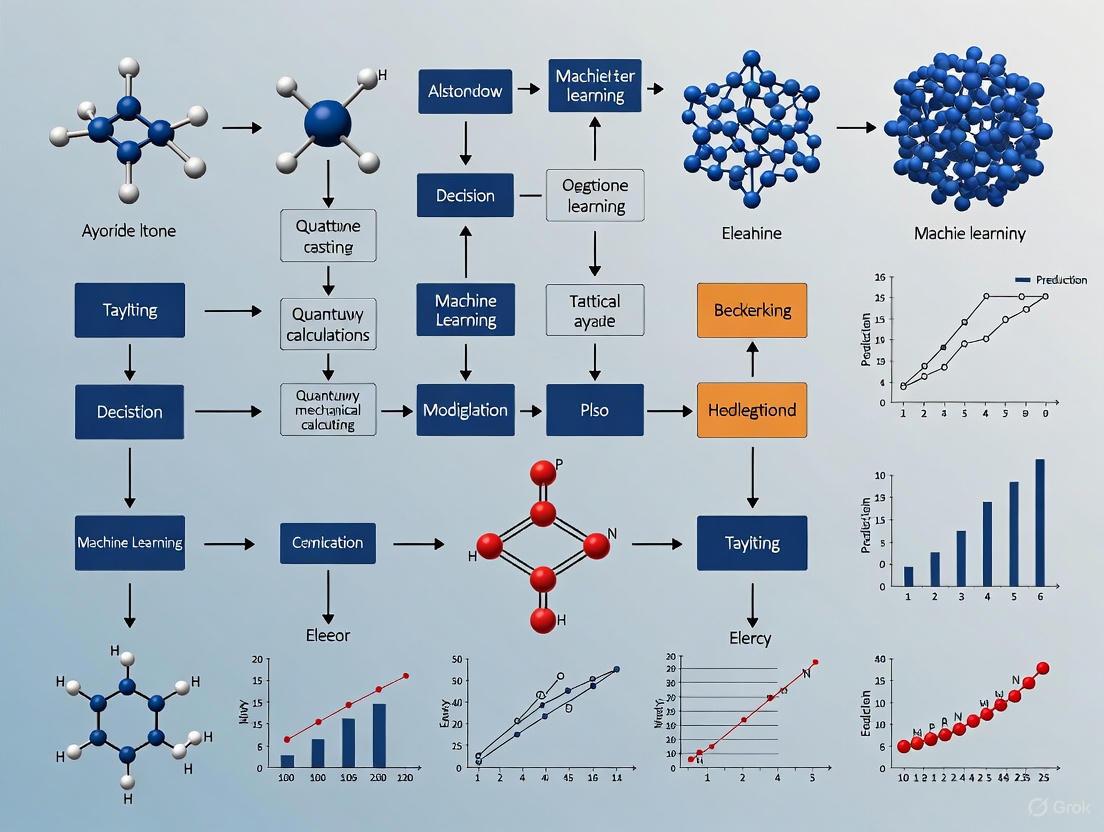
This article explores the transformative integration of machine learning (ML) with electronic structure methods, a paradigm shift accelerating computational chemistry and materials science.
Machine Learning for Electronic Structure Methods: Accelerating Drug Discovery and Materials Design
Abstract
This article explores the transformative integration of machine learning (ML) with electronic structure methods, a paradigm shift accelerating computational chemistry and materials science. It covers foundational concepts where ML surrogates bypass costly quantum mechanics algorithms, enabling simulations at unprecedented scales. The review details cutting-edge methodologies from Hamiltonian prediction to surrogate density matrices and their direct applications in drug discovery, such as virtual screening for cancer therapeutics and catalyst design. It further addresses critical troubleshooting and optimization techniques for improving model generalizability and data efficiency. Finally, the article provides a rigorous validation of ML approaches against established computational benchmarks, demonstrating how these tools achieve gold-standard accuracy at a fraction of the computational cost, thereby opening new frontiers in biomedical research and clinical development.
The New Paradigm: How Machine Learning is Redefining Quantum Chemistry
In computational materials science and chemistry, predicting the electronic structure of matter is a fundamental challenge with profound implications for understanding material properties, chemical reactions, and drug design. Density functional theory (DFT) has served as the cornerstone method for these calculations, achieving remarkable success as evidenced by its recognition with the Nobel Prize in 1998. However, DFT faces a fundamental limitation: its computational cost scales cubically with system size, restricting routine calculations to systems of only a few hundred atoms [1]. This severe constraint has hampered progress in simulating biologically relevant systems, complex material interfaces, and realistic catalytic environments at experimentally relevant scales.
The core challenge thus presents itself as a persistent trade-off between accuracy and efficiency. While more accurate electronic structure methods exist, their prohibitive computational costs render them impractical for large systems. Conversely, efficient approximations often sacrifice the physical fidelity necessary for predictive science. Machine learning (ML) has emerged as a transformative approach to circumvent this long-standing bottleneck [1]. By learning the mapping between atomic configurations and electronic properties from reference calculations, ML models can achieve the computational efficiency of classical force fields while approaching the accuracy of first-principles quantum mechanics.
This Application Note examines cutting-edge ML frameworks that address the accuracy-efficiency trade-off in electronic structure prediction. We detail specific methodologies, provide quantitative performance comparisons, and outline experimental protocols for implementing these approaches, with particular attention to applications in drug development and materials design where both computational tractability and predictive accuracy are paramount.
Machine Learning Approaches to Electronic Structure Prediction
Key Methodological Frameworks
Table 1: Overview of Machine Learning Approaches for Electronic Structure Prediction
| Method | Core Approach | Prediction Target | Key Innovation | Representative Framework |
|---|---|---|---|---|
| LDOS Learning | Real-space locality + nearsightedness principle | Local Density of States (LDOS) | Bispectrum descriptors with neural networks | MALA [2] [1] |
| Hamiltonian Learning | Symmetry-preserving neural networks | Electronic Hamiltonian | E(3)-equivariant architecture with correction scheme | NextHAM [3] |
| Wavefunction-Informed Potentials | Multireference consistency | Potential energy surfaces | Weighted active space protocol | WASP [4] |
| Hybrid Functional Acceleration | Bypassing SCF iterations | Hybrid DFT Hamiltonians | ML-predicted Hamiltonian for hybrid functionals | DeepH+HONPAS [5] |
| Relativistic Hamiltonian Models | Two-component relativistic reduction | Spectroscopic properties | Atomic mean-field X2C Hamiltonians | amfX2C/eamfX2C [6] |
Performance Metrics and Comparative Analysis
Table 2: Quantitative Performance of ML Electronic Structure Methods
| Method | System Size Demonstrated | Accuracy Metrics | Speedup Over DFT | Computational Scaling |
|---|---|---|---|---|
| MALA | 100,000+ atoms | Energy differences to chemical accuracy | 1,000x on tractable systems; enables previously infeasible calculations | Linear with system size [1] |
| DeepH+HONPAS | 10,000 atoms | Hybrid functional accuracy maintained | Makes hybrid functional calculations feasible for large systems | Not specified [5] |
| WASP | Transition metal catalysts | Multireference accuracy for reaction pathways | Months to minutes | Not specified [4] |
| NextHAM | 68 elements across periodic table | Hamiltonian and band structure accuracy | Significant efficiency gains while maintaining accuracy | Not specified [3] |
| amfX2C/eamfX2C | 100+ atoms (4c quality) | Spectroscopic properties with relativistic accuracy | Within 10-20% of non-relativistic calculations | Similar to non-relativistic methods [6] |
Experimental Protocols and Implementation
Protocol 1: LDOS Prediction with MALA Framework
The Materials Learning Algorithms (MALA) package provides a scalable ML framework for predicting electronic structures by leveraging the nearsightedness property of electrons [1]. This principle enables local predictions of the Local Density of States (LDOS) that can be assembled to reconstruct the electronic structure of arbitrarily large systems.
Workflow Overview:
Step-by-Step Procedure:
Training Data Generation
- Perform DFT calculations using Quantum ESPRESSO on small, representative systems (typically 50-500 atoms)
- Extract the Local Density of States (LDOS) across a real-space grid as training labels
- Ensure diverse sampling of atomic environments relevant to target applications
Descriptor Calculation
- For each point in the real-space grid, compute bispectrum coefficients using LAMMPS
- These coefficients encode the atomic arrangement within a specified cutoff radius (typically 4-6 Å)
- The cutoff radius should reflect the nearsightedness length scale of the electronic structure
Neural Network Training
- Implement a feed-forward neural network in PyTorch
- Architecture: 3-5 hidden layers with 100-500 neurons per layer
- Input: Bispectrum coefficients; Output: LDOS at discrete energy values
- Loss function: Mean squared error between predicted and DFT-calculated LDOS
Large-Scale Inference
- Deploy trained model on target large-scale system
- Parallelize prediction across real-space grid points
- Reconstruct global electronic structure from local LDOS predictions
Property Calculation
- Compute electronic density by integrating predicted LDOS over energy
- Calculate density of states by integrating LDOS over real space
- Derive total free energy and other observables from electronic density and DOS
Validation:
- Compare ML-predicted energies and densities with DFT reference calculations on hold-out systems
- Verify size-extensivity of predicted energies
- Assess transferability to different atomic environments not included in training
Protocol 2: Multireference Machine-Learned Potentials with WASP
The Weighted Active Space Protocol (WASP) addresses the critical challenge of modeling transition metal catalysts, where complex electronic structures with near-degeneracies necessitate multireference methods [4].
Workflow Overview:
Step-by-Step Procedure:
Configuration Sampling
- Perform initial molecular dynamics sampling at the DFT level
- Select diverse molecular geometries along reaction pathways
- Focus sampling on regions with suspected strong electron correlation
Reference Multireference Calculations
- Apply multiconfiguration pair-density functional theory (MC-PDFT) to sampled geometries
- Compute accurate energies and forces accounting for multireference character
- These calculations are computationally expensive but provide the accuracy benchmark
Weighted Active Space Protocol (WASP)
- For new geometries, generate consistent wavefunctions as weighted combinations of nearby reference wavefunctions
- Implement the weighting scheme: ( wi = \frac{\exp(-\lambda di)}{\sumj \exp(-\lambda dj)} )
- Where ( d_i ) represents the structural similarity between new geometry and reference geometry i
- The λ parameter controls the locality of the weighting
Machine Learning Potential Training
- Train neural network potentials using the consistently labeled dataset
- Input: Atomic environment descriptors (e.g., SOAP, ACE)
- Output: MC-PDFT quality energies and forces
- Incorporate uncertainty quantification through Bayesian neural networks
Molecular Dynamics Simulation
- Deploy trained ML potential for extended MD simulations
- Access time scales and system sizes inaccessible to direct multireference methods
- Simulate catalytic processes under realistic temperature and pressure conditions
Validation:
- Compare ML potential predictions with direct MC-PDFT calculations on test geometries
- Verify conservation of energy in NVE MD simulations
- Validate reaction barriers and mechanistic pathways against benchmark calculations
The Scientist's Toolkit: Essential Research Reagents
Table 3: Key Software Solutions for ML Electronic Structure Prediction
| Tool/Software | Function | Application Context | Accessibility |
|---|---|---|---|
| MALA [2] [1] | End-to-end ML pipeline for electronic structure | Large-scale material systems, defects, alloys | BSD 3-clause license |
| WASP [4] | Multireference machine-learned potentials | Transition metal catalysts, reaction dynamics | GitHub: GagliardiGroup/wasp |
| DeepH+HONPAS [5] | Hybrid functional DFT acceleration | Twisted 2D materials, complex interfaces | Not specified |
| ReSpect [6] | Relativistic spectroscopic properties | Heavy-element compounds, NMR, EPR | www.respectprogram.org |
| Quantum ESPRESSO [2] | DFT reference calculations | Training data generation, benchmark validation | Open-source |
| LAMMPS [2] | Descriptor calculation, MD simulations | Atomic environment encoding, dynamics | Open-source |
The integration of machine learning with electronic structure theory represents a paradigm shift in computational materials science and chemistry. The frameworks detailed in this Application Note—MALA for large-scale LDOS prediction, WASP for multireference accuracy in catalytic systems, DeepH for efficient hybrid functional calculations, and specialized relativistic approaches—collectively demonstrate that the historical trade-off between accuracy and efficiency is no longer an insurmountable barrier. By adopting these protocols, researchers can access previously intractable system sizes while maintaining the quantum mechanical fidelity necessary for predictive science. As these methods continue to mature, they promise to accelerate the discovery of novel materials, pharmaceuticals, and catalytic systems by bridging the quantum and mesoscopic scales in computational design.
Density Functional Theory (DFT) represents one of the most significant breakthroughs in computational quantum chemistry and materials science, establishing itself as the cornerstone method for predicting electronic structure properties across chemistry, physics, and materials engineering. The foundational principle of DFT is that the ground-state energy of a quantum mechanical system is a unique functional of the electron density, thereby reducing the complex many-body Schrödinger equation with 3N variables (for N electrons) to a manageable problem involving just three spatial variables [7]. This theoretical framework began with the pioneering work of Hohenberg and Kohn in 1964, who established the mathematical foundation that enables the use of electron density as the fundamental variable [7]. Their work was swiftly followed by the practical implementation now known as the Kohn-Sham equations in 1965, which introduced a fictitious system of non-interacting electrons that produce the same density as the real, interacting system [7].
The evolution of DFT has been marked by continuous refinement of the exchange-correlation functional, which encapsulates the quantum mechanical effects of exchange and correlation that are not captured by the simple electrostatic terms in the Kohn-Sham approach. The journey began with the Local Density Approximation (LDA), progressed through Generalized Gradient Approximations (GGAs) in the 1980s, and further advanced with hybrid functionals in the 1990s that incorporated a mixture of Hartree-Fock exchange with DFT exchange-correlation [7]. This progression was formally categorized in what is known as "Jacob's Ladder" of DFT, with each rung representing increased complexity and accuracy through the incorporation of more physically relevant ingredients [7]. The recognition of DFT's impact was cemented when Walter Kohn received the Nobel Prize in Chemistry in 1998 for his foundational contributions [7].
Despite its remarkable success and widespread adoption, traditional DFT faces significant challenges, particularly the computational cost associated with solving the Kohn-Sham equations, which scales cubically with system size, making dynamical studies of complex phenomena at realistic time and length scales computationally prohibitive [8] [9]. This limitation has motivated the development of machine learning approaches that can either accelerate or entirely bypass traditional electronic structure calculations while maintaining quantum mechanical accuracy.
The Machine Learning Revolution in Electronic Structure
Machine-Learned Interatomic Potentials (ML-IAPs)
The field of machine-learned interatomic potentials (ML-IAPs) has emerged as a transformative approach in computational materials science, offering a data-driven alternative to traditional empirical force fields [8]. ML-IAPs leverage deep neural network architectures to directly learn the potential energy surface (PES) from extensive, high-quality quantum mechanical datasets, thereby eliminating the need for fixed functional forms [8]. The principal advantage of ML-IAPs lies in their capacity to reproduce atomic interactions—including energies, forces, and dynamical trajectories—with high fidelity across chemically diverse systems [8].
Early ML-IAPs relied on handcrafted invariant descriptors to encode the potential-energy surface using bond lengths, angles, and dihedral angles. The advent of graph neural networks (GNNs) has transformed this landscape by enabling end-to-end learning of atomic environments [8]. Particularly significant has been the development of equivariant architectures that preserve rotational and translational symmetries, ensuring that scalar predictions (e.g., total energy) remain invariant while vector and tensor targets (e.g., forces, dipole moments) exhibit the correct equivariant behavior [8]. Frameworks such as DeePMD (Deep Potential Molecular Dynamics) have demonstrated remarkable success, achieving quantum mechanical accuracy with computational efficiency comparable to classical molecular dynamics, thereby enabling atomistic simulations at spatiotemporal scales previously inaccessible [8].
Table 1: Comparison of Major ML-IAP Approaches
| Method | Key Features | Accuracy | Applications |
|---|---|---|---|
| DeePMD | Sum of atomic contributions; local environment descriptors; deep neural networks | Energy MAE < 1 meV/atom; Force MAE < 20 meV/Å [8] | Large-scale molecular dynamics; complex materials systems [8] |
| Equivariant Models (e.g., NequIP) | Explicit embedding of physical symmetries; higher-order tensor contributions [8] | Superior accuracy and data efficiency [8] | Complex molecular systems; tensor property prediction [8] |
| MACE | Message passing with equivariant representations; high accuracy for organic molecules [10] | Accurate energies, forces, and dipole moments [10] | IR spectrum prediction; catalytic molecule modeling [10] |
Machine Learning Electronic Structure via Density Matrices
Beyond learning interatomic potentials, a more fundamental approach involves machine learning the electronic structure itself. Recent work has demonstrated that machine learning models based on the one-electron reduced density matrix (1-rdm) can generate surrogate electronic structure methods [11] [12]. This approach exploits the bijective maps established by DFT and Reduced Density Matrix Functional Theory (RDMFT) between the external potential of a many-body system and its electron density, wavefunction, and consequently, the one-particle reduced density matrix [11].
The significant advantage of learning the 1-rdm instead of the electron density alone lies in the ability to deliver expectation values of any one-electron operator, including nonmultiplicative operators such as the kinetic energy, exchange energy, and the corresponding non-local (Hartree-Fock) potential [11]. This approach enables the creation of surrogate models for various electronic structure methods, including local and hybrid DFT, Hartree-Fock, and even full configuration interaction theories [11]. These surrogate models can generate essentially anything that a standard electronic structure method can—from band gaps and Kohn-Sham orbitals to energy-conserving ab-initio molecular dynamics simulations and IR spectra—without needing computationally expensive algorithms such as self-consistent field theory [11] [12].
Deep Learning DFT Emulation
A complementary strategy involves creating end-to-end machine learning models that emulate the essence of DFT by mapping the atomic structure directly to electronic charge density, followed by prediction of other properties such as density of states, potential energy, atomic forces, and stress tensor [9]. This approach, termed ML-DFT, successfully bypasses the explicit solution of the Kohn-Sham equation with orders of magnitude speedup (linear scaling with system size with a small prefactor) while maintaining chemical accuracy [9].
The ML-DFT framework employs a two-step learning procedure that gives particular prominence to the electronic charge density, consistent with the core concept underlying DFT [9]. The first step involves predicting the electronic charge density given just the atomic configuration, while the second step uses the predicted charge density as an auxiliary input (along with atomic configuration fingerprints) to predict all other properties [9]. This strategy has been successfully demonstrated for an extensive database of organic molecules, polymer chains, and polymer crystals [9].
Advanced Applications and Protocols
Infrared Spectroscopy Prediction with Active Learning
Infrared (IR) spectroscopy represents a critical application where machine-learned potentials have demonstrated remarkable success. The interpretation of experimental IR spectra requires high-fidelity simulations that capture anharmonicity and thermal effects, traditionally computed using DFT-based ab-initio molecular dynamics (AIMD), which are computationally expensive and limited in tractable system size and complexity [10].
The PALIRS (Python-based Active Learning Code for Infrared Spectroscopy) framework implements a novel active learning-based approach for efficiently predicting IR spectra of catalytically relevant organic molecules [10]. This workflow employs active learning to train machine-learned interatomic potentials, which are then used for machine learning-assisted molecular dynamics simulations to calculate IR spectra [10]. The method reproduces IR spectra computed with AIMD accurately at a fraction of the computational cost and agrees well with experimental data for both peak positions and amplitudes [10].
Table 2: Performance Metrics for ML-IAP Applications
| Application | Method | Accuracy | Speedup vs Traditional DFT |
|---|---|---|---|
| IR Spectrum Prediction | PALIRS with MACE MLIP [10] | Agreement with AIMD and experimental references for peak positions and amplitudes [10] | Orders of magnitude faster than AIMD [10] |
| Catalyst Dynamics | WASP (Weighted Active Space Protocol) combining MC-PDFT with ML potentials [4] | Accurate description of transition metal electronic structure [4] | Simulations reduced from months to minutes [4] |
| Electronic Structure Emulation | ML-DFT charge density prediction [9] | Chemical accuracy for energies and forces [9] | Linear scaling with system size vs. cubic scaling for traditional DFT [9] |
Diagram 1: Active Learning Workflow for IR Spectrum Prediction
Protocol: Weighted Active Space Protocol (WASP) for Transition Metal Catalysts
Transition metals present particular challenges for electronic structure methods due to their partially filled d-orbitals, which require precise descriptions of electronic structure [4]. The Weighted Active Space Protocol (WASP) addresses this challenge by integrating multireference quantum chemistry methods with machine-learned potentials, delivering both accuracy and efficiency for simulating transition metal catalytic dynamics [4].
Step-by-Step Protocol:
Reference Data Generation: Perform multiconfiguration pair-density functional theory (MC-PDFT) calculations on sampled molecular structures to generate high-quality reference data for transition metal systems [4].
Wave Function Consistency: Implement the WASP algorithm to generate consistent wave functions for new geometries as a weighted combination of wave functions from previously sampled molecular structures. The closer a new geometry is to a known one, the more strongly its wave function resembles that of the known structure [4].
ML Potential Training: Train machine-learned interatomic potentials on the consistently labeled reference data, ensuring accurate representation of the complex electronic structure of transition metals [4].
Molecular Dynamics Simulation: Perform accelerated molecular dynamics simulations using the trained ML potentials to capture catalytic dynamics under realistic conditions of temperature and pressure [4].
This protocol has been successfully demonstrated for thermally activated catalysis, with ongoing work extending the method to light-activated reactions essential for photocatalyst design [4]. The WASP approach delivers dramatic speedups: simulations with multireference accuracy that once took months can now be completed in just minutes [4].
Diagram 2: WASP Protocol for Transition Metal Catalyst Simulation
The Scientist's Toolkit: Essential Research Reagents
Table 3: Essential Software Tools for Machine Learning Electronic Structure
| Tool/Platform | Function | Application Scope |
|---|---|---|
| DeePMD-kit [8] | Implements Deep Potential Molecular Dynamics framework | Large-scale molecular simulations with quantum accuracy [8] |
| PALIRS [10] | Python-based Active Learning for Infrared Spectroscopy | Efficient prediction of IR spectra for organic molecules [10] |
| QMLearn [11] [12] | Implements machine learning methods based on one-electron reduced density matrix | Surrogate electronic structure methods for molecules [11] |
| MALA (Materials Learning Algorithms) [13] | Scalable machine learning for electronic structure prediction | Large-scale DFT calculations with transferability across phase boundaries [13] |
| WASP [4] | Weighted Active Space Protocol for multireference ML potentials | Transition metal catalyst dynamics simulation [4] |
Future Perspectives and Challenges
The integration of machine learning with electronic structure theory continues to face several important challenges. Data fidelity remains a critical concern, as the predictive accuracy of even state-of-the-art ML models is fundamentally limited by the breadth and fidelity of available training data [8]. Model generalizability across different chemical environments and system sizes also presents significant hurdles [8]. Additionally, computational scalability and explainability are active areas of research, particularly crucial for the field of AI for Science (AI4S) [8].
Promising future directions include the development of more sophisticated active learning strategies, multi-fidelity frameworks that leverage data from different levels of theory, scalable message-passing architectures, and methods for enhancing interpretability [8]. The integration of these advances is expected to accelerate materials discovery and provide deeper mechanistic insights into complex material and physical systems [8].
Recent breakthroughs, such as Microsoft's deep-learning-powered DFT model trained on over 100,000 data points, demonstrate the potential for escaping the traditional trade-off between accuracy and computational cost [7]. By applying deep learning to DFT, researchers can allow models to learn which features are relevant for accuracy rather than relying solely on those from Jacob's ladder, laying the foundation for a new era of density functional theory and potential breakthroughs in drug discovery, materials science, and beyond [7].
As machine learning continues to transform electronic structure theory, the synergy between physical principles and data-driven approaches promises to unlock new capabilities for predicting and designing molecular and materials properties with unprecedented accuracy and efficiency.
Computational methods for determining electronic structure, such as Density Functional Theory (DFT), underpin modern materials science and drug discovery by providing atomistic insight into molecular and material properties. However, these methods face significant computational bottlenecks; the cost of DFT, for example, scales as O(N³) with the number of atoms N, primarily due to the need for Hamiltonian matrix diagonalization [8]. This scaling severely restricts the system sizes and time scales accessible for simulation. Machine learning (ML) has emerged as a transformative approach to bypass these limitations by creating accurate, data-driven surrogate models that learn from high-fidelity quantum mechanical calculations [8] [14].
Two complementary ML paradigms have gained prominence: Machine Learning Interatomic Potentials (ML-IAPs or ML-FFs) and Machine Learning Hamiltonians (ML-Hams). ML-IAPs directly learn the potential energy surface (PES) from ab initio data, enabling efficient large-scale molecular dynamics simulations with near-quantum accuracy [8] [14]. In parallel, ML-Ham approaches learn the electronic Hamiltonian itself or the one-electron reduced density matrix (1-rdm) [8] [11]. This provides access to a wider range of electronic properties, offers greater physical interpretability, and follows a structure-physics-property pathway [8]. These methods collectively are revolutionizing computational materials science and chemistry, enabling accurate simulations at extended time and length scales previously inaccessible to first-principles calculations.
Core Conceptual Frameworks
Machine Learning Interatomic Potentials (ML-IAPs)
Machine Learning Interatomic Potentials are surrogates trained on quantum mechanical data to predict the potential energy surface. They frame the problem as learning a mapping from atomic coordinates to energies and atomic forces, effectively "bypassing" the explicit solution of the electronic Schrödinger equation [8]. The fundamental approximation involves expressing the total potential energy of a system as a sum of atomic contributions, each dependent on the local chemical environment within a predefined cutoff radius [8]. A landmark implementation of this concept is the Deep Potential Molecular Dynamics (DeePMD) framework. DeePMD encodes atomic environments using smooth neighbor density functions and processes them through deep neural networks. When trained on large-scale DFT datasets, it can achieve remarkable accuracy—for instance, energy mean absolute errors (MAEs) below 1 meV/atom and force MAEs under 20 meV/Å for water [8]—while maintaining a computational cost comparable to classical molecular dynamics.
A critical aspect of modern ML-IAPs is the embedding of physical symmetries directly into the model architecture. Equivariant models are designed to be inherently invariant or equivariant to translations, rotations, and sometimes reflections of the entire system (corresponding to the E(3) symmetry group) [8]. Unlike models that rely on data augmentation to learn these symmetries, equivariant architectures guarantee that scalar outputs like total energy remain invariant, while vector outputs like forces transform correctly under rotation. This built-in physical consistency, often implemented via Equivariant Graph Neural Networks (GNNs), leads to superior data efficiency and generalization [8].
Machine Learning Hamiltonians and the Role of the Density Matrix
While ML-IAPs directly map structure to energy, ML Hamiltonian approaches target the electronic Hamiltonian or the density matrix, which are more fundamental quantities. Learning the Hamiltonian enables the calculation of a vast range of electronic properties, from band structures and orbital energies to dielectric responses and electron-phonon couplings [8] [15].
The one-electron reduced density matrix (1-rdm), denoted as γ, has emerged as a particularly powerful target for ML models [11]. The 1-rdm provides a complete description of all one-electron properties of a quantum system. Learning the 1-rdm offers several key advantages over learning only the electron density or total energy:
- It grants direct access to the expectation values of any one-electron operator, including the kinetic energy operator and the non-local exchange potential [11].
- It can be used to compute molecular observables, energies, and atomic forces using standard quantum chemical relations or a secondary ML model ("γ-learning" and "γ+δ-learning") [11].
- This approach effectively creates a surrogate electronic structure method that can replicate the output of methods like DFT, Hartree-Fock, or even full configuration interaction without performing a self-consistent field (SCF) calculation [11].
Another innovative concept is Density Matrix Downfolding (DMD), which formalizes the process of deriving an effective low-energy Hamiltonian from a first-principles calculation [16]. DMD frames downfolding as a fitting problem, where the parameters of an effective model Hamiltonian are optimized to reproduce the energy functional of the ab initio Hamiltonian for wavefunctions sampled from the low-energy subspace [16]. This method provides a rigorous, data-driven pathway from complex first-principles simulations to simpler, interpretable model Hamiltonians, such as Hubbard or Heisenberg models.
Table 1: Comparison of Key Machine Learning Approaches in Electronic Structure.
| Approach | Core Target | Primary Outputs | Key Advantages | Example Methods |
|---|---|---|---|---|
| ML-IAPs | Potential Energy Surface (PES) | Energies, Atomic Forces | High efficiency for molecular dynamics; near-quantum accuracy [8] | DeePMD [8], NequIP [8] |
| ML Hamiltonians | Electronic Hamiltonian | Hamiltonian Matrix, Band Structures | Access to electronic properties; clearer physical picture [8] | DeepH [15], NextHAM [15] |
| ML Density Matrix | 1-electron Reduced Density Matrix (1-rdm) | Any one-electron property, Energies, Forces | Versatility; bypasses SCF; surrogates for multiple theories [11] | γ-learning [11] |
Quantitative Performance and Data Requirements
The accuracy and computational efficiency of ML-driven electronic structure methods are critically dependent on the quality and quantity of training data, as well as the model architecture. Performance is typically benchmarked using mean absolute error (MAE) on energies and forces, often reported on standardized datasets.
Table 2: Overview of Common Benchmark Datasets and Representative Model Performance.
| Dataset | Description | Data Scale | Representative Model Performance |
|---|---|---|---|
| QM9 [8] | 134k small organic molecules (C, H, O, N, F) | ~1 million atoms | Used for molecular property prediction (e.g., energies, HOMO-LUMO gaps) |
| MD17 [8] | Molecular dynamics trajectories for 8 small organic molecules | ~100 million atoms | Energy and force MAEs on the order of meV/atom and meV/Å |
| Materials-HAM-SOC [15] | 17,000 material structures with 68 elements, includes spin-orbit coupling | Not specified | NextHAM model: Full Hamiltonian MAE of 1.417 meV; SOC blocks at sub-μeV scale [15] |
High-quality data from advanced density functional approximations, such as meta-GGA functionals, has been shown to significantly improve the transferability and generalizability of the resulting ML models compared to data from semi-local functionals [8]. Furthermore, innovative training objectives that jointly optimize the Hamiltonian in both real space (R-space) and reciprocal space (k-space) have proven effective. This dual-space optimization prevents error amplification in derived band structures that can occur due to the large condition number of the overlap matrix, a common issue when only the real-space Hamiltonian is regressed [15].
Experimental Protocols and Application Notes
Protocol 1: Building a Surrogate Model via γ-Learning
This protocol outlines the procedure for creating a surrogate electronic structure method by learning the 1-electron reduced density matrix, as detailed in the work leading to the QMLearn code [11].
1. Data Generation and Representation:
- Select a Quantum Chemistry Method: Choose the target method to surrogate (e.g., DFT, Hartree-Fock, CI).
- Generate Training Structures: Perform molecular dynamics or use structural databases to sample a diverse set of molecular geometries.
- Compute Reference Data: For each geometry, run the target electronic structure calculation to obtain the reference 1-rdm (γ_ref) and other properties (energy, forces). The 1-rdm and external potential (v) are represented in a Gaussian-type orbital (GTO) basis, which simplifies the handling of rotational and translational invariances [11].
2. Model Training (γ-Learning):
- Feature and Target Definition: The input feature for the ML model is the external potential matrix,
v, in the GTO basis. The target is the corresponding 1-rdm matrix,γ. - Model Implementation: Use a Kernel Ridge Regression (KRR) model, as defined by:
γ_pred = Σ_i β_i * K(v_i, v)whereK(v_i, v_j) = Tr[v_i * v_j]is the kernel function, andβ_iare the regression coefficients learned during training [11]. - Training: The model is trained on the set of
{v_i, γ_i}pairs to learn the mappingv → γ.
3. Prediction and Property Calculation:
- Prediction: For a new molecular structure, construct its external potential
v_newand use the trained KRR model to predict the 1-rdm,γ_pred. - Post-Processing: The predicted
γ_predcan be used in two ways:- Direct Quantum Chemistry: Use
γ_predas a pre-converged density to compute the energy and forces via standard quantum chemistry expressions, completely bypassing the SCF procedure [11]. - Secondary ML Model (γ+δ-learning): Train a second ML model to directly predict the energy and forces from the predicted
γ_pred[11].
- Direct Quantum Chemistry: Use
Protocol 2: Hamiltonian Prediction with the NextHAM Framework
This protocol describes the NextHAM framework, designed for accurate and generalizable prediction of electronic-structure Hamiltonians across a wide range of materials [15].
1. Pre-processing: Zeroth-Step Hamiltonian Construction
- Compute the initial electron density, ρ⁽⁰⁾(r), as a simple sum of the charge densities of isolated atoms at their respective positions in the material structure.
- Construct the zeroth-step Hamiltonian, H⁽⁰⁾, from
ρ⁽⁰⁾(r)without performing any matrix diagonalization. This provides a physically informed starting point for the model [15].
2. Model Architecture and Training
- Input Features: The model uses atomic coordinates and the pre-computed
H⁽⁰⁾matrix as central input features. - Neural Network: A neural Transformer architecture with strict E(3)-equivariance is used. This ensures predictions are invariant to translation, rotation, and inversion of the input structure [15].
- Output and Learning Target: Instead of learning the final Hamiltonian
H⁽ᵀ⁾directly, the model learns the correction termΔH = H⁽ᵀ⁾ - H⁽⁰⁾. This simplifies the learning task and improves accuracy [15]. - Multi-Space Loss Function: The model is trained using a joint loss function that ensures accuracy in both:
- Real Space (R-space): The Hamiltonian matrix itself is accurate.
- Reciprocal Space (k-space): The band structure derived from the Hamiltonian is accurate. This prevents the emergence of unphysical "ghost states" [15].
3. Inference and Application
- The predicted Hamiltonian
H⁽ᵀ⁾ = H⁽⁰⁾ + ΔHcan be diagonalized to compute band structures, density of states, and other electronic properties with high fidelity, achieving DFT-level precision without the SCF loop [15].
Protocol 3: Bayesian Quantum Hamiltonian Learning
This protocol covers an experimental Bayesian approach for learning the Hamiltonian of a quantum system, as demonstrated in an experimental study interfacing a photonic quantum simulator with a solid-state spin qubit [17].
1. Experimental Setup:
- The target system (e.g., a nitrogen-vacancy center in diamond) is interfaced with a probe quantum system (e.g., a photonic quantum simulator) via a classical communication channel [17].
2. Iterative Learning Cycle:
- The probe system prepares a set of initial states and lets them evolve under the influence of the target system's unknown Hamiltonian.
- Measurements are performed on the probe system, and the results are sent to a classical computer.
- A Bayesian inference algorithm running on the classical computer updates the probability distribution over the possible parameters of the target Hamiltonian [17].
- Based on this updated belief, the algorithm designs a new, more informative set of experiments to be performed on the probe system.
- This cycle repeats, progressively refining the Hamiltonian parameter estimates until a desired precision is reached (e.g., an uncertainty of ~10⁻⁵) [17].
3. Model Validation:
- The learning process itself can indicate deficiencies in the assumed Hamiltonian model if the inference saturates at a high uncertainty. This can be used to refine the model itself, leading to improved physical understanding [17].
Visualizing Workflows and Logical Relationships
Workflow for ML-IAP and ML-Hamiltonian Generation
The following diagram illustrates the high-level workflow for developing and applying machine-learned interatomic potentials and Hamiltonians.
Diagram 1: High-level workflow for developing and applying ML-IAPs and ML-Hamiltonians.
Density Matrix Downfolding (DMD) Logical Flow
This diagram outlines the logical flow of the Density Matrix Downfolding (DMD) method for deriving an effective Hamiltonian.
Diagram 2: Logical flow of the Density Matrix Downfolding (DMD) method.
The Scientist's Toolkit: Essential Research Reagents and Computational Solutions
Table 3: Key Software Packages and Computational "Reagents" for ML Electronic Structure Research.
| Tool / "Reagent" | Type | Primary Function | Key Features | Reference |
|---|---|---|---|---|
| DeePMD-kit | Software Package | ML-IAP training and inference | Integrates with LAMMPS for MD; uses Deep Potential formalism [8] | [8] |
| MALA (Materials Learning Algorithms) | Software Package | ML-accelerated electronic structure | Predicts electronic observables (e.g., LDOS) from local descriptors; scalable inference [2] | [2] |
| QMLearn | Software Package | Surrogate methods via 1-rdm learning | Predicts 1-rdm to compute energies, forces, and properties without SCF [11] | [11] |
| NextHAM Framework | Model Architecture | Generalizable Hamiltonian prediction | Uses E(3)-equivariant Transformer and zeroth-step Hamiltonian correction [15] | [15] |
| Quantum ESPRESSO | DFT Code | Ab initio data generation | Used to produce training data for ML models; interfaces with packages like MALA [2] | [2] |
| LAMMPS | MD Simulator | Large-scale molecular dynamics | Performs simulations using trained ML-IAPs like those from DeePMD-kit [2] | [2] |
| Bayesian Inference Engine | Algorithm | Hamiltonian parameter learning | Statistically learns Hamiltonian parameters from experimental/quantum sensor data [17] | [17] |
The "nearsightedness" principle of electronic matter posits that local electronic properties depend primarily on the immediate chemical environment, a tenet that has long justified the use of small-scale simulations in computational chemistry and materials science. However, this principle breaks down for critical phenomena involving long-range interactions, charge transfer, and collective dynamics, presenting fundamental limitations for predicting real-world material behavior and biological activity. The integration of machine learning (ML) with electronic structure methods is now overcoming this constraint, enabling accurate simulations at previously inaccessible scales.
Recent breakthroughs in large-scale quantum chemical datasets and specialized ML architectures have created a paradigm shift in computational molecular sciences. This Application Note details the protocols and resources enabling researchers to simulate systems of realistic complexity, with particular emphasis on applications in drug development and materials design. We present structured experimental data, detailed methodologies, and standardized workflows to facilitate adoption across scientific research communities.
Key Research Reagent Solutions
The following table catalogues essential computational tools and datasets that form the modern researcher's toolkit for overcoming scale limitations in electronic structure simulations.
Table 1: Key Research Reagent Solutions for Large-Scale Simulations
| Resource Name | Type | Primary Function | Relevance to Large-Scale Simulation |
|---|---|---|---|
| OMol25 Dataset [18] [19] [20] | Quantum Chemistry Dataset | Training data for ML potentials | Provides over 100 million DFT-calculated molecular conformations with diverse elements and configurations |
| UMA (Universal Model for Atoms) [18] [20] | Machine Learning Potential | Atomic property prediction | Enables quantum-accurate molecular dynamics at speeds 10,000× faster than DFT [20] |
| DeePMD-Kit [21] | Software Framework | Deep learning molecular dynamics | Provides custom high-performance operators for efficient molecular simulations on specialized hardware |
| NVIDIA MPS (Multi-Process Service) [22] | Computational Tool | GPU utilization optimization | Increases molecular dynamics throughput by enabling concurrent simulations on single GPU |
| "Accompanied Sampling" [18] [20] | AI Methodology | Reward-driven molecular generation | Enables molecular structure generation without training data by leveraging reward signals |
Quantitative Performance Benchmarks
Rigorous evaluation of performance metrics is essential for selecting appropriate methodologies. The following tables summarize key quantitative benchmarks for the core technologies discussed.
Table 2: Performance Benchmarks of ML Potentials Versus Traditional Methods
| Methodology | Accuracy Relative to DFT | Speed Relative to DFT | Maximum Demonstrated System Size | Key Limitations |
|---|---|---|---|---|
| Traditional DFT [23] [19] | Reference | 1× | ~100s of atoms | Computational cost scales poorly with system size |
| Coupled Cluster (CCSD(T)) [23] | Higher accuracy | 0.01× | ~10s of atoms | Prohibitively expensive for large systems |
| UMA Model [18] [20] | Near-DFT accuracy | ~10,000× | 350+ atoms per molecule [19] | Challenges with polymers, complex protonation states [20] |
| DeePMD-Kit [21] | Near-DFT accuracy | >1,000× | 400K+ atoms [22] | Requires per-system training |
Table 3: NVIDIA MPS Performance Enhancement for Molecular Dynamics
| GPU Hardware | System Size (Atoms) | Simulations | Throughput Improvement | Optimal CUDAMPSACTIVETHREADPERCENTAGE |
|---|---|---|---|---|
| NVIDIA H100 [22] | 23,000 (DHFR) | 8 concurrent | >100% increase | 25% |
| NVIDIA L40S [22] | 23,000 (DHFR) | 8 concurrent | ~100% increase | 25% |
| NVIDIA H100 [22] | 408,000 (Cellulose) | 2 concurrent | ~20% increase | 100% |
Experimental Protocols
Protocol: Leveraging OMol25 for Custom ML Potential Development
Purpose: To train machine-learned interatomic potentials (MLIPs) using the OMol25 dataset for system-specific large-scale simulations.
Background: The OMol25 dataset represents the largest collection of quantum chemical calculations for molecules, containing over 100 million density functional theory (DFT) calculations across diverse chemical space, including biomolecules, metal complexes, and electrolytes [19] [20]. The dataset captures molecular conformations, reaction pathways, and electronic properties (energies, forces, charges, orbital information).
Materials:
- OMol25 dataset (available via Hugging Face platform [20])
- High-performance computing resources with GPU acceleration
- ML training framework (PyTorch, TensorFlow, or DeePMD-Kit)
Procedure:
- Data Acquisition and Preprocessing:
- Download relevant subsets of OMol25 based on chemical domain of interest (biomolecules, electrolytes, or metal complexes)
- Convert data into compatible format for ML training (e.g., atomic neighbor lists with feature vectors)
- Split data into training (80%), validation (10%), and test sets (10%)
Model Architecture Selection:
- Implement graph neural network architecture following UMA's hybrid mixture-of-experts design [20]
- Configure input features to represent atomic species, positions, and local environments
- Output layers should predict system energy (scalar), atomic forces (3D vector per atom), and optionally electronic properties
Training Protocol:
- Initialize model with pretrained UMA weights when available for transfer learning
- Employ mean squared error loss function combining energy and force predictions
- Use Adam optimizer with learning rate decay (initial rate: 0.001)
- Train for 100-500 epochs depending on dataset size and complexity
Validation and Testing:
- Evaluate model on test set using standardized metrics:
- Energy mean absolute error (meV/atom)
- Force mean absolute error (meV/Å)
- Perform molecular dynamics sanity checks with small systems comparing to direct DFT
- Evaluate model on test set using standardized metrics:
Troubleshooting:
- If training instability occurs: reduce learning rate, increase batch size, or apply gradient clipping
- If poor generalization: expand training data diversity, adjust data split to ensure representative validation
- For deployment speed issues: optimize with custom operators like those in DeePMD-Kit [21]
Protocol: High-Throughput Molecular Dynamics with NVIDIA MPS
Purpose: To significantly increase molecular dynamics simulation throughput by enabling multiple concurrent simulations on a single GPU.
Background: NVIDIA Multi-Process Service (MPS) enables better GPU utilization by allowing multiple processes to share GPU resources with reduced context-switching overhead [22]. This is particularly valuable for molecular dynamics simulations of small to medium-sized systems (<400,000 atoms) that don't fully utilize modern GPU capacity.
Materials:
- NVIDIA GPU (Volta architecture or newer)
- CUDA-enabled molecular dynamics software (OpenMM recommended [22])
- NVIDIA drivers with MPS support
Procedure:
- Environment Setup:
- Verify CUDA installation and GPU compatibility
- Install OpenMM with CUDA support:
MPS Activation:
- Enable MPS daemon:
- Verify MPS status using
nvidia-smi
Simulation Configuration:
- Prepare multiple simulation input files (coordinate, topology, parameter files)
- For optimal performance, set thread percentage based on number of concurrent simulations:
- Launch concurrent simulations:
Performance Monitoring:
- Track simulation throughput (ns/day) for each concurrent process
- Monitor GPU utilization using
nvidia-smi - Adjust
CUDA_MPS_ACTIVE_THREAD_PERCENTAGEif suboptimal performance observed
Troubleshooting:
- If performance degradation occurs: reduce number of concurrent simulations or adjust thread percentage
- For process failures: check GPU memory limits and reduce concurrent simulations
- To disable MPS:
echo quit | nvidia-cuda-mps-control
Application Workflows
Integrated Workflow for Drug Discovery Applications
The following diagram illustrates the complete computational pipeline from target identification to lead optimization, integrating the tools and protocols described in this document:
The Universal Model for Atoms employs a sophisticated neural architecture enabling both accuracy and computational efficiency:
The integration of machine learning with electronic structure theory has fundamentally transformed our ability to overcome the nearsightedness principle in computational chemistry. Through large-scale datasets like OMol25, universal models such as UMA, and computational optimizations including MPS, researchers can now simulate molecular systems at unprecedented scales with quantum accuracy.
For the drug development community, these advances translate to dramatically accelerated discovery timelines, with the potential to screen thousands of candidates in silico before laboratory synthesis [18] [20]. The protocols outlined in this Application Note provide actionable methodologies for implementing these technologies, while the standardized benchmarking data enables informed selection of computational strategies.
Future developments will likely address current limitations in modeling polymers, complex metallic systems, and long-range interactions. As these methodologies mature, they will further erode the barriers between quantum-scale accuracy and mesoscale phenomena, ultimately enabling fully predictive computational materials design and drug discovery.
The application of machine learning (ML) in electronic structure research represents a paradigm shift in computational chemistry and materials science. The accuracy and generalizability of these models are fundamentally constrained by the quality and scope of the quantum chemical reference data used for their training. High-quality, large-scale datasets enable the development of ML force fields (MLFFs) that operate at quantum mechanical accuracy while being orders of magnitude faster than traditional quantum chemistry methods. This document outlines key datasets, detailed protocols for their utilization, and essential computational tools for researchers working at the intersection of machine learning and electronic structure theory.
Catalog of High-Quality Quantum Chemistry Datasets
The field has seen the emergence of several foundational datasets that provide comprehensive quantum chemical properties across diverse chemical spaces. The table below summarizes the characteristics of principal datasets enabling modern research.
Table 1: Key Quantum Chemistry Datasets for Machine Learning
| Dataset Name | Volume | Molecular Systems | Key Properties | Special Features |
|---|---|---|---|---|
| OMol25 [24] | ~500 TB>4 million calculations | Small organic molecules to large biomolecular complexes | Electronic densities, wavefunctions, molecular orbitals | Raw DFT outputs; electronic structure data at unprecedented scale |
| QCML Dataset [25] | 33.5M DFT14.7B semi-empirical | Small molecules (≤8 heavy atoms) | Energies, forces, multipole moments, Kohn-Sham matrices | Systematic coverage of chemical space; equilibrium and off-equilibrium structures |
| EDBench [26] | 3.3 million molecules | Drug-like molecules | Electron density distributions, energy components, orbital energies | ED-centric benchmark tasks; enables electron-level modeling |
| tmQM/TMC Benchmark Sets [27] | Varies (curated) | Transition metal complexes (TMCs) | Structural data, spin-state energetics, catalytic properties | Focus on challenging transition metal electronic structure |
Experimental Protocols for Data Utilization
Protocol 1: Generating Training Data for ML Force Fields with ASSYST
The Automated Small SYmmetric Structure Training (ASSYST) methodology provides a systematic approach for generating unbiased training data for Machine Learning Interatomic Potentials (MLIPs) in multicomponent systems [28].
Materials and Software Requirements:
- Density Functional Theory (DFT) code (e.g., VASP)
- Structure generation tool (e.g., PYXTAL)
- MLIP framework (e.g., for Moment Tensor Potentials)
Procedure:
- Initial Structure Generation:
- Define the stoichiometric range and maximum atoms per cell (e.g., 1-10 atoms).
- For each stoichiometry, generate
nSPGrandom crystal structures for each of the 230 space groups. - Note: Systems with 8-10 atoms are generally sufficient for generating transferable potentials.
Structure Relaxation:
- Perform sequential DFT relaxations using modest convergence parameters.
- First, relax cell volume while keeping shape and atomic positions fixed.
- Second, perform full relaxation allowing cell shape, size, and atomic positions to vary.
- Collect final structures from both relaxation steps for the training set.
Configuration Space Sampling:
- Apply random perturbations to the relaxed structures.
- For each relaxed configuration, generate
nrattlenew structures. - Randomly displace atomic positions with normal distribution (σ
rattle). - Apply uniformly random strain matrices up to a defined limit (ε
r).
High-Fidelity Calculation:
- Perform highly-converged DFT single-point calculations on all generated structures.
- Extract energies, forces, and stress tensors for the final training set.
Protocol 2: Building Electronic Structure Models with SchNOrb
The SchNOrb framework provides a deep-learning approach to predict molecular electronic structure in a local atomic orbital basis [29].
Materials and Software Requirements:
- SchNOrb architecture (extends SchNet)
- Quantum chemistry data (Hamiltonian & overlap matrices from HF/DFT)
- Training hardware (GPUs recommended)
Procedure:
- Data Preparation and Representation:
- Perform reference Hartree-Fock or DFT calculations to obtain Hamiltonian (H) and overlap (S) matrices.
- Use a local atomic orbital basis (e.g., Gaussian-type orbitals up to d-functions).
- Augment training data with rotated molecular geometries and correspondingly rotated H and S matrices.
Model Training:
- Train the neural network using a combined regression loss function.
- The loss should simultaneously optimize:
- Total energy predictions (as a sum of atom-wise contributions)
- Hamiltonian matrix elements (Hij)
- Overlap matrix elements (Sij)
- Typical training achieves MAE < 8 meV for H and < 1×10⁻⁴ for S.
Property Derivation:
- Solve the generalized eigenvalue problem: Hc = εSc
- Obtain orbital energies (ε) and wavefunction coefficients (c) via matrix diagonalization.
- Derive electronic properties (population analyses, dipole moments, etc.) from the predicted wavefunction.
Application in Dynamics and Optimization:
- Use the model for ML-driven molecular dynamics simulations at significantly reduced computational cost (2-3 orders of magnitude faster).
- Perform inverse design by optimizing molecular structures with respect to electronic properties (e.g., HOMO-LUMO gap) using analytical gradients.
Workflow Visualization
Electronic Structure ML Model Development Workflow
The Scientist's Toolkit: Essential Research Reagents
Table 2: Computational Tools and Resources for Electronic Structure ML
| Tool/Resource | Type | Primary Function | Application Context |
|---|---|---|---|
| molSimplify/QChASM [27] | Software | Automated construction of transition metal complexes | High-throughput screening of organometallic catalysts |
| Gnina 1.3 [30] | Software | Protein-ligand docking with CNN scoring | Structure-based drug discovery; pose prediction |
| TensorFlow/PyTorch [31] | ML Framework | Deep learning model development and training | Flexible implementation of custom neural network architectures |
| Globus [24] | Data Transfer | High-performance access to large datasets (e.g., OMol25) | Efficient handling of terabyte-scale dataset transfers |
| DFT Codes (VASP, PySCF) [28] [32] | Quantum Chemistry | Generate reference data via first-principles calculations | Producing training data and benchmark results for ML models |
| ALCF Computing Resources [24] | Infrastructure | High-performance computing for large-scale data generation | Access to petabyte-scale storage and powerful CPUs/GPUs |
Core Architectures and Breakthrough Applications in Biomedicine
Universal Hamiltonian Prediction with E(3)-Equivariant Models
The prediction of quantum mechanical Hamiltonians is a fundamental challenge in electronic structure theory, with direct applications in materials science and drug discovery. Traditional density functional theory (DFT) calculations are computationally expensive, scaling cubically with system size, creating a bottleneck for high-throughput screening [15] [33]. The emergence of E(3)-equivariant neural networks—invariant to translation, rotation, and reflection in 3D Euclidean space—represents a paradigm shift, enabling data-efficient and highly accurate Hamiltonian prediction while preserving physical symmetries [33] [34]. This document provides application notes and experimental protocols for implementing universal Hamiltonian prediction frameworks, contextualized within a broader thesis on machine learning for electronic structure methods.
Performance Benchmarks
Table 1: Performance Metrics of E(3)-Equivariant Models for Hamiltonian Prediction
| Model Name | Prediction Target | Key Accuracy Metrics | Data Efficiency | System Scale Demonstrated |
|---|---|---|---|---|
| NextHAM [15] | Materials Hamiltonian with SOC | Spin-off-diagonal block: sub-μeV scale; Full Hamiltonian: 1.417 meV | High | 68 elements, 17,000 materials |
| DeepH-E3 [33] | DFT Hamiltonian | Sub-meV accuracy | High | >10^4 atoms |
| EnviroDetaNet [35] | Molecular spectra & properties | Superior MAE vs. benchmarks on dipole, polarizability, hyperpolarizability | 50% data reduction with <10% performance drop | Organic molecules |
| NequIP [34] | Interatomic potentials | State-of-the-art accuracy vs. baselines | 3 orders of magnitude less data | Molecules, materials |
Table 2: Quantitative Error Reduction on Molecular Properties (EnviroDetaNet vs. DetaNet) [35]
| Molecular Property | Error Reduction | Noteworthy Performance Gain |
|---|---|---|
| Polarizability | 52.18% | Lowest MAE among compared models |
| Derivative of Polarizability | 46.96% | Excellent extrapolation capability |
| Derivative of Dipole Moment | 45.55% | Fast convergence in early training |
| Hessian Matrix | 41.84% | Accurate stress distribution & vibration modes |
Experimental Protocols
Protocol 1: Hamiltonian Prediction with NextHAM Framework
Principles and Scope
The NextHAM method advances universal deep learning for electronic-structure Hamiltonian prediction by addressing generalization challenges across diverse elements and structures [15]. It incorporates a correction scheme that simplifies the learning task and employs a Transformer architecture with strict E(3)-equivariance.
Key Innovations:
- Zeroth-Step Hamiltonian (H(0)): Uses an efficiently constructed initial Hamiltonian from non-self-consistent charge density as both an input feature and regression baseline [15].
- Correction Learning: Models the difference ΔH = H(T) - H(0) rather than the full Hamiltonian H(T), significantly reducing model complexity [15].
- Multi-Space Optimization: Implements a joint loss function optimizing both real-space (R-space) and reciprocal-space (k-space) Hamiltonians to prevent error amplification and "ghost states" [15].
Application Scope: Crystalline materials spanning up to 68 elements, explicitly incorporating spin-orbit coupling (SOC) effects, enabling high-throughput screening of quantum materials [15].
Data Preparation and Curation
Materials-HAM-SOC Dataset Construction: [15]
- Structure Selection: Curate a diverse set of material structures spanning the first six rows of the periodic table.
- DFT Calculations: Employ high-quality pseudopotentials with maximal valence electrons for accuracy. Use atomic orbital basis sets up to 4s2p2d1f orbitals per element for fine-grained electronic structure description.
- SOC Incorporation: Explicitly include spin-orbit coupling effects in all calculations.
- Data Formatting: Structure the dataset into training, validation, and test splits ensuring chemical diversity across splits.
Input Data Processing: [15]
- Compute zeroth-step Hamiltonians H(0) from initial electron density without self-consistency.
- Extract target Hamiltonians H(T) from converged DFT calculations.
- Calculate difference Hamiltonians ΔH = H(T) - H(0) as regression targets.
Model Architecture and Training
Network Architecture: [15]
- Embedding Layer: Represent atoms using embeddings informed by H(0) physical priors rather than random initialization.
- E(3)-Equivariant Transformer: Implement message-passing with strict E(3)-symmetry preservation using techniques extending TraceGrad methodology.
- Output Heads: Predict Hamiltonian correction terms in localized orbital basis.
Training Procedure: [15]
- Loss Function: Combine real-space Hamiltonian loss with reciprocal-space band structure loss.
- Optimization: Use Adam or similar optimizer with learning rate scheduling.
- Regularization: Employ model ensemble techniques to enhance prediction robustness.
- Validation: Monitor accuracy on both Hamiltonian matrices and derived band structures.
Validation and Analysis
Accuracy Validation: [15]
- Hamiltonian Accuracy: Quantify mean absolute error between predicted and DFT-calculated Hamiltonians.
- Band Structure Comparison: Compute band structures from predicted Hamiltonians and compare with DFT reference.
- SOC Performance: Specifically evaluate accuracy of spin-off-diagonal blocks.
Computational Efficiency Assessment: [15]
- Speed Benchmark: Compare computation time against traditional DFT for structures of varying sizes.
- Scaling Analysis: Evaluate computational time scaling with system size.
Protocol 2: Molecular Hamiltonian Prediction with Pre-trained Equivariant Networks
Principles and Application Scope
This protocol adapts the EnviroDetaNet framework, which integrates molecular environment information with E(3)-equivariant message passing, for molecular Hamiltonian and property prediction [35]. The approach is particularly valuable for drug development applications where molecular spectra and electronic properties determine biological activity and reactivity.
Key Advantages: [35]
- Incorporates atomic spatial information highlighting ring and conjugation effects.
- Effectively fuses local and global molecular information.
- Demonstrates robust performance even with limited training data.
Application Scope: Organic molecules, pharmaceutical compounds, and materials with complex molecular systems, particularly where infrared, Raman, UV-Vis, or NMR spectral predictions are required [35].
Data Preparation Strategies
Input Representation: [35]
- Atomic Features: Integrate intrinsic atomic properties, spatial characteristics, and environmental information into unified atom representations.
- Molecular Graph Construction: Represent atoms as nodes and chemical bonds as edges within E(3)-equivariant graph neural network.
- Pre-trained Embeddings: Utilize atom vectors from pre-trained models like Uni-Mol as initial features when available.
Handling Limited Data: [35]
- Transfer Learning: Leverage pre-trained weights from related molecular property prediction tasks.
- Data Augmentation: Apply symmetry-preserving transformations to expand training set.
- Active Learning: Prioritize diverse molecular structures for targeted DFT calculations.
Model Adaptation and Fine-tuning
Architecture Customization: [35]
- Backbone Selection: Implement E(3)-equivariant message-passing neural network with self-attention mechanisms.
- Multi-task Output Heads: Configure property-specific output layers for simultaneous prediction of multiple electronic properties.
- Environment Integration: Incorporate molecular environment context through dedicated encoding modules.
Fine-tuning Procedure: [35]
- Warm-starting: Initialize with pre-trained weights when available.
- Progressive Training: Begin with Hamiltonian prediction, then fine-tune on specific spectral properties.
- Regularization: Employ aggressive regularization techniques to prevent overfitting on small datasets.
Workflow Visualization
Universal Hamiltonian Prediction Workflow
Data Preparation from Multiple DFT Packages
The Scientist's Toolkit
Table 3: Essential Research Reagent Solutions for E(3)-Equivariant Hamiltonian Learning
| Tool/Category | Specific Examples | Function and Application |
|---|---|---|
| Software Frameworks | e3nn [34], PyTorch Geometric [36], HamGNN [36] | Provide foundational operations for building E(3)-equivariant neural networks and specialized Hamiltonian prediction models. |
| DFT Data Generators | OpenMX (with postprocess) [36], SIESTA/HONPAS [36], ABACUS [36] | Generate high-quality training data from first-principles calculations with Hamiltonian matrix output capability. |
| Benchmark Datasets | Materials-HAM-SOC [15], HamLib [37], QM9 Derivatives [35] | Provide standardized datasets for training and benchmarking across diverse material classes and system sizes. |
| Pre-trained Models | Uni-Mol embeddings [35], Pre-trained HamGNN [36] | Offer transferable feature representations that enhance data efficiency for new molecular systems. |
| Data Processing Tools | graphdatagen scripts [36], OpenMX postprocessors [36] | Convert raw DFT outputs into standardized graph-based data formats (graph_data.npz) for model training. |
| Specialized Architectures | NextHAM Transformer [15], EnviroDetaNet [35], NequIP [34] | Provide task-optimized model architectures balancing equivariance constraints with expressive capacity. |
The calculation of electronic structure is a fundamental challenge in computational chemistry and materials science, critical for predicting material properties, reaction mechanisms, and drug-target interactions. Conventional electronic structure methods, particularly those based on Density Functional Theory (DFT), face significant computational limitations due to their iterative self-consistent field (SCF) procedure, which scales cubically with system size and becomes prohibitive for large molecules and complex materials [1]. Machine learning (ML) surrogates have emerged as a powerful approach to circumvent these bottlenecks. By learning rigorous mathematical maps from the external potential of a many-body system to its one-electron reduced density matrix (1-RDM), these models can bypass expensive SCF calculations while retaining the accuracy of traditional quantum chemistry methods [11] [12]. This paradigm shift enables energy-conserving ab initio molecular dynamics, spectroscopic calculations, and high-throughput screening for systems previously intractable to conventional electronic structure theory, with profound implications for drug discovery and materials design [30] [11].
Theoretical Foundation
The Central Role of the 1-RDM
The one-electron reduced density matrix (1-RDM) represents a more information-rich quantity than the electron density alone. Formally, it provides the probability of finding an electron at position (\mathbf{r}) while simultaneously having another electron at position (\mathbf{r'}). For machine learning of electronic structure, the 1-RDM serves as an ideal target quantity because it contains sufficient information to compute any one-electron operator, including the non-interacting kinetic energy and exact exchange energy, which are not directly accessible from the electron density in standard Kohn-Sham DFT [11]. The 1-RDM enables direct calculation of molecular properties such as dipole moments, electronic excitations, and forces without additional specialized ML models [11].
The theoretical justification for learning the 1-RDM stems from the bijective maps established by density functional theory and reduced density matrix functional theory. These theorems guarantee that, for non-degenerate ground states, unique maps exist between the external potential (v(\mathbf{r})) and the 1-RDM [11] [12]. This formal foundation ensures that ML models can, in principle, learn these maps without loss of physical information, enabling the creation of surrogate electronic structure methods that faithfully reproduce results from conventional quantum chemistry calculations.
Machine Learning Frameworks
Two principal ML approaches have been developed for learning the 1-RDM:
γ-learning: This approach directly learns Map 1: (\hat{v} \rightarrow \hat{\gamma}), where (\hat{v}) is the external potential and (\hat{\gamma}) is the 1-RDM [11]. The model is trained using kernel ridge regression (KRR) or neural networks to predict the full 1-RDM given an input potential. At inference time, this bypasses the SCF procedure entirely—the major computational bottleneck in conventional electronic structure calculations.
γ+δ-learning: This hybrid approach learns Map 2: ((\hat{v}, \hat{\gamma}) \rightarrow (E, F)), where the ML model uses both the external potential and the predicted 1-RDM to compute the electronic energy (E) and atomic forces (F) [11]. This is particularly valuable for post-Hartree-Fock methods where no pure functional of the 1-RDM exists to directly compute energies.
These frameworks represent the 1-RDM and external potentials in terms of matrix elements over Gaussian-type orbitals (GTOs), which provides a straightforward way to handle rotational and translational invariance—a significant challenge in many ML approaches to quantum chemistry [11].
Table 1: Key Machine Learning Frameworks for 1-RDM Learning
| Framework | Learning Target | Key Advantage | Typical Use Case |
|---|---|---|---|
| γ-learning | (\hat{v} \rightarrow \hat{\gamma}) | Completely bypasses SCF procedure | Local/hybrid DFT, Hartree-Fock |
| γ+δ-learning | ((\hat{v}, \hat{\gamma}) \rightarrow (E, F)) | Enables energy calculation for post-HF methods | Full CI, coupled cluster |
| MALA | Atomic environment → LDOS | Scalable to millions of atoms | Large-scale materials |
Performance Benchmarks and Applications
Accuracy and Efficiency
Machine learning models for the 1-RDM have demonstrated remarkable accuracy in reproducing results from conventional electronic structure methods. Recent implementations achieve 1-RDM predictions that deviate from fully converged results by no more than standard SCF convergence thresholds [38]. This high accuracy is maintained across multiple electronic structure methods, including local and hybrid DFT, Hartree-Fock, and full configuration interaction (FCI) theory [11].
Through targeted model optimization strategies, researchers have substantially reduced the required training set sizes while maintaining this high accuracy [38]. The surrogate models show particular strength in predicting molecular properties beyond total energies, including band gaps, Kohn-Sham orbitals, and atomic forces with accuracy comparable to standard quantum chemistry software [11] [12].
Table 2: Performance Metrics for 1-RDM Learning Across Molecular Systems
| Molecular System | Method | 1-RDM Deviation | Energy Error (kcal/mol) | Speedup Factor |
|---|---|---|---|---|
| Water | DFT/B3LYP | < SCF threshold | < 1.0 | 10-100x |
| Benzene | HF | < SCF threshold | < 1.5 | 10-100x |
| Propanol | FCI | < SCF threshold | < 2.0 | 100-1000x |
| Biphenyl | DFT | < SCF threshold | ~1.0 | 50-200x |
Enabling Large-Scale Applications
The computational efficiency of 1-RDM learning unlocks previously infeasible applications in materials science and drug discovery:
Large-scale biomolecular systems: The development of force-correction algorithms has enabled stable ab initio molecular dynamics simulations powered by ML-predicted 1-RDMs, extending applicability to molecules as large as biphenyl and beyond [38].
Materials discovery: Alternative ML approaches like the Materials Learning Algorithms (MALA) framework predict the local density of states (LDOS) to enable electronic structure calculations on systems containing over 100,000 atoms, achieving up to three orders of magnitude speedup compared to conventional DFT [1].
Drug design: In pharmaceutical research, ML electronic structure methods accelerate the prediction of molecular properties critical for drug candidate evaluation, including absorption, distribution, metabolism, excretion, and toxicity (ADMET) profiles [30]. For example, ML models can replace traditional Time-Dependent Density Functional Theory (TDDFT) calculations for predicting light absorption properties of transition metal-based complexes with significant speed improvements [30].
Experimental Protocols
Workflow for 1-RDM Learning and Utilization
The following diagram illustrates the complete workflow for developing and applying surrogate electronic structure methods based on 1-RDM learning:
Protocol 1: Training Set Generation and Model Development
Training Data Generation
Molecular Selection: Curate a diverse set of molecular structures representing the chemical space of interest. For drug discovery applications, include relevant scaffolds, functional groups, and molecular sizes.
Reference Calculations: Perform conventional electronic structure calculations for each molecular structure:
- Employ target electronic structure methods (DFT, HF, CI) with appropriate basis sets
- Extract converged 1-RDMs, energies, and other properties of interest
- For dynamics applications, include configurations from molecular dynamics trajectories
Descriptor Preparation: Represent external potentials and 1-RDMs in a consistent atomic orbital basis (typically Gaussian-type orbitals):
- For each molecular configuration, compute the matrix elements of the external potential (\hat{v}) in the chosen basis
- Store the corresponding 1-RDM matrix elements (\hat{\gamma}) as targets
- Ensure proper handling of rotational and translational invariance [11]
Model Training
Architecture Selection: Choose appropriate ML models:
Training Procedure:
- Partition data into training, validation, and test sets (typically 80/10/10 split)
- For KRR, optimize regularization parameters via cross-validation
- For neural networks, employ early stopping based on validation loss
- Utilize techniques to address data imbalance if necessary [30]
Validation Metrics:
- Monitor 1-RDM prediction accuracy (mean absolute error, Frobenius norm)
- Evaluate derived properties (energies, forces) against reference calculations
- Ensure predictions satisfy N-representability conditions for physical consistency [39]
Protocol 2: Molecular Dynamics with ML-Predicted 1-RDMs
Force Calculation and Correction
Force Prediction: Compute atomic forces using the predicted 1-RDM:
Force Correction: Apply a correction algorithm to ensure stable dynamics:
- Calculate residual forces between ML-predicted and reference forces for a validation set
- Train a secondary ML model to learn systematic errors in force predictions
- Apply this correction during dynamics simulations to maintain energy conservation [38]
Dynamics Simulation
- Initialization: Start from an appropriate initial molecular configuration
- Integration: Use standard molecular dynamics integrators (Verlet, velocity Verlet) with ML-predicted forces
- Stability Monitoring: Track conservation of total energy and other conserved quantities
- Property Calculation: Extract thermodynamic and spectroscopic properties from trajectories
Essential Research Tools and Datasets
Computational Software and Datasets
Table 3: Essential Research Resources for 1-RDM Learning
| Resource | Type | Key Features | Application |
|---|---|---|---|
| QMLearn | Software Package | Python-based, implements γ-learning and γ+δ-learning | Developing surrogate electronic structure methods [11] [12] |
| OMol25 Dataset | Electronic Structure Database | 500 TB, 4M+ DFT calculations, raw outputs including 1-RDMs | Training data for ML models [24] |
| MALA Framework | Software Package | Predicts local density of states, scales to 100,000+ atoms | Large-scale materials simulations [1] |
| CLAPE-SMB | ML Method | Predicts protein-DNA binding sites from sequence data | Drug discovery applications [30] |
| AGL-EAT-Score | Scoring Function | Graph-based, uses 3D protein-ligand complexes | Binding affinity prediction [30] |
The Scientist's Toolkit: Key Research Reagents
Table 4: Essential Computational "Reagents" for 1-RDM Research
| Research Reagent | Function | Implementation Example |
|---|---|---|
| Gaussian-type Orbitals (GTOs) | Basis set for representing 1-RDMs and potentials | Standard quantum chemistry basis sets (cc-pVDZ, 6-31G*) [11] |
| Kernel Functions | Measure similarity between molecular structures | Linear kernel: (K(\hat{v}i, \hat{v}j) = \text{Tr}[\hat{v}i\hat{v}j]) [11] |
| Bispectrum Descriptors | Encode atomic environment for local predictions | Used in MALA framework for LDOS prediction [1] |
| N-representability Conditions | Ensure physical validity of predicted 1-RDMs | Constraints in variational 2-RDM methods [39] |
| Force Correction Algorithms | Stabilize molecular dynamics with ML-predicted forces | Secondary ML model to correct systematic force errors [38] |
Integration with Drug Discovery Pipelines
The application of 1-RDM learning in drug discovery represents a significant advancement in computational structure-based drug design. The following diagram illustrates how surrogate electronic structure methods integrate into modern drug discovery workflows:
Structure-Based Drug Design Applications
Machine learning electronic structure methods enhance multiple aspects of the drug discovery pipeline:
Binding site identification: Methods like CLAPE-SMB predict protein-DNA binding sites using only sequence data, achieving performance comparable to approaches requiring 3D structural information [30].
High-accuracy scoring functions: Surrogate 1-RDM methods enable the development of advanced scoring functions such as AGL-EAT-Score, which constructs weighted colored subgraphs from 3D protein-ligand complexes to predict binding affinities with improved accuracy [30].
ADMET prediction: ML models trained on electronic structure data provide rapid predictions of absorption, distribution, metabolism, excretion, and toxicity properties. For example, AttenhERG achieves state-of-the-art accuracy in predicting hERG channel toxicity while providing interpretable insights into which molecular features contribute to toxicity [30].
Reactive property prediction: Surrogate electronic structure methods accelerate the prediction of photoactivated chemotherapy candidates by estimating light absorption properties of transition metal complexes, significantly accelerating virtual screening campaigns [30].
Surrogate electronic structure methods based on learning the one-electron reduced density matrix represent a transformative advancement in computational chemistry and drug discovery. By establishing accurate ML models that map external potentials to 1-RDMs, researchers can now bypass the computational bottleneck of SCF calculations while maintaining the accuracy of conventional quantum chemistry methods. These approaches enable high-accuracy molecular dynamics simulations, spectroscopic calculations, and high-throughput screening for systems previously beyond the reach of electronic structure theory. As these methods continue to mature, integrating larger and more diverse training datasets like OMol25, they promise to accelerate drug discovery and materials design by providing quantum-accurate predictions at dramatically reduced computational cost. The integration of these surrogate models into automated discovery pipelines represents the next frontier in computational molecular science.
Weighted Active Space Protocol (WASP) for Transition Metal Catalysts
Machine learning-based interatomic potentials (MLPs) have emerged as powerful tools for simulating catalytic processes, promising quantum mechanical accuracy at a fraction of the computational cost. However, their application to transition metal catalysts has been fundamentally limited by the multiconfigurational character of these systems, which conventional Kohn-Sham density functional theory (KS-DFT) often fails to describe accurately. Multireference methods like multiconfiguration pair-density functional theory (MC-PDFT) provide the required electronic structure accuracy but introduce a critical challenge: the inherent sensitivity of CASSCF wave function optimization to active-space selection across diverse nuclear configurations.
The Weighted Active Space Protocol (WASP) was developed to overcome this persistent "labeling consistency" problem in multireference machine learning. WASP provides a systematic approach to assign consistent, adiabatically connected active spaces across uncorrelated molecular geometries, enabling for the first time the training of reliable MLPs on MC-PDFT energies and gradients for catalytic dynamics simulations.
Theoretical Foundation and Methodology
The Multireference Challenge in Machine Learning
Active-space selection in multireference methods is non-trivial because distinct local minima in the CASSCF wave function may not be adiabatically connected across nuclear configuration space. This problem is particularly acute in transition metal systems requiring large active spaces to capture open-shell character and strong multiconfigurational effects. Traditional automated active-space selection strategies, based on natural orbital occupations or atomic valence rules, are typically tailored for optimized equilibrium structures and fail to provide consistent active spaces for the uncorrelated geometries sampled during dynamics and active learning.
WASP Algorithmic Framework
The Weighted Active Space Protocol generates consistent wave functions for new geometries as a weighted combination of wave functions from previously sampled molecular structures. The fundamental principle is that the closer a new geometry is to a known reference structure, the more strongly its wave function resembles that of the known structure.
Mathematical Implementation: For a new geometry ( R{new} ), WASP computes the wave function ( \Psi{new} ) as:
[ \Psi{new} = \frac{\sum{i=1}^{N} wi \Psii}{\sum{i=1}^{N} wi} ]
where the weights ( w_i ) are determined by:
[ wi = \exp\left(-\frac{d(R{new}, R_i)^2}{2\sigma^2}\right) ]
Here, ( d(R{new}, Ri) ) represents the structural dissimilarity metric, and ( \sigma ) controls the influence range of reference structures.
Integration with Active Learning Cycle
WASP integrates with data-efficient active learning (DEAL) through this workflow:
- Initial Sampling: Enhanced sampling methods (metadynamics, OPES) generate diverse initial configurations
- Wave Function Assignment: WASP assigns consistent active spaces using weighted combinations
- MC-PDFT Calculation: Multireference energies and gradients are computed
- MLP Training: Models are trained on consistent multireference data
- Active Learning: Model uncertainty identifies configurations for iterative dataset expansion
The following diagram illustrates this integrated workflow:
Workflow Diagram Title: WASP Active Learning Cycle
Experimental Protocol and Application
Case Study: TiC+-Catalyzed C-H Activation of Methane
System Preparation:
- Catalytic System: TiC+ cation interacting with methane molecule
- Reaction Pathway: Proton-coupled electron transfer via four-membered transition state
- Active Space: 7 electrons in 9 orbitals (7e,9o) as validated by Geng et al. [40]
- Electronic Structure Method: MC-PDFT with tPBE on-top functional
Computational Methodology:
- Reference Structure Selection:
- Identify key configurations along reaction coordinate: encounter complex (R), transition state (TS), product intermediate (P)
- Compute reference CASSCF wave functions for each configuration
WASP Implementation:
- Calculate structural similarity using root-mean-square deviation (RMSD) of atomic positions
- Set σ parameter to 0.5 Å for Gaussian weight decay
- Generate weighted wave functions for new geometries using WASP algorithm
MLP Training Protocol:
- Architecture: Neural network potential with embedded atom features
- Training Data: 500-1000 configurations spanning reaction pathway
- Loss Function: Weighted combination of energy and force errors
- Validation: 20% holdout set with cross-validation
Performance Metrics and Validation
Table 1: Performance Comparison of Computational Methods for TiC+ Catalysis
| Method | Reaction Barrier (eV) | Relative Energy Error | Computational Cost (CPU-h) | MD Time Achievable |
|---|---|---|---|---|
| KS-DFT (PBE) | 1.2 | Reference | 100 | 10 ps |
| CASPT2 | 0.8 | -33% | 10,000 | 100 fs |
| MC-PDFT | 0.9 | -25% | 1,000 | 1 ps |
| WASP-MLP | 0.9 ± 0.1 | -25% | 10 (training) + 1 (MD) | 1 ns |
Table 2: WASP Protocol Parameters and Specifications
| Parameter | Specification | Effect on Performance |
|---|---|---|
| Reference Set Size | 50-100 structures | Larger sets improve accuracy but increase cost |
| Similarity Metric | Atomic RMSD | Ensures geometric relevance |
| Weight Decay (σ) | 0.3-0.7 Å | Smaller values increase locality |
| Active Space | System-dependent (e.g., 7e,9o for TiC+) | Determines electronic structure accuracy |
| MC-PDFT Functional | tPBE, tBLYP, hybrid variants | Affects dynamic correlation treatment |
The Scientist's Toolkit
Table 3: Essential Research Reagents and Computational Solutions
| Tool/Resource | Function/Role | Implementation Notes |
|---|---|---|
| MC-PDFT Software | Computes multireference energies/forces | Open-source implementations: PySCF, BAGEL |
| WASP Code | Ensures consistent active spaces | Available: https://github.com/GagliardiGroup/wasp [4] |
| MLP Architecture | Learns potential energy surface | Neural networks, Gaussian approximation potentials |
| Active Learning Framework | Iterative training set expansion | DEAL protocol with uncertainty quantification |
| Enhanced Sampling | Explores configuration space | Metadynamics, OPES, replica exchange MD |
| Quantum Chemistry Packages | Reference calculations | OpenMolcas, ORCA, CFOUR for benchmark data |
Technical Specifications and Implementation
Computational Infrastructure Requirements
Hardware Specifications:
- High-Performance Computing Cluster: 100+ CPU cores for training data generation
- GPU Acceleration: NVIDIA V100 or A100 for efficient MLP training
- Memory: 256GB-1TB RAM for large active space calculations
- Storage: High-speed SSD array for handling thousands of molecular configurations
Software Dependencies:
- Quantum Chemistry: PySCF 2.0+ with MC-PDFT capabilities
- Machine Learning: PyTorch 1.9+ or TensorFlow 2.5+
- Molecular Dynamics: LAMMPS with MLP plugin
- Custom Code: WASP module for active space consistency
Validation and Quality Control Protocol
Wave Function Consistency Checks:
- Overlap Validation: Ensure ⟨ΨWASP|Ψdirect⟩ > 0.95 for test configurations
- Energy Continuity: Verify smooth potential energy surface along reaction paths
- Gradient Consistency: Compare analytical and numerical forces for sampled points
MLP Performance Metrics:
- Energy RMSE: < 1 kcal/mol relative to reference MC-PDFT
- Force RMSE: < 0.1 eV/Å for molecular dynamics stability
- Barrier Height Error: < 0.05 eV for accurate kinetics
- Thermodynamic Consistency: ΔG error < 0.5 kcal/mol for reaction energies
The Weighted Active Space Protocol represents a significant advancement in multiscale computational catalysis by bridging the accuracy of multireference quantum chemistry with the efficiency of machine learning. By solving the fundamental challenge of consistent active-space assignment across diverse molecular geometries, WASP enables accurate simulation of transition metal catalytic dynamics—a capability previously limited to either inaccurate DFT methods or prohibitively expensive ab initio molecular dynamics.
This protocol establishes a new paradigm for simulating complex reactive processes beyond the limits of conventional electronic structure methods, with particular impact on rational catalyst design for decarbonization technologies, pharmaceutical development, and sustainable chemical manufacturing. The integration of WASP with emerging machine learning architectures and enhanced sampling techniques promises to further expand the scope of computationally accessible catalytic systems.
Microtubules (MTs), composed of α-/β-tubulin heterodimeric subunits, play a crucial role in essential cellular processes including mitosis, intracellular transport, and cell signaling [41] [42]. In humans, eight α-tubulin and ten β-tubulin isotypes exhibit tissue-specific expression patterns. Among these, the βIII-tubulin isotype is significantly overexpressed in various carcinomas—including ovarian, breast, and lung cancers—and is closely associated with resistance to anticancer agents such as Taxol (paclitaxel) [41] [42] [43]. This makes βIII-tubulin an attractive and specific target for novel cancer therapies aimed at overcoming drug resistance.
This Application Note details a comprehensive computational protocol that integrates structure-based drug design with machine learning (ML) to identify natural compounds targeting the 'Taxol site' of the αβIII-tubulin isotype. The methodology is framed within a broader research context exploring machine learning for electronic structure methods, demonstrating how ML accelerates and refines the drug discovery process [44] [11] [45]. The workflow encompasses homology modeling, high-throughput virtual screening, ML-based active compound identification, ADME-T (Absorption, Distribution, Metabolism, Excretion, and Toxicity) predictions, and molecular dynamics (MD) simulations, providing a validated protocol for researchers and drug development professionals.
Computational Workflow and Signaling Context
The following diagram illustrates the integrated computational and machine learning workflow for identifying αβIII-tubulin inhibitors.
Figure 1: A unified workflow for the identification of αβIII-tubulin inhibitors, integrating structural bioinformatics, machine learning, and molecular modeling.
Biological Signaling and Rationale for Target Engagement
The primary biological signaling pathway relevant to this work is the microtubule-driven cell division pathway. Microtubules are dynamic cytoskeletal polymers whose assembly and disassembly are critical for mitotic spindle formation and accurate chromosome segregation during mitosis [41]. Microtubule-Targeting Agents (MTAs), such as Taxol, suppress this dynamicity, leading to cell cycle arrest and apoptosis in rapidly dividing cancer cells.
However, the overexpression of the βIII-tubulin isotype in cancer cells disrupts this therapeutic pathway. It confers resistance by altering the intrinsic dynamics of microtubules and impairing the binding of Taxol-like agents, thereby allowing cancer cells to bypass the mitotic checkpoint and continue proliferating [41] [42]. The strategic objective of this protocol is to design compounds that specifically and potently bind to the Taxol site of the αβIII-tubulin heterodimer, thereby restoring the disruption of the microtubule dynamics and re-activating the apoptotic signaling cascade in resistant carcinomas.
Experimental Protocols
Protocol 1: Homology Modeling of Human αβIII Tubulin Isotype
Objective: To construct a reliable 3D structural model of the human αβIII tubulin heterodimer for use in subsequent virtual screening.
- Template Selection: Retrieve the crystal structure of the bovine αIBβIIB tubulin isotype bound to Taxol (PDB ID: 1JFF, resolution 3.50 Å) from the RCSB Protein Data Bank. This template shares 100% sequence identity with human β-tubulin [41] [42].
- Target Sequence: Obtain the amino acid sequence of human βIII-tubulin from the UniProt database (Uniprot ID: Q13509).
- Model Generation: Use Modeller 10.2 software to generate 3D atomic coordinates of the human βIII-tubulin isotype. Select the final model based on the lowest Discrete Optimized Protein Energy (DOPE) score [41].
- Model Preparation: Using PyMol v2.5.0, replace the βIIB-chain in the 1JFF structure with the newly modeled βIII-tubulin. Retain the original αIB-tubulin chain, GTP, Mg²⁺, GDP, and Taxol molecules to preserve the natural ligand-binding pocket geometry [42].
- Quality Validation: Assess the stereo-chemical quality of the final homology model using PROCHECK by analyzing the Ramachandran plot. A model with over 90% of residues in the most favored regions is generally acceptable [41].
Protocol 2: Structure-Based Virtual Screening (SBVS)
Objective: To rapidly screen large compound libraries against the target site to identify initial hits.
- Compound Library Preparation: Download 89,399 natural compounds in SDF format from the ZINC natural compound database. Convert all files to PDBQT format using Open-Babel software to prepare them for docking [41] [42].
- Receptor Grid Preparation: Using the modeled αβIII-tubulin structure, define the binding site coordinates centered on the co-crystallized Taxol molecule in the original 1JFF structure.
- High-Throughput Docking: Perform molecular docking using AutoDock Vina. Use its scoring function to evaluate the binding energy of each compound in the library [41].
- Hit Identification: Filter the docking results using InstaDock v1.0 software. Based on binding energy, select the top 1,000 compounds for subsequent machine learning analysis [42].
Protocol 3: Active Compound Identification via Machine Learning
Objective: To refine the 1,000 virtual screening hits and identify compounds with a high probability of genuine anti-tubulin activity.
- Training Data Curation:
- Active Compounds: Compile a set of known Taxol-site targeting drugs.
- Inactive Compounds: Compile a set of drugs that do not target the Taxol site.
- Decoy Generation: Use the Directory of Useful Decoys - Enhanced (DUD-E) server to generate decoy molecules for the active compounds, which have similar physicochemical properties but different molecular topologies [41] [42].
- Descriptor Calculation: For all compounds in the training set and the 1,000 test hits, calculate molecular descriptors and fingerprints from their SMILES representations using the PaDEL-Descriptor software. This generates 797 descriptors and 10 types of fingerprints, creating a numerical representation of each molecule [41].
- Model Training and Validation: Employ a supervised ML approach. The AdaBoost algorithm is recommended based on its successful application in the source study [41]. Use 5-fold cross-validation on the training data to assess model performance using metrics like precision, recall, accuracy, and Area Under the Curve (AUC).
- Prediction and Selection: Apply the trained and validated classifier to the 1,000 test compounds. This step narrowed the list down to 20 active natural compounds in the original study [41] [42].
Protocol 4: ADME-T and Biological Property Evaluation
Objective: To evaluate the drug-likeness and pharmacokinetic properties of the ML-identified hits.
- ADME-T Prediction: Use in silico tools (e.g., SwissADME, pkCSM) to predict key pharmacokinetic parameters for the hit compounds, including human intestinal absorption, CYP450 enzyme inhibition, and Ames mutagenicity.
- PASS Prediction: Use the Prediction of Activity Spectra for Substances (PASS) online tool to predict the potential biological activities of the hits, with a specific focus on predicted anti-tubulin activity [41].
- Selection for Further Analysis: Select compounds that exhibit exceptional ADME-T properties and notable predicted anti-tubulin activity for rigorous docking and dynamics studies. The original study selected four compounds: ZINC12889138, ZINC08952577, ZINC08952607, and ZINC03847075 [42] [43].
Protocol 5: Molecular Docking and Binding Affinity Analysis
Objective: To characterize the binding mode and affinity of the shortlisted compounds with the αβIII-tubulin model.
- Standard Precision Docking: Perform molecular docking using software like Glide (Schrödinger) or AutoDock Vina with higher precision settings than in the initial screening.
- Pose Analysis: Analyze the resulting ligand-protein complexes to identify key hydrogen bonds, hydrophobic interactions, and other binding contacts with the Taxol binding site residues.
- Energy Evaluation: Compare the binding affinities (docking scores) of the final hits with each other and with a reference compound like Taxol.
Protocol 6: Molecular Dynamics (MD) Simulations
Objective: To validate the stability of the ligand-protein complexes and the impact of binding on the tubulin heterodimer structure.
- System Setup: Solvate the top complexes (e.g., the four final hits) and the apo (unbound) αβIII-tubulin structure in an explicit water box (e.g., TIP3P water model). Add ions to neutralize the system.
- Simulation Run: Using a MD engine like GROMACS or AMBER, run simulations for a sufficient duration (e.g., 100-200 nanoseconds) in triplicate to ensure reproducibility.
- Trajectory Analysis: Calculate the following properties over the simulation time course:
- Root Mean Square Deviation (RMSD): Measures the structural stability of the protein-ligand complex.
- Root Mean Square Fluctuation (RMSF): Assesses the flexibility of individual protein residues.
- Radius of Gyration (Rg): Evaluates the overall compactness of the protein structure.
- Solvent Accessible Surface Area (SASA): Analyzes changes in surface area accessibility upon ligand binding [41] [42].
- Binding Free Energy Calculation: Use methods such as Molecular Mechanics/Generalized Born Surface Area (MM/GBSA) on simulation snapshots to calculate the binding free energy and rank the compounds. The original study found the order: ZINC12889138 > ZINC08952577 > ZINC08952607 > ZINC03847075 [41].
Data Presentation
Table 1: Top four natural compound candidates identified against αβIII-tubulin, with their binding energies and key analyses.
| ZINC ID | Binding Affinity (kcal/mol) | ADME-T Profile | PASS Predicted Activity | MM/GBSA Binding Free Energy |
|---|---|---|---|---|
| ZINC12889138 | -10.2 | Favorable | Notable anti-tubulin activity | -68.4 kcal/mol |
| ZINC08952577 | -9.8 | Favorable | Notable anti-tubulin activity | -65.1 kcal/mol |
| ZINC08952607 | -9.5 | Favorable | Notable anti-tubulin activity | -63.7 kcal/mol |
| ZINC03847075 | -9.3 | Favorable | Notable anti-tubulin activity | -60.9 kcal/mol |
Molecular Dynamics Stability Metrics
Table 2: Stability parameters for the αβIII-tubulin heterodimer in complex with the top candidates from MD simulations (representative values).
| System | Average RMSD (Å) | Average Rg (nm) | Average SASA (nm²) | Key Residue RMSF (Å) |
|---|---|---|---|---|
| Apo-αβIII-tubulin | 2.5 | 2.45 | 185 | 1.8 |
| + ZINC12889138 | 1.8 | 2.41 | 178 | 1.2 |
| + ZINC08952577 | 1.9 | 2.42 | 180 | 1.3 |
| + ZINC08952607 | 2.0 | 2.43 | 182 | 1.4 |
| + ZINC03847075 | 2.1 | 2.44 | 183 | 1.5 |
The Scientist's Toolkit: Research Reagent Solutions
Table 3: Essential software, databases, and resources for implementing the described protocols.
| Tool Name | Type/Category | Primary Function in Protocol | Access URL/Reference |
|---|---|---|---|
| Modeller | Homology Modeling | 3D Structure Prediction | https://salilab.org/modeller/ |
| RCSB PDB | Database | Template Structure Retrieval | https://www.rcsb.org/ |
| UniProt | Database | Target Sequence Retrieval | https://www.uniprot.org/ |
| ZINC Database | Database | Natural Compound Library | https://zinc.docking.org/ |
| AutoDock Vina | Molecular Docking | Virtual Screening & Docking | http://vina.scripps.edu/ |
| PaDEL-Descriptor | Cheminformatics | Molecular Descriptor Calculation | http://www.yapcwsoft.com/dd/padeldescriptor/ |
| DUD-E Server | Cheminformatics | Generation of Decoy Molecules | http://dude.docking.org/ |
| Python (scikit-learn) | Machine Learning | ML Classifier Implementation | https://scikit-learn.org/ |
| GROMACS/AMBER | Molecular Dynamics | MD Simulations & Analysis | http://www.gromacs.org/ / http://ambermd.org |
| PyMol | Visualization | Structure Analysis & Rendering | https://pymol.org/ |
Large-Scale Electronic Structure Prediction for Biomolecular Systems
The prediction of electronic structure is fundamental to understanding the physicochemical properties that govern biomolecular function and interaction. Traditional approaches based on Density Functional Theory (DFT) provide accurate electronic structure information but face prohibitive computational scaling limitations, typically cubic (𝒪(N³)) with system size, rendering them intractable for large biomolecular complexes [1] [46]. Machine learning (ML) has emerged as a transformative paradigm, circumventing these scalability constraints while preserving quantum mechanical accuracy. This Application Note details the integration of advanced ML methodologies for electronic structure prediction within biomolecular modeling, enabling applications from drug discovery to biomolecular design.
Key Methodological Advances
ML-Driven Electronic Structure Prediction
Machine learning surrogates for electronic structure prediction leverage the principle of electronic nearsightedness, constructing local mappings between atomic environments and electronic properties [1].
- Materials Learning Algorithms (MALA): This framework predicts the Local Density of States (LDOS) using a feed-forward neural network,
M, that performs the mappingd̃(ε, r) = M(B(J, r)), whereBare bispectrum coefficients encoding local atomic environments,ris a point in real space, andεis energy [1]. The LDOS is then post-processed to obtain key observables like electronic density and total free energy. - NextHAM Hamiltonian Prediction: This approach targets the electronic-structure Hamiltonian matrix directly. It introduces a correction scheme, learning
ΔH = H(T) - H(0)instead of the full HamiltonianH(T), whereH(0)is an efficiently computed initial guess [15]. This simplifies the learning task and enhances accuracy. The model employs a neural Transformer architecture with strict E(3)-symmetry and is trained using a joint loss on both real-space and reciprocal-space Hamiltonians to ensure physical fidelity and prevent error amplification [15]. - Transfer Learning with Uncertainty Quantification: Bayesian Neural Networks (BNNs) enable accurate electron density prediction across scales. A transfer learning strategy first trains models on abundant, small-system data, then fine-tunes with limited large-system data, drastically reducing training costs. The BNNs provide spatial uncertainty maps, crucial for assessing prediction confidence on multi-million atom systems where direct DFT validation is impossible [46].
Table 1: Comparison of ML Electronic Structure Prediction Methods
| Method | Primary Prediction Target | Key Innovation | Reported Accuracy/Performance |
|---|---|---|---|
| MALA [1] | Local Density of States (LDOS) | Bispectrum descriptors & local mapping | Up to 1000x speedup; accurate for >100,000 atom systems |
| NextHAM [15] | Hamiltonian Matrix | Zeroth-step Hamiltonian correction & E(3)-equivariant Transformer | Full Hamiltonian error: 1.417 meV; SOC blocks: sub-μeV scale |
| Transfer Learning BNN [46] | Electron Density | Bayesian transfer learning & uncertainty quantification | Confidently accurate for multi-million atom systems with defects/alloys |
Generalized Biomolecular Structure Modeling
Accurate biomolecular modeling requires predicting the 3D structure of complexes involving proteins, nucleic acids, small molecules, and ions. Recent generalist AI models have made significant strides in this domain.
- AlphaFold 3 (AF3): Employs a diffusion-based architecture to predict the joint structure of biomolecular complexes. It tokenizes inputs (sequences, SMILES, etc.) and processes them through an Evoformer-inspired Pairformer module. A diffusion module then iteratively denoises atom coordinates, learning both local stereochemistry and global assembly [47] [48].
- RoseTTAFold All-Atom (RFAA): Based on a three-track neural network (1D sequences, 2D distances, 3D coordinates), it represents small molecules as atom-bond graphs and integrates heavy atom coordinates to model the full system [49] [48].
Table 2: Performance of Generalized Biomolecular Modeling Tools on Protein-Ligand Docking (PoseBusters Benchmark)
| Model | Success Rate (Ligand RMSD < 2 Å) | Key Features | Access |
|---|---|---|---|
| AlphaFold 3 [47] [48] | 76% | Diffusion-based architecture, comprehensive data augmentation | Online Server (limited queries), Open-source |
| RoseTTAFold All-Atom [48] | 42% | Three-track architecture, atom-bond graph input | Open-source |
| Traditional Docking Tools (e.g., Vina) [48] | Lower than AF3 | Physics-inspired, often requires solved protein structure | Varies |
These models demonstrate a critical synergy: the 3D atomic structures they output provide the essential spatial coordinates required for subsequent high-fidelity electronic structure calculations using the ML methods in Section 2.1.
Application Protocols
Protocol 1: Electronic Structure Prediction for a Biomolecular Complex
This protocol outlines the workflow for predicting the electronic structure of a protein-ligand complex using integrated structure prediction and ML-based electronic structure methods.
Workflow Overview
Step-by-Step Procedure
Input Preparation
Biomolecular Structure Prediction
- Submit the inputs to a structure prediction tool. For instance, use the AlphaFold Server or locally run RoseTTAFold All-Atom.
- AlphaFold 3 Execution: The model processes inputs through its Pairformer and diffusion modules. A single prediction on 16 NVIDIA A100 GPUs takes several minutes [48].
- Output: The result is a 3D atomic coordinate file (e.g., PDB format) for the full complex.
Electronic Structure Calculation
- Convert the atomic coordinates into a format suitable for electronic structure ML models.
- Path A: Electron Density Prediction
- Use the MALA framework. The software calculates bispectrum descriptors
B(J, r)for pointsrin a real-space grid encompassing the structure [1]. - The pre-trained neural network
Minfers the LDOSd̃(ε, r)at each point.
- Use the MALA framework. The software calculates bispectrum descriptors
- Path B: Hamiltonian Prediction
- Use the NextHAM model. The framework constructs an initial Hamiltonian
H(0)and uses its E(3)-equivariant Transformer to predict the correctionΔH, yielding the final HamiltonianH(T)[15].
- Use the NextHAM model. The framework constructs an initial Hamiltonian
Property Extraction
Protocol 2: Large-Scale Screening of Putative Drug Binders
This protocol is designed for virtual screening, where electronic properties are used to rank thousands of candidate molecules.
Workflow Overview
Step-by-Step Procedure
Library Curation
- Compile a library of candidate small molecules (e.g., from ZINC or in-house databases) in SMILES format.
- Pre-filter based on drug-likeness (e.g., Lipinski's Rule of Five) and physicochemical properties.
High-Throughput Structure Prediction
Rapid Electronic Structure Analysis
- For each predicted complex structure, perform a fast electronic structure calculation using a pre-trained MALA model to predict the electron density.
- The local mapping in MALA allows for efficient, parallel inference across the system [1].
- Extract a proxy for binding affinity, such as the electronic density-derived interaction energy or a Hamiltonian-based energy difference.
Ranking and Validation
- Rank all candidates based on the calculated electronic structure-informed score.
- Select the top-ranking candidates for further validation using more computationally intensive methods (e.g., molecular dynamics with ML potentials) or experimental testing.
The Scientist's Toolkit
Table 3: Essential Research Reagents and Computational Tools
| Item / Resource | Function / Purpose | Access / Availability |
|---|---|---|
| OMol25 Dataset [24] | Provides 500 TB of electronic structure data (densities, wavefunctions) from 4M+ DFT calculations for training specialized ML models. | Materials Data Facility (Requires Globus) |
| Materials-HAM-SOC Dataset [15] | A benchmark dataset of 17,000 material structures with Hamiltonian information, spanning 68 elements, useful for testing transferability. | Likely included with NextHAM publication |
| MALA (Materials Learning Algorithms) [1] [13] | End-to-end software package for ML-driven electronic structure prediction, from descriptor calculation to LDOS inference. | Open-source |
| AlphaFold Server [48] | Web interface to run AlphaFold 3 for predicting structures of protein-ligand and other biomolecular complexes. | alphafoldserver.com (Free, limited queries) |
| RoseTTAFold All-Atom [49] [48] | Open-source software for generalized biomolecular structure modeling, enabling high-throughput batch processing. | GitHub |
| LAMMPS [1] | Molecular dynamics simulator used within MALA for calculating bispectrum descriptors from atomic coordinates. | Open-source |
| High-Performance Computing (HPC) | Essential for training large models (e.g., NextHAM, AF3) and running high-throughput virtual screening. | University/National Clusters, Cloud Computing (e.g., Azure, AWS) |
Navigating Challenges: Data, Generalization, and Physical Constraints
Ensuring Label Consistency for Multireference Machine-Learned Potentials
Machine-learned potentials (MLPs) have emerged as powerful tools in computational chemistry and materials science, enabling accurate molecular dynamics simulations at a fraction of the computational cost of ab initio methods [40]. However, a significant challenge persists when applying these approaches to systems with strong multiconfigurational character, particularly those involving transition metal catalysts. The accuracy of MLPs depends critically on the quality and consistency of the quantum mechanical data used for training [4].
For multireference electronic structure methods like multiconfiguration pair-density functional theory (MC-PDFT), ensuring label consistency—the reliable and continuous assignment of energies and forces across diverse nuclear configurations—remains a substantial obstacle [40]. This challenge stems from the inherent sensitivity of multireference calculations to the selection of the active space, which can lead to discontinuous potential energy surfaces when inconsistent active spaces are used across different molecular geometries. Such discontinuities fundamentally prevent the training of reliable MLPs [40].
The Weighted Active Space Protocol (WASP) represents a methodological breakthrough that systematically addresses this label consistency problem. By providing a uniform definition of active spaces across uncorrelated geometries, WASP enables the consistent labeling of multireference calculations, thereby opening the door to accurate MLPs for strongly correlated systems [4] [40].
The Label Consistency Challenge in Multireference Systems
Fundamental Limitations of Conventional Approaches
In single-reference quantum chemistry methods, such as Kohn-Sham density functional theory (KS-DFT), the mapping from nuclear coordinates to electronic energies and forces is inherently smooth and deterministic. This consistency enables the successful training of MLPs as the model learns a continuous potential energy surface. However, for multireference systems—including open-shell transition metal complexes, bond-breaking processes, and electronically excited states—KS-DFT often fails to provide an accurate description [4] [40].
Multireference methods like MC-PDFT offer a more accurate treatment of strongly correlated systems but introduce a critical dependency: the calculated energies and forces depend on the underlying Complete Active Space Self-Consistent Field (CASSCF) wave function [40]. The CASSCF optimization process is highly sensitive to the initial active space guess and can converge to different local minima for geometries that lack a continuous connecting path. This phenomenon creates a fundamental inconsistency in how electronic properties are "labeled" across configuration space, manifesting as discontinuities that prevent effective MLP training [40].
Consequences for Machine-Learned Potentials
When training MLPs on multireference data, inconsistent active space selection leads to several critical issues:
- Non-smooth potential energy surfaces that violate physical principles
- Unreliable force predictions that destabilize molecular dynamics simulations
- Poor generalization to unseen configurations during active learning
- Failure to converge during model training due to conflicting labels
These challenges are particularly acute in transition metal catalysis, where accurate description of electronic structure is essential for predicting reaction barriers and mechanisms [4].
The Weighted Active Space Protocol (WASP)
Theoretical Foundation
The Weighted Active Space Protocol (WASP) introduces a systematic approach to ensure consistent active-space assignment across uncorrelated molecular geometries [40]. The core innovation of WASP is its treatment of the wavefunction for a new geometry as a weighted combination of wavefunctions from previously sampled structures, where the weighting is determined by geometric similarity.
This approach is formally analogous to interpolation in a high-dimensional space of electronic configurations. As explained by Aniruddha Seal, lead developer of WASP: "Think of it like mixing paints on a palette. If I want to create a shade of green that's closer to blue, I'll use more blue paint and just a little yellow. If I want a shade leaning toward yellow, the balance flips. The closer my target color is to one of the base paints, the more heavily it influences the mix. WASP works the same way: it blends information from nearby molecular structures, giving more weight to those that are most similar, to create an accurate prediction for the new geometry" [4].
Protocol Implementation
The WASP methodology can be decomposed into discrete, implementable steps:
Step 1: Reference Configuration Selection
- Identify and compute high-quality multireference wavefunctions for strategically chosen reference configurations
- Ensure reference set adequately spans relevant regions of configuration space
- For catalytic systems, include reactants, transition states, intermediates, and products
Step 2: Geometric Similarity Assessment
- For each new geometry, compute similarity metrics relative to all reference structures
- Employ appropriate distance measures (e.g., root-mean-square deviation, topology-aware descriptors)
- Identify k-nearest neighbors in reference set based on geometric similarity
Step 3: Wavefunction Interpolation
- Compute weights for each reference wavefunction based on similarity to target geometry
- Construct interpolated wavefunction for new geometry as linear combination of reference wavefunctions
- Ensure proper normalization and antisymmetrization of the resulting wavefunction
Step 4: Active Space Consistency Enforcement
- Apply consistent orbital ordering and phase conventions across all geometries
- Maintain identical active space size and composition throughout
- Validate consistency through inspection of natural orbital occupations
Step 5: MC-PDFT Property Calculation
- Compute consistent energies and analytical gradients using interpolated wavefunctions
- Ensure smooth potential energy surface across all sampled geometries
- Verify physical reasonableness of resulting properties
Table 1: Key Computational Components in WASP Implementation
| Component | Function | Implementation Consideration |
|---|---|---|
| Reference Database | Stores wavefunctions for key configurations | Must include diverse geometries spanning reaction pathway |
| Similarity Metric | Quantifies geometric similarity between structures | RMSD, topology-preserving descriptors, or learned metrics |
| Weighting Function | Determines contribution of each reference | Typically inverse distance or kernel-based function |
| Wavefunction Combiner | Constructs new wavefunctions from references | Ensures proper symmetry and antisymmetrization |
| Consistency Enforcer | Maintains consistent active space definition | Orbital ordering, phase convention, active space size |
Integration with Active Learning
WASP integrates seamlessly with data-efficient active learning (DEAL) protocols to create a robust framework for multireference MLP development [40]. The complete workflow involves:
- Initialization: Generate small set of reference calculations using WASP
- Active Learning Cycle:
- Train MLP on current dataset
- Identify configurations with high uncertainty
- Apply WASP to compute consistent multireference labels for new configurations
- Augment training set with newly labeled data
- Convergence: Iterate until MLP achieves target accuracy across configuration space
This integrated approach enables the construction of accurate MLPs with significantly reduced computational cost compared to conventional strategies [40].
Application Protocol: TiC+-Catalyzed C-H Activation
System Specification
The WASP methodology has been successfully demonstrated for the TiC+-catalyzed C-H activation of methane, a prototypical reaction that challenges conventional DFT methods due to significant multireference character [40] [4].
The reaction proceeds through three key stages:
- Encounter complex formation: Doublet ground-state TiC+ approaches methane
- Transition state: Hydrogen atom migration through a four-membered ring structure
- Product formation: New C-H bond formation in the reaction intermediate
Table 2: Computational Specifications for TiC+ System
| Parameter | Specification | Rationale |
|---|---|---|
| Active Space | 7 electrons in 9 orbitals | Captures essential correlation effects |
| Multireference Method | MC-PDFT | Balanced accuracy and efficiency |
| Reference Method | CASSCF | Provides reference wavefunction |
| Functional | on-top functional | Captures dynamic correlation |
| Basis Set | Appropriate for transition metals | Balances accuracy and computational cost |
Step-by-Step Implementation
Phase 1: System Preparation
- Obtain initial coordinates for reactant, transition state, and product structures
- Define consistent active space (7e, 9o) across all geometries
- Select reference configurations spanning the reaction pathway
Phase 2: Reference Calculation
- Perform high-quality CASSCF calculations for reference configurations
- Compute MC-PDFT energies and analytical gradients
- Store wavefunctions and associated metadata in reference database
Phase 3: WASP Integration
- For each new geometry in active learning cycle:
- Compute similarity to reference structures
- Calculate weighting factors based on geometric proximity
- Construct interpolated wavefunction using WASP algorithm
- Compute consistent MC-PDFT energy and forces
- Add newly labeled configurations to training set
Phase 4: MLP Training and Validation
- Train machine-learned potential on WASP-labeled data
- Validate against held-out multireference calculations
- Perform molecular dynamics simulations to assess stability
- Compute reaction rates and compare to experimental data
Essential Research Reagent Solutions
The successful implementation of WASP requires careful selection of computational tools and methods. The following table summarizes the essential components of the computational research toolkit.
Table 3: Research Reagent Solutions for Multireference MLP Development
| Reagent / Software | Role in Workflow | Key Features |
|---|---|---|
| MC-PDFT Implementation | Multireference electronic structure method | On-top functionals, analytical gradients, active space flexibility |
| CASSCF Solver | Reference wavefunction generation | Active space optimization, state-average capabilities |
| WASP Code | Active space consistency | Geometric similarity assessment, wavefunction interpolation [4] |
| MLP Architecture | Potential energy surface approximation | Equivariant models, uncertainty quantification [40] |
| Active Learning Framework | Training data acquisition | Uncertainty estimation, configuration sampling [40] |
| Enhanced Sampling | Reaction pathway exploration | Metadynamics, OPES, replica exchange [40] |
Workflow Visualization
The following diagram illustrates the integrated WASP-DEAL workflow for developing multireference machine-learned potentials:
WASP Active Learning Workflow
The diagram above illustrates the integrated workflow combining WASP with active learning for developing multireference machine-learned potentials. The process begins with careful selection of reference configurations and progresses through iterative cycles of model training and data acquisition until a production-ready MLP is obtained.
Technical Specifications and Validation
Performance Metrics
The WASP methodology has demonstrated significant computational advantages while maintaining high accuracy:
- Speedup: Simulations with multireference accuracy that previously required months can now be completed in minutes [4]
- Accuracy: MC-PDFT barrier heights show improved agreement with experimental and high-level theoretical data compared to conventional DFT [40]
- Data Efficiency: The DEAL protocol enables uniformly accurate reactive modeling with fewer ab initio calculations [40]
Validation Protocols
To ensure reliability of WASP-generated MLPs, implement the following validation procedures:
- Energy Conservation: Verify energy conservation in microcanonical molecular dynamics simulations
- Barrier Comparison: Compare reaction barriers to high-level wavefunction methods
- Spectroscopic Validation: Compute vibrational spectra and compare to experimental data
- Property Prediction: Validate prediction of auxiliary properties (dipole moments, population analysis)
The Weighted Active Space Protocol represents a significant advancement in ensuring label consistency for multireference machine-learned potentials. By solving the fundamental challenge of active space consistency across diverse nuclear configurations, WASP enables accurate and efficient modeling of strongly correlated systems that were previously inaccessible to MLP approaches.
The integration of WASP with data-efficient active learning creates a powerful framework for simulating complex reactive processes, particularly in transition metal catalysis where multireference character is ubiquitous. As the methodology continues to develop, future applications may expand to photochemical reactions, excited state dynamics, and larger molecular assemblies.
The public availability of the WASP code ensures that this methodology can be adopted and extended by the broader computational chemistry community, potentially accelerating the discovery and optimization of catalysts for energy-relevant transformations [4].
Achieving Generalization Across the Periodic Table
A central challenge in machine learning (ML) for electronic structure theory is developing models that generalize accurately across the entire periodic table. The immense chemical diversity of elements, each with unique atomic numbers, valence electron configurations, and bonding characteristics, creates a complex and high-dimensional input space for ML models. Achieving broad generalization requires innovative approaches that integrate deep physical principles with advanced neural network architectures to create transferable and data-efficient models. This Application Note details the key methodological frameworks, experimental protocols, and computational tools required to build and validate ML electronic structure models with periodic-table-wide applicability, directly supporting accelerated materials discovery and drug development.
Methodological Frameworks for Generalization
The Hamiltonian Learning Paradigm
A highly promising approach involves using ML to directly predict the electronic Hamiltonian in an atomic-orbital basis from the atomic structure. The Hamiltonian is a local and nearsighted physical quantity, enabling models to scale linearly with system size. Models trained on small structures can generalize to predict the Hamiltonian for large, unseen systems with ab initio accuracy, from which all electronic properties can be derived [50]. The core challenge is that most materials calculations use a plane-wave (PW) basis, while existing ML Hamiltonian methods were, until recently, compatible only with an atomic-orbital (AO) basis. A real-space reconstruction method has been developed to bridge this gap, enabling the efficient computation of AO Hamiltonians from PW Density Functional Theory (DFT) results. This method is orders of magnitude faster than traditional projection-based techniques and faithfully reproduces the PW electronic structure, allowing ML models to leverage the high accuracy of PW-DFT [50].
The Density Matrix Learning Framework
An alternative, powerful paradigm shifts the learning target to the one-electron reduced density matrix (1-rdm) [11] [12]. The 1-rdm is an information-dense quantity from which the expectation value of any one-electron operator—including the energy, forces, dipole moments, and the Kohn-Sham Hamiltonian—can be directly computed. This approach, termed γ-learning, involves learning the rigorous map from the external potential of a system to its corresponding 1-rdm [11]. Representing the 1-rdm and external potentials using Gaussian-type orbitals (GTOs) provides a framework that naturally handles rotational and translational invariances. A significant advantage is the ability to generate "surrogate electronic structure methods" that bypass the self-consistent field procedure, enabling rapid computation of various molecular observables, band structures, and dynamics with the accuracy of the target method (e.g., DFT or Hartree-Fock) [11].
Architectural Innovations: NextHAM
The NextHAM framework addresses generalization challenges through a correction-based neural network architecture [51]. Its key innovations are:
- Zeroth-Step Hamiltonian (
H(0)): This physical quantity is efficiently constructed from the initial electron density of isolated atoms, requiring no matrix diagonalization. It serves as an informative input feature and an initial estimate, allowing the neural network to predict the correction (ΔH = H(T) - H(0)) to the target Hamiltonian. This simplifies the learning task and compresses the output space. - E(3)-Equivariant Transformer: The model employs a neural Transformer architecture that strictly respects Euclidean E(3) symmetry (comprising translation, rotation, and reflection) while maintaining high non-linear expressiveness, which is crucial for modeling diverse atomic environments.
- Joint Real- and Reciprocal-Space Optimization: The model is trained with a loss function that refines the Hamiltonian in both real space (R-space) and reciprocal space (k-space). This prevents error amplification in derived band structures caused by the large condition number of the overlap matrix, a common issue in methods that only regress the real-space Hamiltonian [51].
Quantitative Performance Comparison
The following table summarizes the performance and scope of the ML electronic structure methods discussed.
Table 1: Comparison of Generalizable ML Electronic Structure Methods
| Method / Framework | Key Innovation | Reported Performance | System Scope / Generalizability |
|---|---|---|---|
| Real-Space Hamiltonian Reconstruction [50] | Bridges PW-DFT and AO-ML; enables fast conversion of PW Hamiltonians to AO basis. | Reconstruction is orders of magnitude faster than traditional projection methods. | Allows ML models to be trained on highly accurate PW-DFT data for broad material classes. |
| γ-Learning (1-rdm) [11] [12] | Learns the one-electron reduced density matrix to compute all one-electron observables. | Energies accurate to ~1 kcal⋅mol⁻¹; enables energy-conserving molecular dynamics and IR spectra. | Demonstrated on molecules from water to benzene and propanol. |
| NextHAM [51] | Correction scheme based on H(0); E(3)-equivariant Transformer; joint R/k-space loss. |
Full Hamiltonian error: 1.417 meV; spin-orbit coupling blocks at sub-μeV scale. | Benchmarked on 17,000 materials spanning 68 elements (rows 1-6 of the periodic table). |
Experimental Protocols
Protocol 1: Constructing a Generalizable Hamiltonian Model with NextHAM
This protocol outlines the steps for training a universal deep learning model for Hamiltonian prediction.
- Step 1: Dataset Curation. Assemble a broad-coverage dataset. The Materials-HAM-SOC benchmark, for example, contains 17,000 material structures spanning up to 68 elements from the first six rows of the periodic table. DFT calculations should use high-quality pseudopotentials with extensive valence electrons and atomic orbital basis sets (e.g., up to 4s2p2d1f orbitals) for fine-grained electronic structure description [51].
- Step 2: Compute Zeroth-Step Hamiltonians. For each structure in the dataset, compute the initial electron density
ρ(0)(r)as a sum of isolated atomic densities. Use this to construct the non-self-consistentH(0)matrix for each system [51]. - Step 3: Model Training.
- Input Features: Atomic coordinates, elemental species, and the
H(0)matrix. - Architecture: Implement an E(3)-equivariant Transformer network (e.g., based on TraceGrad principles) to ensure symmetry enforcement and high expressiveness.
- Training Target: Set the regression target to the correction term
ΔH = H(T) - H(0), whereH(T)is the ground-truth Hamiltonian from converged DFT. - Loss Function: Use a combined loss
L = α * L_R + β * L_k, whereL_Ris the mean-squared error in real-space andL_kis the error in the reciprocal-space (band structure) Hamiltonian [51].
- Input Features: Atomic coordinates, elemental species, and the
- Step 4: Validation and Deployment.
- Validation: Evaluate the model on a held-out test set containing unseen elements and crystal structures. Key metrics include the error in the predicted Hamiltonian matrix and the resulting band structure compared to reference DFT.
- Deployment: Use the trained model to perform inference on new material structures, directly predicting the Hamiltonian and diagonalizing it to obtain band structures and other electronic properties without a self-consistent loop.
Protocol 2: Building a Surrogate Method via γ-Learning
This protocol describes creating a surrogate for a specific electronic structure method (e.g., hybrid DFT) by learning the 1-rdm.
- Step 1: Generate Training Data. Perform electronic structure calculations using the target method (e.g., DFT, Hartree-Fock) on a diverse set of molecular structures. For each calculation, extract and store the converged 1-rdm (
γ) and the external potential (v) represented in a GTO basis [11]. - Step 2: Train the γ-Learning Model.
- Representation: Use the matrix elements of the external potential
vin the GTO basis as input features. - Model: Employ a supervised learning model, such as Kernel Ridge Regression (KRR) with a linear kernel
K(v_i, v) = Tr[v_i v], to learn the mapγ[v] = Σ β_i K(v_i, v)[11]. - Output: The model directly predicts the full 1-rdm for a new external potential.
- Representation: Use the matrix elements of the external potential
- Step 3: Compute Observable Properties.
- Option A (Direct Calculation): For mean-field methods, use the predicted 1-rdm to directly compute observables. For example, the electronic energy can be calculated as
E = Tr[γ * h], wherehis the core Hamiltonian [11]. - Option B (Secondary ML Model): For post-Hartree-Fock methods where no direct functional exists, train a second ML model (e.g., a neural network) to predict the total energy and forces from the predicted 1-rdm [11].
- Option A (Direct Calculation): For mean-field methods, use the predicted 1-rdm to directly compute observables. For example, the electronic energy can be calculated as
- Step 4: Application to Molecular Dynamics. For dynamics simulations, use the surrogate to predict energies and forces at each configuration. This enables ab initio molecular dynamics that capture anharmonicity and thermal effects at a fraction of the computational cost, allowing for the calculation of properties like IR spectra [11].
Workflow Visualization
The following diagram illustrates the high-level workflow for developing and deploying a generalizable ML electronic structure model, integrating the key concepts from the protocols above.
The Scientist's Toolkit: Key Research Reagents
This section details essential computational "reagents" required for developing and applying generalizable ML electronic structure models.
Table 2: Essential Computational Tools and Datasets
| Tool / Resource | Type | Function in Research |
|---|---|---|
| Plane-Wave DFT Code (e.g., VASP, Quantum ESPRESSO) | Software | Generates high-fidelity training data (Hamiltonians, densities, total energies) for periodic materials; serves as the accuracy benchmark. |
| Atomic Orbital Basis Set (e.g., GTOs) | Mathematical Basis | Provides a compact, chemically intuitive representation for the Hamiltonian and 1-rdm, facilitating the learning of local quantum mechanical interactions [50] [11]. |
| Zeroth-Step Hamiltonian (H(0)) | Physical Descriptor | Informs the ML model with a physically meaningful prior, simplifying the learning task to a correction problem and enhancing generalization across elements [51]. |
| Materials-HAM-SOC Dataset | Benchmark Dataset | Provides a large-scale, diverse collection of material structures and their Hamiltonians for training and rigorously evaluating model generalizability across the periodic table [51]. |
| E(3)-Equivariant Neural Network Architecture | ML Model Core | Ensures model predictions are invariant to translation and rotation and equivariant to reflection, a fundamental physical constraint for learning atomic-scale properties [51]. |
| QMLearn | Software Package | A Python code that implements γ-learning for molecules, enabling the creation of surrogate methods and the computation of a wide range of observables [11] [12]. |
Addressing Data Imbalance and Scarcity in Biological Property Prediction
The application of machine learning (ML) in biological property prediction represents a frontier in accelerating drug discovery and materials design. However, the efficacy of data-driven approaches is fundamentally constrained by two pervasive challenges: data scarcity, where insufficient labeled data exist for robust model training, and data imbalance, where critical classes (e.g., active drug molecules, toxic compounds) are significantly underrepresented in datasets [52] [53]. In molecular property prediction, these challenges are exacerbated by the high cost and complexity of generating reliable experimental or computational data, particularly for novel biological targets or complex properties [54]. This document provides detailed application notes and protocols for mitigating these challenges, framed within the context of machine learning for electronic structure methods research, to enable more reliable and predictive modeling in biological contexts.
The following tables summarize the core techniques for handling data imbalance and scarcity, along with empirical performance data from recent studies.
Table 1: Core Techniques for Addressing Data Imbalance and Scarcity
| Technique Category | Specific Methods | Primary Function | Example Applications in Biology/Chemistry |
|---|---|---|---|
| Resampling (Imbalance) | SMOTE, Borderline-SMOTE, SVM-SMOTE, RF-SMOTE, Safe-level-SMOTE [52] | Generates synthetic samples for the minority class to balance dataset distribution. | Predicting protein-protein interaction sites, identifying HDAC8 inhibitors [52]. |
| Resampling (Imbalance) | Random Under-Sampling (RUS), NearMiss, Tomek Links [52] | Reduces the number of majority class samples to balance dataset distribution. | Drug-target interaction (DTI) prediction, protein acetylation site prediction [52]. |
| Algorithmic (Scarcity & Imbalance) | Multi-task Learning (MTL), Adaptive Checkpointing with Specialization (ACS) [53] | Leverages correlations across multiple related tasks to improve learning, especially for tasks with few labels. | Molecular property prediction (e.g., Tox21, SIDER), predicting sustainable aviation fuel properties [53]. |
| Data Augmentation (Scarcity) | Generative Adversarial Networks (GANs) [55] | Generates synthetic run-to-failure or molecular data to augment small datasets. | Predictive maintenance, creating synthetic training data for ML models [55]. |
| Data Augmentation (Scarcity) | Leveraging Physical Models, Large Language Models (LLMs) [52] | Uses computational or AI-based models to generate or annotate additional data. | New material design and production [52]. |
Table 2: Performance Comparison of Multi-Task Learning Schemes on Molecular Property Benchmarks (AUROC, %)
Data from Nandy et al. (2025) demonstrates the effectiveness of different MTL schemes on benchmark datasets from MoleculeNet [53]. The Adaptive Checkpointing with Specialization (ACS) method consistently matches or surpasses other approaches.
| Dataset (Number of Tasks) | Single-Task Learning (STL) | MTL (No Checkpointing) | MTL with Global Loss Checkpointing (MTL-GLC) | ACS (Proposed) |
|---|---|---|---|---|
| ClinTox (2 tasks) | Baseline | +3.9% (avg. vs. STL) | +5.0% (avg. vs. STL) | +15.3% (vs. STL) |
| SIDER (27 tasks) | Baseline | +3.9% (avg. vs. STL) | +5.0% (avg. vs. STL) | +8.3% (avg. vs. STL) |
| Tox21 (12 tasks) | Baseline | +3.9% (avg. vs. STL) | +5.0% (avg. vs. STL) | +8.3% (avg. vs. STL) |
| Overall Average | Baseline | +3.9% (avg. vs. STL) | +5.0% (avg. vs. STL) | +8.3% (avg. vs. STL) |
Experimental Protocols
Protocol: Addressing Data Imbalance with SMOTE and Variants
This protocol outlines the steps for applying the Synthetic Minority Over-sampling Technique (SMOTE) to a biological property prediction task, such as classifying active versus inactive drug compounds [52].
1. Problem Formulation and Data Preparation:
- Define Classification Task: Formulate a binary classification problem (e.g., active vs. inactive compounds, toxic vs. non-toxic molecules).
- Feature Engineering: Represent each molecule or biological entity using a consistent featurization scheme (e.g., molecular fingerprints, molecular graph representations, or physiochemical descriptors).
- Split Dataset: Partition the data into training, validation, and test sets. It is critical to apply resampling techniques only to the training set to prevent data leakage and over-optimistic performance estimates.
2. Imbalance Assessment:
- Calculate the ratio of majority class samples to minority class samples within the training set.
- Proceed with resampling if the imbalance ratio is severe (e.g., > 4:1).
3. Application of SMOTE:
- Basic SMOTE: For each sample in the minority class, SMOTE identifies its k-nearest neighbors (typically k=5). New synthetic samples are generated along the line segments joining the original sample and its neighbors [52].
- SMOTE Variant Selection: Choose an advanced variant based on dataset characteristics:
4. Model Training and Validation:
- Train a classifier (e.g., Random Forest, Support Vector Machine, Graph Neural Network) on the resampled training data.
- Validate model performance on the untouched validation set using metrics robust to imbalance, such as AUC-ROC, Precision-Recall curve (AUPRC), F1-score, and Balanced Accuracy.
5. Final Evaluation:
- Evaluate the final model on the held-out test set, which retains the original, natural class distribution, to estimate real-world performance.
Protocol: Multi-Task Learning with Adaptive Checkpointing for Data-Scarce Properties
This protocol details the use of ACS to mitigate negative transfer in MTL, enabling accurate prediction of properties with ultra-low data (e.g., as few as 29 samples) [53].
1. Task and Model Architecture Definition:
- Task Selection: Identify a set of related molecular property prediction tasks (e.g., multiple toxicity endpoints, physicochemical properties). Let
Tbe the total number of tasks. - Model Architecture: Construct a model with a shared backbone and task-specific heads.
- Shared Backbone: A Graph Neural Network (GNN) that processes input molecules into a general-purpose latent representation [53].
- Task-Specific Heads: A collection of
Tseparate multi-layer perceptrons (MLPs), each taking the shared representation as input and producing a prediction for one specific task [53].
2. Training with Loss Masking:
- Implement a loss function that automatically masks contributions from missing labels, which is common in real-world multi-task datasets. This allows for full utilization of all available data without imputation [53].
- Use a standard optimizer (e.g., Adam) to minimize the combined loss across all tasks.
3. Adaptive Checkpointing:
- Throughout the training process, monitor the validation loss for each individual task.
- For each task
i, maintain a dedicated checkpoint register. - Whenever the validation loss for task
ireaches a new minimum, checkpoint the current shared backbone parameters along with the parameters of the task-i-specific head into its register [53]. This captures a model state that is specialized for taskiat its optimal performance point.
4. Model Specialization and Inference:
- After training is complete, for each task
i, load the corresponding specialized backbone-head pair from its checkpoint register. - This results in
Tspecialized models, each optimized for its respective task while having benefited from shared representations during training, thus effectively mitigating negative transfer [53].
Workflow and Architecture Visualizations
MTL with Adaptive Checkpointing
Handling Data Imbalance Workflow
The Scientist's Toolkit: Research Reagent Solutions
Table 3: Essential Computational Reagents for Imbalanced and Scarce Data Research
| Research Reagent (Software/Method) | Function | Application Context |
|---|---|---|
| SMOTE & Variants (e.g., imbalanced-learn) | Algorithmic oversampling to synthetically generate minority class samples. | Correcting class imbalance in binary/multi-class classification tasks (e.g., active drug prediction). |
| Graph Neural Network (GNN) Framework (e.g., PyTor Geometric) | Provides the shared backbone architecture for learning molecular representations. | Enabling Multi-task Learning (MTL) by processing molecular graphs into latent features. |
| Adaptive Checkpointing Script | Custom training loop logic to save task-specific model checkpoints based on validation loss. | Mitigating negative transfer in MTL, crucial for learning from tasks with ultra-low data. |
| Generative Adversarial Network (GAN) | Generates synthetic molecular data or sensor readings to augment small datasets. | Addressing data scarcity in molecular design or predictive maintenance applications [55]. |
| Multi-Task Dataset (e.g., MoleculeNet) | Curated benchmark datasets containing multiple property labels per molecule. | Training and evaluating MTL models like ACS on standardized tasks (e.g., Tox21, SIDER) [53]. |
Incorporating Physical Priors and Symmetries for Model Robustness
The integration of machine learning (ML) with electronic structure methods represents a paradigm shift in computational materials science and drug discovery. A cornerstone of this integration is the principled incorporation of physical priors and symmetries, which is critical for developing models that are not only accurate but also physically plausible, data-efficient, and generalizable. Models lacking these physical foundations often struggle with reliability and transferability, limiting their utility in practical research and development. This document outlines the core physical principles involved, provides detailed protocols for their implementation, and presents a quantitative analysis of their impact on model performance, serving as a practical guide for researchers aiming to build more robust ML models for electronic structure prediction.
Theoretical Foundation: Core Physical Principles
Integrating physical priors begins with identifying the fundamental symmetries and conservation laws that govern quantum mechanical systems.
Key Symmetries and Their Implications
- E(n) Equivariance: The energy of a system should be invariant, and its Hamiltonian equivariant, to any translation, rotation, or inversion of the system's coordinates in Euclidean space (E(n) transformations) [15] [56]. An E(3)-equivariant model ensures that a rotation of the input structure produces a correspondingly rotated Hamiltonian.
- Gauge Invariance: Predictions for physical observables must be independent of the arbitrary phase choices of quantum mechanical wavefunctions [57].
- Permutation Invariance: The model's predictions must be unchanged upon swapping the labels of any two identical atoms in the system.
Physical Priors Beyond Symmetry
- Nearsightedness Principle: Electronic properties at a point are predominantly determined by the immediate chemical environment, a principle justifying the use of local atomic environments or cluster-based approaches in model design [56] [57].
- Hamiltonian Correctness: Instead of learning the full Hamiltonian from scratch, a model can achieve higher accuracy and data efficiency by learning a correction to an inexpensive initial guess (e.g., a zeroth-step Hamiltonian from a non-self-consistent DFT calculation) [15].
- Unified Physical Loss: Joint optimization in both real space (R-space) and reciprocal space (k-space) prevents error amplification and the emergence of unphysical "ghost states" that can occur when only the R-space Hamiltonian is regressed [15].
Methodological Approaches and Quantitative Benchmarks
Several advanced architectures have been developed to embed these physical principles. The table below summarizes the performance of key models on electronic structure prediction tasks.
Table 1: Performance comparison of physics-informed machine learning models for electronic structure prediction.
| Model Name | Core Physical Principle | Key Architectural Feature | Reported Performance | Reference |
|---|---|---|---|---|
| NextHAM | E(3)-equivariance; Hamiltonian correction | Transformer with strict E(3)-symmetry | Hamiltonian error: 1.417 meV; SOC block error: <1 μeV | [15] |
| SEN | Crystal symmetry perception | Capsule transformers for multi-scale patterns | Bandgap prediction MAE: 0.181 eV; Formation energy MAE: 0.0161 eV/atom | [56] |
| WANDER | Information sharing (force field & electronic structure) | Wannier-function basis; physics-informed input | Enables electronic structure simulation for multi-million atom systems | [57] [58] |
| γ-learning | Learning the 1-electron reduced density matrix (1-rdm) | Kernel Ridge Regression | Generates energies, forces, and band gaps without SCF cycle | [11] |
| MolEdit | Symmetry-aware 3D molecular generation | Group-optimized (GO) labeling for diffusion | Generates valid, stable molecular structures from text or scaffolds | [59] |
The quantitative results demonstrate that models incorporating physical priors achieve high accuracy while dramatically reducing computational cost, enabling simulations at scales previously infeasible with traditional density functional theory (DFT) [58].
Experimental Protocols
Protocol 1: Hamiltonian Prediction with E(3)-Equivariant Networks
This protocol details the procedure for training the NextHAM model to predict electronic-structure Hamiltonians [15].
Research Reagent Solutions
Table 2: Essential computational tools and datasets for Hamiltonian prediction.
| Name | Function | Application Note |
|---|---|---|
| Materials-HAM-SOC Dataset | Training and evaluation data | Contains 17,000 material structures spanning 68 elements, includes spin-orbit coupling (SOC) [15]. |
| Zeroth-Step Hamiltonian (H⁽⁰⁾) | Input feature and output target | Inexpensive initial Hamiltonian from non-SCF DFT; simplifies learning to a correction task [15]. |
| E(3)-Equivariant Transformer | Model backbone | Ensures predictions respect Euclidean symmetries; provides high non-linear expressiveness [15]. |
| Joint R-space & k-space Loss | Training objective | Ensures accuracy in both real and reciprocal space, preventing "ghost states" [15]. |
Step-by-Step Procedure
Data Preparation:
- Generate the
Materials-HAM-SOCdataset or a comparable collection of material structures. - For each structure, perform a DFT calculation to obtain the ground-truth, self-consistent Hamiltonian,
H(T). - Compute the zeroth-step Hamiltonian,
H(0), from the initial electron density (sum of atomic densities). - Calculate the regression target as the difference:
ΔH = H(T) - H(0).
- Generate the
Model Training:
- Inputs: Atomic coordinates, atomic numbers, and the
H(0)matrix. - Architecture: Implement an E(3)-equivariant Transformer network.
- Training: Train the model to predict
ΔHusing a joint loss functionL_total = α * L_R-space + β * L_k-space, whereL_R-spaceis the MSE between the predicted and true real-space Hamiltonians, andL_k-spaceis the MSE between the resulting band structures.
- Inputs: Atomic coordinates, atomic numbers, and the
Validation:
- Predict Hamiltonians on a held-out test set.
- Derive band structures from the predicted k-space Hamiltonians and compare them to DFT-calculated ground truths to validate physical fidelity.
The following workflow diagram illustrates this protocol:
Protocol 2: Building a Dual-Functional Model for Structures and Electronics
This protocol outlines the WANDER approach for creating a single model that predicts both atomic forces and electronic structures, leveraging a pre-trained machine learning force field [57].
Research Reagent Solutions
Table 3: Key components for the dual-functional WANDER model.
| Name | Function | Application Note |
|---|---|---|
| Wannier Functions | Basis set for Hamiltonian | "Semi-localized" functions from atomic orbitals; balance accuracy and efficiency [57]. |
| Pre-trained Force Field | Source of structural information | Model (e.g., Deep Potential) provides input representations for electronic structure prediction [57]. |
| Physics-Informed Categorization | Organizes Hamiltonian elements | Classifies Wannier Hamiltonian elements as on-site, intra-layer, or inter-layer interactions [57]. |
Step-by-Step Procedure
Basis Set Generation:
- For a representative structure, compute Maximally Localized Wannier Functions (MLWFs) using a package like
Wannier90. - Approximate these MLWFs with a set of atomic orbitals.
- Use these orbitals as the initial projection and perform a finite number of localization iterations (e.g., 40) to obtain "semi-localized" Wannier functions for use as the model's basis.
- For a representative structure, compute Maximally Localized Wannier Functions (MLWFs) using a package like
Force Field Training:
- Train a machine learning force field model (e.g., a Deep Potential model) on a dataset of structures, energies, and forces. This model learns descriptors of the local atomic environment.
Dual-Functional Model Integration (WANDER):
- Input: A new atomic structure.
- Force Prediction: The pre-trained force field backbone computes atomic forces and energy.
- Hamiltonian Prediction: The WANDER module uses the internal descriptors from the force field model.
- Physics-Informed Routing: Wannier Hamiltonian elements are calculated based on their category. For example, on-site interactions use single-atom descriptors, while hopping integrals use descriptors from the involved atom pairs.
- Output: The model outputs both the atomic forces/energy and the real-space Wannier Hamiltonian, from which the k-space Hamiltonian and band structure can be derived via Fourier transform.
The architecture and information flow of this dual-functional model is shown below:
The conscientious incorporation of physical priors and symmetries is not merely an optimization for machine learning in electronic structure methods; it is a fundamental requirement for developing robust, reliable, and computationally transformative models. The protocols and benchmarks detailed herein provide a concrete roadmap for researchers to implement these principles, enabling the creation of models that truly capture the underlying physics. This approach is pivotal for accelerating the discovery of new materials and therapeutic compounds, bridging the gap between high-accuracy quantum mechanics and large-scale practical simulation.
Optimizing Hyperparameters and Avoiding Overfitting in Small Datasets
In the field of machine learning for electronic structure methods research, the challenge of working with small datasets is particularly pronounced. The acquisition of high-fidelity quantum mechanical data, such as that from density functional theory (DFT) or full configuration interaction calculations, is computationally prohibitive, often resulting in limited datasets for training models. This constraint makes the dual tasks of hyperparameter optimization and overfitting prevention critically important for developing reliable, predictive models. Overfitting occurs when a model learns the training data too well, including its noise and fluctuations, but fails to generalize to new, unseen data [60]. For researchers, scientists, and drug development professionals working in molecular property prediction and materials discovery, mastering these techniques is essential for creating robust models that can accelerate discovery while maintaining scientific accuracy.
Understanding Overfitting in Electronic Structure Methods
Definition and Consequences of Overfitting
Overfitting represents a fundamental challenge in machine learning where a model captures not only the underlying patterns in the training data but also the noise and random fluctuations [60]. In the context of electronic structure research, this manifests as models that perform excellently on training molecular configurations but fail to predict accurate energies, forces, or electronic properties for new atomic structures.
The consequences of overfitting are particularly severe in scientific applications:
- Poor Generalization: The primary effect is the model's inability to generalize beyond its training set, severely limiting its utility in real-world materials discovery or drug development pipelines [60].
- Reduced Predictive Power: Overfit models exhibit diminished accuracy on new data, making them unreliable for predicting molecular properties or material behaviors [60].
- Computational Inefficiency: Resources are wasted learning noise rather than fundamental patterns, which is especially problematic given the already high computational costs of generating reference data [60].
- Scientific Misinterpretation: Inaccurate predictions can lead to incorrect conclusions about material properties or molecular behaviors, potentially derailing research directions.
Why Overfitting Occurs in Small Datasets
Several factors contribute to overfitting, particularly in the context of small datasets common in electronic structure research:
- Model Complexity: Selecting a model that is too complex for the available dataset leads to learning noise rather than true underlying physical patterns [60]. This is especially problematic when using deep neural networks for molecular property prediction.
- Inadequate Data: When training datasets are small, models tend to memorize the training data rather than learning generalizable patterns [60]. In electronic structure methods, where data generation is computationally expensive, this is a frequent challenge.
- Noisy Data: Quantum mechanical data can contain numerical noise from convergence thresholds or approximation errors, which models may incorporate into their learning [60].
- Feature-Rich, Sample-Poor Regimes: Molecular representations often employ high-dimensional feature spaces (e.g., orbital compositions, structural descriptors), creating scenarios where the number of features approaches or exceeds the number of samples [61].
Fundamental Techniques to Prevent Overfitting
Data-Centric Strategies
Data Splitting and Cross-Validation The most fundamental approach involves carefully splitting data into training, validation, and test sets. A common split ratio is 80% for training and 20% for testing, though with very small datasets, this may be modified [61]. K-fold cross-validation provides a more robust approach by dividing the dataset into K equally sized subsets and iteratively using each as a validation set while training on the others [62]. This ensures all data is eventually used for training while providing better generalization estimates.
Data Augmentation For small datasets, data augmentation artificially increases dataset size by applying meaningful transformations to existing data [60] [61]. In molecular contexts, this might include small perturbations of atomic positions that preserve chemical identity or generating symmetric equivalents of crystal structures.
Feature Selection Reducing the feature space to only the most relevant descriptors helps prevent overfitting [61]. For molecular property prediction, this might involve selecting only the most physically meaningful representations rather than using all available descriptors.
Model-Centric Strategies
Regularization Techniques Regularization methods add penalty terms to the loss function to prevent model coefficients from taking extreme values. L1 regularization (Lasso) encourages sparsity by allowing some weights to become exactly zero, while L2 regularization (Ridge) shrinks weights toward zero but not exactly to zero [60] [61]. The regularization strength is a key hyperparameter that must be tuned for optimal performance.
Dropout In neural networks, dropout randomly deactivates a subset of neurons during training, preventing the network from becoming over-reliant on specific neurons and forcing it to develop redundant representations [60]. This technique has been successfully applied in various deep learning architectures for molecular property prediction.
Early Stopping Monitoring model performance on a validation set during training and halting when performance begins to degrade prevents the model from over-optimizing on the training data [60] [62]. This is particularly valuable with small datasets where training can quickly lead to overfitting.
Reducing Model Complexity Selecting simpler model architectures with fewer layers or parameters can directly address overfitting when data is limited [60]. This might involve using shallow neural networks or models with fewer units per layer when working with small molecular datasets.
Ensemble Methods Combining predictions from multiple models can improve overall performance and reduce overfitting [60]. Methods like Random Forest build multiple decision trees and combine their predictions, with each tree trained on different subsets of the data.
Table 1: Summary of Overfitting Prevention Techniques
| Technique | Mechanism | Best For | Considerations |
|---|---|---|---|
| Cross-Validation | Robust performance estimation | Small to medium datasets | Computationally expensive |
| Regularization (L1/L2) | Penalizes complex models | All model types | Strength parameter needs tuning |
| Dropout | Random neuron deactivation | Neural networks | Increases training time |
| Early Stopping | Halts training before overfitting | Iterative algorithms | Requires validation set |
| Data Augmentation | Artificially expands dataset | Data-limited scenarios | Must preserve physical meaning |
| Ensemble Methods | Averages multiple models | Various scenarios | Increases computational cost |
| Feature Selection | Reduces input dimensionality | High-dimensional data | Risk of losing important features |
Hyperparameter Optimization Strategies
Key Hyperparameters in Deep Learning for Molecular Systems
Hyperparameters are configuration settings that control the learning process and must be set before training begins, unlike model parameters that are learned during training [63]. For electronic structure and molecular property prediction, several hyperparameters are particularly critical:
- Learning Rate: Controls how much the model updates its weights after each step. Too high can cause divergence; too low makes training slow [64].
- Batch Size: Number of training samples processed before updating model weights. Larger batches train faster but may generalize poorly; smaller batches introduce noise but can escape local minima [64].
- Number of Epochs: Total passes through the full training dataset. Too few leads to underfitting; too many can overfit the data [64].
- Optimizer Choice: Algorithm that adjusts weights to minimize the loss function (e.g., SGD, Adam, RMSprop) [64].
- Activation Functions: Introduce non-linearity to the model (e.g., ReLU, Tanh, Sigmoid) [64].
- Dropout Rate: Fraction of neurons randomly disabled during training to prevent overfitting [64].
- Regularization Strength: Determines the penalty applied for model complexity in L1/L2 regularization [64].
Hyperparameter Optimization Methods
Grid Search Grid search systematically tries every possible combination of hyperparameter values from predefined sets [64]. While comprehensive, it becomes computationally prohibitive as the number of hyperparameters increases, making it less suitable for complex models or limited computational resources.
Random Search Random search samples combinations of hyperparameters randomly from defined distributions, exploring the hyperparameter space more broadly than grid search and often finding good configurations faster [63] [64].
Bayesian Optimization Bayesian optimization builds a probabilistic model of the objective function and uses it to predict promising hyperparameter combinations, balancing exploration of new areas with exploitation of known promising regions [63] [64]. This is particularly valuable for deep learning in electronic structure applications where model training is expensive and time-consuming.
Hyperband The Hyperband algorithm combines random search with early stopping, aggressively allocating resources to promising configurations while quickly discarding poor ones [63]. This makes it highly efficient for optimizing deep learning models.
Bayesian Optimization with Hyperband (BOHB) Combining Bayesian optimization with Hyperband leverages the strengths of both approaches, using Bayesian optimization to guide the search while employing Hyperband's resource allocation efficiency [63].
Table 2: Comparison of Hyperparameter Optimization Methods
| Method | Mechanism | Advantages | Limitations |
|---|---|---|---|
| Grid Search | Exhaustive search over predefined grid | Guaranteed to find best in grid | Computationally expensive for high dimensions |
| Random Search | Random sampling from distributions | More efficient than grid search | May miss important regions |
| Bayesian Optimization | Probabilistic model guides search | Sample efficient | Sequential nature can be slow |
| Hyperband | Early stopping + random search | Computational efficiency | May discard promising configurations early |
| BOHB | Bayesian + Hyperband combination | Balance of efficiency and guidance | Implementation complexity |
Integrated Experimental Protocol for Small Datasets
Comprehensive Workflow for Model Development
The following integrated protocol provides a systematic approach for developing robust machine learning models for electronic structure applications with limited data:
Detailed Protocol Steps
Step 1: Data Preparation and Preprocessing
- Gather available quantum mechanical data (energies, forces, electronic properties)
- Perform feature selection to reduce dimensionality while preserving physically meaningful descriptors
- Normalize or standardize features to similar scales
- Apply data augmentation techniques where physically justified (e.g., small atomic displacements, symmetry operations)
Step 2: Data Splitting Strategy
- Implement stratified splitting if dealing with imbalanced datasets
- For very small datasets (N < 1000), use k-fold cross-validation with k=5 or k=10
- Reserve a completely held-out test set (10-20%) for final model evaluation
- Ensure splits maintain similar distributions of key properties
Step 3: Model Architecture Selection
- For small datasets, prefer simpler architectures (shallow networks, simpler kernel machines)
- Incorporate physical constraints or symmetries when possible (e.g., E(3) invariance for molecular systems) [8]
- Consider starting with established architectures for molecular systems (e.g., graph neural networks with appropriate geometric constraints)
Step 4: Hyperparameter Optimization Implementation
- Select appropriate HPO method based on computational constraints:
- For quick iterations: Random search with 50-100 trials
- For maximum sample efficiency: Bayesian optimization with 30-50 iterations
- For complex models: BOHB combining both approaches
- Define appropriate search spaces for key hyperparameters:
- Learning rate: log-uniform between 1e-5 and 1e-2
- Batch size: categorical from {16, 32, 64, 128}
- Dropout rate: uniform between 0.1 and 0.5
- L2 regularization: log-uniform between 1e-6 and 1e-2
- Use parallelization where possible to accelerate the search process
Step 5: Regularized Training with Monitoring
- Implement early stopping with patience parameter (typically 10-50 epochs)
- Apply appropriate regularization (L2 for weight decay, dropout for neural networks)
- Monitor both training and validation loss to detect overfitting
- Use learning rate scheduling (e.g., reduce on plateau) to refine learning in later stages
Step 6: Validation and Model Selection
- Select the best performing model based on validation performance
- Perform final evaluation on completely held-out test set
- Analyze error patterns to identify potential systematic issues
- For production models, consider ensemble methods combining multiple good performers
The Scientist's Toolkit: Essential Research Reagents
Table 3: Essential Software Tools and Their Applications in Electronic Structure ML
| Tool Name | Type | Primary Function | Application in Electronic Structure |
|---|---|---|---|
| KerasTuner | Python Library | Hyperparameter optimization | User-friendly HPO for molecular DNNs [63] |
| Optuna | Python Library | Hyperparameter optimization | Advanced HPO with BOHB support [63] |
| DeePMD-kit | Software Package | ML Interatomic Potentials | High-accuracy force fields from DFT data [8] |
| NequIP | Software Package | Equivariant Neural Networks | E(3)-invariant property prediction [8] |
| XGBoost | Library | Gradient Boosting | Molecular property prediction with built-in regularization [65] |
| TensorFlow/PyTorch | Framework | Deep Learning | Flexible model development and training |
| QMLearn | Python Code | Electronic Structure ML | Surrogate methods for DFT and beyond [11] |
Case Study: Molecular Property Prediction with Limited Data
Application Scenario
Consider the challenge of predicting formation energies of crystalline materials with only a few hundred examples. This scenario is common in materials discovery where synthesis and characterization are resource-intensive. The following protocol demonstrates a specialized approach:
Data Considerations:
- Start with available datasets (e.g., Materials Project, OQMD, or domain-specific collections)
- Apply careful feature engineering using physically meaningful descriptors (structural, electronic, compositional)
- Use data augmentation through symmetric operations or small perturbations
Model Architecture:
- Implement a graph neural network with E(3)-equivariant layers to respect physical symmetries [8]
- Use moderate hidden dimensions (64-128) with regularization
- Include skip connections to stabilize training
Hyperparameter Optimization:
- Employ Bayesian optimization with 50 trials focusing on:
- Learning rate (log-uniform: 1e-5 to 1e-2)
- Hidden dimension (categorical: 32, 64, 128, 256)
- Number of message passing layers (integer: 2-6)
- Dropout rate (uniform: 0.1-0.5)
- Use 5-fold cross-validation for robust performance estimation
- Implement early stopping with patience of 20 epochs
Regularization Strategy:
- Apply L2 regularization (weight decay) with λ ~ 1e-4
- Use dropout between fully connected layers
- Implement gradient clipping to stabilize training
- Employ learning rate reduction on plateau
Expected Outcomes and Validation
With this approach, researchers can achieve:
- Prediction errors within chemical accuracy (~1 kcal/mol) even with limited data
- Robust generalization to unseen material compositions and structures
- Physically consistent predictions that respect fundamental symmetries
- Accelerated materials screening compared to direct quantum mechanical calculations
Validation should include:
- Hold-out test set performance
- External validation on newly synthesized or measured compounds
- Analysis of failure cases to identify systematic errors
- Comparison to baseline methods (traditional QSAR, simple regression)
Advanced Considerations for Electronic Structure Methods
Specialized Architectures for Molecular Data
Recent advances in machine learning for electronic structure methods have highlighted the importance of incorporating physical constraints directly into model architectures:
Equivariant Models: Geometrically equivariant models explicitly embed the inherent symmetries of physical systems, which is critical for accurately modeling quantum mechanical properties [8]. For molecular systems, E(3) equivariance (invariance to translations, rotations, and reflections) ensures that predictions transform correctly under these operations.
Hamiltonian Learning: Instead of directly predicting properties, some advanced approaches learn the electronic Hamiltonian itself, from which multiple properties can be derived [11] [15]. This provides a more fundamental representation of the quantum system and can improve data efficiency.
Transfer Learning: Leveraging models pre-trained on larger datasets (e.g., QM9 with 134k molecules) and fine-tuning on specific, smaller datasets can significantly improve performance with limited data [8].
Emerging Techniques
Multi-fidelity Learning: Combining high-fidelity (e.g., CCSD(T)) and lower-fidelity (e.g., DFT) data can expand effective dataset size while maintaining accuracy where it matters most.
Active Learning: Intelligent selection of which data points to calculate next can maximize information gain while minimizing computational cost for data generation.
Physics-Informed Regularization: Incorporating physical constraints (e.g., known asymptotic behaviors, conservation laws) as regularization terms can guide models toward physically realistic solutions even with limited data.
Optimizing hyperparameters and preventing overfitting in small datasets remains a critical challenge in machine learning for electronic structure methods. By combining careful data management, appropriate model selection, systematic hyperparameter optimization, and robust regularization strategies, researchers can develop reliable models even with limited data. The integrated protocol presented here provides a roadmap for navigating these challenges while maintaining scientific rigor. As the field advances, incorporating physical principles directly into model architectures and training strategies will further enhance our ability to extract meaningful insights from scarce data, accelerating materials discovery and drug development while reducing computational costs.
Benchmarking Performance: Accuracy, Speed, and Predictive Power
The integration of machine learning (ML) into computational chemistry is transforming the landscape of electronic structure calculation. Traditional quantum chemistry methods, while accurate, are often computationally prohibitive for large systems or high-throughput screening. Coupled cluster theory with single, double, and perturbative triple excitations (CCSD(T)) is widely regarded as the "gold standard" for quantum chemical accuracy, but its steep computational cost limits applications to small molecules. Density functional theory (DFT) offers a more practical alternative but suffers from limitations in accuracy across diverse chemical systems. This application note provides a comprehensive benchmark analysis of emerging ML methodologies that aim to bridge this accuracy-efficiency gap, offering detailed protocols for validating ML predictions against these established quantum chemical standards.
Performance Benchmarking: Quantitative Accuracy Assessment
Energy and Force Predictions
Table 1: Benchmarking ML performance for energy and force predictions across molecular systems
| Method | System Type | Energy Error | Force Error | Reference Method |
|---|---|---|---|---|
| ML-CCSD(T) Δ-learning [66] | Covalent Organic Frameworks | < 0.4 meV/atom | N/A | CCSD(T) |
| γ-learning ML Model [11] | Small/Medium Molecules (Water-Benzene) | ~1 kcal/mol (Chemical Accuracy) | Energy-conserving | DFT, HF, FCI |
| WANet + WALoss [67] | Large Molecules (40-100 atoms) | 47.193 kcal/mol (Total Energy) | N/A | DFT (B3LYP) |
| aPBE0 [68] | QM9 Molecules | 1.32 kcal/mol (Atomization) | Minimal change | CCSD(T)/cc-pVTZ |
| DeePMD [8] | Water | < 1 meV/atom | < 20 meV/Å | DFT |
Electronic Property Predictions
Table 2: Accuracy of electronic properties and frontier orbital predictions
| Property | ML Method | System | Error | Baseline Method | Improvement Over Baseline |
|---|---|---|---|---|---|
| HOMO-LUMO Gap [68] | aPBE0 | QM7b Organic Molecules | 0.86 eV (vs GW) | PBE0: 3.52 eV | 2.67 eV/ molecule (75.8%) |
| Electron Density [68] | aPBE0 | QM9 Molecules | 0.12% deviation | PBE0: 0.18% | 33% relative improvement |
| Band Structure [67] | WANet | PubChemQH | SCF convergence achieved | Traditional DFT | 82% SCF iterations |
Methodological Protocols and Implementation
ML-CCSD(T) Potential with Δ-Learning Protocol
The Δ-learning methodology enables CCSD(T)-level accuracy for extended systems by leveraging a dispersion-corrected tight-binding baseline [66].
Experimental Protocol:
- System Fragmentation: Decompose extended covalent networks (e.g., COFs) into manageable molecular fragments that capture essential chemical environments.
- Baseline Calculation: Perform tight-binding calculations with dispersion corrections to establish baseline energies and forces.
- Reference Data Generation: Compute CCSD(T) corrections for a representative subset of configurations to generate training data for the Δ-model.
- Model Training: Train ML potential to predict the difference between CCSD(T) and tight-binding results using kernel ridge regression or neural networks.
- vdW Inclusion: Incorporate van der Waals-bound multimers in training set to capture long-range interactions.
- Validation: Assess performance on held-out test sets and validate against full CCSD(T) calculations where feasible.
One-Electron Reduced Density Matrix (1-rdm) Learning
The γ-learning framework enables surrogate electronic structure methods by machine learning the one-electron reduced density matrix [11].
Implementation Protocol:
- Representation: Express external potentials and target 1-rdms in terms of Gaussian-type orbital (GTO) basis sets to maintain rotational and translational invariance.
- Kernel Learning: Apply kernel ridge regression (KRR) with the kernel function (K(\hat{v}i, \hat{v}j) = \text{Tr}[\hat{v}i\hat{v}j]) to learn the map from external potential to 1-rdm.
- Descriptor Construction: Utilize atomic environment descriptors within the GTO framework to ensure model transferability.
- Observable Calculation: From predicted 1-rdms, compute molecular observables including energies, forces, Kohn-Sham orbitals, and band gaps.
- Dynamics Simulation: Conduct energy-conserving ab initio molecular dynamics simulations without expensive self-consistent field iterations.
Adaptive Hybrid Functionals with ML-Optimized Mixing
The aPBE0 method uses ML to predict system-specific exact exchange mixing parameters for hybrid DFT functionals [68].
Experimental Workflow:
- Reference Data Generation: Compute optimal exact exchange fractions (a_opt) for a training set of molecules by minimizing errors relative to high-level reference data (e.g., CCSD(T)).
- Feature Engineering: Employ compact convolutional many-body distribution functional (cMBDF) representations to encode atomic structures.
- Model Training: Train kernel ridge regression models to predict a_opt from molecular structures.
- Uncertainty Quantification: Implement model uncertainty constraints to ensure graceful fallback to default PBE0 for out-of-distribution systems.
- Property Prediction: Perform PBE0 calculations using predicted a_opt values to compute energies, densities, and electronic properties.
Research Reagent Solutions
Table 3: Essential software tools and datasets for ML electronic structure research
| Tool/Dataset | Type | Primary Function | Application Scope |
|---|---|---|---|
| QMLearn [11] | Software Package | γ-learning for 1-rdm prediction | Surrogate DFT, HF, and FCI methods |
| MALA [2] | ML Framework | Scalable ML-DFT acceleration | Large-scale materials simulations |
| WANet + WALoss [67] | Deep Learning Architecture | Kohn-Sham Hamiltonian prediction | Large molecules (40-100+ atoms) |
| DeePMD-kit [8] | ML Potential Package | Deep potential molecular dynamics | Large-scale MD with DFT accuracy |
| QM9/GMTKN55 [68] [8] | Benchmark Datasets | Small organic molecule properties | Method validation and training |
| PubChemQH [67] | Large Molecule Dataset | Hamiltonian learning benchmark | Molecules with 40-100 atoms |
The benchmark analyses presented herein demonstrate that machine learning methodologies are rapidly closing the accuracy gap with traditional quantum chemical methods while offering substantial computational advantages. ML potentials trained on CCSD(T) data can achieve chemical accuracy of ~1 meV/atom for diverse molecular systems, while ML-accelerated DFT approaches enable high-fidelity simulations at previously inaccessible scales. Key challenges remain in ensuring model transferability, improving data efficiency, and enhancing physical interpretability. The integration of active learning, multi-fidelity training frameworks, and physically constrained architectures represents the next frontier in ML-driven electronic structure research. As these methodologies mature, they promise to democratize high-accuracy quantum chemical calculations for broader scientific communities, accelerating discoveries across materials science, drug development, and chemical engineering.
The field of computational science is undergoing a transformative shift driven by the integration of machine learning (ML) with established electronic structure and simulation methods. Traditional approaches, such as Density Functional Theory (DFT) and Finite Element (FE) simulations, are often limited by steep computational scaling and prohibitive costs for large-scale systems. Recent breakthroughs have demonstrated that machine learning frameworks can overcome these barriers, achieving orders-of-magnitude speedups while maintaining high accuracy. This Application Note details these advancements, providing structured quantitative data, experimental protocols, and visual workflows to guide researchers in leveraging these powerful new tools for electronic structure research and drug development.
The table below summarizes key recent achievements in computational scaling, highlighting the methods, demonstrated speedups, and applications.
Table 1: Orders-of-Magnitude Speedups in Computational Methods
| Method / Framework | Reported Speedup | System Scale | Key Application Area |
|---|---|---|---|
| COMMET FEM Framework [69] | >1000x (Three orders of magnitude) | Large-scale FE simulations | Solid mechanics with neural constitutive models |
| Concurrent Stochastic Propagation [70] | ~10x (One order of magnitude) | 1 billion atoms | Quantum mechanics (density of states, electronic conductivity) |
| WASP (Weighted Active Space Protocol) [4] | Months to minutes | Molecular catalysts | Transition metal catalyst dynamics |
| MALA (Materials Learning Algorithms) [2] | Enables simulations beyond standard DFT scales | Large-scale atomistic systems | Electronic structure prediction |
Detailed Experimental Protocols & Methodologies
Protocol 1: COMMET for Finite Element Analysis with Neural Constitutive Models
The COMMET framework addresses the bottleneck of costly constitutive evaluations in Finite Element simulations, particularly for complex neural material models [69].
1. System Setup and Discretization
- Input: Define the geometry, boundary conditions, and loading for the solid mechanics problem.
- Mesh Generation: Discretize the domain into a finite element mesh. The COMMET architecture is designed to handle large-scale meshes efficiently.
- Material Model: Define a Neural Constitutive Model (NCM) to represent the material's stress-strain relationship. This model is a highly expressive neural network.
2. Batch-Vectorized Constitutive Evaluation
- Batching: At each time step or load increment, gather integration point data (e.g., deformation gradients) from across the entire mesh into large, contiguous batches.
- Vectorized Forward Pass: Process these batches through the NCM using highly optimized, vectorized operations on GPU or CPU. This step replaces inefficient for-loop-based evaluations.
- Compute-Graph-Optimized Derivatives: Instead of relying on standard automatic differentiation, compute stress and stiffness derivatives using pre-optimized computational graphs. This avoids the overhead of constructing large graphs for every evaluation and is a key source of speedup [69].
3. Parallelized Finite Element Assembly
- Novel Assembly Algorithm: Employ COMMET's distributed-memory parallelism via Message Passing Interface (MPI).
- Global Stiffness Matrix and Force Vector: Assemble the global system of equations from the batched, vectorized constitutive outputs. The framework's redesigned assembly algorithm is built to efficiently handle data from the batched evaluations.
4. Solution and Output
- Solve the linear system of equations for the nodal displacements.
- Output the results (e.g., stress, strain, displacement fields) for post-processing.
Protocol 2: WASP for Transition Metal Catalyst Dynamics
The Weighted Active Space Protocol (WASP) integrates multireference quantum chemistry with machine-learned potentials to accurately and efficiently simulate catalytic systems involving transition metals [4].
1. Initial High-Accuracy Sampling
- Select System: Choose a transition metal catalytic system (e.g., an iron-based Haber-Bosch catalyst model).
- Generate Reference Data: Use a high-accuracy, computationally expensive electronic structure method (Multiconfiguration Pair-Density Functional Theory, MC-PDFT) to compute energies and wavefunctions for a set of representative molecular geometries along a reaction pathway.
2. Active Space and Wavefunction Consistency
- Define Active Space: For the transition metal center, identify the relevant d-orbitals and ligand orbitals to form the active space for multireference calculations.
- Apply WASP Algorithm: For a new molecular geometry, generate a consistent wavefunction as a weighted combination of wavefunctions from the nearest reference geometries.
- Calculate the similarity between the new geometry and all reference geometries.
- Assign weights proportional to this similarity.
- Blend the reference wavefunctions using these weights to produce a unique, consistent wavefunction label for the new geometry [4].
3. Machine-Learned Potential Training
- Feature Generation: Use the molecular geometries as input features.
- Label Assignment: Use the WASP-generated consistent energies and forces as target labels.
- Model Training: Train a machine-learned interatomic potential (ML-potential) on this dataset. The consistent labels prevent training instability and ensure accuracy.
4. Accelerated Molecular Dynamics Simulation
- Run Dynamics: Perform molecular dynamics simulations using the trained ML-potential instead of the original MC-PDFT method.
- Compute Properties: From the dynamics trajectory, calculate catalytic properties, such as reaction rates and free energy profiles, at a fraction of the computational cost.
This section lists key software, algorithms, and computational resources essential for implementing the described speedup methods.
Table 2: Key Research Reagents and Computational Solutions
| Item Name | Type | Function / Application | Source/Availability |
|---|---|---|---|
| COMMET | Open-source FE Framework | Accelerates FE simulations via batch-vectorized NCM updates and distributed parallelism [69] | Open-source |
| WASP | Computational Algorithm & Code | Bridges multireference quantum chemistry (MC-PDFT) with ML-potentials for catalyst dynamics [4] | GitHub: GagliardiGroup/wasp |
| MALA Package | Scalable ML Software Package | Accelerates electronic structure calculations by replacing direct DFT with ML models [2] | BSD 3-clause license |
| QMLearn | Python Code | Surrogate electronic structure methods via machine learning of the one-electron reduced density matrix [11] | Python, platform-specific |
| Stochastic Propagation Code | Research Algorithm | Enables billion-atom quantum simulations via concurrent, non-sequential propagation [70] | Associated with publication |
The integration of machine learning into computational electronic structure methods and finite element analysis is delivering unprecedented performance gains. Frameworks like COMMET and algorithms like WASP and concurrent stochastic propagation demonstrate that orders-of-magnitude speedups are not only possible but are already being realized for scientifically and industrially relevant problems. These advancements enable researchers to access larger length and time scales, tackle more complex systems like transition metal catalysts, and accelerate the discovery and design of new materials and pharmaceuticals. By adopting the protocols and tools outlined in this document, researchers can leverage these cutting-edge capabilities in their own work.
Purpose and Scope
This document provides detailed application notes and protocols for leveraging molecular dynamics (MD) and machine learning (ML) to validate binding affinity predictions, a critical task in structure-based drug design. These methodologies are framed within a broader research context focused on machine learning for electronic structure methods, demonstrating how surrogates of quantum mechanical calculations can enhance the efficiency and accuracy of molecular simulations. The protocols outlined herein are designed for researchers, scientists, and drug development professionals seeking to integrate computational physics and machine learning into their biomarker discovery and lead optimization pipelines. The emphasis is on practical, validated approaches that move beyond static structural models to account for full molecular flexibility and dynamics, thereby improving the predictive power of in-silico assays.
Background and Significance
Accurately predicting the binding affinity of a ligand for its target protein remains a central challenge in computational chemistry and drug discovery. Classical scoring functions often fail to achieve satisfactory correlation with experimental results due to insufficient conformational sampling and an inability to fully capture the physics of molecular recognition. Molecular dynamics simulations address the sampling limitation by explicitly modeling the time-dependent motions of the protein-ligand complex in a solvated environment. Concurrently, machine learning models trained on electronic structure data are emerging as powerful tools for generating accurate molecular observables without the prohibitive cost of full quantum calculations. The integration of these domains—using ML-accelerated electronic structure features within rigorous MD sampling protocols—creates a robust framework for validating biomedical predictions.
Quantitative Performance Metrics for Model Validation
Rigorous validation of predictive models requires multiple performance metrics to assess different aspects of model quality. No single metric should be used in isolation. The following tables summarize key metrics for classification and regression tasks relevant to binding affinity prediction.
Table 1: Key Metrics for Classification Models (e.g., Binder/Non-Binder Classification)
| Metric | Formula/Description | Interpretation and Consideration |
|---|---|---|
| Confusion Matrix | A table layout visualizing true positives (TP), false positives (FP), true negatives (TN), and false negatives (FN). | Foundation for calculating multiple metrics. Essential for understanding error types [71]. |
| Sensitivity (Recall) | ( \text{TP} / (\text{TP} + \text{FN}) ) | Measures the model's ability to identify all positive cases (e.g., true binders). High sensitivity reduces false negatives [71]. |
| Specificity | ( \text{TN} / (\text{TN} + \text{FP}) ) | Measures the model's ability to identify negative cases (e.g., non-binders). High specificity reduces false positives [71]. |
| Precision | ( \text{TP} / (\text{TP} + \text{FP}) ) | Measures the reliability of a positive prediction. In drug discovery, high precision means fewer compounds are incorrectly advanced [71]. |
| F1 Score | ( 2 \times \frac{\text{Precision} \times \text{Recall}}{\text{Precision} + \text{Recall}} ) | The harmonic mean of precision and recall. Useful for imbalanced datasets where one class is underrepresented [71]. |
| AUROC | Area Under the Receiver Operating Characteristic curve. Plots TPR (Sensitivity) vs. FPR (1-Specificity) | Measures overall discrimination ability. A value of 0.5 indicates random performance, 1.0 indicates perfect performance. Can be optimistic on imbalanced data [71]. |
| AUPRC | Area Under the Precision-Recall Curve. Plots Precision vs. Recall. | Often more informative than AUROC for imbalanced datasets. The baseline is the prevalence of the positive class in the data [71]. |
Table 2: Key Metrics for Regression Models (e.g., Predicting Binding Affinity Values)
| Metric | Formula/Description | Interpretation and Consideration |
|---|---|---|
| Mean Squared Error (MSE) | ( \frac{1}{n} \sum{i=1}^{n} (Yi - \hat{Y_i})^2 ) | Average of squared differences between predicted and observed values. Penalizes larger errors more heavily. Closer to 0 indicates better performance [71]. |
| Root Mean Squared Error (RMSE) | ( \sqrt{\text{MSE}} ) | Square root of MSE. Interpretable in the original units of the measured variable (e.g., kcal/mol) [71]. |
| Pearson R² (Coefficient of Determination) | - | Proportion of variance in the observed data that is predictable from the model. Ranges from 0 to 1, with higher values indicating a better fit [72]. |
Table 3: Advanced Considerations for Model Trustworthiness
| Aspect | Description | Evaluation Method |
|---|---|---|
| Calibration | Measures how well a model's predicted probabilities match the true underlying probabilities. | Calibration plots. A well-calibrated model should have its predictions lie on the diagonal line of the plot [71]. |
| Algorithmic Fairness | Ensures models do not exhibit systematic bias against specific subpopulations. | Metrics like equalized odds and demographic parity. Requires checking performance across pre-defined groups [71]. |
| Feature Importance | Statistical validation of which input features the model deems most important for its predictions. | Goes beyond predictive accuracy to offer mechanistic interpretation, crucial for biomedical applications [73]. |
| Data Leakage | Inflation of performance metrics due to overly similar data points in training and test sets. | Structure-based clustering to ensure strict separation between training and validation datasets [74]. |
Protocol: Validating Binding Affinity Predictions with MD and ML
The following diagram illustrates the integrated workflow for validating binding affinity predictions, combining molecular dynamics simulations and machine learning model assessment.
Step-by-Step Experimental Methodology
Step 1: System Preparation and Molecular Dynamics Simulation
- Objective: To generate an ensemble of conformational states for the protein-ligand complex through all-atom, explicitly solvated molecular dynamics simulations.
- Detailed Procedure:
- Initial Structure Preparation: Obtain the protein-ligand complex structure from a Protein Data Bank file or a computational model. Add missing hydrogen atoms and assign protonation states of ionizable residues (e.g., using
MDAnalysisorPDB2PQR). - Force Field Parameterization: Assign appropriate force field parameters to the protein and standard ligand (e.g., AMBER, CHARMM). For non-standard ligands, generate parameters using tools like
antechamber(GAFF) orCGenFF. - Solvation and Ionization: Embed the complex in a periodic box of explicit water molecules (e.g., TIP3P model). Add ions to neutralize the system's charge and to achieve a physiologically relevant salt concentration (e.g., 150 mM NaCl).
- Energy Minimization: Perform steepest descent or conjugate gradient energy minimization to remove bad contacts and steric clashes introduced during system setup.
- System Equilibration:
- Conduct a short MD simulation (50-100 ps) with positional restraints on the heavy atoms of the protein and ligand, allowing the solvent and ions to relax around the solute.
- Gradually release the restraints in subsequent stages, equilibrating the entire system at the target temperature (e.g., 310 K) and pressure (e.g., 1 bar) for an additional 100-500 ps.
- Production MD: Run an unrestrained MD simulation for a duration sufficient to capture relevant motions (typically hundreds of nanoseconds to microseconds). Save trajectory frames at regular intervals (e.g., every 100 ps) for analysis. Multiple replicates are recommended to ensure statistical robustness [75].
- Initial Structure Preparation: Obtain the protein-ligand complex structure from a Protein Data Bank file or a computational model. Add missing hydrogen atoms and assign protonation states of ionizable residues (e.g., using
- Troubleshooting Note: Instability during equilibration often stems from incorrect protonation states, missing force field parameters, or insufficient minimization.
Step 2: Feature Extraction and Machine Learning Model Training
- Objective: To distill the high-dimensional MD trajectory data into informative features for training a machine learning model to predict binding affinity or classify binder/non-binder status.
- Detailed Procedure:
- Trajectory Analysis: Use a library like
MDTrajto analyze the simulation trajectories [76]. Calculate a set of features that may include:- Root-mean-square deviation (RMSD) of protein and ligand heavy atoms to assess stability.
- Root-mean-square fluctuation (RMSF) of protein residues to identify flexible regions.
- Number and stability of specific protein-ligand contacts (e.g., hydrogen bonds, hydrophobic contacts, salt bridges).
- Solvent-accessible surface area (SASA) of the binding pocket.
- Spatial Distribution Function (SDF) of ligand atoms to evaluate its movement and confinement within the binding pocket [72].
- Dataset Curation (Critical Step): To ensure the model generalizes and is not biased by data leakage, rigorously filter the training data. Use a structure-based clustering algorithm (e.g., as implemented for creating
PDBbind CleanSplit) that assesses:- Protein similarity (using TM-score).
- Ligand similarity (using Tanimoto score).
- Binding conformation similarity (using pocket-aligned ligand RMSD). This removes training complexes that are overly similar to those in the test set, forcing the model to learn generalizable principles rather than memorizing data [74].
- Model Training: Train a machine learning model (e.g., Graph Neural Network - GNN, Random Forest) using the extracted features as input and experimental binding affinities (e.g., pKd, pKi) or a binary binder/non-binder label as the target. For GNNs, represent the protein-ligand complex as a graph where nodes are atoms or residues and edges represent interactions [74].
- Trajectory Analysis: Use a library like
Step 3: Binding Free Energy Calculation and Model Validation
- Objective: To compute a physics-based estimate of binding affinity and perform a holistic validation of the ML model's predictions.
- Detailed Procedure:
- Alchemical Binding Free Energy Calculation:
- Use the equilibrated MD structures as starting points for alchemical free energy calculations, such as the Bennett Acceptance Ratio (BAR) method [72].
- The alchemical path is divided into multiple intermediate states (λ values), where the ligand is gradually decoupled from its environment.
- Perform MD simulations at each λ window to sample the system's configurations.
- The BAR algorithm analyzes the energy differences between adjacent λ windows to compute the total binding free energy (ΔG_bind). This value can be directly compared to experimental data.
- Comprehensive Model Validation:
- Discrimination: Calculate the model's performance on a strictly independent test set using metrics from Tables 1 and 2 (e.g., AUROC, RMSE).
- Calibration: Generate a calibration plot to assess the agreement between predicted probabilities and actual outcomes [71].
- Analysis: Use statistically validated feature importance measures to interpret the model and ensure its predictions are based on biophysically reasonable factors, such as specific protein-ligand interactions, and not spurious correlations [73].
- Alchemical Binding Free Energy Calculation:
The Scientist's Toolkit: Research Reagent Solutions
Table 4: Essential Software and Computational Tools
| Tool Name | Type/Category | Primary Function in Workflow |
|---|---|---|
| GROMACS | Molecular Dynamics Engine | High-performance MD simulation software used for energy minimization, system equilibration, and production trajectories [72]. |
| AMBER/CHARMM | Force Field Packages | Provides empirical potential energy functions and parameters for proteins, nucleic acids, lipids, and small molecules for MD simulations [72]. |
| MDTraj | Trajectory Analysis Library | A modern, open-source Python library for the fast analysis of MD simulation trajectories. Used for feature extraction like RMSD, RMSF, and contact maps [76]. |
| MALA | Machine Learning Framework | A scalable ML framework designed to accelerate electronic structure (DFT) calculations, predicting key electronic observables for materials [2]. |
| QMLearn | Machine Learning Code | A Python package that implements surrogate electronic structure methods using the one-electron reduced density matrix as the central learned quantity [11]. |
| PDBbind CleanSplit | Curated Dataset | A filtered version of the PDBbind database designed to eliminate train-test data leakage, enabling genuine evaluation of model generalizability [74]. |
| Graph Neural Network (GNN) | Machine Learning Model Architecture | A type of neural network that operates on graph structures, ideal for representing and predicting properties of protein-ligand complexes [74]. |
The computational design of catalysts, particularly those involving transition metals, requires highly accurate simulations that can capture complex electronic interactions and dynamic behavior under realistic conditions. For decades, Density Functional Theory (DFT) has served as the cornerstone method for such investigations, providing a quantum mechanical description of electronic structure by solving the Kohn-Sham equations to determine ground-state properties [77]. However, its computational scalability limitation, typically scaling as O(N³) with system size (N), restricts practical application to relatively small systems and short timescales [8].
The emergence of Machine-Learned Interatomic Potentials (MLIPs) represents a paradigm shift, offering a data-driven pathway to bridge the accuracy-cost gap. These potentials are trained on high-fidelity ab initio data to construct surrogate models that operate efficiently at extended scales, enabling faithful recreation of potential energy surfaces (PES) without explicit electronic structure calculations [8]. This application note provides a comprehensive comparison of these methodologies within the specific context of catalyst simulation, supported by quantitative benchmarks, detailed protocols, and implementation resources.
Comparative Performance Analysis
Quantitative Accuracy and Efficiency Benchmarks
Table 1: Comparative performance of MLIPs and traditional DFT for catalytic system properties.
| Property | Traditional DFT | MLIP Approach | MLIP Accuracy | Speedup Factor |
|---|---|---|---|---|
| Energy/Forces | O(N³) scaling, meV accuracy | Near-DFT accuracy (e.g., MAE ~1 meV/atom for DeePMD on water [8]) | High (MAE energy < 1 meV/atom, forces < 20 meV/Å [8]) | 100-1000x for MD [10] |
| Phonon Properties | Computationally intensive harmonic approximation | MLIP-MD for anharmonic effects; uMLIPs achieving high harmonic accuracy [78] | Moderate to High (Model-dependent, some uMLIPs show substantial inaccuracies [78]) | Enables previously infeasible calculations [78] |
| IR Spectra | AIMD with inherent anharmonicity, computationally prohibitive for convergence | MLIP-MD with dipole prediction (e.g., PALIRS) [10] | High (agreement with AIMD and experiment for peak position/amplitude [10]) | ~1000x faster than AIMD [10] |
| Transition Metal Catalysts | Standard DFT struggles with multireference character; high-level methods (e.g., MC-PDFT) are prohibitively slow [4] | WASP framework integrates multireference accuracy into MLIPs [4] | High (Multireference accuracy for electronic structure [4]) | Reduces months of calculation to minutes [4] |
Case Study: Simulating a Transition Metal Catalyst with the WASP Framework
The Weighted Active Space Protocol (WASP) directly addresses a critical limitation of standard DFT and conventional MLIPs: accurately simulating transition metal catalysts with complex electronic structures.
- Challenge: Transition metals possess partially filled d-orbitals, leading to multireference character where single-reference DFT methods like generalized gradient approximation (GGA) can fail. While multiconfiguration pair-density functional theory (MC-PDFT) provides high accuracy, it is too slow for molecular dynamics [4].
- MLIP Solution: WASP generates consistent wave functions for new molecular geometries by creating a weighted combination of wave functions from known structures. This ensures unique, reliable labels for training an MLIP on high-fidelity MC-PDFT data [4].
- Impact: This integration delivers multireference accuracy at the computational cost of a classical force field, enabling accurate simulation of industrial catalysts (e.g., for the Haber-Bosch process) under realistic conditions of temperature and pressure [4].
Experimental and Computational Protocols
Protocol 1: Active Learning for IR Spectra Prediction with PALIRS
This protocol outlines the procedure for efficiently predicting anharmonic infrared spectra of organic molecules relevant to catalysis, using the PALIRS (Python-based Active Learning Code for Infrared Spectroscopy) framework [10].
- Objective: To train MLIPs for accurate, efficient IR spectra prediction of small organic molecules.
- Step 1 – Initial Data Generation and MLIP Training
- Initial Sampling: Sample molecular geometries along normal vibrational modes obtained from a DFT calculation (e.g., using FHI-aims code).
- Initial Model Training: Train an initial ensemble of three MACE MLIP models on this small dataset (~2000 structures) to predict energies and forces. An ensemble is used for uncertainty quantification [10].
- Step 2 – Active Learning Loop
- MLMD Simulation: Run molecular dynamics (MLMD) at multiple temperatures (e.g., 300 K, 500 K, 700 K) using the current MLIP to explore configurational space.
- Uncertainty Quantification: Use the ensemble of models to predict forces and calculate their disagreement as the uncertainty metric.
- Data Acquisition: Select molecular configurations from the MLMD trajectories where the model shows the highest uncertainty in force predictions.
- DFT Labeling: Perform DFT calculations on the acquired structures to obtain accurate energy and force labels.
- Model Retraining: Expand the training set with the newly labeled data and retrain the MLIP ensemble. Iterate this loop until force errors converge to a desired threshold (e.g., ~40 active learning iterations) [10].
- Step 3 – Dipole Moment Model Training
- Train a separate ML model (e.g., a MACE model) specifically to predict dipole moments for all structures in the final, refined dataset [10].
- Step 4 – Production IR Spectra Calculation
- MLMD Production Run: Perform a long MLMD simulation using the final, refined MLIP (from Step 2) to generate a trajectory.
- Dipole Moment Prediction: Use the trained dipole model (from Step 3) to predict dipole moment vectors for every structure in the production trajectory.
- Spectra Generation: Calculate the IR spectrum via the Fourier transform of the autocorrelation function of the dipole moment [10].
Diagram 1: Active learning workflow for MLIP-based IR spectra prediction [10].
Protocol 2: Passively Training MLIPs for Thermal and Mechanical Properties
This protocol describes a "passive" training approach for MLIPs using pre-computed ab initio molecular dynamics (AIMD) trajectories, suitable for studying properties like thermal conductivity [79] [80].
- Objective: To develop an MLIP for predicting thermal and mechanical properties of a material (e.g., a 2D nanostructure like C₂N or a superionic conductor like Cu₇PS₆).
- Step 1 – AIMD Trajectory Generation
- Step 2 – Model Training and Validation
- Extract a diverse set of atomic configurations (snapshots) from the AIMD trajectories.
- Train an MLIP (e.g., a Moment Tensor Potential (MTP) or Neuroevolution Potential (NEP)) on these snapshots, using the DFT-calculated energies and forces as targets.
- Validate the potential on a held-out test set of configurations. Successful potentials achieve very low root-mean-square errors (RMSE) for energies and forces compared to DFT [80].
- Step 3 – Large-Scale Property Prediction
- Use the validated MLIP in classical Molecular Dynamics (MD) simulations (e.g., using LAMMPS) at a much larger scale and longer timescales than possible with AIMD.
- Calculate properties such as:
The Scientist's Toolkit: Key Research Reagents and Software
Table 2: Essential software and computational tools for developing and applying MLIPs.
| Tool Name | Type/Function | Key Application in Research |
|---|---|---|
| DeePMD-kit [8] | MLIP Package (Deep Potential) | Large-scale MD with near-DFT accuracy; used for complex systems like water [8]. |
| MALA [2] | Scalable ML Framework | Accelerates electronic structure calculations; predicts electronic properties like local density of states for large systems [2]. |
| PALIRS [10] | Active Learning Software | Specialized workflow for efficient MLIP training and IR spectra prediction [10]. |
| WASP [4] | Multireference ML Protocol | Enables MLIPs with accuracy of multireference quantum chemistry (e.g., MC-PDFT) for transition metal catalysts [4]. |
| MACE [10] | MLIP Architecture (Message Passing Neural Network) | High-accuracy model used in active learning studies; requires ensemble for uncertainty [10]. |
| MTP [80] | MLIP (Moment Tensor Potential) | Used in MLIP package; demonstrates high accuracy in reproducing DFT properties for materials [80]. |
| LAMMPS [2] [79] | Molecular Dynamics Simulator | Widely-used engine for performing MD simulations with MLIPs [2] [79]. |
| Quantum ESPRESSO [2] | DFT Code | Generates ab initio data for training MLIPs; integrated with frameworks like MALA [2]. |
| VASP [78] [80] | DFT Code | Commonly used for generating reference data and for benchmarking phonon and other properties [78] [80]. |
Machine-learned interatomic potentials have matured into powerful tools that can either replace or dramatically accelerate traditional DFT simulations, particularly for catalytic applications requiring extensive sampling or large system sizes. While universal MLIPs are advancing rapidly, achieving high accuracy for properties dependent on the curvature of the potential energy surface like phonons [78], specialized approaches like active learning [10] and multireference integration [4] are pushing the boundaries of accuracy for complex catalytic systems. The choice between a generalized uMLIP and a specially-trained MLIP depends on the target property and required fidelity, but both paths offer a transformative reduction in computational cost, paving the way for the realistic in silico design of next-generation catalysts.
Independent validation is a cornerstone of robust machine learning (ML) research, ensuring that predictive models perform reliably on data not encountered during training. Within electronic structure methods research, where ML is increasingly used to develop potential energy surfaces (PESs), rigorous validation is particularly critical due to the high computational costs and scientific implications of these models. Without proper external validation, models may suffer from overfitting and exhibit deceptively high accuracy that fails to generalize to new chemical spaces or dynamics simulations [81]. This protocol outlines comprehensive methodologies for establishing model credibility through standardized validation frameworks, performance metrics, and reproducibility practices tailored to computational chemistry and materials science applications.
Experimental Protocols for Independent Validation
External Validation Methodology
External validation tests a model's performance on completely independent datasets sourced from different origins than the training data. This process is essential for verifying generalizability.
- Data Source Independence: Secure test data from different computational codes, experimental sources, or material systems than those used in training. For ML-PESs, this could involve quantum chemistry calculations performed with different basis sets or functional theories [82].
- Temporal Splitting: When working with data accumulated over time, use a prospective validation approach where models trained on historical data are tested on the most recent data to simulate real-world deployment conditions [83].
- Multi-institutional Collaboration: Partner with independent research groups to validate models on their proprietary datasets, ensuring diversity in data generation protocols and instrumentation [84].
Implementation of Cross-Validation Techniques
For robust internal validation prior to external testing, implement these cross-validation strategies:
- Nested Cross-Validation: Employ a two-layer structure where an inner loop performs hyperparameter optimization while an outer loop provides nearly unbiased performance estimates. This approach prevents overfitting during model selection [83].
- Stratified Splitting: Maintain consistent distributions of key properties (e.g., chemical elements, bond types, or energy ranges) across training and validation splits to ensure representative sampling [82].
- Grouped Cross-Validation: When multiple data points originate from the same source (e.g., molecular dynamics trajectories from the same simulation), keep all related data points together in the same split to prevent data leakage [81].
Temporal Validation Framework
In dynamic research environments, data distributions can shift over time due to evolving methodologies. Implement a diagnostic framework to assess temporal consistency [83]:
- Performance Tracking: Evaluate model performance on data partitioned by year or version of computational methods
- Drift Characterization: Monitor temporal evolution of input features and outcomes
- Longevity Analysis: Explore trade-offs between data quantity and recency in training
- Feature Importance Monitoring: Track changes in feature significance over time
Table 1: Cross-Validation Methods for ML in Electronic Structure Research
| Method | Protocol | Advantages | Limitations |
|---|---|---|---|
| k-Fold Cross-Validation | Random splitting into k subsets; iterative training on k-1 folds and validation on the held-out fold | Maximizes data usage; provides variance estimate | Risk of data leakage for correlated systems; optimistic bias for small k |
| Leave-Group-Out | Entire classes of compounds or specific element combinations held out | Tests transferability to novel chemical spaces; challenging validation | Computationally intensive; may be overly pessimistic |
| Nested Cross-Validation | Inner loop for hyperparameter tuning; outer loop for performance estimation | Nearly unbiased performance estimate; robust parameter selection | Computationally expensive; complex implementation |
| Temporal Validation | Training on older data; validation on newer data | Simulates real-world deployment; detects concept drift | Requires time-stamped data; potentially reduced performance |
Performance Metrics and Benchmarking
Quantitative Performance Standards
Comprehensive validation requires multiple complementary metrics to assess different aspects of model performance:
- Discrimination Metrics: Evaluate the model's ability to distinguish between different states or properties
- Area Under the Curve (AUC): For classification tasks, report AUC with interquartile ranges (e.g., median diagnostic AUC of 0.87 with IQR 0.81-0.94 as reported in systematic reviews of ML applications) [85]
- Coefficient of Determination (R²): For regression tasks like energy prediction, report R² values on external test sets
- Calibration Metrics: Assess the agreement between predicted probabilities and actual outcomes through calibration plots and statistical tests [84]
- Composite Clinical Measures: Adapt domain-specific composite scores that weight errors based on their scientific significance [81]
Benchmarking Against Established Methods
Always compare new ML methodologies against appropriate baselines:
- Traditional Computational Methods: Compare accuracy and computational efficiency against standard density functional theory (DFT), coupled cluster, or force field calculations [82]
- Previous State-of-the-Art: Contextualize performance improvements relative to existing ML approaches in the literature
- Simple Benchmarks: Include comparisons against simple linear models or heuristic methods to ensure the ML approach adds genuine value
Table 2: Performance Benchmarks for ML Potential Energy Surfaces (ML-PESs)
| Model Type | Typical RMSE (Energy) | Typical RMSE (Forces) | Application Scope | Reference Data |
|---|---|---|---|---|
| Neural Network Potentials | 1-3 meV/atom | 50-100 meV/Å | Reactive molecular dynamics | DFT (PBE, B3LYP) |
| Kernel Methods | 0.5-2 meV/atom | 30-80 meV/Å | Small molecule dynamics | CCSD(T) |
| Graph Neural Networks | 2-5 meV/atom | 70-120 meV/Å | Crystalline materials | DFT with various functionals |
| Hybrid ML/MM | 1-4 meV/atom | 60-150 meV/Å | Biomolecular systems | DFT for active site, MM for environment |
The Scientist's Toolkit: Research Reagent Solutions
Table 3: Essential Computational Tools for ML Validation in Electronic Structure Research
| Tool/Category | Specific Examples | Function in Validation | Implementation Considerations |
|---|---|---|---|
| ML-PES Models | SchNet, PhysNet, PaiNN, Nequip, MACE, Allegro | Neural network architectures for representing potential energy surfaces | Selection based on problem nature: chemical reactivity, spectroscopy, or dynamics [82] |
| Reference Data | Materials Project, AFLOW, OQMD, C2DB | Sources of quantum mechanical calculations for training and testing | Data quality assessment; consistency checks; normalization procedures [86] |
| Validation Frameworks | Standardized FDA-aligned frameworks, custom diagnostic pipelines | Structured validation protocols encompassing multiple validation types | Model description, data documentation, training procedures, evaluation, lifecycle maintenance [81] |
| Explainability Tools | SHAP, LIME, feature importance analysis | Interpretation of model predictions and identification of key descriptors | Enhanced trust and understanding; identification of potential spurious correlations [85] |
Workflow Visualization
ML Validation Workflow: This diagram illustrates the comprehensive validation pipeline for machine learning models in electronic structure research, highlighting the critical stages from problem definition through lifecycle maintenance.
Validation Strategy Taxonomy: This diagram categorizes and connects different validation approaches, showing how internal, external, and temporal validation strategies interrelate in a comprehensive validation framework.
Reproducibility and Reporting Standards
Essential Documentation
Ensure complete research reproducibility through comprehensive documentation:
- Data Provenance: Record all data sources, preprocessing steps, and exclusion criteria. For ML-PESs, document the level of theory, basis sets, and convergence criteria for quantum chemistry calculations [82].
- Model Architecture: Specify all architectural details, including feature representations (e.g., symmetry functions, many-body descriptors), network layers, and activation functions.
- Hyperparameters: Report all training parameters including learning rates, batch sizes, regularization methods, and early stopping criteria.
- Code Availability: Share complete code repositories with version control history and environment specifications to enable exact replication [84].
Standardized Reporting Guidelines
Adopt domain-specific reporting standards to facilitate comparison and meta-analysis:
- Minimum Information Standards: Develop checklists ensuring all critical experimental and computational details are reported
- Negative Results: Document cases where models underperform or fail to generalize to specific chemical domains
- Uncertainty Quantification: Report confidence intervals, Bayesian posterior distributions, or ensemble variances for all performance metrics [81]
Independent validation through rigorous external testing is not merely a final verification step but an integral component throughout the ML model development lifecycle in electronic structure research. By implementing the protocols outlined in this document—including comprehensive external validation, temporal consistency checks, standardized performance metrics, and complete reproducibility practices—researchers can develop ML potential energy surfaces and electronic structure models that are both statistically robust and scientifically reliable. These practices ensure that reported performance metrics reflect true generalizability rather than optimistic biases from overfitting, ultimately accelerating the adoption of ML methods in computational chemistry and materials science.
Conclusion
The integration of machine learning with electronic structure methods marks a revolutionary advance, transitioning these tools from conceptual frameworks to practical, high-throughput engines for discovery. By achieving gold-standard accuracy at dramatically reduced computational cost, these methods are now capable of tackling biologically relevant systems of unprecedented scale, from modeling drug-resistant cancer targets to designing novel catalysts. The key takeaways—improved accuracy through learned Hamiltonians, transformative speed enabling large-scale dynamics, and robust generalizability across diverse elements—collectively empower researchers to explore vast chemical spaces efficiently. For biomedical and clinical research, the future implications are profound. These tools promise to accelerate the rational design of novel therapeutics, personalize medicine through high-fidelity biomolecular modeling, and rapidly optimize materials for drug delivery and medical devices, ultimately shortening the pipeline from computational prediction to clinical application.
References
- 1. Predicting electronic structures at any length scale with ... [https://www.nature.com/articles/s41524-023-01070-z]
- 2. Materials Learning Algorithms (MALA): Scalable machine ... [https://www.sciencedirect.com/science/article/pii/S0010465525001560]
- 3. [2509.19877] Advancing Universal Deep Learning for ... [https://arxiv.org/abs/2509.19877]
- 4. New method improves the accuracy of machine-learned ... [https://pme.uchicago.edu/news/new-method-improves-accuracy-machine-learned-potentials-simulating-catalysts]
- 5. Combining DeepH with HONPAS for accurate and efficient ... [https://pubs.rsc.org/en/content/articlelanding/2025/dd/d5dd00128e]
- 6. X2C Hamiltonian Models in ReSpect: Bridging Accuracy ... [https://arxiv.org/html/2505.01088v1]
- 7. Timeline: The continuing evolution of density functional ... [https://www.microsoft.com/en-us/research/articles/timeline-the-continuing-evolution-of-density-functional-theory/]
- 8. A critical review of machine learning interatomic potentials ... [https://www.oaepublish.com/articles/jmi.2025.17]
- 9. A deep learning framework to emulate density functional ... [https://www.nature.com/articles/s41524-023-01115-3]
- 10. Leveraging active learning-enhanced machine ... [https://www.nature.com/articles/s41524-025-01827-8]
- 11. Machine learning electronic structure methods based on ... [https://www.nature.com/articles/s41467-023-41953-9]
- 12. Machine Learning Electronic Structure Methods Based On ... [https://arxiv.org/abs/2302.10741]
- 13. Machine Learning in Electronic-Structure Theory [https://www.imsi.institute/activities/data-driven-materials-informatics/machine-learning-in-electronic-structure-theory/]
- 14. The evolution of machine learning potentials for molecules, ... [https://pubs.rsc.org/en/content/articlelanding/2025/cs/d5cs00104h]
- 15. Advancing Universal Deep Learning for Electronic ... [https://arxiv.org/html/2509.19877v2]
- 16. From Real Materials to Model Hamiltonians With Density ... [https://www.frontiersin.org/journals/physics/articles/10.3389/fphy.2018.00043/full]
- 17. Experimental quantum Hamiltonian learning | Nature Physics [https://www.nature.com/articles/nphys4074]
- 18. Meta开源分子数据集OMol25、原子通用模型UMA [https://www.sohu.com/a/895466315_121156425]
- 19. 解锁计算化学:培训AI模型的创纪录数据集已启动-Berkeley Lab [https://ourcoders.com/news/show/37820/]
- 20. Meta重磅推出OMol25化学数据集与UMA模型,加速新药与材料研发 [https://www.itbear.com.cn/html/2025-05/821835.html]
- 21. 基于深度学习的分子动力学 [https://www.hiascend.com/software/cann/molecule]
- 22. 借助NVIDIA 多进程服务更大限度地提高OpenMM 分子动力 ... [https://developer.nvidia.cn/blog/maximizing-openmm-molecular-dynamics-throughput-with-nvidia-multi-process-service/]
- 23. 16、电子结构计算与机器学习方法综述原创 [https://blog.csdn.net/numpy6sculptor/article/details/152584113]
- 24. Meta OMol25 Electronic Structures Dataset | MDF Spotlight [https://www.materialsdatafacility.org/spotlight/omol25]
- 25. The QCML dataset, Quantum chemistry reference data ... [https://www.nature.com/articles/s41597-025-04720-7]
- 26. EDBench: Large-Scale Electron Density Data for Molecular ... [https://arxiv.org/html/2505.09262v1]
- 27. generating high-quality datasets of transition metal ... [https://www.sciencedirect.com/science/article/abs/pii/S2211339825001017]
- 28. Automated generation of structure datasets for machine ... [https://www.nature.com/articles/s41524-025-01669-4]
- 29. Unifying machine learning and quantum chemistry with a ... [https://pmc.ncbi.nlm.nih.gov/articles/PMC6858523/]
- 30. Advanced machine learning for innovative drug discovery [https://jcheminf.biomedcentral.com/articles/10.1186/s13321-025-01061-w]
- 31. Applications of machine learning in drug discovery and ... [https://pmc.ncbi.nlm.nih.gov/articles/PMC6552674/]
- 32. Exploring the design space of machine-learning models for ... [https://arxiv.org/abs/2504.01187]
- 33. General framework for E(3)-equivariant neural network ... [https://www.nature.com/articles/s41467-023-38468-8]
- 34. E(3)-equivariant graph neural networks for data-efficient and ... [https://pmc.ncbi.nlm.nih.gov/articles/PMC9068614/]
- 35. Pretrained E(3)-equivariant message-passing neural ... [https://www.nature.com/articles/s41524-025-01698-z]
- 36. QuantumLab-ZY/HamGNN: An E(3) equivariant Graph ... [https://github.com/QuantumLab-ZY/HamGNN]
- 37. HamLib: A library of Hamiltonians for benchmarking ... [https://arxiv.org/html/2306.13126v5]
- 38. Learning the One-Electron Reduced Density Matrix at SCF ... [https://chemrxiv.org/engage/chemrxiv/article-details/68c9a9763e708a76498380b5]
- 39. Classical optimization of reduced density matrix ... [https://arxiv.org/html/2411.18430v2]
- 40. Weighted Active Space Protocol for Multireference ... [https://arxiv.org/html/2505.10505v1]
- 41. Structure based drug design and machine learning ... [https://pmc.ncbi.nlm.nih.gov/articles/PMC12460642/]
- 42. Structure based drug design and machine learning ... [https://www.nature.com/articles/s41598-025-17708-5]
- 43. Structure based drug design and machine learning ... [https://pubmed.ncbi.nlm.nih.gov/40993165/]
- 44. Machine Learning for Molecular Modelling in Drug Design [https://pmc.ncbi.nlm.nih.gov/articles/PMC6627644/]
- 45. Transforming modern drug discovery with machine learning [https://www.sciencedirect.com/science/article/abs/pii/S0065774325000016]
- 46. Electronic structure prediction of multi-million atom systems ... [https://www.nature.com/articles/s41524-024-01305-7]
- 47. Accurate structure prediction of biomolecular interactions ... [https://www.nature.com/articles/s41586-024-07487-w]
- 48. Revolutionizing biomolecular structure determination with ... [https://pmc.ncbi.nlm.nih.gov/articles/PMC11572485/]
- 49. An AI-Based Biomolecular Structure Prediction & Design Tool [https://www.bnl.gov/newsroom/news.php?a=222225]
- 50. Generalizing deep learning electronic structure calculation ... [https://www.nature.com/articles/s43588-024-00701-9]
- 51. Advancing Universal Deep Learning for Electronic ... [https://arxiv.org/html/2509.19877v1]
- 52. A review of machine learning methods for imbalanced data ... [https://pmc.ncbi.nlm.nih.gov/articles/PMC12013631/]
- 53. Molecular property prediction in the ultra‐low data regime [https://www.nature.com/articles/s42004-025-01592-1]
- 54. Audacity of huge: overcoming challenges of data scarcity ... [http://hjkgrp.mit.edu/publication/nandy-audacity-2022/]
- 55. Strategies for overcoming data scarcity, imbalance, and ... [https://www.nature.com/articles/s41598-024-59958-9]
- 56. Material symmetry recognition and property prediction ... [https://www.nature.com/articles/s41467-023-40756-2]
- 57. Bridging deep learning force fields and electronic ... [https://www.nature.com/articles/s41524-025-01668-5]
- 58. Researchers Apply Machine Learning and AI in Search of ... [https://www.mtu.edu/mechanical-aerospace/magazine/2024/stories/machine-learning-ai/]
- 59. In-silico 3D molecular editing through physics-informed and ... [https://pmc.ncbi.nlm.nih.gov/articles/PMC12217601/]
- 60. How to Avoid Overfitting in Machine Learning? [https://www.geeksforgeeks.org/machine-learning/how-to-avoid-overfitting-in-machine-learning/]
- 61. 8 Simple Techniques to Prevent Overfitting [https://medium.com/data-science/8-simple-techniques-to-prevent-overfitting-4d443da2ef7d]
- 62. Overfitting in Machine Learning Explained [https://aws.amazon.com/what-is/overfitting/]
- 63. Methodology for hyperparameter tuning of deep neural ... [https://www.sciencedirect.com/science/article/abs/pii/S0098135424003466]
- 64. The Ultimate Guide to Deep Learning Hyperparameter ... [https://www.blog.trainindata.com/the-ultimate-guide-to-deep-learning-hyperparameter-tuning/]
- 65. AI Model Optimization Techniques for Enhanced ... [https://www.netguru.com/blog/ai-model-optimization]
- 66. Machine-learning interatomic potentials achieving CCSD(T ... [https://arxiv.org/abs/2508.14306]
- 67. WANet与WALoss:突破量子化学中的哈密顿量计算瓶颈 [https://www.microsoft.com/en-us/research/articles/wanet-waloss/]
- 68. 机器学习赋能量子计算,自适应杂化泛函提高预测精度 [https://hub.baai.ac.cn/view/44926]
- 69. orders-of-magnitude speed-up in finite element method via ... [https://arxiv.org/abs/2510.00884]
- 70. Large-scale Stochastic Propagation Achieves Order-of- ... [https://quantumzeitgeist.com/large-scale-stochastic-propagation-achieves-order-magnitude-speedup/]
- 71. Evaluating Prediction Model Performance - PMC [https://pmc.ncbi.nlm.nih.gov/articles/PMC10529246/]
- 72. Enhancing binding affinity predictions through efficient ... [https://pmc.ncbi.nlm.nih.gov/articles/PMC12118577/]
- 73. Statistical Validation of Feature Importance in Biomedical ... [https://www.sciencedirect.com/science/article/abs/pii/S0169260725005024]
- 74. Resolving data bias improves generalization in binding ... [https://www.nature.com/articles/s42256-025-01124-5]
- 75. Improving the Efficiency of Ligand-Binding Protein Design ... [https://pmc.ncbi.nlm.nih.gov/articles/PMC7532806/]
- 76. MDTraj: A Modern Open Library for the Analysis of ... [https://www.sciencedirect.com/science/article/pii/S0006349515008267]
- 77. Density functional theory [https://en.wikipedia.org/wiki/Density_functional_theory]
- 78. Universal machine learning interatomic potentials are ... [https://www.nature.com/articles/s41524-025-01650-1]
- 79. A comparison of machine-learning-based and classical ... [https://www.sciencedirect.com/science/article/abs/pii/S001793102100692X]
- 80. Constructing accurate machine learned potential and ... [https://www.sciencedirect.com/science/article/abs/pii/S0927025625000291]
- 81. A Standardized Validation Framework for Clinically ... [https://www.mdpi.com/1999-4893/18/6/343]
- 82. Design, Assessment, and Application of Machine Learning ... [https://arxiv.org/html/2511.00951v1]
- 83. Diagnostic framework to validate clinical machine learning ... [https://pmc.ncbi.nlm.nih.gov/articles/PMC12219301/]
- 84. Externally validated and clinically useful machine learning ... [https://bmcmedresmethodol.biomedcentral.com/articles/10.1186/s12874-025-02463-y]
- 85. Machine Learning for Multi-Omics Characterization of Blood ... [https://pmc.ncbi.nlm.nih.gov/articles/PMC12427946/]
- 86. Machine learning-enabled optoelectronic material discovery [https://www.oaepublish.com/articles/jmi.2025.13]