MLIP Benchmarking in Drug Discovery: A Comprehensive Guide to Protocols, Best Practices, and Validation
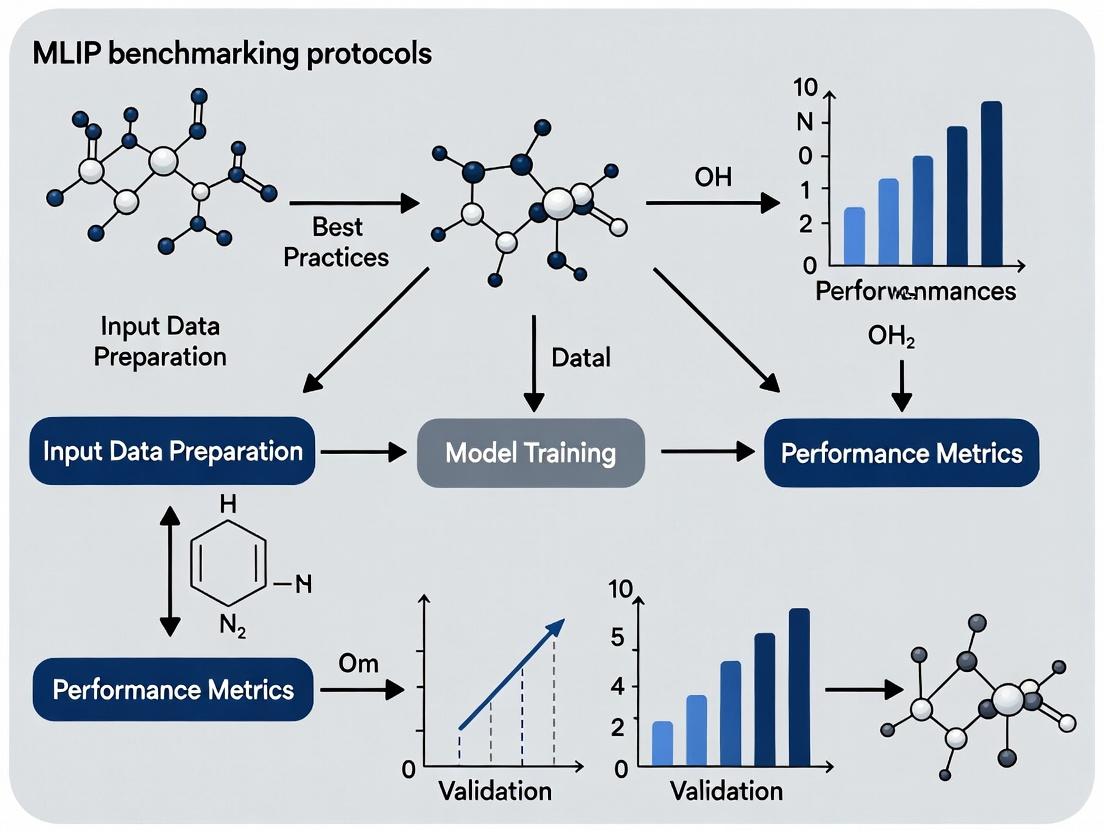
This article provides a comprehensive guide to Machine Learning Interatomic Potential (MLIP) benchmarking for drug development researchers and scientists.
MLIP Benchmarking in Drug Discovery: A Comprehensive Guide to Protocols, Best Practices, and Validation
Abstract
This article provides a comprehensive guide to Machine Learning Interatomic Potential (MLIP) benchmarking for drug development researchers and scientists. We cover the foundational concepts of MLIPs, detailed methodological protocols for application, troubleshooting strategies for common pitfalls, and robust validation frameworks for comparative analysis. This holistic guide equips professionals to implement rigorous, reproducible, and predictive MLIP simulations in biomedical research.
What Are MLIPs? Core Concepts and When to Use Them in Drug Discovery
Defining Machine Learning Interatomic Potentials (MLIPs) vs. Traditional Force Fields
Within the context of establishing rigorous benchmarking protocols and best practices for interatomic potentials, a fundamental step is to precisely define and contrast the two dominant paradigms: Machine Learning Interatomic Potentials (MLIPs) and Traditional Force Fields. The choice between these approaches directly impacts the accuracy, computational cost, and predictive reliability of molecular simulations in materials science, chemistry, and drug development.
Core Definitions and Theoretical Foundation
Traditional Force Fields
Traditional force fields are based on pre-defined analytical mathematical functions that describe the potential energy of a system as a sum of terms representing bonded and non-bonded interactions. The functional form and its parameters are derived from empirical fitting, quantum mechanical calculations, and experimental data.
General Functional Form: E_total = E_bonded + E_non-bonded E_bonded = E_bond_stretch + E_angle_bend + E_torsion + E_improper E_non-bonded = E_van_der_Waals + E_electrostatic
Machine Learning Interatomic Potentials
MLIPs are statistical models trained on high-fidelity quantum mechanical (e.g., Density Functional Theory) data. They learn a mapping from atomic configurations (positions, chemical species) to total energy, forces, and sometimes other properties, without requiring a pre-specified functional form. The energy is typically expressed as a sum of atomic contributions, ensuring linear scaling.
General Form: E_total = Σ_i E_i, where E_i = f( {r_ij, z_j} ) is learned by a neural network, Gaussian process, or other ML model.
Table 1: Core Characteristics Comparison
| Feature | Traditional Force Fields | Machine Learning Interatomic Potentials (MLIPs) |
|---|---|---|
| Functional Form | Pre-defined, fixed analytical equations. | Flexible, learned from data (no explicit form). |
| Parameter Source | Fit to experimental & QM data; often transferable. | Trained exclusively on high-fidelity QM data. |
| Accuracy | Limited by functional form; typically 1-5 kcal/mol error for energy. | Can approach QM accuracy (<< 1 kcal/mol error) within training domain. |
| Computational Cost | Very low (fast evaluation). | Moderate to high (depends on model complexity), but far cheaper than QM. |
| Extrapolation | Generally poor outside parametrized regimes. | Poor; strictly interpolative within training data manifold. |
| Domain of Applicability | Broad but shallow; good for known chemistries. | Narrow but deep; excellent for specific systems covered in training. |
| Treatment of Electronic Effects | Implicit, via fixed partial charges and functional terms. | Captured implicitly if present in training data (e.g., polarization). |
| Development Workflow | Manual parameterization, iterative refinement. | Automated training pipeline, requires careful dataset generation. |
Table 2: Typical Benchmark Performance Metrics (Representative Values)
| Metric | Traditional FF (e.g., GAFF) | MLIP (e.g., NequIP, MACE) | Target (QM) |
|---|---|---|---|
| Energy RMSE (meV/atom) | 20 - 100 | 1 - 10 | 0 |
| Force RMSE (meV/Å) | 200 - 1000 | 10 - 50 | 0 |
| Inference Speed (atom-step/s) | 10^7 - 10^9 | 10^5 - 10^7 | 10^-2 - 10^1 |
| Training Data Size (configurations) | N/A (param fit) | 10^3 - 10^5 | N/A |
Experimental Protocols for Benchmarking
A robust benchmarking protocol is essential for comparative evaluation within MLIP research.
Protocol 4.1: Generation of Reference Quantum Mechanical Dataset
Objective: Create a high-quality, diverse dataset for training and testing potentials.
- System Selection: Define the chemical space (elements, phases, compositions).
- Configuration Sampling: Use ab initio molecular dynamics (AIMD) at relevant temperatures, random structure searches, or displacement perturbations from equilibrium geometries to sample configurations.
- QM Calculation: Perform DFT (or higher-level) calculations for each snapshot. Key Outputs: Total energy, atomic forces, stress tensor.
- Dataset Splitting: Partition into training (≈80%), validation (≈10%), and held-out test (≈10%) sets. Ensure statistical representativeness.
Protocol 4.2: Training a Neural Network Potential (e.g., Behler-Parrinello type)
Objective: Train an MLIP model on the QM dataset.
- Featureization: Transform atomic coordinates into invariant/equivariant descriptors (e.g., atom-centered symmetry functions, ACE, or SOAP).
- Model Architecture: Construct a neural network with 2-3 hidden layers (e.g., (50, 50) nodes). Input: descriptors for atom i. Output: atomic energy contribution E_i.
- Loss Function: Define L = w_E * MSE(E) + w_F * MSE(F) + w_S * MSE(S), where E, F, S are energy, forces, and stress.
- Training: Use Adam optimizer. Monitor validation loss. Employ early stopping to prevent overfitting.
Protocol 4.3: Validation and Benchmarking Simulation
Objective: Assess the predictive performance and stability of the trained MLIP.
- Static Property Prediction: Predict energies/forces for the held-out test set. Calculate RMSE and MAE vs. QM reference.
- Dynamic Stability Test: Run MD (NVT ensemble) at a temperature not included in training.
- Measure property evolution (e.g., radial distribution function, mean squared displacement).
- Check for unphysical energy drift or structural collapse.
- Property Calculation: Perform a production MD simulation to compute target macroscopic properties (e.g., diffusion coefficient, lattice constant, elastic moduli, phonon spectrum). Compare to FF predictions and experimental data (if available).
Visualization of Workflows and Relationships
Diagram 1: MLIP vs FF Benchmarking Research Workflow (100 chars)
Diagram 2: Conceptual Comparison of FF and MLIP Models (99 chars)
The Scientist's Toolkit: Key Research Reagents & Solutions
Table 3: Essential Materials for MLIP/FF Benchmarking Studies
| Item / Solution | Category | Function / Purpose |
|---|---|---|
| VASP / Quantum ESPRESSO / Gaussian | QM Software | Generates the high-fidelity reference data (energies, forces) for training and testing. |
| LAMMPS / GROMACS / OpenMM | MD Engine | Performs molecular dynamics simulations using either the traditional FF or the MLIP (via interface). |
| Atomic Cluster Expansion (ACE) / SOAP | MLIP Descriptor | Translates atomic neighbor environments into a fixed-length, rotationally invariant vector for ML model input. |
| n2p2 / DeepMD-kit / AMPTORCH | MLIP Training Code | Provides frameworks to construct, train, and export neural network or other ML-based potentials. |
| QUIP / INTERFACE | MLIP-MD Interface | Libraries (e.g., ML-IAP, TorchANI) that allow MD packages to call MLIP models during simulation. |
| Reference Molecular Dynamics (RMD) Dataset | Benchmark Data | A curated set of diverse atomic configurations with QM-calculated properties for standardized testing. |
| Force Field Parameterization Tool (e.g., ffTK, LigParGen) | FF Development | Aids in deriving partial charges, torsion parameters, etc., for traditional force fields for organic molecules. |
| Visualization Suite (VMD, OVITO) | Analysis Tool | Critical for visualizing trajectories, debugging unphysical structures, and analyzing simulation results. |
The Critical Role of MLIPs in Modern Computational Drug Discovery
Machine Learning Interatomic Potentials (MLIPs) have emerged as a transformative force in computational drug discovery. They bridge the gap between quantum mechanical (QM) accuracy and classical molecular dynamics (MD) scalability, enabling high-fidelity simulations of biomolecular systems at unprecedented scales. Within the broader thesis on benchmarking protocols, this document establishes application notes and experimental methodologies for the rigorous evaluation and deployment of MLIPs in target validation, ligand binding studies, and free energy calculations.
Quantitative Comparison of MLIP Frameworks
Table 1: Benchmarking Performance of Popular MLIPs on Drug Discovery-Relevant Tasks (2024 Data)
| MLIP Model | Underlying Architecture | Typical System Size (atoms) | Speed vs. DFT | Force Error (eV/Å) | Key Drug Discovery Application |
|---|---|---|---|---|---|
| ANI-2x | AE-ANN | 50,000 | 10^6–10^7x | ~0.03 | High-throughput ligand geometry optimization |
| MACE | Equivariant MPNN | 20,000 | 10^5–10^6x | ~0.02 | Protein-ligand binding dynamics with full QM accuracy |
| NequIP | E(3)-Equivariant GNN | 10,000 | 10^5x | ~0.015 | Allosteric site discovery via side-chain flexibility |
| GemNet | SE(3)-Equivariant | 5,000 | 10^4x | ~0.01 | Transition state modeling for reaction mechanism studies |
| CHGNet | GNN + Charge Features | 100,000+ | 10^6x | ~0.04 | Long-timescale MD for protein folding/misfolding |
Table 2: Computational Cost Analysis for a 100ns Simulation of a Protein-Ligand Complex
| Method | Hardware (GPU) | Wall-clock Time | Estimated Cost (Cloud) | Energy Error (kcal/mol) |
|---|---|---|---|---|
| DFT (CP2K) | 256 CPU Cores | ~3 years | $220,000 | 0.0 (reference) |
| Classical FF (AMBER) | 1x A100 | 5 days | $400 | 5.0–10.0 |
| MLIP (MACE) | 4x A100 | 12 days | $2,800 | 0.5–1.5 |
| MLIP (ANI-2x) | 1x A100 | 7 days | $900 | 1.0–2.0 |
Application Notes & Detailed Protocols
Protocol: MLIP-Driven Binding Free Energy Calculation (ΔG)
Objective: To compute the relative binding free energy of a congeneric ligand series to a kinase target using MLIP-refined simulations.
Workflow Diagram Title: MLIP-Enhanced Binding Free Energy Workflow
Step-by-Step Protocol:
- System Preparation: Using PDB ID 3P7N (PI3Kγ kinase), prepare the protein-ligand complex with protonation states assigned at pH 7.4. Solvate in a TIP3P water box with 12 Å buffer. Add 0.15 M NaCl.
- Initial Minimization & Equilibration: Use OpenMM with the CHARMM36m force field. Minimize energy for 5,000 steps (steepest descent). Equilibrate in NVT ensemble (298 K, Langevin thermostat) for 100 ps, then NPT ensemble (1 atm, Monte Carlo barostat) for 200 ps.
- MLIP Refinement: Extract 10 equidistant snapshots from the last 50 ps of classical NPT. For each snapshot, perform geometry optimization using the ANI-2x potential (via TorchANI) with the protein backbone constrained (force constant 1.0 kcal/mol/Ų). Use the lowest-energy refined structure for FEP.
- Classical FEP Setup: Using the refined structure, set up a relative FEP calculation for 5 ligand analogs. Employ 12 dual-topology λ windows. Run 1 ns equilibration per window, followed by 5 ns production per window (AMBER22, GPU pmemd).
- MLIP Correction: Extract 500 snapshots from the production phase of each λ window. Calculate the potential energy for each snapshot using both the classical force field and the MACE MLIP (single-point calculations). Compute the energy difference (ΔEMLIP - ΔEMM) for each snapshot.
- Analysis: Use the Multistate Bennett Acceptance Ratio (MBAR) to compute the classical ΔΔG. Apply the ensemble-average MLIP energy correction to each transformation's free energy estimate: ΔΔGcorrected = ΔΔGclassical + <ΔEMLIP - ΔEMM>.
Protocol: High-Throughput Virtual Screening with MLIP Re-scoring
Objective: To screen 10,000 compounds from the ZINC20 library against the SARS-CoV-2 Mpro active site using a Glide/MLIP hybrid protocol.
Workflow Diagram Title: MLIP-Rescoring Virtual Screening Pipeline
Step-by-Step Protocol:
- Library Preparation: Download SMILES strings for 10,000 "drug-like" molecules from ZINC20. Generate up to 32 stereoisomers, tautomers, and protonation states per molecule (pH 7.0 ± 2.0) using LigPrep (Schrödinger Suite). Output as 3D SDF files.
- Protein Preparation: Prepare the Mpro structure (PDB 6LU7) with the Protein Preparation Wizard: add missing hydrogens, assign bond orders, optimize H-bond networks, and perform a constrained minimization (OPLS4).
- Initial Docking: Define the active site grid centered on the cocrystallized ligand. Perform Glide Standard Precision (SP) docking for all prepared ligands. Retain the top 1,000 poses based on GlideScore.
- Refinement with MMGBSA: For the top 1,000 poses, perform Prime MMGBSA calculation. Use the VSGB solvation model and OPLS4 force field. Minimize the complex while keeping the protein rigid. Retain the top 500 based on MMGBSA ΔG.
- MLIP Re-scoring: For each of the 500 complexes, run a short 10 ps NVT MD simulation at 300 K using the NequIP potential to relax side chains and ligand. From the final snapshot, calculate the protein-ligand interaction energy as: Einteraction = Ecomplex - (Eprotein + Eligand). Use this as the MLIP score.
- Consensus Ranking: Normalize scores from Glide, MMGBSA, and MLIP to Z-scores. Generate a final rank using a weighted sum: Final Score = 0.3Z(GlideScore) + 0.3Z(MMGBSA) + 0.4*Z(MLIP_Interaction).
The Scientist's Toolkit: Essential Research Reagents & Solutions
Table 3: Key Software and Database Solutions for MLIP-Driven Drug Discovery
| Item Name | Vendor/Project | Function in MLIP Workflow | Key Feature for Drug Discovery |
|---|---|---|---|
| TorchANI | OpenAI | Provides pre-trained ANI-2x potential | Fast, GPU-accelerated energy/force calls for geometry optimization. |
| MACE | MACE Developers | Equivariant MLIP for high accuracy | Models explicit long-range electrostatics critical for binding. |
| NequIP | MIT | E(3)-equivariant graph neural network potential | Data-efficient, excellent for small biomolecule systems. |
| OpenMM | Stanford/Virtual School | MD engine with MLIP plugin support | Enables hybrid MLIP/classical simulation workflows. |
| CHARMM36m | CHARMM Developers | Traditional force field | Baseline for equilibration and MLIP correction protocols. |
| PDB | RCSB | Source of experimental structures | Provides initial coordinates and validation benchmarks. |
| ZINC20 | UCSF | Free database of commercially available compounds | Library for virtual screening and lead discovery. |
| AlphaFold DB | DeepMind | Repository of predicted protein structures | Enables MLIP studies on targets without crystal structures. |
| AWS ParallelCluster | Amazon Web Services | HPC cluster management on cloud | Scalable infrastructure for large-scale MLIP MD simulations. |
| JupyterLab | Project Jupyter | Interactive development environment | Facilitates data analysis, visualization, and protocol sharing. |
Pathway Visualization: MLIPs Enabling Allosteric Drug Discovery
Diagram Title: MLIP-Driven Allosteric Site Identification Pathway
Application Notes
This document provides application notes and experimental protocols for key Machine Learning Interatomic Potential (MLIP) architectures, framed within a benchmarking thesis for computational materials science and drug development. MLIPs bridge quantum mechanical accuracy with classical molecular dynamics speed, enabling large-scale, high-fidelity simulations.
Neural Network Potentials (NNPs), such as Behler-Parrinello and Deep Potential, use atom-centered symmetry functions or embedding networks to represent atomic environments, followed by feed-forward neural networks to predict energies. They excel in modeling complex, high-dimensional potential energy surfaces (PES) for diverse material systems.
Gaussian Process Regression (GPR) potentials offer a non-parametric, Bayesian approach. They provide inherent uncertainty quantification, which is critical for active learning and robust sampling of configurations. Their computational cost scales cubically with training set size, often limiting them to smaller systems or used in hybrid approaches.
Other Architectures include linear models (e.g., Spectral Neighbor Analysis Potential, SNAP), kernel-based methods, and emerging graph neural networks (e.g., MACE, Allegro). These architectures balance interpretability, data efficiency, and scalability.
The choice of architecture depends on system complexity, data availability, required accuracy, and computational budget. Benchmarking protocols must standardize training, validation, and testing across these paradigms.
Experimental Protocols for MLIP Benchmarking
Protocol 1: Unified Training and Validation Workflow
- Data Curation: Assemble a diverse dataset of atomic configurations (e.g., from ab initio molecular dynamics, density functional theory calculations). Split into training (70%), validation (15%), and hold-out test (15%) sets.
- Descriptor/Feature Generation: For each architecture, compute relevant input features.
- For NNPs (Behler-Parrinello): Calculate radial and angular symmetry functions for each atom.
- For GPR: Compute a smooth overlap of atomic positions (SOAP) or atomic cluster descriptors.
- For Linear Models: Build the bispectrum or equivalent descriptor vectors.
- Model Training:
- NNP: Train feed-forward network using mean squared error loss between predicted and DFT energies/forces. Use validation set for early stopping.
- GPR: Optimize kernel hyperparameters (length scale, noise) by maximizing the log marginal likelihood on the training set.
- Hyperparameter Optimization: Conduct a grid or Bayesian search over key parameters (e.g., network width/depth, learning rate, regularization for NNPs; kernel type and scale for GPR).
Protocol 2: Performance Benchmarking on Test Set
- Energy & Force Accuracy: Calculate Root Mean Square Error (RMSE) and Mean Absolute Error (MAE) for energy per atom and atomic force components on the hold-out test set.
- Phonon Dispersion & Elastic Constants: Perform finite-displacement calculations to derive phonon spectra and elastic tensors. Compare to reference DFT results.
- Molecular Dynamics (MD) Validation: Run NVT and NPT MD simulations on unseen phases or defect structures. Monitor stability and compare radial distribution functions, diffusion coefficients, or phase transition temperatures to ab initio or experimental benchmarks.
Protocol 3: Efficiency Assessment
- Training Time & Scalability: Measure wall-clock time to convergence vs. training set size.
- Inference Speed: Measure the time (and cost) to perform a single MD step for a standardized system (e.g., 256 atoms). Compare to a baseline (e.g., DFT, classical force field).
Table 1: Benchmark Performance of MLIP Architectures on a Standardized Test Set (Example: Silicon Bulk & Defects)
| Architecture | Energy RMSE (meV/atom) | Force RMSE (eV/Å) | Single-step Inference Time (ms) | Max Stable MD Time (ps) | Training Time (GPU-hr) |
|---|---|---|---|---|---|
| Behler-Parrinello NNP | 2.1 | 0.15 | 5.2 | >100 | 12.5 |
| DeepPot-SE | 1.8 | 0.12 | 7.8 | >100 | 25.0 |
| Gaussian Approximation Pot. (GAP) | 1.5 | 0.10 | 45.0 | >100 | 120.0 (CPU) |
| Spectral Neighbor Anal. Pot. (SNAP) | 3.0 | 0.22 | 12.3 | 85 | 5.0 (CPU) |
| Graph Neural Network (MACE) | 1.2 | 0.08 | 15.5 | >100 | 40.0 |
Table 2: Typical Hyperparameter Search Space for Key Architectures
| Architecture | Key Hyperparameters | Typical Search Range |
|---|---|---|
| Behler-Parrinello NNP | Number of hidden layers, neurons/layer, radial/angular function cutoffs | 2-4 layers, 10-50 neurons, 4.0-8.0 Å |
| Deep Potential | Size of embedding & fitting nets, smoothing parameter (r_sel) | (25,50,100) nets, 5.0-7.0 Å |
| Gaussian Process (GPR) | Kernel type (SOAP, dot product), length scale, noise | Length scale: 0.1-10.0 |
| Linear Model (SNAP) | Bispectrum order (jmax), radial basis cutoff | jmax: 1-5, cutoff: 4.0-6.0 Å |
Visualizations
Title: Standard MLIP Development and Benchmarking Workflow
Title: MLIP Architecture Comparison: Types and Trade-offs
The Scientist's Toolkit: Research Reagent Solutions
Table 3: Essential Software and Libraries for MLIP Research
| Item (Software/Library) | Primary Function | Key Use Case in Protocol |
|---|---|---|
| LAMMPS | Molecular Dynamics Simulator | The primary engine for running MD simulations with fitted MLIPs (Protocol 2, Step 3). |
| QUIP/GAP | Software package for GAP | Used to fit and run Gaussian Approximation Potentials (Protocol 1, Step 3). |
| DeePMD-kit | Toolkit for Deep Potential | Training and running DeepPot-SE and related NNPs (Protocol 1 & 2). |
| ASE (Atomic Simulation Environment) | Python toolkit for atomistics | Used for data set manipulation, descriptor calculation, and interfacing different codes. |
| PyTorch/TensorFlow | Deep Learning Frameworks | Backend for building and training custom neural network potentials. |
| SNAPU or LibTorch-SNAP | Implementations of SNAP | Fitting Spectral Neighbor Analysis Potentials (Protocol 1). |
| JAX or JAX-MD | Accelerated computing library | Increasingly used for developing new, differentiable MLIP models. |
| VASP/Quantum ESPRESSO | Ab Initio Electronic Structure | Generating the reference training data (Protocol 1, Step 1). |
Application Notes on Multi-Fidelity Training Data for MLIPs
The development of robust and transferable Machine Learning Interatomic Potentials (MLIPs) for chemical and biochemical systems requires training on high-quality, multi-fidelity datasets. These datasets span varying levels of computational cost and accuracy, from fast but approximate Density Functional Theory (DFT) to highly accurate but expensive coupled-cluster theory (CCSD(T)) and experimental measurements.
Table 1: Characteristic Fidelity, Cost, and Applications of Core Data Sources
| Data Source | Typical Accuracy (Energy) | Computational Cost | Primary Use in Training | Key Limitations |
|---|---|---|---|---|
| DFT (e.g., PBE, B3LYP) | ~5-10 kcal/mol | Moderate | Generating large-scale structural datasets; initial potential fitting. | Functional dependence; poor dispersion; inaccurate for transition states. |
| CCSD(T)/CBS (Gold Standard) | <1 kcal/mol | Very High | Small, high-accuracy training sets; correction schemes; final validation. | Prohibitively expensive for >20 atoms or dynamical sampling. |
| Experimental Data (e.g., XRD, NMR, ∆G) | Varies (Direct Physical Measurement) | N/A (Acquisition Cost) | Anchoring model to physical reality; thermodynamic/kinetic parameter fitting. | Sparse; often indirect for energies; requires careful error modeling. |
Best Practices for Data Curation
- Stratified Sampling: Training sets must sample relevant chemical and conformational space. Use DFT-based active learning or molecular dynamics to generate candidate structures, then select a subset for high-level (CCSD(T)) single-point energy calculations.
- Error Consistency: Quantify and document systematic errors for each data source. For example, a specific DFT functional may consistently underbind dispersion complexes by 2 kcal/mol.
- Multi-Fidelity Integration: Employ Δ-Machine Learning or hierarchical approaches. A base model is trained on abundant DFT data, then a correction model is trained on the difference between CCSD(T) and DFT energies for a smaller, representative set.
- Experimental Data Integration: Experimental observables (e.g., free energies of binding, lattice constants) should be incorporated via a loss function during training or used for rigorous validation, not as direct energy labels.
Detailed Protocols for Constructing a Multi-Fidelity Training Set
Protocol: Generating a CCSD(T)-Corrected DFT Dataset for Organic Molecule Conformers
Objective: Create a dataset of organic molecule conformer energies suitable for training a generalizable MLIP.
Materials & Software:
- Initial Conformer Pool: Generated using RDKit or CREST.
- DFT Engine: Gaussian 16, ORCA, or PSI4.
- High-Level Computation Engine: MRCC, CFOUR, or ORCA (for DLPNO-CCSD(T)).
- Scripting: Python with ASE (Atomic Simulation Environment) or Psi4NumPy.
Procedure:
- Conformer Generation: For each target molecule (e.g., drug-like fragments), generate an ensemble of low-energy conformers using a meta-dynamics or systematic search (MMFF94 force field).
- DFT Pre-Optimization and Single-Point: Optimize all conformer geometries using a standard DFT functional (e.g., ωB97X-D/def2-SVP). Perform a tighter single-point energy calculation on each optimized geometry (e.g., ωB97X-D/def2-QZVP).
- High-Level Subset Selection: Cluster conformers based on root-mean-square deviation (RMSD). From each major cluster, select the centroid and 1-2 edge-case structures.
- CCSD(T) Benchmark Calculation: Perform DLPNO-CCSD(T)/def2-QZVP single-point energy calculations on the selected subset (typically 50-100 structures per molecule). Note: Ensure extrapolation to the complete basis set (CBS) if maximum accuracy is required.
- Δ-Data Creation: For the subset, calculate ΔE = ECCSD(T) - EDFT. Train a
Δ-model(e.g., Gaussian Process Regression) to predict this correction as a function of the DFT-derived electronic descriptors or geometry. - Corrected Dataset Assembly: Apply the trained
Δ-modelto predict corrections for the entire DFT dataset. Create the final training set labels: Efinal = EDFT + ΔE_predicted.
Protocol: Integrating Experimental Binding Free Energy Data
Objective: Refine an MLIP to reproduce experimental protein-ligand binding affinities (ΔG).
Materials:
- MLIP: Pre-trained on DFT data (e.g., ANI-2x, MACE).
- Experimental Data: Public databases (e.g., PDBbind, BindingDB).
- Free Energy Calculation Software: SOMD, GROMACS with plumed, or Schrodinger FEP+.
Procedure:
- Data Curation: From PDBbind, select a high-quality subset of protein-ligand complexes with experimentally measured ΔG, crystal structures (resolution < 2.0 Å), and well-defined binding pockets.
- System Preparation: Prepare the complexes (protonation, solvation, minimization) using a standard molecular mechanics force field.
- Alchemical Transformation Setup: Set up free energy perturbation (FEP) or thermodynamic integration (TI) calculations for a series of congeneric ligands.
- MLIP-Driven Simulation: Perform the alchemical simulations using the MLIP (via interfaces like TorchMD or DeepMD) for the ligand and its immediate environment, while treating the rest of the protein with a classical force field.
- Loss Function and Refinement: Define a loss function L = Σ (ΔGcalc - ΔGexp)². Use gradient-based optimization to refine the MLIP's last layer or a dedicated correction network, minimizing L. This is typically a fine-tuning step, not training from scratch.
- Validation: Validate the refined MLIP on a held-out test set of experimental ΔG data not used in refinement.
Visualizations
The Scientist's Toolkit: Essential Research Reagents & Materials
Table 2: Key Computational Reagents for Multi-Fidelity Dataset Creation
| Item/Software | Category | Primary Function in Protocol |
|---|---|---|
| RDKit / CREST | Conformer Generation | Generates initial, diverse ensembles of molecular geometries for subsequent QM treatment. |
| ORCA / Gaussian 16 | DFT Engine | Performs density functional theory calculations for geometry optimization and moderate-accuracy single-point energies. |
| MRCC / CFOUR | Coupled-Cluster Engine | Executes high-accuracy CCSD(T) calculations, often considered the quantum chemical "gold standard." |
| DLPNO-CCSD(T) | Approximate Coupled-Cluster | Enables CCSD(T)-level calculations on larger systems (50-200 atoms) with minimal accuracy loss. |
| ASE (Atomic Simulation Environment) | Scripting & Workflow | Python library for orchestrating calculations across different quantum chemistry codes and managing atoms. |
| TorchMD / DeepMD-Kit | MLIP Simulation Interface | Allows pre-trained MLIPs to be used for molecular dynamics and free energy simulations. |
| PDBbind / BindingDB | Experimental Database | Curated sources of experimental protein-ligand binding affinities and structures for validation/refinement. |
| GROMACS / SOMD | Free Energy Calculation | Software to perform alchemical free energy simulations (FEP/TI) using MLIPs or classical force fields. |
Application Notes
The benchmarking of Machine Learning Interatomic Potentials (MLIPs) is critical for establishing trust in their application to computational drug discovery. Within the broader thesis on MLIP benchmarking protocols, three high-value use cases emerge: predicting protein-ligand binding affinities, sampling conformational dynamics, and modeling solvation effects. These applications test an MLIP's accuracy beyond single-point energies, evaluating its performance on thermodynamic and kinetic properties essential for understanding biomolecular function.
Quantitative benchmarks require comparison against high-level quantum mechanics (QM) and/or robust experimental data. The tables below summarize key performance metrics and datasets relevant for MLIP evaluation in these domains.
Table 1: Benchmark Datasets for MLIP Validation in Drug-Relevant Use Cases
| Dataset Name | Primary Use Case | Target Property | Reference Data Source | Key Metric(s) |
|---|---|---|---|---|
| PoseBusters | Protein-Ligand Binding | Binding pose plausibility | Crystal structures & physics | RMSD, steric clashes, formal charges |
| PLAS-5k | Protein-Ligand Binding | Relative binding free energy (ΔΔG) | Experimental affinity | RMSE, R², Kendall's τ |
| Protein Conformational Ensembles | Conformational Dynamics | State populations, transition rates | NMR, DEER spectroscopy | Free energy landscape, kinetics |
| SPICE | Solvation | Solvation free energies (ΔG_solv) | Experimental/Implicit solvation | RMSE, Mean Absolute Error |
| WSAS | Solvation | Water site stability & entropy | MD simulations with explicit water | Residence time, density maps |
Table 2: Typical MLIP Performance Targets for Biomolecular Simulations
| Property | Target Accuracy (vs. QM/Experiment) | Required Simulation Time | Relevant MLIP Architecture Examples |
|---|---|---|---|
| Binding Affinity (ΔG) | < 1.0 kcal/mol RMSE | 10-100 ns per window | NequIP, Allegro, MACE |
| Side-Chain Rotamer Populations | > 0.9 Correlation | 100 ns - 1 µs | TorchANI, ANI-2x, PiNN |
| Solvation Free Energy | < 1.5 kcal/mol RMSE | 1-10 ns per compound | Solvent-trained specialized MLIPs |
| Macromolecular RMSD Stability | < 2.0 Å (vs. Target) | 100 ns - 1 µs | Generalizable biomolecular MLIPs |
Experimental Protocols
Protocol 1: Relative Binding Free Energy (RBFE) Calculation using MLIPs
This protocol outlines an alchemical free energy perturbation (FEP) approach to compute ΔΔG for congeneric ligands, a critical benchmark for MLIPs in drug discovery.
1. System Preparation:
- Source: Obtain protein-ligand complexes from the PDB or prepare using docking (e.g., GLIDE, AutoDock).
- Parameterization: Generate initial coordinates and topologies for the protein and ligands. Use the MLIP for all atoms, avoiding hybrid QM/MM setups for pure MLIP tests.
- Solvation: Solvate the system in a truncated octahedral or rectangular water box, ensuring a minimum 10 Å buffer from the solute. Add ions to neutralize charge and achieve physiological concentration (e.g., 150 mM NaCl).
2. Alchemical Pathway Setup:
- Define the thermodynamic cycle linking two ligands (L1 → L2).
- Discretize the transformation into 12-24 λ windows. Use a soft-core potential for Lennard-Jones interactions to avoid singularities.
- For each λ window, energy minimize and equilibrate (NVT then NPT) for 100-200 ps.
3. Production Simulation & Analysis:
- Run molecular dynamics for each λ window using the MLIP. Collect 5-10 ns of data per window (total ~60-240 ns per transformation).
- Use the Multistate Bennett Acceptance Ratio (MBAR) or Thermodynamic Integration (TI) to analyze the energy differences and compute ΔΔG.
- Benchmarking: Compare MLIP-derived ΔΔG values against experimental IC50/Ki data (converted to ΔG) and results from classical FEP (e.g., using AMBER/CHARMM). Calculate RMSE, R², and Kendall's τ rank correlation.
Protocol 2: Characterizing Conformational Dynamics via MLIP MD
This protocol benchmarks an MLIP's ability to reproduce protein conformational landscapes and transition kinetics.
1. Initial Structure and Simulation Setup:
- Select a protein with well-characterized conformational states (e.g., T4 lysozyme L99A, GPCRs).
- Prepare the system as in Protocol 1, ensuring the simulation box accommodates large-scale motion.
- Perform extended energy minimization and equilibration.
2. Enhanced Sampling Simulation:
- Employ enhanced sampling methods to overcome timescale limitations. Use Gaussian Accelerated MD (GaMD) or Metadynamics.
- For GaMD: Calculate system potential statistics over a 20 ns preliminary run, then apply the boost potential for a 500 ns - 1 µs production run using the MLIP.
- Select collective variables (CVs) carefully (e.g., distance between key residues, dihedral angles).
3. Analysis of Dynamics:
- Free Energy Surface: Construct 2D free energy landscapes by projecting the simulation trajectory onto the selected CVs.
- State Identification: Use clustering (e.g., k-means, hierarchical) on CVs or RMSD to identify metastable conformational states.
- Kinetics: Perform Markov State Model (MSM) analysis to compute transition rates between identified states.
- Benchmarking: Compare state populations, free energy barriers, and transition rates against experimental data (NMR relaxation, smFRET) or long-timescale classical MD simulations.
Protocol 3: Solvation Free Energy Calculation
This protocol tests an MLIP's accuracy in modeling solvent interactions by calculating the solvation free energy (ΔG_solv) for small molecules.
1. Ligand and Simulation Setup:
- Select a diverse set of 10-20 small molecules from the SPICE or FreeSolv database.
- For each molecule, create two simulation systems: (1) solute in vacuum, (2) solute solvated in water (TIP3P or SPC/E, or as defined by MLIP training).
- Use a smaller box (≥8 Å buffer) for efficiency. Apply periodic boundary conditions.
2. Alchemical Decoupling Simulation:
- Define an alchemical path to decouple the solute from the solvent over 12-16 λ windows. Electrostatic interactions are typically decoupled before van der Waals.
- For each λ window, equilibrate for 50 ps, then run production MLIP-MD for 2-5 ns.
3. Free Energy Analysis and Validation:
- Use MBAR/TI to compute ΔG_solv from the alchemical work values.
- Benchmarking: Compare the MLIP-computed ΔG_solv against the reference experimental values from the database. Compute mean unsigned error (MUE) and RMSE. A robust MLIP should achieve an MUE < 1.0 kcal/mol for drug-like molecules.
Visualization
MLIP Benchmarking Workflow
Binding Free Energy Thermodynamic Cycle
Conformational Dynamics State Model
The Scientist's Toolkit: Research Reagent Solutions
Table 3: Essential Resources for MLIP Biomolecular Benchmarking
| Item Name | Category | Function & Relevance to Benchmarking |
|---|---|---|
| OpenMM | Simulation Engine | A versatile, high-performance toolkit for running MLIP and classical MD simulations. Essential for implementing alchemical FEP and enhanced sampling protocols. |
| MDAnalysis | Analysis Library | A Python library to analyze trajectories from MLIP-MD. Used to compute RMSD, distances, dihedrals, and other CVs for dynamics benchmarks. |
| pymbar | Analysis Library | Python implementation of the MBAR estimator for accurate free energy calculation from alchemical simulations (Protocols 1 & 3). |
| PLUMED | Enhanced Sampling | A library for implementing GaMD, Metadynamics, and defining CVs. Integrates with MLIP codes to sample conformational transitions (Protocol 2). |
| SPICE Dataset | Reference Data | A curated QM and experimental dataset of small molecule solvation and thermodynamic properties. Primary benchmark for solvation free energy calculations. |
| PDBbind | Reference Data | A comprehensive database of protein-ligand complex structures and binding affinities. Used to curate test sets for binding affinity prediction benchmarks. |
| DeePMD-kit | MLIP Framework | A widely used framework to run simulations with MLIPs like DeepPot-SE. Often used as a baseline for performance comparisons. |
| CHARMM36 | Classical Force Field | The standard classical force field for biomolecules. Provides the essential reference point against which MLIP accuracy and efficiency are compared. |
A Step-by-Step Protocol for Robust MLIP Benchmarking and Deployment
Within the broader thesis on Machine Learning Interatomic Potential (MLIP) benchmarking protocols, this document provides detailed Application Notes and Protocols. A rigorous, standardized workflow is essential for the robust evaluation of MLIPs, which are critical tools for researchers, scientists, and drug development professionals in molecular simulation and materials discovery.
The Benchmarking Workflow: A Five-Stage Protocol
A comprehensive MLIP benchmarking workflow consists of five sequential, interdependent stages.
Diagram 1: MLIP Benchmarking Workflow
Title: Five-Stage MLIP Benchmarking Workflow
Stage 1: Problem Definition & Scope Delineation
Protocol: Before any data is collected, explicitly define the chemical space, material classes (e.g., organic molecules, metallic alloys, semiconductors), and target properties for evaluation. Document intended use cases (e.g., molecular dynamics for protein folding, energy prediction for crystal structures).
Output: A benchmarking charter specifying elements, phases, conditions (T, P), and key properties of interest (energy, forces, stresses, vibrational spectra, defect formation energies).
Stage 2: Data Curation & Dataset Assembly
This foundational stage involves sourcing and preparing high-quality reference data. Sources include Density Functional Theory (DFT) databases, experimental repositories, and high-level quantum chemistry calculations.
Protocol 2.2.1: Multi-Source Data Aggregation
- Source Identification: Query established databases (see Table 1). Use APIs (e.g., Materials Project API, OQMD API) for programmatic retrieval.
- Data Download: Extract structures and target properties (energy, forces).
- Initial Filtering: Remove duplicates and structures with failed calculations.
- Format Standardization: Convert all data to a common format (e.g., ASE.db, .xyz, extended XYZ).
Protocol 2.2.2: Dataset Splitting Strategy
- Define Splits: Create distinct sets for Training (≈70-80%), Validation (≈10-15%), and Testing (≈10-15%).
- Apply Splitting Algorithm: Use structure-based splitting (e.g., SLATM, SOAP) via tools like
sklearnormdsplitsto ensure dissimilar structures are in different splits, preventing data leakage. - Finalize & Archive: Save split indices and final datasets with unique identifiers. Calculate dataset statistics.
Table 1: Key Data Sources for MLIP Benchmarking
| Source Name | Type | Primary Content | Access Method | Key Consideration |
|---|---|---|---|---|
| Materials Project | DFT Database | Inorganic crystals, formation energies, elastic tensors | REST API | PBE functional; may require correction schemes. |
| OQMD | DFT Database | Inorganic materials, thermodynamic stability | REST API | Large volume; requires careful quality filtering. |
| NOMAD | Repository | Diverse data (DFT, experiment, MD) | Archive Browser/API | Heterogeneous; requires extensive curation. |
| ANI-1x/ANI-2x | ML-Oriented | DFT (wB97X/6-31G*) organic molecules | Download | High-quality, general-purpose for molecules. |
| rMD17 | ML-Oriented | DFT (PBE+D3) trajectories of small molecules | Download | Benchmark for forces and dynamics. |
Model Training & Validation Protocol
Protocol 3.1: Standardized Training Loop
- Initialization: Initialize MLIP architecture (e.g., NequIP, MACE, Allegro) with published or defined hyperparameters.
- Loss Function Definition: Use a composite loss:
L = w_energy * MSE(E) + w_forces * MSE(F) + [w_stress * MSE(S)]. - Optimization: Use Adam or AdamW optimizer with a learning rate scheduler (e.g., ReduceLROnPlateau).
- Validation Checkpointing: After each epoch, compute validation loss. Save the model with the best validation loss.
- Early Stopping: Halt training if validation loss does not improve for a pre-defined number of epochs (patience=50).
Diagram 2: Training & Validation Loop
Title: MLIP Training and Validation Loop
Systematic Evaluation & Testing Protocol
Protocol 4.1: Property Prediction on Static Test Set
- Inference: Use the checkpointed best model to predict energies (E), atomic forces (F), and stresses (σ) for all entries in the held-out test set.
- Error Calculation: Compute per-structure errors relative to reference (DFT) values. Common metrics include Mean Absolute Error (MAE) and Root Mean Square Error (RMSE).
Protocol 4.2: Molecular Dynamics Stability Test
- Simulation Setup: Select 5-10 diverse test structures. Run NVT MD using the MLIP at a relevant temperature (e.g., 300K, 1000K) for 10-50 ps with a 0.5-1.0 fs timestep.
- Stability Metric: Monitor the root mean square deviation (RMSD) of the core structure and check for unphysical bond breaking or atom evaporation.
- Energy Conservation: In an NVE simulation, monitor the total energy drift per atom over time (should be < 1 meV/atom/ps).
Table 2: Example Benchmarking Results on a Hypothetical Test Set
| Model Architecture | Energy MAE (meV/atom) | Forces MAE (meV/Å) | Stress MAE (GPa) | Stable MD? (Y/N) | Energy Drift (meV/atom/ps) |
|---|---|---|---|---|---|
| Model A (e.g., NequIP) | 8.2 | 86.5 | 0.45 | Y | 0.3 |
| Model B (e.g., MACE) | 6.5 | 71.2 | 0.38 | Y | 0.2 |
| Model C (Baseline) | 25.1 | 152.7 | 1.12 | N | 5.8 |
Metric Calculation, Reporting, and Analysis
Protocol 5.1: Comprehensive Metric Calculation
- Aggregate Statistics: Calculate mean, standard deviation, and max error across the entire test set for all primary properties.
- Per-Element/Per-Phase Analysis: Segment errors by chemical element or crystal phase to identify model biases.
- Speed Benchmarking: Measure the wall-clock time for a single force call and for 1 ps of MD simulation on standard hardware (e.g., 1x NVIDIA A100 GPU).
Protocol 5.2: Reporting Standard Create a final benchmark report containing:
- Dataset statistics (size, composition, splits).
- Full training hyperparameters.
- Table of aggregate metrics (like Table 2).
- Per-element error plots.
- MD stability/energy drift results.
- Computational cost metrics.
The Scientist's Toolkit: Research Reagent Solutions
Table 3: Essential Tools and Libraries for MLIP Benchmarking
| Item (Tool/Library) | Category | Function & Purpose |
|---|---|---|
| ASE (Atomic Simulation Environment) | Core Library | Python framework for setting up, running, and analyzing atomistic simulations. Handles I/O, geometry optimization, and MD. |
| JAX / PyTorch | ML Framework | Libraries for building, training, and executing machine learning models, including graph neural networks for MLIPs. |
| DeePMD-kit | MLIP Framework | A toolkit for training and running the DeepPot-SE model. Provides utilities for data preparation and model deployment. |
| NequIP / MACE / Allegro | MLIP Architecture | State-of-the-art, equivariant graph neural network architectures for constructing highly accurate and data-efficient MLIPs. |
| FAIR-Chem-LAMMPS | MD Engine | A modified version of LAMMPS integrated with PyTorch and JAX for efficient MD simulations with MLIPs on GPUs. |
| CHGNet / M3GNet | Pretrained Potential | Broad, pretrained MLIPs for inorganic materials, useful as baselines or for initial structure screening. |
| Matbench | Benchmarking Suite | A collection of ready-to-use benchmark tasks for evaluating ML models on materials science problems. |
| MODEL-ZOO | Model Repository | A platform for sharing and discovering pretrained MLIPs, promoting reproducibility and community standards. |
This document provides application notes and protocols for dataset splitting, a foundational step in machine learning for interatomic potentials (MLIP) development and benchmarking within drug discovery and materials science. Proper partitioning is critical for developing robust, generalizable models and for fair performance evaluation.
Core Principles and Quantitative Guidelines
Table 1: Recommended Dataset Split Ratios by Scenario
| Scenario / Data Type | Typical Size | Training (%) | Validation (%) | Hold-out Test (%) | Key Rationale |
|---|---|---|---|---|---|
| Large, Homogeneous Dataset | >100,000 samples | 70-80 | 10-15 | 10-15 | Maximizes learning, sufficient data for reliable validation/test. |
| Medium-Sized Dataset | 10,000 - 100,000 samples | 60-70 | 15-20 | 15-20 | Balances learning with evaluation stability. |
| Small or Expensive Dataset | <10,000 samples | 50-60 | 20-25 | 20-25 | Prioritizes evaluation reliability; may require cross-validation. |
| Temporal/Sequential Data | Variable | Chronological first 70-80 | Chronological next 10-15 | Chronological last 10-15 | Preserves temporal causality; prevents data leakage. |
| Highly Imbalanced Classes | Variable | Preserve class ratios in all splits (Stratified Splitting) | Ensures all splits represent the underlying class distribution. |
Table 2: Common Splitting Pitfalls and Mitigations
| Pitfall | Consequence | Mitigation Protocol |
|---|---|---|
| Data Leakage | Over-optimistic, invalid performance estimates. | Hold-out test set must be locked before any model development. Apply same pre-processing (scaling, imputation) independently per split using training set parameters only. |
| Non-IID Splits | Poor model generalization to new data distributions. | Use domain-aware splitting (e.g., by scaffold, by composition, by temporal block). |
| Inadequate Validation Set | Unreliable hyperparameter tuning and model selection. | Ensure validation set is large enough to detect performance differences (> a few hundred samples). Use k-fold cross-validation for small datasets. |
| Single Random Split | High variance in reported performance metrics. | Use multiple random splits with different seeds or nested cross-validation; report mean and std. dev. of metrics. |
Experimental Protocols for MLIP Benchmarking
Protocol 3.1: Standard Randomized Split for Homogeneous Data
- Objective: Create baseline splits for initial model development.
- Materials: Complete dataset (D), random number generator with seed.
- Procedure:
- Shuffle dataset D randomly using a fixed seed for reproducibility.
- Allocate 70% of D to the training set (Dtrain).
- Allocate 15% of D to the validation set (Dval).
- Allocate the final 15% of D to the hold-out test set (Dtest).
- Lock Dtest: Store it separately and do not use for any training or validation activities.
- Use Dtrain for model fitting and Dval for hyperparameter tuning.
- Perform final evaluation once on D_test.
Protocol 3.2: Scaffold Split for Molecular Datasets in Drug Development
- Objective: Assess MLIP ability to generalize to novel chemical scaffolds.
- Materials: Molecular dataset with associated Bemis-Murcko scaffold identifiers.
- Procedure:
- Generate a unique molecular scaffold for each compound in D.
- Group all molecules by their scaffold.
- Sort scaffold groups by size (descending).
- Iteratively assign entire scaffold groups to Dtrain, Dval, and Dtest to approximate target ratios (e.g., 70/15/15). This ensures no scaffold appears in more than one split.
- Lock Dtest and proceed as in Protocol 3.1.
Protocol 3.3: Temporal Split for Evolving Datasets
- Objective: Simulate real-world deployment where future data is unknown.
- Materials: Dataset with timestamps (e.g., experimental results over time).
- Procedure:
- Sort dataset D chronologically by timestamp.
- Designate the earliest 70% of data points as Dtrain.
- Designate the next 15% as Dval.
- Designate the most recent 15% as Dtest.
- Lock Dtest and proceed. Do not shuffle.
Protocol 3.4: Nested Cross-Validation for Small Datasets
- Objective: Maximize use of limited data for both hyperparameter tuning and unbiased performance estimation.
- Procedure:
- Define an outer k-fold (e.g., k=5). Split data into k folds.
- For each outer fold
i:- Hold out fold
ias the test set. - Use the remaining k-1 folds for an inner loop:
- Perform a second, independent k-fold split on the k-1 folds.
- Use these inner splits to tune hyperparameters via grid/random search.
- Train a final model on the k-1 folds with the best hyperparameters.
- Evaluate this model on the held-out outer test fold
i.
- Hold out fold
- The final performance estimate is the average across all k outer test folds.
Visualizations
Diagram Title: Workflow for Dataset Splitting and Model Development
Diagram Title: Nested 5-Fold Cross-Validation Schema
The Scientist's Toolkit
Table 3: Essential Research Reagent Solutions for Dataset Management
| Item / Tool | Primary Function | Application in MLIP/Drug Development Context |
|---|---|---|
Scikit-learn (train_test_split, StratifiedKFold, GroupShuffleSplit) |
Provides robust, standard algorithms for creating dataset splits. | Implementing Protocols 3.1, 3.3, and 3.4. Essential for reproducible random sampling and stratified splits. |
| RDKit | Open-source cheminformatics toolkit. | Generating molecular scaffolds (Bemis-Murcko) for implementing Protocol 3.2 (scaffold split). |
| Pandas / NumPy | Data manipulation and numerical computing in Python. | Core libraries for loading, filtering, shuffling, and indexing datasets before and after splitting. |
| Chemical Checker or TDC (Therapeutics Data Commons) | Provide pre-processed, curated biomedical datasets with suggested benchmark splits. | Accessing standardized datasets and split definitions for fair MLIP benchmarking in drug discovery tasks. |
| Weights & Biases (W&B) / MLflow | Experiment tracking and versioning platforms. | Logging dataset split hash/version, hyperparameters, and results to ensure traceability and reproducibility. |
| Custom Splitting Scripts (Python) | Domain-specific splitting logic. | Implementing complex splitting rules (e.g., by material composition, by protein family) not covered by standard libraries. |
| Checksum Tool (e.g., MD5) | Generating unique hash identifiers for files. | Creating a unique fingerprint for locked test sets to guarantee their integrity throughout a research project. |
Within the thesis on Machine Learning Interatomic Potential (MLIP) benchmarking protocols and best practices, the rigorous selection and calculation of essential metrics form the cornerstone of reliable model validation. This document provides detailed application notes and protocols for evaluating MLIP performance based on energy, atomic forces, and material property predictions. Accurate benchmarking across these metrics is critical for the deployment of MLIPs in research and industrial applications, such as drug development and materials discovery.
Core Quantitative Metrics: Definitions & Equations
The performance of an MLIP is quantified by comparing its predictions against reference data, typically derived from quantum mechanical calculations like Density Functional Theory (DFT). The following errors are fundamental.
Table 1: Definitions of Core MLIP Error Metrics
| Metric | Formula | Description |
|---|---|---|
| Energy Error (per atom) | RMSE_E = sqrt( 1/N ∑_i^N ((E_i_pred - E_i_ref)/n_i)^2 ) |
Root Mean Square Error (RMSE) in total energy, normalized per atom for system size independence. n_i is the number of atoms in configuration i. |
| Forces Error | RMSE_F = sqrt( 1/(3*M) ∑_i^M ∑_α (F_i,α_pred - F_i,α_ref)^2 ) |
RMSE over all M atoms and all Cartesian components (α ∈ {x,y,z}) of the atomic force vectors. |
| Energy-Forces Trade-off | Typically visualized via a 2D scatter plot of RMSE_E vs. RMSE_F for multiple models. |
Highlights the Pareto front; models closer to the origin and the front are superior. |
| Property Error | Error_P = | P_pred - P_ref | (or relative error) |
Error in derived material properties (e.g., lattice constant, elastic moduli, vibrational frequencies). |
Experimental Protocols for Metric Calculation
Protocol 3.1: Dataset Preparation and Partitioning
Objective: To create a standardized dataset for training, validation, and testing.
- Source Data: Gather reference data from databases (e.g., Materials Project, QM9, OC20) or generate new DFT calculations.
- Splitting: Implement a structure-based split (e.g., by composition, crystal prototype, or molecular scaffold) to prevent data leakage. A common ratio is 70:15:15 (Train:Validation:Test).
- Normalization: Scale energy and force targets to zero mean and unit variance using training set statistics.
Protocol 3.2: Calculation of Energy and Force Errors
Objective: To compute RMSEE and RMSEF on a held-out test set.
- Model Inference: Use the trained MLIP to predict energies (
E_pred) and forces (F_pred) for all configurations in the test set. - Per-configuration Error: Calculate Mean Absolute Error (MAE) per configuration for debugging.
- Aggregate RMSE: Apply the formulas in Table 1 across the entire test set to compute the final RMSE values.
- Unit Conversion: Report errors in standardized units (e.g., meV/atom for energy, meV/Å for forces).
Protocol 3.3: Calculation of Material Property Errors
Objective: To predict macroscopic properties from MLIP-driven simulations.
- Property Selection: Choose relevant properties (e.g., lattice parameter
a₀, bulk modulusB, cohesive energy). - Simulation Setup: Use the MLIP within a molecular dynamics (MD) or Monte Carlo (MC) engine (e.g., LAMMPS, ASE).
- Protocol Execution:
- For
a₀: Perform variable-cell relaxation at 0K. - For
B: Fit an equation of state (e.g., Birch-Murnaghan) to energy-volume curves. - For
E_coh:E_coh = (E_crystal - N * E_atom) / N, whereE_atomis the energy of an isolated atom.
- For
- Error Reporting: Compute absolute or relative error against the DFT-derived reference property.
Visualization of Benchmarking Workflow
Diagram 1: MLIP Benchmarking and Metric Calculation Workflow (100 chars)
The Scientist's Toolkit: Essential Research Reagents & Software
Table 2: Key Research Reagent Solutions for MLIP Benchmarking
| Item Name | Category | Function & Explanation |
|---|---|---|
| VASP / Quantum ESPRESSO | Reference Data Generator | First-principles electronic structure codes to generate the "ground truth" training and test data. |
| ASE (Atomic Simulation Environment) | Python Library | Facilitates the setup, execution, and analysis of DFT calculations and atomistic simulations with MLIPs. |
| LAMMPS | Simulation Engine | High-performance MD code with broad support for MLIPs via interfaces (e.g., mliap). Used for property prediction. |
| SGDML / sGDML | Force-Field Model | A specialized MLIP for molecular systems, providing accurate forces for benchmarking. |
| MACE / Allegro / NequIP | Graph Neural Network MLIPs | State-of-the-art, equivariant MLIP architectures that set modern performance benchmarks. |
| OCP / CHGNet | Pre-trained MLIPs | Broad-coverage models for catalysis and materials, useful as baselines. |
| Phonopy | Property Calculator | Calculates vibrational properties (phonons) from force constants for error validation. |
| pymatgen | Materials Analysis | Python library for analyzing structural data, calculating materials properties, and managing datasets. |
1. Introduction within Thesis Context This protocol provides a standardized framework for executing Molecular Dynamics (MD) simulations using Machine Learning Interatomic Potentials (MLIPs). Within the broader thesis on MLIP benchmarking, this document serves as the foundational application note, detailing the precise steps for simulation setup, execution, and initial validation across common computational frameworks (LAMMPS, ASE). Adherence to this protocol ensures consistency, reproducibility, and comparability of results, which are critical for subsequent performance analysis and validation studies.
2. Core Software & Integration Pathways MLIPs are typically implemented via interfaces or wrappers within established MD codes. The workflow involves preparing the atomic system, selecting and configuring the MLIP, and running the simulation through the chosen engine.
Diagram Title: MLIP Simulation Software Integration Pathways
3. Research Reagent Solutions: Essential Software Toolkit
| Tool Name | Primary Function | Key Notes for Protocol |
|---|---|---|
| LAMMPS | High-performance MD engine. | Primary platform via pair_style mlip or pair_style pace. Use stable release (e.g., 2Aug2023). |
| Atomic Simulation Environment (ASE) | Python library for atomistic modeling. | Provides flexible calculator interface for various MLIPs. Ideal for prototyping and complex workflows. |
MLIP Implementation (e.g., mlip-2, pacemaker, mace-torch) |
The core MLIP library/package. | Must be compiled/installed with compatibility for LAMMPS or ASE. Version pinning is critical. |
libtorch or jax |
Backend for neural network inference. | Required by many MLIPs. Match the version specified by the MLIP developers. |
| DeePMD-kit | Software stack for DeePMD models. | Enables pair_style deepmd in LAMMPS. A widely used MLIP framework. |
nequip or allegro packages |
Implementations of E(3)-equivariant MLIPs. | Typically run via ASE or through dedicated LAMMPS interfaces. |
phonopy, fit3 |
Validation tools. | Used for calculating phonon spectra or elastic constants to check MLIP stability post-simulation. |
4. Detailed Experimental Protocol: A Standardized Run
4.1. System Preparation & MLIP Selection
- Input Generation: Prepare an initial atomic configuration (POSCAR,
xyz, LAMMPSdatafile). Ensure periodic boundary conditions are correctly defined. - Model Acquisition: Obtain the MLIP model file (
.pt,.pth,.pb,.json/.yaml+.pth). Record the model's training data domain and intended chemical species.
4.2. Simulation Setup in LAMMPS
This protocol uses the mlip pair style (example for mlip-2).
Table 1: Key Parameters for a Typical MLIP-MD Run
| Parameter | Typical Value (Example) | Purpose & Consideration |
|---|---|---|
| Time Step | 0.5 - 1.0 fs | Lower than classical MD (0.5-1 fs) due to stiffer potentials. |
| Neighbor Cutoff | Model-defined (e.g., 5.0 Å) | Must match the model's training cutoff. Use neighbor skin (~2.0 Å) for list building. |
| Minimization Tol. | 1.0e-6 (etol), 1.0e-8 (ftol) |
Crucial to relax high-energy configurations before dynamics. |
| Thermostat | Nosé-Hoover (npt, nvt) |
Use moderate damping (100-500 fs) for smooth coupling. |
| Production Length | 10 - 1000 ps | Depends on property; start short for stability testing. |
4.3. Simulation Setup in ASE This protocol provides a complementary approach using Python scripting.
5. Validation & Stability Checks Protocol Prior to production, conduct short validation runs as per benchmarking thesis guidelines.
Diagram Title: Pre-Production MLIP Simulation Validation Checks
Table 2: Quantitative Stability Metrics for Validation Run (Example Output)
| Metric | Acceptable Range | Out-of-Range Indicates |
|---|---|---|
| Total Energy Drift (NVE) | < 1 meV/atom/ps | Potential instability or insufficient training. |
| Temperature Std. Dev. (NVT) | < 5% of target | Inadequate thermostatting or forces. |
| Max Atomic Displacement | < Cutoff radius/2 | Unphysical configurations or "atoms flying". |
| Mean Absolute Force | Consistent with training set | Model operating far from its training domain. |
This application note details a structured benchmarking protocol for a Machine Learning Interatomic Potential (MLIP) applied to small organic molecules and protein fragments. The work contributes to a broader thesis on establishing standardized, rigorous, and reproducible benchmarking practices for MLIPs in computational chemistry and drug development. The goal is to evaluate the potential's accuracy, computational efficiency, and transferability beyond its training domain.
Key Experiments & Quantitative Benchmarking
Accuracy on Quantum Chemistry Datasets
A critical test is the MLIP's ability to reproduce high-level ab initio quantum chemistry (QC) reference data for molecular properties.
Protocol 1.1: Single-Point Energy and Force Calculation
- Input Preparation: Curate a benchmark set of 500 diverse conformations for 50 small molecules (e.g., from ANI-1x, COMP6, or QM9 datasets). Include protein fragment dipeptides (e.g., ACE-ALA-NME).
- Reference Calculation: Perform DFT (ωB97X/6-31G*) single-point energy and force calculations for each conformation using software like ORCA or Gaussian. Record total energy (Eh), per-atom forces (Eh/Å).
- MLIP Inference: Using the trained MLIP (e.g., MACE, NequIP, ANI), evaluate the energy and forces for each conformation.
- Error Metric Calculation: Compute Mean Absolute Error (MAE) and Root Mean Square Error (RMSE) for energies (normalized per atom) and force components across all atoms.
Table 1: Energy and Force Error Metrics vs. DFT
| Molecule Class | # Conformers | Energy MAE (meV/atom) | Energy RMSE (meV/atom) | Force MAE (meV/Å) | Force RMSE (meV/Å) |
|---|---|---|---|---|---|
| Alkanes (C<10) | 100 | 1.8 | 2.5 | 24 | 38 |
| Functionalized Organics | 250 | 3.2 | 4.9 | 41 | 65 |
| Dipeptide Fragments | 150 | 5.7 | 8.1 | 68 | 102 |
| Overall | 500 | 3.6 | 5.2 | 44 | 70 |
Molecular Dynamics Stability and Property Prediction
Assess the MLIP's performance in finite-temperature simulations and its prediction of macroscopic properties.
Protocol 2.1: Microcanonical (NVE) Stability MD
- System Setup: Solvate a small molecule (e.g., aspirin) or a protein fragment (e.g., ACE-(ALA)5-NME) in a cubic water box with ~1000 TIP3P water molecules using MD engine (OpenMM, LAMMPS).
- Equilibration: Run 100 ps of NPT simulation at 300 K, 1 bar using a classical force field (GAFF2/TIP3P) to equilibrate density.
- Production Run: Switch to the MLIP for the solute, keeping water classical. Run a 1 ns NVE simulation from the equilibrated state.
- Analysis: Monitor total energy drift. A stable potential should show minimal drift (< 0.1% over 1 ns). Analyze solute root-mean-square deviation (RMSD) to assess structural integrity.
Protocol 2.2: Thermodynamic Property Calculation
- Setup: Create a periodic box of 200 pure organic molecule (e.g., ethanol) copies.
- Simulation: Using the MLIP, run a 2 ns NPT simulation (300 K, 1 bar) with a Langevin thermostat and barostat.
- Property Calculation:
- Density: Average over the final 1 ns.
- Enthalpy of Vaporization (ΔHvap): Calculate as ΔHvap = Egas - Eliq + RT, where energies are from separate gas and liquid phase simulations.
Table 2: Predicted Thermodynamic Properties vs. Experiment
| Property | Molecule | MLIP Prediction | Experimental Value | % Error |
|---|---|---|---|---|
| Density (g/cm³) | Ethanol | 0.781 | 0.789 | -1.0% |
| ΔHvap (kJ/mol) | Ethanol | 42.1 | 42.3 | -0.5% |
| Density (g/cm³) | Acetone | 0.784 | 0.790 | -0.8% |
| ΔHvap (kJ/mol) | Acetone | 31.2 | 31.0 | +0.6% |
Transferability and Rare Event Sampling
Evaluate performance on tasks outside the direct training distribution.
Protocol 3.1: Torsional Potential Energy Scan
- Selection: Choose a central rotatable bond in a molecule not prominently featured in training (e.g., a drug-like molecule).
- Scan: Rotate the dihedral angle in 15° increments, minimizing the geometry at each step with the MLIP.
- Reference: Perform a relaxed scan at the DFT (B3LYP-D3/6-31G) level.
- Comparison: Plot and compare energy profiles. Calculate MAE of relative torsion energies.
Experimental Workflow Diagram
Title: MLIP Benchmarking Workflow
MLIP Energy Evaluation Pathway
Title: MLIP Architecture and Training
The Scientist's Toolkit: Research Reagent Solutions
Table 3: Essential Tools for MLIP Benchmarking
| Item / Solution | Function in Benchmarking | Example / Note |
|---|---|---|
| Reference QC Datasets | Provides ground-truth data for accuracy tests. | ANI-1x, COMP6, SPICE, QM9. Critical for error metric calculation. |
| MLIP Software | Framework for potential energy evaluation and MD. | MACE, NequIP, Allegro, CHGNET. Chosen based on system symmetry. |
| MD Simulation Engine | Performs dynamics and sampling using the MLIP. | LAMMPS, OpenMM with custom interface (e.g., TorchMD-Net). |
| Quantum Chemistry Code | Generates high-fidelity reference data. | ORCA, Gaussian, PSI4. Level of theory (e.g., DLPNO-CCSD(T)) must be specified. |
| Analysis & Visualization Suite | Processes trajectories and calculates metrics. | MDAnalysis, VMD, Matplotlib, pandas. For RMSD, density, energy drift. |
| Classical Force Field Parameters | Baseline for comparison of speed/accuracy. | GAFF2 (organics), CHARMM36 (proteins). Highlights MLIP's value proposition. |
| Curated Benchmark Molecule Set | Standardized test for transferability. | Created from drug fragments (e.g., from PDB) & challenging conformations. |
Diagnosing and Fixing Common MLIP Pitfalls: Overfitting, Extrapolation, and Failure Modes
Within the framework of developing robust Machine Learning Interatomic Potential (MLIP) benchmarking protocols, overfitting represents a primary challenge. An MLIP that overfits its training data fails to generalize to unseen atomic configurations, compromising its predictive reliability in molecular dynamics simulations for drug discovery. This document provides application notes and detailed experimental protocols for identifying overfitting and implementing two cornerstone mitigation strategies: regularization and early stopping, contextualized for MLIP development and validation.
Identifying Overfitting: Key Metrics and Protocols
Protocol 2.1: Train-Validation-Test Split for MLIPs
- Objective: To establish independent datasets for model training, hyperparameter tuning, and final unbiased evaluation.
- Methodology:
- Data Curation: Assemble a diverse dataset of atomic structures (e.g., molecules, crystals, surfaces) with corresponding reference energies and forces from ab initio calculations (e.g., DFT).
- Stratified Splitting: Partition the dataset into three subsets:
- Training Set (70-80%): Used to optimize the model's weights (e.g., neural network parameters).
- Validation Set (10-15%): Used during training to monitor performance on unseen data and to make decisions about hyperparameters (e.g., regularization strength, early stopping point).
- Test Set (10-15%): Used only once, after model selection and training are complete, to provide a final estimate of generalization error. This set must remain untouched during all development phases.
- Crucial Consideration: Ensure splits preserve the distribution of key chemical/structural features (e.g., bond types, coordination numbers) to avoid bias.
Protocol 2.2: Monitoring Learning Curves
- Objective: To visually diagnose overfitting by comparing model performance on training vs. validation sets across training epochs.
- Methodology:
- During model training, log the chosen loss function (e.g., Mean Squared Error for energy/forces) for both the training and validation sets at regular intervals (e.g., every epoch).
- Plot the learning curves: epochs (x-axis) vs. loss (y-axis), with two lines for training and validation loss.
- Diagnosis: A diverging gap where training loss continues to decrease while validation loss plateaus or increases is the hallmark of overfitting.
Mitigation Protocol: Regularization Techniques
Regularization modifies the learning algorithm to discourage complexity, promoting simpler models that generalize better.
Protocol 3.1: L1/L2 Weight Regularization
- Objective: Penalize large weight magnitudes in the MLIP's neural network.
- Methodology:
- Modify the loss function (L) by adding a penalty term Ω(w) for the weights (w).
- L2 Regularization (Weight Decay): Ω(w) = λ Σ ||w||². Encourages small, distributed weights.
- L1 Regularization: Ω(w) = λ Σ |w|. Promotes sparsity by driving some weights to zero.
- Implementation: The regularization strength (λ) is a key hyperparameter. Tune λ using the validation set performance (Protocol 2.1).
Protocol 3.2: Dropout for Atomic Neural Networks
- Objective: Prevent complex co-adaptations of neurons by randomly dropping a fraction of units during training.
- Methodology:
- For each training batch and layer, randomly deactivate a fraction p (e.g., 0.1-0.5) of neurons and their connections.
- During validation or testing, all neurons are active, but their outputs are scaled by (1-p) to maintain expected output magnitude.
- MLIP Consideration: Apply dropout to dense hidden layers of the atomic neural network, but typically not to the final energy/force output layer.
Table 1: Comparison of Common Regularization Techniques for MLIPs
| Technique | Primary Mechanism | Key Hyperparameter | Pros for MLIPs | Cons for MLIPs |
|---|---|---|---|---|
| L2 Regularization | Penalizes sum of squared weights. | Decay rate (λ) | Stabilizes training; widely supported. | Does not promote sparse models. |
| L1 Regularization | Penalizes sum of absolute weights. | Decay rate (λ) | Creates sparse, interpretable networks. | May be too aggressive for force accuracy. |
| Dropout | Randomly drops neurons during training. | Dropout rate (p) | Robust ensemble effect; reduces overfitting. | Increases training variance; longer training. |
| Noise Injection | Adds Gaussian noise to training data/features. | Noise magnitude (σ) | Simulates larger dataset; improves robustness. | Can slow convergence if poorly tuned. |
Mitigation Protocol: Early Stopping
Protocol 4.1: Implementing Early Stopping
- Objective: Halt training when performance on the validation set stops improving, preventing the model from memorizing training data.
- Detailed Methodology:
- Before training, define:
- Patience (P): Number of epochs to wait after the last improvement (e.g., 50-100).
- Delta (Δ): Minimum change in monitored metric to qualify as an improvement (e.g., 1e-5 in validation loss).
- Checkpointing: Always save a copy of the model parameters when a new best validation score is achieved.
- During training (after each epoch): a. Evaluate the model on the validation set. b. If the validation loss decreases by > Δ, save the model checkpoint and reset the wait counter. c. If the validation loss does not improve for P consecutive epochs, stop training. d. Restore the model parameters from the best saved checkpoint.
- Final Step: Evaluate the final, checkpointed model on the held-out test set (Protocol 2.1) for the final performance report.
- Before training, define:
The Scientist's Toolkit: MLIP Regularization Research Reagents
Table 2: Essential Materials and Software for Protocol Implementation
| Item Name | Function/Description | Example/Tool |
|---|---|---|
| Ab Initio Dataset | Reference data for training and validation. High-quality energies and forces. | Quantum Espresso, VASP output processed via ASE. |
| MLIP Framework | Software with built-in support for regularization and validation. | AMPTorch, DeepMD-kit, SchNetPack, MACE. |
| Automatic Differentiation Library | Enables gradient-based optimization and loss function customization. | PyTorch, JAX, TensorFlow. |
| Hyperparameter Optimization Suite | Systematically tunes λ, p, and early stopping parameters. | Optuna, Ray Tune, Weights & Biases Sweeps. |
| Checkpointing Utility | Saves and restores model state during training. | PyTorch Lightning ModelCheckpoint, custom callbacks. |
| Visualization Library | Generates learning curves and diagnostic plots. | Matplotlib, Seaborn, TensorBoard. |
1. Introduction & Application Notes Within Machine Learning Interatomic Potential (MLIP) benchmarking protocols, extrapolation refers to making predictions for atomic configurations, chemistries, or phases that reside outside the convex hull of the training data manifold. This is a critical failure mode, as MLIPs can produce dangerously confident but physically implausible results, compromising reliability in drug development (e.g., protein-ligand binding energy prediction) and materials discovery. These notes outline protocols for recognizing and mitigating extrapolation.
2. Quantitative Risk Indicators & Detection Metrics The following table summarizes key quantitative indicators used to flag potential extrapolation in MLIPs.
Table 1: Metrics for Extrapolation Detection in MLIPs
| Metric Category | Specific Metric | Threshold Indicator (Typical) | Interpretation |
|---|---|---|---|
| Uncertainty Quantification | Predictive Variance (Ensemble) | > 2-3x mean training variance | High uncertainty suggests OOD query. |
| Calibration Error | Expected vs. observed error mismatch | Poor calibration often correlates with extrapolation. | |
| Data-Distance Measures | Mahalanobis Distance (in latent space) | Percentile > 95-99% of training distribution | Query is far from the training data centroid. |
| k-Nearest Neighbor Distance | Distance >> max training k-NN distance | Local data sparsity detected. | |
| Model Internals | Neural Network Activation Statistics | Significant deviation from training norms | Hidden layer patterns are novel. |
| Kernel Function Value (for kernel-based MLIPs) | Value below a defined cutoff | Similarity to training data is insufficient. |
3. Experimental Protocols for Benchmarking Extrapolation Robustness
Protocol 3.1: Systematic Leave-Cluster-Out Validation
- Objective: To evaluate model performance on systematically excluded domains (e.g., specific molecular functional groups, crystal phases).
- Methodology:
- Cluster training data using a relevant descriptor (e.g., SOAP, CM, Morgan fingerprints).
- Iteratively hold out all data from one or more clusters as the test set.
- Train the MLIP on the remaining data.
- Evaluate the model on the held-out cluster. Quantify errors (MAE, RMSE) and uncertainty metrics (variance).
- Correlate error explosion with distance metrics from Table 1.
Protocol 3.2: Progressive Domain Shift Stress Test
- Objective: To measure model degradation as queries move further from the training domain.
- Methodology:
- Define a reaction coordinate (e.g., bond strain, torsion angle, lattice constant).
- Generate configurations along this coordinate, starting within and moving outside the training range.
- Compute reference energies (DFT, CCSD(T)) for these points.
- Predict energies/forces using the MLIP and its built-in uncertainty estimator.
- Plot error and uncertainty versus the reaction coordinate to identify the "extrapolation cliff."
4. Visualization of Workflows and Relationships
MLIP Extrapolation Detection Workflow (94 chars)
Data Density and Prediction Risk Regions (85 chars)
5. The Scientist's Toolkit: Research Reagent Solutions
Table 2: Essential Tools for Extrapolation Research in MLIPs
| Item / Solution | Function in Research |
|---|---|
| Uncertainty-Aware MLIPs (e.g., Ensemble, Bayesian NN, Deep Evidential) | Provides inherent predictive variance as a primary signal for OOD detection. |
| High-Dimensional Descriptors (e.g., Smooth Overlap of Atomic Positions - SOAP) | Enables meaningful distance metrics between atomic environments for density estimation. |
| Conformal Prediction Frameworks | Generates statistically rigorous prediction intervals with guaranteed coverage under data exchangeability. |
| Active Learning Loop Software (e.g., FLARE, ChemFlow) | Automates the detection of uncertain points and iterative addition to training data to reduce extrapolation. |
| Ab Initio Reference Databases (e.g., QM9, Materials Project, OC20) | Provides ground-truth data for creating controlled train/test splits and stress-testing benchmarks. |
| Dimensionality Reduction Tools (e.g., UMAP, t-SNE) | Visualizes the distribution of training and query data in a low-dimensional latent space to identify OOD clusters. |
Within the context of developing robust benchmarking protocols for Machine Learning Interatomic Potentials (MLIPs), a central challenge is the curation of high-quality, representative training data. Insufficient or biased data leads to models with poor generalizability and transferability, critically undermining their utility in computational materials science and drug development. This document details application notes and experimental protocols for two cornerstone mitigation strategies: Active Learning (AL) and Data Augmentation (DA).
Active Learning (AL) for Targeted Data Acquisition
Active Learning iteratively selects the most informative data points for labeling, optimizing the use of expensive quantum-mechanical (e.g., DFT) calculations.
Core Query Strategies & Performance Metrics
A live search of recent literature (2023-2024) reveals quantitative comparisons of common AL strategies in MLIP development.
Table 1: Performance of Active Learning Query Strategies for MLIPs
| Query Strategy | Key Principle | Avg. Error Reduction* | Computational Overhead | Best Suited For |
|---|---|---|---|---|
| Uncertainty Sampling | Selects configurations where model prediction variance is highest. | 40-50% | Low | Initial exploration of configuration space. |
| Query-by-Committee | Selects points with highest disagreement among an ensemble of models. | 55-65% | High (requires multiple models) | Complex, multi-funnel energy landscapes. |
| Expected Error Reduction | Selects points that minimize future model error. | 60-70% | Very High | Data-efficient production of final model. |
| Density-Based Methods | Balances uncertainty with spatial diversity in descriptor space. | 50-60% | Medium | Avoiding cluster bias, ensuring broad coverage. |
*Reported as approximate reduction in force mean absolute error (MAE) compared to random sampling after a fixed budget of DFT calculations.
Protocol: Active Learning Loop for MLIP Training
Title: Iterative Protocol for Uncertainty-Driven Data Acquisition in MLIPs.
Objective: To systematically build a training dataset that minimizes MLIP error for a target chemical system with a limited DFT budget.
Materials & Software:
- Initial seed dataset (10-100 structures with energies/forces).
- Quantum mechanics code (e.g., VASP, Gaussian, CP2K).
- MLIP code with uncertainty quantification (e.g., AMPTorch, MACE, SNAP).
- Sampling engine (e.g., ASE, LAMMPS for MD).
Procedure:
- Initialization: Train a preliminary MLIP on the small seed dataset.
- Exploration Simulation: Perform an exploratory molecular dynamics (MD) or structure search simulation using the current MLIP to generate a large pool of candidate structures (C).
- Uncertainty Quantification: For each candidate in C, compute an uncertainty metric (e.g., predicted variance, ensemble disagreement).
- Query Selection: Rank candidates by uncertainty and select the top N (e.g., N=20) most uncertain structures. Apply a diversity filter (e.g., Euclidean distance in feature space) to avoid selecting highly similar configurations.
- High-Fidelity Labeling: Compute ground-truth energies and forces for the N selected structures using DFT.
- Dataset Update & Retraining: Append the newly labeled data to the training set. Retrain the MLIP from scratch or fine-tune.
- Convergence Check: Evaluate the model on a fixed, held-out validation set. If error metrics have plateaued or the DFT budget is exhausted, stop. Otherwise, return to Step 2.
Diagram 1: Active learning workflow for MLIPs (100 chars).
Data Augmentation (DA) for Exploiting Existing Data
Data Augmentation artificially expands the training set by applying symmetry-preserving or physically-informed transformations to existing labeled data.
Common Augmentation Techniques for Atomistic Systems
Table 2: Efficacy of Data Augmentation Techniques for MLIPs
| Augmentation Technique | Description | Typical Impact on Test Error* | Computational Cost | Physical Basis |
|---|---|---|---|---|
| Random Rotation | Applies random 3D rotation to the atomic system. | 5-15% reduction | Negligible | Rotational invariance of energies/forces. |
| Random Translation | Translates entire system in space. | ~0% reduction | Negligible | Translational invariance. |
| Perturbative Noise | Adds Gaussian noise to atomic coordinates. | 10-25% reduction | Negligible | Simulates thermal vibration, improves smoothness. |
| Supercell Stretching | Applies small random strains to simulation cell. | 15-30% reduction | Low (requires recomputing neighbors) | Teaches model elastic responses. |
| Elemental Substitution | Replaces atoms with similar ones (e.g., in alloys). | 20-40% reduction | Medium (requires careful validation) | Expands chemical space. |
Reported as reduction in energy MAE on diverse test sets, assuming a baseline of non-augmented data. *Highly system-dependent.
Protocol: Symmetry-Aware Augmentation for a Molecular Dataset
Title: On-the-Fly Augmentation for Molecular Conformation Training.
Objective: To generate a robust training set for a molecular MLIP by explicitly enforcing physical invariants.
Materials & Software:
- Base dataset of molecular conformations with DFT labels.
- Scripting environment (e.g., Python with NumPy, ASE).
- MLIP training framework.
Procedure:
- Batch Generation: During each training epoch, for each original configuration in the mini-batch:
- Rotation: Generate a random rotation matrix R (∈ SO(3)) and apply it to all atomic positions and force vectors.
- Translation: Apply a random translation vector to all positions (optional, often redundant with periodic boundaries or centering).
- Perturbation: For each atomic coordinate xi, add noise: xi' = x_i + η, where η ~ N(0, σ). A typical σ is 0.01-0.05 Å.
- Label Transformation: Correspondingly transform the target force vectors: F_i' = R * F_i. The scalar energy label remains unchanged.
- Model Training: Pass the augmented batch of
{rotated & perturbed coordinates, original energies, rotated forces}to the training routine. - Validation: Always evaluate model performance on a non-augmented, held-out validation set to assess true generalizability.
Diagram 2: On-the-fly data augmentation process (95 chars).
The Scientist's Toolkit: Research Reagent Solutions
Table 3: Essential Tools for Managing Training Data in MLIP Development
| Item/Category | Example Solutions | Function & Rationale |
|---|---|---|
| High-Fidelity Label Generator | VASP, Gaussian, CP2K, Quantum ESPRESSO, ORCA. | Produces the ground-truth energy and force labels for training data via quantum mechanical calculations. |
| Automated Sampling Driver | ASE, pymatgen, FLARE, ChemFlow. | Automates the generation of candidate structures through MD, Monte Carlo, or structure search algorithms. |
| MLIP with Uncertainty | AMPTorch (SNGP), MACE (Ensembles), GAP (SOAP). | MLIP frameworks that provide native uncertainty quantification metrics essential for Active Learning loops. |
| Data Augmentation Library | Modifiable scripts in ASE; internal functions in MLIP codes (e.g., MACE). | Applies symmetry operations and perturbations to existing datasets to improve data efficiency and model invariance. |
| Benchmarking Dataset | Materials Project, QM9, rMD17, SPICE, ANI-1x. | Public, curated datasets for initial method development and comparative benchmarking against published results. |
| Workflow Manager | AiiDA, FireWorks, Signac, Nextflow. | Manages complex, multi-step computational workflows (AL loops), ensuring provenance tracking and reproducibility. |
Thesis Context: This document serves as an application note within a broader thesis on Machine Learning Interatomic Potential (MLIP) benchmarking protocols and best practices, aimed at providing actionable methodologies for the community.
In the development of MLIPs for materials science and drug development, a fundamental trade-off exists between computational cost and predictive accuracy. This application note provides detailed protocols for systematically navigating this trade-off through rigorous model selection and hyperparameter tuning, framed within the established MLIP benchmarking framework of our overarching thesis.
Core Quantitative Comparisons
The following tables summarize key metrics for common MLIP architectures, based on current literature and benchmarks.
Table 1: Model Architecture Cost-Accuracy Trade-off (Representative Values)
| Model Type | Typical Training Cost (GPU-hr) | Typical Inference Speed (atom/ms) | Typical MAE on MD17 (meV/atom) | Best Suited For |
|---|---|---|---|---|
| Behler-Parrinello NN | 5 - 20 | 10^4 - 10^5 | 8 - 15 | Small systems, high accuracy |
| Deep Potential (DeePMD) | 20 - 100 | 10^3 - 10^4 | 5 - 12 | Large-scale MD, materials |
| SchNet | 50 - 200 | 10^2 - 10^3 | 6 - 10 | Molecular properties |
| Neural Equivariant IP | 100 - 500 | 10^1 - 10^2 | 4 - 8 | High accuracy, directional properties |
| Gaussian Approximation (GAP) | 10 - 50 (CPU-intensive) | 10^2 - 10^3 | 7 - 14 | Broad materials classes |
| MACE | 200 - 1000 | 10^1 - 10^2 | 3 - 7 | State-of-the-art accuracy |
Table 2: Hyperparameter Impact on Cost & Accuracy
| Hyperparameter | Typical Range | Primary Impact on Cost | Primary Impact on Accuracy | Tuning Recommendation |
|---|---|---|---|---|
| Radial Cutoff (Å) | 4.0 - 8.0 | Increases with r^3 | Crucial for long-range | Start at 5.0, increase if needed for properties. |
| Neural Network Layers | 2 - 8 | Linear increase with depth | Diminishing returns after 3-4 layers | 3-4 layers optimal for most systems. |
| Hidden Layer Dimension | 16 - 256 | Quadratic increase | Improves representation capacity | Tune via Bayesian opt. between 64-128. |
| Training Set Size (configs) | 100 - 50,000 | Linear scaling in training | Reduces error ~1/sqrt(N) | Active learning to minimize size. |
| Batch Size | 1 - 32 | Larger batches faster but more memory | Can affect convergence stability | Use largest size memory permits. |
Experimental Protocols
Protocol 3.1: Systematic Low-Cost Model Screening
Objective: To identify promising model candidates with minimal computational expenditure. Steps:
- Data Subsetting: Create a representative, minimal training subset (100-500 configurations) and a fixed validation set (50-100 configs) from the target dataset using farthest point sampling.
- Fixed-Budget Training: Train each candidate model architecture (e.g., SchNet, DimeNet++, MACE) for a strictly fixed number of steps (e.g., 50,000) or wall-clock time (e.g., 2 GPU-hours) using sensible default hyperparameters.
- Validation: Evaluate each model on the fixed validation set, recording energy and force Mean Absolute Error (MAE).
- Selection: Rank models by validation MAE per training time. The top 2-3 architectures proceed to full hyperparameter tuning.
Protocol 3.2: Multi-Fidelity Hyperparameter Tuning
Objective: To efficiently optimize hyperparameters, balancing search cost with result quality. Steps:
- Define Search Space: For the selected model, define key hyperparameters (cutoff, network width/depth, learning rate) with broad ranges.
- Low-Fidelity Loop: Run a Bayesian Optimization (BO) or Hyperband search for 50 iterations. Each trial uses the small training subset from Protocol 3.1 and is limited to 20,000 training steps.
- High-Fidelity Verification: Take the top 5 hyperparameter sets from Step 2. Retrain each on the full training dataset (or a 5x larger subset) for 200,000 steps.
- Final Selection: Select the hyperparameter set yielding the lowest error on a separate, held-out test set. Document final cost (GPU-hours) and accuracy metrics.
Protocol 3.3: Pareto-Optimal Frontier Analysis
Objective: To explicitly characterize the cost-accuracy trade-off and select a final model. Steps:
- For the final model candidate(s), generate variants by systematically varying one cost-driving factor (e.g., neural network size, descriptor complexity).
- Train each variant to full convergence.
- Measure final test error (accuracy) and total computational cost (training + inference time for a standard MD simulation).
- Plot all variants on a 2D scatter plot: Computational Cost (x-axis) vs. Prediction Error (y-axis). Identify the Pareto frontier—the set of models where improving one metric worsens the other.
- The final model choice is made from the frontier based on the project's explicit cost budget or accuracy requirement.
Visualizations
Title: Model Selection and Tuning Workflow
Title: Pareto Frontier of Model Cost vs. Error
The Scientist's Toolkit: Key Research Reagent Solutions
Table 3: Essential Software & Libraries for MLIP Development
| Tool/Solution | Primary Function | Role in Cost-Accuracy Optimization |
|---|---|---|
| Atomic Simulation Environment (ASE) | Atomistic simulations & I/O. | Universal interface for training data generation, model evaluation, and MD runs; enables consistent benchmarking. |
| DeePMD-kit | Toolkit for Deep Potential models. | Provides highly optimized training/inference pipeline for one major MLIP architecture, setting a cost baseline. |
| nequip | Framework for E(3)-equivariant networks (e.g., MACE, Allegro). | Implements state-of-the-art accurate models; essential for exploring the high-accuracy end of the Pareto frontier. |
| OCP (Open Catalyst Project) | PyTorch-based framework for SchNet, DimeNet++, etc. | Offers a broad suite of model architectures for direct comparison in Protocol 3.1. |
| Ax/Botorch | Bayesian Optimization library (from PyTorch). | Enables efficient multi-fidelity hyperparameter tuning (Protocol 3.2), reducing search cost. |
| FLARE | On-the-fly learning and uncertainty quantification. | Incorporates active learning to strategically grow training sets, optimizing data generation cost. |
| LAMMPS / GPUMD | High-performance MD engines with MLIP support. | Provides fast, production-level inference for final model deployment and cost assessment. |
| MLIP (Mikhailov) Package | Integrated toolkit for moment tensor potentials. | Alternative paradigm (linear model) for extremely fast inference, useful for cost-sensitive applications. |
Troubleshooting Simulation Instabilities in Molecular Dynamics
1. Introduction Within the broader thesis on Machine Learning Interatomic Potential (MLIP) benchmarking protocols, a critical challenge is managing simulation instabilities. These instabilities, often manifested as unphysical energy spikes, atom overlaps, or system disintegration, undermine the reliability of MLIP-based molecular dynamics (MD) for drug discovery. This document provides application notes and protocols for diagnosing and resolving common instability sources, ensuring robust simulations for MLIP validation and production use.
2. Common Instability Sources & Diagnostics Quantitative indicators of instability are summarized in the table below.
Table 1: Key Indicators and Thresholds for Simulation Instability
| Indicator | Stable Range | Warning Threshold | Critical (Instability) Threshold | Diagnostic Tool |
|---|---|---|---|---|
| Total Energy Drift | Linear, minimal slope | > 0.01 kcal/mol/ps | > 0.1 kcal/mol/ps or spike > 10% | Energy time-series plot |
| Temperature RMSD | ± 5-10 K from target | ± 15 K from target | ± 25 K from target | Temperature fluctuation analysis |
| Max Atomic Force | System-dependent | > 10 eV/Å | > 50 eV/Å | Force distribution analysis |
| Bond Length Deviation | < 0.1 Å from eq. | 0.1 - 0.2 Å from eq. | > 0.2 Å from eq. | Geometry analysis |
| Numerical Overflow | Not present | NaN/Inf in log | Simulation crash | Simulation output logs |
3. Core Troubleshooting Protocols
Protocol 3.1: Systematic Diagnosis of MLIP-Induced Instabilities Objective: Isolate the source of instability to the MLIP, its implementation, or the simulation setup. Materials: Unstable trajectory, reference DFT or force field data for the same initial structure, MLIP inference code, MD engine (e.g., LAMMPS, ASE). Procedure:
- Energy/Force Comparison at t=0: On the initial snapshot, compute energies and forces using the MLIP and a reference method (e.g., DFT). Calculate Mean Absolute Error (MAE).
- Single-Point Sampling: Generate 100-1000 perturbed configurations around the initial structure (e.g., via normal mode displacement or random atom jittering). Compute MLIP vs. reference energies/forces for each.
- Gradient Check: For a subset of configurations, compute numerical gradients of the MLIP energy (using finite differences) and compare to the MLIP's analytical forces to verify consistency.
- Short Constrained Dynamics: Run a 100-fs MD simulation with heavily restrained (e.g., 1000 kcal/mol/Ų) atomic positions. Monitor force distributions; they should be noisy but bounded.
- Analysis: Compile results into a diagnostic table. High MAE at t=0 suggests a model error. High MAE on perturbations suggests poor generalization. Failing the gradient check indicates implementation bugs. Large forces in constrained dynamics hint at pathological configurations.
Protocol 3.2: Remediation via Time-Step and Thermostat Optimization Objective: Stabilize dynamics by adjusting numerical integration and temperature coupling. Materials: The unstable system, MD engine with thermostat controls (e.g., Nosé-Hoover, Langevin). Procedure:
- Reduce Time Step: Sequentially reduce the integration time step from 2 fs to 1 fs, 0.5 fs, and 0.25 fs. Run 1-ps simulations at each step, monitoring max force.
- Thermostat Re-parameterization: For Nosé-Hoover chains, increase the chain length to 3-5 and adjust the damping parameter (typically 50-100 fs). For Langevin, increase the damping coefficient (e.g., from 1 ps⁻¹ to 10 ps⁻¹).
- Gradual Heating: If instability occurs at target temperature (e.g., 300K), restart from 0K and increase temperature in increments of 50K over 10-20 ps each.
- Verification: Perform a 10-20 ps stability test with the optimized parameters, logging all metrics from Table 1.
Protocol 3.3: Structure Sanitization and Equilibration for MLIPs Objective: Prepare initial structures that minimize high-energy configurations for MLIPs. Materials: Initial PDB file, classical force field (e.g., GAFF2), energy minimization tool, solvation tool. Procedure:
- Force Field Pre-Relaxation: Solvate and add ions using standard protocols. Perform extensive energy minimization and a 100-ps equilibration MD using a classical force field.
- Frame Selection & Conversion: Extract the final equilibrated frame. Strip water and ions if needed. Convert coordinates for MLIP simulation.
- MLIP Gentle Minimization: Perform a two-stage minimization: first with strong positional restraints (10 kcal/mol/Ų) on all protein/ligand atoms, then with no restraints. Use a conjugate gradient algorithm with tight tolerance (force < 0.001 eV/Å).
- Controlled MLIP Heating: Using the optimized thermostat from Protocol 3.2, heat from 0K to the target temperature over 50 ps with positional restraints on heavy atoms (force constant 1 kcal/mol/Ų), followed by 50 ps of restrained equilibration.
4. Visual Workflows
Instability Diagnostic Decision Tree
MLIP Simulation Stabilization Workflow
5. The Scientist's Toolkit: Research Reagent Solutions
Table 2: Essential Tools for MLIP Stability Analysis
| Tool / Reagent | Category | Primary Function in Troubleshooting |
|---|---|---|
| LAMMPS | MD Engine | Flexible integration for many MLIPs; allows detailed logging of energies, forces, and diagnostics for analysis. |
| Atomic Simulation Environment (ASE) | Python Library | Provides utilities for single-point energy/force calculations, structure manipulation, and easy interfacing between different calculators (DFT, MLIP). |
| VASP/CP2K/Gaussian | Ab Initio Reference | Generate reference energy and force data for critical configurations to benchmark and diagnose MLIP accuracy (Protocol 3.1). |
| MDAnalysis/MDTraj | Analysis Library | Process trajectory files to compute geometric metrics (bond lengths, RMSD) and identify structural anomalies leading to instability. |
| Jupyter Notebook | Analysis Environment | Interactive environment for plotting energy/force time-series, creating diagnostic dashboards, and documenting the troubleshooting process. |
| TensorBoard/Weights & Biases | ML Monitoring | Track model training metrics; useful for correlating simulation instability with specific model versions or training data deficiencies. |
| Amber/CHARMM Tools | Classical Force Field Suite | Used for initial system building, solvation, and force field-based pre-equilibration to generate sanitized starting structures (Protocol 3.3). |
| PLUMED | Enhanced Sampling | Can be used to apply restraining potentials during problematic simulation phases and analyze collective variables for early warning signs. |
Validating MLIP Performance: Comparative Benchmarks Against Ab Initio and Experiment
Introduction and Context
Within the ongoing research on Machine Learning Interatomic Potential (MLIP) benchmarking protocols, establishing a comprehensive and rigorous validation strategy is paramount for adoption in materials science and drug development. This document provides application notes and detailed protocols for a three-tiered validation framework: Physical, Energetic, and Dynamical Tests. This strategy moves beyond simple energy/force accuracy metrics to assess the real-world predictive reliability of MLIPs for complex molecular and condensed-phase systems.
1. Physical Property Validation
This tier assesses the MLIP's ability to reproduce fundamental, temperature-dependent macroscopic properties derived from equilibrium molecular dynamics (MD) simulations.
Protocol 1.1: Liquid Density and Enthalpy of Vaporization
Objective: To validate the MLIP's description of cohesive forces and intermolecular interactions for bulk solvents or drug-like molecules.
Methodology:
- System Preparation: Build a cubic simulation box containing 500-1000 molecules of the target compound (e.g., water, ethanol, a small drug molecule). Use Packmol or similar tools for initial packing.
- Equilibration: Perform a 2 ns NPT (constant Number of particles, Pressure, Temperature) simulation at 1 atm and 298.15 K (or relevant physiological temperature) using the MLIP. Use a Nosé-Hoover thermostat and barostat with coupling constants of 100 fs and 1000 fs, respectively.
- Production: Run a 10 ns NPT production simulation, saving the trajectory every 1 ps.
- Analysis:
- Density (ρ): Calculate the average box volume over the production run. ρ = (Total Mass of Molecules) / (Average Volume).
- Enthalpy of Vaporization (ΔHvap): Compute using the formula: ΔHvap = ⟨Egas⟩ - ⟨Eliq⟩ + RT, where ⟨Egas⟩ is the average potential energy per molecule from a short gas-phase simulation, ⟨Eliq⟩ is the average potential energy per molecule from the liquid simulation, R is the gas constant, and T is the temperature.
Data Presentation:
Table 1.1: Representative Physical Property Validation Data (Example: Water at 298.15K)
| Property | MLIP Prediction | Experimental Reference | High-Level QM Reference (e.g., DSD-BLYP-D3) | Error (MLIP vs Exp) |
|---|---|---|---|---|
| Density (g/cm³) | 0.997 ± 0.002 | 0.997 | 1.001 | +0.0% |
| ΔHvap (kJ/mol) | 43.9 ± 0.3 | 44.0 | 44.5 | -0.2% |
Protocol 1.2: Radial Distribution Function (RDF)
Objective: To validate the local structure and short-range order of liquids.
Methodology:
- Use the equilibrated liquid trajectory from Protocol 1.1.
- Calculate the site-site RDF, g(r), for key atom pairs (e.g., O-O, O-H for water) using analysis tools (e.g., MDAnalysis, VMD).
- Compare peak positions, heights, and coordination numbers (integral of g(r)) to experimental neutron/X-ray scattering data or high-level QM-MD benchmarks.
2. Energetic and Thermodynamic Validation
This tier evaluates the accuracy of relative energies, conformational preferences, and free energy landscapes.
Protocol 2.1: Conformational Energy Ranking
Objective: To test the MLIP's accuracy for intramolecular forces and torsional profiles.
Methodology:
- Conformer Generation: For a flexible drug-like molecule (e.g., alanine dipeptide, torsional drug fragment), generate an ensemble of 10-50 distinct conformers using systematic search or conformational sampling.
- Single-Point Energy Calculation: Optimize each conformer at a high-level QM theory (e.g., DLPNO-CCSD(T)/def2-TZVP) to create the reference set. Compute single-point energies for each optimized geometry using the MLIP.
- Analysis: Align energies relative to the global minimum for both QM and MLIP datasets. Calculate root-mean-square error (RMSE) and mean absolute error (MAE) of the relative energies.
Data Presentation:
Table 2.1: Conformational Energy Ranking Performance
| Molecule (No. Conformers) | MLIP RMSE (kcal/mol) | MLIP MAE (kcal/mol) | Required Accuracy Threshold |
|---|---|---|---|
| Alanine Dipeptide (10) | 0.15 | 0.11 | < 0.5 kcal/mol |
| Drug Fragment X (25) | 0.42 | 0.31 | < 1.0 kcal/mol |
Protocol 2.2: Binding Free Energy (ΔG) Calculation
Objective: The critical test for drug development applications, assessing the MLIP's ability to predict protein-ligand affinity.
Methodology (Alchemical Free Energy Perturbation):
- System Setup: Prepare a solvated protein-ligand complex, the solvated protein, and the solvated ligand in identical simulation boxes.
- Lambda Staging: Define a series of 10-20 λ windows that gradually transform the ligand into a non-interacting "dummy" particle (or transform one ligand into another).
- Simulation: Run equilibrium MD using the MLIP at each λ window in both the complex and solvent phases (NPT ensemble, 310 K). Use soft-core potentials for van der Waals and electrostatic interactions to avoid singularities.
- Analysis: Use the Multistate Bennett Acceptance Ratio (MBAR) or Thermodynamic Integration (TI) to analyze the energy differences between λ windows and compute the absolute or relative ΔG.
3. Dynamical Property Validation
This tier assesses the fidelity of time-dependent properties and kinetic rates.
Protocol 3.1: Vibrational Density of States (VDOS)
Objective: To validate the fidelity of the MLIP's second derivative (Hessian) and, by extension, its description of bond and angle vibrations.
Methodology:
- Simulation: Run a 20-50 ps NVE (microcanonical) simulation of a solvated system, saving velocities at every step (e.g., 1 fs).
- Calculation: Compute the velocity autocorrelation function (VACF) for each atom type: C(t) = ⟨v(0)·v(t)⟩. The VDOS is the Fourier transform of the total VACF.
- Comparison: Compare peak positions and shapes in the VDOS spectrum to experimental infrared/Raman data or ab initio MD results.
Protocol 3.2: Diffusion Coefficient Calculation
Objective: To validate transport properties and long-timescale dynamical behavior.
Methodology:
- Use a long (≥ 50 ns) NVT simulation of a bulk liquid (from Protocol 1.1).
- Calculate the Mean Squared Displacement (MSD) of the molecule's center of mass: MSD(t) = ⟨|r(t) - r(0)|²⟩.
- Fit the linear regime of the MSD (typically after the ballistic regime) to the Einstein relation: MSD(t) = 6Dt + C, where D is the diffusion coefficient.
Data Presentation:
Table 3.1: Dynamical Property Validation Data (Example: Water at 298.15K)
| Property | MLIP Prediction | Experimental Reference | Error |
|---|---|---|---|
| Diffusion Coeff. (10⁻⁵ cm²/s) | 2.3 ± 0.1 | 2.3 | +0.0% |
| O-H Stretch Peak (cm⁻¹) | ~3400 (broad) | ~3400 | Matches line shape |
Visualizations
Three-Tiered MLIP Validation Strategy Workflow
Protocol for Alchemical Binding Free Energy Calculation
The Scientist's Toolkit: Key Research Reagent Solutions
Table: Essential Materials and Tools for MLIP Validation
| Item / Reagent | Function in Validation | Example / Note |
|---|---|---|
| Reference QM Dataset | Gold-standard truth for training & testing energies/forces. | ANI-1x, SPICE, QM9; or custom CCSD(T)-level calculations. |
| MD Simulation Engine | Platform to run dynamics using the MLIP. | LAMMPS (libtorch, Kokkos), ASE, OpenMM (TorchANI, DMFF). |
| System Preparation Suite | Builds solvated, neutralized simulation boxes. | CHARMM-GUI, PACKMOL, LEaP (AmberTools), MDAnalysis. |
| Enhanced Sampling Plugins | Enables free energy and rare event sampling. | PLUMED (integrated with LAMMPS, GROMACS, OpenMM). |
| Free Energy Analysis Tool | Analyzes alchemical or umbrella sampling data. | pymbar, alchemical-analysis, Parsimonious MBAR. |
| Trajectory Analysis Library | Processes MD trajectories to compute properties. | MDAnalysis, MDTraj, VMD (with Tcl/Python scripts). |
| Benchmarking Software | Automates validation workflows and comparison. | MLIP-based tools (e.g., mliptools), custom Snakemake/Nextflow pipelines. |
| High-Performance Compute (HPC) Cluster | Provides resources for large-scale MD and QM calculations. | CPU/GPU nodes with SLURM/PBS workload managers. |
This document, framed within a broader thesis on Machine Learning Interatomic Potential (MLIP) benchmarking protocols and best practices, provides detailed Application Notes and Protocols for the comparative evaluation of computational methods in materials science and molecular modeling. The goal is to equip researchers and drug development professionals with a standardized framework to assess the accuracy, computational cost, and applicability of MLIPs against Density Functional Theory (DFT), classical Force Fields (FFs), and other MLIPs.
Table 1: Comparative Overview of Computational Methods
| Metric | DFT (e.g., VASP, Quantum ESPRESSO) | Classical FFs (e.g., AMBER, CHARMM) | MLIPs (e.g., MACE, NequIP, Allegro) | Other MLIPs (e.g., ANI, GAP) |
|---|---|---|---|---|
| Accuracy (MAE on energies [meV/atom]) | 0 (Reference) | 50 - 500 | 1 - 10 | 5 - 50 |
| Speed (atoms × steps / s) | 10² - 10³ | 10⁷ - 10⁹ | 10⁴ - 10⁶ | 10⁴ - 10⁶ |
| Data Requirement | N/A | Low (Parametric) | High (~10³-10⁴ configs) | Medium-High |
| Transferability | High (First-principles) | Low-Moderate | Moderate (Data-Dependent) | Moderate |
| Explicit Electron Effects | Yes | No | No (Typically) | No |
| Typical System Size | 10² - 10³ atoms | 10⁵ - 10⁸ atoms | 10³ - 10⁶ atoms | 10³ - 10⁶ atoms |
| Software Cost | High (License/CPU) | Low | Medium (GPU hardware) | Medium |
Table 2: Benchmark Results on Standard Datasets (e.g., rMD17, 3BPA)
| Method | Aspirin Energy MAE [meV/atom] | Aspirin Forces MAE [meV/Å] | Inference Speed (atoms/ms) | Training Data Size |
|---|---|---|---|---|
| DFT (PBE/def2-SVP) | 0.0 (Ref) | 0.0 (Ref) | ~0.001 | N/A |
| Classical FF (GAFF) | 68.5 | 120.3 | 1,000,000 | Parametric |
| MACE-MP-0 | 1.2 | 9.8 | 50 | ~50,000 structures |
| Allegro | 1.5 | 10.5 | 45 | ~50,000 structures |
| ANI-2x | 4.8 | 18.7 | 120 | ~10M conformations |
Detailed Experimental Protocols
Protocol 3.1: Benchmarking Accuracy on Molecular Dynamics Trajectories
Objective: Quantify the error of MLIPs/FFs versus DFT reference data for energy and force predictions on a curated trajectory.
Materials:
- Reference Dataset:
rMD17(or a custom AIMD trajectory). - Software:
ASE(Atomic Simulation Environment),IQMol/VMDfor visualization. - Computing: GPU node (for MLIP inference), CPU cluster (for DFT single-point calculations if needed).
Procedure:
- Data Preparation: Download the
rMD17benchmark dataset for a target molecule (e.g., Aspirin, Ethanol). - Reference Data: Extract DFT-level energies and forces for all configurations.
- Potential Setup:
- MLIPs: Load pre-trained models (e.g., from
MACE,NequIPrepositories) or train on a subset using frameworks likePyTorch Geometric. - Classical FFs: Parameterize the molecule using
antechamber(GAFF) orCGenFFand simulate inOpenMMorLAMMPSto generate matched trajectories.
- MLIPs: Load pre-trained models (e.g., from
- Prediction: For each configuration in the test set, compute the predicted energy and atomic forces using each method.
- Error Calculation: Compute Mean Absolute Error (MAE) and Root Mean Square Error (RMSE) for energies (per atom) and forces (per component) relative to DFT.
Protocol 3.2: Benchmarking Computational Performance & Scaling
Objective: Measure the wall-clock time and scaling behavior for molecular dynamics simulations.
Materials:
- Software:
LAMMPS(withML-PACE,KOKKOSfor MLIPs; installed plugins for DeePMD, etc.),OpenMM. - System: Pre-equilibrated simulation box of water (e.g., 1k, 10k, 100k atoms).
- Computing: Standard CPU node, GPU node (NVIDIA V100/A100).
Procedure:
- System Generation: Create cubic boxes of TIP3P water of varying sizes.
- Simulation Setup: Prepare input files for
LAMMPS/OpenMMfor each method (DFT-not feasible for large, Classical FF, MLIP-A, MLIP-B). - Performance Run: Run a short NVT simulation (e.g., 100 steps) after equilibration. Use
timecommand or internal timers. - Metric Collection: Record:
- Time per MD step (in ms).
- Atom-step per second (the primary performance metric).
- Memory usage.
- Scaling Test: Repeat for different system sizes and, if applicable, different numbers of GPUs/CPUs.
Protocol 3.3: Benchmarking Transferability & Robustness
Objective: Assess performance on out-of-distribution (OOD) data, e.g., different phases, chemistries, or geometries.
Materials:
- Datasets:
QM9(small molecules),Materials Project(crystals),SPICE(biomolecular dimers). - Software:
OCPmodels,CHGNet,ANI,MACEtrained on broad data.
Procedure:
- OOD Test Set Definition: Select a chemical space not represented in the primary training set (e.g., evaluate a model trained on organic molecules on inorganic crystals or transition states).
- Prediction: Run inference on the OOD test set.
- Error Analysis: Compute MAE. Create parity and residual plots to identify systematic failures.
- Active Learning Loop (Optional): Use uncertainty quantification (e.g., ensemble variance) to select OOD points for DFT calculation and retraining.
Visualization of Workflows and Relationships
Title: MLIP Benchmarking Workflow
Title: Method Selection Logic Map
The Scientist's Toolkit: Essential Research Reagents & Materials
Table 3: Key Research Reagent Solutions for MLIP Benchmarking
| Item / Solution | Function / Purpose | Example Source / Tool |
|---|---|---|
| Reference Datasets | Provide ground-truth quantum mechanical data for training and validation. | rMD17, QM9, 3BPA, Materials Project, SPICE. |
| MLIP Training Frameworks | Software to architect, train, and export MLIP models. | MACE, NequIP, Allegro, DeePMD-kit, AMPTorch. |
| Molecular Dynamics Engines | Simulation platforms that integrate different potentials to run MD. | LAMMPS (with plugins), OpenMM, GROMACS (with ML interfaces). |
| Force Field Parameterization Tools | Generate parameters for classical simulations of novel molecules. | antechamber (GAFF), CGenFF, LigParGen. |
| Ab Initio Calculation Suites | Generate high-quality reference data. | VASP, Quantum ESPRESSO, Gaussian, ORCA. |
| Analysis & Visualization Suites | Process trajectories, calculate properties, and visualize results. | ASE (Atomic Simulation Environment), MDTraj, VMD, Ovito. |
| Uncertainty Quantification (UQ) Libraries | Estimate prediction uncertainty for active learning and robustness checks. | uncertainty-calibration (Python), ensemble methods, evidential deep learning. |
| High-Performance Computing (HPC) Resources | CPU/GPU clusters necessary for training MLIPs and running large-scale benchmarks. | Local clusters, Cloud (AWS, GCP), NSF/XSEDE resources. |
Within the broader thesis on Machine Learning Interatomic Potential (MLIP) benchmarking protocols and best practices, validation against experimentally accessible drug discovery properties is paramount. While traditional benchmarks focus on molecular dynamics (MD) stability or energy/force errors, true utility in computer-aided drug design requires demonstrating predictive accuracy for binding affinities (ΔG) and the ability to reconstruct free energy landscapes (FELs) that govern binding kinetics and mechanisms. This Application Note details protocols for these critical validations.
Application Notes: Key Validation Metrics & Protocols
Core Validation Thesis: An MLIP must not only be stable for nanosecond-scale simulations but must also reproduce the quantitative thermodynamic and kinetic profiles of biomolecular recognition. The following properties serve as primary validation targets.
Validation Target: Binding Affinity (ΔG)
Binding affinity, quantified as the binding free energy (ΔG), is the central predictive endpoint in drug discovery. MLIPs enable long-timescale MD for free energy calculations via methods like alchemical free energy perturbation (FEP) or potential of mean force (PMF) calculations.
Table 1: Representative Benchmark Data for Binding Affinity Prediction (Model Systems)
| Protein-Ligand System (PDB) | Experimental ΔG (kcal/mol) | MLIP-Predicted ΔG (kcal/mol) | Method Used | Error (kcal/mol) | Required Simulation Time (MLIP) |
|---|---|---|---|---|---|
| T4 Lysozyme L99A / Benzene (181L) | -5.2 | -5.4 ± 0.3 | TI / FEP | 0.2 | ~50 ns per λ window |
| FKBP / 4-Hydroxybenzaldehyde (1D6H) | -7.1 | -6.8 ± 0.4 | PMF (US) | 0.3 | ~100 ns (collective) |
| MCL1 / Inhibitor (6G3O) | -9.8 | -9.2 ± 0.6 | FEP | 0.6 | ~80 ns per λ window |
Validation Target: Free Energy Landscapes (FELs)
FELs describe the probability of molecular conformations as a function of collective variables (CVs), revealing metastable states, barriers, and binding/unbinding pathways. MLIPs allow exhaustive sampling to construct these landscapes.
Table 2: Key Features of Free Energy Landscapes for Validation
| Landscape Feature | Experimental Proxy | MLIP Validation Protocol | Quantitative Metric |
|---|---|---|---|
| Global Minimum Location | Crystal Pose | PMF along binding CV | RMSD of sampled pose to experimental (< 2.0 Å) |
| Relative State Stability | Kinetic data (if available) | Compare well depths in FEL | ΔΔG between states (kcal/mol) |
| Major Energy Barrier Height | Residence Time (1/k_off) | Transition Path Sampling | Barrier ΔG‡ (correlate with ln(k_off)) |
| Reaction Pathway | Molecular Mechanism Hypothesis | Committor Analysis | Pathway probability |
Detailed Experimental Protocols
Protocol 3.1: Alchemical Free Energy Perturbation (FEP) for ΔG using MLIPs
Objective: Compute the absolute or relative binding free energy of a ligand to a protein target.
Materials: See "Scientist's Toolkit" (Section 5).
Procedure:
- System Preparation:
- Obtain protein-ligand coordinates (e.g., from PDB). Prepare system using standard tools (e.g.,
pdb2gmx,tleap). Generate topology for the MLIP (e.g., DeePMD-kit, MACE). - Solvate the complex in a rectangular water box (≥ 10 Å padding). Add ions to neutralize and reach physiological concentration (e.g., 150 mM NaCl).
- Obtain protein-ligand coordinates (e.g., from PDB). Prepare system using standard tools (e.g.,
- Equilibration:
- Minimize energy using the MLIP for 5,000-10,000 steps.
- Heat system to 310 K over 100 ps in the NVT ensemble using a stochastic thermostat (e.g., Bussi thermostat).
- Equilibrate density at 1 bar over 200 ps in the NPT ensemble using a Parrinello-Rahman barostat.
- Conduct unrestrained production MD for 5-10 ns to confirm stability.
- FEP Setup:
- Define the alchemical pathway (λ) from 0 (ligand fully interacting) to 1 (ligand decoupled). Use 16-24 intermediate λ windows.
- For each window, generate initial coordinates (often from the equilibrated structure).
- Sampling & Data Collection:
- Run independent MD simulations at each λ window using the MLIP. Length: 2-10 ns/window depending on convergence. Use a velocity rescaling thermostat and a flexible barostat.
- Record potential energy differences (
ΔU) between adjacent λ windows at frequent intervals (e.g., every 1 ps).
- Analysis (BAR/MBAR):
- Use the Bennett Acceptance Ratio (BAR) or Multistate BAR (MBAR) method on the collected
ΔUdata to compute the free energy change for the alchemical transformation. - Compute statistical error via bootstrapping (≥ 200 iterations).
- For relative binding, perform the same calculation for the ligand in solvent and subtract the results.
- Use the Bennett Acceptance Ratio (BAR) or Multistate BAR (MBAR) method on the collected
Protocol 3.2: Constructing a 2D Free Energy Landscape via Metadynamics
Objective: Obtain the FEL of ligand binding as a function of two collective variables (CVs).
Procedure:
- CV Selection: Define two CVs that describe the binding process (e.g., CV1: Distance between protein binding site center and ligand center; CV2: Number of protein-ligand hydrophobic contacts).
- Well-Tempered Metadynamics Simulation:
- Start from the bound state. Use a Gaussian height of 0.5-1.5 kJ/mol, width of 0.05-0.2 for normalized CVs, and a deposition stride of 500-1000 MD steps.
- Set a bias factor (γ) between 10 and 60 (defining the exploration breadth).
- Run a single, long simulation (200-500 ns) using the MLIP, allowing the metadynamics bias to push the system along the CVs and explore unbinding and rebinding events.
- Landscape Reconstruction:
- After confirming the CVs have diffused freely (hills have stopped growing), use the final history of Gaussian deposits to reconstruct the FEL via the
sum_hillsutility. - The FEL, F(s), is computed as the negative of the bias potential at convergence.
- After confirming the CVs have diffused freely (hills have stopped growing), use the final history of Gaussian deposits to reconstruct the FEL via the
- Validation:
- Identify free energy minima. Ensure the global minimum corresponds to the crystallographic pose.
- Estimate the dissociation free energy (ΔGbind) from the difference between the bound minimum and the bulk solvent plateau.
- Compute the dissociation rate constant (koff) from the barrier height (ΔG‡) using the approximated relation koff ≈ ν * exp(-ΔG‡/kBT), where ν is an attempt frequency (~1 ps^-1).
Diagrams & Workflows
The Scientist's Toolkit: Research Reagent Solutions
Table 3: Essential Materials & Tools for MLIP-Based Binding Validation
| Item Name (Vendor/Example) | Category | Function in Protocol |
|---|---|---|
| DeePMD-kit (DeepModeling) | MLIP Software | Provides inference engine for DeePMD model potentials in MD simulations. |
| MACE (Equivariant MLIP) | MLIP Software | A state-of-the-art equivariant MLIP for high-accuracy molecular simulations. |
| GROMACS/LAMMPS (Open Source) | MD Engine | Molecular dynamics engines patched to interface with MLIPs for simulation execution. |
| PLUMED (Open Source) | Enhanced Sampling Library | Integrates with MD code to perform metadynamics, umbrella sampling, etc., for FEL construction. |
| CHARMM/AMBER Force Fields | Traditional FF | Used for initial system preparation and topology generation prior to MLIP simulation. |
| TIP3P/SPC/E Water Model | Solvent Model | The explicit water model used to solvate the system in the simulation box. |
| Visualization Suite (VMD/PyMOL) | Analysis Tool | Used for trajectory visualization, CV definition, and pose analysis. |
| alchemical-analysis.py (OpenMM) | Analysis Script | A standard tool for analyzing FEP data using BAR/MBAR methods. |
Within the broader thesis on Machine Learning for Interatomic Potentials (MLIP) benchmarking protocols and best practices, public benchmarks and challenges serve as critical infrastructure. They accelerate methodological progress, ensure rigorous comparison, and establish community-wide standards. This document outlines application notes and protocols derived from the MLIP community's experiences, targeting researchers and industry professionals in computational materials science and drug development.
The following table summarizes key public benchmarks central to MLIP development and evaluation.
Table 1: Key Public Benchmarks in the MLIP Field
| Benchmark Name | Primary Focus | Key Metrics | Number of Systems/Configurations | Notable Participating Models |
|---|---|---|---|---|
| MD17 | Molecular Dynamics (Small Molecules) | Force/Energy RMSE (meV/Å, meV/atom) | 7 molecules, ~100k configurations | sGDML, ANI, PhysNet |
| QM9 | Quantum Chemical Properties | MAE on 12 properties (e.g., U₀, α, GAP) | 134k stable organic molecules | DimeNet, SphereNet, PaiNN |
| OC20/OC22 | Catalyst Surfaces & Adsorption | Energy MAE (eV), Force MAE (eV/Å), Adsorption Error | Millions of relaxations/steps | GemNet, CHGNet, MACE |
| SPICE | Drug-like Molecules & Proteins | Torsion & Interaction Energy MAE | ~1M conformations for diverse ligands | Equiformer, NequIP, Allegro |
| rMD17 | Robust MD (Revised MD17) | Force/Energy RMSE with corrected splits | 10 molecules | Various models tested for robustness |
Detailed Experimental Protocols
Protocol 1: Benchmarking Energy and Force Accuracy on MD17/rMD17
Objective: To evaluate an MLIP's ability to reproduce ab initio energies and forces for molecular dynamics trajectories.
Materials: rMD17 dataset (download from figshare), MLIP training framework (e.g., PyTorch, JAX), compute cluster with GPU acceleration.
Procedure:
- Data Acquisition and Partitioning:
- Download the specific molecule dataset (e.g., Aspirin, Ethanol).
- Adhere strictly to the predefined train/validation/test splits provided by rMD17 to ensure comparability.
- Model Training:
- Standardize input features (atom types, positions).
- Configure the model with published hyperparameters (e.g., cutoff radius, network depth).
- Train using a loss function combining Mean Squared Error (MSE) for energy and forces:
L = λ_E * MSE(E) + λ_F * MSE(F), where typicalλ_E = 0.01,λ_F = 0.99. - Employ an optimizer (Adam) with learning rate decay.
- Validation and Early Stopping:
- Evaluate the force RMSE (meV/Å) on the validation set after each epoch.
- Stop training when validation error plateaus for >50 epochs.
- Testing and Reporting:
- Evaluate the final model on the held-out test set.
- Report both Energy RMSE (meV/atom) and Force RMSE (meV/Å) as per benchmark standard.
Protocol 2: Evaluating Catalyst Adsorption Energy on OC20
Objective: To assess an MLIP's performance in predicting adsorption energies and structures for catalytic systems.
Materials: OC20 dataset (via ocp package), ASE (Atomic Simulation Environment) interface, SLURM cluster for high-throughput relaxations.
Procedure:
- Dataset and Task Selection:
- Select a specific task (e.g., IS2RE: Initial Structure to Relaxed Energy, or S2EF: Structure to Energy and Forces).
- Download the corresponding data splits (train, valid, valoodads, valood_cat).
- Model Inference and Relaxation (for IS2RE):
- Load the pre-trained or newly trained MLIP into the ASE calculator interface.
- For each initial adsorbate-surface structure in the validation set, perform a geometry relaxation using the MLIP (e.g., with ASE's BFGS optimizer).
- Record the final predicted relaxed energy.
- Adsorption Energy Calculation:
- Calculate the predicted adsorption energy:
E_ads_pred = E_slab+ads_pred - (E_slab_pred + E_ads_pred). - Obtain the ground-truth adsorption energy from the dataset metadata.
- Calculate the predicted adsorption energy:
- Metric Computation:
- Compute the Mean Absolute Error (MAE) in eV between predicted and true adsorption energies across the validation set.
- Report separate scores for in-distribution (
val_id) and out-of-distribution (val_ood_*) splits to assess generalization.
Visualizations
MLIP Benchmarking Workflow
MLIP Challenge Feedback Cycle
The Scientist's Toolkit: Key Research Reagent Solutions
Table 2: Essential Materials & Tools for MLIP Benchmarking
| Item Name | Provider/Source | Function in Benchmarking |
|---|---|---|
| ASE (Atomic Simulation Environment) | ase.io | Universal interface for atomistic simulations; enables MLIP deployment, structure relaxation, and property calculation. |
| PyTorch Geometric / DGL | pytorch-geometric.readthedocs.io | Libraries for building and training graph neural network-based MLIPs on molecular and materials data. |
| JAX / Equivariant Libraries (e.g., e3nn) | github.com/google/jax, github.com/e3nn | Frameworks for developing rotationally equivariant models, critical for accurate force fields. |
| OCP (Open Catalyst Project) Package | github.com/Open-Catalyst-Project | Provides dataloaders, baseline models, and evaluation scripts specifically for the OC20/OC22 benchmarks. |
| MD17 & rMD17 Datasets | figshare.com, quantum-machine.org | Standardized datasets of molecular dynamics trajectories with ab initio energies and forces. |
| QM9 Dataset | figshare.com | Comprehensive dataset of quantum chemical properties for small organic molecules. |
| SPICE Dataset | github.com/openmm/spice-dataset | Large-scale dataset of drug-like molecule conformations and energies for training and validation. |
| MLIP Training Suite (e.g., MACE, NequIP) | github.com/ACEsuit | Specific, optimized codebases for training state-of-the-art equivariant MLIPs. |
Assessing Transferability and Generality Across Chemical and Biomolecular Space
Within the broader thesis on Machine Learning Interatomic Potential (MLIP) benchmarking protocols, this document establishes application notes and protocols for assessing model transferability and generality. A model's utility in drug development and molecular simulation hinges on its performance beyond its training distribution. This requires systematic evaluation across diverse chemical and biomolecular spaces.
Quantitative Benchmarks: Current State of Cross-Dataset Performance
The table below summarizes recent benchmark results for selected generalist MLIPs, highlighting their performance on out-of-domain datasets. Lower values indicate better performance (RMSE in meV/atom for energy, eV/Å for forces).
| Model (Year) | Training Data Scope | Test Dataset (OOD) | Energy RMSE | Forces RMSE | Reference/Code |
|---|---|---|---|---|---|
| MACE-MP-0 (2023) | Materials Project 3D crystals | MD17 (small molecules) | 8.2 | 151.0 | Batatia et al., 2023 |
| CHGNet (2023) | Materials Project, OQMD | QM9 (organic molecules) | 18.7 | 94.3 | Deng et al., 2023 |
| EquiformerV2 (2023) | OC20, OC22, TMQM | SPICE (biomolecules) | 10.5 | 32.1 | Liao & Smidt, 2023 |
| GemNet-T (2022) | OC20 | rMD17 (biomolecular dihedrals) | 6.8 | 41.5 | Gasteiger et al., 2022 |
OOD: Out-Of-Distribution; RMSE: Root Mean Square Error.
Core Experimental Protocols
Protocol 3.1: Systematic Out-of-Domain (OOD) Validation
Objective: To quantitatively assess an MLIP's transferability to unseen chemical species, bonding environments, or molecular conformations. Materials: Pre-trained MLIP, reference ab initio (DFT) calculation software, standardized benchmark datasets (e.g., SPICE, rMD17, Peptide-1B subset). Procedure:
- Dataset Curation: Select or create a target OOD dataset. Ensure no chemical species overlap between target and training sets. Document composition, charge states, and conformational diversity.
- Energy & Forces Inference: Run the MLIP on all structures in the target dataset to predict total energies and atomic forces.
- Reference Calculation: Perform DFT single-point energy and force calculations using a consistent functional (e.g., ωB97M-D3(BJ)/def2-TZVP) for all structures.
- Error Metric Calculation: Compute per-atom energy RMSE and per-component force RMSE between MLIP and DFT predictions.
- Stratified Analysis: Break down errors by atom type (e.g., C, N, O, metal), hybridization state, and bond order to identify specific failure modes.
Protocol 3.2: Active Learning for Domain Expansion
Objective: To iteratively improve model generality by identifying and incorporating informative failures from the chemical space. Materials: Initial MLIP, query strategy algorithm (e.g., D-optimality, uncertainty sampling), DFT workflow. Procedure:
- Initial Sampling: Use the initial MLIP to run molecular dynamics (MD) or Monte Carlo (MC) sampling on a target system (e.g., a protein-ligand complex).
- Candidate Selection: Extract snapshots where model uncertainty (variance across ensemble or latent space distance) exceeds a defined threshold.
- Ab Initio Labeling: Compute reference DFT energies/forces for the selected high-uncertainty configurations.
- Model Retraining: Fine-tune or retrain the MLIP on the union of the original training data and the newly labeled, high-uncertainty data.
- Iteration: Repeat steps 1-4 until performance on a held-out validation set from the target domain converges.
Mandatory Visualizations
Diagram Title: Active Learning Loop for Enhancing MLIP Generality
Diagram Title: Stratified Error Analysis for OOD Biomolecules
The Scientist's Toolkit: Key Research Reagent Solutions
| Item / Solution | Function / Purpose | Example / Note |
|---|---|---|
| Standardized Benchmark Datasets | Provide consistent, high-quality ab initio reference data for OOD testing. | SPICE (small molecules & peptides), rMD17 (biomolecular torsions), Peptide-1B (large-scale conformational diversity). |
| MLIP Software Framework | Provides infrastructure for training, inference, and MD simulation with MLIPs. | MACE, NequIP, CHGNet, Allegro. Enable force evaluation and integration with MD engines. |
| Uncertainty Quantification (UQ) Module | Quantifies model confidence on new predictions to guide active learning. | Ensemble variance, latent distance metrics, or dropout variance. Critical for Protocol 3.2. |
| High-Throughput DFT Workflow Manager | Automates the submission and management of thousands of ab initio calculations for labeling. | FireWorks, AiiDA, ASE. Ensures consistency and reproducibility of reference data generation. |
| Stratified Analysis Scripts | Parses prediction errors by chemical descriptors to identify specific weaknesses. | Custom Python scripts grouping errors by atom type, bond order, partial charge, or local symmetry. |
Conclusion
Effective MLIP benchmarking is not a single step but an iterative cycle encompassing foundational understanding, rigorous methodology, proactive troubleshooting, and comprehensive validation. By adhering to the protocols and best practices outlined across these four intents, researchers can develop and deploy MLIPs with confidence, ensuring their predictions are accurate, reliable, and impactful. The future of MLIPs in drug discovery hinges on standardized, transparent benchmarking, which will accelerate their transition from research tools to validated components of the clinical development pipeline, enabling the simulation of increasingly complex biological phenomena with quantum-mechanical fidelity.