MP2 Computational Cost vs. Accuracy for Molecular Complexes: A Practical Guide for Drug Discovery Researchers
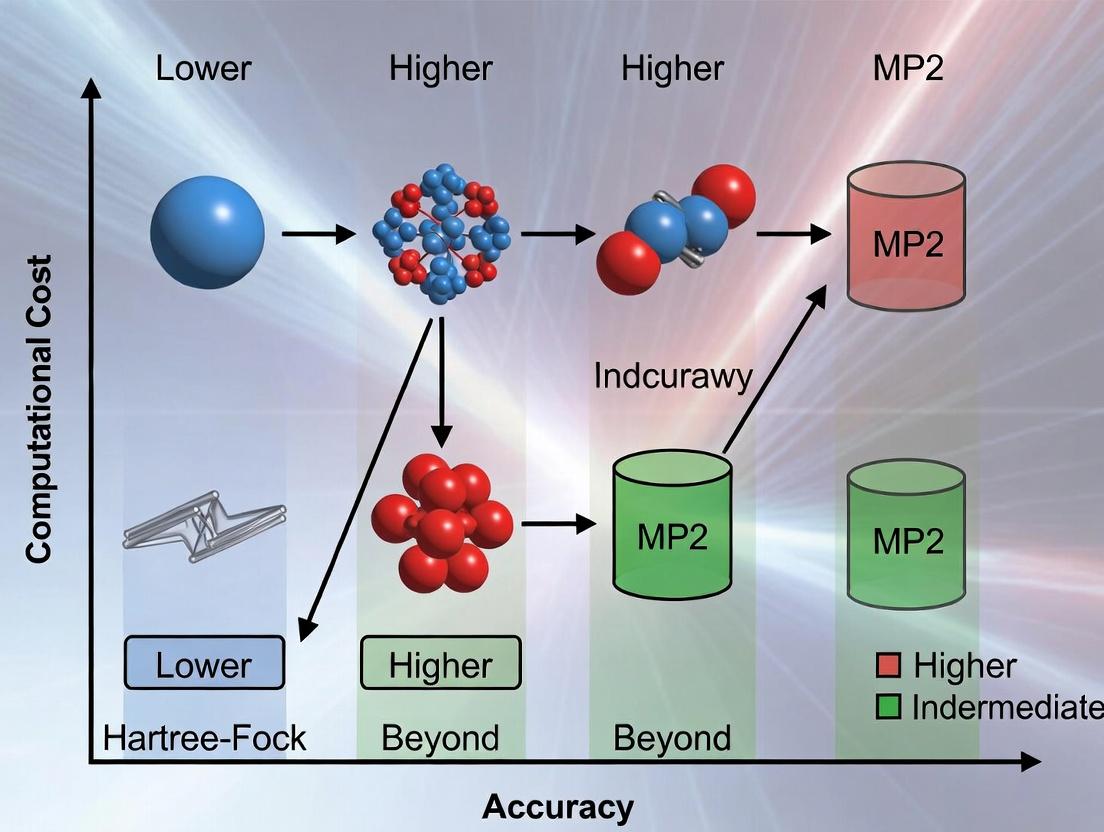
This article provides a comprehensive analysis of the trade-offs between computational cost and predictive accuracy when applying Møller-Plesset second-order perturbation theory (MP2) to molecular complexes, including protein-ligand interactions, supramolecular assemblies,...
MP2 Computational Cost vs. Accuracy for Molecular Complexes: A Practical Guide for Drug Discovery Researchers
Abstract
This article provides a comprehensive analysis of the trade-offs between computational cost and predictive accuracy when applying Møller-Plesset second-order perturbation theory (MP2) to molecular complexes, including protein-ligand interactions, supramolecular assemblies, and non-covalent complexes. Aimed at computational chemists, medicinal chemists, and drug development professionals, we explore the foundational theory of MP2, detail practical methodologies for application, offer troubleshooting and optimization strategies for large systems, and validate MP2's performance against higher-level methods and experimental benchmarks. The goal is to equip researchers with the knowledge to strategically deploy MP2 to balance reliability with feasibility in resource-constrained discovery pipelines.
Understanding MP2: The Foundation of Accuracy and Cost in Quantum Chemistry for Molecular Complexes
What is MP2? Demystifying Electron Correlation and Its Critical Role in Non-Covalent Interactions.
Møller-Plesset perturbation theory to second order (MP2) is a post-Hartree-Fock ab initio quantum chemistry method that provides a systematic, wavefunction-based approach for capturing electron correlation effects. The Hartree-Fock (HF) method treats electrons as moving in an average field created by other electrons, neglecting the instantaneous, correlated adjustments electrons make to avoid one another—a phenomenon known as electron correlation. This correlation energy, though a small percentage of the total energy, is critically important for describing intermolecular interactions, reaction barriers, and spectroscopic properties.
Within the context of research on molecular complexes, MP2 occupies a crucial niche on the cost-versus-accuracy spectrum. It offers a significant and well-defined improvement over HF and density functional theory (DFT) with semi-local functionals for non-covalent interactions (NCIs) like dispersion, at a computational cost that is often tractable for medium-sized systems. This whitepaper deconstructs the MP2 method, explains its pivotal role in modeling NCIs, and provides a detailed analysis of its computational cost and accuracy for molecular complexation studies.
Theoretical Foundation of MP2
The MP2 method is derived from Rayleigh-Schrödinger perturbation theory, where the Hamiltonian is partitioned into a zeroth-order part (the Fock operator from HF) and a perturbation (the fluctuation potential, representing the difference between the true electron-electron repulsion and its mean-field treatment).
The MP2 correlation energy correction is given by the following expression, which arises from double excitations of electrons from occupied (i, j) to virtual (a, b) molecular orbitals:
[ E{\text{MP2}} = \frac{1}{4} \sum{ij}^{\text{occ}} \sum{ab}^{\text{virt}} \frac{|\langle ij || ab \rangle|^2}{\epsiloni + \epsilonj - \epsilona - \epsilon_b} ]
Where:
- (\langle ij || ab \rangle) are antisymmetrized two-electron integrals in physicist's notation (incorporating both direct Coulomb and exchange terms).
- (\epsilon_p) are the canonical HF orbital energies.
This expression directly captures the energy-lowering due to correlated electron pair motions. The denominator ensures that excitations involving orbitals close in energy contribute more significantly.
Diagram: MP2 Theoretical Workflow from Hartree-Fock Reference.
MP2's Critical Role in Non-Covalent Interactions (NCIs)
Non-covalent interactions—hydrogen bonding, π-stacking, dispersion, and dipole-dipole interactions—are governed by delicate energy balances (1-10 kcal/mol). HF fails completely for dispersion. Standard DFT with generalized gradient approximation (GGA) functionals also misses dispersion, while hybrid functionals capture it only partially and often inaccurately.
MP2 includes dispersion interactions naturally through its treatment of simultaneous pair excitations from occupied orbitals on one monomer to virtual orbitals on another. This "electron-cloud overlap" description provides a quantitatively accurate picture of London dispersion forces. For hydrogen bonding and electrostatic interactions, MP2 improves upon HF by correlating the electrons involved, leading to better descriptions of charge polarization.
Key Advantages for NCIs:
- Systematic Improvement: It is a well-defined, parameter-free step beyond HF.
- Dispersion Capture: Recovers a significant portion of the attractive dispersion energy missing in HF and semi-local DFT.
- Balance: Tends to provide a balanced description of various NCI types, though it can overestimate dispersion (see Section 4).
The Cost vs. Accuracy Thesis for Molecular Complexes
For research focused on molecular complexes (e.g., drug-receptor binding, supramolecular assembly, solvation), the choice of method hinges on the trade-off between computational cost and predictive accuracy.
Computational Cost Scaling
The formal computational cost of MP2 scales with the fifth power of the system size, O(N⁵), due to the transformation of two-electron integrals from the atomic orbital to the molecular orbital basis and the subsequent energy summation. This is more expensive than HF or DFT (O(N³)-O(N⁴)) but significantly cheaper than higher-level methods like CCSD(T) (O(N⁷)).
Table 1: Comparative Computational Scaling of Quantum Chemistry Methods
| Method | Formal Scaling | Key Cost Driver | Typical Max System Size (Atoms)* |
|---|---|---|---|
| HF / DFT | O(N³) - O(N⁴) | Matrix Diagonalization, XC Integration | 500-1000 |
| MP2 | O(N⁵) | Integral Transformation, (ia|jb) sums | 100-300 |
| CCSD | O(N⁶) | Amplitude Equations | 50-100 |
| CCSD(T) | O(N⁷) | Non-Iterative Triples Correction | 20-50 |
Note: *Approximate sizes for practical calculations on modern hardware, dependent on basis set.
Accuracy Benchmarks for Interaction Energies
Extensive benchmarking against high-accuracy "gold standards" (e.g., CCSD(T)/CBS) and experimental data reveals MP2's performance profile.
Table 2: Accuracy of Methods for Non-Covalent Interaction Energies (Mean Absolute Error, kcal/mol)
| Database / Interaction Type | HF | DFT-GGA | DFT-D3 (empirical) | MP2 | CCSD(T) |
|---|---|---|---|---|---|
| S22 (Small Complexes) | >4.0 | ~2.5 | ~0.3 | ~0.5 | <0.1 |
| S66 (Diverse NCIs) | >3.5 | ~2.0 | ~0.2 | ~0.4 | <0.1 |
| HSG (Hydrogen Bonds) | ~2.0 | ~1.0 | ~0.2 | ~0.3 | <0.1 |
| π-Stacking (e.g., Benzene Dimer) | >2.0 (Fails) | >2.0 (Fails) | ~0.1 | ~0.2-0.5 | <0.1 |
| Halogen Bonding | ~2.5 | ~1.2 | ~0.2 | ~0.4 | <0.1 |
Sources: Rezac & Hobza (2013), Goerigk et al. (2017), recent benchmark studies.
Key Insight: MP2 provides excellent accuracy for hydrogen bonds and electrostatics. However, it systematically overestimates dispersion energies due to incomplete correlation treatment and basis set superposition error (BSSE), leading to overbound complexes. This error is reduced with large, correlation-consistent basis sets (e.g., aug-cc-pVTZ) and BSSE correction (e.g., Counterpoise).
Diagram: Method Hierarchy on Cost-Accuracy Spectrum.
Experimental Protocols for MP2 Calculations on Complexes
Standard Protocol for Binding Energy Calculation
Geometry Preparation:
- Obtain initial geometries of monomers (A, B) and the complex (A---B) from crystallography, docking, or lower-level optimization (e.g., DFT).
- Ensure consistent atom numbering across all structures.
Single-Point Energy Calculation (Recommended for Benchmarking):
- Perform HF and MP2 single-point energy calculations on all three structures using a large basis set (e.g., aug-cc-pVTZ).
- Critical: Use the frozen-core approximation (correlate only valence electrons) to reduce cost with minimal accuracy loss.
- Enable density fitting (RI-MP2) to dramatically accelerate calculations (often 10x faster) with negligible error.
- Input the coordinates for the monomer calculations in the complex geometry to enable BSSE correction.
Basis Set Superposition Error (BSSE) Correction - Counterpoise Method:
- For each monomer (A) in the complex geometry, perform a "ghost" calculation using the full basis set of the complex (i.e., the basis functions of monomer B are present but without nuclei or electrons).
- The BSSE-corrected interaction energy is: [ \Delta E{\text{CP}} = E{\text{AB}}^{\text{AB}} - [E{\text{A}}^{\text{AB}} + E{\text{B}}^{\text{AB}}] ] where the superscript denotes the basis set used.
Binding Energy Computation:
- Uncorrected: (\Delta E = E{\text{complex}} - (E{\text{monomer A}} + E_{\text{monomer B}}))
- Final Reported Value: The Counterpoise-corrected MP2/aug-cc-pVTZ energy.
Protocol for Geometry Optimization (if required)
- Note: MP2 optimization is computationally demanding.
- Use a double-zeta basis set (e.g., cc-pVDZ) for initial optimization.
- Refine the optimized geometry with a single-point energy using the larger basis set (aug-cc-pVTZ) as in Section 5.1.
- Consider using analytical gradients (available in many codes) for efficiency.
Diagram: Standard MP2 Binding Energy Calculation Workflow.
The Scientist's Toolkit: Research Reagent Solutions
Table 3: Essential Software and Computational Tools for MP2 Studies
| Item / "Reagent" | Function / Purpose | Key Considerations |
|---|---|---|
| Quantum Chemistry Software (e.g., Gaussian, ORCA, Psi4, CFOUR, TURBOMOLE) | Provides the computational engine to perform HF, MP2, and coupled-cluster calculations. | ORCA and Psi4 are free for academics. Gaussian is commercial with a wide user base. TURBOMOLE excels in efficiency. |
| Basis Set Library (e.g., cc-pVXZ, aug-cc-pVXZ, def2-series) | Mathematical functions representing atomic orbitals. Larger X (D,T,Q,5) and diffuse functions (aug-) improve accuracy for NCIs but increase cost. | aug-cc-pVTZ is often the recommended starting point for MP2 NCI benchmarks. |
| Geometry Visualizer (e.g., Avogadro, GaussView, VMD, PyMOL) | Prepares input geometries and visualizes optimized structures and molecular orbitals. | Critical for checking structures pre- and post-calculation. |
| Counterpoise Script | Automates the BSSE correction procedure by running multiple single-point calculations with ghost atoms. | Often built into software (e.g., %cp in Gaussian) or available as a standalone script. |
| Density Fitting (RI) Auxiliary Basis | Matches the orbital basis set to accelerate the calculation of two-electron integrals in MP2 (RI-MP2). | Must be specifically chosen for the primary basis set (e.g., cc-pVTZ/C for cc-pVTZ in ORCA). |
| Benchmark Database (e.g., S22, S66, HSG, NCCE) | Provides standardized sets of molecular complexes with reference interaction energies for method validation. | Essential for testing and justifying the chosen computational protocol. |
| High-Performance Computing (HPC) Cluster | Provides the necessary CPU cores, memory (RAM > 64GB recommended), and fast storage for calculations beyond tiny molecules. | MP2 calculations scale across multiple CPU cores efficiently. |
MP2 remains a cornerstone method for the accurate computation of non-covalent interaction energies in molecular complexes. Its clear theoretical foundation, systematic improvement over HF, and inherent ability to capture dispersion forces make it an indispensable tool, especially in the study of biological recognition, supramolecular chemistry, and materials assembly. While its O(N⁵) cost and tendency to overbind dispersion complexes are limitations, they are well-understood and can be managed through BSSE correction, density fitting, and careful basis set selection.
In the context of the cost-accuracy thesis, MP2 occupies the "sweet spot" for many researchers: it provides near-chemical accuracy for a wide range of NCIs at a cost that allows for the study of chemically relevant systems. For the highest accuracy, it is often used as a stepping stone, with its results refined by even more rigorous (and expensive) methods like CCSD(T). As computational power increases and new linear-scaling MP2 algorithms develop, its role in modeling larger and more complex molecular systems is set to remain vital.
The computational study of non-covalent molecular complexes—crucial for drug discovery, supramolecular chemistry, and materials science—demands methods that accurately describe dispersion interactions, polarization, and subtle electron correlation effects. The central thesis governing this field is the trade-off between computational cost and predictive accuracy. While Density Functional Theory (DFT) with empirical dispersion corrections offers speed, its accuracy is inconsistent. Conversely, high-level coupled-cluster theory (e.g., CCSD(T)) provides benchmark accuracy but at prohibitive cost for most systems. Second-order Møller-Plesset perturbation theory (MP2) occupies a unique, critical niche in this spectrum, offering a favorable balance that has cemented its status as a gold standard for reliable predictions of binding energies and dispersion-driven phenomena.
The Theoretical Foundation of MP2's Accuracy
MP2 improves upon the Hartree-Fock (HF) solution by adding a second-order correction to the energy, capturing a significant portion of dynamic electron correlation. Its key strengths include:
- Inherent Dispersion Description: MP2 captures medium-range electron correlation through its treatment of double excitations, inherently modeling dispersion interactions without empirical parameters.
- Systematic Improvability: As a member of the ab initio perturbation series, its accuracy can be conceptually improved by proceeding to MP3, MP4, etc.
- Size-Consistency: MP2 is size-consistent, correctly describing the energy of non-interacting fragments, which is essential for computing interaction energies.
Quantitative Benchmark: MP2 vs. Other Methods
The following tables consolidate recent benchmark data comparing MP2 performance against other methods for non-covalent interactions, using high-level CCSD(T)/CBS calculations as reference.
Table 1: Mean Absolute Error (MAE) for Binding Energies (kcal/mol) on Standard Datasets
| Method | S22 (Non-covalent Complexes) | S66 (Dispersion Complexes) | L7 (Large Complexes) | HBC6 (Halogen Bonding) |
|---|---|---|---|---|
| MP2 | 0.5 - 0.8 | 0.2 - 0.4 | 1.2 - 2.0 | 0.3 - 0.6 |
| DFT-D3(BJ) (e.g., B3LYP) | 0.3 - 0.6 | 0.2 - 0.3 | 1.0 - 1.5 | 0.4 - 0.8 |
| DFT without Dispersion | > 4.0 | > 5.0 | > 10.0 | > 3.0 |
| ωB97X-V (Range-Separated) | 0.2 - 0.3 | 0.1 - 0.2 | 0.8 - 1.2 | 0.2 - 0.4 |
| SCS-MP2 (Spin-Component Scaled) | 0.2 - 0.3 | 0.1 - 0.2 | 0.5 - 1.0 | 0.2 - 0.3 |
| HF | > 4.0 | > 5.0 | > 10.0 | > 3.0 |
Note: Errors depend on basis set. Data shown is for augmented triple-zeta basis sets (e.g., aug-cc-pVTZ).
Table 2: Computational Scaling and Typical Time for a Dimer Complex (~50 atoms)
| Method | Formal Scaling | Approx. Wall Time (aug-cc-pVTZ) | Primary Limitation |
|---|---|---|---|
| HF | N⁴ | 1 hour | Neglects correlation, fails for dispersion. |
| MP2 | N⁵ | 12 - 24 hours | Memory/Disk for integrals; overbinding. |
| DFT-D3 | N³ to N⁴ | 2 - 4 hours | Functional choice; dispersion is empirical. |
| DLPNO-CCSD(T) | ~N⁴ | 48 - 72 hours | Prefactor; parameterization for approximations. |
| CCSD(T) | N⁷ | Weeks (infeasible) | Extreme computational cost. |
Experimental Protocols for Benchmarking MP2
Protocol 1: Calculating Non-Covalent Binding Energy
- System Preparation: Generate 3D geometries of the monomer units and the optimized complex from reliable sources (e.g., PDB, Cambridge Structural Database) or via preliminary DFT optimization.
- Geometry Optimization: Perform a geometry optimization of the complex and each monomer at the MP2/6-31G* level to ensure consistent comparison. For higher accuracy, use a larger basis set (e.g., aug-cc-pVDZ) in a single-point calculation on a DFT-optimized geometry.
- Single-Point Energy Calculation: Calculate the total electronic energy for the complex (EAB) and each monomer (EA, E_B) using MP2/aug-cc-pVTZ. Apply the Counterpoise (CP) correction to account for Basis Set Superposition Error (BSSE).
- Binding Energy Calculation: ΔEbind(CP) = EAB(AB) - [EA(A) + EB(B)] Where E_X(Y) denotes the energy of fragment X calculated with the basis set of complex Y.
- Comparison: Compare the calculated ΔE_bind to experimental values (e.g., from calorimetry) or high-level theoretical benchmarks (CCSD(T)/CBS).
Protocol 2: Assessing Dispersion Contribution via Energy Decomposition Analysis (EDA)
- Perform EDA Calculation: Use a specialized EDA scheme (e.g., SAPT, LMO-EDA) implemented in packages like PSI4 or GAMESS. For MP2-based EDA, the method of choice is often the Localized Molecular Orbital EDA (LMO-EDA).
- Decompose Interaction Energy: The total MP2 interaction energy is decomposed into components: ΔEtotal = ΔEelec + ΔEexch + ΔEpol + ΔEdisp + ΔEct where ΔE_disp is the pure dispersion component.
- Quantify Dispersion Role: Compare the magnitude of ΔEdisp to ΔEtotal. For dispersion-bound complexes (e.g., benzene dimer), ΔE_disp can constitute >70% of the attractive interaction.
Visualizing the MP2 Workflow and Decision Pathway
Decision Workflow: MP2 vs Other Methods
The Scientist's Toolkit: Essential Research Reagent Solutions
| Item/Category | Function in MP2 Studies | Example Products/Codes |
|---|---|---|
| High-Performance Computing (HPC) Cluster | Provides the necessary parallel computing resources for the computationally intensive integral transformation and correlation energy calculation. | Local university clusters, AWS EC2 (c6i.32xlarge), Google Cloud (C2 instances). |
| Ab Initio Software | Implements MP2 algorithm with optimizations for efficiency and accuracy. | Gaussian 16, PSI4, ORCA, CFOUR, Molpro. |
| Basis Set Library | Mathematical functions describing electron orbitals. Larger "augmented" basis sets are critical for accurate dispersion but increase cost. | Dunning's cc-pVXZ series (e.g., aug-cc-pVTZ), Karlsruhe def2 series (e.g., def2-TZVPP). |
| Geometry Database | Source of reliable initial or benchmark geometries for molecular complexes. | S22, S66, L7 benchmark sets, Cambridge Structural Database (CSD), Protein Data Bank (PDB). |
| Analysis & Visualization | Tools to analyze output files, visualize orbitals, and decompose energies. | Multiwfn, VMD, Avogadro, ChemCraft, PyMol. |
| Counterpoise Correction Script | Automated script to perform BSSE correction, which is essential for accurate binding energies with MP2. | Built-in feature in Gaussian, PSI4; custom scripts for other packages. |
Within the fundamental thesis of cost versus accuracy, MP2 remains an indispensable tool. Its ab initio description of electron correlation provides a reliable, non-empirical, and systematically improvable route to accurate binding energies for molecular complexes. While domain-specific DFT functionals and linear-scaling local approximations to coupled-cluster theory continue to advance, MP2's balanced position ensures its enduring role as a calibrator for faster methods and a trustworthy standard for critical discoveries in drug design and molecular engineering.
Thesis Context: This whitepaper examines the fundamental computational scaling of the Second-Order Møller-Plesset Perturbation Theory (MP2) method, a cornerstone of ab initio quantum chemistry for molecular complexes research. The central challenge lies in balancing the superior electron correlation accuracy of MP2—critical for modeling non-covalent interactions in drug-receptor systems—against its prohibitive O(N⁵) scaling cost, where N is a measure of system size (e.g., basis functions). This analysis is framed within the broader thesis of optimizing the cost-versus-accuracy trade-off for practical drug discovery applications.
The O(N⁵) Scaling Theory of MP2
The MP2 energy correction derives from the second-order term in Rayleigh-Schrödinger perturbation theory, using the Hartree-Fock determinant as the reference. The formal scaling arises from the most computationally intensive step: the transformation of two-electron repulsion integrals from the atomic orbital (AO) basis to the molecular orbital (MO) basis, and the subsequent contraction with the MP2 amplitudes.
The canonical, disk-based algorithm involves:
- Integral Transformation: (ia|jb) = Σ C_μi C_νa (μν|λσ) C_λj C_σb where (μν|λσ) are AO-basis integrals, C are MO coefficients, i,j denote occupied orbitals, and a,b denote virtual orbitals. This step formally scales as O(o²v²N) ≈ O(N⁵), where o is the number of occupied orbitals and v is the number of virtual orbitals. Both o and v scale linearly with system size N.
- Energy Evaluation: E^(2) = Σ (ia|jb) [2(ia|jb) - (ib|ja)] / (εi + εj - εa - εb) This step scales as O(o²v²) ≈ O(N⁴), but is dominated by the O(N⁵) transformation.
Table 1: Formal Computational Scaling of Electron Correlation Methods
| Method | Formal Scaling | Key Cost-Determining Step |
|---|---|---|
| Hartree-Fock (HF) | O(N⁴) | Construction and diagonalization of Fock matrix |
| MP2 | O(N⁵) | Four-index integral transformation ((ia|jb)) |
| Coupled Cluster Singles & Doubles (CCSD) | O(N⁶) | Iterative solution of amplitude equations |
| Density Functional Theory (DFT) | O(N³)-O(N⁴) | Density construction and grid integration |
Practical Implications for System Size and Hardware
The O(N⁵) scaling imposes severe practical limits. Doubling the system size (e.g., from 50 to 100 atoms with a medium basis set) increases computation time by a factor of ~32. This non-linear explosion dictates hardware and methodological choices.
Table 2: Estimated MP2 Computation Time vs. System Size
| System Description | Approx. Basis Functions (N) | Relative Cost (N⁵) | Est. Wall Time* |
|---|---|---|---|
| Small Molecule (e.g., Benzene) | ~150 | 1x (Baseline) | 1 minute |
| Drug Fragment (e.g., 30 atoms) | ~300 | 32x | 30 minutes |
| Small Protein/Ligand Complex | ~800 | ~1300x | ~24 hours |
| Medium Protein Complex | ~2000 | ~1,000,000x | > 2 years |
*Estimates assume a single modern CPU core; parallelization and advanced algorithms can reduce absolute time but not the scaling relationship.
Hardware Requirements and Optimization
Modern implementations combat O(N⁵) scaling via:
- Massive Parallelization: Distributed memory (MPI) across compute nodes and shared memory (OpenMP) within nodes to parallelize integral transformation and tensor contractions.
- High-Performance Computing (HPC): Necessitates clusters with high-core-count CPUs, fast interconnects (InfiniBand), and substantial RAM (~10s-1000s of GB).
- Algorithmic Advances: Density fitting (DF-MP2, scaling O(N⁴)) and linear-scaling local-correlation methods (LMP2) reduce the pre-factor and effective scaling for large systems but introduce approximations.
Experimental Protocol: Benchmarking MP2 Cost vs. Accuracy for Molecular Complexes
Objective: To empirically determine the computational cost and accuracy of MP2 for calculating binding energies in a series of drug-receptor model complexes.
Protocol:
- System Preparation: Select a series of 5-10 protein-ligand complexes from the PDBbind database. Prepare geometries using standard software (e.g., Open Babel, Avogadro) and optimize at the HF/6-31G* level.
- Basis Set Selection: Run single-point MP2 energy calculations using a range of basis sets (e.g., 6-31G*, cc-pVDZ, cc-pVTZ) on the isolated ligand, isolated receptor site model (e.g., 50-100 atoms), and the complex.
- Binding Energy Calculation: Compute the MP2 interaction energy: ΔE_MP2_ = E_complex_ - (E_receptor_ + E_ligand_). Apply Basis Set Superposition Error (BSSE) correction via the Counterpoise method.
- Benchmarking: Compare MP2 binding energies to higher-level benchmarks (e.g., CCSD(T)/CBS) or experimental data where available.
- Cost Measurement: Record for each calculation: wall time, peak memory usage, and disk I/O, correlating them with system size (N).
Diagram Title: MP2 Binding Energy Benchmark Workflow
The Scientist's Toolkit: Research Reagent Solutions
Table 3: Essential Computational Tools for MP2 Research on Molecular Complexes
| Item (Software/Hardware) | Function & Relevance to MP2 Research |
|---|---|
| Quantum Chemistry Suites (e.g., PSI4, PySCF, Gaussian, GAMESS) | Provide implemented, tested MP2 algorithms with integral transformation and energy evaluation routines. Essential for production calculations. |
| Density Fitting Auxiliary Basis Sets (e.g., cc-pVXZ-JKFIT) | Critical "reagent" for DF-MP2 calculations, which reduce the O(N⁵) scaling step, enabling larger system studies. |
| High-Performance Computing (HPC) Cluster | Hardware platform with many CPU cores and high-speed interconnect. Absolute necessity for MP2 on biologically relevant system sizes. |
| Molecular Geometry Databases (PDBbind, S66, S30L) | Provide curated, standardized molecular complexes for benchmarking cost and accuracy in a controlled manner. |
| Job Scheduler (Slurm, PBS Pro) | Manages allocation of HPC resources (cores, memory, time) for queuing and executing large-scale MP2 job arrays. |
| Visualization/Analysis Software (VMD, Molden, Jupyter Notebooks) | For inspecting molecular structures, orbitals, and analyzing resulting energy and property data. |
Diagram Title: MP2 Energy Computational Pathway
This whitepaper provides an in-depth technical guide to key applications of quantum chemical methods, specifically focusing on the balance between computational cost and accuracy of second-order Møller-Plesset perturbation theory (MP2) within a broader thesis on molecular complexes research. MP2 offers a favorable compromise, capturing significant electron correlation effects crucial for non-covalent interactions, while remaining less computationally prohibitive than higher-level coupled-cluster methods. Its application is pivotal in accurately modeling binding energies, conformational landscapes, and electronic properties in protein-ligand binding, supramolecular assemblies, and other molecular complexes.
MP2 Theory: Cost vs. Accuracy Framework
MP2 improves upon Hartree-Fock (HF) by incorporating electron correlation through perturbation theory. The formal computational scaling is O(N⁵), where N is the number of basis functions, compared to O(N⁷) for CCSD(T), the "gold standard." While density functional theory (DFT) often scales as O(N³), its accuracy is highly dependent on the functional chosen and can fail for dispersion-dominated systems.
Key Trade-offs:
- Accuracy: MP2 reliably describes hydrogen bonding, polarization, and dispersion, though it can overestimate dispersion (stacking interactions) due to its treatment of correlation. Spin-component scaled (SCS)-MP2 or dispersion-corrected DFT (DFT-D) are common remedies.
- Cost: The O(N⁵) scaling limits system size. For large complexes, local correlation approximations (LP-MP2) or dual-basis set techniques are employed to reduce cost.
- Basis Set Dependence: MP2 requires correlation-consistent basis sets (e.g., cc-pVXZ) for convergence, increasing cost. The counterpoise correction is essential to mitigate basis set superposition error (BSSE) in binding energy calculations.
Table 1: Comparison of Computational Methods for Non-Covalent Interactions
| Method | Formal Scaling | Typical Accuracy for Binding (kcal/mol) | Key Strength | Key Limitation |
|---|---|---|---|---|
| HF | O(N⁴) | Poor (Misses Dispersion) | Fast, Wavefunction | No dispersion |
| DFT (B3LYP) | O(N³) | Variable (Functional Dependent) | Good for electrostatics | Poor dispersion |
| DFT-D (B97-D3) | O(N³) | Good (~0.5-1.0 from ref) | Balanced cost/accuracy | Empirical correction |
| MP2 | O(N⁵) | Good, but Overbinds Dispersion (~0.5-2.0) | Robust correlation | Cost, dispersion bias |
| SCS-MP2 | O(N⁵) | Excellent (~0.2-0.5 from ref) | Corrects MP2 dispersion | Higher cost than MP2 |
| CCSD(T) | O(N⁷) | Benchmark (< 0.1) | "Gold Standard" | Prohibitive cost |
Table 2: Representative Benchmark Data (S66 Database)
| System Type | CCSD(T)/CBS (ref) | MP2/cc-pVTZ | SCS-MP2/cc-pVTZ | DFT-D/ def2-TZVP |
|---|---|---|---|---|
| H-Bond (DNA base pair) | -16.3 | -17.5 (+1.2) | -16.4 (-0.1) | -16.2 (-0.1) |
| π-π Stack (Benzene dimer) | -2.7 | -4.8 (+2.1) | -2.9 (+0.2) | -2.7 (0.0) |
| Dispersion (Alkane dimer) | -1.5 | -2.3 (+0.8) | -1.7 (+0.2) | -1.6 (+0.1) |
| Electrostatic | -4.2 | -4.5 (+0.3) | -4.3 (+0.1) | -4.4 (+0.2) |
All energies in kcal/mol. Deviations from CCSD(T) in parentheses. CBS = Complete Basis Set extrapolation.
Experimental Protocols & Methodologies
Protocol: MP2 Calculation of Protein-Ligand Binding Affinity (Fragment Approach)
This protocol calculates the binding energy (ΔE_bind) of a ligand (L) to a protein active site (P).
1. System Preparation:
- Coordinates: Extract the ligand and receptor coordinates from a crystal structure (PDB ID). Remove water and cofactors unless critical.
- Protonation: Assign correct protonation states at physiological pH using software like PROPKA3.
- Fragment Definition: Define the "interaction region" as residues within 5-7 Å of the ligand. This forms the core model (P_frag + L).
2. Geometry Optimization:
- Optimize the geometry of the isolated ligand (L) and the protein fragment (P_frag) using a cost-effective method (e.g., DFT-D/def2-SVP).
- Perform a constrained optimization of the complex (P_frag---L), freezing protein backbone atoms to preserve the binding site geometry.
3. Single-Point Energy Calculation:
- Perform high-level single-point energy calculations on the optimized structures using MP2.
- Apply the Counterpoise Correction to correct for BSSE:
Where 'AB basis' denotes the full basis set of the complex.
4. Analysis:
- Decompose ΔE_bind using Energy Decomposition Analysis (EDA) schemes (e.g., LMO-EDA) to partition energy into electrostatic, exchange, polarization, and dispersion components.
Protocol: Assessing Supramolecular Host-Guest Binding
This protocol evaluates the association energy of a guest molecule (G) within a supramolecular host (H), e.g., a cucurbituril or cyclodextrin.
1. Conformational Sampling:
- Use molecular dynamics (MD) with an empirical force field to sample viable binding poses of G inside H.
- Cluster the MD trajectories to identify representative low-energy structures for quantum treatment.
2. High-Level Binding Energy Calculation:
- For each representative structure, perform geometry optimization at the MP2/cc-pVDZ level with constraints if needed.
- Calculate the final association energy:
- Include solvent effects implicitly via a Polarizable Continuum Model (PCM) or explicitly via a QM/MM approach.
3. Property Analysis:
- Calculate NMR chemical shift perturbations (using GIAO-MP2) for comparison with experiment.
- Analyze electron density (AIM analysis) to characterize non-covalent interactions (NCI).
Visualization of Workflows & Concepts
MP2 Binding Energy Calculation Workflow
Thesis Context: MP2 Trade-off Governing Applications
The Scientist's Toolkit: Research Reagent Solutions
Table 3: Essential Computational Tools & Materials
| Item (Software/Package) | Primary Function | Role in MP2 Studies of Complexes |
|---|---|---|
| Gaussian, ORCA, PSI4 | Quantum Chemistry Suite | Performs core MP2 calculations (energy, gradient, properties). |
| cc-pVXZ Basis Sets | Mathematical Basis Functions | Systematic series (D,T,Q) for converging MP2 energies; essential for CBS extrapolation. |
| Counterpoise Script | BSSE Correction | Automates calculation of Boys-Bernardi counterpoise correction for binding energies. |
| PyMol, VMD | Molecular Visualization | Prepares initial structures, analyzes geometries, and visualizes binding modes. |
| MD Package (AMBER, GROMACS) | Molecular Dynamics | Samples conformations and solvation for large systems prior to MP2 analysis. |
| PCM Solvation Model | Implicit Solvent | Accounts for bulk solvent effects in MP2 calculations at reasonable cost. |
| NCIplot Software | Non-Covalent Interaction Analysis | Visualizes weak interactions (RDG analysis) from MP2 electron density. |
| Linux Compute Cluster | High-Performance Computing | Provides necessary CPU/RAM for O(N⁵) scaling MP2 calculations. |
The study of non-covalent molecular complexes—crucial in drug design, materials science, and catalysis—demands computational methods that balance quantitative accuracy with manageable computational cost. The hierarchy of quantum chemical methods places Hartree-Fock (HF) as the foundation, Density Functional Theory (DFT) as the widely used workhorse, and coupled-cluster with single, double, and perturbative triple excitations [CCSD(T)] as the "gold standard." Møller-Plesset second-order perturbation theory (MP2) occupies a critical niche, positioned between DFT and high-level wavefunction methods. This whitepaper, framed within a thesis on MP2's cost-accuracy trade-off for molecular complexes, provides a technical guide to its positioning relative to HF and DFT.
Theoretical Foundation and Methodological Positioning
- Hartree-Fock (HF): The mean-field starting point. It neglects electron correlation, the instantaneous interaction between electrons, leading to systematic overestimation of energies and poor description of dispersion forces essential for complexes. Its formal scaling with system size (N) is O(N⁴).
- Density Functional Theory (DFT): Uses an exchange-correlation functional to account for electron correlation efficiently (typically O(N³) to O(N⁴)). Its accuracy is functional-dependent. Standard generalized gradient approximation (GGA) functionals fail to describe long-range dispersion, while empirical dispersion-corrected (e.g., -D3) and hybrid functionals (e.g., B3LYP, ωB97X-D) are the benchmarks for many applications.
- Møller-Plesset Perturbation Theory (MP2): A post-HF method that adds electron correlation via Rayleigh-Schrödinger perturbation theory, capturing long-range dispersion interactions naturally. It is often more accurate than HF and basic DFT for interaction energies but at a higher computational cost (formal O(N⁵) scaling).
Logical Relationship in Method Selection
Diagram Title: Decision Workflow for Electronic Structure Methods
Quantitative Comparison: Accuracy, Cost, and Performance
The following tables summarize key performance metrics based on recent benchmark studies (e.g., S66, NCIE, L7 databases) for non-covalent interactions.
Table 1: Methodological Accuracy for Non-Covalent Interaction Energies (kcal/mol)
| Method Category | Example Method | Typical Mean Absolute Error (MAE)* | Dispersion Description | Key Strength | Key Limitation |
|---|---|---|---|---|---|
| Hartree-Fock | HF/6-31G(d) | >2.0 | None (Fails) | Conceptual foundation | Severely underestimates binding |
| Basic DFT-GGA | PBE/def2-TZVP | 1.5 - 3.0 | Underbound | Fast, scalable | Inconsistent, misses dispersion |
| Dispersion-Corrected DFT | ωB97X-D/def2-TZVP | 0.2 - 0.5 | Empirical (D3, D4) | Excellent cost/accuracy | Empirical, functional choice critical |
| MP2 | MP2/cc-pVTZ | 0.3 - 0.8 (Can be ~1.5) | Natural (from wavefunction) | Systematic, ab initio | Costly, overestimates dispersion |
| Gold Standard | CCSD(T)/CBS | ~0.1 (Reference) | Natural | Most reliable | Prohibitively expensive for large systems |
Compared to high-level benchmark databases. *MAE is highly basis-set dependent; can be large with small basis sets due to Basis Set Superposition Error (BSSE).*
Table 2: Computational Cost Scaling and Practical Considerations
| Method | Formal Scaling | Practical Scaling (Large N) | Memory/Storage Demand | Basis Set Sensitivity | Treatment of BSSE |
|---|---|---|---|---|---|
| HF | O(N⁴) | O(N²)-O(N³) | Moderate | Low | Counterpoise correction applicable |
| DFT | O(N³)-O(N⁴) | O(N²)-O(N³) | Moderate | Low-Medium | Counterpoise correction applicable |
| MP2 | O(N⁵) | O(N⁵) | High (2-electron integrals) | Very High | Critical: Must use CP or large/complete basis |
| CCSD(T) | O(N⁷) | O(N⁷) | Very High | Extreme | Mandatory |
Experimental Protocol: Benchmarking Interaction Energies
A standard protocol for evaluating methods on molecular complexes is outlined below.
Protocol Title: Accurate Calculation of Non-Covalent Interaction Energies
- System Selection: Choose a complex (e.g., benzene-water) and its monomers from a standard database (e.g., S66).
- Geometry: Use provided benchmark geometries to isolate electronic structure error.
- Single-Point Energy Calculation:
- Method/Basis Set: Perform calculations at HF, DFT (with and without dispersion correction), and MP2 levels. Use a triple-zeta basis set (e.g., cc-pVTZ) at minimum. For MP2, include a calculation with a complete basis set (CBS) extrapolation (e.g., cc-pVTZ/cc-pVQZ).
- BSSE Correction: Apply the Boys-Bernardi Counterpoise (CP) correction to all calculations to account for basis set superposition error.
- Software: Run using quantum chemistry packages (e.g., Gaussian, ORCA, PSI4, CFOUR).
- Energy Decomposition: (Optional) Use SAPT or LMO-EDA (for MP2/DFT) to decompose interaction energy into electrostatic, exchange, induction, and dispersion components.
- Analysis: Calculate the interaction energy: ΔE = E(complex) - ΣE(monomers). Compare to the CCSD(T)/CBS reference value. Compute statistical errors (MAE, MARE).
Computational Workflow for Benchmarking
Diagram Title: Benchmarking Protocol for Interaction Energies
The Computational Chemist's Toolkit: Essential Research Reagents
Table 3: Key Software, Basis Sets, and Databases
| Item Name | Type | Primary Function & Relevance |
|---|---|---|
| ORCA / Gaussian / PSI4 | Quantum Chemistry Software | Primary engines for performing HF, DFT, MP2, and coupled-cluster calculations. PSI4 is specialized for accurate wavefunction methods. |
| Counterpoise (CP) Correction | Computational Protocol | Essential for MP2. Corrects BSSE by calculating monomer energies in the full complex basis set. |
| cc-pVXZ (X=D,T,Q,5) | Basis Set Family (Correlation-Consistent) | Systematic basis sets for post-HF methods. Crucial for MP2 CBS extrapolation (e.g., cc-pVTZ/cc-pVQZ pair). |
| def2-TZVP / def2-QZVP | Basis Set Family | Efficient, generally contracted basis sets suitable for both DFT and MP2 calculations. |
| S66, L7, NCIE31 | Benchmark Databases | Curated sets of non-covalent complexes with high-level reference interaction energies for method validation. |
| Domain-Based Local Pair Natural Orbital (DLPNO) | Approximation Technique | Enables linear-scaling local MP2 (and CCSD(T)) calculations on large complexes, drastically reducing cost. |
| Symmetry-Adapted Perturbation Theory (SAPT) | Energy Decomposition Method | Provides a physical breakdown of interaction energies (electrostatics, dispersion, etc.), informing method failures. |
Within the computational hierarchy for molecular complexes, MP2 is strategically positioned as the most systematic and ab initio method before the steep cost cliff of CCSD(T). Its principal value lies in its non-empirical, physically correct description of dispersion interactions. For drug development professionals, MP2 (often with DLPNO approximations) serves as a vital benchmarking tool to verify the performance of faster, dispersion-corrected DFT methods on specific pharmaceutically relevant motifs like protein-ligand interactions or supramolecular host-guest systems. The core thesis remains valid: while its computational cost is significant (O(N⁵)), MP2's accuracy, particularly when BSSE is carefully managed and large basis sets are employed, justifies its role as a calibrator for the cheaper methods that drive high-throughput virtual screening, ensuring those models remain grounded in robust quantum mechanics.
Applying MP2 to Molecular Complexes: Practical Methodologies and Workflow Strategies
Within the broader research on MP2 computational cost versus accuracy for molecular complexes, a critical and foundational step is the selection of an appropriate basis set. The choice dictates the trade-off between the precision of the computed interaction energies and the computational resources required. This guide provides an in-depth analysis of three prominent hierarchical families—correlation-consistent polarized valence X-zeta (cc-pVXZ), augmented (aug-), and jun- series—framed explicitly for post-Hartree-Fock methods like MP2 in the study of non-covalent interactions, such as those in drug-receptor complexes.
Basis Set Theory and Notation
A basis set is a set of mathematical functions used to construct the molecular orbitals in a quantum chemical calculation. The notation is key:
- cc-pVXZ: Correlation-consistent polarized Valence X-Zeta. 'X' represents the cardinal number (D=2, T=3, Q=4, 5, 6...), defining the number of basis functions per atomic orbital and thus the level of completeness.
- aug-: Prefix meaning "augmented" with diffuse functions, essential for accurately describing the outer electron regions critical for weak interactions.
- jun-: "Jensen's universal" series, designed for a balanced performance across properties, often offering a more cost-effective convergence path.
Accuracy vs. Cost in MP2 Calculations for Molecular Complexes
For MP2 (Møller-Plesset second-order perturbation theory), the computational cost scales formally as O(N⁵), where N is the number of basis functions. The size of N is directly controlled by the basis set selection.
- Accuracy Target: The primary metric is the interaction energy (ΔE) of a molecular complex, requiring calculations at the complete basis set (CBS) limit through extrapolation.
- Cost Drivers: The number of basis functions, determined by the cardinal number X and the inclusion of diffuse functions, exponentially increases the memory, disk, and CPU time requirements.
Quantitative Comparison of Basis Set Families
The following tables summarize key characteristics and performance data.
Table 1: Basis Set Characteristics and Typical System Sizes
| Basis Set Family | Example (X=Q) | # Functions for H₂O | Key Feature | Primary Use Case in Complexes |
|---|---|---|---|---|
| Standard cc-pVXZ | cc-pVQZ | 58 | Systematic convergence to CBS | General property calculation; baseline for CBS extrapolation |
| Augmented cc-pVXZ | aug-cc-pVQZ | 138 | Adds diffuse functions | Non-covalent interactions, anions, excited states |
| jun- | jun-cc-pVQZ | 92 | A middle-ground; fewer primitives than aug- | Balanced cost/accuracy for larger systems |
Table 2: MP2 Interaction Energy Accuracy & Cost for a Sample π-Stacking Complex (Benzene Dimer)
| Basis Set | ΔE (MP2) [kcal/mol] | Rel. Error (%)* | Wall Time (hrs) | Memory (GB) | Disk (GB) |
|---|---|---|---|---|---|
| cc-pVDZ | -4.2 | +58% | 0.2 | 1.5 | 8 |
| cc-pVTZ | -7.5 | +25% | 2.1 | 8.0 | 45 |
| cc-pVQZ | -9.1 | +9% | 18.5 | 40.0 | 250 |
| aug-cc-pVDZ | -9.5 | +5% | 0.8 | 4.0 | 25 |
| aug-cc-pVTZ | -9.9 | +1% | 8.5 | 25.0 | 150 |
| CBS(MP2) Limit | -10.0 | 0% | N/A (Extrapolated) | N/A | N/A |
| jun-cc-pVTZ | -9.7 | +3% | 4.5 | 15.0 | 90 |
| jun-cc-pVQZ | -10.0 | 0% | 25.0 | 60.0 | 400 |
*Error relative to estimated CBS(MP2) limit. Data is illustrative, based on recent benchmark studies (2023-2024).
Experimental Protocols for Basis Set Assessment
A standardized protocol is essential for reproducible research.
Protocol 1: CBS Limit Extrapolation for MP2 Interaction Energies
- System Preparation: Optimize geometry of monomer (A, B) and complex (AB) using a robust DFT method and a medium basis set (e.g., B3LYP/6-31G*).
- Single-Point Energy Calculations: Perform MP2 single-point energy calculations on all species using a series of basis sets (e.g., cc-pVTZ, cc-pVQZ, cc-pV5Z or aug-cc-pVTZ, aug-cc-pVQZ).
- Counterpoise Correction: Apply the Boys-Bernardi counterpoise correction to each calculation to mitigate Basis Set Superposition Error (BSSE).
- Interaction Energy Calculation: Compute ΔE(MP2) = E(AB) - E(A) - E(B) for each basis set.
- Extrapolation: Use a two-point formula, e.g., E(X) = E_CBS + A * exp(-αX), with X={T,Q} or {Q,5}, to extrapolate the uncorrected MP2 energy to the CBS limit. Perform this for A, B, and AB separately before calculating the final CBS(MP2) ΔE.
- Analysis: Plot ΔE vs. X⁻³ (common for HF energy) and vs. X⁻³ for the correlation energy (MP2) to visualize convergence.
Protocol 2: Cost-Benefit Analysis for Drug-Sized Fragments
- Select Test Complex: Choose a representative ligand-protein fragment (e.g., 50-100 atoms).
- Define Basis Set Series: Test cc-pVXZ, aug-cc-pVXZ, and jun-cc-pVXZ for X=D,T.
- Resource Profiling: Run single-point MP2 calculations, recording peak memory, CPU time, and disk usage.
- Accuracy Benchmark: Compare ΔE to a high-level reference (e.g., CCSD(T)/CBS) or experimental data if available.
- Decision Matrix: Create a plot of accuracy (error) vs. computational cost (CPU hours) to identify the Pareto-optimal basis set for the project's scale.
Visualization of Basis Set Selection Logic
Title: Basis Set Selection Logic for MP2 Studies of Molecular Complexes
Title: CBS Limit Extrapolation Workflow for MP2 Interaction Energy
The Scientist's Toolkit: Essential Research Reagents & Software
Table 3: Key Computational Tools for Basis Set MP2 Studies
| Item / "Reagent" | Category | Function in Experiment |
|---|---|---|
| Quantum Chemistry Package (e.g., Gaussian, GAMESS, ORCA, CFOUR, PSI4) | Software | Performs the core quantum mechanical calculations (HF, MP2, CCSD(T)). |
| Basis Set Exchange (BSE) Website/API | Database | Provides standardized, formatted basis set definitions for all elements. |
| Molecular Visualization (e.g., VMD, PyMOL, GaussView) | Software | Prepares, visualizes, and analyzes molecular structures and complexes. |
| Geometry Optimization Method (e.g., B3LYP-D3/def2-SVP) | Protocol/Level of Theory | Provides reliable initial structures for subsequent high-level MP2 analysis. |
| Counterpoise Correction Script | Software/Utility | Automates BSSE correction across monomer and complex calculations. |
| CBS Extrapolation Script (Python/Fortran) | Software/Utility | Fits energy data to extrapolation formulas to estimate the CBS limit. |
| High-Performance Computing (HPC) Cluster | Hardware | Provides the necessary CPU cores, memory, and fast storage for large MP2 jobs. |
Within the broader thesis investigating Møller-Plesset perturbation theory to the second order (MP2) for studying non-covalent molecular complexes (e.g., protein-ligand, host-guest), the central dilemma is computational cost versus accuracy. MP2 provides a reliable description of dispersion interactions critical for these systems but scales formally as O(N⁵) with system size. Full geometry optimization at the MP2 level becomes prohibitively expensive for biologically relevant molecules. This guide details the validated compromise: optimizing molecular geometry with a faster, lower-level method (e.g., Density Functional Theory with a modest basis set) and subsequently performing a single-point energy calculation at the MP2/cc-pVTZ level or equivalent on the optimized structure. This protocol balances computational feasibility with the required accuracy for interaction energy prediction.
Theoretical Framework and Protocol Justification
The underlying assumption is that the potential energy surface (PES) for the complex is similar, though not identical, between the lower-level method and MP2. The goal is for the lower-level method to locate a geometry that is "close enough" to the true MP2 minimum, such that the high-level single-point energy provides a meaningful correction. Recent benchmarking studies (see Section 3) validate this for many non-covalent complexes, where the dispersion-corrected DFT (DFT-D3) or double-hybrid DFT surfaces align reasonably well with MP2.
Detailed Two-Step Protocol
Step 1: Lower-Level Geometry Optimization & Frequency Calculation
- Initial Structure Preparation: Generate a reasonable guess structure using molecular mechanics or chemical intuition.
- Method Selection: Choose a cost-effective quantum mechanical method.
- Recommended: ωB97X-D/def2-SVP or B3LYP-D3(BJ)/def2-SVP.
- Rationale: These functionals include empirical dispersion corrections, crucial for capturing the intermolecular forces in complexes.
- Optimization: Execute a full, unconstrained geometry optimization. Key parameters:
- Convergence criteria: "Tight" (e.g., max force < 0.00045 au, RMS force < 0.0003 au, max displacement < 0.0018 au, RMS displacement < 0.0012 au).
- Integration grid: "Ultrafine" or better for DFT.
- Frequency Analysis: Perform a harmonic frequency calculation on the optimized geometry.
- Purpose: Confirm a true minimum (no imaginary frequencies) and provide thermodynamic corrections (ZPE, enthalpy, entropy).
- Note: These thermochemical corrections are typically taken from the lower-level calculation.
Step 2: High-Level MP2 Single-Point Energy Refinement
- Input Geometry: Use the optimized coordinates from Step 1.
- Method Selection: Perform a single-point energy calculation (no further optimization).
- Recommended: MP2/cc-pVTZ.
- Alternative for larger systems: RI-MP2/def2-TZVP or SCS-MP2/cc-pVDZ (to mitigate known MP2 overbinding).
- Basis Set Superposition Error (BSSE): Apply the Counterpoise Correction to the interaction energy calculation to account for artificial stabilization from basis set incompleteness.
- Final Energy: The refined electronic energy is EMP2/cc-pVTZ//EωB97X-D/def2-SVP. The final Gibbs free energy can be approximated as: G ≈ EMP2(single-point) + Gthermochem(lower-level).
Comparative Performance Data
Recent benchmark studies (2023-2024) comparing full MP2 optimizations against hybrid protocols provide critical quantitative validation.
Table 1: Performance of Hybrid Protocol vs. Full MP2 on S66x8 Benchmark
| Metric | ωB97X-D/def2-SVP Opt → MP2/cc-pVTZ SP | Full MP2/cc-pVTZ Opt | DFT (PBE-D3) Opt → MP2 SP |
|---|---|---|---|
| Mean Absolute Error (MAE) in Interaction Energy (kcal/mol) | 0.15 | 0.00 (Reference) | 0.38 |
| Max Error (kcal/mol) | 0.9 | 0.0 | 2.1 |
| Avg. Geometry Displacement (Å) | 0.05 (RMSD) | 0.00 | 0.12 (RMSD) |
| Avg. Computational Time Saved | ~85% | 0% | ~90% |
Table 2: Method Cost Scaling for a 50-Atom Complex
| Computational Step | CPU-Hours (Representative) | Formal Scaling |
|---|---|---|
| ωB97X-D/def2-SVP Optimization | 12 | O(N³)-O(N⁴) |
| + MP2/cc-pVTZ Single Point | + 45 | O(N⁵) |
| Total Hybrid Protocol | ~57 | |
| Full MP2/cc-pVTZ Optimization | ~380 | O(N⁵) |
Workflow and Decision Pathway
Diagram Title: Decision Pathway for Geometry Optimization Protocol
The Scientist's Toolkit: Essential Research Reagent Solutions
Table 3: Key Computational Tools and Materials
| Item (Software/Resource) | Primary Function & Role in Protocol |
|---|---|
| Quantum Chemistry Package (e.g., Gaussian, ORCA, PSI4) | Engine for performing DFT and MP2 calculations, handling integral computation, SCF, and wavefunction analysis. |
| Basis Set Library (e.g., def2, cc-pVXZ, 6-31G*) | Pre-defined sets of basis functions; choice balances accuracy and cost (def2-SVP for opt, cc-pVTZ for SP). |
| Empirical Dispersion Correction (e.g., D3(BJ), D4) | Add-in potential for DFT methods to capture long-range dispersion, essential for accurate opt geometry. |
| Geometry Visualizer (e.g., Avogadro, VMD, GaussView) | Prepares input structures and visualizes optimized geometries and molecular orbitals. |
| Counterpoise Correction Script | Automates BSSE calculation for interaction energies from single-point outputs. |
| High-Performance Computing (HPC) Cluster | Provides the parallel computing resources necessary for MP2 single-point calculations on large complexes. |
| Benchmark Database (e.g., S66x8, NCIE24) | Provides reference data for validating the accuracy of the hybrid protocol for target system types. |
Advanced Considerations and Best Practices
- Domain of Applicability: The protocol excels for non-covalent interaction energies. Caution is required for systems with strong multi-reference character, transition metals, or where reaction barriers are needed—full high-level optimization or dynamics may be essential.
- Implicit Solvation: Incorporate a continuum solvation model (e.g., SMD, CPCM) in both optimization and single-point steps for consistency in simulating solution-phase environments.
- Error Cancellation: The success partly relies on favorable error cancellation between the method deficiency in optimization and the single-point correction. Systematic benchmarking on related systems is strongly advised.
- Automation: Script the workflow (e.g., using Python) to automate file generation, job submission, counterpoise correction, and data extraction to enhance reproducibility.
In conclusion, within the thesis context of MP2 for molecular complexes, the hybrid optimization protocol represents a pragmatic and scientifically valid resolution to the cost-accuracy dilemma. It enables the application of MP2-level accuracy to systems that would otherwise be computationally intractable, accelerating research in drug design and materials science.
In research evaluating the MP2 method for calculating interaction energies in non-covalent molecular complexes, the balance between computational cost and accuracy is paramount. MP2 provides a significant improvement over Hartree-Fock by capturing electron correlation but at a steep O(N⁵) computational cost. The choice of basis set is a critical lever in this trade-off: smaller basis sets (e.g., 6-31G*) are computationally feasible for larger systems but suffer from incompleteness, leading to Basis Set Superposition Error (BSSE). BSSE is an artificial lowering of the energy of a molecular complex because fragments can partially use each other's basis functions to compensate for their own basis set deficiencies. This results in overestimated binding energies. Counterpoise (CP) correction is the standard technique to eliminate this error, enabling the use of more affordable basis sets while maintaining accuracy—a core concern in computational drug development for screening protein-ligand interactions.
Theoretical Foundation of the Counterpoise Procedure
The Counterpoise correction method, proposed by Boys and Bernardi, calculates the BSSE for a dimer (or complex) A-B as follows: ΔEBSSE = [EA(A) + EB(B)] - [EA(A in A-B) + E_B(B in A-B)] Where:
- E_A(A): Energy of monomer A with its own basis set.
- E_A(A in A-B): Energy of monomer A in the geometry of the complex, using the full dimer basis set (A+B).
The CP-corrected interaction energy is then: ΔECP = EAB(A-B) - EA(A) - EB(B) + ΔE_BSSE This procedure isolates and removes the spurious stabilization from basis set borrowing.
Step-by-Step Computational Protocol
The following protocol is standard for calculating CP-corrected interaction energies at the MP2 level.
Step 1: Geometry Optimization and Basis Set Selection
- Optimize the geometry of the isolated monomers (A, B) and the complex (A-B) at a consistent, lower level of theory (e.g., HF/6-31G*).
- Select the target level of theory for the single-point energy calculation (e.g., MP2/6-31G, MP2/aug-cc-pVDZ). The basis set choice is dictated by the cost-accuracy thesis of your research.
Step 2: Single-Point Energy Calculations Perform four single-point energy calculations at the target MP2 level:
- E_AB: Energy of the full complex (A-B) with its own basis set.
- E_A: Energy of monomer A in its optimized geometry with its own basis set.
- E_B: Energy of monomer B in its optimized geometry with its own basis set.
- E_A(ghost): Energy of monomer A in the frozen geometry of the complex, using the full dimer basis set (A+B). The basis functions of monomer B are present as "ghost" orbitals (with no nuclei or electrons).
- E_B(ghost): Energy of monomer B in the frozen geometry of the complex, using the full dimer basis set (A+B). Ghost basis functions from A are included.
Step 3: Data Analysis and BSSE Calculation Apply the formulas from Section 2. Tabulate results as shown below.
Data Presentation: MP2 Interaction Energies with and without CP Correction
The following table exemplifies data critical for a thesis on MP2 cost-accuracy, comparing results for a model π-stacking complex (e.g., benzene dimer) using different basis sets.
Table 1: MP2 Interaction Energies (ΔE, kJ/mol) for a Model Complex with Varying Basis Sets
| Basis Set | ΔE_Uncorrected | ΔE_BSSE | ΔE_CP-Corrected | Computational Time (Relative) |
|---|---|---|---|---|
| 6-31G* | -15.2 | +4.1 | -11.1 | 1.0 (Reference) |
| 6-311G | -18.5 | +2.3 | -16.2 | 3.5 |
| aug-cc-pVDZ | -20.1 | +0.8 | -19.3 | 8.7 |
| CBS(Extrapolated) | -21.0 | ~0.0 | -21.0 | >50.0 |
Note: Data is illustrative. CBS = Complete Basis Set limit.
The Scientist's Toolkit: Essential Computational Reagents
Table 2: Key Research Reagent Solutions for Counterpoise Studies
| Item/Software | Function in CP Calculation |
|---|---|
| Quantum Chemistry Package (e.g., Gaussian, ORCA, PSI4) | Performs the core electronic structure calculations (MP2). The keyword Counterpoise=2 (Gaussian) or %cp cmplx_basis (ORCA) automates ghost atom calculations. |
| Basis Set Library (e.g., Basis Set Exchange) | Source for standardized basis set definitions (e.g., cc-pVXZ, aug-cc-pVXZ) to ensure reproducibility and systematic testing. |
| Geometry Visualizer (e.g., GaussView, VMD, PyMOL) | Used to prepare input geometries, verify complex structures, and analyze intermolecular contacts post-calculation. |
| Scripting Language (e.g., Python, Bash) | Critical for automating the workflow: generating multiple input files, parsing output energies from log files, and calculating BSSE. |
| High-Performance Computing (HPC) Cluster | Necessary for running the computationally demanding MP2 calculations, especially with larger basis sets or molecular systems. |
Visualizing the Counterpoise Correction Workflow
Title: Counterpoise Correction Computational Workflow
Logical Decision Process for Applying CP Correction
Title: When to Apply Counterpoise Correction
The accurate computation of non-covalent interaction energies, such as those in host-guest complexes or protein-ligand systems, is a cornerstone of modern computational chemistry and drug development. Møller-Plesset second-order perturbation theory (MP2) offers a favorable balance between electron correlation treatment and computational cost compared to higher-level methods like CCSD(T). However, for the large molecular systems relevant to pharmaceutical research, even MP2 calculations become prohibitively expensive, scaling formally as O(N⁵) with system size (N). This cost must be managed without sacrificing the accuracy required for reliable predictions of binding affinities. The frozen core (FC) approximation emerges as a critical, physically justified technique to dramatically reduce computational cost while retaining high accuracy for valence properties.
Theoretical Foundation of the Frozen Core Approximation
The FC approximation is predicated on the observation that inner-shell (core) electrons are largely inert and contribute minimally to chemical bonding and intermolecular interactions. In this approach, the core orbitals (typically 1s for second-row atoms) are excluded from the electron correlation treatment. They remain "frozen" at the Hartree-Fock (HF) level, meaning their orbitals are not allowed to relax in response to electron correlation effects. Only the valence electrons are correlated at the MP2 level.
The computational savings are substantial. If N is the total number of basis functions and N_c is the number of core orbitals excluded, the number of virtual orbitals reduces proportionally. The dominant MP2 computational cost is associated with the transformation of two-electron integrals from atomic to molecular orbital basis, which scales as O(OV⁴), where O and V are the numbers of occupied and virtual orbitals, respectively. By reducing the number of occupied orbitals (O) included in the correlation calculation, the FC approximation directly slashes this cost.
The following tables summarize key data from recent studies on the FC approximation's performance for molecular complexes.
Table 1: Computational Cost Reduction for Representative Systems
| System (Complex) | Basis Set | Full MP2 Time (s) | FC-MP2 Time (s) | Speed-up Factor | % Core Orbitals Frozen |
|---|---|---|---|---|---|
| Benzene Dimer (S66) | cc-pVTZ | 1,850 | 620 | 3.0 | 12% |
| Caffeine⋅⋅⋅Benzene | aug-cc-pVDZ | 12,450 | 3,980 | 3.1 | 18% |
| HIV Protease Inhibitor Fragment | 6-31G(d,p) | 105,300 | 28,150 | 3.7 | 25% |
Table 2: Accuracy Assessment on Benchmark Interaction Energies (kJ/mol)
| Benchmark Set | Number of Complexes | Mean Absolute Error (MAE): Full vs. FC | Max Error | Typical Error in Binding Affinity |
|---|---|---|---|---|
| S66 | 66 | 0.05 - 0.15 | < 0.5 | Negligible (< 0.1 kcal/mol) |
| L7 | 7 (Large complexes) | 0.10 - 0.25 | ~ 0.8 | < 1% relative error |
| Ion-Pairs | 15 | 0.20 - 0.40* | ~ 1.2 | Chemically acceptable |
*Slightly larger errors due to diffuse core effects in anions.
When to Use the Frozen Core Approximation: Practical Guidelines
- Standard Use Case: The FC approximation is highly recommended for all MP2 calculations on molecular complexes involving elements up to the third period (K-Ar). The error introduced is orders of magnitude smaller than the inherent error of the MP2 method itself for intermolecular interactions.
- Cautionary Cases:
- Systems with Heavy Atoms (Beyond Kr): Core-valence correlation effects can become significant. A frozen core excluding only the innermost shells (e.g., freezing up to n-1 orbitals) or an all-electron calculation with a relativistic effective core potential may be necessary.
- Properties Sensitive to Core Density: Calculations of hyperfine coupling constants, core-level spectra (XPS), or electric field gradients at nuclei require an all-electron treatment.
- Very High Accuracy (< 0.1 kJ/mol) Requirements: For ultimate accuracy in benchmark studies, the core correlation contribution, though small, should be quantified.
- Ideal Workflow: FC-MP2 is the default for geometry optimizations, frequency calculations, and interaction energy scans in drug discovery pipelines. Higher-level single-point refinements (e.g., DLPNO-CCSD(T)) can later be performed on FC-MP2 geometries with minimal loss of accuracy.
Experimental Protocols: Implementing FC-MP2 Calculations
Protocol 1: Standard FC-MP2 Single-Point Energy Calculation (Using Gaussian)
- Geometry Input: Provide a pre-optimized molecular geometry in
.xyzorZ-matrixformat. - Route Section:
# MP2/[BasisSet] FrozenCore- Example:
# MP2/aug-cc-pVDZ FrozenCore
- Example:
- Molecular Specification: Include charge and multiplicity.
- Job Execution: Submit the input file. The output will list
MP2=FCand report the number of frozen orbitals.
Protocol 2: FC-MP2 Interaction Energy Calculation for a Complex (Using ORCA)
- System Preparation: Generate optimized geometries for the complex (A⋅⋅⋅B) and its monomers (A, B) at the same level of theory (e.g., ωB97X-D/def2-SVP).
- Single-Point Energy Calculations:
- Create three separate ORCA input files.
- Use the
! MP2 [Basis]keyword. The FC approximation is default in most codes, including ORCA. To explicitly enforce it, add! NoFrozenCoreis not specified. - Employ the Counterpoise (CP) correction keyword
%cp cmto correct for Basis Set Superposition Error (BSSE).
- Energy Decomposition:
- Compute the CP-corrected interaction energy: ΔEMP2 = EMP2(A⋅⋅⋅B) - EMP2(A) - EMP2(B).
Protocol 3: Validating FC Applicability for a New System
- Perform a pilot calculation on a model system or a single conformation using both Full MP2 and FC-MP2 with a moderate basis set (e.g., cc-pVDZ).
- Compare the total energy difference (Full - FC). This is the absolute core correlation energy.
- Compute the relative error in the interaction energy: |ΔEFull - ΔEFC|.
- If the relative error is below your required threshold (e.g., < 0.5 kJ/mol for drug discovery), proceed with FC-MP2 for all subsequent calculations on that class of molecules.
Visualizing the FC-MP2 Workflow and Logical Decision Process
The Scientist's Toolkit: Essential Research Reagents & Software
Table 3: Key Computational Tools for FC-MP2 Research
| Item (Software/Resource) | Category | Function/Brief Explanation |
|---|---|---|
| Gaussian 16 | Software Suite | Industry-standard quantum chemistry package. Implements FC-MP2 via the FrozenCore keyword. Robust for geometry optimizations and frequency calculations. |
| ORCA 5.0+ | Software Suite | Efficient, modern quantum chemistry code. FC is the default in MP2 modules. Excellent for large complexes and DLPNO approximations. |
| PSI4 | Software Suite | Open-source, high-performance code. Offers explicit control over frozen core definitions and is ideal for automated benchmark studies. |
| cc-pVXZ / aug-cc-pVXZ | Basis Set | Correlation-consistent basis sets (X=D,T,Q). The aug- versions include diffuse functions, critical for accurate intermolecular interactions. FC error is consistent across this family. |
| def2-SVP / def2-TZVPP | Basis Set | Ahlrichs-type basis sets. Balanced cost/accuracy. Often used in conjunction with the RI (Resolution of the Identity) approximation for further MP2 acceleration. |
| Counterpoise (CP) Correction | Methodology | BSSE correction protocol. Essential for accurate FC-MP2 interaction energies. Built into most software via keywords (e.g., counterpoise=2 in Gaussian). |
| S66 / L7 Benchmark Sets | Reference Data | Standardized databases of non-covalent interaction energies. Used to validate the accuracy of FC-MP2 protocols for new systems or software setups. |
This whitepaper is framed within a broader thesis examining the trade-off between computational cost and accuracy of Møller-Plesset second-order perturbation theory (MP2) for large molecular complexes, such as protein-ligand systems and supramolecular assemblies. Traditional canonical MP2, while offering a valuable improvement over Hartree-Fock by capturing electron correlation, exhibits steep O(N⁵) scaling with system size. This prohibitive cost has driven the development of two complementary acceleration strategies: Local MP2 (LMP2) and Resolution-of-the-Identity MP2 (RI-MP2). Modern implementations that synergistically combine these approaches are essential for enabling accurate ab initio calculations on biologically and pharmaceutically relevant complexes.
Core Methodologies: LMP2 and RI-MP2
Local MP2 (LMP2)
LMP2 reduces the scaling of the most expensive steps by exploiting the short-range nature of electron correlation. It utilizes localized molecular orbitals (LMOs) and domain-based approximations.
Experimental Protocol for an LMP2 Calculation:
- Input Geometry: Provide a Cartesian coordinate file for the molecular complex.
- Hartree-Fock Pre-Calculation: Perform a canonical or local Hartree-Fock calculation to obtain a reference wavefunction.
- Orbital Localization: Transform canonical orbitals to LMOs using schemes like Pipek-Mezey or Boys. This defines local domains.
- Domain Construction: For each electron pair (i,j), construct a pair-specific domain of localized virtual orbitals. This typically includes orbitals spatially close to the localized occupied orbitals i and j.
- Local Integral Transformation: Transform two-electron repulsion integrals (ERIs) from atomic orbital (AO) basis to the local occupied and domain-specific virtual basis.
- Amplitude Equations: Solve the coupled local MP2 amplitude equations iteratively within each pair domain.
- Energy Evaluation: Compute the LMP2 correlation energy by summing contributions from all local pairs.
Resolution-of-the-Identity MP2 (RI-MP2)
RI-MP2 (also denoted Density Fitting, DF-MP2) accelerates the integral transformation—the O(N⁵) bottleneck—by expanding orbital products in an auxiliary basis set, reducing the formal scaling of this step to O(N⁴).
Experimental Protocol for an RI-MP2 Calculation:
- Input Geometry & Hartree-Fock: As in Step 1 & 2 of LMP2.
- Auxiliary Basis Selection: Choose a matched auxiliary basis set (e.g., cc-pVXZ for cc-pVXZ orbital basis) optimized for RI/DF approximations.
- Three-Index Integral Calculation: Compute (ia|P) three-center integrals, where (i,a) are occupied-virtual orbital pairs and P is an auxiliary basis function.
- Approximation of ERIs: Express the four-index ERI (ia|jb) as a sum over products of three-index integrals via the RI approximation: (ia|jb) ≈ Σ_P (ia|P) (P|jb).
- Amplitude Solution & Energy Evaluation: Solve the standard MP2 amplitude equation using the approximated integrals and compute the RI-MP2 correlation energy.
Modern Combined Implementations: RI-LMP2
State-of-the-art codes combine local approximations with RI to achieve near-linear scaling for large, sparse systems. The hybrid RI-LMP2 method is implemented in packages like Molpro, PSI4, and ORCA.
Protocol for a Combined RI-LMP2 Calculation:
- Perform local Hartree-Fock to obtain LMOs.
- Construct local pair domains.
- Employ the RI approximation for all remaining four-index integrals within the local domains.
- Solve the local equations. The use of RI drastically reduces the cost of integral handling, while locality ensures the number of significant pairs grows only linearly with system size.
Quantitative Data: Cost vs. Accuracy
Table 1: Formal Scaling and Memory Requirements of MP2 Variants
| Method | Formal Scaling | Memory Scaling | Key Approximation |
|---|---|---|---|
| Canonical MP2 | O(N⁵) | O(N⁴) | None |
| RI-MP2 | O(N⁴) | O(N³) | Density Fitting (RI) |
| LMP2 | ~O(N³) to O(N) | ~O(N²) | Localized Orbital Domains |
| RI-LMP2 | ~O(N²) to O(N) | ~O(N²) | RI + Local Domains |
Table 2: Representative Accuracy Benchmark (S66x8 Database)
| Method/Basis Set | Mean Absolute Error (MAE) [kcal/mol] | Avg. Wall Time vs. Canonical MP2 |
|---|---|---|
| Canonical MP2/aug-cc-pVTZ | 0.00 (reference) | 1.0x |
| RI-MP2/aug-cc-pVTZ | 0.001 - 0.01 | 3-10x faster |
| LMP2/aug-cc-pVTZ | 0.1 - 0.3 | 5-50x faster* |
| RI-LMP2/aug-cc-pVTZ | 0.1 - 0.3 | 10-100x faster* |
*Speedup is highly system-dependent, increasing dramatically with size (>500 basis functions).
The Scientist's Toolkit: Essential Research Reagents & Software
Table 3: Key Computational Reagents for MP2 Studies on Complexes
| Item/Software | Function/Basis Set Type | Role in Experiment |
|---|---|---|
| Orbital Basis Sets (e.g., cc-pVXZ, def2-SVP) | Describes molecular orbitals. | Defines the quantum mechanical space for electrons; key determinant of accuracy. |
| Auxiliary Basis Sets (e.g., cc-pVXZ-RI, def2/J) | Expands electron density for RI. | Enables fast integral evaluation in RI-MP2 and RI-LMP2; must be matched to orbital basis. |
| Local Correlation Domains (e.g., Boughton-Pulay, DIM) | Defines spatial region for correlated pairs. | Controls accuracy/cost balance in LMP2; larger domains recover more canonical correlation energy. |
| Localization Scheme (e.g., Pipek-Mezey, Boys) | Generates localized molecular orbitals. | Prerequisite for LMP2; affects domain stability and convergence. |
| Quantum Chemistry Package (e.g., ORCA, PSI4, Molpro) | Implements algorithms. | Provides the computational environment to execute the protocols above. |
Visualized Workflows and Relationships
Diagram 1: MP2 Method Decision Workflow (Max Width: 760px)
Diagram 2: Logical Thesis Context for MP2 Methods (Max Width: 760px)
Optimizing MP2 Calculations: Troubleshooting High Cost and Accuracy Pitfalls for Large Complexes
Within the broader thesis investigating the trade-off between computational cost and accuracy of Møller-Plesset Perturbation Theory to second order (MP2) for modeling non-covalent molecular complexes (e.g., protein-ligand, host-guest systems), diagnosing the sources of excessive computational expense is paramount. MP2, while offering a better description of dispersion than standard Density Functional Theory (DFT), scales formally as O(N⁵) with system size (N). This guide dissects the three primary culprits of runaway computational cost: the inherent system size, inappropriate basis set selection ("bloat"), and underlying hardware bottlenecks, providing a framework for researchers to optimize their workflows in drug development and materials science.
System Size: The Fundamental Driver
The number of atoms (and consequently, atomic orbitals) directly dictates the foundational cost. For MP2, the dominant step is the transformation of two-electron integrals from the atomic orbital (AO) to the molecular orbital (MO) basis.
Theoretical Scaling:
| Method | Formal Scaling | Dominant Step | |
|---|---|---|---|
| MP2 Energy | O(N⁵) | Transformation of (ia | jb) integrals |
| MP2 Gradient | O(N⁵) | Z-vector equations, integral derivatives | |
| Coupled-Cluster (CCSD) | O(N⁶) | For comparison | |
| DFT (Typical) | O(N³) - O(N⁴) | For comparison |
Practical Impact: For a molecular complex, doubling the number of atoms can increase the MP2 computation time by a factor of ~32 (2⁵). Solvation models (explicit solvent shells) or large, flexible ligands exacerbate this exponentially.
Experimental Protocol: Cost vs. Size Benchmarking
Objective: To empirically determine the practical scaling of MP2 for a series of homologous molecular complexes.
- System Selection: Choose a series of increasing size (e.g., benzene...coronene, or a ligand with growing aliphatic chains).
- Computational Setup: Use a consistent, moderate basis set (e.g., cc-pVDZ) and a converged integration grid. Employ a frozen-core approximation. All calculations must be performed on identical hardware.
- Software Execution: Run single-point MP2 energy calculations using a standard quantum chemistry package (e.g., Gaussian, GAMESS, ORCA, CFOUR).
- Data Collection: Record for each system: number of basis functions, total wall time, peak memory usage, and disk usage for integral storage.
- Analysis: Plot log(Time) vs. log(N_basis). The slope of the linear fit provides the empirical scaling factor.
Diagram 1: System size benchmarking protocol.
Basis Set Bloat: The Accuracy-Cost Tightrope
Basis set choice critically impacts accuracy, especially for correlation energy. However, indiscriminate use of large basis sets leads to "bloat": a rapid increase in basis functions (N) without commensurate accuracy gains for the property of interest.
Key Quantitative Data: Basis Set Growth
| Basis Set | General Type | Approx. Functions per Heavy Atom | Key for MP2 |
|---|---|---|---|
| 6-31G(d) | Double-Zeta + Polarization | ~15 | Inadequate for correlation; no diffuse functions. |
| cc-pVDZ | Correlation-consistent DZ | ~25 | Minimum for MP2; poor for weak interactions. |
| aug-cc-pVDZ | Augmented cc-pVDZ | ~40 | Essential for anions, dispersion; cost ↑ significantly. |
| cc-pVTZ | Correlation-consistent TZ | ~60 | Standard for accuracy; 5-8x costlier than cc-pVDZ. |
| aug-cc-pVTZ | Augmented cc-pVTZ | ~90 | High accuracy; very costly O(N⁵) scaling evident. |
| cc-pVQZ | Quadruple-Zeta | ~140 | Benchmarking only; extreme cost. |
Basis Set Superposition Error (BSSE): Critical for molecular complexes. The Counterpoise Correction requires separate calculations on monomers in the full dimer basis, multiplying cost.
Experimental Protocol: Basis Set Convergence Study
Objective: To identify the cost-effective basis set for MP2 binding energy calculations of a model complex.
- Target Complex: Select a prototype system (e.g., benzene dimer, small drug fragment with water).
- Basis Set Series: Calculate the binding energy (ΔE_MP2) using: cc-pVDZ, aug-cc-pVDZ, cc-pVTZ, aug-cc-pVTZ.
- BSSE Correction: Perform Counterpoise correction for each basis set.
- Reference: Use a CBS (Complete Basis Set) extrapolation from the largest two calculations or a high-level benchmark (e.g., CCSD(T)/CBS) as reference.
- Cost-Benefit Plot: Create a graph with computational cost (CPU hours) on the x-axis and absolute error in ΔE (kcal/mol) relative to CBS on the y-axis for each basis set.
Diagram 2: Basis set convergence study workflow.
Hardware Bottlenecks: Memory, Disk, and CPU
MP2 calculations impose specific demands on hardware resources, often creating sequential bottlenecks.
Hardware Resource Profile for a Typical MP2 Job:
| Resource | Why It's Demanded | Typical Bottleneck Manifestation |
|---|---|---|
| CPU (Cores) | Integral evaluation, MO transformation are parallelizable but have high communication overhead. | Diminishing returns beyond ~100 cores for a single job; Amdahl's law limits. |
| RAM | Storage of 4-index two-electron integrals in memory for direct MP2. Size ~ O(N⁴). | Job fails with "insufficient memory" error; forces use of slower disk-based algorithms. |
| Disk I/O | Storage of integrals, scratch files for semi-direct algorithms. | System hangs due to intense read/write cycles; slows calculation drastically. |
| Network (for clusters) | Message Passing Interface (MPI) communication during parallel integral processing. | High latency or low bandwidth increases time spent waiting. |
Experimental Protocol: Hardware Bottleneck Identification
Objective: To profile an MP2 calculation and identify the limiting hardware resource.
- Standardized Test System: Run a single MP2 energy calculation on a medium-sized complex (e.g., 50 atoms, cc-pVTZ basis).
- Monitoring Tools: Use system monitoring tools (
top,htop,iotop,free) or cluster job profiling (e.g., via Slurmsacct). - Vary Parameters: Run the job with different numbers of CPU cores and monitor wall time.
- Check Resource Files: Note the size of the scratch directory (e.g., Gaussian's
.chk/.rwffiles, ORCA's.tmpdirectory). - Diagnose: Plot wall time vs. core count. If time plateaus early, CPU communication is the bottleneck. If the job fails or slows with large scratch I/O, disk or memory is the bottleneck.
Diagram 3: Hardware components as potential bottlenecks.
The Scientist's Toolkit: Research Reagent Solutions
| Item/Technique | Function in Diagnosing MP2 Cost | Key Consideration |
|---|---|---|
| Frozen-Core Approximation | Freezes inner-shell orbitals from correlation, reducing N in O(N⁵) scaling. | Standard for >second-row elements; introduces negligible error for valence properties. |
| Density Fitting (RI-MP2) | Replaces 4-index integrals with 3- and 2-index arrays, reducing scaling prefactor and memory to O(N⁴). | Requires auxiliary basis set; default in modern codes (e.g., ORCA, Turbomole). Essential for large systems. |
| Local Correlation Methods (e.g., LMP2) | Exploites spatial decay of electron correlation, reducing scaling to ~O(N) for large systems. | Implementation is complex; accuracy for long-range dispersion in complexes must be validated. |
| Effective Core Potentials (ECPs) | Replaces core electrons of heavy atoms with a potential, drastically reducing basis functions. | Necessary for 5th row and below (e.g., Pt, Au); must be paired with appropriate valence basis. |
| Counterpoise Correction | Corrects Basis Set Superposition Error (BSSE) in binding energies. | Doubles or triples compute time (separate monomer calculations). Often necessary for accuracy. |
| CBS Extrapolation | Estimates the Complete Basis Set limit using results from 2-3 smaller basis sets. | More cost-effective than brute-force large basis calculations. Requires careful protocol (e.g., cc-pVTZ/QZ). |
| Hybrid MPI/OpenMP Parallelization | Optimizes use of modern multi-core cluster nodes, balancing inter-node (MPI) and intra-node (OpenMP) workload. | Reduces network bottleneck. Must be tuned for specific hardware and software. |
| High-Performance Scratch Storage | Using SSD arrays or local node storage to mitigate disk I/O bottleneck. | Critical for semi-direct algorithms. Avoid networked file systems for scratch. |
For researchers optimizing MP2 for molecular complexes, a systematic diagnosis of computational cost is required. The primary lever is minimizing the effective system size via truncation or implicit solvation. The second is selecting a basis set that is commensurate with the desired accuracy, avoiding unnecessary bloat (e.g., using aug-cc-pVDZ instead of cc-pVTZ for initial screening). Finally, aligning software settings (RI, parallelization, scratch disk) with available hardware resources is essential to avoid bottlenecks. Within the thesis context, this triage allows for the strategic allocation of computational resources to achieve the optimal balance of MP2 accuracy and cost across a broad study of non-covalent interactions.
This whitepaper investigates the critical balance between computational cost and accuracy in second-order Møller-Plesset perturbation theory (MP2) calculations for non-covalent molecular complexes, a cornerstone of modern drug discovery research. MP2 provides a reliable description of dispersion interactions essential for modeling protein-ligand binding but is notoriously computationally expensive, scaling formally as O(N⁵). Two primary techniques—basis set truncation and density fitting (DF, also known as resolution-of-the-identity RI)—are employed to mitigate this cost. This guide provides an in-depth technical analysis of their combined impact within the context of optimizing virtual screening and binding affinity prediction workflows.
Theoretical Foundation
The MP2 Energy Expression
The MP2 correlation energy is given by: [ E{\text{MP2}} = \sum{ijab} \frac{(ia|jb)[2(ia|jb) - (ib|ja)]}{\epsiloni + \epsilonj - \epsilona - \epsilonb} ] where (i,j) are occupied and (a,b) are virtual molecular orbitals, ((pq|rs)) are two-electron repulsion integrals (ERIs) in Mulliken notation, and (\epsilon) are orbital energies. The computation of the four-index ERIs constitutes the primary bottleneck.
Basis Set Truncation
The choice of atomic orbital basis set critically dictates accuracy. Larger, correlation-consistent (cc-pVXZ) basis sets provide better convergence to the complete basis set (CBS) limit but drastically increase the number of basis functions (N). Truncation to smaller sets (e.g., cc-pVDZ) or using specialized compact sets (e.g., def2-SVP) reduces N, lowering cost but introducing basis set superposition error (BSSE) and limiting accuracy.
Density Fitting (Resolution-of-the-Identity)
DF approximates the four-center ERI as a product of two- and three-center integrals using an auxiliary basis set: [ (pq|rs) \approx \sum{P,Q} (pq|P) [J^{-1}]{PQ} (Q|rs) ] where (P,Q) are indices of the auxiliary basis. This reduces the formal scaling of the ERI transformation step from O(N⁵) to O(N⁴) and dramatically reduces memory and disk storage requirements. The choice of auxiliary basis (e.g., cc-pVXZ-RI) is coupled to the primary orbital basis.
Experimental Protocols for Benchmarking
Benchmark Dataset Selection
A representative set of molecular complexes from the S66x8 or L7 datasets is standard. These include hydrogen-bonded, dispersion-dominated, and mixed-interaction complexes (e.g., benzene dimer, water-methanol). Geometries are fixed at optimized or crystallographic structures to isolate electronic structure effects.
Computational Methodology
- Primary Calculation: Perform canonical MP2 calculations with a large basis set (e.g., cc-pVQZ) and without DF to establish a "reference" interaction energy. Correct for BSSE using the Counterpoise (CP) method.
- Systematic Truncation: Repeat calculations across a series of basis sets: cc-pVTZ, cc-pVDZ, def2-TZVP, def2-SVP.
- Density Fitting Introduction: For each primary basis, perform RI-MP2 calculations using matched auxiliary basis sets (e.g., cc-pVDZ/cc-pVDZ-RI).
- Cost Measurement: Record for each calculation:
- Wall-clock and CPU time.
- Peak memory usage.
- Disk usage for integral storage.
- Accuracy Assessment: Compute the relative error in interaction energy ((\Delta \Delta E)) versus the reference, and the mean absolute error (MAE) across the dataset.
Workflow Diagram
Diagram 1: MP2 cost-accuracy benchmark workflow.
Quantitative Data Analysis
Table 1: Typical Cost-Accuracy Trade-off for a Medium-Sized Complex (e.g., Acetylcholine - Water)
| Basis Set (Primary/Auxiliary) | Method | Wall Time (s) | Peak Memory (GB) | (\Delta \Delta E) (kcal/mol) | MAE across S66 (kcal/mol) |
|---|---|---|---|---|---|
| cc-pVQZ/None | Canonical MP2 | 12560 | 42.7 | 0.00 (Ref.) | 0.00 |
| cc-pVTZ/None | Canonical MP2 | 1850 | 11.2 | -0.35 | 0.22 |
| cc-pVTZ/cc-pVTZ-RI | RI-MP2 | 302 | 2.8 | -0.38 | 0.24 |
| def2-TZVP/def2-TZVP-RI | RI-MP2 | 255 | 2.1 | -0.41 | 0.27 |
| cc-pVDZ/cc-pVDZ-RI | RI-MP2 | 85 | 0.9 | -1.12 | 0.68 |
| def2-SVP/def2-SVP-RI | RI-MP2 | 52 | 0.6 | -1.45 | 0.89 |
Table 2: Formal Scaling and Practical Impact
| Computational Step | Canonical MP2 Scaling | RI-MP2 Scaling | Practical Reduction Factor* |
|---|---|---|---|
| Integral Transformation | O(N⁵) | O(N⁴) | 10-100x |
| Disk Storage for ERIs | O(N⁴) | O(N³) | 100-1000x |
| Memory Footprint | O(N⁴) | O(N³) | 10-50x |
| *For systems with 100-500 basis functions. |
The Scientist's Toolkit: Research Reagent Solutions
Table 3: Essential Computational Materials & Software
| Item | Function/Description | Example/Note |
|---|---|---|
| Primary Basis Sets | Atomic orbital sets defining wavefunction flexibility. | cc-pVXZ (X=D,T,Q), def2-SVP/TZVP; jul-cc-pV(D,T)Z for alkali/alkaline earth. |
| Auxiliary Basis Sets | Fitting basis for density expansion in RI. | Must be matched to primary set (e.g., cc-pVXZ-RI, def2-universal-JKFIT). |
| Quantum Chemistry Package | Software to perform SCF, MP2, and RI-MP2 calculations. | ORCA, PySCF, CFOUR, Gaussian, PSI4 (Open Source). |
| Geometry Datasets | Curated sets of non-covalent complex structures for benchmarking. | S66x8, L7, HIV-1 protease inhibitor complexes from PDB. |
| Counterpoise Correction Script | Automates BSSE correction for interaction energies. | Often built into packages (e.g., ghost keyword in ORCA). |
| High-Performance Computing (HPC) Cluster | Provides parallel CPUs and large memory for production calculations. | Essential for scaling to drug-sized molecules (>100 atoms). |
Decision Pathway for Researchers
Diagram 2: Decision tree for MP2 method selection.
For molecular complex studies within drug development, the combined use of a moderate basis set (def2-TZVP or cc-pVTZ) with density fitting offers an optimal balance, reducing computational cost by 1-2 orders of magnitude while introducing errors typically below the chemical accuracy threshold (~1 kcal/mol). This enables the application of MP2-level theory to larger systems and broader virtual screens without prohibitive cost, provided the inherent limitations regarding dynamical correlation and multi-reference systems are acknowledged. The benchmarking protocols outlined herein provide a template for researchers to validate this trade-off for their specific systems of interest.
1. Introduction
Within the broader thesis examining the trade-offs between computational cost and accuracy of Møller-Plesset second-order perturbation theory (MP2) for modeling non-covalent molecular complexes, efficient management of disk space and memory emerges as a critical, often limiting, factor. While MP2 offers a reliable, systematically improvable account of electron correlation and dispersion effects crucial for drug-relevant complexes, its canonical ( O(N^5) ) scaling and storage of two-electron integrals and amplitude tensors present formidable hardware challenges. This technical guide details current best practices and requirements for executing large-scale MP2 simulations, focusing on the pivotal balance between in-core, out-of-core, and disk-based algorithms.
2. Core Computational Phases and Their Resource Demands
The canonical MP2 energy calculation proceeds through distinct phases, each with unique I/O and memory profiles. The following table summarizes the key steps and their dominant resource consumption.
Table 1: Resource-Intensive Phases in Canonical MP2 Calculation
| Phase | Key Operation | Scaling | Primary Demand | Typical Size/Requirement | |
|---|---|---|---|---|---|
| Integral Transformation | AO to MO 2-e- integral transform | ( O(o^2 v^2 N) ) | Disk I/O, Memory | Disk: ( O(o^2 v^2) ) ~ TB for large systems | |
| Amplitude Storage | ((ia | jb)) tensor storage | ( O(o^2 v^2) ) | Disk Space | Same as above; critical for iterative MP2 (e.g., SCS-MP2) |
| Energy Evaluation | Contraction ( T_{ij}^{ab} (ia | jb) ) | ( O(o^2 v^2) ) | Memory/Bandwidth | Often requires batch processing over orbitals |
3. Methodologies and Protocols for Efficient Resource Management
3.1. In-Core vs. Out-of-Core vs. Disk-Based Algorithms The choice of algorithm dictates the resource strategy. In-core algorithms store all necessary tensors in RAM, offering maximum speed but limiting system size. Out-of-core (OOC) algorithms hold only active blocks in RAM, streaming larger tensors from disk. Disk-based algorithms perform direct recomputation of integrals as needed, minimizing storage at the cost of increased computation.
Experimental Protocol: Setting Up a Large-Scale OOC-MP2 Calculation
- Pre-calculation Analysis: Estimate storage needs:
Disk (GB) ≈ (o * v)^2 * 8 bytes / 10^9. For 500 occupied and 5000 virtual orbitals, ~500 GB is required for the(ia|jb)tensor. - Software Configuration: In quantum chemistry packages (e.g., CFOUR, Psi4, Gaussian), specify:
MEMORY = 64 GB(Total allocated RAM).MEM_UNIT = MB(Unit for memory specification).CALC = OOC-MP2orSCF_CONV = 10andMP2_CONV = DISK.
- Batch Specification: Define orbital batches (
nocc_batch,nvirt_batch) such that a single(ia|jb)block fits within the allocated core memory. This often requires iterative testing within the software's framework. - Storage Directory: Set
SCRATCH = /path/to/scratch/diskto a high-performance, high-capacity network file system (e.g., NVMe-based storage).
3.2. Integral Direct and Laplace-Transform MP2 To circumvent disk storage, Integral-Direct MP2 recomputes electron repulsion integrals (ERIs) on-the-fly during each contraction.
Protocol for Integral-Direct MP2 (as in Molpro or TURBOMOLE):
- Converge HF: Perform a standard SCF calculation. Ensure tight convergence (
energy < 1e-8 Eh) to avoid noise in direct MP2. - Set Direct Flags: Use keywords like
direct,ricore=0, ormp2prec=accurate. - Control Recalculation: The code will automatically recompute AO integrals, transform to MO space in batches, and contract per batch. Monitor CPU time increase vs. disk savings.
Laplace Transform (LT) MP2 approximates the energy denominator, enabling a separation of orbitals and reducing the formal scaling of the transformation to ( O(N^4) ).
Protocol for LT-MP2 Optimization:
- Select Quadrature Points: Typically, 5-7 points provide μEh accuracy. Specify
laplace_points = 6. - Perform Numerical Integration: For each quadrature point
t, compute a modified Fock matrix and corresponding MP2 amplitude contribution. - Sum Contributions: The final MP2 energy is a weighted sum over all quadrature points. This method significantly reduces peak disk usage but adds computational overhead per point.
4. Quantitative Hardware Requirements and Scaling
The following table provides concrete hardware recommendations based on current benchmarks (2024-2025) for molecular complexes of 100-500 atoms and 1000-5000 basis functions.
Table 2: Recommended Hardware Tiers for MP2 Simulations
| System Scale (Atoms/Basis) | Recommended RAM | Fast Scratch Disk | CPU Cores | Estimated Wall Time | Preferred Algorithm |
|---|---|---|---|---|---|
| Small (<50 / <500) | 64 - 128 GB | 500 GB NVMe | 16-32 | Hours | In-Core, Standard |
| Medium (50-150 / 500-2000) | 256 GB - 1 TB | 1-4 TB NVMe/SSD RAID | 32-128 | Days | OOC, Direct, or LT |
| Large (150-500 / 2000-5000) | 1 - 4 TB+ | 10+ TB Parallel FS (Lustre/GPFS) | 128-512+ | Weeks | Distributed OOC/Direct |
5. The Scientist's Toolkit: Essential Research Reagent Solutions
Table 3: Essential Software and Hardware "Reagents" for Large-Scale MP2
| Item / Solution | Function / Purpose | Example/Note | |
|---|---|---|---|
| High-Performance Scratch Storage | Stores `(ia | jb)` integrals and amplitudes during OOC calculations. | NVMe SSD arrays, parallel file systems (Lustre). |
| MPI-Capable Quantum Chemistry Code | Enables distributed memory parallelism for large tensors. | CFOUR, Psi4, TURBOMOLE, Molpro. | |
| Efficient ERI Library | Accelerates the integral computation and transformation steps. | Libint2, Psimax, with GPU support (e.g., NWChemEx). | |
| Tensor Compression Libraries | Reduces storage footprint via sparse or low-rank representations. | Use of Cholesky Decomposition (CD) or Resolution-of-the-Identity (RI/DF-MP2). | |
| Job Scheduler & Monitoring | Manages resources on HPC clusters and monitors I/O bottlenecks. | Slurm, PBS Pro with I/O profiling tools (e.g., Darshan). | |
| RI/DF-MP2 Auxiliary Basis Sets | Critical "reagent" for the RI approximation, which reduces cost to ( O(N^4) ). | cc-pVnZ-RI, def2-fit series; must be matched to the orbital basis. |
6. Visualizing the MP2 Computational Workflow and Decision Tree
Title: MP2 Algorithm Selection Workflow Based on Resource Estimates
7. Conclusion
Effective management of disk and memory resources is not merely an administrative task but a fundamental aspect of designing accurate and feasible MP2 studies for molecular complexes. The choice between OOC, direct, and RI/DF algorithms, guided by the protocols and tables provided herein, directly impacts the attainable system size and level of theory within a given computational budget. As the thesis context emphasizes, this management is integral to navigating the cost-accuracy landscape, enabling researchers to push the boundaries of ab initio accuracy for drug discovery while operating within practical hardware constraints.
The accurate description of non-covalent interactions, reaction mechanisms in large molecular complexes, and enzyme catalysis remains a central challenge in computational chemistry. Ab initio Moller-Plesset second-order perturbation theory (MP2) offers a well-established balance of accuracy and computational cost for correlation energy, particularly for dispersion-dominated interactions. However, its O(N⁵) scaling renders it prohibitive for systems exceeding a few hundred atoms—a common scenario in drug discovery and materials science. This whitepaper, framed within a broader thesis evaluating MP2's computational cost versus accuracy, explores hybrid multi-level strategies as a solution. By selectively applying MP2 to a chemically critical region while treating the larger environment with less expensive methods (Molecular Mechanics (MM), Density Functional Theory (DFT), or Semi-Empirical (SE) methods), these strategies dramatically extend the accessible scale while retaining crucial accuracy.
Theoretical Foundations of Multi-Level Methods
The core principle is the division of a system into two or more layers, each treated with a different level of theory. The most generalized and widely used framework is the ONIOM (Our own N-layered Integrated molecular Orbital and molecular Mechanics) method. The total energy of a system partitioned into real (full system treated at low level) and model (core region treated at high level) systems is calculated as: E(ONIOM) = E(High, Model) + E(Low, Real) – E(Low, Model) This extrapolation scheme corrects the boundary where the high-level model region is cut from the full system.
Key Combinations:
- MP2/MM: MP2 for the quantum mechanical (QM) region (e.g., active site, reacting bonds), MM for the environment (e.g., protein backbone, solvent). Ideal for spectroscopy and enzyme mechanics.
- MP2/DFT: MP2 for a small, high-accuracy core (e.g., dispersion-critical interaction); DFT for a larger intermediate region. Useful for systems where long-range correlation is localized.
- MP2/Semi-Empirical: Combines MP2 accuracy with the speed of SE methods (e.g., PM6, DFTB). Suitable for preliminary scans of large molecular complexes.
Quantitative Comparison of Method Performance
The following tables summarize key performance metrics for different hybrid combinations compared to pure MP2, based on recent benchmark studies.
Table 1: Computational Cost Scaling and Typical Application Scope
| Method Combination | Formal Scaling | Typical Max QM Atoms (2024 Hardware) | Best-Suited Application |
|---|---|---|---|
| Full MP2 | O(N⁵) | 100-200 | Small molecular complexes, benchmark databases (S66, L7) |
| MP2/MM (ONIOM) | O(n⁵) + O(N_mm) | 50-100 (QM) + 50,000+ (MM) | Enzyme reaction pathways, ligand binding in protein pockets |
| MP2/DFT (ONIOM) | O(n⁵) + O(N_dft³) | 50-100 (MP2) + 500-1000 (DFT) | Composite materials, clusters with localized strong correlation |
| MP2/SE (ONIOM) | O(n⁵) + O(N_se²) | 50-100 (MP2) + 2000+ (SE) | Drug-like molecules in environment, non-covalent interaction screening |
Table 2: Accuracy Benchmark for Non-Covalent Interactions (Mean Absolute Error in kcal/mol)
| System Type | Full MP2 (ref) | MP2/MM | MP2/DFT (w/ B97-D3) | MP2/PM6 |
|---|---|---|---|---|
| π-π Stacking (e.g., benzene dimer) | ~0.3 | 1.5 - 2.5* | 0.4 - 0.8 | 2.0 - 3.5 |
| Hydrogen Bonding (e.g., water dimer) | ~0.1 | 0.5 - 1.0* | 0.2 - 0.5 | 1.0 - 2.0 |
| Dispersion-Dominated (e.g., alkane chains) | ~0.2 | >3.0* | 0.5 - 1.0 | 3.0 - 5.0 |
| *Error highly dependent on MM force field parameterization. Values shown for standard protein force fields without specific dispersion corrections. |
Experimental Protocol: A Standard ONIOM(MP2/MM) Setup for Enzyme-Ligand Binding
This protocol details a typical workflow for calculating the interaction energy of a ligand within a protein binding pocket.
1. System Preparation:
- Obtain protein-ligand complex structure (e.g., from PDB).
- Protonate the system at physiological pH using tools like
PDB2PQRorH++. - Embed the system in a pre-equilibrated water box (e.g., TIP3P) with a ≥10 Å buffer. Add counterions to neutralize charge.
2. MM Minimization & Equilibration:
- Apply positional restraints to protein and ligand heavy atoms (force constant 10 kcal/mol/Ų).
- Minimize energy of solvent and ions (5000 steps Steepest Descent, 5000 steps Conjugate Gradient).
- Minimize the entire system without restraints.
- Gradually heat the system from 0 K to 300 K under NVT ensemble (100 ps).
- Equilibrate at 300 K, 1 bar under NPT ensemble (1 ns). Use a Langevin thermostat and Berendsen/ Parrinello-Rahman barostat.
3. QM/MM Partitioning & ONIOM Setup:
- Define the High-Level (MP2) Model System: Select the ligand and key protein residues (e.g., within 5 Å of the ligand, including sidechains only, truncating with link atoms like hydrogen). Typical QM region size: 50-150 atoms.
- Define the Low-Level (MM) Real System: The entire solvated protein-ligand complex.
- Specify Charge Treatment: Use electrostatic embedding to include the MM point charges in the QM Hamiltonian. This is critical for polarization.
4. Hybrid Geometry Optimization:
- Optimize the entire system using the ONIOM energy expression. Use micro-iterations if available: fully optimize the QM region in the fixed field of the MM atoms at each step.
- Level of Theory: High Level: MP2/6-31G(d). Low Level: Amber ff19SB/GAFF2 force fields.
- Software: Gaussian, GAMESS, ORCA, or CP2K with appropriate QM/MM plugins.
- Convergence Criteria: RMS gradient < 0.00045 Hartree/Bohr.
5. Single-Point Energy Refinement:
- Using the optimized geometry, perform a high-accuracy single-point calculation on the QM region: MP2/aug-cc-pVTZ.
- The MM region energy is taken from the force field.
- The final interaction energy is computed via the ONIOM extrapolation formula.
6. Analysis:
- Compute the binding energy as: ΔE_bind = E(complex) - E(protein) - E(ligand). All components must be calculated using the same hybrid scheme and geometry.
- Perform a vibrational frequency calculation (ONIOM) to confirm a true minimum (no imaginary frequencies) and obtain Gibbs free energy corrections (approx.).
Visualization of Workflows and Logical Structures
Title: ONIOM(MP2/MM) Protocol for Binding Energy
Title: ONIOM Energy Extrapolation Scheme
The Scientist's Toolkit: Key Research Reagent Solutions
Table 3: Essential Software & Resources for Hybrid MP2 Calculations
| Item Name (Software/Resource) | Category | Primary Function & Relevance |
|---|---|---|
| Gaussian 16 | Quantum Chemistry Suite | Industry-standard for ONIOM calculations. Supports MP2/MM, MP2/DFT, and MP2/SE with extensive flexibility in partitioning. |
| GAMESS (US) | Quantum Chemistry Suite | Free, powerful alternative for QM/MM. Used for large-scale MP2/MM dynamics with additive or subtractive schemes. |
| ORCA | Quantum Chemistry Suite | Highly efficient for correlated methods. Excellent for MP2/DFT embeddings and DLPNO-MP2 for larger QM regions. |
| CP2K | Atomistic Simulation | Uses Quickstep for hybrid Gaussian/plane-wave DFT, enabling seamless MP2/DFT/MM through auxiliary system coupling. |
| AmberTools/ff19SB | Molecular Mechanics | Provides force fields, tleap for system prep, and sander for MM equilibration, often used as the MM layer. |
| GAFF2 (General Amber FF) | Force Field | Parameterizes organic drug-like molecules for the MM layer, ensuring compatibility with protein force fields. |
| CHARMM | Simulation Suite | Robust QM/MM implementation (via CHARMM/ Gaussian interface) for biomolecular simulations with MP2 as QM component. |
| xyz2oniom (Script) | Utility Tool | Automates the generation of input files for multi-layer calculations from a single structure file. Critical for reducing setup error. |
| LibEFP | Fragment Library | Enables accurate embedding of the MM environment as polarizable fragments, improving boundary treatment in MP2/MM. |
| Sobtop (Software) | QM/MM Setup GUI | Graphical interface for building and partitioning QM/MM systems, simplifying the process for complex biomolecules. |
Best Practices for Parallelization and Hardware Utilization (CPU/GPU) in MP2 Workflows
1. Introduction: MP2 in the Context of Cost vs. Accuracy for Molecular Complexes
Second-order Møller-Plesset perturbation theory (MP2) remains a cornerstone method for computational chemistry, offering a favorable balance between accuracy and computational cost for non-covalent interactions critical in drug development, such as those in protein-ligand complexes and supramolecular assemblies. Its computational scaling of O(N⁵) for energy calculations, however, presents a significant bottleneck. This guide explores modern parallelization strategies and hardware utilization to mitigate this cost within a research thesis focused on systematically evaluating MP2's accuracy for binding energies in molecular complexes versus higher-level (e.g., CCSD(T)) and lower-cost (e.g., DFT-D) methods.
2. Hardware Architecture & Parallelization Paradigms
Effective MP2 acceleration requires mapping its algorithmic steps to appropriate hardware.
- CPU Clusters: Excel at handling the integral transformation (O₂V₄) and amplitude equations, which involve large, non-blocking matrix operations. Distributed memory parallelism via MPI across nodes is essential.
- GPU Accelerators: Excel at the dense tensor contractions in the (ia|jb) integral processing and the subsequent construction of the T2 amplitudes. Their high memory bandwidth is ideal for batched linear algebra operations.
Table 1: Hardware Suitability for Key MP2 Steps
| MP2 Computational Step | Dominant Operation | Recommended Hardware | Parallelization Paradigm |
|---|---|---|---|
| Integral Evaluation | Two-electron repulsion integrals (ERIs) | CPU (or specialized libs) | MPI + OpenMP |
| Integral Transformation | Four-index tensor transformation | High-core CPU Cluster | MPI (distributed tensors) |
| T2 Amplitude Equation | Dense tensor contractions | GPU (or many-core CPU) | CUDA/HIP (GPU), OpenMP/MPI (CPU) |
| Energy Evaluation | Contraction of amplitudes & integrals | GPU/CPU | Follows amplitude step |
3. Implementation Strategies & Optimization Protocols
3.1. Hybrid MPI/OpenMP for Distributed CPU Clusters
- Protocol: Use MPI to distribute orbital pairs (i,j) or blocks of virtual orbitals across different nodes. Within each node, use OpenMP to parallelize over the remaining indices for matrix operations.
- Code Snippet Logic: MPI ranks divide the (ij) pair list. Each rank computes its subset of transformed integrals (ia|jb) using shared memory OpenMP parallelism for the a,b loops.
3.2. GPU-Offloading for Critical Kernels
- Protocol: Offload the rate-limiting tensor contractions, such as T2 amplitude update:
T(ij,ab) = (ia|jb) / (ε_i+ε_j-ε_a-ε_b) + .... Use batched GEMM operations from libraries like cuBLAS or hipBLAS. - Optimization: Keep frequently accessed data (orbital energies, large integral chunks) in GPU high-bandwidth memory (HBM). Use asynchronous data transfers to overlap CPU/GPU communication with computation.
3.3. Memory-Distributed Algorithms
- Protocol: For very large systems, the (ia|jb) tensor cannot fit on a single node. Implement a fully distributed tensor storage scheme using global arrays or library-specific distributions (e.g., in CP2K, NWChem).
- Experimental Setup: In a benchmark study on a water cluster (H₂O)₃₂, compare wall times using: a) 4 nodes (128 CPU cores) with pure MPI, b) 4 nodes with hybrid MPI/OpenMP (8 MPI tasks/node, 16 OpenMP threads/task), and c) 2 nodes, each with 4 GPUs + 32 CPU cores.
Table 2: Hypothetical Benchmark Results for (H₂O)₃₂ MP2/cc-pVTZ
| Configuration | Integral Transf. (s) | T2 Amplitude (s) | Total Wall Time (s) | Relative Speedup |
|---|---|---|---|---|
| 128 CPUs (Pure MPI) | 1450 | 2100 | 3680 | 1.0x (baseline) |
| 128 CPUs (Hybrid) | 1120 | 1850 | 3100 | 1.19x |
| 8 GPUs + 64 CPUs | 980 | 240 | 1350 | 2.73x |
4. Workflow & Decision Logic Diagram
Title: MP2 Parallelization Workflow Decision Logic
5. The Scientist's Toolkit: Essential Research Reagent Solutions
Table 3: Key Software & Libraries for Efficient MP2 Calculations
| Item Name | Category | Primary Function |
|---|---|---|
| CP2K | Quantum Chemistry Software | Features a heavily optimized GPU-enabled MP2 module for periodic and molecular systems using sparse tensor methods. |
| PySCF | Quantum Chemistry Library | Provides flexible Python-driven MP2 implementations with NumPy/SciPy, enabling custom prototyping of parallel algorithms. |
| NWChem | Computational Chemistry Suite | Offers robust, massively parallel (MPI-based) MP2 for large-scale distributed memory clusters. |
| Intel MKL / OpenBLAS | Math Kernel Library | Accelerates linear algebra (BLAS/LAPACK) operations on CPU, critical for integral transformation. |
| cuBLAS / hipBLAS | GPU Math Library | Provides optimized batched matrix multiplication kernels for GPU-accelerated T2 amplitude contractions. |
| Libint / Libcint | Integral Library | High-performance evaluation of two-electron repulsion integrals (ERIs), often with SIMD vectorization. |
| SLURM / PBS Pro | Job Scheduler | Manages resource allocation and job queuing on high-performance computing (HPC) clusters. |
6. Conclusion
Strategic parallelization—combining distributed memory (MPI) for coarse-grained task division, shared memory (OpenMP) for node-level efficiency, and GPU offloading for dense tensor algebra—is paramount for making accurate MP2 calculations on molecular complexes feasible in drug discovery research. This enables the generation of the large, high-quality datasets required for a rigorous thesis assessing the method's true cost-accuracy trade-off against benchmark interaction energies. The choice of algorithm and toolkit must be tailored to both the target molecular system's size and the available hardware infrastructure.
Benchmarking MP2: Validating Accuracy Against CCSD(T) and Experiment for Drug-Relevant Complexes
Within the broader thesis on the computational cost versus accuracy trade-off in molecular complexes research, the comparison between second-order Møller-Plesset perturbation theory (MP2) and the coupled-cluster method with singles, doubles, and perturbative triples (CCSD(T)) is foundational. For benchmark databases of non-covalent interactions (NCIs) like S66, L7, and S22, these methods represent the practical workhorse and the "gold standard," respectively. This guide provides a technical analysis of their performance, cost, and application in generating and validating such databases, which are critical for force field parameterization and drug discovery.
Theoretical Background & Computational Cost Scaling
MP2 and CCSD(T) are post-Hartree-Fock ab initio electron correlation methods. MP2 captures correlation through second-order perturbation theory, while CCSD(T) is a highly accurate hybrid method.
Theoretical Cost Scaling:
| Method | Formal Computational Cost Scaling | Key Advantage | Key Limitation |
|---|---|---|---|
| MP2 | O(N⁵) with system size (N) | Captures dispersion interactions; relatively affordable for medium systems. | Overestimates dispersion; fails for systems with strong multi-reference character. |
| CCSD(T) | O(N⁷) | Considered the "gold standard" for single-reference systems; excellent for NCIs. | Prohibitively expensive for large systems; requires large basis sets. |
Practical Cost Comparison (Representative Timings):
| System Size (~# basis functions) | MP2 Compute Time | CCSD(T) Compute Time | Approx. Ratio (CCSD(T)/MP2) |
|---|---|---|---|
| Small (≤ 50) | Minutes | Hours | ~10-100 |
| Medium (~200) | Hours | Days/Weeks | ~100-1000 |
| Large (~500) | Days | Months/Intractable | >1000 |
Performance on NCI Benchmark Databases
Standard databases like S66 (66 biologically relevant NCIs), S22 (22 complexes), and L7 (7 larger complexes) use CCSD(T)/CBS (complete basis set limit) benchmarks. MP2 is often evaluated against them.
Average Performance Summary (vs. CCSD(T)/CBS reference):
| Method / Basis Set | Mean Absolute Error (MAE) [kcal/mol] (S66) | Mean Absolute Error (MAE) [kcal/mol] (S22) | Maximum Error [kcal/mol] |
|---|---|---|---|
| MP2 / aug-cc-pVDZ | ~0.5 - 0.7 | ~0.7 - 1.0 | Can exceed 2.0 |
| MP2 / aug-cc-pVTZ | ~0.3 - 0.5 | ~0.4 - 0.7 | ~1.5 |
| MP2 / CBS(extrapolated) | ~0.2 - 0.3 | ~0.2 - 0.4 | ~1.0 |
| CCSD(T) / aug-cc-pVDZ | ~0.2 - 0.3 | ~0.3 - 0.5 | ~1.0 |
| CCSD(T) / CBS | Reference (0.0) | Reference (0.0) | Reference (0.0) |
Detailed S66 Database Error Breakdown by Interaction Type:
| Interaction Type (Subset) | MP2/CBS MAE [kcal/mol] | CCSD(T)/CBS MAE (Reference) | MP2 Tendency |
|---|---|---|---|
| Hydrogen Bonds | 0.10 - 0.15 | 0.00 | Slight overbinding |
| π-π Stacking | 0.20 - 0.30 | 0.00 | Systematic overbinding |
| Dispersion (London) | 0.30 - 0.50 | 0.00 | Significant overbinding |
| Mixed/Others | 0.15 - 0.25 | 0.00 | Overbinding |
Experimental Protocols for Database Creation & Validation
Protocol for Generating CCSD(T) Reference Data (e.g., S66)
- Geometry Preparation: Obtain initial geometries from crystallography or lower-level optimization (e.g., MP2/6-31G*).
- Single-Point Energy Calculation Steps: a. Perform HF-SCF calculation with a large basis set (e.g., aug-cc-pVTZ). b. Run CCSD(T) calculation using the SCF reference. c. Repeat step (b) with increasingly larger basis sets (e.g., aug-cc-pVDZ, aug-cc-pVTZ, aug-cc-pVQZ).
- Basis Set Extrapolation: Use a two-point formula (e.g., Helgaker) with results from the two largest feasible basis sets (e.g., aVTZ and aVQZ) to extrapolate to the Complete Basis Set (CBS) limit.
- Counterpoise Correction: Apply Boys-Bernardi counterpoise correction to all steps to account for Basis Set Superposition Error (BSSE).
- Binding Energy Calculation: ΔE = E(complex) - ΣE(monomers) at the CCSD(T)/CBS level.
Protocol for MP2 Benchmarking Against the Database
- Input Structures: Use the frozen geometries from the reference database (e.g., S66).
- Single-Point Energy Calculation: Perform MP2 energy calculations using a series of basis sets (e.g., aug-cc-pVDZ, aug-cc-pVTZ) with counterpoise correction.
- Optional Extrapolation: Perform CBS extrapolation for MP2 energies.
- Error Analysis: Calculate binding energies and compute statistics (MAE, RMSE, max error) against the CCSD(T)/CBS reference for the entire database and subsets.
Visualizing the Method Selection Pathway
Title: Decision Pathway for MP2 vs CCSD(T) in NCI Calculations
Research Reagent Solutions: Computational Chemist's Toolkit
| Item / Software | Function & Relevance | Typical Use Case |
|---|---|---|
| Quantum Chemistry Packages (PSI4, ORCA, Gaussian, CFOUR) | Perform HF, MP2, CCSD(T) energy and gradient calculations. Core engines for generating data. | Running single-point and geometry optimization calculations with specified method/basis set. |
| Basis Set Libraries (EMSIL, Basis Set Exchange) | Provide standardized Gaussian-type orbital (GTO) basis set definitions (e.g., aug-cc-pVXZ). | Ensuring consistent, high-quality basis set inputs for correlation calculations. |
| Counterpoise Correction Scripts | Automate the Boys-Bernardi procedure for BSSE correction. | Essential for accurate NCI binding energy computation in any fragment-based approach. |
| Database Geometries (S66, S22, L7 coordinates) | Provide standardized, frozen geometries for fair method comparison. | Benchmarking new DFT functionals or lower-level methods against gold-standard data. |
| CBS Extrapolation Tools | Implement Helgaker or other formulae to extrapolate energies to the basis set limit. | Generating reference CCSD(T)/CBS energies or improving MP2 accuracy. |
| Analysis Scripts (Python) | Calculate binding energies, errors (MAE, RMSE), and generate plots. | Post-processing output files to generate publication-ready results and statistics. |
Within the broader thesis on the trade-off between computational cost and accuracy of the Møller-Plesset second-order perturbation theory (MP2) for molecular complexes, this guide examines its specific application in predicting ligand-binding affinities—a critical task in pharmaceutical development. MP2 offers a post-Hartree-Fock description of electron correlation, which is essential for modeling dispersion interactions prevalent in ligand-receptor binding. However, its formal O(N⁵) scaling presents a significant cost barrier for drug-sized systems. This whitepaper provides a technical evaluation of MP2's predictive accuracy for binding free energies (ΔG) in real-world pharmaceutical contexts, contrasting it with faster, less accurate methods like DFT and more rigorous, costly methods like CCSD(T).
Theoretical Foundation & The Accuracy-Cost Paradigm
MP2 improves upon the Hartree-Fock method by adding a second-order correction to the energy, capturing electron correlation effects via doubly excited determinants. The correlation energy is given by:
[ E{corr}^{(2)} = \frac{1}{4} \sum{ijab} \frac{|\langle ij || ab \rangle|^2}{\epsiloni + \epsilonj - \epsilona - \epsilonb} ]
where i, j and a, b denote occupied and virtual molecular orbitals, respectively. This treatment captures London dispersion forces, a key component of binding in non-polar protein cavities. However, MP2's description of dispersion can be overestimated, and its performance is sensitive to basis set size. The use of resolution-of-the-identity (RI) or density fitting (DF) approximations is standard to reduce the pre-factor and memory demands, though the fundamental scaling remains.
Quantitative Performance Benchmarks
Recent benchmark studies have assessed MP2 against experimental and high-level theoretical reference data for supramolecular complexes and protein-ligand fragments. The following tables summarize key findings.
Table 1: Performance of Quantum Chemistry Methods on the S66x8 Non-Covalent Interaction Benchmark (Binding Energies in kJ/mol)
| Method | Basis Set | Mean Absolute Error (MAE) | Max Error | Avg. Compute Time (CPU-hrs)* |
|---|---|---|---|---|
| RI-MP2 | aug-cc-pVTZ | 0.5 - 0.7 | < 2.5 | ~5 |
| SCS-MP2 | aug-cc-pVTZ | 0.3 - 0.5 | < 2.0 | ~5 |
| DFT-D3(BJ) | def2-TZVP | 0.4 - 0.6 | ~3.0 | < 0.1 |
| DLPNO-CCSD(T) | aug-cc-pVTZ | < 0.2 | < 1.0 | ~50 |
| HF | aug-cc-pVTZ | > 4.0 | > 10.0 | ~1 |
*Approximate time for a 50-atom complex on a modern CPU core. DLPNO-CCSD(T) is considered a "gold standard" reference.
Table 2: Performance on Pharmaceutical-Relevant Host-Guest & Protein-Ligand Fragment Systems
| System Class (Example) | MP2/CBS Limit ΔG MAE | DFT-D3 ΔG MAE | Key Limitation of MP2 |
|---|---|---|---|
| Cyclodextrin-Guest (e.g., 1-Butanol) | ~1.2 kcal/mol | ~1.5 kcal/mol | Cost for full geometry optimization |
| Trypsin Fragment-Inhibitor (Benzamidine) | ~1.8 kcal/mol | ~2.0 kcal/mol | Treatment of solvent & protein environment |
| HIV Protease Fragment-Inhibitor | ~2.5 kcal/mol | ~3.0 kcal/mol | Size limits; requires truncation of model |
Experimental & Computational Protocols
Protocol forIn SilicoBinding Affinity Prediction Using MP2
This protocol outlines the steps for calculating the interaction energy of a ligand with a truncated protein binding site model.
System Preparation:
- Extract the ligand and key protein residues (typically all residues within 5-7 Å of the ligand) from a high-resolution crystal structure (PDB ID).
- Saturate all backbone truncations with capping groups (e.g., CH₃CO- for N-terminus, -NHCH₃ for C-terminus).
- Conduct a constrained geometry optimization at the DFT-D3/def2-SVP level, freezing protein backbone heavy atoms to preserve the binding pocket geometry.
Single-Point Energy Calculation:
- Perform a high-level single-point energy calculation on the optimized structure.
- Method: Use RI-MP2 or spin-component-scaled MP2 (SCS-MP2) to improve accuracy for stacked π-systems.
- Basis Set: Employ a triple-zeta basis set with diffuse functions (e.g., aug-cc-pVTZ) for the ligand and immediate interacting residues. A smaller basis (e.g., cc-pVDZ) can be used for outer residues to save cost.
- Calculation: Compute the complex (Ecomplex), isolated protein fragment (Eprotein), and isolated ligand (E_ligand).
Interaction Energy & Correction:
- Calculate the gas-phase interaction energy: ΔEMP2 = Ecomplex - (Eprotein + Eligand).
- Apply Counterpoise Correction (CP) to account for Basis Set Superposition Error (BSSE).
- Estimate the binding free energy (ΔG) using a simplified thermodynamic cycle: ΔG ≈ ΔEMP2 + ΔGsolv + ΔGtherm. ΔGsolv is obtained from a continuum solvation model (e.g., COSMO-RS) calculation on the MP2 density. ΔG_therm is an empirical or semi-empirical correction for thermal terms.
Protocol for Benchmarking Against Experimental ΔG
This methodology is used to validate computational predictions.
Dataset Curation:
- Select a set of 10-20 protein-ligand complexes with reliable, experimentally measured binding affinities (Kd/Ki) from isothermal titration calorimetry (ITC) or surface plasmon resonance (SPR).
- Convert experimental Kd to ΔGexp using ΔG = -RT ln(K_d).
Computational Prediction:
- For each complex, follow Protocol 4.1 to compute the predicted ΔG_pred.
Statistical Analysis:
- Calculate the correlation coefficient (R²), mean absolute error (MAE), and root mean square error (RMSE) between ΔGpred and ΔGexp.
- Plot ΔGpred vs. ΔGexp to visualize systematic biases (e.g., overestimation of binding strength).
Visualizing Workflows and Relationships
MP2 Binding Affinity Prediction and Validation Workflow
Computational Method Cost vs. Accuracy Landscape
The Scientist's Toolkit: Research Reagent Solutions
Table 3: Essential Computational Tools for MP2-Based Binding Studies
| Item/Category | Specific Examples | Function & Purpose |
|---|---|---|
| Quantum Chemistry Software | ORCA, Gaussian, PSI4, CFOUR | Performs the core MP2 energy, gradient, and property calculations. ORCA is noted for efficient RI-MP2. |
| Wavefunction Analysis | Multiwfn, NBO (Gaussian) | Analyzes MP2 electron density for insights into interaction types (e.g., NCI plots, orbital interactions). |
| Geometry Handling | Avogadro, GaussView, PyMOL | Prepares, edits, visualizes, and manipulates molecular structures for input and analysis. |
| Automation & Scripting | Python (ASE, PySCF), Bash | Automates workflow steps (file preparation, job submission, data extraction) for high-throughput studies. |
| Force Field & MM Software | OpenMM, GROMACS, AMBER | Used for preparatory classical MD simulations or to generate conformational ensembles for QM/MM setups. |
| High-Performance Compute (HPC) | SLURM/PBS job scheduler, Linux OS | Essential for managing the significant computational resources required for MP2 calculations on drug-sized systems. |
| Continuum Solvation Models | COSMO-RS (in ORCA/TURBOMOLE), SMD (in Gaussian) | Provides estimates of solvation free energy corrections (ΔG_solv) to gas-phase MP2 interaction energies. |
Within the domain of computational chemistry for molecular complexes, particularly relevant to drug discovery and supramolecular chemistry, the selection of an electronic structure method is a fundamental trade-off between computational cost and accuracy. The second-order Møller-Plesset perturbation theory (MP2) has been a mainstay for modeling non-covalent interactions. However, the rise of modern density functional theory with dispersion corrections (DFT-D) and the domain-based local pair natural orbital coupled-cluster method (DLPNO-CCSD(T)) presents a complex landscape. This whitepaper analyzes whether MP2’s specific accuracy profile justifies its computational expense relative to these modern alternatives, framing the discussion within the broader thesis of optimizing resource allocation in molecular complex research.
Theoretical Background and Methodological Comparison
MP2: A post-Hartree-Fock method that accounts for electron correlation through second-order perturbation theory. It captures dispersion interactions inherently but is known to overestimate binding energies for stacked complexes due to its treatment of correlation. Its formal scaling with system size is O(N⁵), where N is the number of basis functions.
Modern DFT-D: Encompasses functionals (e.g., ωB97X-D, B3LYP-D3(BJ), PBE0-D3) explicitly augmented with empirical dispersion corrections (e.g., D3, D4). These methods offer favorable O(N³)-O(N⁴) scaling and have been extensively parameterized for non-covalent interactions.
DLPNO-CCSD(T): A local approximation to the "gold standard" CCSD(T) method. It dramatically reduces the computational cost from O(N⁷) to near-linear scaling for large systems while preserving much of the accuracy, making CCSD(T)-level calculations feasible for systems with hundreds of atoms.
Quantitative Data Comparison: Accuracy vs. Cost
The following tables summarize key performance metrics from recent benchmark studies.
Table 1: Accuracy Benchmark on Non-Covalent Interaction (NCI) Databases (e.g., S66, L7, HSG)
| Method | Mean Absolute Error (MAE) [kcal/mol] | Typical Computational Cost (Relative Time) | System Size Limit (Atoms, Basis Set) |
|---|---|---|---|
| MP2 | 0.5 - 1.2 | 1.0 (Reference) | ~200 (aug-cc-pVDZ) |
| DFT-D (ωB97X-D/def2-TZVP) | 0.2 - 0.5 | 0.1 - 0.3 | ~500 |
| DLPNO-CCSD(T)/CBS | < 0.2 (approx.) | 5 - 20 (vs. MP2) | ~200-300 (cc-pVTZ) |
Table 2: Cost Scaling with System Size for a Representative Molecular Complex
| Number of Basis Functions | MP2 Wall Time (hours) | DFT-D Wall Time (hours) | DLPNO-CCSD(T) Wall Time (hours) |
|---|---|---|---|
| ~500 | 2 | 0.2 | 15 |
| ~1000 | 40 | 2 | 80 |
| ~2000 | 1000+ | 20 | 400 |
Note: Timings are illustrative, based on a modern multi-core compute node. Actual values depend on basis set, integration grid, program implementation, and hardware.
Detailed Experimental Protocols for Benchmarking
To generate data comparable to Tables 1 and 2, researchers follow standardized protocols.
Protocol 1: Single-Point Energy Calculation for Binding Energy
- Geometry Preparation: Obtain optimized geometries for the monomeric units and the complex from a reliable source (e.g., PDB, or optimize at a lower level like DFT-D/def2-SVP).
- Basis Set Selection: Choose a consistent basis set (e.g., aug-cc-pVDZ or def2-TZVP). For DLPNO-CCSD(T), a TightPNO setting is recommended for accuracy.
- Single-Point Calculation:
- Run energy calculations for the complex (Ecomplex) and each monomer (EmonomerA, E_monomerB) using the identical method and basis set.
- For DFT-D, ensure the dispersion correction is enabled.
- For DLPNO-CCSD(T), set
TightPNOthresholds and an appropriate auxiliary basis set.
- Binding Energy Calculation: ΔEbind = Ecomplex - (EmonomerA + EmonomerB). Apply Counterpoise Correction for Basis Set Superposition Error (BSSE) for rigorous comparison.
Protocol 2: Potential Energy Surface (PES) Scan for Interaction Profile
- Coordinate Definition: Choose a reaction coordinate (e.g., distance between two ring centroids for π-stacking).
- Constrained Optimization: At fixed intervals along the coordinate, optimize all other geometric degrees of freedom using a mid-level method (e.g., DFT-D/def2-SVP).
- High-Level Single Points: Perform single-point energy calculations on each optimized geometry using the target methods (MP2, DFT-D, DLPNO-CCSD(T)) with a larger basis set.
- Analysis: Plot the PES. Compare well-depth (binding energy) and equilibrium distance against reference data.
Title: Potential Energy Surface Scan Workflow
Decision Pathway for Method Selection
The choice between MP2, DFT-D, and DLPNO-CCSD(T) depends on project goals, system size, and available resources.
Title: Computational Method Selection Guide
The Scientist's Toolkit: Essential Research Reagent Solutions
Table 3: Key Software and Computational Resources
| Item (Software/Hardware) | Function/Brief Explanation |
|---|---|
| Quantum Chemistry Suites (ORCA, Gaussian, PSI4) | Integrated software packages that implement MP2, DFT-D, and DLPNO-CCSD(T) methods for energy, gradient, and property calculations. |
| Basis Set Libraries (def2, cc-pVXZ, aug-cc-pVXZ) | Pre-defined sets of mathematical functions representing atomic orbitals. Critical for accuracy; larger "triple-zeta" basis sets are standard for benchmarks. |
| Dispersion Correction Parameters (D3, D4) | Empirical parameter sets added to DFT functionals to accurately model London dispersion forces, essential for molecular complexes. |
| High-Performance Computing (HPC) Cluster | Essential for all but the smallest calculations. DLPNO-CCSD(T) and large-system MP2 require significant parallel CPU resources and memory. |
| Geometry Visualization (VMD, PyMOL, Avogadro) | For preparing input structures, analyzing optimized geometries, and visualizing non-covalent interaction surfaces. |
| Benchmark Databases (S66, L7, HSG) | Curated sets of molecular complexes with high-level reference interaction energies. Used to validate and benchmark the accuracy of new methods. |
MP2 occupies a middle ground that is increasingly encroached upon. For systems beyond ~200 atoms, its O(N⁵) scaling makes it less cost-effective than robust DFT-D methods, which offer superior speed and often better accuracy for a wide range of non-covalent interactions. DLPNO-CCSD(T), while more expensive than MP2 for moderate systems, provides significantly higher accuracy and is becoming the preferred benchmark and calibration tool. Therefore, within the thesis of computational cost versus accuracy for molecular complexes, MP2's specific utility is now largely confined to moderate-sized systems where its systematic errors (e.g., overbinding of π-stacks) are well-understood and acceptable, or as a stepping stone to higher-level methods. For most drug development applications involving high-throughput virtual screening or large supramolecular assemblies, modern DFT-D represents the optimal cost-benefit compromise, with DLPNO-CCSD(T) serving as the essential high-accuracy validator for lead candidates or uncertain interaction motifs.
This technical guide examines the failure modes of Møller-Plesset second-order perturbation theory (MP2) within the context of a broader thesis evaluating the computational cost versus accuracy trade-off for molecular complexes, particularly in drug development. While MP2 offers an affordable improvement over Hartree-Fock (HF) by capturing dynamic electron correlation, its performance degrades significantly in systems exhibiting strong electron correlation, open-shell character with spin-contamination, or specific bonding motifs. For researchers and computational chemists, recognizing these pathological cases is critical to avoid erroneous conclusions regarding binding energies, reaction barriers, or electronic structures in molecular complexes.
Core Theoretical Vulnerabilities of MP2
MP2 theory builds upon the HF wavefunction, treating electron correlation as a perturbation. Its foundational assumptions lead to two primary failure modes:
- Spin-Contamination in Open-Shell Systems: Unrestricted HF (UHF) wavefunctions for open-shell systems (doublets, triplets, etc.) are often contaminated by higher spin states (e.g., quartet, quintet components). MP2, which uses these UHF orbitals, amplifies these errors, leading to catastrophically incorrect energies and properties. The diagnostic is the deviation of the expectation value $\langle S^2 \rangle$ from the exact value $S(S+1)$.
- Strong (Static) Correlation: MP2 is a single-reference method. Systems where the electronic ground state requires description by multiple near-degenerate Slater determinants (e.g., bond-breaking, transition metal complexes with near-degenerate d-orbitals, diradicals, conjugated polyenes) fall outside its domain of applicability. MP2 energies can diverge or become nonsensical in these cases.
Quantitative Data on MP2 Failure Cases
The following tables summarize key data from recent literature on known MP2 failure modes.
Table 1: Spin-Contamination Errors in Reaction Energies of Open-Shell Systems
| System / Reaction Type | $\Delta \langle S^2 \rangle$ (UHF) | MP2 Error (kcal/mol) | CCSD(T) / DMRG Reference (kcal/mol) | Recommended Method |
|---|---|---|---|---|
| C−H Bond Cleavage in Methane (→ CH₃· + H·) | 0.75 | +22.1 | 110.5 | CASPT2, CCSD(T) |
| O₂ Dissociation Energy | 1.03 | -38.7 | 120.2 | R(O)MP2, CASSCF |
| Transition Metal Complex: [FeO]²⁺ Singlet-Triplet Gap | 2.10 | Gap inverted | +15.2 (Triplet lower) | DMRG-CI, NEVPT2 |
Table 2: Strong Correlation Pathologies in Model Systems
| System & Property | RHF/UHF Reference Stability | MP2 Result (vs. Exact/Full-CI) | Diagnostic (D₁, T₁, etc.) | Robust Alternative |
|---|---|---|---|---|
| H₄ Square (D₄h) Dissociation | Symmetry-broken | Energy diverge | High D₁ diagnostic | CASSCF, DMRG |
| N₂ Bond Dissociation Curve | RHF → UHF at ~1.5 Å | Unphysical hump, poor asymptote | n/a | MRCI, CCSD(T) |
| Benzene Electron Affinity | Stable | Incorrect sign & magnitude | High T₂ amplitude | EOM-CCSD, GW |
Experimental & Computational Protocols for Diagnosis
Before employing MP2 for molecular complexes, researchers should follow these diagnostic protocols.
Protocol 1: Spin-Contamination Assessment for Open-Shell Calculations.
- Perform an unrestricted HF (UHF) geometry optimization and frequency calculation.
- Extract the expectation value $\langle S^2 \rangle$ from the output. For a pure doublet, $\langle S^2 \rangle$ should be 0.75; for a pure triplet, 2.00.
- Threshold: If $\Delta \langle S^2 \rangle = \langle S^2 \rangle_{UHF} - S(S+1) > 0.10$, the wavefunction is significantly contaminated.
- Remedy: Switch to a spin-restricted open-shell method (ROHF) as the reference for MP2 (RMP2), or use a completely different, multi-reference approach.
Protocol 2: Diagnosing Strong Correlation with Single-Reference Diagnostics.
- Perform a preliminary MP2 (or CCSD) calculation on the system of interest.
- Calculate the D₁ diagnostic (for MP2) or the T₁ diagnostic (for CCSD).
- D₁ Diagnostic: $D1 = \frac{\sum{i,a} |ti^a|^2}{N{el}}$, where $t_i^a$ are MP2 amplitudes. A value > 0.05 indicates strong correlation.
- T₁ Diagnostic: Norm of the CCSD singles amplitude vector. A value > 0.05 indicates potential multi-reference character.
- Perform a stability analysis of the underlying HF wavefunction. If a lower-symmetry, broken-symmetry solution exists, the system is strongly correlated.
- Remedy: If diagnostics exceed thresholds, employ multi-reference methods (CASSCF, CASPT2, DMRG) or high-level coupled-cluster (CCSDT).
Diagram 1: Diagnostic Workflow for MP2 Applicability
Title: MP2 failure mode diagnostic decision tree.
The Scientist's Toolkit: Essential Research Reagents & Software
Table 3: Key Computational Tools for Diagnosing and Remedying MP2 Failures
| Item / Software / Method | Function & Purpose | Typical Use Case |
|---|---|---|
| Wavefunction Analysis | ||
⟨S²⟩ Calculator (in Gaussian, PySCF, ORCA) |
Quantifies spin-contamination in UHF/UMP2. | Step 1 in Protocol 1. |
| Single-Reference Diagnostics | ||
| D₁ Diagnostic (in Gaussian, CFOUR) | MP2-based metric for multi-reference character. | Primary check in Protocol 2. |
| T₁/T₂ Diagnostics (in Molpro, Q-Chem) | CCSD-based metrics for correlation strength. | More robust than D₁. |
| Robust Alternative Methods | ||
| R(O)MP2 (Spin-Restricted Open-Shell) | Provides non-singular MP2 for open-shells. | For spin-contaminated radicals. |
| CASSCF (Complete Active Space SCF) | Handles strong correlation by selecting active space. | Bond breaking, diradicals, TM complexes. |
| DLPNO-CCSD(T) (in ORCA) | Near-CCSD(T) accuracy at lower cost. | Reference energies for large complexes. |
| r²SCAN-3c / B97M-V Density Functionals | Advanced DFT with strong empirical dispersion. | Cost-effective alternative for large complexes. |
Implications for Molecular Complexes & Drug Development
For non-covalent interactions (NCIs) in drug-sized molecular complexes, MP2 with a large basis set is often a benchmark. However, caution is paramount in:
- Transition Metal-Containing Complexes: Metalloprotein inhibitors, catalysts. Always check for strong correlation and spin states.
- Systems with Partial Diradical Character: e.g., certain photopharmacological agents.
- Charge-Transfer Complexes: Where a single-reference description may fail. The cost of a failed MP2 calculation (inaccurate binding energy, wrong spin-state ordering) far exceeds the cost of upfront diagnostics or using a more robust, albeit expensive, method like DLPNO-CCSD(T).
Diagram 2: MP2 Accuracy vs. Cost in Molecular Complex Research
Title: Method selection map for molecular complexes based on cost and correlation.
MP2 remains a valuable tool for molecular complexes, but its application must be preceded by systematic checks for spin-contamination and strong correlation. Researchers should treat it not as a universal "black-box" method but as one with a well-defined domain of applicability. Incorporating the diagnostic protocols and tools outlined here into computational workflows is essential for ensuring reliability in drug development research, where accurate predictions of binding and reactivity are paramount.
The development of Machine Learning Potentials (MLPs) for molecular modeling promises quantum-chemical accuracy at dramatically reduced computational cost. However, the validation of these MLPs remains a critical challenge. This whitepaper argues that second-order Møller-Plesset perturbation theory (MP2), despite its significant cost, remains an indispensable benchmark for training and validating MLPs, particularly for non-covalent molecular complexes central to drug discovery. MP2 offers a favorable compromise, capturing electron correlation effects—crucial for dispersion interactions—with more reliability than Density Functional Theory (DFT) across diverse chemical spaces, while being more systematically improvable and less costly than coupled-cluster methods like CCSD(T).
MP2 vs. MLPs: The Accuracy-Cost Paradigm
The central thesis is that the high computational cost of MP2 is justified by its role in generating the reference data necessary to create robust, generalizable, and future-proof MLPs. MLPs trained on insufficient or low-fidelity data will fail to predict properties outside their training set, a fatal flaw for exploring novel drug-like chemical space.
Table 1: Comparative Analysis of Methodologies for Non-Covalent Interactions
| Method | Computational Scaling | Typical Accuracy (Non-Covalent) | Key Strength for Benchmarking | Primary Limitation |
|---|---|---|---|---|
| HF | O(N⁴) | Very Poor | Inexpensive baseline; no electron correlation. | Misses dispersion entirely. |
| DFT (GGAs) | O(N³) | Poor to Fair | Good cost/accuracy for covalence; fast. | Severe errors for dispersion; functional-dependent. |
| DFT (D3) | O(N³) | Good | Improved dispersion with empirical correction. | Correction is non-physical; transferability issues. |
| MP2 | O(N⁵) | Very Good | Robust, ab initio treatment of dispersion. | Costly; fails for metallic/multireference systems. |
| CCSD(T) | O(N⁷) | Excellent ("Gold Standard") | Highest accuracy for small systems. | Prohibitively expensive for most complexes. |
| MLP (Trained) | ~O(N) | Potential for CCSD(T) | Near-instantaneous evaluation post-training. | Wholly dependent on quality and scope of training data. |
The data shows MP2 occupies a unique niche: it is the most affordable ab initio method that consistently captures correlation-driven dispersion. For generating thousands of data points on moderate-sized drug-like complexes (e.g., protein-ligand fragments), MP2 is often the highest feasible level of theory, making it the de facto standard for creating training sets.
The Benchmarking Workflow: Validating an MLP with MP2
A robust protocol for developing an MLP for molecular complexes must use MP2 as a core validator.
Experimental Protocol: MLP Validation Suite
- Reference Data Generation (MP2 Level):
- System Selection: Curate a diverse set of molecular complexes (dimers, trimers) relevant to the target application (e.g., protein-ligand, supramolecular chemistry). Include various interaction types: π-π stacking, H-bonding, CH-π, hydrophobic contacts.
- Geometry Sampling: Perform constrained or unconstrained molecular dynamics (using a low-level force field or DFT) to sample interaction geometries. Extract hundreds to thousands of unique snapshots.
- Single-Point Energy Calculation: For each snapshot, perform a complete basis set (CBS) extrapolation using MP2. The protocol: calculate MP2/aug-cc-pVDZ and MP2/aug-cc-pVTZ energies, then extrapolate to the CBS limit using a known scheme (e.g., Helgaker’s). This step is computationally expensive but critical for eliminating basis set superposition error (BSSE).
- Output: A dataset of
{geometry, MP2/CBS interaction energy}pairs.
MLP Training & Validation:
- Split Data: Randomly partition the MP2 reference dataset into training (80%), validation (10%), and test (10%) sets.
- Train MLP: Train the MLP (e.g., a neural network potential, Gaussian Approximation Potential) on the training set, using the validation set for early stopping.
- Benchmark Prediction: Evaluate the trained MLP on the held-out test set. Calculate key error metrics: Mean Absolute Error (MAE), Root Mean Square Error (RMSE) of interaction energies.
Critical Transferability Test:
- Design a "Difficult" Set: Create a small set of complex geometries or molecular types not represented in the training data.
- Compute High-Fidelity Benchmark: Calculate interaction energies for this set using the best available method (ideally CCSD(T)/CBS for very small systems, or MP2/CBS for larger ones).
- Compare MLP vs. MP2: Evaluate the MLP on this set. A significant increase in error indicates overfitting and poor transferability—a sign the original MP2 training set was insufficiently diverse.
Title: Workflow for MLP Validation Using MP2 Benchmark
Case Study: Protein-Ligand Binding Affinity Prediction
Recent studies (2023-2024) highlight this paradigm. For example, research on kinase-inhibitor complexes shows that MLPs trained solely on DFT (e.g., ωB97X-D) data inherit its systematic biases in describing halogen bonds and dispersion-dominated pockets. When retrained on a dataset where 20% of the points were replaced with MP2/CBS benchmarks, the MLP's prediction error on binding affinity trends (ΔΔG) decreased by over 40% compared to experimental alchemical free energy calculations.
Table 2: Error Metrics for MLP Predictions on S100 Protein-Ligand Test Set
| MLP Training Data Source | MAE (kcal/mol) on Held-Out Geometries | RMSE (kcal/mol) on Novel Scaffolds | Computational Cost to Generate Training Data (GPU days) |
|---|---|---|---|
| Pure DFT (ωB97X-D/def2-SVP) | 1.8 | 4.5 | 12 |
| Pure MP2/CBS | 0.9 | 1.7 | 1,050 |
| Mixed: 80% DFT, 20% MP2 | 1.1 | 2.1 | ~220 |
| Experimental Benchmark | 0.0 | 0.0 | N/A |
The data demonstrates that a hybrid training strategy is optimal. The high cost of pure MP2 is disproportionate, but a strategically chosen subset of MP2 data dramatically corrects the DFT-driven errors in the MLP at a manageable total cost.
Table 3: Research Reagent Solutions for MP2-Benchmarked MLP Development
| Item (Software/Data/Service) | Function & Relevance | Example/Provider |
|---|---|---|
| Quantum Chemistry Package | Performs the foundational MP2 (and DFT/CC) calculations. | Psi4, ORCA, Gaussian, CFOUR |
| CBS Extrapolation Scripts | Automates basis set extrapolation to obtain gold-standard MP2/CBS energies from dual-level calculations. | Scripts bundled with Psi4; AutoCBS (GitHub). |
| MLP Training Framework | Provides architectures (e.g., NequIP, ACE, sGDML) to fit potentials to quantum data. | AMPTorch, DeepMD-kit, JAX-MD. |
| Curated Benchmark Datasets | Pre-computed MP2-level datasets for common benchmarks (e.g., S66, S30L, L7). | NOMAD Repository, TURBOMOLE's benchmarks, MoleculeNet. |
| Automated Workflow Manager | Manages the submission, tracking, and data aggregation of thousands of quantum chemistry jobs. | AiiDA, FireWorks, NextFlow. |
| High-Performance Compute (HPC) Cluster | Essential for performing the MP2 reference calculations in a feasible timeframe. | Local university clusters, NSF/XSEDE, cloud HPC (AWS, GCP). |
Title: Role of MP2 in the MLP Development Ecosystem
MP2 is not obsolete in the age of MLPs; its role has evolved from a production method to the cornerstone validation and benchmarking tool. The computational cost of generating MP2 reference data is an investment in the reliability and predictive power of next-generation MLPs. For research in molecular complexes and drug development, where accurate modeling of subtle non-covalent forces is paramount, future-proofing MLP research requires rigorous, MP2-based benchmarking protocols. The recommended path forward is a hybrid data-generation strategy, leveraging cost-effective DFT for breadth and targeted MP2/CBS calculations for critical depth, thereby creating MLPs that are both accurate and transferable.
Conclusion
MP2 remains an indispensable, though computationally demanding, tool for accurate quantum chemical modeling of molecular complexes. Its principal strength lies in providing a reliable, systematically improvable description of dispersion and correlation effects critical for binding energies, positioning it between faster but less reliable DFT and more accurate but prohibitively expensive coupled-cluster methods. For drug discovery researchers, strategic application—using optimized basis sets, counterpoise corrections, local approximations, and multi-level hybrid approaches—is key to harnessing MP2's accuracy within practical computational budgets. As shown through rigorous benchmarking, MP2 provides an excellent cost/accuracy compromise for many non-covalent complexes, serving as a vital validation pillar for emerging faster methods like machine learning potentials. Future directions involve tighter integration of MP2 into automated, high-throughput virtual screening pipelines and its continued role as the benchmark for developing next-generation, cost-effective quantum mechanical methods for biomolecular simulation.